Start CHRYSLER PACIFICA 2017 2.G Owners Manual
[x] Cancel search | Manufacturer: CHRYSLER, Model Year: 2017, Model line: PACIFICA, Model: CHRYSLER PACIFICA 2017 2.GPages: 828, PDF Size: 7.58 MB
Page 570 of 828
CAUTION!(Continued)
damaged if the inflatable spare tire is mounted
incorrectly.
WARNING!
To avoid the risk of forcing the vehicle off the jack,
do not tighten the wheel nuts fully until the vehicle
has been lowered. Failure to follow this warning may
result in serious injury.
NOTE: Do not install the wheel cover on the inflatable
spare tire.
7. Leave the car on the jack and start inflating the inflatable spare after the tire has been mounted to the
car. Secure the wheel to the hub by tightening the nuts
with wrench. After inflation, once the vehicle is low-
ered you will have a second opportunity to “torque”
the lug nuts.
8. Inflate the tire to the prescribed pressure 60 psi (4.2 Bar) using the Portable Air Compressor or Tire
Service Kit if equipped. Refer to “Portable Air Com-
pressor” in this section for usage procedure if
Mounting Inflatable Spare Tire
568 IN CASE OF EMERGENCY
Page 575 of 828
5. Always start the engine beforeturning ON the Portable Air Com-
pressor.
6. Switch the power button ON. 7. Inflate the tire to 60 psi (4.2 Bar)
recommended as per the label on
the wheel or if the vehicle equipped
with the inflatable spare tire pres-
sure indicated on the Tire and
Loading information label located
on the driver-side door opening.
NOTE: If the tire is over inflated, use the deflation button
to reduce the tire air pressure.
8. After the tire reaches the recom-mended pressure, lower the vehicle
with the jack as described in the
Jack Instructions section in this
manual.
7
IN CASE OF EMERGENCY 573
Page 580 of 828
3. Uncoil the Power Plug and insertthe plug into the vehicle’s 12 Volt
power outlet.
4. Place the Tire Service Kit on the ground next to the deflated tire.
5. Engage parking brake before turning the engine ON. 6. Always start the engine beforeturning ON the Tire Service Kit. 7. Turn the Mode Select Knob to Air
Mode position.
NOTE: Do not fill inflatable spare tire with sealant. Refer
to “Tire Service Kit” in this chapter for repairing tires.
8. Switch the power button ON.
578 IN CASE OF EMERGENCY
Page 590 of 828
3. Remove the cap from the valvestem and then screw the fitting at
the end of the Sealant Hose onto the
valve stem.
4. Uncoil the Power Plug and insert the plug into the vehicle’s 12 Volt
power outlet.
NOTE: Do not remove foreign objects (e.g., screws or
nails) from the tire. Injecting Tire Service Kit Sealant Into The Deflated Tire:
1. Always start the engine beforeturning ON the Tire Service Kit.
2. Ensure the Mode Select Knob is to the Sealant Mode position.
588 IN CASE OF EMERGENCY
Page 592 of 828
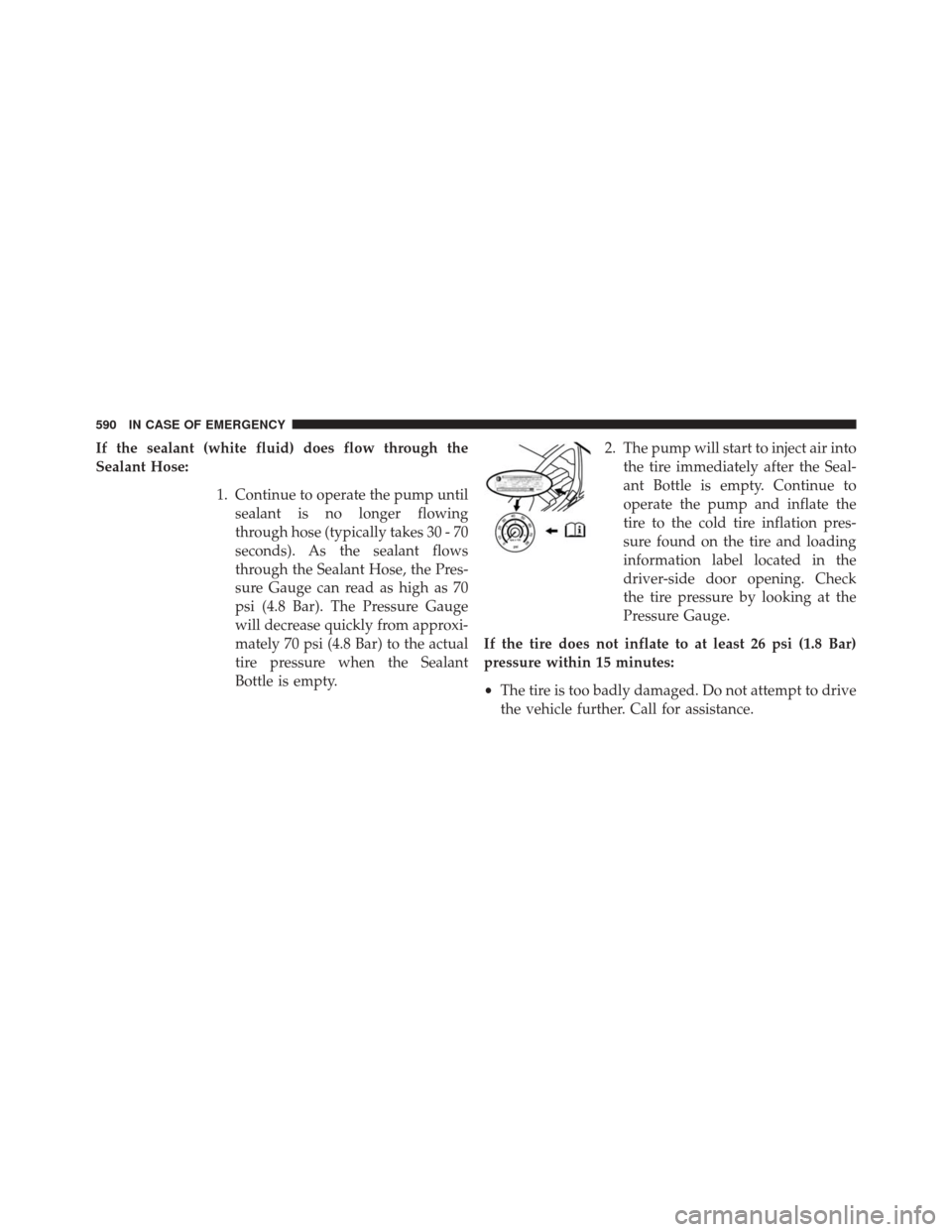
If the sealant (white fluid) does flow through the
Sealant Hose:1. Continue to operate the pump untilsealant is no longer flowing
through hose (typically takes 30 - 70
seconds). As the sealant flows
through the Sealant Hose, the Pres-
sure Gauge can read as high as 70
psi (4.8 Bar). The Pressure Gauge
will decrease quickly from approxi-
mately 70 psi (4.8 Bar) to the actual
tire pressure when the Sealant
Bottle is empty. 2. The pump will start to inject air into
the tire immediately after the Seal-
ant Bottle is empty. Continue to
operate the pump and inflate the
tire to the cold tire inflation pres-
sure found on the tire and loading
information label located in the
driver-side door opening. Check
the tire pressure by looking at the
Pressure Gauge.
If the tire does not inflate to at least 26 psi (1.8 Bar)
pressure within 15 minutes:
• The tire is too badly damaged. Do not attempt to drive
the vehicle further. Call for assistance.
590 IN CASE OF EMERGENCY
Page 597 of 828
4. Rotate the bottle up beyond vertical to release.
5. Pull the bottle away from the Compressor.
NOTE:
•For sealant bottle installation follow these steps re-
verse order.
• Replacement sealant bottles are available at authorized
service centers.
JUMP-STARTING
If your vehicle has a discharged battery it can be jump-
started using a set of jumper cables and a battery in
another vehicle or by using a portable battery booster
pack. Jump-starting can be dangerous if done improperly
so please follow the procedures in this section carefully. NOTE:
When using a portable battery booster pack
follow the manufacturer ’s operating instructions and
precautions.
CAUTION!
Do not use a portable battery booster pack or any
other booster source with a system voltage greater
than 12 Volts or damage to the battery, starter motor,
alternator or electrical system may occur.
WARNING!
Do not attempt jump-starting if the battery is frozen.
It could rupture or explode and cause personal injury.
7
IN CASE OF EMERGENCY 595
Page 598 of 828
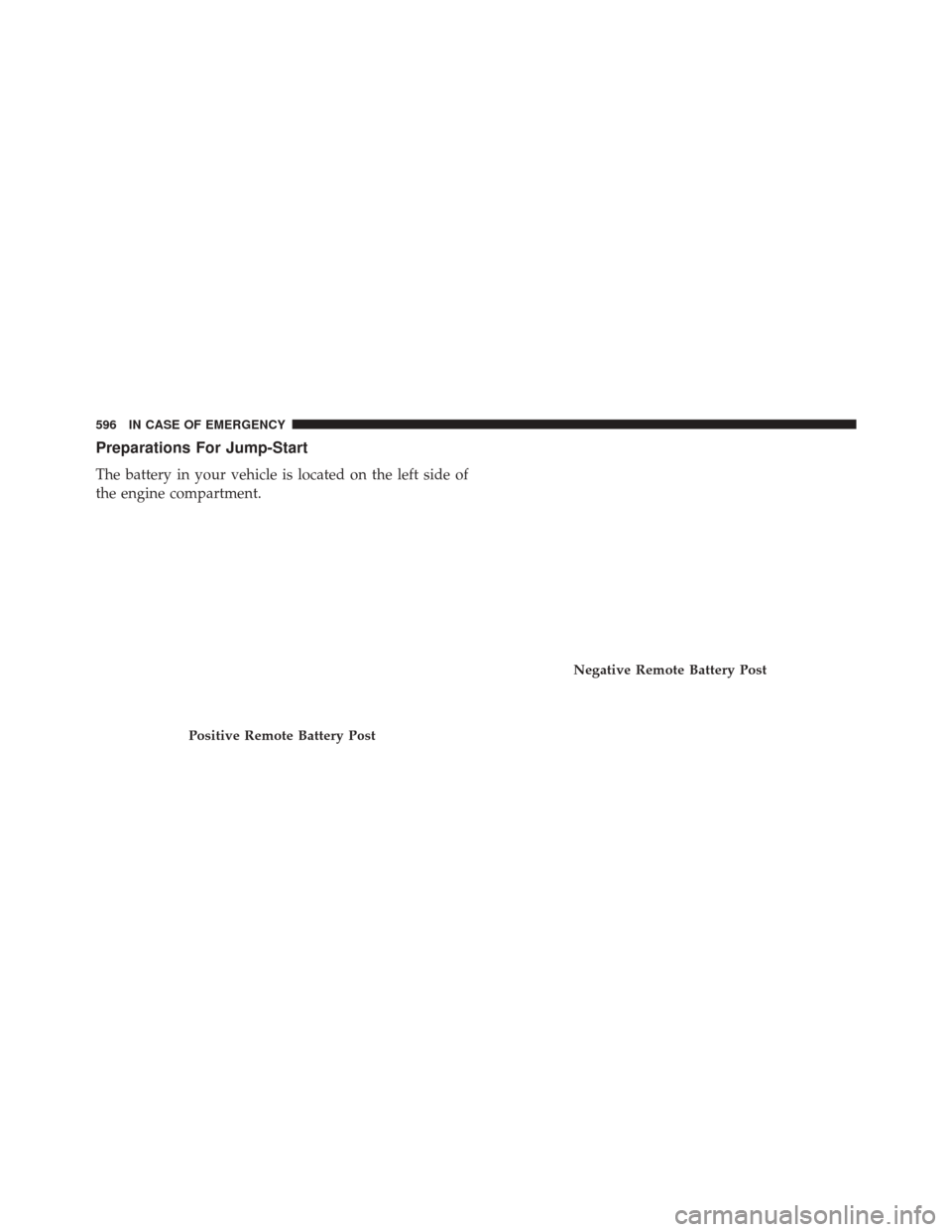
Preparations For Jump-Start
The battery in your vehicle is located on the left side of
the engine compartment.
Positive Remote Battery Post
Negative Remote Battery Post
596 IN CASE OF EMERGENCY
Page 599 of 828
WARNING!
•Take care to avoid the radiator cooling fan when-
ever the hood is raised. It can start anytime the
ignition switch is ON. You can be injured by
moving fan blades.
• Remove any metal jewelry such as rings, watch
bands and bracelets that could make an inadvertent
electrical contact. You could be seriously injured.
• Batteries contain sulfuric acid that can burn your
skin or eyes and generate hydrogen gas which is
flammable and explosive. Keep open flames or
sparks away from the battery.
1. Set the parking brake, shift the automatic transmission into PARK and turn the ignition to LOCK.
2. Turn off the heater, radio, and all unnecessary electri- cal accessories. 3. If using another vehicle to jump-start the battery, park
the vehicle within the jumper cables reach, set the
parking brake and make sure the ignition is OFF.
WARNING!
Do not allow vehicles to touch each other as this
could establish a ground connection and personal
injury could result.
Jump-Starting Procedure
WARNING!
Failure to follow this jump-starting procedure could
result in personal injury or property damage due to
battery explosion.
7
IN CASE OF EMERGENCY 597
Page 600 of 828
CAUTION!
Failure to follow these procedures could result in
damage to the charging system of the booster vehicle
or the discharged vehicle.
Connecting The Jumper Cables
1. Connect the positive (+)end of the jumper cable to the
positive (+)post of the vehicle with the discharged
battery.
2. Connect the opposite end of the positive (+)jumper
cable to the positive (+)post of the booster battery.
3. Connect the negative (-)end of the jumper cable to the
negative (-)post of the booster battery. 4.
Connect the opposite end of the negative
(-)jumper
cable to the negative post near the windshield cowl
(exposed metal part of the discharged vehicle’s engine).
WARNING!
Do not connect the jumper cable to the negative (-)
post of the discharged battery. The resulting electri-
cal spark could cause the battery to explode and
could result in personal injury. Only use the specific
ground point, do not use any other exposed metal
parts.
5. Start the engine in the vehicle that has the booster battery, let the engine idle a few minutes, and then
start the engine in the vehicle with the discharged
battery.
598 IN CASE OF EMERGENCY
Page 601 of 828
6. Once the engine is started, remove the jumper cablesin the reverse sequence:
Disconnecting The Jumper Cables
1. Disconnect the negative (-)end of the jumper cable
from the engine ground of the vehicle with the dis-
charged battery.
2. Disconnect the opposite end of the negative (-)jumper
cable from the negative (-)post of the booster battery.
3. Disconnect the positive (+)end of the jumper cable
from the positive (+)post of the booster battery.
4. Disconnect the opposite end of the positive (+)jumper
cable from the positive (+)post of the vehicle with the
discharged battery.
If frequent jump-starting is required to start your vehicle
you should have the battery and charging system in-
spected at your authorized dealer.CAUTION!
Accessories plugged into the vehicle power outlets
draw power from the vehicle’s battery, even when not
in use (i.e., cellular devices, etc.). Eventually, if
plugged in long enough without engine operation,
the vehicle’s battery will discharge sufficiently to
degrade battery life and/or prevent the engine from
starting.
REFUELLING IN EMERGENCY
The funnel for the Cap-Less Fuel System is located with
the spare tire (if equipped) or in the upper storage bin. If
your vehicle is out of fuel and an auxiliary fuel can is
needed, insert the funnel into the filler neck and proceed
to fill the vehicle.7
IN CASE OF EMERGENCY 599