child lock CHRYSLER PACIFICA 2017 2.G Owner's Manual
[x] Cancel search | Manufacturer: CHRYSLER, Model Year: 2017, Model line: PACIFICA, Model: CHRYSLER PACIFICA 2017 2.GPages: 828, PDF Size: 7.58 MB
Page 367 of 828
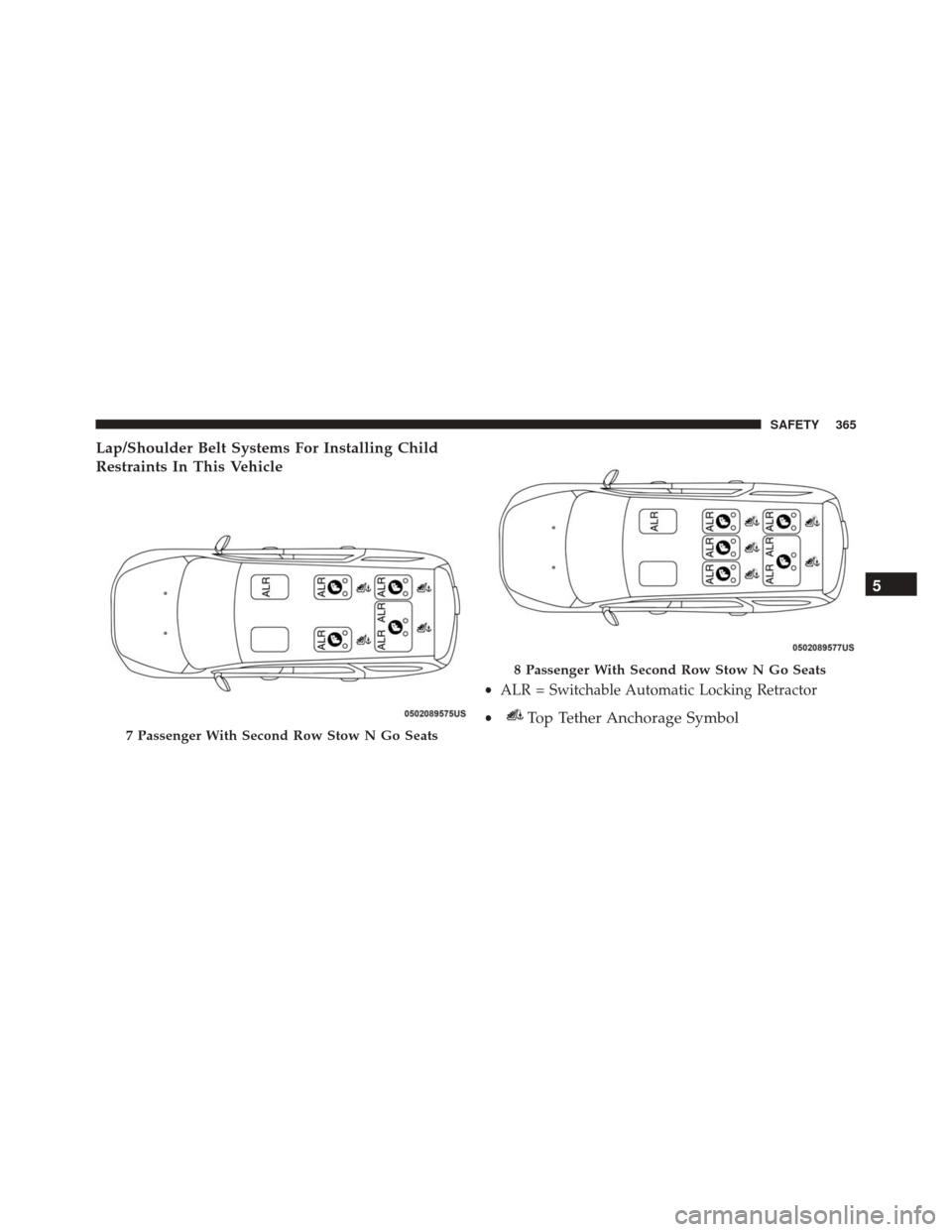
Lap/Shoulder Belt Systems For Installing Child
Restraints In This Vehicle
7 Passenger With Second Row Stow N Go Seats
8 Passenger With Second Row Stow N Go Seats
•ALR = Switchable Automatic Locking Retractor
•
Top Tether Anchorage Symbol 5
SAFETY 365
Page 369 of 828
Frequently Asked Questions
Can the buckle stalk be twisted to tighten the seat belt against the belt path of the child restraint? No
Do not twist the buckle stalk in a seating
position with an ALR retractor.
NOTE: If the folding, non-adjustable head restraint in-
terferes with the installation of the child restraint, the
head restraint may be folded and the child seat installed
in front of it.
WARNING!
Always make sure the head restraint is in its upright
position when the seat is to be used by an occupant
who is not in a child restraint. Sitting in a seat with
the head restraint in its lowered position could result
in serious injury or death in a collision.
Installing A Child Restraint With A Switchable
Automatic Locking Retractor (ALR)
1. Place the child seat in the center of the seating position. For some second row seats, you may need to
recline the seat and/or raise the head restraint to get a
better fit. If the rear seat can be moved forward and
rearward in the vehicle, you may wish to move it to its
rear-most position to make room for the child seat.
You may also move the front seat forward to allow
more room for the child seat.
2. Pull enough of the seat belt webbing from the retractor to pass it through the belt path of the child restraint.
Do not twist the belt webbing in the belt path.5
SAFETY 367
Page 370 of 828
3. Slide the latch plate into the buckle until you hear a“click.”
4. Pull on the webbing to make the lap portion tight against the child seat.
5. To lock the seat belt, pull down on the shoulder part of the belt until you have pulled all the seat belt webbing
out of the retractor. Then, allow the webbing to retract
back into the retractor. As the webbing retracts, you
will hear a clicking sound. This means the seat belt is
now in the Automatic Locking mode.
6. Try to pull the webbing out of the retractor. If it is locked, you should not be able to pull out any web-
bing. If the retractor is not locked, repeat step 5.
7. Finally, pull up on any excess webbing to tighten the lap portion around the child restraint while you push
the child restraint rearward and downward into the
vehicle seat. 8. If the child restraint has a top tether strap and the
seating position has a top tether anchorage, connect
the tether strap to the anchorage and tighten the tether
strap. See the section “Installing Child Restraints
Using the Top Tether Anchorage” for directions to
attach a tether anchor.
9. Test that the child restraint is installed tightly by pulling back and forth on the child seat at the belt
path. It should not move more than 1 inch (25.4 mm)
in any direction.
Any seat belt system will loosen with time, so check the
belt occasionally, and pull it tight if necessary.
368 SAFETY
Page 385 of 828
STARTING PROCEDURES
Before starting your vehicle, adjust your seat, adjust both
inside and outside mirrors, and fasten your seat belts.
WARNING!
•When leaving the vehicle, always remove the Key
Fob from the vehicle and lock your vehicle.
• Never leave children alone in a vehicle, or with
access to an unlocked vehicle.
• Allowing children to be in a vehicle unattended is
dangerous for a number of reasons. A child or
others could be seriously or fatally injured. Chil-
dren should be warned not to touch the parking
brake, brake pedal or the transmission gear selec-
tor.
• Do not leave the Key Fob in or near the vehicle, or
in a location accessible to children, and do not
(Continued)
WARNING! (Continued)
leave the ignition of a vehicle equipped with
Keyless Enter-N-Go in the ACC or ON/RUN mode.
A child could operate power windows, other con-
trols, or move the vehicle.
Start the engine with the gear selector in the NEUTRAL
or PARK position. Apply the brake before shifting to any
driving range.
Normal Starting
NOTE: Normal starting of either a cold or a warm engine
is obtained without pumping or pressing the accelerator
pedal.
To Turn On The Engine Using ENGINE START/STOP
Button
1. The transmission must be in PARK or NEUTRAL.
6
STARTING AND OPERATING 383
Page 393 of 828
NOTE:When parking on a hill, it is important to turn the
front wheels toward the curb on a downhill grade and
away from the curb on an uphill grade. Apply the park
brake before placing the gear selector in PARK, otherwise
the load on the transmission locking mechanism may
make it difficult to move the gear selector out of PARK.
The park brake should always be applied whenever the
driver is not in the vehicle.
WARNING!
• Never use the PARK position as a substitute for the
parking brake. Always apply the parking brake
fully when parked to guard against vehicle move-
ment and possible injury or damage.
• When leaving the vehicle, always make sure the
ignition is in the OFF mode, remove the Key Fob
from the vehicle, and lock your vehicle.
(Continued)
WARNING! (Continued)
•Never leave children alone in a vehicle, or with
access to an unlocked vehicle. Allowing children to
be in a vehicle unattended is dangerous for a
number of reasons. A child or others could be
seriously or fatally injured. Children should be
warned not to touch the parking brake, brake pedal
or the transmission gear selector.
• Do not leave the Key Fob in or near the vehicle, (or
in a location accessible to children), and do not
leave the ignition in the ACC or ON/RUN mode. A
child could operate power windows, other controls,
or move the vehicle.
• Be sure the parking brake is fully disengaged
before driving; failure to do so can lead to brake
failure and a collision.
(Continued)
6
STARTING AND OPERATING 391
Page 397 of 828
CAUTION!(Continued)
•Do not shift between PARK, REVERSE, NEU-
TRAL, or DRIVE when the engine is above idle
speed.
• Before shifting into any gear, make sure your foot
is firmly pressing the brake pedal.
WARNING!
• It is dangerous to shift out of PARK or NEUTRAL
if the engine speed is higher than idle speed. If
your foot is not firmly pressing the brake pedal, the
vehicle could accelerate quickly forward or in re-
verse. You could lose control of the vehicle and hit
someone or something. Only shift into gear when
the engine is idling normally and your foot is
firmly pressing the brake pedal.
(Continued)
WARNING! (Continued)
•Unintended movement of a vehicle could injure
those in or near the vehicle. As with all vehicles,
you should never exit a vehicle while the engine is
running. Before exiting a vehicle, always apply the
parking brake, shift the transmission into PARK,
turn the engine OFF, and remove the Key Fob.
When the ignition is in the OFF mode, the trans-
mission is locked in PARK, securing the vehicle
against unwanted movement.
• When leaving the vehicle, always make sure the
ignition is in the OFF mode, remove the Key Fob
from the vehicle, and lock the vehicle.
• Never leave children alone in a vehicle, or with
access to an unlocked vehicle. Allowing children to
be in a vehicle unattended is dangerous for a
number of reasons. A child or others could be
(Continued)
6
STARTING AND OPERATING 395
Page 398 of 828
WARNING!(Continued)
seriously or fatally injured. Children should be
warned not to touch the parking brake, brake pedal
or the transmission gear selector.
• Do not leave the Key Fob in or near the vehicle (or
in a location accessible to children), and do not
leave the ignition in the ACC or ON/RUN position.
A child could operate power windows, other con-
trols, or move the vehicle.
NOTE: You must press and hold the brake pedal while
shifting out of PARK.
Ignition Park Interlock
This vehicle is equipped with a Ignition Park Interlock
which requires the transmission to be in PARK before the
engine can be turned off. This helps the driver avoid
inadvertently leaving the vehicle without placing the transmission in PARK. This system also locks the trans-
mission in PARK whenever the ignition switch is in the
OFF position.
Brake/Transmission Shift Interlock System
This vehicle is equipped with a Brake Transmission Shift
Interlock system (BTSI) that holds the transmission gear
selector in PARK unless the brakes are applied. To shift
the transmission out of PARK, the engine must be
running and the brake pedal must be pressed. The brake
pedal must also be pressed to shift from NEUTRAL into
DRIVE or REVERSE when the vehicle is stopped or
moving at low speeds.
Nine-Speed Automatic Transmission
The transmission is controlled using a rotary electronic
gear selector located on the center console. The transmis-
sion gear selector has PARK, REVERSE, NEUTRAL,
DRIVE, and LOW shift positions. Using the LOW posi-
tion manually downshifts the transmission to a lower
396 STARTING AND OPERATING
Page 402 of 828
WARNING!(Continued)
•When leaving the vehicle, always make sure the
ignition is in the OFF position, remove the Key Fob
from the vehicle, and lock the vehicle.
• Never leave children alone in a vehicle, or with
access to an unlocked vehicle. Allowing children to
be in a vehicle unattended is dangerous for a
number of reasons. A child or others could be
seriously or fatally injured. Children should be
warned not to touch the parking brake, brake pedal
or the transmission gear selector.
• Do not leave the Key Fob in or near the vehicle (or
in a location accessible to children), and do not
leave the ignition in the ACC or ON/RUN position.
A child could operate power windows, other con-
trols, or move the vehicle.
CAUTION!
• Before moving the transmission gear selector out of
PARK, you must start the engine and also press the
brake pedal. Otherwise, damage to the gear selector
could result.
• DO NOT race the engine when shifting from
PARK or NEUTRAL into another gear range, as this
can damage the drivetrain.
The following indicator should be used to ensure that
you have engaged the transmission into the PARK posi-
tion:
• With brake pedal released, look at the transmission
gear position display and verify that it indicates the
PARK position (P).
400 STARTING AND OPERATING
Page 579 of 828
WARNING!(Continued)
•Tire Service Kit Sealant solution contains latex. In
case of an allergic reaction or rash, consult a phy-
sician immediately. Keep Tire Service Kit out of
reach of children. If swallowed, rinse mouth imme-
diately with plenty of water and drink plenty of
water. Do not induce vomiting! Consult a physician
immediately.
Whenever You Stop To Use Tire Service Kit:
1. Pull over to a safe location and turn on the vehicle’s Hazard Warning flashers.
2. Verify that the valve stem (on the wheel with the deflated tire) is in a position that is near to the ground.
This will allow the Tire Service Kit Hose to reach the
valve stem and keep the Tire Service Kit flat on the
ground. This will provide the best positioning of the kit when running the air pump. Move the vehicle as
necessary to place the valve stem in this position
before proceeding.
3. Place the transmission in PARK and cycle the ignition in the OFF position.
4. Ensure the park brake is engaged.
Setting Up To Use Tire Service Kit:
1. Remove the Tire Service Kit from the storage location. 2. Uncoil the Sealant/Air Hose. Re-move the cap from the valve stem
and then screw the fitting in at the
end of the Sealant/Air Hose clock-
wise onto the valve stem.
7
IN CASE OF EMERGENCY 577
Page 810 of 828
Master Cylinder....................... .636
Parking ............................. .389
Warning Light ........................ .233
Brake/Transmission Interlock .................396
Brightness, Interior Lights ...................118
Bulb Replacement ........................ .543
Bulbs, Light ...................... .377, 537, 543
Camera, Rear ........................ .494, 497
Capacities, Fluid ......................... .686
Caps, Filler Fuel ............................ .502, 599
Radiator (Coolant Pressure) ................633
Carbon Monoxide Warning ...............374, 681
Cargo Compartment Luggage Carrier ....................... .201
Cargo (Vehicle Loading) ....................168
Car Washes ............................ .669
Cellular Phone .......................... .770Center High Mounted Stop Light
..............546
Certification Label ........................ .504
Chains, Tire ............................ .661
Changing A Flat Tire ....................559, 639
Checking Your Vehicle For Safety ..............373
Checks, Safety .......................... .373
Child Restraint .......................... .346
Child Restraints Booster Seats ......................... .351
Center Seat LATCH ..................... .361
Child Restraints ....................... .346
Child Seat Installation .................365, 367
How To Stow An Unused ALR Seat Belt .......363
Infants And Child Restraints ...............349
Installing Child Restraints Using The Vehicle Seat
Belt ................................ .364
Lower Anchors And Tethers For Children ......354
Older Children And Child Restraints .........350
Seating Positions ....................... .353
808 INDEX