tow CHRYSLER PACIFICA 2017 2.G Workshop Manual
[x] Cancel search | Manufacturer: CHRYSLER, Model Year: 2017, Model line: PACIFICA, Model: CHRYSLER PACIFICA 2017 2.GPages: 828, PDF Size: 7.58 MB
Page 307 of 828
position the Seat Belt Reminder Light will turn on and
remain on until both outboard front seat belts are buck-
led. The outboard front passenger seat BeltAlert is not
active when an outboard front passenger seat is unoccu-
pied.
BeltAlert Warning Sequence
The BeltAlert warning sequence is activated when the
vehicle is moving above a specified vehicle speed range
and the driver or outboard front seat passenger is un-
buckled (if equipped with outboard front passenger seat
BeltAlert). The BeltAlert warning sequence starts by
blinking the Seat Belt Reminder Light and sounding an
intermittent chime. Once the BeltAlert warning sequence
has completed, the Seat Belt Reminder Light will remain
on until the seat belts are buckled. The BeltAlert warning
sequence may repeat based on vehicle speed until thedriver and occupied outboard front seat passenger seat
belts are buckled. The driver should instruct all occu-
pants to buckle their seat belts.
Change Of Status
If the driver or outboard front seat passenger (if
equipped with outboard front passenger seat BeltAlert)
unbuckles their seat belt while the vehicle is traveling,
the BeltAlert warning sequence will begin until the seat
belts are buckled again.
The outboard front passenger seat BeltAlert is not active
when the outboard front passenger seat is unoccupied.
BeltAlert may be triggered when an animal or other items
are placed on the outboard front passenger seat or when
the seat is folded flat (if equipped). It is recommended
that pets be restrained in the rear seat (if equipped) in pet
harnesses or pet carriers that are secured by seat belts,
and cargo is properly stowed.
5
SAFETY 305
Page 313 of 828
stowed position. If necessary, slide the latch plate
down the webbing to allow the seat belt to retract
fully.
Lap/Shoulder Belt Untwisting Procedure
Use the following procedure to untwist a twisted lap/
shoulder belt.
1. Position the latch plate as close as possible to theanchor point.
2. At about 6 to 12 in (15 to 30 cm) above the latch plate, grasp and twist the seat belt webbing 180 degrees to
create a fold that begins immediately above the latch
plate.
3. Slide the latch plate upward over the folded webbing. The folded webbing must enter the slot at the top of
the latch plate. 4. Continue to slide the latch plate up until it clears the
folded webbing and the seat belt is no longer twisted.
Adjustable Upper Shoulder Belt Anchorage
In the front and second row outboard seats the shoulder
belt can be adjusted upward or downward to position the
seat belt away from your neck. Push or squeeze the
anchorage button to release the anchorage, and move it
up or down to the position that serves you best.
5
SAFETY 311
Page 315 of 828
1. Remove the mini-latch plate and regular latch platefrom its stowed position in the headliner slightly
behind the third row seat. 2. Grasp the mini-latch plate and pull the seat belt over
the seat.
Mini-Latch Stowage
Mini-Latch Plate
5
SAFETY 313
Page 318 of 828
belt. To loosen the lap belt if it is too tight, pull on the
lap belt. A snug seat belt reduces the risk of sliding
under the seat belt in a collision.
8. Position the shoulder belt on your chest so that it is comfortable and not resting on your neck. The retrac-
tor will withdraw any slack in the seat belt.
9. To release the seat belt, push the red button on the buckle.
10. To disengage the mini-latch plate from the mini- buckle for storage, insert the regular latch plate into
the center red slot on the mini-buckle. The seat belt
will automatically retract to its stowed position. If
necessary, slide the latch plate down the webbing to
allow the seat belt to retract fully. Insert the mini-
latch plate and regular latch plate into its stowed
position.WARNING!
•If the mini-latch plate and mini-buckle are not
properly connected when the seat belt is used by an
occupant, the seat belt will not be able to provide
proper restraint and will increase the risk of injury
in a collision.
• When reattaching the mini-latch plate and mini-
buckle, ensure the seat belt webbing is not twisted.
If the webbing is twisted, follow the preceding
procedure to detach the mini-latch plate and mini-
buckle, untwist the webbing, and reattach the
mini-latch plate and mini-buckle.
Seat Belt Extender
If a seat belt is not long enough to fit properly, even when
the webbing is fully extended and the adjustable upper
shoulder belt anchorage (if equipped) is in its lowest
position, your authorized dealer can provide you with a
316 SAFETY
Page 321 of 828
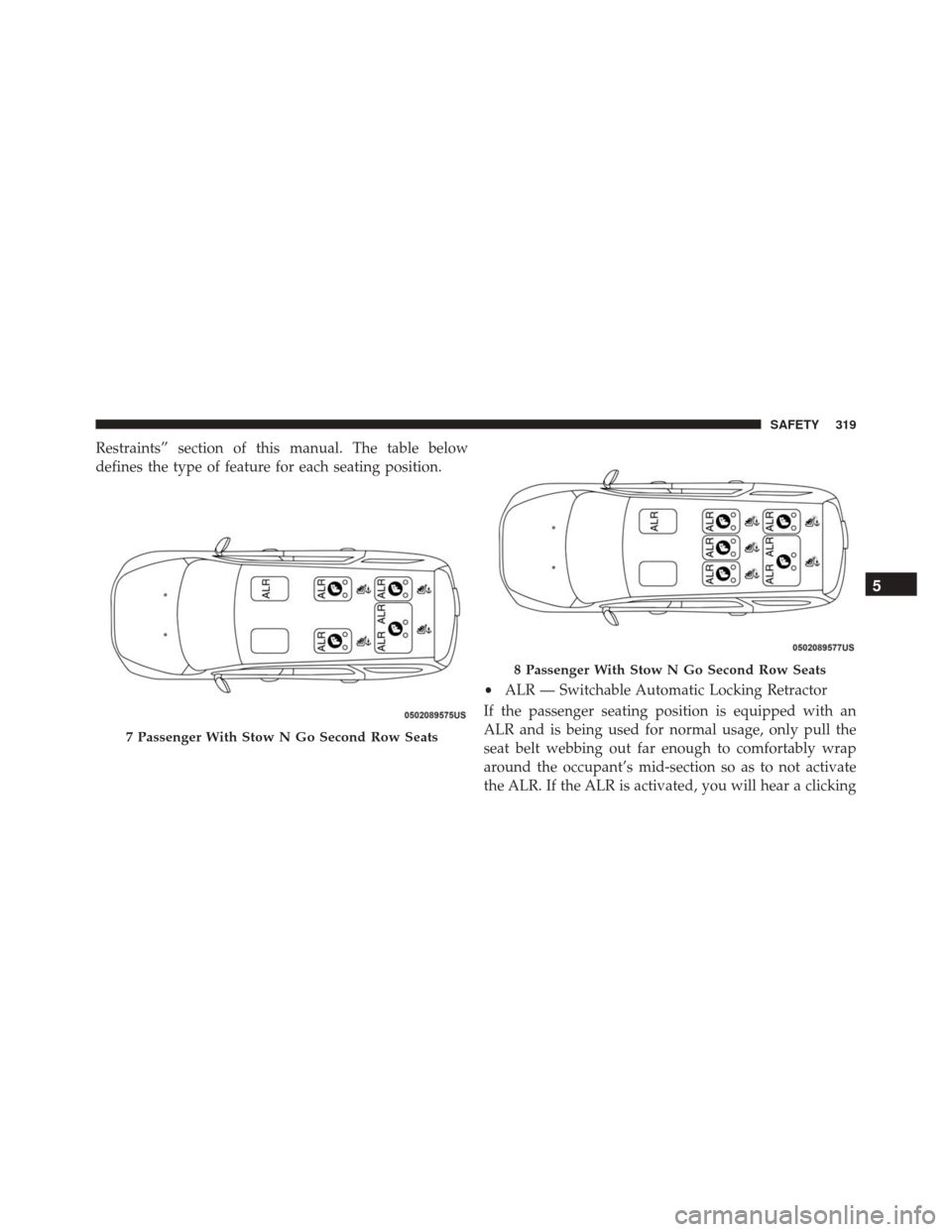
Restraints” section of this manual. The table below
defines the type of feature for each seating position.If the passenger seating position is equipped with an
ALR and is being used for normal usage, only pull the
seat belt webbing out far enough to comfortably wrap
around the occupant’s mid-section so as to not activate
the ALR. If the ALR is activated, you will hear a clicking
7 Passenger With Stow N Go Second Row Seats
8 Passenger With Stow N Go Second Row Seats
•ALR — Switchable Automatic Locking Retractor
5
SAFETY 319
Page 357 of 828
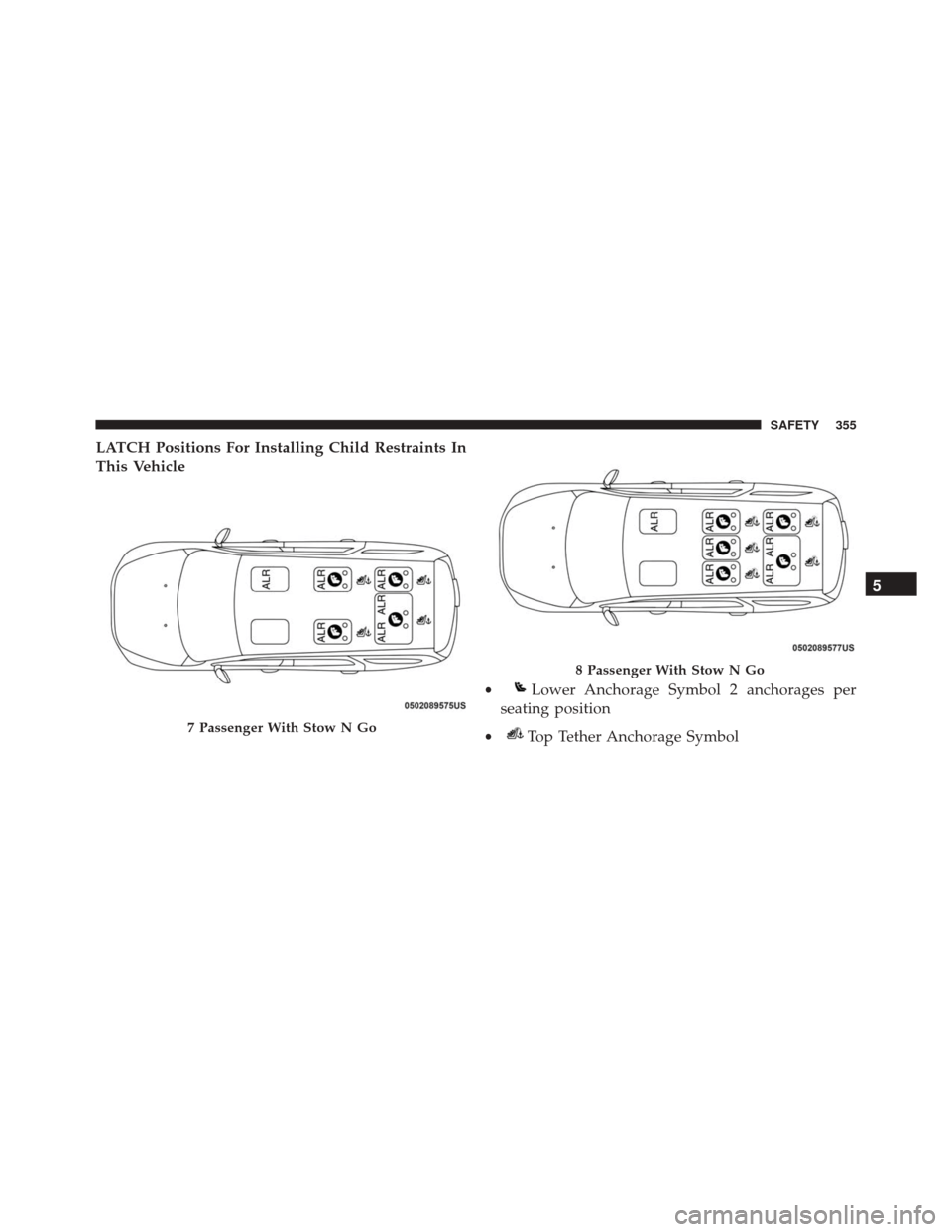
LATCH Positions For Installing Child Restraints In
This Vehicle
7 Passenger With Stow N Go
8 Passenger With Stow N Go
•Lower Anchorage Symbol 2 anchorages per
seating position
•Top Tether Anchorage Symbol 5
SAFETY 355
Page 360 of 828
Frequently Asked Questions
Can the head restraints be re- moved? Yes The 2nd row head restraints on
bench and fixed quad seats and inthe center seat (if equipped), are
removable. 2nd row outboard stow ’n go head restraints are not re-
movable. The 3rd row center head restraint is removable in all ve-
hicles, but the 3rd row outboard
head restraints are not removable.
NOTE: If the folding, non-adjustable head restraint in-
terferes with the installation of the child restraint, the
head restraint may be folded and the child seat installed
in front of it.
WARNING!
Always make sure the head restraint is in its upright
position when the seat is to be used by an occupant
who is not in a child restraint. Sitting in a seat with
the head restraint in its lowered position could result
in serious injury or death in a collision.
358 SAFETY
Page 364 of 828
center position blocks the outboard LATCH anchors or
seat belt, do not install a child seat in that outboard
position.
WARNING!
•Use anchorages C and D to install a LATCH-
compatible child restraint in the center seating
position (2). Do not install a LATCH-compatible
child restraint using anchorages B and C. This is
not a LATCH-compatible position in your vehicle.
• Never use the same lower anchorage to attach more
than one child restraint. Please refer to “Installing
The LATCH-Compatible Child Restraint System”
for typical installation instructions.
Always follow the directions of the child restraint
manufacturer when installing your child restraint. Not
all child restraint systems will be installed as described
here.
To install a LATCH-Compatible Child Restraint
If the selected seating position has a Switchable Auto-
matic Locking Retractor (ALR) seat belt, stow the seat
belt, following the instructions below. See the section
“Installing Child Restraints Using the Vehicle Seat Belt”
to check what type of seat belt each seating position has.
1. Loosen the adjusters on the lower straps and on the tether strap of the child seat so that you can more
easily attach the hooks or connectors to the vehicle
anchorages.
2. Place the child seat between the lower anchorages for that seating position. For some second row seats, you
may need to recline the seat and / or raise the head
restraint to get a better fit. If the rear seat can be moved
forward and rearward in the vehicle, you may wish to
move it to its rear-most position to make room for the
child seat. You may also move the front seat forward
to allow more room for the child seat.
362 SAFETY
Page 365 of 828
3. Attach the lower hooks or connectors of the childrestraint to the lower anchorages in the selected seat-
ing position.
4. If the child restraint has a tether strap, connect it to the top tether anchorage. See the section “Installing Child
Restraints Using the Top Tether Anchorage” for direc-
tions to attach a tether anchor.
5. Tighten all of the straps as you push the child restraint rearward and downward into the seat. Remove slack
in the straps according to the child restraint manufac-
turer ’s instructions.
6. Test that the child restraint is installed tightly by pulling back and forth on the child seat at the belt
path. It should not move more than 1 inch (25.4 mm)
in any direction.How To Stow An Unused ALR Seat Belt
When using the LATCH attaching system to install a
child restraint, stow all ALR seat belts that are not being
used by other occupants or being used to secure child
restraints. An unused belt could injure a child if they play
with it and accidentally lock the seat belt retractor. Before
installing a child restraint using the LATCH system,
buckle the seat belt behind the child restraint and out of
the child’s reach. If the buckled seat belt interferes with
the child restraint installation, instead of buckling it
behind the child restraint, route the seat belt through the
child restraint belt path and then buckle it. Do not lock
the seat belt. Remind all children in the vehicle that the
seat belts are not toys and that they should not play with
them.
5
SAFETY 363
Page 367 of 828
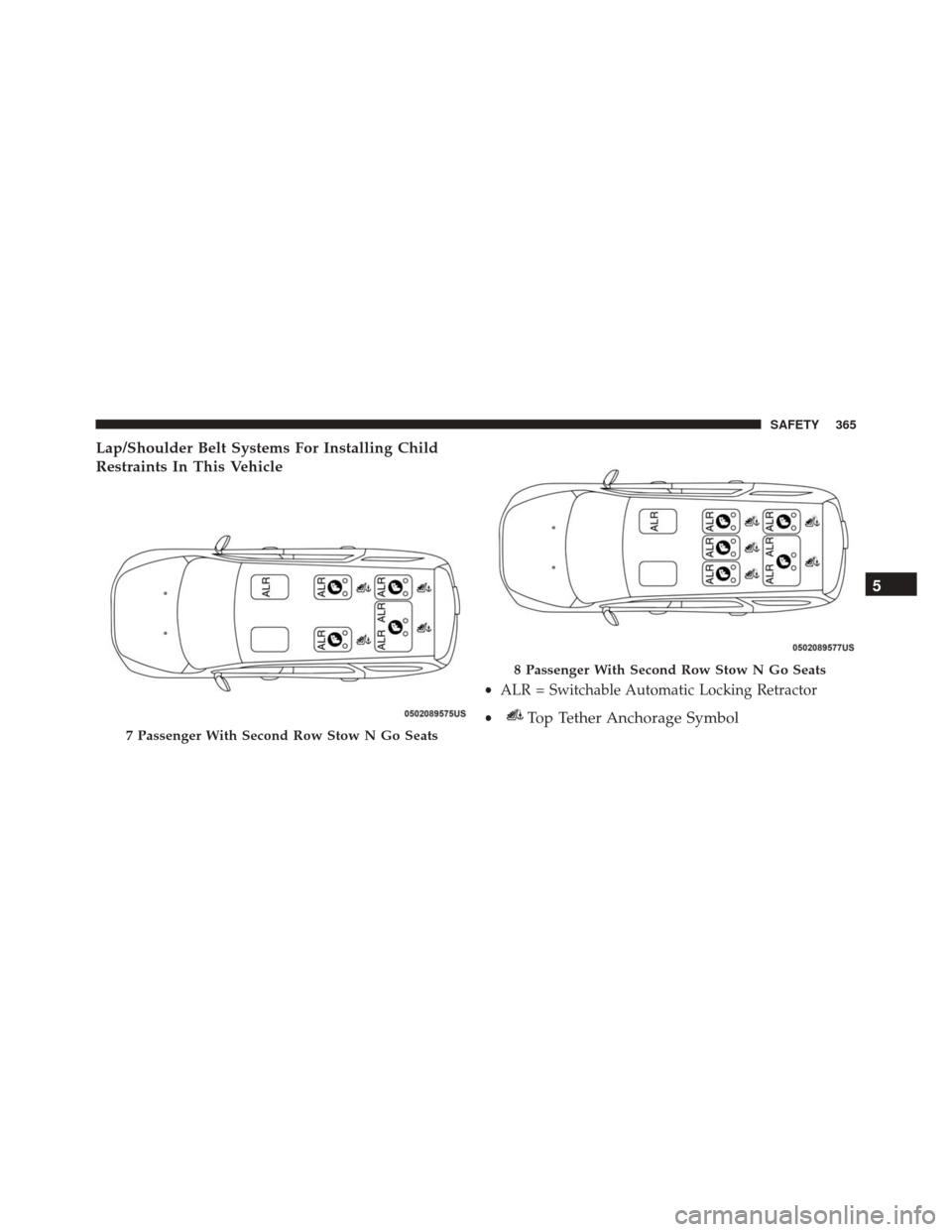
Lap/Shoulder Belt Systems For Installing Child
Restraints In This Vehicle
7 Passenger With Second Row Stow N Go Seats
8 Passenger With Second Row Stow N Go Seats
•ALR = Switchable Automatic Locking Retractor
•
Top Tether Anchorage Symbol 5
SAFETY 365