engine oil CHRYSLER PACIFICA 2019 Owner's Manual
[x] Cancel search | Manufacturer: CHRYSLER, Model Year: 2019, Model line: PACIFICA, Model: CHRYSLER PACIFICA 2019Pages: 718, PDF Size: 8.6 MB
Page 526 of 718
Windshield Wiper Blades
Clean the rubber edges of the wiper blades and the
windshield periodically with a sponge or soft cloth and a
mild nonabrasive cleaner. This will remove accumulations
of salt or road film.
Operation of the wipers on dry glass for long periods may
cause deterioration of the wiper blades. Always use washer
fluid when using the wipers to remove salt or dirt from a
dry windshield.
Avoid using the wiper blades to remove frost or ice from
the windshield. Keep the blade rubber out of contact with
petroleum products such as engine oil, gasoline, etc.
NOTE:Life expectancy of wiper blades varies depending
on geographical area and frequency of use. Poor perfor-
mance of blades may be present with chattering, marks,
water lines or wet spots. If any of these conditions are
present, clean the wiper blades or replace as necessary.
The wiper blades and wiper arms should be inspected
periodically, not just when wiper performance problems
are experienced. This inspection should include the follow-
ing points:
• Wear or uneven edges
• Foreign material •
Hardening or cracking
• Deformation or fatigue
If a wiper blade or wiper arm is damaged, replace the
affected wiper arm or blade with a new unit. Do not
attempt to repair a wiper arm or blade that is damaged.
Front Wiper Blade Removal/Installation
CAUTION!
Do not allow the wiper arm to spring back against the
glass without the wiper blade in place or the glass may
be damaged.
1. Lift the wiper arm to raise the wiper blade off of the glass, until the wiper arm is in the full up position.
524 SERVICING AND MAINTENANCE
Page 531 of 718
Installing The Rear Wiper
1. Lift the rear wiper arm pivot cap away from the glass toallow the rear wiper blade to be raised off of the glass.
NOTE: The rear wiper arm cannot be fully raised off the
glass unless the wiper arm pivot cap is unsnapped first.
Attempting to fully raise the rear wiper arm without
unsnapping the wiper arm pivot cap may damage the
vehicle.
2. Lift the rear wiper arm fully off the glass.
3. Insert the wiper blade pivot pin into the opening on the end of the wiper arm. Grab the bottom end of the wiper
arm with one hand, and press the wiper blade flush
with the wiper arm until it snaps into place.
4. Lower the wiper blade onto the glass and snap the wiper arm pivot cap back into place.
Exhaust System
The best protection against carbon monoxide entry into the
vehicle body is a properly maintained engine exhaust
system.
If you notice a change in the sound of the exhaust system;
or if the exhaust fumes can be detected inside the vehicle; or when the underside or rear of the vehicle is damaged;
have an authorized technician inspect the complete ex-
haust system and adjacent body areas for broken, dam-
aged, deteriorated, or mispositioned parts. Open seams or
loose connections could permit exhaust fumes to seep into
the passenger compartment. In addition, have the exhaust
system inspected each time the vehicle is raised for lubri-
cation or oil change. Replace as required.
WARNING!
•
Exhaust gases can injure or kill. They contain carbon
monoxide (CO), which is colorless and odorless.
Breathing it can make you unconscious and can
eventually poison you. To avoid breathing CO, refer
to “Safety Tips” in “Safety” for further information.
• A hot exhaust system can start a fire if you park over
materials that can burn. Such materials might be
grass or leaves coming into contact with your exhaust
system. Do not park or operate your vehicle in areas
where your exhaust system can contact anything that
can burn.
8
SERVICING AND MAINTENANCE 529
Page 538 of 718
WARNING!
•Use only manufacturer’s recommended brake fluid.
Refer to “Fluids And Lubricants” in “Technical
Specifications” for further information. Using the
wrong type of brake fluid can severely damage your
brake system and/or impair its performance. The
proper type of brake fluid for your vehicle is also
identified on the original factory installed hydraulic
master cylinder reservoir.
• To avoid contamination from foreign matter or mois-
ture, use only new brake fluid or fluid that has been
in a tightly closed container. Keep the master cylin-
der reservoir cap secured at all times. Brake fluid in
a open container absorbs moisture from the air
resulting in a lower boiling point. This may cause it
to boil unexpectedly during hard or prolonged brak-
ing, resulting in sudden brake failure. This could
result in a collision.
• Overfilling the brake fluid reservoir can result in
spilling brake fluid on hot engine parts, causing the
brake fluid to catch fire. Brake fluid can also damage
painted and vinyl surfaces, care should be taken to
avoid its contact with these surfaces.
(Continued)
WARNING! (Continued)
•Do not allow petroleum based fluid to contaminate
the brake fluid. Brake seal components could be
damaged, causing partial or complete brake failure.
This could result in a collision.
Automatic Transmission
Selection Of Lubricant
It is important to use the proper transmission fluid to
ensure optimum transmission performance and life. Use
only the manufacturer’s specified transmission fluid. Refer
to “Fluids And Lubricants” in “Technical Specifications”
for fluid specifications. It is important to maintain the
transmission fluid at the correct level using the recom-
mended fluid.
NOTE: No chemical flushes should be used in any trans-
mission; only the approved lubricant should be used.
CAUTION!
Using a transmission fluid other than the manufactur-
er ’s recommended fluid may cause deterioration in
(Continued)
536 SERVICING AND MAINTENANCE
Page 573 of 718
In the event power assist is lost for any reason (i.e.,
repeated brake applications with the engine off) the brakes
will still function. However, the effort required to brake the
vehicle will be much greater than that required with the
power system operating.
WHEEL AND TIRE TORQUE SPECIFICATIONS
Proper lug nut/bolt torque is very important to ensure that
the wheel is properly mounted to the vehicle. Any time a
wheel has been removed and reinstalled on the vehicle, the
lug nuts/bolts should be torqued using a properly cali-
brated torque wrench using a high quality six sided (hex)
deep wall socket.
Torque Specifications
Lug Nut/BoltTorque **Lug Nut/Bolt
Size Lug Nut/Bolt
Socket Size
100 Ft-Lbs (135 N·m) M12 x 1.5
19 mm
**Use only your authorized dealer recommended lug nuts/
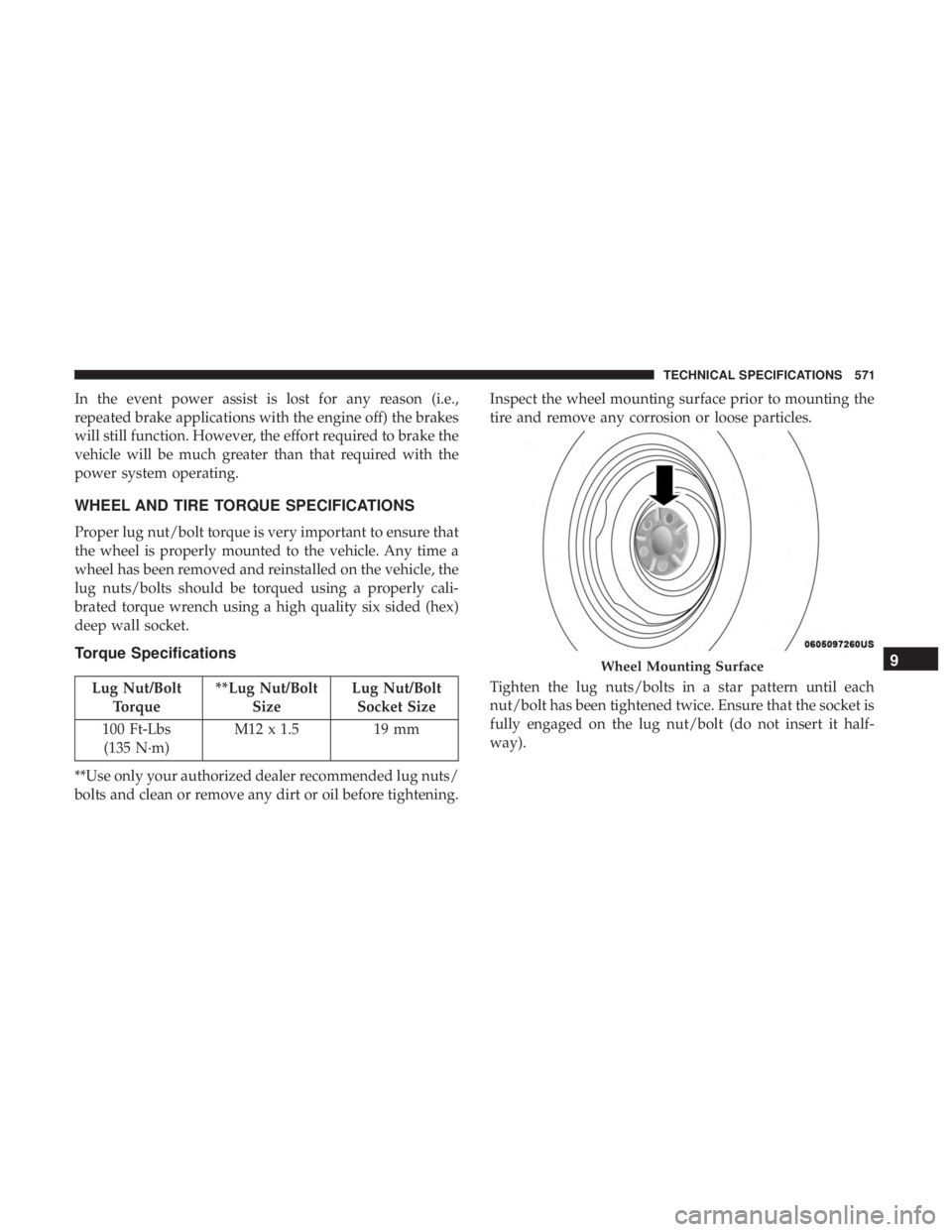
bolts and clean or remove any dirt or oil before tightening. Inspect the wheel mounting surface prior to mounting the
tire and remove any corrosion or loose particles.
Tighten the lug nuts/bolts in a star pattern until each
nut/bolt has been tightened twice. Ensure that the socket is
fully engaged on the lug nut/bolt (do not insert it half-
way).
Wheel Mounting Surface9
TECHNICAL SPECIFICATIONS 571
Page 578 of 718
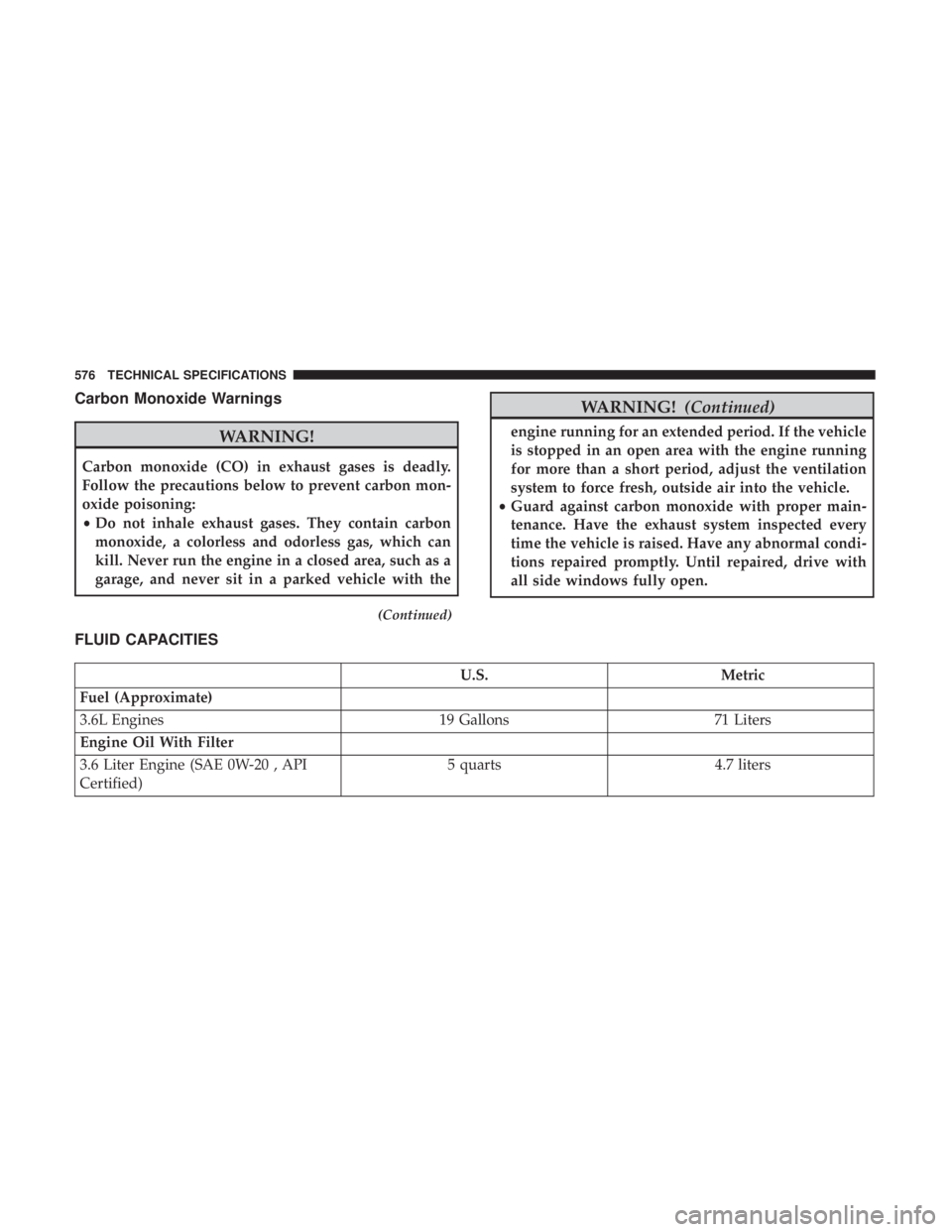
Carbon Monoxide Warnings
WARNING!
Carbon monoxide (CO) in exhaust gases is deadly.
Follow the precautions below to prevent carbon mon-
oxide poisoning:
•Do not inhale exhaust gases. They contain carbon
monoxide, a colorless and odorless gas, which can
kill. Never run the engine in a closed area, such as a
garage, and never sit in a parked vehicle with the
(Continued)
WARNING! (Continued)
engine running for an extended period. If the vehicle
is stopped in an open area with the engine running
for more than a short period, adjust the ventilation
system to force fresh, outside air into the vehicle.
• Guard against carbon monoxide with proper main-
tenance. Have the exhaust system inspected every
time the vehicle is raised. Have any abnormal condi-
tions repaired promptly. Until repaired, drive with
all side windows fully open.
FLUID CAPACITIES
U.S. Metric
Fuel (Approximate)
3.6L Engines 19 Gallons71 Liters
Engine Oil With Filter
3.6 Liter Engine (SAE 0W-20 , API
Certified) 5 quarts
4.7 liters
576 TECHNICAL SPECIFICATIONS
Page 579 of 718
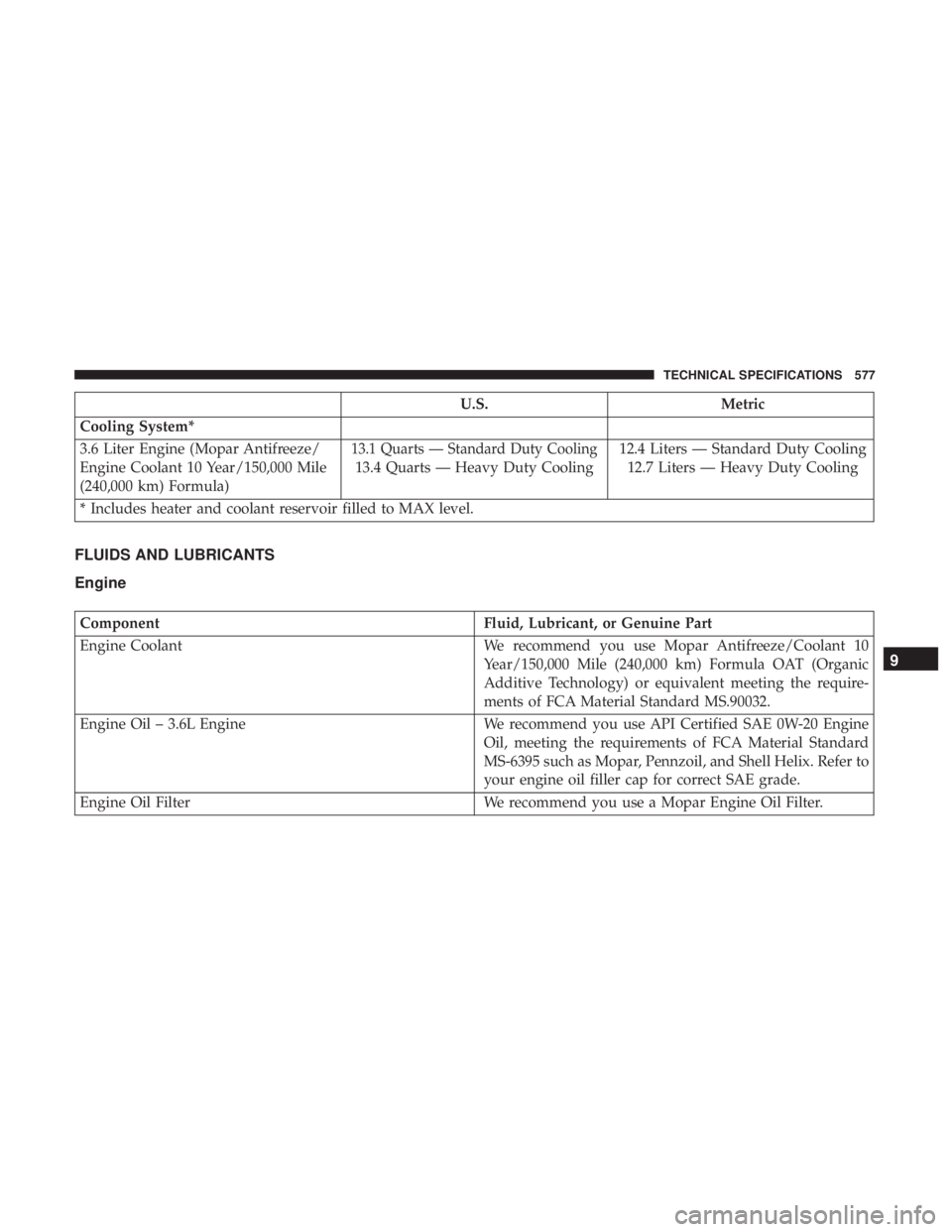
U.S.Metric
Cooling System*
3.6 Liter Engine (Mopar Antifreeze/
Engine Coolant 10 Year/150,000 Mile
(240,000 km) Formula)
13.1 Quarts — Standard Duty Cooling
13.4 Quarts — Heavy Duty Cooling 12.4 Liters — Standard Duty Cooling
12.7 Liters — Heavy Duty Cooling
* Includes heater and coolant reservoir filled to MAX level.
FLUIDS AND LUBRICANTS
Engine
Component Fluid, Lubricant, or Genuine Part
Engine Coolant We recommend you use Mopar Antifreeze/Coolant 10
Year/150,000 Mile (240,000 km) Formula OAT (Organic
Additive Technology) or equivalent meeting the require-
ments of FCA Material Standard MS.90032.
Engine Oil – 3.6L Engine We recommend you use API Certified SAE 0W-20 Engine
Oil, meeting the requirements of FCA Material Standard
MS-6395 such as Mopar, Pennzoil, and Shell Helix. Refer to
your engine oil filler cap for correct SAE grade.
Engine Oil Filter We recommend you use a Mopar Engine Oil Filter.
9
TECHNICAL SPECIFICATIONS 577
Page 703 of 718
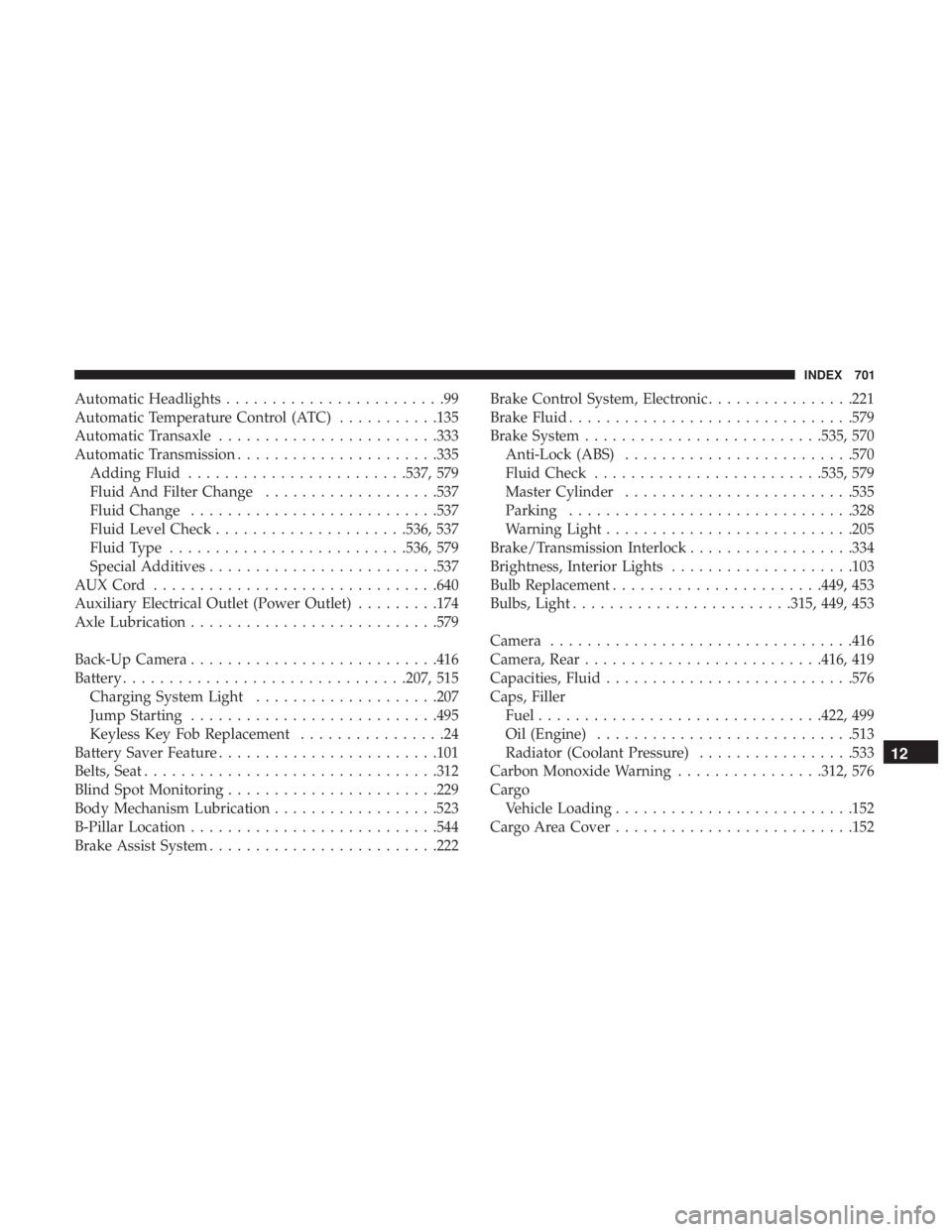
Automatic Headlights........................99
Automatic Temperature Control (ATC) ...........135
Automatic Transaxle ....................... .333
Automatic Transmission ..................... .335
Adding Fluid ....................... .537, 579
Fluid And Filter Change ...................537
Fluid Change .......................... .537
Fluid Level Check .....................536, 537
Fluid Type ......................... .536, 579
Special Additives ........................ .537
AUXCord .............................. .640
Auxiliary Electrical Outlet (Power Outlet) .........174
Axle Lubrication .......................... .579
Back-Up Camera .......................... .416
Battery .............................. .207, 515
Charging System Light ....................207
Jump Starting .......................... .495
Keyless Key Fob Replacement ................24
Battery Saver Feature ....................... .101
Belts, Seat ............................... .312
Blind Spot Monitoring ...................... .229
Body Mechanism Lubrication ..................523
B-Pillar Location .......................... .544
Brake Assist System ........................ .222Brake Control System, Electronic
................221
Brake Fluid .............................. .579
Brake System ......................... .535, 570
Anti-Lock (ABS) ........................ .570
Fluid Check ........................ .535, 579
Master Cylinder ........................ .535
Parking .............................. .328
Warning Light .......................... .205
Brake/Transmission Interlock ..................334
Brightness, Interior Lights ....................103
Bulb Replacement ...................... .449, 453
Bulbs,
Light ....................... .315, 449, 453
Camera ................................ .416
Camera, Rear ......................... .416, 419
Capacities, Fluid .......................... .576
Caps, Filler Fuel .............................. .422, 499
Oil (Engine) ........................... .513
Radiator (Coolant Pressure) .................533
Carbon Monoxide Warning ................312, 576
Cargo Vehicle Loading ......................... .152
Cargo Area Cover ......................... .152
12
INDEX 701
Page 704 of 718
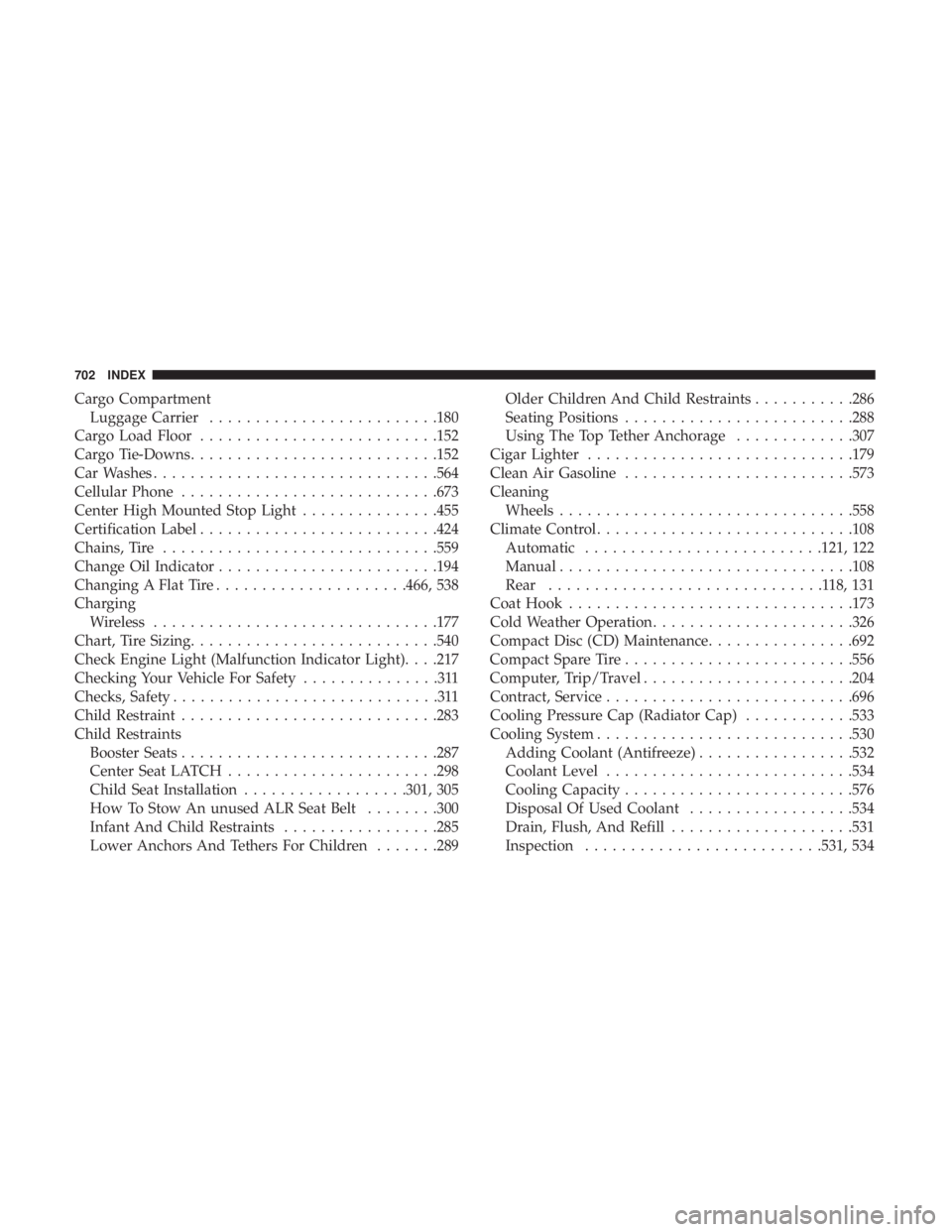
Cargo CompartmentLuggage Carrier ........................ .180
Cargo Load Floor ......................... .152
Cargo Tie-Downs .......................... .152
Car Washes .............................. .564
Cellular Phone ........................... .673
Center High Mounted Stop Light ...............455
Certification Label ......................... .424
Chains, Tire ............................. .559
Change Oil Indicator ....................... .194
Changing A Flat Tire .....................466, 538
Charging Wireless .............................. .177
Chart, Tire Sizing .......................... .540
Check Engine Light (Malfunction Indicator Light). . . .217
Checking Your Vehicle For Safety ...............311
Checks, Safety .............................311
Child Restraint ........................... .283
Child Restraints Booster Seats ........................... .287
Center Seat LATCH ...................... .298
Child Seat Installation ..................301, 305
How To Stow An unused ALR Seat Belt ........300
Infant And Child Restraints .................285
Lower Anchors And Tethers For Children .......289Older Children And Child Restraints
...........286
Seating Positions ........................ .288
Using The Top Tether Anchorage .............307
Cigar Lighter ............................ .179
Clean Air Gasoline ........................ .573
Cleaning Wheels ............................... .558
Climate Control ........................... .108
Automatic ......................... .121, 122
Manual ............................... .108
Rear ..............................118,131
Coat Hook .............................. .173
Cold Weather Operation ..................... .326
Compact
Disc (CD) Maintenance ................692
Compact Spare Tire ........................ .556
Computer, Trip/Travel ...................... .204
Contract, Service .......................... .696
Cooling Pressure Cap (Radiator Cap) ............533
Cooling System ........................... .530
Adding Coolant (Antifreeze) .................532
Coolant Level .......................... .534
Cooling Capacity ........................ .576
Disposal Of Used Coolant ..................534
Drain, Flush, And Refill ....................531
Inspection ......................... .531, 534
702 INDEX
Page 705 of 718
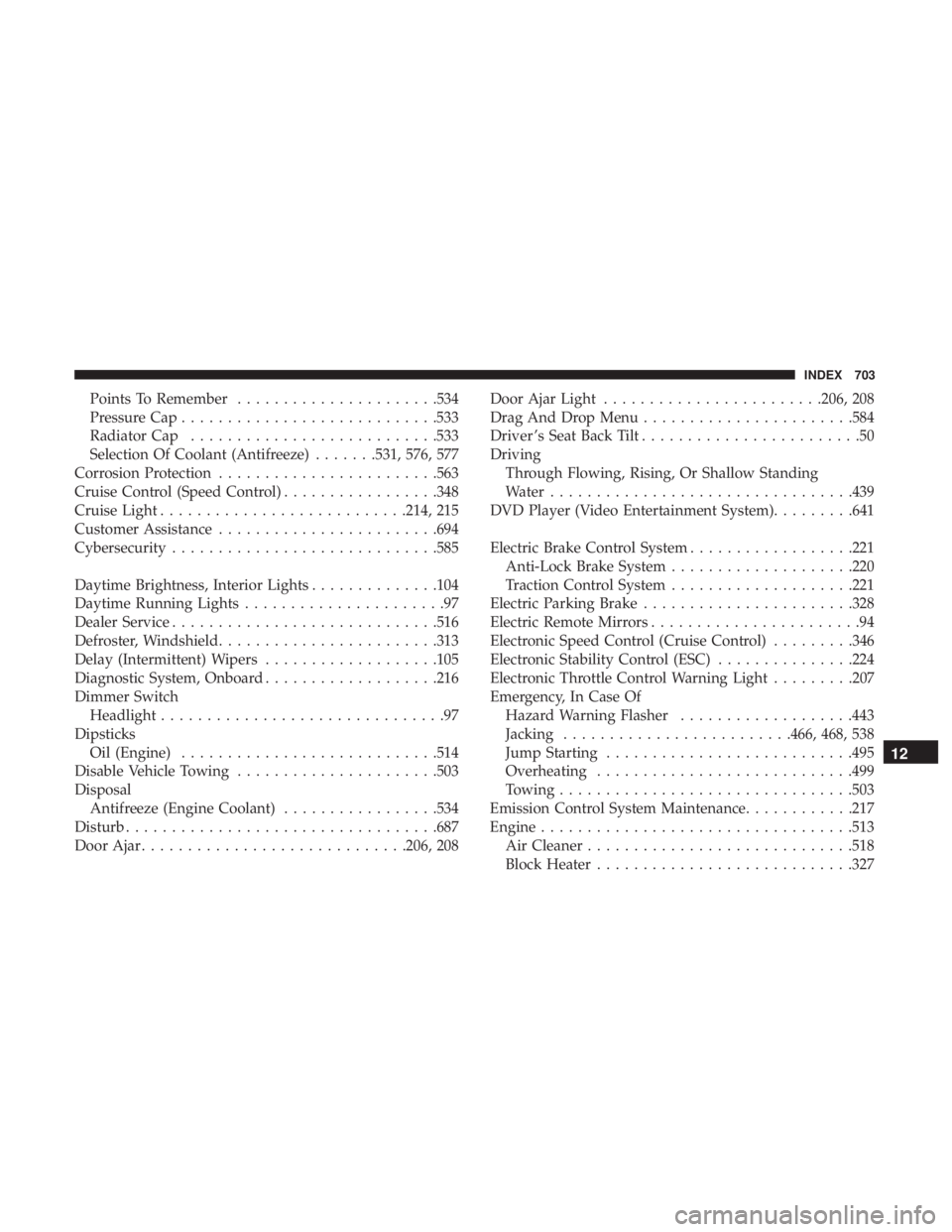
Points To Remember..................... .534
Pressure Cap ........................... .533
Radiator Cap .......................... .533
Selection Of Coolant (Antifreeze) .......531, 576, 577
Corrosion Protection ....................... .563
Cruise Control (Speed Control) .................348
Cruise Light .......................... .214, 215
Customer Assistance ....................... .694
Cybersecurity ............................ .585
Daytime Brightness, Interior Lights ..............104
Daytime Running Lights ......................97
Dealer Service ............................ .516
Defroster, Windshield ....................... .313
Delay (Intermittent) Wipers ...................105
Diagnostic System, Onboard ...................216
Dimmer Switch Headlight ...............................97
Dipsticks Oil (Engine) ........................... .514
Disable Vehicle Towing ..................... .503
Disposal Antifreeze (Engine Coolant) .................534
Disturb ................................. .687
Door Ajar ............................ .206, 208Door Ajar Light
....................... .206, 208
Drag And Drop Menu ...................... .584
Driver ’s Seat Back Tilt ........................50
Driving Through Flowing, Rising, Or Shallow Standing
Water ................................ .439
DVD Player (Video Entertainment System) .........641
Electric Brake Control System ..................221
Anti-Lock Brake System ....................220
Traction Control System ....................221
Electric Parking Brake ...................... .328
Electric Remote Mirrors .......................94
Electronic Speed Control (Cruise Control) .........346
Electronic Stability Control (ESC) ...............224
Electronic Throttle Control Warning Light .........207
Emer
gency, In Case Of
Hazard Warning Flasher ...................443
Jacking ........................ .466, 468, 538
Jump Starting .......................... .495
Overheating ........................... .499
Towing ............................... .503
Emission Control System Maintenance ............217
Engine ................................. .513
Air Cleaner ............................ .518
Block Heater ........................... .327
12
INDEX 703
Page 706 of 718
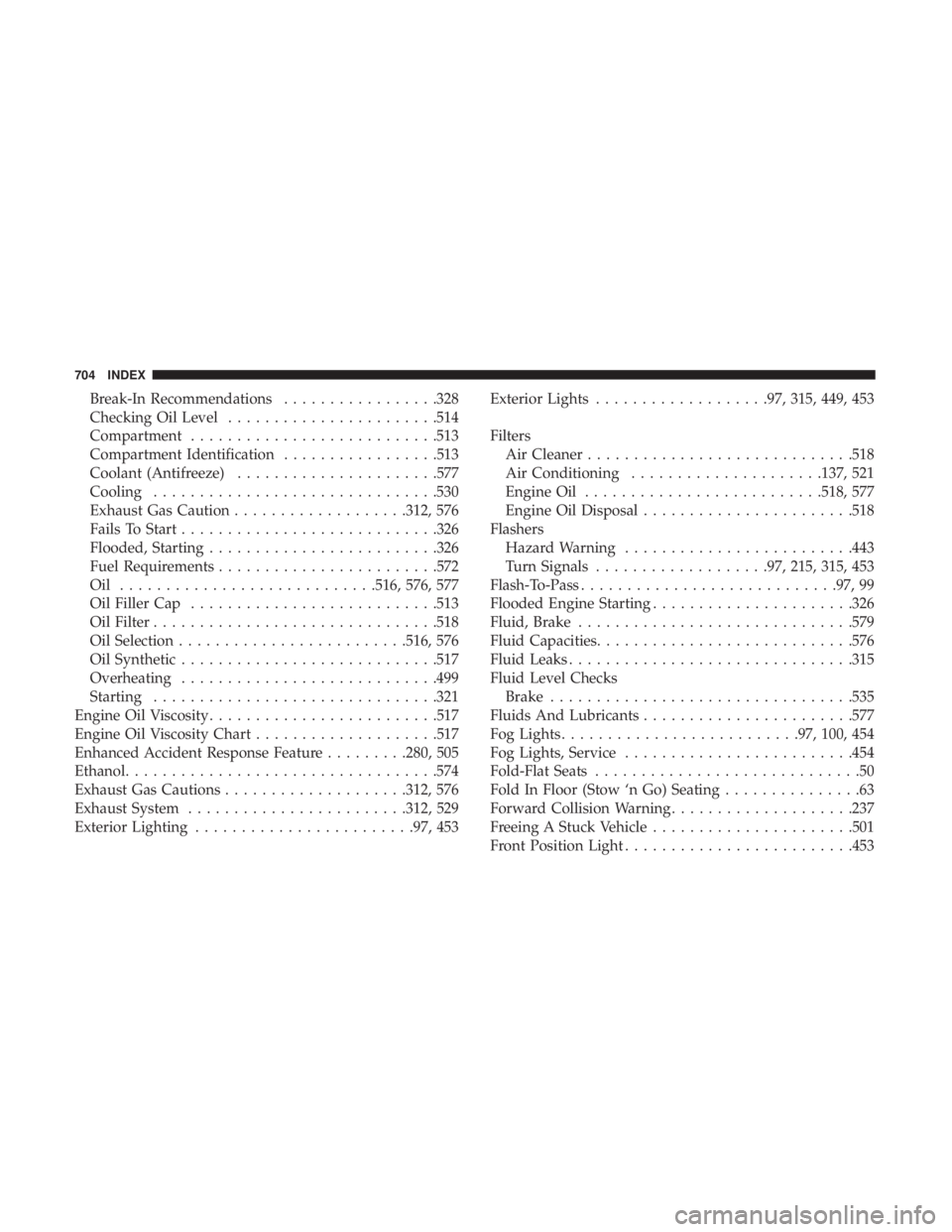
Break-In Recommendations.................328
Checking Oil Level ...................... .514
Compartment .......................... .513
Compartment Identification .................513
Coolant (Antifreeze) ..................... .577
Cooling .............................. .530
Exhaust Gas Caution ...................312, 576
Fails To Start ........................... .326
Flooded, Starting ........................ .326
Fuel Requirements ....................... .572
Oil ........................... .516, 576, 577
Oil Filler Cap .......................... .513
Oil Filter .............................. .518
Oil Selection ........................ .516, 576
Oil Synthetic ........................... .517
Overheating ........................... .499
Starting .............................. .321
Engine Oil Viscosity ........................ .517
Engine Oil Viscosity Chart ....................517
Enhanced Accident Response Feature .........280, 505
Ethanol ................................. .574
Exhaust Gas Cautions ....................312, 576
Exhaust System ....................... .312, 529
Exterior Lighting ....................... .97, 453Exterior Lights
...................97, 315, 449, 453
Filters Air Cleaner ............................ .518
Air Conditioning .....................137, 521
Engine Oil ......................... .518, 577
Engine Oil Disposal ...................... .518
Flashers Hazard Warning ........................ .443
Turn Signals ...................97, 215, 315, 453
Flash-To-Pass ........................... .97, 99
Flooded Engine Starting ..................... .326
Fluid, Brake ............................. .579
Fluid
Capacities ........................... .576
Fluid Leaks .............................. .315
Fluid Level Checks Brake ................................ .535
Fluids And Lubricants ...................... .577
Fog Lights ......................... .97, 100, 454
Fog Lights, Service ........................ .454
Fold-Flat Seats .............................50
Fold In Floor (Stow ‘n Go) Seating ...............63
Forward Collision Warning ....................237
Freeing A Stuck Vehicle ..................... .501
Front Position Light ........................ .453
704 INDEX