Low fuel warning light CHRYSLER PACIFICA 2023 User Guide
[x] Cancel search | Manufacturer: CHRYSLER, Model Year: 2023, Model line: PACIFICA, Model: CHRYSLER PACIFICA 2023Pages: 328, PDF Size: 16.37 MB
Page 200 of 328
198SAFETY
The TPMS will warn the driver of a low tire pressure if the
tire pressure falls below the low-pressure warning limit for
any reason, including low temperature effects and natural
pressure loss through the tire.
The TPMS will continue to warn the driver of low tire
pressure as long as the condition exists, and will not turn
off until the tire pressure is at or above the recommended
cold placard pressure. Once the low tire pressure warning
(TPMS Warning Light) illuminates, you must increase the
tire pressure to the recommended cold placard pressure
in order for the TPMS Warning Light to turn off.
The system will automatically update and the TPMS
Warning Light will turn off once the system receives the
updated tire pressures. The vehicle may need to be driven
for up to 20 minutes above 15 mph (24 km/h) in order for
the TPMS to receive this information.
For example, your vehicle may have a recommended cold
(parked for more than three hours) placard pressure of
33 psi (227 kPa). If the ambient temperature is 68°F
(20°C) and the measured tire pressure is 28 psi
(193 kPa), a temperature drop to 20°F (-7°C) will
decrease the tire pressure to approximately 24 psi
(165 kPa). This tire pressure is low enough to turn on the
TPMS Warning Light. Driving the vehicle may cause the tire
pressure to rise to approximately 28 psi (193 kPa), but the
TPMS Warning Light will still be on. In this situation, the
TPMS Warning Light will turn off only after the tires are
inflated to the vehicle’s recommended cold placard
pressure value
Úpage 312.
NOTE:When filling warm tires, the tire pressure may need to be
increased up to an additional 4 psi (28 kPa) above the
recommended cold placard pressure in order to turn the
TPMS Warning Light off.NOTE:
The TPMS is not intended to replace normal tire care
and maintenance, or to provide warning of a tire failure
or condition.
The TPMS should not be used as a tire pressure gauge
while adjusting your tire pressure.
Driving on a significantly underinflated tire causes the
tire to overheat and can lead to tire failure. Underinfla -
tion also reduces fuel efficiency and tire tread life, and
may affect the vehicle’s handling and stopping ability.
The TPMS is not a substitute for proper tire mainte -
nance, and it is the driver’s responsibility to maintain
correct tire pressure using an accurate tire pressure
gauge, even if underinflation has not reached the level
to trigger illumination of the TPMS Warning Light.
Seasonal temperature changes will affect tire pres -
sure, and the TPMS will monitor the actual tire pres -
sure in the tire.
Premium System
The Tire Pressure Monitoring System (TPMS) uses wireless
technology with wheel rim mounted electronic sensors to
monitor tire pressure levels. Sensors, mounted to each
wheel as part of the valve stem, transmit tire pressure
readings to the receiver module.
NOTE:It is particularly important for you to check the tire
pressure in all of the tires on your vehicle monthly and to
maintain the proper pressure.
CAUTION!
The TPMS has been optimized for the original equip -
ment tires and wheels. TPMS pressures and warning
have been established for the tire size equipped on
your vehicle. Undesirable system operation or sensor
damage may result when using replacement equip -
ment that is not of the same size, type, and/or style.
The TPMS sensor is not designed for use on after -
market wheels and may contribute to a poor overall
system performance or sensor damage. Customers
are encouraged to use Original Equipment Manufac -
turer (OEM) wheels to ensure proper TPMS feature
operation.
Using aftermarket tire sealants may cause the Tire
Pressure Monitoring System (TPMS) sensor to
become inoperable. After using an aftermarket tire
sealant it is recommended that you take your vehicle
to an authorized dealer to have your sensor function
checked.
After inspecting or adjusting the tire pressure always
reinstall the valve stem cap. This will prevent mois -
ture and dirt from entering the valve stem, which
could damage the TPMS sensor.
23_RUP_OM_EN_USC_t.book Page 198
Page 220 of 328
218SAFETY
(Continued)
Enhanced Accident Response System
In the event of an impact, if the communication network
remains intact, and the power remains intact, depending
on the nature of the event, the Occupant Restraint
Controller (ORC) will determine whether to have the
Enhanced Accident Response System perform the
following functions:
Cut off fuel to the engine (if equipped).
Cut off battery power to the electric motor (if equipped).
Flash hazard lights as long as the battery has power.
Turn on the interior lights, which remain on as long as
the battery has power or for 15 minutes from the inter -
vention of the Enhanced Accident Response System.
Unlock the power door locks.
Your vehicle may also be designed to perform any of these
other functions in response to the Enhanced Accident
Response System:
Turn off the Fuel Filter Heater, Turn off the HVAC Blower
Motor, Close the HVAC Circulation Door
Cut off battery power to the:
Engine
Electric Motor (if equipped)
Electric power steering
Brake booster
Electric park brake
Automatic transmission gear selector
Horn
Front wiper
Headlight washer pump (if equipped)
NOTE:After an accident, remember to cycle the ignition to the
STOP (OFF/LOCK) position and remove the key from the
ignition switch to avoid draining the battery. Carefully
check the vehicle for fuel leaks in the engine compartment
and on the ground near the engine compartment and fuel
tank before resetting the system and starting the engine.
If there are no fuel leaks or damage to the vehicle elec -
trical devices (e.g. headlights) after an accident, reset the
system by following the procedure described below. If you
have any doubt, contact an authorized dealer.
Enhanced Accident Response System
Reset Procedure
If applicable, refer to the “Hybrid Supplement” for
additional information.
In order to reset the Enhanced Accident Response System
functions after an event, the ignition switch must be
changed from ignition START or ON/RUN to ignition OFF.
Carefully check the vehicle for fuel leaks in the engine
compartment and on the ground near the engine
compartment and fuel tank before resetting the system
and starting the engine.
After an accident, if the vehicle will not start after
performing the reset procedure, the vehicle must be
towed to an authorized dealer to be inspected and to have
the Enhanced Accident Response System reset.
Maintaining Your Air Bag System
WARNING!
Modifications to any part of the air bag system could
cause it to fail when you need it. You could be injured
if the air bag system is not there to protect you. Do
not modify the components or wiring, including
adding any kind of badges or stickers to the steering
wheel hub trim cover or the upper passenger side of
the instrument panel. Do not modify the front fascia/
bumper, vehicle body structure, or add aftermarket
side steps or running boards.
23_RUP_OM_EN_USC_t.book Page 218
Page 237 of 328
SAFETY235
(Continued)
Lights
Have someone observe the operation of brake lights and
exterior lights while you work the controls. Check turn
signal and high beam indicator lights on the instrument
panel.
Door Latches
Check for proper closing, latching, and locking.
Fluid Leaks
Check area under the vehicle after overnight parking for
fuel, coolant, oil, or other fluid leaks. Also, if gasoline
fumes are detected or if fuel or brake fluid leaks are
suspected, the cause should be located and corrected
immediately.
EXHAUST GAS
The best protection against carbon monoxide entry into
the vehicle body is a properly maintained engine exhaust
system.
Whenever a change is noticed in the sound of the exhaust
system, when exhaust fumes can be detected inside the
vehicle, or when the underside or rear of the vehicle is
damaged, have an authorized dealer inspect the complete
exhaust system and adjacent body areas for broken,
damaged, deteriorated, or mispositioned parts. Open
seams or loose connections could permit exhaust fumes
to seep into the passenger compartment. In addition,
inspect the exhaust system each time the vehicle is raised
for lubrication or oil change. Replace as required.
CARBON MONOXIDE WARNINGS
WARNING!
Exhaust gases can injure or kill. They contain carbon
monoxide (CO), which is colorless and odorless.
Breathing it can make you unconscious and can
eventually poison you. To avoid breathing (CO), follow
these safety tips:
Do not run the engine in a closed garage or in
confined areas any longer than needed to move your
vehicle in or out of the area.
If you are required to drive with the trunk/liftgate/
rear doors open, make sure that all windows are
closed and the climate control BLOWER switch is set
at high speed. DO NOT use the recirculation mode.
If it is necessary to sit in a parked vehicle with the
engine running, adjust your heating or cooling
controls to force outside air into the vehicle. Set the
blower at high speed.
WARNING!
WARNING!
Carbon monoxide (CO) in exhaust gases is deadly.
Follow the precautions below to prevent carbon
monoxide poisoning:
Do not inhale exhaust gases. They contain carbon
monoxide, a colorless and odorless gas, which can
kill. Never run the engine in a closed area, such as a
garage, and never sit in a parked vehicle with the
engine running for an extended period. If the vehicle
is stopped in an open area with the engine running
for more than a short period, adjust the ventilation
system to force fresh, outside air into the vehicle.
Guard against carbon monoxide with proper mainte -
nance. Have the exhaust system inspected every
time the vehicle is raised. Have any abnormal condi -
tions repaired promptly. Until repaired, drive with all
side windows fully open.
When exiting the vehicle, always make sure the igni -
tion is in the OFF position, remove the key fob from
the vehicle, and lock your vehicle.
6
23_RUP_OM_EN_USC_t.book Page 235
Page 254 of 328
252IN CASE OF EMERGENCY
JUMP STARTING PROCEDURE
Connecting The Jumper Cables
1. Connect the positive
(+) end of the jumper cable to
the positive (+)
post of the vehicle with the
discharged battery.
2. Connect the opposite end of the positive (+) jumper
cable to the positive (+) post of the booster battery.
3. Connect the negative (-) end of the jumper cable to
the negative (-) post of the booster battery.
4. Connect the opposite end of the negative (-) jumper
cable to the remote negative (-) post near the
windshield cowl (exposed metallic/unpainted post of
the discharge vehicle). 5. Start the engine in the vehicle that has the booster
battery, let the engine idle a few minutes, and then
start the engine in the vehicle with the discharged
battery.
6. Once the engine is started, see the following discon- necting procedure for the next steps.
Disconnecting The Jumper Cables
1. Disconnect the negative
(-)
end of the jumper cable
from the remote negative post of the vehicle with the
discharged battery.
2. Disconnect the opposite end of the negative (-)
jumper cable from the negative (-) post of the booster
battery.
3. Disconnect the positive (+) end of the jumper cable
from the positive (+) post of the booster battery.
4. Disconnect the opposite end of the positive (+)
jumper cable from the positive (+) post of the vehicle
with the discharged battery and reinstall the
protective cap.
If frequent jump starting is required to start your vehicle
you should have the battery and charging system
inspected at an authorized dealer.
REFUELING IN EMERGENCY – IF EQUIPPED
The vehicle is equipped with a refueling funnel for a
Cap-Less Fuel System. If refueling is necessary, while
using an approved gas can, insert the refueling funnel into
the filler neck opening. Take care to open both flappers
with the funnel to avoid spills.
NOTE:In certain cold conditions, ice may prevent the fuel door
from opening. If this occurs, lightly push on the fuel door
to break the ice buildup and re-release the fuel door by
pushing at the rear center edge to unlatch.
Refueling Funnel
WARNING!
Failure to follow this jump starting procedure could
result in personal injury or property damage due to
battery explosion.
CAUTION!
Failure to follow these procedures could result in
damage to the charging system of the booster vehicle
or the discharged vehicle.
WARNING!
Do not connect the jumper cable to the negative (-) post
of the discharged battery. The resulting electrical spark
could cause the battery to explode and could result in
personal injury.
CAUTION!
Accessories plugged into the vehicle power outlets draw
power from the vehicle’s battery, even when not in use
(i.e., cellular devices, etc.). Eventually, if plugged in long
enough without engine operation, the vehicle’s battery
will discharge sufficiently to degrade battery life and/or
prevent the engine from starting.
23_RUP_OM_EN_USC_t.book Page 252
Page 255 of 328
IN CASE OF EMERGENCY253
(Continued)
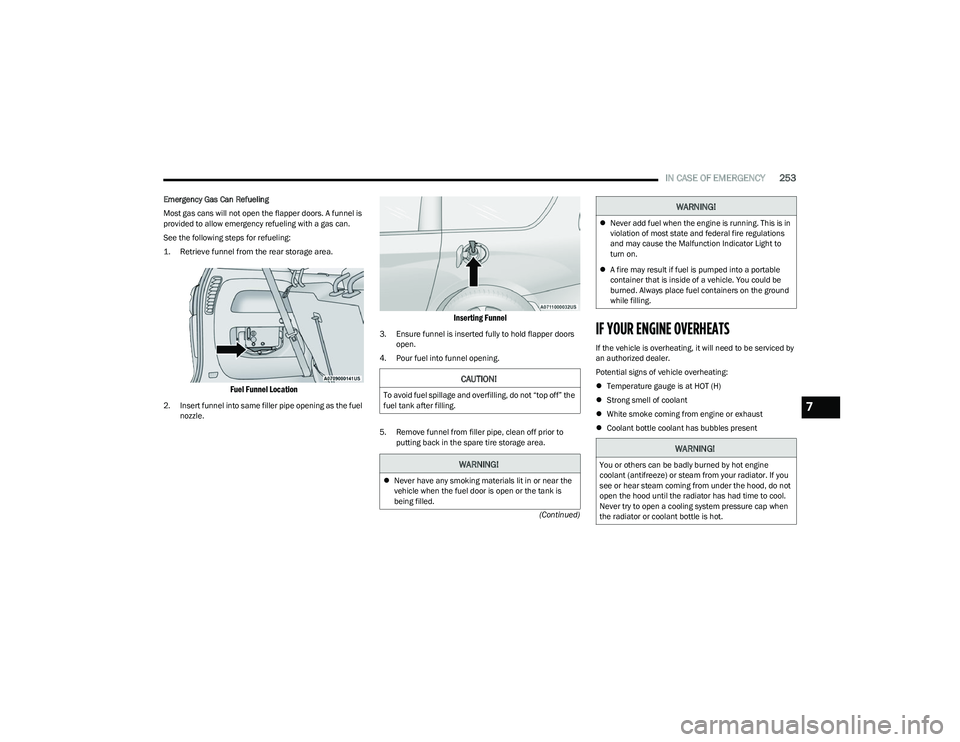
Emergency Gas Can Refueling
Most gas cans will not open the flapper doors. A funnel is
provided to allow emergency refueling with a gas can.
See the following steps for refueling:
1. Retrieve funnel from the rear storage area.
Fuel Funnel Location
2. Insert funnel into same filler pipe opening as the fuel
nozzle.
Inserting Funnel
3. Ensure funnel is inserted fully to hold flapper doors open.
4. Pour fuel into funnel opening.
5. Remove funnel from filler pipe, clean off prior to putting back in the spare tire storage area.IF YOUR ENGINE OVERHEATS
If the vehicle is overheating, it will need to be serviced by
an authorized dealer.
Potential signs of vehicle overheating:
Temperature gauge is at HOT (H)
Strong smell of coolant
White smoke coming from engine or exhaust
Coolant bottle coolant has bubbles present
CAUTION!
To avoid fuel spillage and overfilling, do not “top off” the
fuel tank after filling.
WARNING!
Never have any smoking materials lit in or near the
vehicle when the fuel door is open or the tank is
being filled.
Never add fuel when the engine is running. This is in
violation of most state and federal fire regulations
and may cause the Malfunction Indicator Light to
turn on.
A fire may result if fuel is pumped into a portable
container that is inside of a vehicle. You could be
burned. Always place fuel containers on the ground
while filling.
WARNING!
You or others can be badly burned by hot engine
coolant (antifreeze) or steam from your radiator. If you
see or hear steam coming from under the hood, do not
open the hood until the radiator has had time to cool.
Never try to open a cooling system pressure cap when
the radiator or coolant bottle is hot.
WARNING!
7
23_RUP_OM_EN_USC_t.book Page 253
Page 306 of 328
304TECHNICAL SPECIFICATIONS
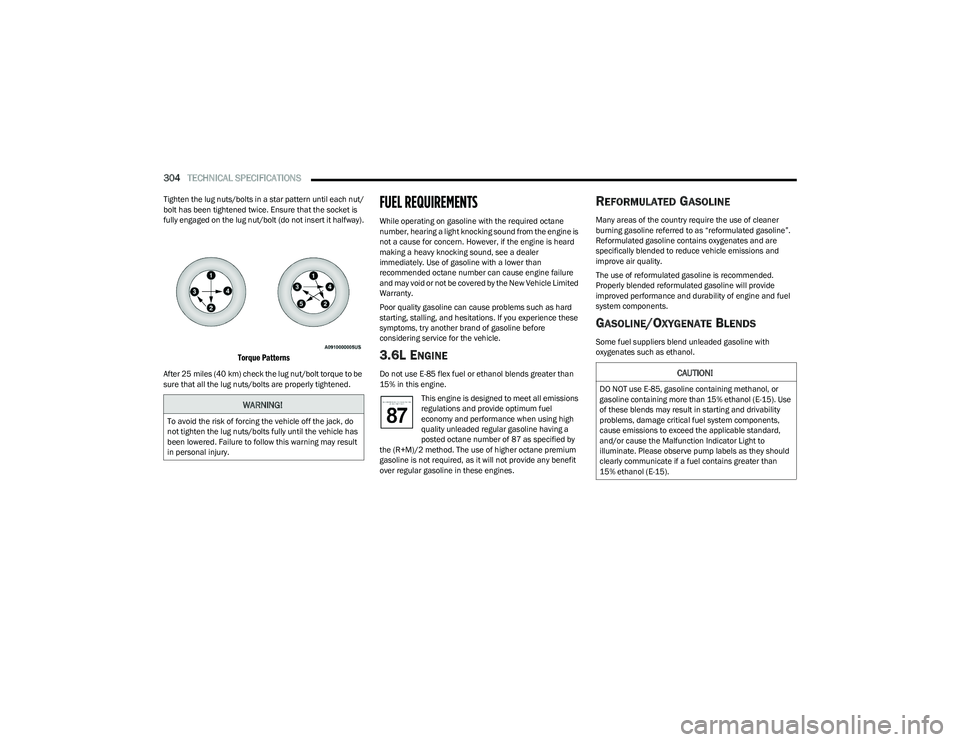
Tighten the lug nuts/bolts in a star pattern until each nut/
bolt has been tightened twice. Ensure that the socket is
fully engaged on the lug nut/bolt (do not insert it halfway).
Torque Patterns
After 25 miles (40 km) check the lug nut/bolt torque to be
sure that all the lug nuts/bolts are properly tightened.
FUEL REQUIREMENTS
While operating on gasoline with the required octane
number, hearing a light knocking sound from the engine is
not a cause for concern. However, if the engine is heard
making a heavy knocking sound, see a dealer
immediately. Use of gasoline with a lower than
recommended octane number can cause engine failure
and may void or not be covered by the New Vehicle Limited
Warranty.
Poor quality gasoline can cause problems such as hard
starting, stalling, and hesitations. If you experience these
symptoms, try another brand of gasoline before
considering service for the vehicle.
3.6L ENGINE
Do not use E-85 flex fuel or ethanol blends greater than
15% in this engine.
This engine is designed to meet all emissions
regulations and provide optimum fuel
economy and performance when using high
quality unleaded regular gasoline having a
posted octane number of 87 as specified by
the (R+M)/2 method. The use of higher octane premium
gasoline is not required, as it will not provide any benefit
over regular gasoline in these engines.
REFORMULATED GASOLINE
Many areas of the country require the use of cleaner
burning gasoline referred to as “reformulated gasoline”.
Reformulated gasoline contains oxygenates and are
specifically blended to reduce vehicle emissions and
improve air quality.
The use of reformulated gasoline is recommended.
Properly blended reformulated gasoline will provide
improved performance and durability of engine and fuel
system components.
GASOLINE/OXYGENATE BLENDS
Some fuel suppliers blend unleaded gasoline with
oxygenates such as ethanol.
WARNING!
To avoid the risk of forcing the vehicle off the jack, do
not tighten the lug nuts/bolts fully until the vehicle has
been lowered. Failure to follow this warning may result
in personal injury.
CAUTION!
DO NOT use E-85, gasoline containing methanol, or
gasoline containing more than 15% ethanol (E-15). Use
of these blends may result in starting and drivability
problems, damage critical fuel system components,
cause emissions to exceed the applicable standard,
and/or cause the Malfunction Indicator Light to
illuminate. Please observe pump labels as they should
clearly communicate if a fuel contains greater than
15% ethanol (E-15).
23_RUP_OM_EN_USC_t.book Page 304
Page 316 of 328
314
Brake System ...................................................... 273, 303
Anti-Lock (ABS)........................................................ 303 Fluid Check..................................................... 274
, 307
Master Cylinder ....................................................... 274
Parking .................................................................... 115
Warning Light .......................................................... 103
Brake/Transmission Interlock..................................... 118
Brightness, Interior Lights .............................................. 58
Bulb Replacement ....................................................... 282
Bulbs, Light.......................................................... 235
, 282
CCamera ......................................................................... 142
Camera, Rear ...................................................... 142, 143
Capacities, Fluid ........................................................... 306
Caps, Filler Fuel .......................................................................... 146
Oil (Engine) .............................................................. 262
Radiator (Coolant Pressure)................................... 272
Car Washes .................................................................. 300
Carbon Monoxide Warning .......................................... 235
Cargo Vehicle Loading..........................................................86
Cargo Compartment Luggage Carrier..........................................................90
Cargo Load Floor ............................................................. 86
Cellular Phone .............................................................. 186
Certification Label ........................................................ 146
Chains, Tire................................................................... 297
Change Oil Indicator ....................................................... 98
Changing A Flat Tire ..................................................... 239 Chart, Tire Sizing ...........................................................284
Check Engine Light (Malfunction Indicator Light) ...... 110
Checking Your Vehicle For Safety ................................ 233
Checks, Safety .............................................................. 233
Child Restraint .............................................................. 219
Child Restraints Booster Seats .......................................................... 221
Center Seat LATCH ..................................................226
Child Seat Installation ................................... 228
, 230
How To Stow An unused ALR Seat Belt .................227 Infant And Child Restraints ..................................... 220
Lower Anchors And Tethers For Children............... 222
Older Children And Child Restraints....................... 221
Seating Positions ..................................................... 222Using The Top Tether Anchorage ...........................231
Clean Air Gasoline ........................................................ 304
Cleaning Wheels .....................................................................296
Climate Control ............................................................... 60 Automatic ................................................................... 61
Manual ....................................................................... 66
Rear ..................................................................... 64
, 69
Cold Weather Operation ............................................... 113
Compact Spare Tire ...................................................... 295
Contract, Service .......................................................... 310
Cooling Pressure Cap (Radiator Cap) ..........................272 Cooling System ............................................................. 271
Adding Coolant (Antifreeze) .................................... 272
Coolant Level........................................................... 273
Cooling Capacity...................................................... 306
Disposal Of Used Coolant ....................................... 273
Drain, Flush, And Refill ........................................... 272
Inspection .......................................................271
, 273
Points To Remember .............................................. 273
Pressure Cap ........................................................... 272
Radiator Cap............................................................ 272
Selection Of Coolant (Antifreeze) ..................272
, 306
Corrosion Protection .................................................... 300
Cruise Control ............................................................... 123
Cruise Control (Speed Control) .................................... 124
Cruise Light ..........................................................107
, 108
Customer Assistance ................................................... 308
Cybersecurity ................................................................ 157
DDaytime Running Lights ................................................. 54 Dealer Service .............................................................. 264
Defroster, Windshield .................................................. 234
Delay (Intermittent) Wipers............................................ 59
Diagnostic System, Onboard ....................................... 109
Dimmer Switch Headlight ................................................................... 54
Dipsticks Oil (Engine) .............................................................. 263
23_RUP_OM_EN_USC_t.book Page 314
Page 317 of 328
315
Disable Vehicle Towing ................................................ 256
DisposalAntifreeze (Engine Coolant) ................................... 273
Door Ajar .............................................................. 103
, 104
Door Ajar Light..................................................... 103, 104
Driver’s Seat Back Tilt ....................................................28
Driving Through Flowing, Rising, Or Shallow Standing Water .................................................. 156
EElectric Brake Control System..................................... 188Anti-Lock Brake System ......................................... 187
Traction Control System ......................................... 191
Electric Parking Brake ................................................. 115
Electronic Stability Control (ESC) ................................ 189
Electronic Throttle Control Warning Light................... 104
Emergency Braking ...................................................... 197
Emergency, In Case Of Hazard Warning Flasher ......................................... 236
Jacking............................................................ 239
, 240
Jump Starting .......................................................... 251
Overheating ............................................................. 253
Towing ..................................................................... 256
Emission Control System Maintenance...................... 110 Engine............................................................................262
Air Cleaner ............................................................... 265
Block Heater ............................................................114Break-In Recommendations ...................................114
Checking Oil Level ...................................................263
Compartment...........................................................262
Compartment Identification....................................262
Coolant (Antifreeze)................................................. 306
Cooling .....................................................................271
Exhaust Gas Caution ............................................... 235
Fails To Start ............................................................114Flooded, Starting ..................................................... 114Fuel Requirements ..................................................304
Oil ................................................................... 264
, 306
Oil Filler Cap ............................................................. 262
Oil Filter ....................................................................265 Oil Selection ................................................... 264
, 306
Oil Synthetic ............................................................. 264
Overheating ............................................................. 253
Starting.....................................................................111
Engine Oil Life ¹............................................................... 98
Enhanced Accident Response Feature ............. 218
, 258
Ethanol .......................................................................... 304
Exhaust Gas Cautions ..................................................235
Exhaust System .................................................. 235
, 270
Exterior Lighting .....................................................54, 282
Exterior Lights .............................................. 54, 235, 282
FFamCam System .......................................................... 145
Filters Air Cleaner ............................................................... 265Air Conditioning ................................................ 71
, 266
Engine Oil................................................................. 265
Engine Oil Disposal ................................................. 265
FireTV ............................................................................ 181
Flashers Hazard Warning....................................................... 236Turn Signals................................... 54
, 108, 235, 282
Flash-To-Pass........................................................... 54, 56
Flat Tire Changing ..................................... 239, 283, 295
Flat Tire Stowage ....................................... 245, 283, 295
Flooded Engine Starting............................................... 114
Fluid Capacities ............................................................ 306
Fluid Leaks.................................................................... 235
Fluid Level Checks Brake........................................................................ 274
Engine Oil................................................................. 263
Fluid, Brake................................................................... 307
Fog Lights................................................................. 54
, 57
Fold In Floor (Stow ‘n Go) Seating ................................. 36 Fold-Flat Seats ................................................................ 28
Forward Collision Warning ........................................... 195
Freeing A Stuck Vehicle ............................................... 255
Front Position Light ...................................................... 282
11
23_RUP_OM_EN_USC_t.book Page 315
Page 318 of 328
316
Fuel ............................................................................... 304Additives .................................................................. 305
Clean Air .................................................................. 304
Ethanol .................................................................... 304
Filler Cap (Gas Cap) ................................................ 146
Gasoline .................................................................. 304
Materials Added...................................................... 305
Methanol ................................................................. 304
Octane Rating ................................................ 304
, 306
Requirements ......................................................... 304 Specifications.......................................................... 306
Tank Capacity.......................................................... 306
Fuses ............................................................................ 275
GGarage Door Opener (HomeLink®) ...............................51
Gas Cap (Fuel Filler Cap) ............................................. 146
Gasoline, (Fuel) ............................................................ 304
Gasoline, Clean Air ....................................................... 304
Gasoline, Reformulated............................................... 304
Gear Ranges ................................................................. 119
Glass Cleaning ............................................................. 302
Gross Axle Weight Rating ............................................ 148
Gross Vehicle Weight Rating ....................................... 147
GVWR ............................................................................ 146
HHands-Free Sliding Door ................................................ 25
Hazard Driving Through Flowing, Rising, Or ShallowStanding Water...................................................156
Hazard Warning Flashers ............................................. 236
Head Restraints .............................................................. 45
Headlights ....................................................................... 54 Cleaning ...................................................................300High Beam/Low Beam Select Switch ...................... 54
Lights On Reminder............................................ 54
, 57
Passing................................................................ 54, 56
Switch......................................................................... 54
Time Delay ................................................................. 54
Washers ..................................................................... 56
Heated Mirrors ......................................................... 48
, 50
Heated Seats .................................................................. 43
Heater, Engine Block ....................................................114
Hill Start Assist .............................................................. 190
Hitches Trailer Towing .......................................................... 149
HomeLink® (Garage Door Opener) ............................... 51 Hood Prop ....................................................................... 82
Hood Release.................................................................. 82
IIgnition ............................................................................ 15 Switch ........................................................................ 15
Indicator Lights Blue .......................................................................... 109
Green ....................................................................... 107
White ........................................................................ 108
Yellow....................................................................... 107
Inside Rearview Mirror .......................................... 48
, 236
Instrument Cluster .................................................. 94, 96
Display ....................................................................... 97
Display Controls ........................................................ 97
Menu Items ............................................................... 99
Instrument Cluster ¹ ....................................................... 96 Instrument Panel Lens Cleaning ................................. 302
Interior And Instrument Lights....................................... 58
Interior Appearance Care............................................. 301
Interior Lights.................................................................. 58
Intermittent Wipers (Delay Wipers) ............................... 59
Inverter Power ......................................................................... 77
JJack Location ................................................................ 240
Jack Operation.............................................................. 239
Jacking And Tire Changing — If Equipped
b
............ 239
Jump Starting ............................................................... 251
23_RUP_OM_EN_USC_t.book Page 316
Page 319 of 328
317
K
Key Fob ............................................................................12 Arm The System .........................................................19
Disarm The Alarm ...................................................... 19
Programming Additional Key Fobs ...........................14
Key Fob Battery Service (Remote Keyless Entry) .........13
Key Fob Programming (Remote Keyless Entry) ............ 14
Keyless Enter 'n Go™ ...................................................... 21 Passive Entry .............................................................. 21
Keys .................................................................................12
Keysense .........................................................................98
LLane Change And Turn Signals ...................................... 54
Lane Change Assist .................................................54, 57
LaneSense.................................................................... 140
Lap/Shoulder Belts ...................................................... 202
Latches ......................................................................... 235 Hood ...........................................................................82
Lead Free Gasoline ...................................................... 304
Leaks, Fluid .................................................................. 235
Life Of Tires .................................................................. 293
Liftgate .............................................................................83 Hands-Free .................................................................84
Power ..........................................................................83
Light Bulbs ........................................................... 235
, 282 Lights .............................................................................235
Air Bag ................................................... 102
, 209, 233
Anti Lock Brake System ..........................................105
Automatic Emergency Braking OFF ........................ 107 Battery Saver ............................................................. 57
Brake Assist Warning .............................................. 190Brake Warning ......................................................... 103
Bulb Replacement...................................................282
Cruise ............................................................. 107
, 108
Daytime Running ....................................................... 54
Dimmer Switch, Headlight ........................................ 54
Electric Power Steering Fault..................................103
Electronic Park Brake.............................................. 105 Electronic Stability Control Active...........................105
Electronic Throttle Control ...................................... 104Engine Temperature Warning................................. 104
Exterior ........................................................... 235
, 282
Fog.....................................................................57, 108
Headlights ........................................................... 54, 56
High Beam ............................................................... 109
High Beam/Low Beam Select .................................. 54
Hood Open ............................................................... 104
Instrument Cluster .................................................... 54
Intensity Control ........................................................ 58
Interior........................................................................ 58
KeySense ................................................................. 108
LaneSense ..................................................... 105
, 108 Liftgate Open ........................................................... 104
Lights On Reminder ........................................... 54
, 57
Low Fuel................................................................... 105
Low Washer Fluid .................................................... 106
Malfunction Indicator (Check Engine) ................... 106 Oil Pressure ............................................................. 104
Oil Temperature ...................................................... 104
Park .......................................................................... 108
Passing ............................................................... 54
, 56
Reading...................................................................... 58
Seat Belt Reminder ................................................. 104 Security Alarm ......................................................... 105
Service ..................................................................... 282Service Automatic Emergency Braking.................. 106
Service AWD ............................................................ 106
Service LaneSense ................................................. 106Service Stop Start System ...................................... 106
Side Marker ............................................................. 282
SmartBeams.............................................................. 56
Stop Start Active...................................................... 108
Tire Pressure Monitoring (TPMS) ........................... 106Traction Control ....................................................... 190Transmission Temperature .................................... 104
Turn Signals................................... 54
, 108, 235, 282
Load Floor, Cargo ........................................................... 86
Load Shed Battery Saver Mode................................... 101
11
23_RUP_OM_EN_USC_t.book Page 317