torque CHRYSLER PACIFICA 2023 User Guide
[x] Cancel search | Manufacturer: CHRYSLER, Model Year: 2023, Model line: PACIFICA, Model: CHRYSLER PACIFICA 2023Pages: 328, PDF Size: 16.37 MB
Page 245 of 328
IN CASE OF EMERGENCY243
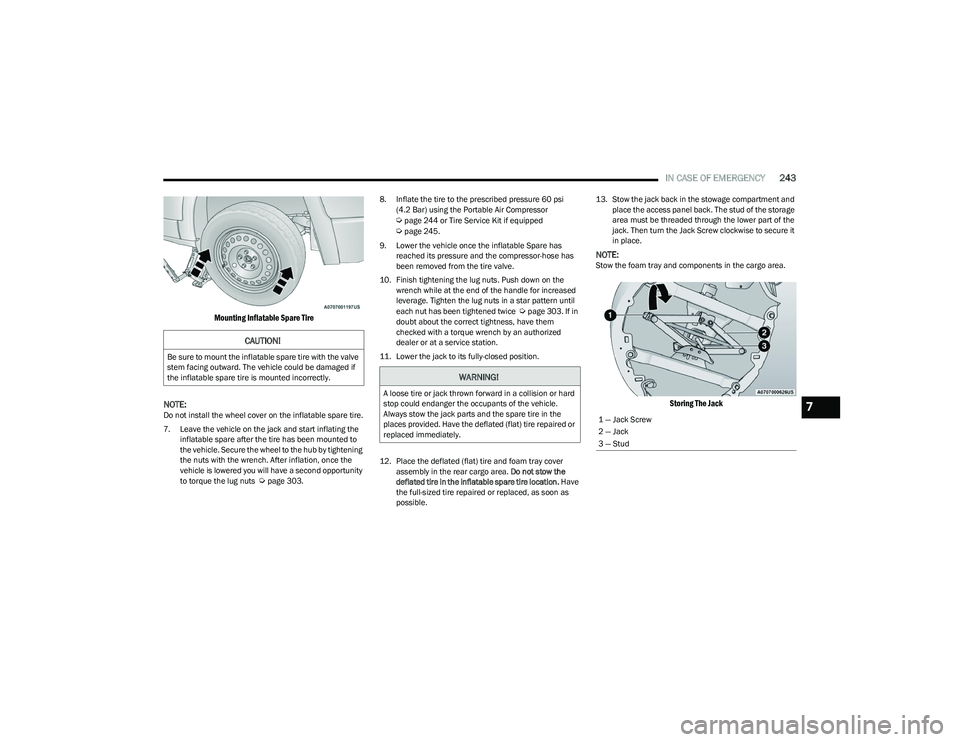
Mounting Inflatable Spare Tire
NOTE:
Do not install the wheel cover on the inflatable spare tire.
7. Leave the vehicle on the jack and start inflating the inflatable spare after the tire has been mounted to
the vehicle. Secure the wheel to the hub by tightening
the nuts with the wrench. After inflation, once the
vehicle is lowered you will have a second opportunity
to torque the lug nuts
Úpage 303. 8. Inflate the tire to the prescribed pressure 60 psi
(4.2 Bar) using the Portable Air Compressor
Úpage 244 or Tire Service Kit if equipped Úpage 245.
9. Lower the vehicle once the inflatable Spare has reached its pressure and the compressor-hose has
been removed from the tire valve.
10. Finish tightening the lug nuts. Push down on the wrench while at the end of the handle for increased
leverage. Tighten the lug nuts in a star pattern until
each nut has been tightened twice
Úpage 303. If in
doubt about the correct tightness, have them
checked with a torque wrench by an authorized
dealer or at a service station.
11. Lower the jack to its fully-closed position.
12. Place the deflated (flat) tire and foam tray cover assembly in the rear cargo area. Do not stow the
deflated tire in the inflatable spare tire location. Have
the full-sized tire repaired or replaced, as soon as
possible. 13. Stow the jack back in the stowage compartment and
place the access panel back. The stud of the storage
area must be threaded through the lower part of the
jack. Then turn the Jack Screw clockwise to secure it
in place.
NOTE:Stow the foam tray and components in the cargo area.
Storing The Jack
CAUTION!
Be sure to mount the inflatable spare tire with the valve
stem facing outward. The vehicle could be damaged if
the inflatable spare tire is mounted incorrectly.
WARNING!
A loose tire or jack thrown forward in a collision or hard
stop could endanger the occupants of the vehicle.
Always stow the jack parts and the spare tire in the
places provided. Have the deflated (flat) tire repaired or
replaced immediately.
1 — Jack Screw
2 — Jack
3 — Stud7
23_RUP_OM_EN_USC_t.book Page 243
Page 246 of 328

244IN CASE OF EMERGENCY
ROAD TIRE INSTALLATION
Vehicles Equipped With Wheel Covers
1. Mount the road tire on the axle.
2. To ease the installation process for steel wheels with
wheel covers, install two lug nuts on the mounting
studs which are on each side of the valve stem. Install
the lug nuts with the cone shaped end of the nut
toward the wheel. Lightly tighten the lug nuts.
Tire And Wheel Cover Or Center Cap
3. Align the valve notch in the wheel cover with the valve stem on the wheel. Install the cover by hand,
snapping the cover over the two lug nuts. Do not use
a hammer or excessive force to install the cover.
4. Install the remaining lug nuts with the cone shaped end of the nut toward the wheel. Lightly tighten all the
lug nuts until the wheel sits flush onto the hub and
there is no play. The nuts will have to be fully
tightened once the vehicle is lowered. Tightening an
improperly seated wheel under vehicle load can
damage the threads, cause vibration, and undermine
safety.
5. Lower the vehicle to the ground by turning the jack handle counterclockwise.
6. Finish tightening the lug nuts. Push down on the wrench while at the end of the handle for increased
leverage. Tighten the lug nuts in a star pattern until
each nut has been tightened twice
Úpage 303. If in
doubt about the correct tightness, have them
checked with a torque wrench by an authorized
dealer or at a service station.
7. After 25 miles (40 km) check the lug nut torque with a torque wrench to ensure that all lug nuts are
properly seated against the wheel.
PORTABLE AIR COMPRESSOR —
I
F EQUIPPED
Your vehicle may be equipped with a Portable Air
Compressor. Use the Portable Air Compressor located in
the side compartment of the cargo area to inflate the
inflatable tire to 60 psi (4.2 Bar).
Portable Air Compressor
1 — Valve Stem
2 — Valve Notch
3 — Road Tire
4 — Wheel Cover
5 — Wheel Lug Nut
WARNING!
To avoid the risk of forcing the vehicle off the jack, do
not tighten the wheel nuts fully until the vehicle has
been lowered. Failure to follow this warning may result
in serious injury.
1 — Power Plug
2 — Deflation Button
3 — Pressure Gauge
4 — Power Button
5 — Air Hose
23_RUP_OM_EN_USC_t.book Page 244
Page 277 of 328
SERVICING AND MAINTENANCE275
(Continued)
NOTE:No chemical flushes should be used in any transmission;
only the approved lubricant should be used.
FUSES
General Information
The fuses protect electrical systems against excessive
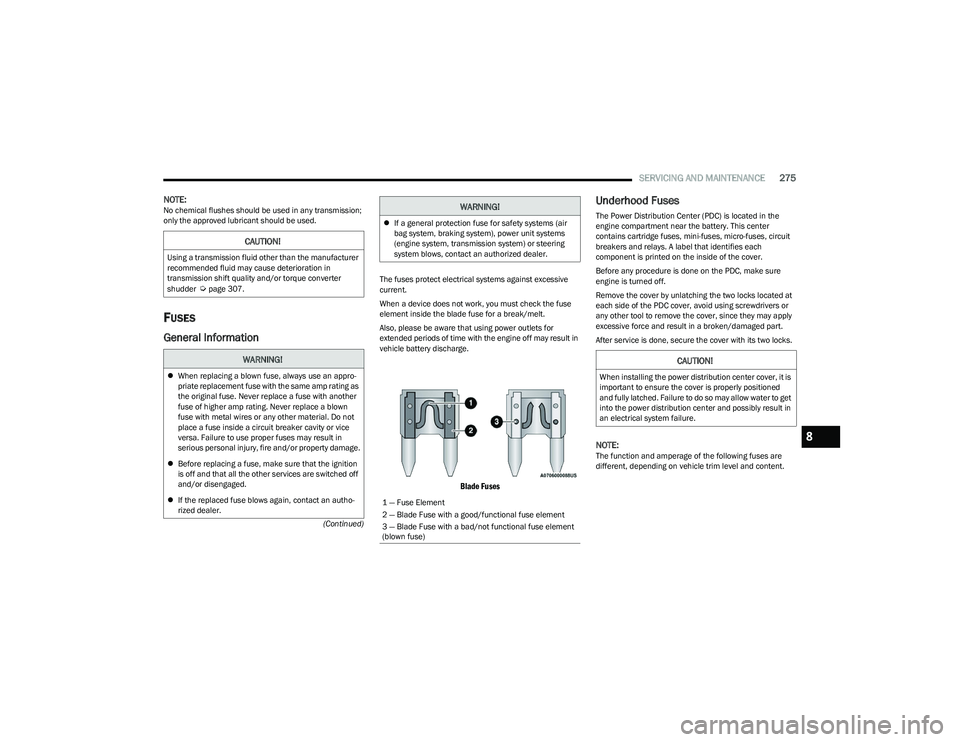
current.
When a device does not work, you must check the fuse
element inside the blade fuse for a break/melt.
Also, please be aware that using power outlets for
extended periods of time with the engine off may result in
vehicle battery discharge.
Blade Fuses
Underhood Fuses
The Power Distribution Center (PDC) is located in the
engine compartment near the battery. This center
contains cartridge fuses, mini-fuses, micro-fuses, circuit
breakers and relays. A label that identifies each
component is printed on the inside of the cover.
Before any procedure is done on the PDC, make sure
engine is turned off.
Remove the cover by unlatching the two locks located at
each side of the PDC cover, avoid using screwdrivers or
any other tool to remove the cover, since they may apply
excessive force and result in a broken/damaged part.
After service is done, secure the cover with its two locks.
NOTE:The function and amperage of the following fuses are
different, depending on vehicle trim level and content.
CAUTION!
Using a transmission fluid other than the manufacturer
recommended fluid may cause deterioration in
transmission shift quality and/or torque converter
shudder
Úpage 307.
WARNING!
When replacing a blown fuse, always use an appro -
priate replacement fuse with the same amp rating as
the original fuse. Never replace a fuse with another
fuse of higher amp rating. Never replace a blown
fuse with metal wires or any other material. Do not
place a fuse inside a circuit breaker cavity or vice
versa. Failure to use proper fuses may result in
serious personal injury, fire and/or property damage.
Before replacing a fuse, make sure that the ignition
is off and that all the other services are switched off
and/or disengaged.
If the replaced fuse blows again, contact an autho -
rized dealer.
If a general protection fuse for safety systems (air
bag system, braking system), power unit systems
(engine system, transmission system) or steering
system blows, contact an authorized dealer.
1 — Fuse Element
2 — Blade Fuse with a good/functional fuse element
3 — Blade Fuse with a bad/not functional fuse element
(blown fuse)
WARNING!
CAUTION!
When installing the power distribution center cover, it is
important to ensure the cover is properly positioned
and fully latched. Failure to do so may allow water to get
into the power distribution center and possibly result in
an electrical system failure.
8
23_RUP_OM_EN_USC_t.book Page 275
Page 305 of 328
303
TECHNICAL SPECIFICATIONS
VEHICLE IDENTIFICATION NUMBER (VIN)
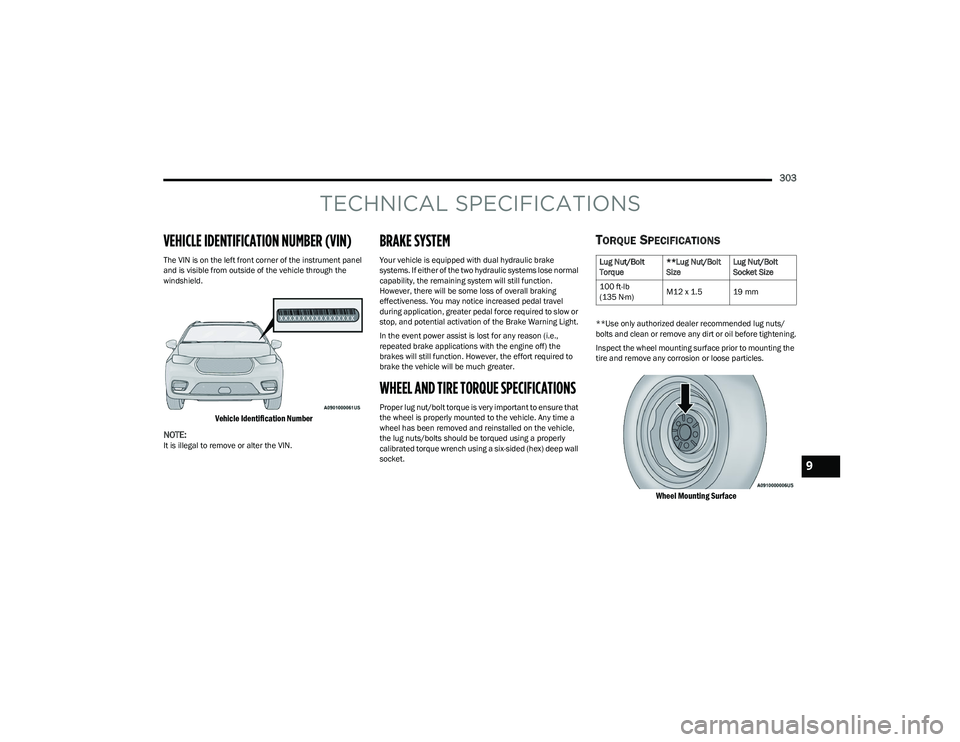
The VIN is on the left front corner of the instrument panel
and is visible from outside of the vehicle through the
windshield.
Vehicle Identification Number
NOTE:
It is illegal to remove or alter the VIN.
BRAKE SYSTEM
Your vehicle is equipped with dual hydraulic brake
systems. If either of the two hydraulic systems lose normal
capability, the remaining system will still function.
However, there will be some loss of overall braking
effectiveness. You may notice increased pedal travel
during application, greater pedal force required to slow or
stop, and potential activation of the Brake Warning Light.
In the event power assist is lost for any reason (i.e.,
repeated brake applications with the engine off) the
brakes will still function. However, the effort required to
brake the vehicle will be much greater.
WHEEL AND TIRE TORQUE SPECIFICATIONS
Proper lug nut/bolt torque is very important to ensure that
the wheel is properly mounted to the vehicle. Any time a
wheel has been removed and reinstalled on the vehicle,
the lug nuts/bolts should be torqued using a properly
calibrated torque wrench using a six-sided (hex) deep wall
socket.
TORQUE SPECIFICATIONS
**Use only authorized dealer recommended lug nuts/
bolts and clean or remove any dirt or oil before tightening.
Inspect the wheel mounting surface prior to mounting the
tire and remove any corrosion or loose particles.
Wheel Mounting Surface
Lug Nut/Bolt
Torque **Lug Nut/Bolt
SizeLug Nut/Bolt
Socket Size
100 ft-lb
(135 N·m) M12 x 1.5 19 mm
9
23_RUP_OM_EN_USC_t.book Page 303
Page 306 of 328
304TECHNICAL SPECIFICATIONS
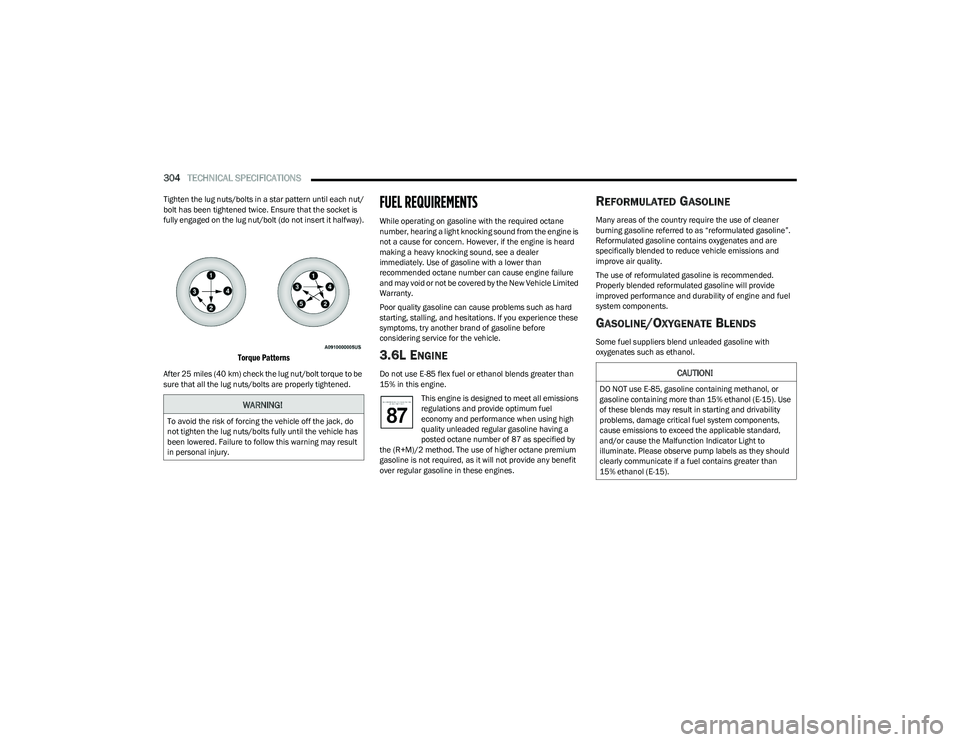
Tighten the lug nuts/bolts in a star pattern until each nut/
bolt has been tightened twice. Ensure that the socket is
fully engaged on the lug nut/bolt (do not insert it halfway).
Torque Patterns
After 25 miles (40 km) check the lug nut/bolt torque to be
sure that all the lug nuts/bolts are properly tightened.
FUEL REQUIREMENTS
While operating on gasoline with the required octane
number, hearing a light knocking sound from the engine is
not a cause for concern. However, if the engine is heard
making a heavy knocking sound, see a dealer
immediately. Use of gasoline with a lower than
recommended octane number can cause engine failure
and may void or not be covered by the New Vehicle Limited
Warranty.
Poor quality gasoline can cause problems such as hard
starting, stalling, and hesitations. If you experience these
symptoms, try another brand of gasoline before
considering service for the vehicle.
3.6L ENGINE
Do not use E-85 flex fuel or ethanol blends greater than
15% in this engine.
This engine is designed to meet all emissions
regulations and provide optimum fuel
economy and performance when using high
quality unleaded regular gasoline having a
posted octane number of 87 as specified by
the (R+M)/2 method. The use of higher octane premium
gasoline is not required, as it will not provide any benefit
over regular gasoline in these engines.
REFORMULATED GASOLINE
Many areas of the country require the use of cleaner
burning gasoline referred to as “reformulated gasoline”.
Reformulated gasoline contains oxygenates and are
specifically blended to reduce vehicle emissions and
improve air quality.
The use of reformulated gasoline is recommended.
Properly blended reformulated gasoline will provide
improved performance and durability of engine and fuel
system components.
GASOLINE/OXYGENATE BLENDS
Some fuel suppliers blend unleaded gasoline with
oxygenates such as ethanol.
WARNING!
To avoid the risk of forcing the vehicle off the jack, do
not tighten the lug nuts/bolts fully until the vehicle has
been lowered. Failure to follow this warning may result
in personal injury.
CAUTION!
DO NOT use E-85, gasoline containing methanol, or
gasoline containing more than 15% ethanol (E-15). Use
of these blends may result in starting and drivability
problems, damage critical fuel system components,
cause emissions to exceed the applicable standard,
and/or cause the Malfunction Indicator Light to
illuminate. Please observe pump labels as they should
clearly communicate if a fuel contains greater than
15% ethanol (E-15).
23_RUP_OM_EN_USC_t.book Page 304
Page 323 of 328
321
Sizes ........................................................................ 284
Snow Tires ............................................................... 294Spare Tires ............................................240
, 295, 296
Spinning .................................................................. 292
Trailer Towing .......................................................... 152
Tread Wear Indicators ............................................ 293
Wheel Nut Torque ................................................... 303
To Open Hood..................................................................82
Tongue Weight/Trailer Weight .................................... 151
Towing ........................................................................... 147 Disabled Vehicle ..................................................... 256
Guide ....................................................................... 149Recreational ............................................................ 154
Weight...................................................................... 149
Towing Behind A Motorhome ...................................... 154
Traction ......................................................................... 155
Traction Control............................................................ 191
Trailer Sway Control (TSC) ........................................... 192
Trailer Towing ............................................................... 147 Hitches .................................................................... 149
Minimum Requirements ........................................ 151
Tips .......................................................................... 153
Trailer And Tongue Weight ..................................... 151
Wiring....................................................................... 152
Trailer Towing Guide .................................................... 149
Trailer Weight ............................................................... 149
Transaxle Automatic ................................................................ 117Operation................................................................. 117 Transmission................................................................. 118
Automatic ....................................................... 118, 274
Maintenance............................................................274
Transporting Pets ......................................................... 233
Tread Wear Indicators ..................................................293
Turn Signals ................................................. 54
, 108, 282
UUconnect 4C/4C Nav With 8.4-Inch Display ............... 158
Uconnect Settings Customer Programmable Features .......................... 21
Passive Entry Programming ...................................... 21
Uniform Tire Quality Grades ......................................... 298
Universal Garage Door Opener (HomeLink®) —
If Equipped
b
............................................................... 51
Unleaded Gasoline ....................................................... 304
Untwisting Procedure, Seat Belt ..................................204
USB .................................................................................. 74
VVacuum ........................................................................... 86 Stow ‘n Vac ................................................................ 86
Vanity Mirrors .................................................................. 48
Vehicle Identification Number (VIN) ............................ 303
Vehicle Loading................................................... 146
, 288
Vehicle Maintenance ....................................................264
Vehicle Modifications/Alterations ................................... 8
Vehicle Storage ............................................................... 70
Ventilated Seats ............................................................. 44
Voice Command.............................................................. 47
Voice Recognition System (VR) ...................................... 47
WWarning Lights Red........................................................................... 102
Yellow....................................................................... 105
Warning Lights And Messages .................................... 102
Warranty Information ................................................... 310
Washers, Windshield ................................................... 263
Washing Vehicle ........................................................... 300
Water Driving Through ....................................................... 156
Wheel And Wheel Tire Care ......................................... 296
Wheel And Wheel Tire Trim.......................................... 296
Wind Buffeting ................................................................ 79
Window Fogging ............................................................. 70
Windows.......................................................................... 78 Power ......................................................................... 78
Windshield Defroster ................................................... 234
Windshield Washers ............................................. 59
, 263
Fluid ......................................................................... 263
Windshield Wiper Blades ............................................. 268
Wipers Blade Replacement ......................................... 268
Wipers, Intermittent ....................................................... 59 Wireless Charging Pad ................................................... 77
Wrecker Towing ............................................................ 256
11
23_RUP_OM_EN_USC_t.book Page 321