child lock CHRYSLER PACIFICA 2023 Owner's Manual
[x] Cancel search | Manufacturer: CHRYSLER, Model Year: 2023, Model line: PACIFICA, Model: CHRYSLER PACIFICA 2023Pages: 328, PDF Size: 16.37 MB
Page 209 of 328
SAFETY207
Seat Belt Pretensioner
The front outboard seat belt system is equipped with
pretensioning devices that are designed to remove slack
from the seat belt in the event of a collision. These devices
may improve the performance of the seat belt by removing
slack from the seat belt early in a collision. Pretensioners
work for all size occupants, including those in child restraints.
NOTE:These devices are not a substitute for proper seat belt
placement by the occupant. The seat belt still must be
worn snugly and positioned properly.
The pretensioners are triggered by the Occupant Restraint
Controller (ORC). Like the air bags, the pretensioners are
single use items. A deployed pretensioner or a deployed
air bag must be replaced immediately.
Energy Management Feature
The front outboard seat belt system is equipped with an
Energy Management feature that may help further reduce
the risk of injury in the event of a collision. The seat belt
system has a retractor assembly that is designed to
release webbing in a controlled manner.
Switchable Automatic Locking Retractors
(ALR)
If applicable, refer to the “Hybrid Supplement” for
additional information.
The seat belts in the passenger seating positions are
equipped with a Switchable Automatic Locking Retractor
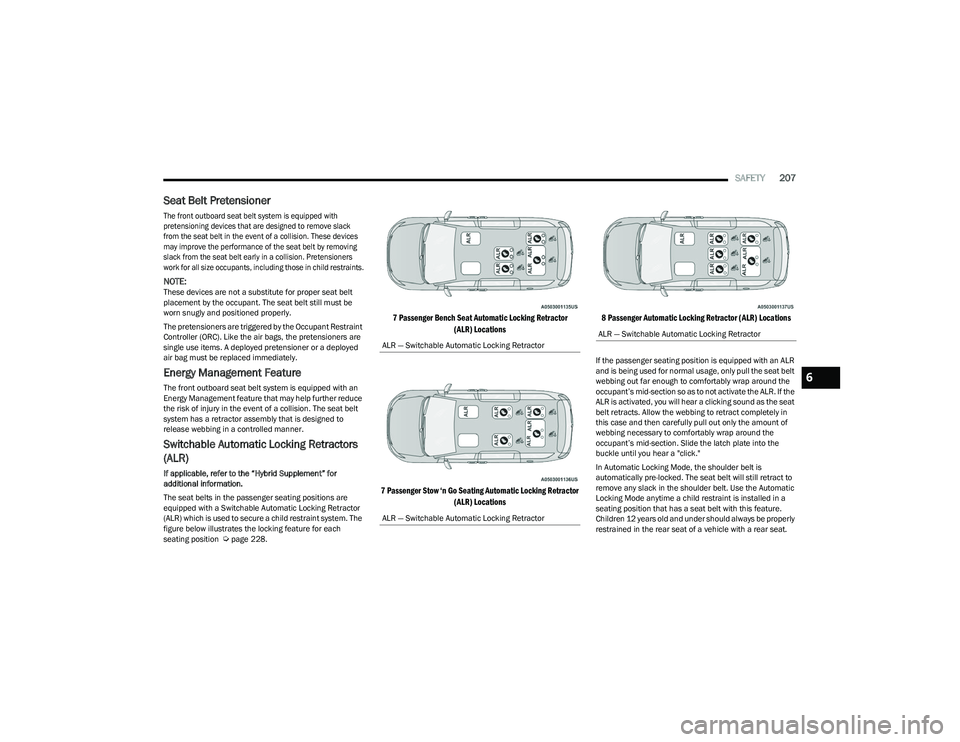
(ALR) which is used to secure a child restraint system. The
figure below illustrates the locking feature for each
seating position
Úpage 228.
7 Passenger Bench Seat Automatic Locking Retractor
(ALR) Locations
7 Passenger Stow ‘n Go Seating Automatic Locking Retractor (ALR) Locations 8 Passenger Automatic Locking Retractor (ALR) Locations
If the passenger seating position is equipped with an ALR
and is being used for normal usage, only pull the seat belt
webbing out far enough to comfortably wrap around the
occupant’s mid-section so as to not activate the ALR. If the
ALR is activated, you will hear a clicking sound as the seat
belt retracts. Allow the webbing to retract completely in
this case and then carefully pull out only the amount of
webbing necessary to comfortably wrap around the
occupant’s mid-section. Slide the latch plate into the
buckle until you hear a "click."
In Automatic Locking Mode, the shoulder belt is
automatically pre-locked. The seat belt will still retract to
remove any slack in the shoulder belt. Use the Automatic
Locking Mode anytime a child restraint is installed in a
seating position that has a seat belt with this feature.
Children 12 years old and under should always be properly
restrained in the rear seat of a vehicle with a rear seat.
ALR — Switchable Automatic Locking Retractor
ALR — Switchable Automatic Locking Retractor
ALR — Switchable Automatic Locking Retractor
6
23_RUP_OM_EN_USC_t.book Page 207
Page 210 of 328
208SAFETY
How To Engage The Automatic Locking Mode
1. Buckle the combination lap and shoulder belt.
2. Grab the shoulder portion and pull downward until
the entire seat belt is extracted.
3. Allow the seat belt to retract. As the seat belt retracts, you will hear a clicking sound. This indicates the seat
belt is now in the Automatic Locking Mode.
How To Disengage The Automatic Locking Mode
Unbuckle the combination lap/shoulder belt and allow it
to retract completely to disengage the Automatic Locking
Mode and activate the vehicle sensitive (emergency)
locking mode.
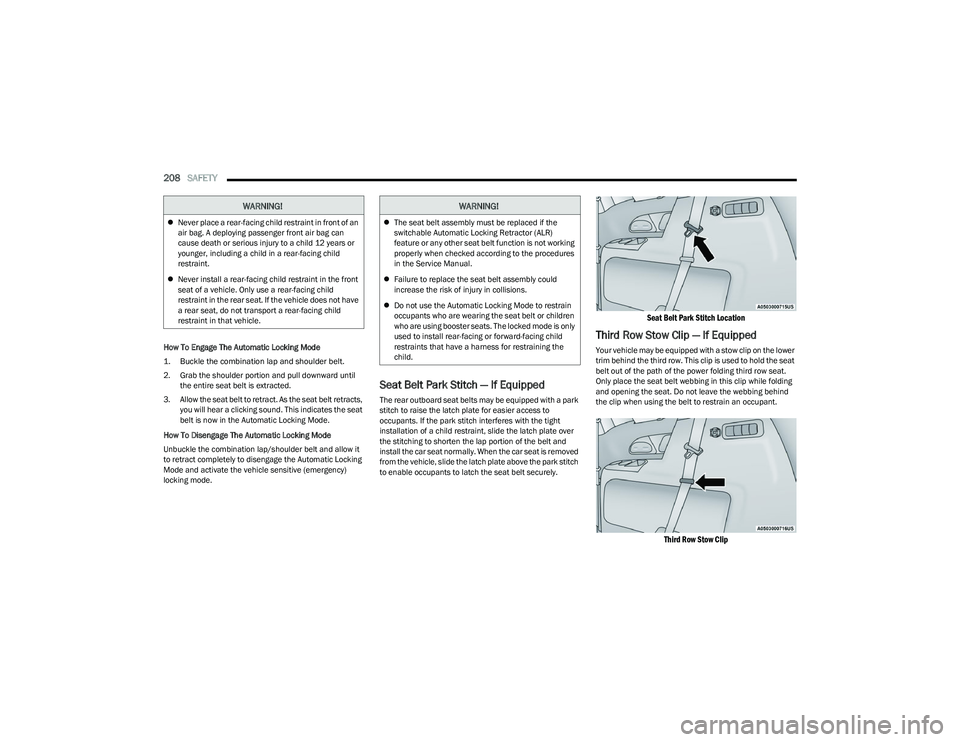
Seat Belt Park Stitch — If Equipped
The rear outboard seat belts may be equipped with a park
stitch to raise the latch plate for easier access to
occupants. If the park stitch interferes with the tight
installation of a child restraint, slide the latch plate over
the stitching to shorten the lap portion of the belt and
install the car seat normally. When the car seat is removed
from the vehicle, slide the latch plate above the park stitch
to enable occupants to latch the seat belt securely.
Seat Belt Park Stitch Location
Third Row Stow Clip — If Equipped
Your vehicle may be equipped with a stow clip on the lower
trim behind the third row. This clip is used to hold the seat
belt out of the path of the power folding third row seat.
Only place the seat belt webbing in this clip while folding
and opening the seat. Do not leave the webbing behind
the clip when using the belt to restrain an occupant.
Third Row Stow Clip
WARNING!
Never place a rear-facing child restraint in front of an
air bag. A deploying passenger front air bag can
cause death or serious injury to a child 12 years or
younger, including a child in a rear-facing child
restraint.
Never install a rear-facing child restraint in the front
seat of a vehicle. Only use a rear-facing child
restraint in the rear seat. If the vehicle does not have
a rear seat, do not transport a rear-facing child
restraint in that vehicle.
WARNING!
The seat belt assembly must be replaced if the
switchable Automatic Locking Retractor (ALR)
feature or any other seat belt function is not working
properly when checked according to the procedures
in the Service Manual.
Failure to replace the seat belt assembly could
increase the risk of injury in collisions.
Do not use the Automatic Locking Mode to restrain
occupants who are wearing the seat belt or children
who are using booster seats. The locked mode is only
used to install rear-facing or forward-facing child
restraints that have a harness for restraining the
child.
23_RUP_OM_EN_USC_t.book Page 208
Page 218 of 328
216SAFETY
(Continued)
The SABIC deploys downward, covering the side windows.
An inflating SABIC pushes the outside edge of the
headliner out of the way and covers the window. The
SABICs inflate with enough force to injure occupants if
they are not belted and seated properly, or if items are
positioned in the area where the SABICs inflate. Children
are at an even greater risk of injury from a deploying air
bag.
The SABICs may help reduce the risk of partial or complete
ejection of vehicle occupants through side windows in
certain side impact events.
Side Impacts
The Side Air Bags are designed to activate in certain side
impacts. The Occupant Restraint Controller (ORC)
determines whether the deployment of the Side Air Bags
in a particular impact event is appropriate, based on the
severity and type of collision. The side impact sensors aid
the ORC in determining the appropriate response to
impact events. The system is calibrated to deploy the Side
Air Bags on the impact side of the vehicle during impacts
that require Side Air Bag occupant protection. In side
impacts, the Side Air Bags deploy independently; a left
side impact deploys the left Side Air Bags only and a
right-side impact deploys the right Side Air Bags only.
Vehicle damage by itself is not a good indicator of whether
or not Side Air Bags should have deployed.
The Side Air Bags will not deploy in all side collisions,
including some collisions at certain angles, or some side
collisions that do not impact the area of the passenger
compartment. The Side Air Bags may deploy during angled
or offset frontal collisions where the front air bags deploy.
Side Air Bags are a supplement to the seat belt restraint
system. Side Air Bags deploy in less time than it takes to
blink your eyes.
NOTE:Air bag covers may not be obvious in the interior trim, but
they will open during air bag deployment.
WARNING!
Do not mount equipment, or stack luggage or other
cargo up high enough to block the deployment of the
SABICs. The trim covering above the side windows
where the SABIC and its deployment path are located
should remain free from any obstructions.
In order for the SABICs to work as intended, do not
install any accessory items in your vehicle which
could alter the roof. Do not add an aftermarket
sunroof to your vehicle. Do not add roof racks that
require permanent attachments (bolts or screws) for
installation on the vehicle roof. Do not drill into the
roof of the vehicle for any reason.
WARNING!
Occupants, including children, who are up against or
very close to Side Air Bags can be seriously injured or
killed. Occupants, including children, should never
lean on or sleep against the door, side windows, or
area where the side air bags inflate, even if they are
in an infant or child restraint.
Seat belts (and child restraints where appropriate)
are necessary for your protection in all collisions.
They also help keep you in position, away from an
inflating Side Air Bag. To get the best protection from
the Side Air Bags, occupants must wear their seat
belts properly and sit upright with their backs against
the seats. Children must be properly restrained in a
child restraint or booster seat that is appropriate for
the size of the child.
WARNING!
Side Air Bags need room to inflate. Do not lean
against the door or window. Sit upright in the center
of the seat.
Being too close to the Side Air Bags during deploy -
ment could cause you to be severely injured or killed.
Relying on the Side Air Bags alone could lead to more
severe injuries in a collision. The Side Air Bags work
with your seat belt to restrain you properly. In some
collisions, Side Air Bags won’t deploy at all. Always
wear your seat belt even though you have Side Air
Bags.
WARNING!
23_RUP_OM_EN_USC_t.book Page 216
Page 229 of 328
SAFETY227
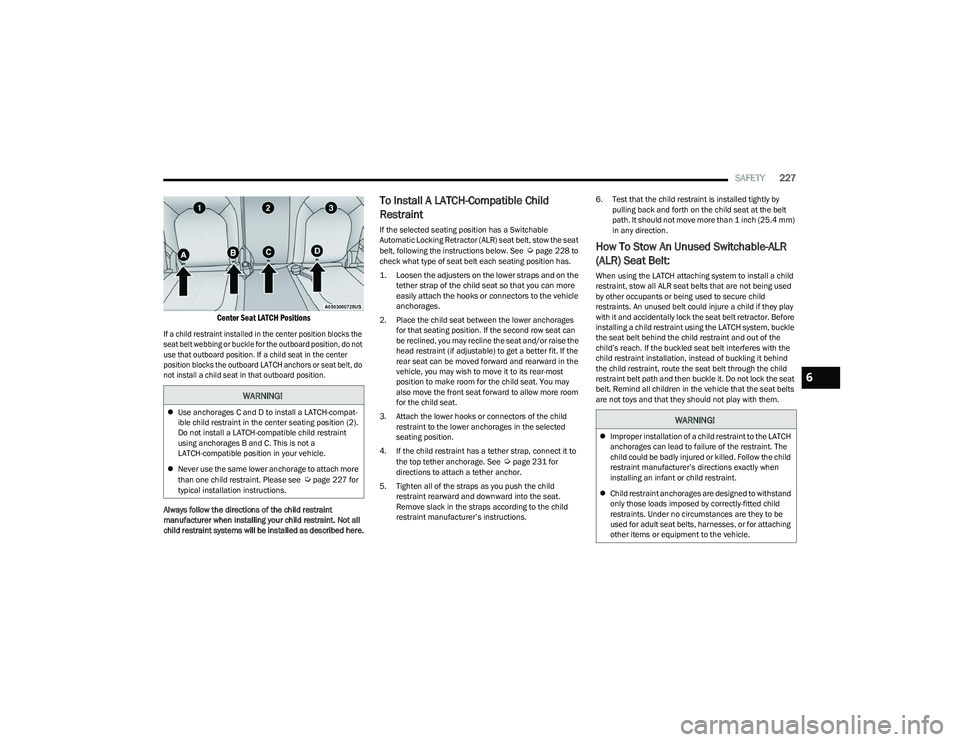
Center Seat LATCH Positions
If a child restraint installed in the center position blocks the
seat belt webbing or buckle for the outboard position, do not
use that outboard position. If a child seat in the center
position blocks the outboard LATCH anchors or seat belt, do
not install a child seat in that outboard position.
Always follow the directions of the child restraint
manufacturer when installing your child restraint. Not all
child restraint systems will be installed as described here.
To Install A LATCH-Compatible Child
Restraint
If the selected seating position has a Switchable
Automatic Locking Retractor (ALR) seat belt, stow the seat
belt, following the instructions below. See
Úpage 228 to
check what type of seat belt each seating position has.
1. Loosen the adjusters on the lower straps and on the tether strap of the child seat so that you can more
easily attach the hooks or connectors to the vehicle
anchorages.
2. Place the child seat between the lower anchorages for that seating position. If the second row seat can
be reclined, you may recline the seat and/or raise the
head restraint (if adjustable) to get a better fit. If the
rear seat can be moved forward and rearward in the
vehicle, you may wish to move it to its rear-most
position to make room for the child seat. You may
also move the front seat forward to allow more room
for the child seat.
3. Attach the lower hooks or connectors of the child restraint to the lower anchorages in the selected
seating position.
4. If the child restraint has a tether strap, connect it to the top tether anchorage. See
Úpage 231 for
directions to attach a tether anchor.
5. Tighten all of the straps as you push the child restraint rearward and downward into the seat.
Remove slack in the straps according to the child
restraint manufacturer’s instructions. 6. Test that the child restraint is installed tightly by
pulling back and forth on the child seat at the belt
path. It should not move more than 1 inch (25.4 mm) in any direction.
How To Stow An Unused Switchable-ALR
(ALR) Seat Belt:
When using the LATCH attaching system to install a child
restraint, stow all ALR seat belts that are not being used
by other occupants or being used to secure child
restraints. An unused belt could injure a child if they play
with it and accidentally lock the seat belt retractor. Before
installing a child restraint using the LATCH system, buckle
the seat belt behind the child restraint and out of the
child’s reach. If the buckled seat belt interferes with the
child restraint installation, instead of buckling it behind
the child restraint, route the seat belt through the child
restraint belt path and then buckle it. Do not lock the seat
belt. Remind all children in the vehicle that the seat belts
are not toys and that they should not play with them.
WARNING!
Use anchorages C and D to install a LATCH-compat -
ible child restraint in the center seating position (2).
Do not install a LATCH-compatible child restraint
using anchorages B and C. This is not a
LATCH-compatible position in your vehicle.
Never use the same lower anchorage to attach more
than one child restraint. Please see
Úpage 227 for
typical installation instructions.
WARNING!
Improper installation of a child restraint to the LATCH
anchorages can lead to failure of the restraint. The
child could be badly injured or killed. Follow the child
restraint manufacturer’s directions exactly when
installing an infant or child restraint.
Child restraint anchorages are designed to withstand
only those loads imposed by correctly-fitted child
restraints. Under no circumstances are they to be
used for adult seat belts, harnesses, or for attaching
other items or equipment to the vehicle.
6
23_RUP_OM_EN_USC_t.book Page 227
Page 230 of 328
228SAFETY
Installing Child Restraints Using The
Vehicle Seat Belt
Child restraint systems are designed to be secured in
vehicle seats by lap belts or the lap belt portion of a lap/
shoulder belt.
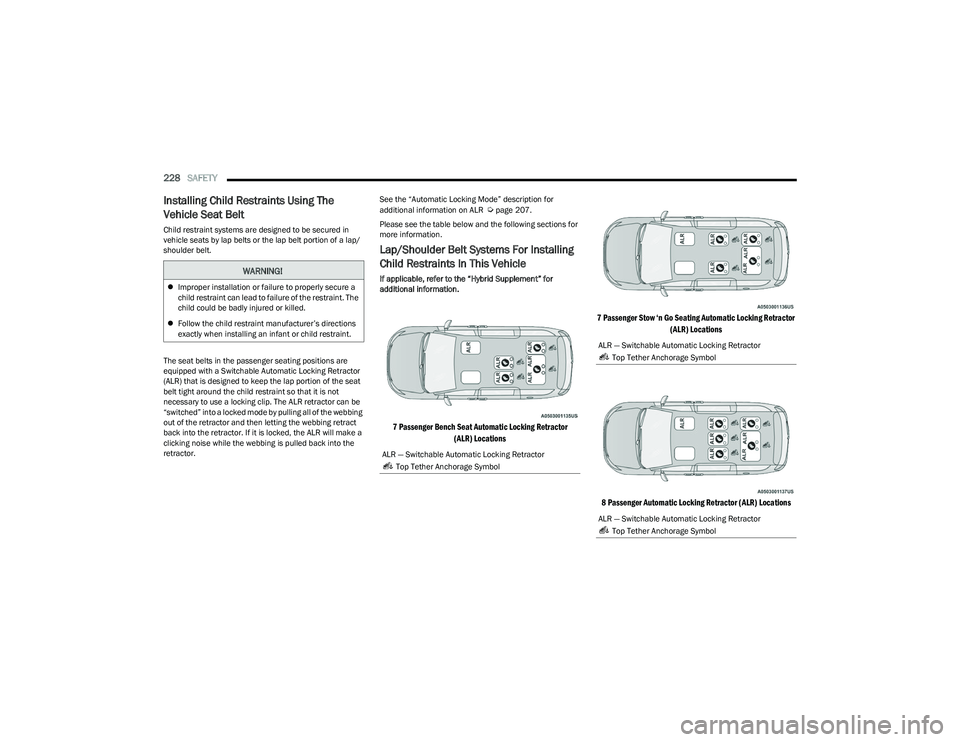
The seat belts in the passenger seating positions are
equipped with a Switchable Automatic Locking Retractor
(ALR) that is designed to keep the lap portion of the seat
belt tight around the child restraint so that it is not
necessary to use a locking clip. The ALR retractor can be
“switched” into a locked mode by pulling all of the webbing
out of the retractor and then letting the webbing retract
back into the retractor. If it is locked, the ALR will make a
clicking noise while the webbing is pulled back into the
retractor. See the “Automatic Locking Mode” description for
additional information on ALR
Úpage 207.
Please see the table below and the following sections for
more information.
Lap/Shoulder Belt Systems For Installing
Child Restraints In This Vehicle
If applicable, refer to the “Hybrid Supplement” for
additional information.
7 Passenger Bench Seat Automatic Locking Retractor (ALR) Locations 7 Passenger Stow ‘n Go Seating Automatic Locking Retractor
(ALR) Locations
8 Passenger Automatic Locking Retractor (ALR) Locations
WARNING!
Improper installation or failure to properly secure a
child restraint can lead to failure of the restraint. The
child could be badly injured or killed.
Follow the child restraint manufacturer’s directions
exactly when installing an infant or child restraint.
ALR — Switchable Automatic Locking Retractor
Top Tether Anchorage Symbol
ALR — Switchable Automatic Locking Retractor Top Tether Anchorage Symbol
ALR — Switchable Automatic Locking Retractor Top Tether Anchorage Symbol
23_RUP_OM_EN_USC_t.book Page 228
Page 232 of 328
230SAFETY
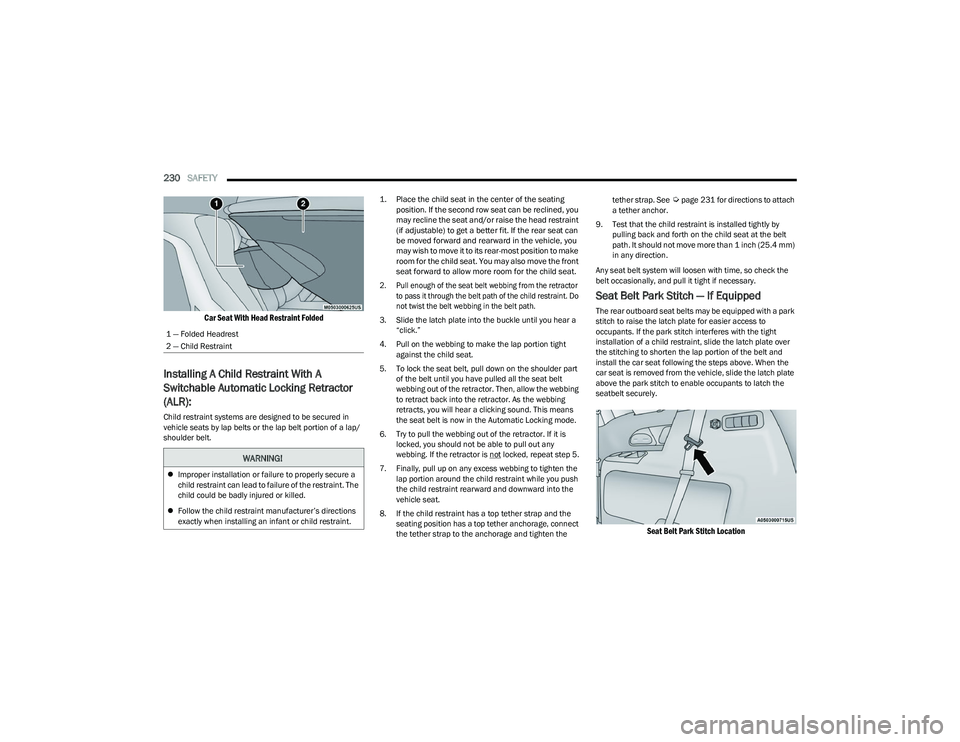
Car Seat With Head Restraint Folded
Installing A Child Restraint With A
Switchable Automatic Locking Retractor
(ALR):
Child restraint systems are designed to be secured in
vehicle seats by lap belts or the lap belt portion of a lap/
shoulder belt.
1. Place the child seat in the center of the seating
position. If the second row seat can be reclined, you
may recline the seat and/or raise the head restraint
(if adjustable) to get a better fit. If the rear seat can
be moved forward and rearward in the vehicle, you
may wish to move it to its rear-most position to make
room for the child seat. You may also move the front
seat forward to allow more room for the child seat.
2. Pull enough of the seat belt webbing from the retractor to pass it through the belt path of the child restraint. Do
not twist the belt webbing in the belt path.
3. Slide the latch plate into the buckle until you hear a “click.”
4. Pull on the webbing to make the lap portion tight against the child seat.
5. To lock the seat belt, pull down on the shoulder part of the belt until you have pulled all the seat belt
webbing out of the retractor. Then, allow the webbing
to retract back into the retractor. As the webbing
retracts, you will hear a clicking sound. This means
the seat belt is now in the Automatic Locking mode.
6. Try to pull the webbing out of the retractor. If it is locked, you should not be able to pull out any
webbing. If the retractor is not
locked, repeat step 5.
7. Finally, pull up on any excess webbing to tighten the lap portion around the child restraint while you push
the child restraint rearward and downward into the
vehicle seat.
8. If the child restraint has a top tether strap and the seating position has a top tether anchorage, connect
the tether strap to the anchorage and tighten the tether strap. See
Úpage 231 for directions to attach
a tether anchor.
9. Test that the child restraint is installed tightly by pulling back and forth on the child seat at the belt
path. It should not move more than 1 inch (25.4 mm) in any direction.
Any seat belt system will loosen with time, so check the
belt occasionally, and pull it tight if necessary.
Seat Belt Park Stitch — If Equipped
The rear outboard seat belts may be equipped with a park
stitch to raise the latch plate for easier access to
occupants. If the park stitch interferes with the tight
installation of a child restraint, slide the latch plate over
the stitching to shorten the lap portion of the belt and
install the car seat following the steps above. When the
car seat is removed from the vehicle, slide the latch plate
above the park stitch to enable occupants to latch the
seatbelt securely.
Seat Belt Park Stitch Location
1 — Folded Headrest
2 — Child Restraint
WARNING!
Improper installation or failure to properly secure a
child restraint can lead to failure of the restraint. The
child could be badly injured or killed.
Follow the child restraint manufacturer’s directions
exactly when installing an infant or child restraint.
23_RUP_OM_EN_USC_t.book Page 230
Page 233 of 328
SAFETY231
(Continued)
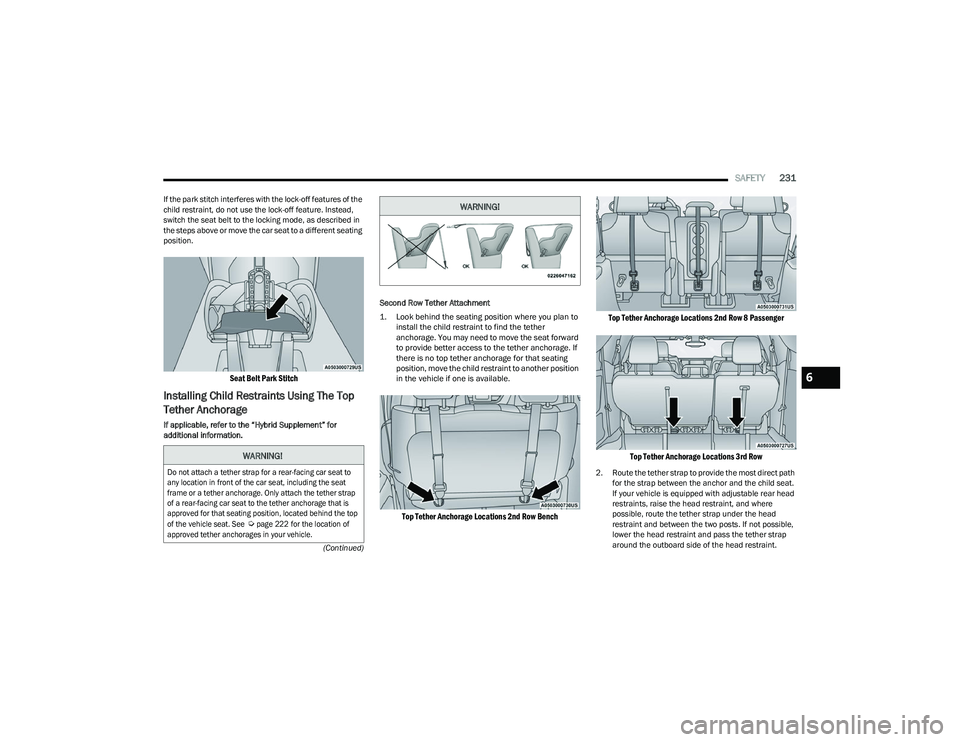
If the park stitch interferes with the lock-off features of the
child restraint, do not use the lock-off feature. Instead,
switch the seat belt to the locking mode, as described in
the steps above or move the car seat to a different seating
position.
Seat Belt Park Stitch
Installing Child Restraints Using The Top
Tether Anchorage
If applicable, refer to the “Hybrid Supplement” for
additional information.
Second Row Tether Attachment
1. Look behind the seating position where you plan to
install the child restraint to find the tether
anchorage. You may need to move the seat forward
to provide better access to the tether anchorage. If
there is no top tether anchorage for that seating
position, move the child restraint to another position
in the vehicle if one is available.
Top Tether Anchorage Locations 2nd Row Bench Top Tether Anchorage Locations 2nd Row 8 Passenger
Top Tether Anchorage Locations 3rd Row
2. Route the tether strap to provide the most direct path for the strap between the anchor and the child seat.
If your vehicle is equipped with adjustable rear head
restraints, raise the head restraint, and where
possible, route the tether strap under the head
restraint and between the two posts. If not possible,
lower the head restraint and pass the tether strap
around the outboard side of the head restraint.
WARNING!
Do not attach a tether strap for a rear-facing car seat to
any location in front of the car seat, including the seat
frame or a tether anchorage. Only attach the tether strap
of a rear-facing car seat to the tether anchorage that is
approved for that seating position, located behind the top
of the vehicle seat. See
Ú
page 222 for the location of
approved tether anchorages in your vehicle.
WARNING!
6
23_RUP_OM_EN_USC_t.book Page 231
Page 316 of 328
314
Brake System ...................................................... 273, 303
Anti-Lock (ABS)........................................................ 303 Fluid Check..................................................... 274
, 307
Master Cylinder ....................................................... 274
Parking .................................................................... 115
Warning Light .......................................................... 103
Brake/Transmission Interlock..................................... 118
Brightness, Interior Lights .............................................. 58
Bulb Replacement ....................................................... 282
Bulbs, Light.......................................................... 235
, 282
CCamera ......................................................................... 142
Camera, Rear ...................................................... 142, 143
Capacities, Fluid ........................................................... 306
Caps, Filler Fuel .......................................................................... 146
Oil (Engine) .............................................................. 262
Radiator (Coolant Pressure)................................... 272
Car Washes .................................................................. 300
Carbon Monoxide Warning .......................................... 235
Cargo Vehicle Loading..........................................................86
Cargo Compartment Luggage Carrier..........................................................90
Cargo Load Floor ............................................................. 86
Cellular Phone .............................................................. 186
Certification Label ........................................................ 146
Chains, Tire................................................................... 297
Change Oil Indicator ....................................................... 98
Changing A Flat Tire ..................................................... 239 Chart, Tire Sizing ...........................................................284
Check Engine Light (Malfunction Indicator Light) ...... 110
Checking Your Vehicle For Safety ................................ 233
Checks, Safety .............................................................. 233
Child Restraint .............................................................. 219
Child Restraints Booster Seats .......................................................... 221
Center Seat LATCH ..................................................226
Child Seat Installation ................................... 228
, 230
How To Stow An unused ALR Seat Belt .................227 Infant And Child Restraints ..................................... 220
Lower Anchors And Tethers For Children............... 222
Older Children And Child Restraints....................... 221
Seating Positions ..................................................... 222Using The Top Tether Anchorage ...........................231
Clean Air Gasoline ........................................................ 304
Cleaning Wheels .....................................................................296
Climate Control ............................................................... 60 Automatic ................................................................... 61
Manual ....................................................................... 66
Rear ..................................................................... 64
, 69
Cold Weather Operation ............................................... 113
Compact Spare Tire ...................................................... 295
Contract, Service .......................................................... 310
Cooling Pressure Cap (Radiator Cap) ..........................272 Cooling System ............................................................. 271
Adding Coolant (Antifreeze) .................................... 272
Coolant Level........................................................... 273
Cooling Capacity...................................................... 306
Disposal Of Used Coolant ....................................... 273
Drain, Flush, And Refill ........................................... 272
Inspection .......................................................271
, 273
Points To Remember .............................................. 273
Pressure Cap ........................................................... 272
Radiator Cap............................................................ 272
Selection Of Coolant (Antifreeze) ..................272
, 306
Corrosion Protection .................................................... 300
Cruise Control ............................................................... 123
Cruise Control (Speed Control) .................................... 124
Cruise Light ..........................................................107
, 108
Customer Assistance ................................................... 308
Cybersecurity ................................................................ 157
DDaytime Running Lights ................................................. 54 Dealer Service .............................................................. 264
Defroster, Windshield .................................................. 234
Delay (Intermittent) Wipers............................................ 59
Diagnostic System, Onboard ....................................... 109
Dimmer Switch Headlight ................................................................... 54
Dipsticks Oil (Engine) .............................................................. 263
23_RUP_OM_EN_USC_t.book Page 314
Page 320 of 328
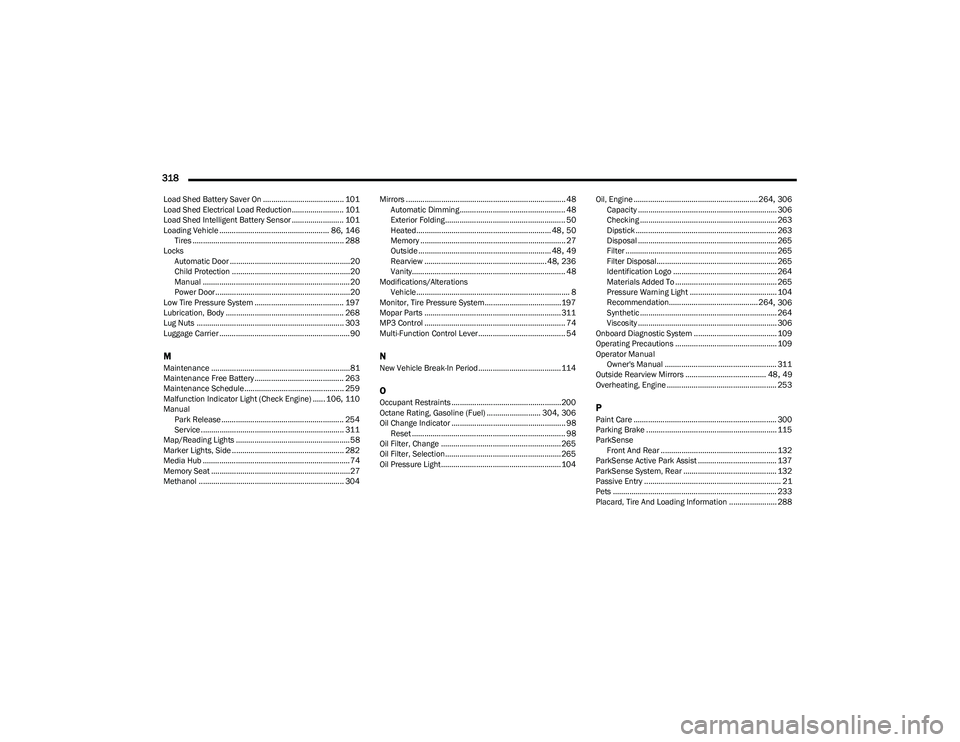
318
Load Shed Battery Saver On ....................................... 101
Load Shed Electrical Load Reduction......................... 101
Load Shed Intelligent Battery Sensor ......................... 101
Loading Vehicle ..................................................... 86
, 146
Tires ......................................................................... 288
Locks Automatic Door ..........................................................20
Child Protection .........................................................20
Manual ....................................................................... 20
Power Door .................................................................20
Low Tire Pressure System ........................................... 197
Lubrication, Body ......................................................... 268
Lug Nuts ....................................................................... 303
Luggage Carrier ............................................................... 90
MMaintenance ...................................................................81
Maintenance Free Battery ........................................... 263
Maintenance Schedule................................................ 259
Malfunction Indicator Light (Check Engine) ...... 106
, 110
Manual Park Release ........................................................... 254
Service ..................................................................... 311
Map/Reading Lights ....................................................... 58
Marker Lights, Side ...................................................... 282
Media Hub ....................................................................... 74 Memory Seat ...................................................................27
Methanol ...................................................................... 304 Mirrors ............................................................................. 48
Automatic Dimming................................................... 48
Exterior Folding.......................................................... 50
Heated................................................................. 48
, 50
Memory ...................................................................... 27
Outside ................................................................ 48
, 49
Rearview ...........................................................48, 236
Vanity.......................................................................... 48
Modifications/Alterations Vehicle.......................................................................... 8
Monitor, Tire Pressure System..................................... 197
Mopar Parts .................................................................. 311
MP3 Control .................................................................... 74 Multi-Function Control Lever .......................................... 54
NNew Vehicle Break-In Period ........................................ 114
OOccupant Restraints ..................................................... 200
Octane Rating, Gasoline (Fuel) .......................... 304, 306
Oil Change Indicator ....................................................... 98 Reset .......................................................................... 98
Oil Filter, Change .......................................................... 265
Oil Filter, Selection........................................................ 265
Oil Pressure Light.......................................................... 104 Oil, Engine ............................................................ 264
, 306
Capacity ................................................................... 306
Checking .................................................................. 263
Dipstick .................................................................... 263
Disposal ................................................................... 265
Filter ......................................................................... 265
Filter Disposal.......................................................... 265
Identification Logo .................................................. 264
Materials Added To ................................................. 265 Pressure Warning Light .......................................... 104Recommendation...........................................264
, 306
Synthetic .................................................................. 264
Viscosity ................................................................... 306
Onboard Diagnostic System ........................................ 109
Operating Precautions ................................................. 109
Operator Manual Owner's Manual ...................................................... 311
Outside Rearview Mirrors ....................................... 48
, 49
Overheating, Engine ..................................................... 253
PPaint Care ..................................................................... 300
Parking Brake ............................................................... 115
ParkSense Front And Rear ........................................................ 132
ParkSense Active Park Assist ...................................... 137
ParkSense System, Rear ............................................. 132
Passive Entry .................................................................. 21
Pets ............................................................................... 233
Placard, Tire And Loading Information ....................... 288
23_RUP_OM_EN_USC_t.book Page 318
Page 321 of 328
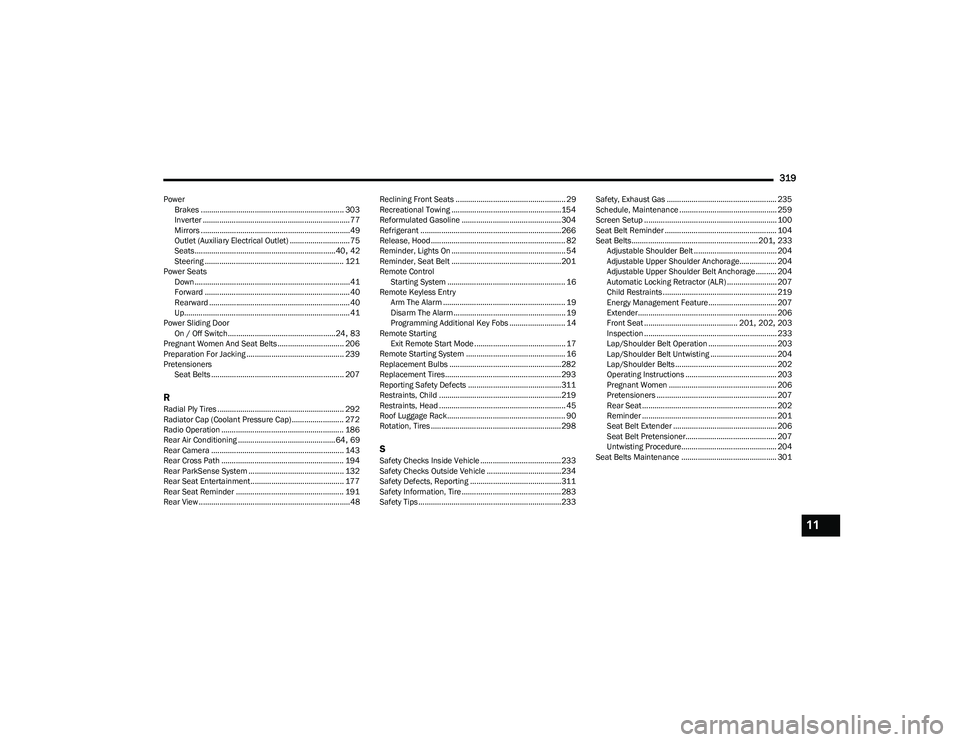
319
PowerBrakes ..................................................................... 303
Inverter ....................................................................... 77
Mirrors ........................................................................49
Outlet (Auxiliary Electrical Outlet) ............................. 75
Seats.................................................................... 40
, 42
Steering ................................................................... 121
Power Seats Down...........................................................................41
Forward ...................................................................... 40
Rearward ....................................................................40
Up................................................................................ 41
Power Sliding Door On / Off Switch.................................................... 24
, 83
Pregnant Women And Seat Belts................................ 206
Preparation For Jacking ............................................... 239
Pretensioners Seat Belts ................................................................ 207
RRadial Ply Tires ............................................................. 292
Radiator Cap (Coolant Pressure Cap) ......................... 272
Radio Operation ........................................................... 186
Rear Air Conditioning ............................................... 64
, 69
Rear Camera ................................................................ 143
Rear Cross Path ........................................................... 194
Rear ParkSense System .............................................. 132
Rear Seat Entertainment............................................. 177
Rear Seat Reminder .................................................... 191
Rear View .........................................................................48 Reclining Front Seats ..................................................... 29
Recreational Towing ..................................................... 154
Reformulated Gasoline ................................................ 304
Refrigerant ....................................................................266
Release, Hood................................................................. 82
Reminder, Lights On ....................................................... 54
Reminder, Seat Belt ..................................................... 201
Remote Control Starting System ......................................................... 16
Remote Keyless Entry Arm The Alarm ........................................................... 19
Disarm The Alarm ...................................................... 19
Programming Additional Key Fobs ........................... 14
Remote Starting Exit Remote Start Mode ............................................ 17
Remote Starting System ................................................ 16
Replacement Bulbs ...................................................... 282
Replacement Tires........................................................ 293
Reporting Safety Defects ............................................. 311
Restraints, Child ...........................................................219
Restraints, Head ............................................................. 45
Roof Luggage Rack......................................................... 90
Rotation, Tires ............................................................... 298SSafety Checks Inside Vehicle ....................................... 233
Safety Checks Outside Vehicle ....................................234
Safety Defects, Reporting ............................................311
Safety Information, Tire ................................................ 283
Safety Tips.....................................................................233 Safety, Exhaust Gas ..................................................... 235
Schedule, Maintenance ............................................... 259
Screen Setup ................................................................ 100
Seat Belt Reminder ...................................................... 104
Seat Belts............................................................. 201
, 233
Adjustable Shoulder Belt ........................................ 204 Adjustable Upper Shoulder Anchorage.................. 204
Adjustable Upper Shoulder Belt Anchorage .......... 204
Automatic Locking Retractor (ALR) ........................ 207
Child Restraints ....................................................... 219Energy Management Feature................................. 207Extender................................................................... 206
Front Seat ............................................. 201
, 202, 203
Inspection ................................................................ 233
Lap/Shoulder Belt Operation ................................. 203 Lap/Shoulder Belt Untwisting ................................ 204
Lap/Shoulder Belts ................................................. 202Operating Instructions ............................................ 203
Pregnant Women .................................................... 206
Pretensioners .......................................................... 207
Rear Seat ................................................................. 202
Reminder ................................................................. 201
Seat Belt Extender .................................................. 206
Seat Belt Pretensioner............................................ 207
Untwisting Procedure.............................................. 204
Seat Belts Maintenance .............................................. 301
11
23_RUP_OM_EN_USC_t.book Page 319