plug CHRYSLER PACIFICA HYBRID 2022 Owner's Manual
[x] Cancel search | Manufacturer: CHRYSLER, Model Year: 2022, Model line: PACIFICA HYBRID, Model: CHRYSLER PACIFICA HYBRID 2022Pages: 384, PDF Size: 23.92 MB
Page 301 of 384
IN CASE OF EMERGENCY299
NOTE:If tire has improper inflation follow these next
steps:
1. Uncoil the Sealant Hose, and then remove the
cap from the fitting at the end of the hose.
2. Place the Tire Service Kit flat on
the ground next to the deflated tire.
3. Remove the cap from the valve stem, and then screw the fitting at the end of the Sealant Hose
onto the valve stem.
4. Uncoil the Power Plug and insert
the plug into the vehicle's 12 Volt
power outlet.
5. Uncoil the Hose and screw the
fitting at the end of the hose onto the
valve stem.
6. Turn the Mode Select Knob and
turn to the Air Mode position.
7. Check the pressure in the tire by reading the Pressure Gauge. If tire pressure is less than 19 psi (1.3 bar):
The tire is too badly damaged. Do not attempt to
drive the vehicle further. Call for assistance.
If the tire pressure is 19 psi (1.3 bar) or higher:
1. Push the Power Button to turn on
Tire Service Kit and inflate the tire to
the cold tire inflation pressure found
on the tire and loading information
label located in the driver-side door opening.
NOTE:If the tire becomes overinflated, push the Deflation
Button to reduce the tire pressure to the recom -
mended inflation pressure before continuing.
2. Disconnect the Tire Service Kit from the valve stem, reinstall the cap on the valve stem and
unplug from 12 Volt outlet.
3. Place the Tire Service Kit in its proper storage area in the vehicle.
4. Have the tire inspected and repaired or replaced at the earliest opportunity at an
authorized dealer or tire service center.
5. Remove the Speed Limit sticker from the steering wheel after the tire has been repaired. 6. Replace the Sealant Bottle at an authorized
dealer as soon as possible.
NOTE:When having the tire serviced, advise the autho -
rized dealer or service center that the tire has been
sealed using the Tire Service Kit.
Sealant Bottle Replacement:
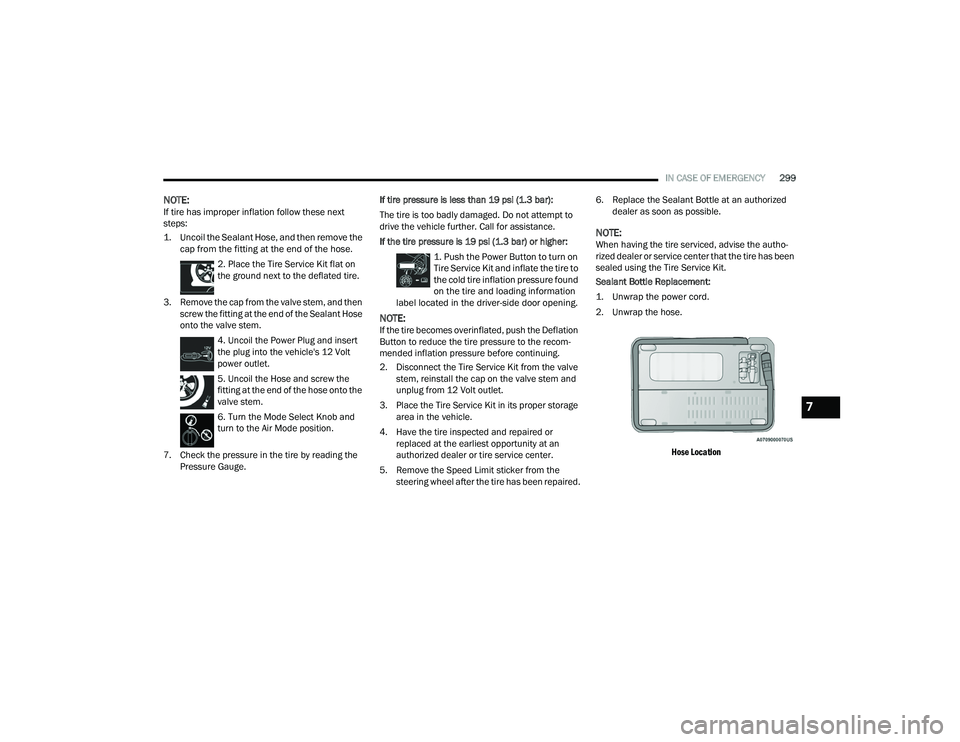
1. Unwrap the power cord.
2. Unwrap the hose.
Hose Location
7
22_RUP_OM_EN_USC_t.book Page 299
Page 304 of 384
302IN CASE OF EMERGENCY
5. Start the engine in the vehicle that has the booster battery, let the engine idle a few
minutes, and then start the engine in the
vehicle with the discharged battery.
6. Once the engine is started, see the following disconnecting procedure for the next steps.
Disconnecting The Jumper Cables
1. Disconnect the negative
(-)
end of the jumper
cable from the remote negative post of the
vehicle with the discharged battery.
2. Disconnect the opposite end of the negative (-)
jumper cable from the negative (-) post of the
booster battery.
3. Disconnect the positive (+) end of the jumper
cable from the positive (+) post of the booster
battery.
4. Disconnect the opposite end of the positive (+)
jumper cable from the remote positive (+) post
of the vehicle with the discharged battery and
reinstall the protective cap. If frequent jump starting is required to start your
vehicle you should have the battery and charging
system inspected at an authorized dealer.
REFUELING IN EMERGENCY – IF EQUIPPED
The vehicle is equipped with a refueling funnel for
a Cap-Less Fuel System. If refueling is necessary,
while using an approved gas can, insert the
refueling funnel into the filler neck opening. Take
care to open both flappers with the funnel to avoid
spills.
NOTE:In certain cold conditions, ice may prevent the fuel
door from opening. If this occurs, lightly push on
the fuel door to break the ice buildup and
re-release the fuel door by pushing at the rear
center edge to unlatch.
Refueling Funnel
Emergency Gas Can Refueling
Most gas cans will not open the flapper doors. A
funnel is provided to allow emergency refueling
with a gas can.
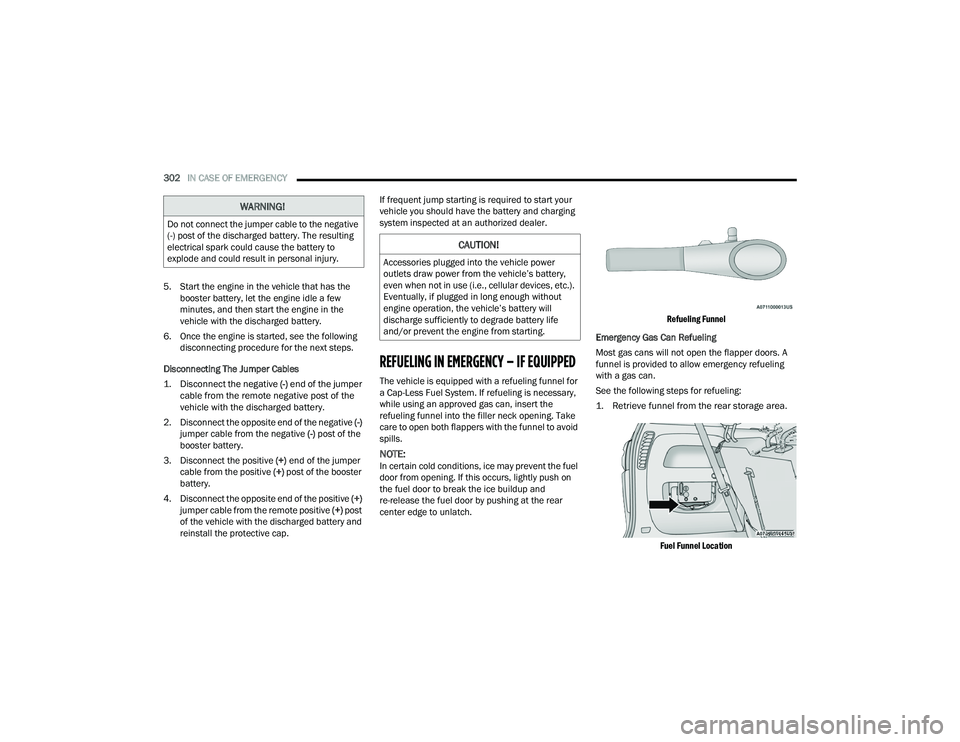
See the following steps for refueling:
1. Retrieve funnel from the rear storage area.
Fuel Funnel Location
WARNING!
Do not connect the jumper cable to the negative
(-) post of the discharged battery. The resulting
electrical spark could cause the battery to
explode and could result in personal injury.
CAUTION!
Accessories plugged into the vehicle power
outlets draw power from the vehicle’s battery,
even when not in use (i.e., cellular devices, etc.).
Eventually, if plugged in long enough without
engine operation, the vehicle’s battery will
discharge sufficiently to degrade battery life
and/or prevent the engine from starting.
22_RUP_OM_EN_USC_t.book Page 302
Page 314 of 384

312SERVICING AND MAINTENANCE
Additional Maintenance
Replace engine air cleaner filter XX X XX
Replace cabin air filter To be replaced every 12,000 miles (19,000 km).
Replace spark plugs
1X
Replace the front accessory drive belt X
Flush and replace the engine coolant at 10 years or
150,000 miles (240,000 km) whichever comes first X
X
Replace PCV valve X
1. The spark plug change interval is mileage-based only; yearly intervals do not apply.
Mileage Or Time Passed (Whichever Comes First)
20,000
30,000
40,000
50,000
60,000
70,000
80,000
90,000
100,000
110,000
120,000
130,000
140,000
150,000
Or Years: 2 3 4 5 6 7 8 9 10 11 12 13 14 15
Or Kilometers:
32,000
48,000
64,000
80,000
96,000
112,000
128,000
144,000
160,000
176,000
192,000
208,000
224,000
240,000
WARNING!
You can be badly injured working on or around a motor vehicle. Do only service work for which you have the knowledge and the right equipment. If you have
any doubt about your ability to perform a service job, take your vehicle to a competent mechanic.
Failure to properly inspect and maintain your vehicle could result in a component malfunction and affect vehicle handling and performance. This could cause
an accident.
22_RUP_OM_EN_USC_t.book Page 312
Page 327 of 384
SERVICING AND MAINTENANCE325
Selection Of Coolant
For further information Úpage 365.
NOTE:
Mixing of engine coolant (antifreeze) other than
specified Organic Additive Technology (OAT)
engine coolant, may result in engine damage
and may decrease corrosion protection.
OAT engine coolant is different and should not
be mixed with Hybrid Organic Additive Tech -
nology (HOAT) engine coolant or any “globally
compatible” coolant. If a non-OAT engine
coolant is introduced into the cooling system in
an emergency, the cooling system will need to
be drained, flushed, and refilled with fresh OAT
coolant (conforming to MS.90032), by an autho -
rized dealer as soon as possible.
Do not use water alone or alcohol-based engine
coolant products. Do not use additional rust
inhibitors or anti-rust products, as they may not
be compatible with the radiator engine coolant
and may plug the radiator.
This vehicle has not been designed for use with
propylene glycol-based engine coolant. Use of
propylene glycol-based engine coolant is not
recommended.
Some vehicles require special tools to add
coolant properly. Failure to fill these systems
properly could lead to severe internal engine
damage. If any coolant is needed to be added to
the system please contact an authorized dealer.
Adding Coolant
Your vehicle has been built with an improved
engine coolant (OAT coolant conforming to
MS.90032) that allows extended maintenance
intervals. This engine coolant (antifreeze) can be
used up to ten years or 150,000 miles
(240,000 km) before replacement. To prevent
reducing this extended maintenance period, it is
important that you use the same engine coolant
(OAT coolant conforming to MS.90032) throughout
the life of your vehicle.
Please review these recommendations for using
OAT engine coolant that meets the requirements of
the manufacturer Material Standard MS.90032.
When adding engine coolant:
We recommend using Mopar® Antifreeze/
Coolant 10 Year/150,000 Mile (240,000 km)
Formula OAT that meets the requirements of the
manufacturer Material Standard MS.90032.
Mix a minimum solution of 50% OAT engine
coolant that meets the requirements of the
manufacturer Material Standard MS.90032
and distilled water. Use higher concentrations
(not to exceed 70%) if temperatures
below −34°F (−37°C) are anticipated. Please
contact an authorized dealer for assistance.
Use only high purity water such as distilled or
deionized water when mixing the water/engine
coolant solution. The use of lower quality water
will reduce the amount of corrosion protection
in the engine cooling system.
NOTE:
It is the owner's responsibility to maintain the
proper level of protection against freezing
according to the temperatures occurring in the
area where the vehicle is operated.
Some vehicles require special tools to add
coolant properly. Failure to fill these systems
properly could lead to severe internal engine
damage. If any coolant is needed to be added to
the system, please contact an authorized
dealer.
Mixing engine coolant types is not recom -
mended and can result in cooling system
damage. If HOAT and OAT coolant are mixed in
an emergency, have an authorized dealer drain,
flush, and refill with OAT coolant (conforming to
MS.90032) as soon as possible.
8
22_RUP_OM_EN_USC_t.book Page 325
Page 364 of 384

362TECHNICAL SPECIFICATIONS
GASOLINE/OXYGENATE BLENDS
Some fuel suppliers blend unleaded gasoline with
oxygenates such as ethanol.
Problems that result from using gasoline
containing more than 15% ethanol (E-15) or
gasoline containing methanol are not the
responsibility of the manufacturer and may void or
not be covered under New Vehicle Limited
Warranty.
DO NOT USE E-85 IN NON-FLEX FUEL
V
EHICLES
Non-Flex Fuel Vehicles (FFV) are compatible with
gasoline containing up to 15% ethanol (E-15). Use
of gasoline with higher ethanol content may void
the New Vehicle Limited Warranty.
If a Non-FFV vehicle is inadvertently fueled with
E-85 fuel, the engine will have some or all of these
symptoms:
Operate in a lean mode
OBD II Malfunction Indicator Light on
Poor engine performance
Poor cold start and cold drivability
Increased risk for fuel system component
corrosion
CNG AND LP FUEL SYSTEM
M
ODIFICATIONS
Modifications that allow the engine to run on
Compressed Natural Gas (CNG) or Liquid Propane
(LP) may result in damage to the engine,
emissions, and fuel system components. Problems
that result from running CNG or LP are not the
responsibility of the manufacturer and may void or
not be covered under the New Vehicle Limited
Warranty.
METHYLCYCLOPENTADIENYL
M
ANGANESE TRICARBONYL (MMT) IN
G
ASOLINE
MMT is a manganese-containing metallic additive
that is blended into some gasoline to increase
octane. Gasoline blended with MMT provides no
performance advantage beyond gasoline of the
same octane number without MMT. Gasoline
blended with MMT reduces spark plug life and
reduces emissions system performance in some
vehicles. The manufacturer recommends that
gasoline without MMT be used in your vehicle. The
MMT content of gasoline may not be indicated on
the gasoline pump; therefore, you should ask your
gasoline retailer whether the gasoline contains
MMT. MMT is prohibited in Federal and California
reformulated gasoline.
CAUTION!
DO NOT use E-85, gasoline containing methanol,
or gasoline containing more than 15% ethanol
(E-15). Use of these blends may result in starting
and drivability problems, damage critical fuel
system components, cause emissions to exceed
the applicable standard, and/or cause the
Malfunction Indicator Light to illuminate. Please
observe pump labels as they should clearly
communicate if a fuel contains greater than
15% ethanol (E-15).
22_RUP_OM_EN_USC_t.book Page 362
Page 368 of 384
366TECHNICAL SPECIFICATIONS
CHASSIS FLUIDS AND LUBRICANTS
CAUTION!
Mixing of engine coolant (antifreeze) other than specified Organic Additive Technology (OAT) engine coolant (antifreeze), may result in engine damage and
may decrease corrosion protection. Organic Additive Technology (OAT) engine coolant is different and should not be mixed with Hybrid Organic Additive Tech -
nology (HOAT) engine coolant (antifreeze) or any “globally compatible” coolant (antifreeze). If a non-OAT engine coolant (antifreeze) is introduced into the
cooling system in an emergency, the cooling system will need to be drained, flushed, and refilled with fresh OAT coolant (conforming to MS.90032), by an
authorized dealer as soon as possible.
Do not use water alone or alcohol-based engine coolant (antifreeze) products. Do not use additional rust inhibitors or antirust products, as they may not be
compatible with the radiator engine coolant and may plug the radiator.
This vehicle has not been designed for use with propylene glycol-based engine coolant (antifreeze). Use of propylene glycol-based engine coolant (antifreeze)
is not recommended.
Component Fluid, Lubricant, or Genuine Part
Automatic Transmission Use only Mopar® ZF 8 & 9 Speed ATF Automatic Transmission Fluid, or
equivalent.
Failure to use the correct fluid may affect the function or performance of your
transmission.
Brake Master Cylinder We recommend using Mopar® DOT 3 Brake Fluid, SAE J1703 should be used.
22_RUP_OM_EN_USC_t.book Page 366
Page 380 of 384
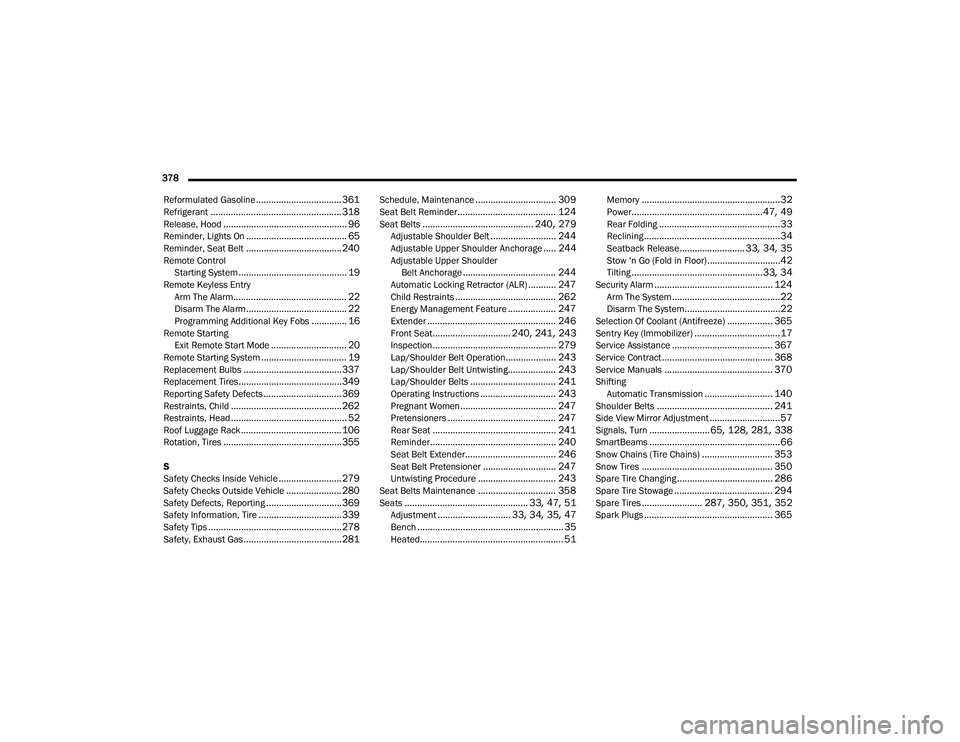
378 Reformulated Gasoline
.................................. 361Refrigerant.................................................... 318Release, Hood................................................. 96Reminder, Lights On........................................ 65Reminder, Seat Belt...................................... 240Remote Control Starting System........................................... 19Remote Keyless EntryArm The Alarm............................................. 22Disarm The Alarm........................................ 22Programming Additional Key Fobs.............. 16Remote StartingExit Remote Start Mode.............................. 20Remote Starting System.................................. 19Replacement Bulbs....................................... 337Replacement Tires......................................... 349Reporting Safety Defects............................... 369Restraints, Child............................................ 262Restraints, Head.............................................. 52Roof Luggage Rack........................................ 106Rotation, Tires............................................... 355
S
Safety Checks Inside Vehicle......................... 279Safety Checks Outside Vehicle...................... 280Safety Defects, Reporting.............................. 369Safety Information, Tire................................. 339Safety Tips..................................................... 278Safety, Exhaust Gas....................................... 281
Schedule, Maintenance................................ 309Seat Belt Reminder....................................... 124Seat Belts............................................ 240, 279Adjustable Shoulder Belt.......................... 244Adjustable Upper Shoulder Anchorage..... 244Adjustable Upper Shoulder Belt Anchorage..................................... 244Automatic Locking Retractor (ALR)........... 247Child Restraints........................................ 262Energy Management Feature................... 247Extender................................................... 246Front Seat............................... 240, 241, 243Inspection................................................. 279Lap/Shoulder Belt Operation.................... 243Lap/Shoulder Belt Untwisting................... 243Lap/Shoulder Belts.................................. 241Operating Instructions.............................. 243Pregnant Women...................................... 247Pretensioners........................................... 247Rear Seat................................................. 241Reminder.................................................. 240Seat Belt Extender.................................... 246Seat Belt Pretensioner............................. 247Untwisting Procedure............................... 243Seat Belts Maintenance............................... 358Seats................................................. 33, 47, 51Adjustment............................. 33, 34, 35, 47Bench.......................................................... 35Heated......................................................... 51
Memory.......................................................32Power....................................................47, 49Rear Folding................................................33Reclining......................................................34Seatback Release.......................... 33, 34, 35Stow ‘n Go (Fold in Floor).............................42Tilting....................................................33, 34Security Alarm............................................... 124Arm The System...........................................22Disarm The System......................................22Selection Of Coolant (Antifreeze).................. 365Sentry Key (Immobilizer)..................................17Service Assistance........................................ 367Service Contract............................................ 368Service Manuals........................................... 370ShiftingAutomatic Transmission........................... 140Shoulder Belts.............................................. 241Side View Mirror Adjustment............................57Signals, Turn........................ 65, 128, 281, 338SmartBeams....................................................66Snow Chains (Tire Chains)............................ 353Snow Tires.................................................... 350Spare Tire Changing...................................... 286Spare Tire Stowage....................................... 294Spare Tires........................ 287, 350, 351, 352Spark Plugs................................................... 365
22_RUP_OM_EN_USC_t.book Page 378