fuel CHRYSLER PT CRUISER 2004 1.G Owner's Manual
[x] Cancel search | Manufacturer: CHRYSLER, Model Year: 2004, Model line: PT CRUISER, Model: CHRYSLER PT CRUISER 2004 1.GPages: 341, PDF Size: 5.06 MB
Page 243 of 341

MAINTAINING YOUR VEHICLE
CONTENTS
m2.4L High Output Turbo Engine Compartment . . 246
m2.4L Engine Compartment................247
mOnboard Diagnostic System Ð OBD II........248
mEmissions Inspection And Maintenance
Programs............................249
mReplacement Parts......................250
mDealer Service.........................250
mMaintenance Procedures..................251
NEngine Oil..........................251NDrive Belts Ð Check Condition And Tension . . 256
NSpark Plugs.........................256
NIgnition Wiring System.................256
NCatalytic Converter....................256
NEngine Timing Belt....................258
NCrankcase Emission Control System........258
NFuel Filter..........................258
NAir Cleaner Element (Filter)..............258
NMaintenance-Free Battery................259
7
Page 244 of 341

NAir Conditioner......................261
NPower Steering Ð Fluid Check............261
NFront Suspension Ball Joints..............262
NBody Lubrication.....................262
NWindshield Wiper Blades................263
NWindshield Washer Reservoir.............264
NExhaust System......................264
NCooling System.......................265
NHoses And Vacuum/Vapor Harnesses.......269
NFuel System Connections................270
NBrake System........................270
NAutomatic Transaxle...................273
NManual Transaxle.....................276NAppearance Care And Protection From
Corrosion...........................276
mFuses...............................282
NUnderhood Fuses
(Power Distribution Center)..............282
NInterior Fuses........................285
mVehicle Storage........................285
mReplacement Bulbs......................286
mBulb Replacement......................287
NHeadlight Bulb Replacement.............287
NFront Park/Turn Signal/Side Marker Lights . . 288
NFront Fog Lights Ð If Equipped...........288
NTail/Stop, And Rear Turn Signal Lights......288
NBack Up Light Bulb....................289
244 MAINTAINING YOUR VEHICLE
Page 248 of 341

ONBOARD DIAGNOSTIC SYSTEM Ð OBD II
Your vehicle is equipped with a sophisticated onboard
diagnostic system called OBD II. This system monitors
the performance of the emissions, engine, and automatic
transmission control systems. When these systems are
operating properly, your vehicle will provide excellent
performance and fuel economy, as well as engine emis-
sions well within current government regulations.
If any of these systems require service, the OBD II system
will turn on the ªMalfunction Indicator Light.º It will
also store diagnostic codes and other information to
assist your service technician in making repairs. Al-
though your vehicle will usually be drivable and not
need towing, see your dealer for service as soon as
possible.CAUTION!
²Prolonged driving with the ªMalfunction Indica-
tor Lightº on could cause further damage to the
emission control system. It could also affect fuel
economy and driveability. The vehicle must be
serviced before any emissions tests can be per-
formed.
²If the ªMalfunction Indicator Lightº is flashing
while the engine is running, severe catalytic con-
verter damage and power loss will soon occur.
Immediate service is required.
248 MAINTAINING YOUR VEHICLE
Page 251 of 341
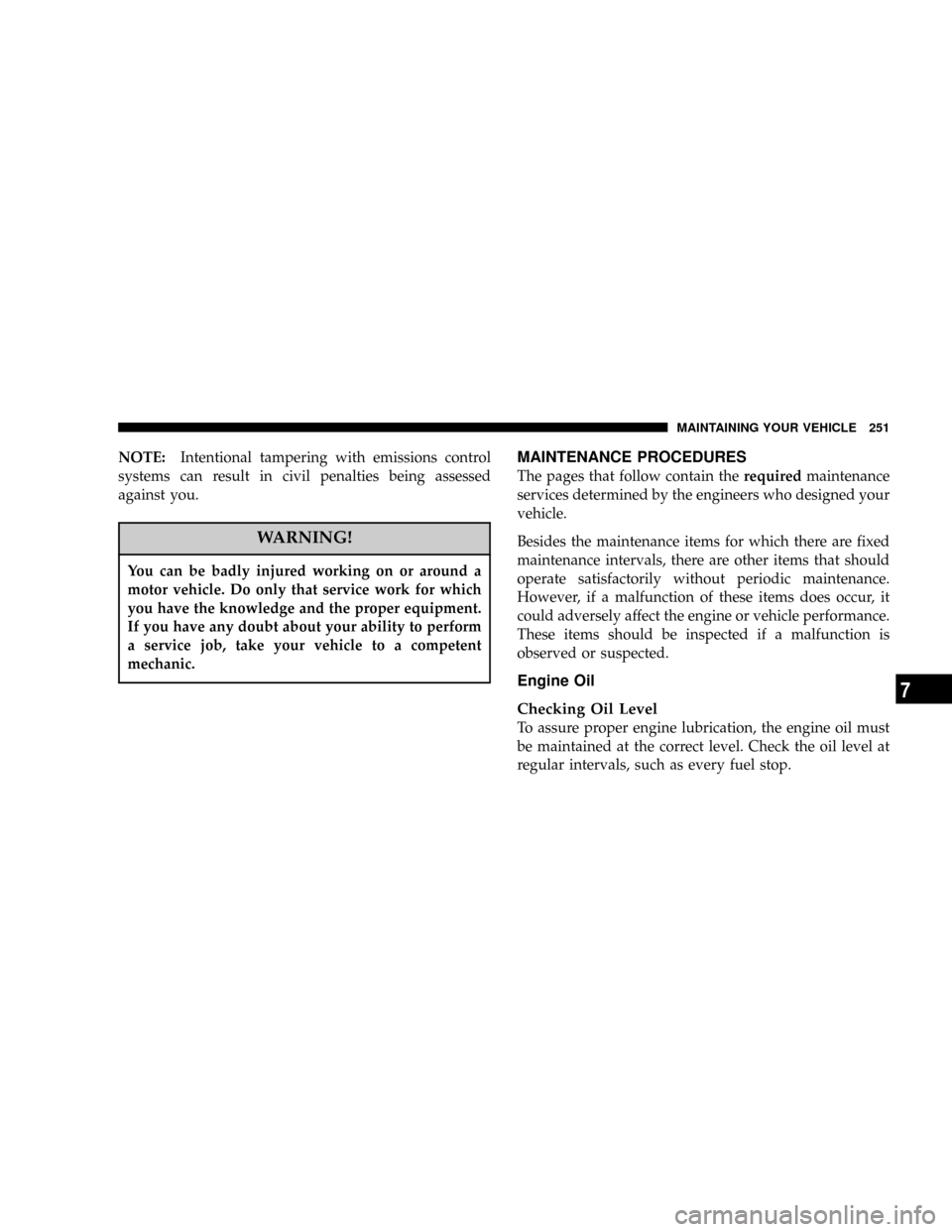
NOTE:Intentional tampering with emissions control
systems can result in civil penalties being assessed
against you.
WARNING!
You can be badly injured working on or around a
motor vehicle. Do only that service work for which
you have the knowledge and the proper equipment.
If you have any doubt about your ability to perform
a service job, take your vehicle to a competent
mechanic.
MAINTENANCE PROCEDURES
The pages that follow contain therequiredmaintenance
services determined by the engineers who designed your
vehicle.
Besides the maintenance items for which there are fixed
maintenance intervals, there are other items that should
operate satisfactorily without periodic maintenance.
However, if a malfunction of these items does occur, it
could adversely affect the engine or vehicle performance.
These items should be inspected if a malfunction is
observed or suspected.
Engine Oil
Checking Oil Level
To assure proper engine lubrication, the engine oil must
be maintained at the correct level. Check the oil level at
regular intervals, such as every fuel stop.
MAINTAINING YOUR VEHICLE 251
7
Page 254 of 341

American Petroleum Institute (API) Engine Oil
Identification Symbol
This symbol means that the oil has
been certified by the American
Petroleum Institute (API). The
manufacturer only recommends
API Certified engine oils.
Engine Oil Viscosity (SAE Grade)
The proper SAE viscosity grade of engine oil should be
selected based on the following recommendation and be
within the operating temperature shown in the engine oil
viscosity chart.²SAE 5W-30engine oil is preferred. SAE 5W-30 engine
oils improve low temperature starting and helps ve-
hicle fuel economy.
Lubricants which do not have both, the engine oil certi-
fication mark and the correct SAE viscosity grade num-
ber should not be used.
254 MAINTAINING YOUR VEHICLE
Page 256 of 341

Drive Belts Ð Check Condition and Tension
At the mileage shown in the maintenance schedules,
check all drive belts for condition and proper tension.
Improper belt tension can cause belt slippage and failure.
Inspect the drive belts for evidence of cuts, cracks, or
glazing and replace them if there is any sign of damage
which could result in belt failure. If adjustment is re-
quired, see your authorized dealer for service.
Special tools are required to properly measure tension
and to restore belt tension to factory specifications. Also,
check belt routing to make sure there is no interference
between the belts and other engine components.
Spark Plugs
Spark plugs must fire properly to assure engine perfor-
mance and emission control. New plugs should be in-
stalled at the specified mileage. The entire set should be
replaced if there is any malfunction due to a faulty sparkplug. Refer to the Engine data Label located under the
hood for the proper type of spark plug for use in your
vehicle.
Ignition Wiring System
The ignition cables should be kept clean and properly
connected. Terminals should be fully seated. Cracked,
damaged, or faulty cables should be replaced.
Catalytic Converter
The catalytic converter requires the use of unleaded fuel
only. Leaded gasoline will destroy the effectiveness of the
catalyst as an emission control device.
Under normal operating conditions, the catalytic con-
verter will not require maintenance. However, it is im-
portant to keep the engine properly tuned to assure
proper catalyst operation and prevent possible catalyst
damage.
256 MAINTAINING YOUR VEHICLE
Page 258 of 341

To minimize the possibility of catalyst damage:
²Do not shut off the engine or interrupt the ignition
when the transaxle is in gear and the vehicle is in
motion.
²Do not try to start the engine by pushing or towing the
vehicle.
²Do not idle the engine with any spark plug wires
disconnected for prolonged period.
Engine Timing Belt
Replace the engine timing belt at the intervals described
in the appropriate maintenance schedule.
Crankcase Emission Control System
Proper operation of this system depends on freedom
from sticking or plugging due to deposits. As vehicle
mileage builds up, the PCV valve and passages mayaccumulate deposits. If a valve is not working properly,
replace it with a new valve. DO NOT ATTEMPT TO
CLEAN THE OLD PCV VALVE!
Check ventilation hose for indication of damage or
plugging deposits. Replace if necessary.
Fuel Filter
A plugged fuel filter can cause hard starting or limit the
speed at which a vehicle can be driven. Should an
excessive amount of dirt accumulate in the fuel tank,
frequent filter replacement may be necessary. The fuel
filters are located inside the fuel tank. See your dealer for
service.
Air Cleaner Element (Filter)
Under normal driving conditions, replace the filter at the
intervals shown on Schedule ªAº. If, however, you drive
the vehicle frequently under dusty or severe conditions,
258 MAINTAINING YOUR VEHICLE
Page 270 of 341

Insure nylon tubing in these areas has not melted or
collapsed
Inspect all hose connections such as clamps and cou-
plings to make sure the are secure and no leaks are
present.
Components should be replaced immediately if there is
any evidence of degradation that could cause failure.
Fuel System Connections
Electronic Fuel Injection high pressure fuel systems are
designed with tubes and special connects, connections
and clamps which have unique material characteristics to
provide adequate sealing and resist attack by deterio-
rated gasoline.
You are urged to use only the manufactures-specified
tubes, connections and clamps, or their equivalent in
material and specification, in any fuel system servicing.
Brake System
In order to assure brake system performance, all brake
system components should be inspected periodically.
Suggested service intervals can be found in the Mainte-
nance Section.
WARNING!
Riding the brakes can lead to brake failure and
possibly an accident. Driving with your foot resting
or riding on the brake pedal can result in abnormally
high brake temperatures, excessive lining wear, and
possible brake damage. You wouldn't have your full
braking capacity in an emergency.
Brake And Power Steering System Hoses
When servicing the vehicle for scheduled maintenance,
inspect the surface of the hoses and nylon tubing for
evidence of heat and mechanical damage. Hard and
270 MAINTAINING YOUR VEHICLE
Page 284 of 341
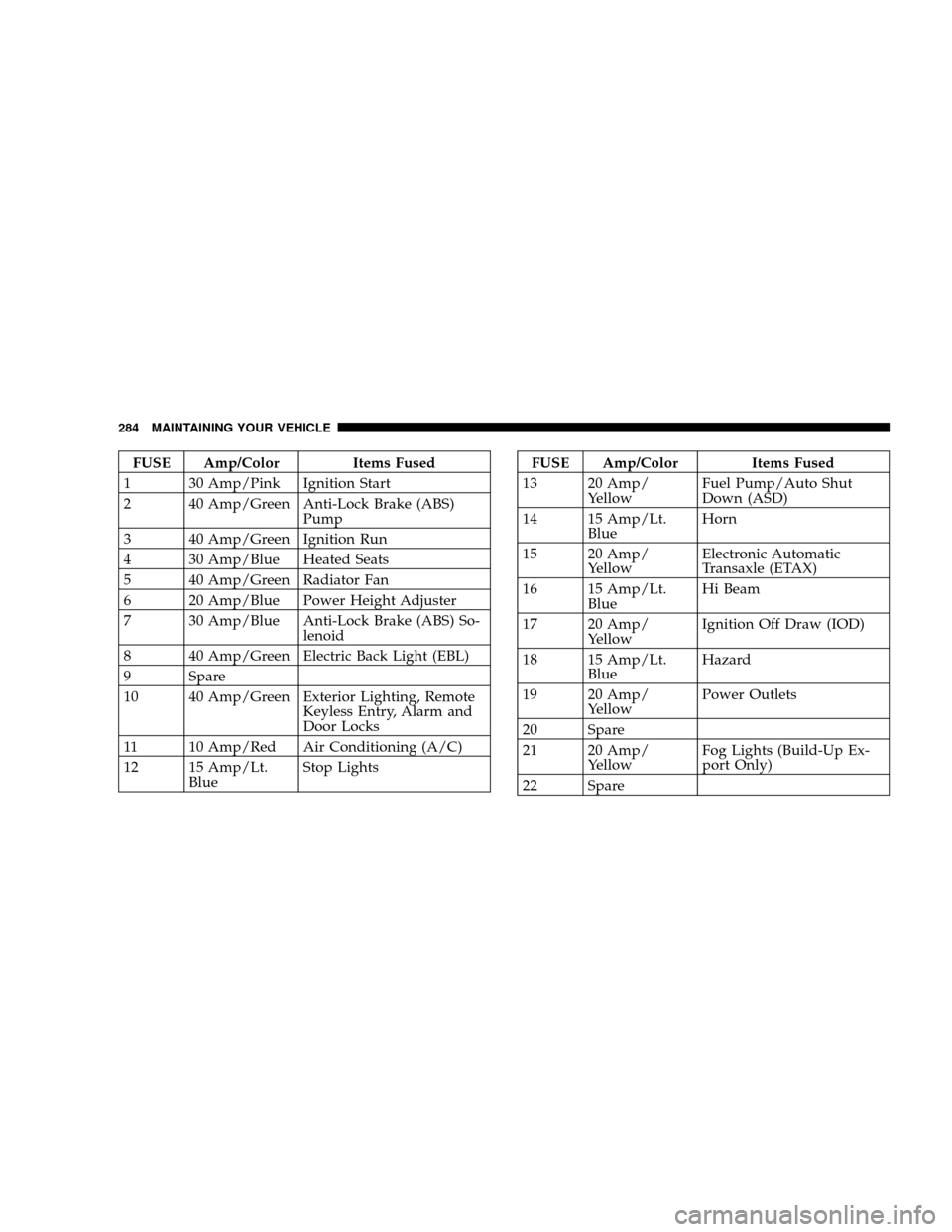
FUSE Amp/Color Items Fused
1 30 Amp/Pink Ignition Start
2 40 Amp/Green Anti-Lock Brake (ABS)
Pump
3 40 Amp/Green Ignition Run
4 30 Amp/Blue Heated Seats
5 40 Amp/Green Radiator Fan
6 20 Amp/Blue Power Height Adjuster
7 30 Amp/Blue Anti-Lock Brake (ABS) So-
lenoid
8 40 Amp/Green Electric Back Light (EBL)
9 Spare
10 40 Amp/Green Exterior Lighting, Remote
Keyless Entry, Alarm and
Door Locks
11 10 Amp/Red Air Conditioning (A/C)
12 15 Amp/Lt.
BlueStop LightsFUSE Amp/Color Items Fused
13 20 Amp/
YellowFuel Pump/Auto Shut
Down (ASD)
14 15 Amp/Lt.
BlueHorn
15 20 Amp/
YellowElectronic Automatic
Transaxle (ETAX)
16 15 Amp/Lt.
BlueHi Beam
17 20 Amp/
YellowIgnition Off Draw (IOD)
18 15 Amp/Lt.
BlueHazard
19 20 Amp/
YellowPower Outlets
20 Spare
21 20 Amp/
YellowFog Lights (Build-Up Ex-
port Only)
22 Spare
284 MAINTAINING YOUR VEHICLE
Page 286 of 341

REPLACEMENT BULBS
LIGHT BULBS Ð Inside Bulb No.
ABS Indicator.......................... LED
Airbag Indicator........................ LED
Brake System Warning Indicator............. LED
Center Console Floor Lamp................. T37
Climate Controls......................6233137
Console Gear Selector...................PC194
Cruise Indicator....................... VFD*
Dome Light............................T579
Door Ajar Indicator..................... VFD*
Front Fog Indicator...................... LED
High Beam Indicator....................... 74
Instrument Cluster Illumination.............. 74
Liftgate Ajar Indicator.................... LED
Low Fuel Indicator....................... LED
Low Oil Pressure Indicator................. LED
Overhead Reading Light (Overhead Console). . . T1037LIGHT BULBS Ð Inside Bulb No.
Overhead Reading Light (Rearview Mirror).....T192
Rear Cargo............................T906
Seat Belt Indicator....................... LED
Security Alarm Indicator................... LED
Malfunction Indicator Light................ LED
Temperature Indicator.................... LED
Trac (Active) Indicator................... VFD*
TRAC OFF Indicator..................... LED
Trip Indicator......................... VFD*
Turn Signal Indicator...................... 103
Visor Vanity.........................6501966
Voltage Indicator........................ LED
NOTE:* Vacuum Fluorescent Display
All the inside bulbs are brass or glass wedge base.
Aluminum base bulbs are not approved and should not
be used for replacement.
286 MAINTAINING YOUR VEHICLE