automatic transmission CHRYSLER PT CRUISER 2007 1.G User Guide
[x] Cancel search | Manufacturer: CHRYSLER, Model Year: 2007, Model line: PT CRUISER, Model: CHRYSLER PT CRUISER 2007 1.GPages: 467, PDF Size: 7.57 MB
Page 288 of 467

ª1º Low
This range should be used for maximum engine braking
when descending steep grades. In this range, up shifts
will occur only to prevent engine over speed while down
shifts from 2nd to first will occur as early as possible.
AUTOSTICK Ð IF EQUIPPED
Autostick is a driver-interactive transmission that offers
manual gear shifting capability to provide you with more
control. Autostick allows you to maximize engine brak-
ing, eliminate undesirable upshifts and downshifts, and
improve overall vehicle performance. This system can
also provide you with more control during passing, city
driving, cold slippery conditions, mountain driving,
trailer towing, and many other situations.
Autostick Operation
The Autostick position is just below the Overdrive posi-
tion and is identified by the word ªAUTOSTICKº. When
you place the shift lever in the Autostick position, it can
be moved from side to side. Moving the lever to the left
(-) triggers a downshift and to the right (+) an upshift.
The gear position will be shown in the transmission gear
display, located in the instrument cluster.
You can shift in or out of the autostick mode at any time
without taking your foot off the accelerator pedal. If you
choose the Overdrive mode, the transmission will oper-
ate automatically; shifting between the four available
gears. When you wish to engage autostick, simply move
the shift lever to the AUTOSTICK position. The transmis-
sion will remain in the current gear until an upshift or
downshift is chosen.
Move the lever back to the Overdrive position to shift out
of the Autostick mode.
288 STARTING AND OPERATING
Page 289 of 467

Autostick General Information
²
The transmission will automatically upshift from first
to second gear and from second to third gear when
engine speed reaches about 6300 RPM.
²Downshifts from third to second gear above 74 mph
(119 km/h) and from second to first gear above 41
mph (66 km/h) will be ignored.
²You can start out in first, second, or third gear. Shifting
into fourth gear can occur only after vehicle speed
reaches 15 mph (24 km/h).
²The transmission will automatically downshift to first
gear when coming to a stop.
²Starting out in third gear is helpful in snowy or icy
conditions.
²While in the Autostick mode, Speed Control will only
function in third or fourth gear.Downshifting out of third gear will turn off the speed
control.
²If the system detects powertrain overheating, the
transmission will revert to the automatic shift mode
and remain in that mode until the powertrain cools off.
²If the system detects a problem it will disable the
Autostick mode and the transmission will return to the
automatic mode until the problem is corrected.
STARTING AND OPERATING 289
5
Page 333 of 467
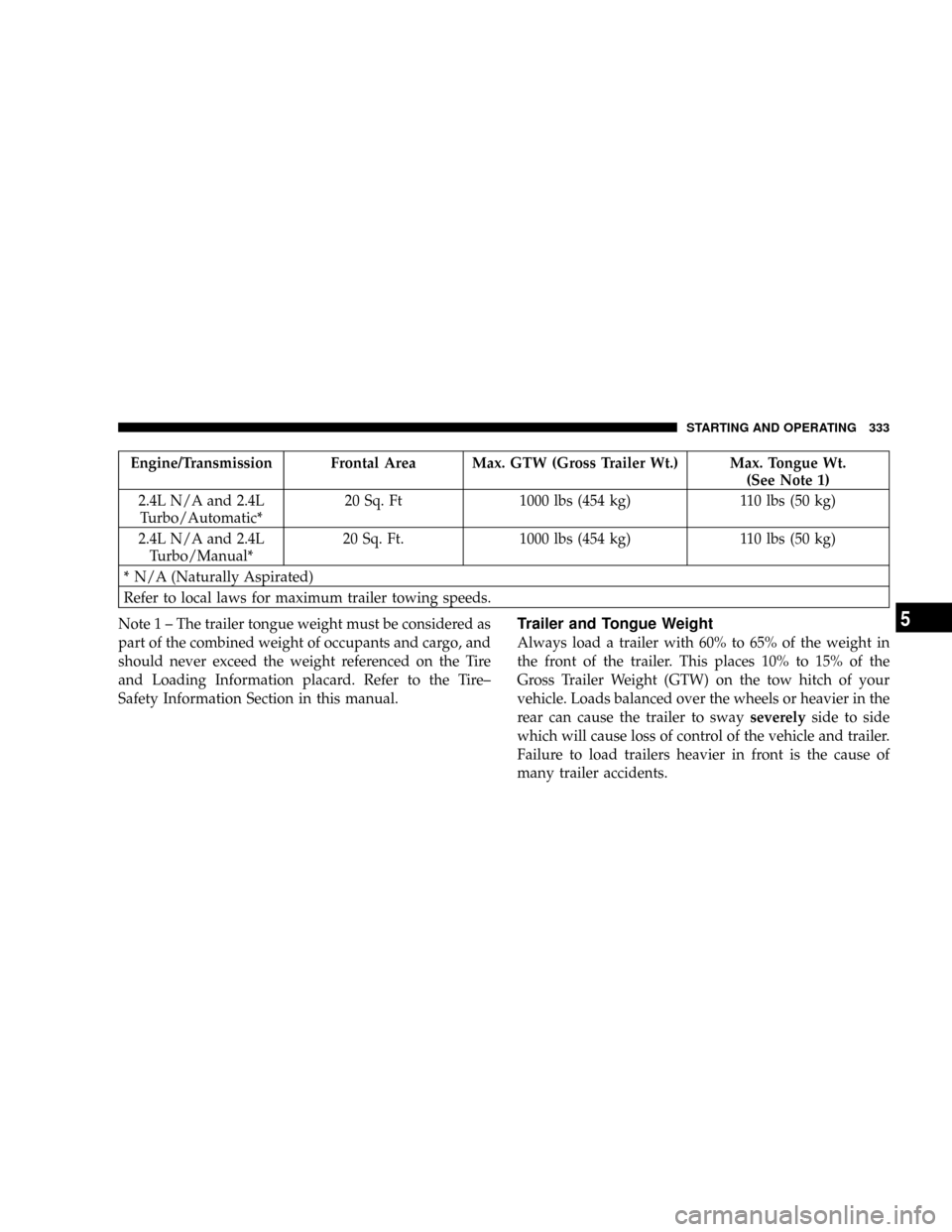
Engine/Transmission Frontal Area Max. GTW (Gross Trailer Wt.) Max. Tongue Wt.
(See Note 1)
2.4L N/A and 2.4L
Turbo/Automatic*20 Sq. Ft 1000 lbs (454 kg) 110 lbs (50 kg)
2.4L N/A and 2.4L
Turbo/Manual*20 Sq. Ft. 1000 lbs (454 kg) 110 lbs (50 kg)
* N/A (Naturally Aspirated)
Refer to local laws for maximum trailer towing speeds.
Note 1 ± The trailer tongue weight must be considered as
part of the combined weight of occupants and cargo, and
should never exceed the weight referenced on the Tire
and Loading Information placard. Refer to the Tire±
Safety Information Section in this manual.
Trailer and Tongue Weight
Always load a trailer with 60% to 65% of the weight in
the front of the trailer. This places 10% to 15% of the
Gross Trailer Weight (GTW) on the tow hitch of your
vehicle. Loads balanced over the wheels or heavier in the
rear can cause the trailer to swayseverelyside to side
which will cause loss of control of the vehicle and trailer.
Failure to load trailers heavier in front is the cause of
many trailer accidents.
STARTING AND OPERATING 333
5
Page 336 of 467

²Safety chains must always be used between your
vehicle and trailer. Always connect the chains to the
frame or hook retainers of the vehicle hitch. Cross the
chains under the trailer tongue and allow enough
slack for turning corners.
²Vehicles with trailers should not be parked on a grade.
When parking, apply the parking brake on the tow
vehicle. Put the tow vehicle automatic transmission in
P for Park. Always, block or9chock9the trailer wheels.
²GCWR must not be exceeded.
²Total weight must be distributed between the tow
vehicle and the trailer such that the following four
ratings are not exceeded:
1. GVWR
2. GTW
3. GAWR4. Tongue weight rating for the trailer hitch utilized
(This requirement may limit the ability to always
achieve the 10% to 15% range of tongue weight as a
percentage of total trailer weight).
Towing Requirements Ð Tires
þ
Do not attempt to tow a trailer while using a compact
spare tire.
þProper tire inflation pressures are essential to the safe
and satisfactory operation of your vehicle. Refer to the
Tires±General Information section of this manual on
Tire Pressures for proper tire inflation procedures.
þAlso, check the trailer tires for proper tire inflation
pressures before trailer usage.
þCheck for signs of tire wear or visible tire damage
before towing a trailer. Refer to the Tires±General
Information section of this manual on Tread Wear
Indicators for the proper inspection procedure.
336 STARTING AND OPERATING
Page 339 of 467

Towing Tips
Before setting out on a trip, practice turning, stopping
and backing the trailer in an area away from heavy
traffic.
Towing Tips Ð Automatic Transmission
The ªDº range can be selected when towing. However, if
frequent shifting occurs while in this range, the ª3º range
should be selected.
NOTE:Using the ª3º range while operating the vehicle
under heavy operating conditions will improve perfor-
mance and extend transmission life by reducing exces-
sive shifting and heat build up. This action will also
provide better engine braking.
The automatic transmission fluid and filter should be
changed if you REGULARLY tow a trailer for more than
45 minutes of continuous operation. See Schedule ªBº in
section 8 of this manual for transmission fluid change
intervals.
NOTE:Check the automatic transmission fluid level
before towing.
7- Pin Connector
STARTING AND OPERATING 339
5
Page 364 of 467

ONBOARD DIAGNOSTIC SYSTEM Ð OBD II
Your vehicle is equipped with a sophisticated onboard
diagnostic system called OBD II. This system monitors
the performance of the emissions, engine, and automatic
transmission control systems. When these systems are
operating properly, your vehicle will provide excellent
performance and fuel economy, as well as engine emis-
sions well within current government regulations.
If any of these systems require service, the OBD II system
will turn on the ªMalfunction Indicator Light.º It will
also store diagnostic codes and other information to
assist your service technician in making repairs. Al-
though your vehicle will usually be drivable and not
need towing, see your dealer for service as soon as
possible.CAUTION!
²Prolonged driving with the ªMalfunction Indica-
tor Lightº on could cause further damage to the
emission control system. It could also affect fuel
economy and driveability. The vehicle must be
serviced before any emissions tests can be per-
formed.
²If the ªMalfunction Indicator Lightº is flashing
while the engine is running, severe catalytic con-
verter damage and power loss will soon occur.
Immediate service is required.
Loose Fuel Filler Cap Message
After fuel is added, the vehicle diagnostic system can
determine if the fuel filler cap is loose, improperly
installed, or damaged. A gASCAP message will be dis-
played in the instrument cluster. Tighten the gas cap until
364 MAINTAINING YOUR VEHICLE
Page 390 of 467
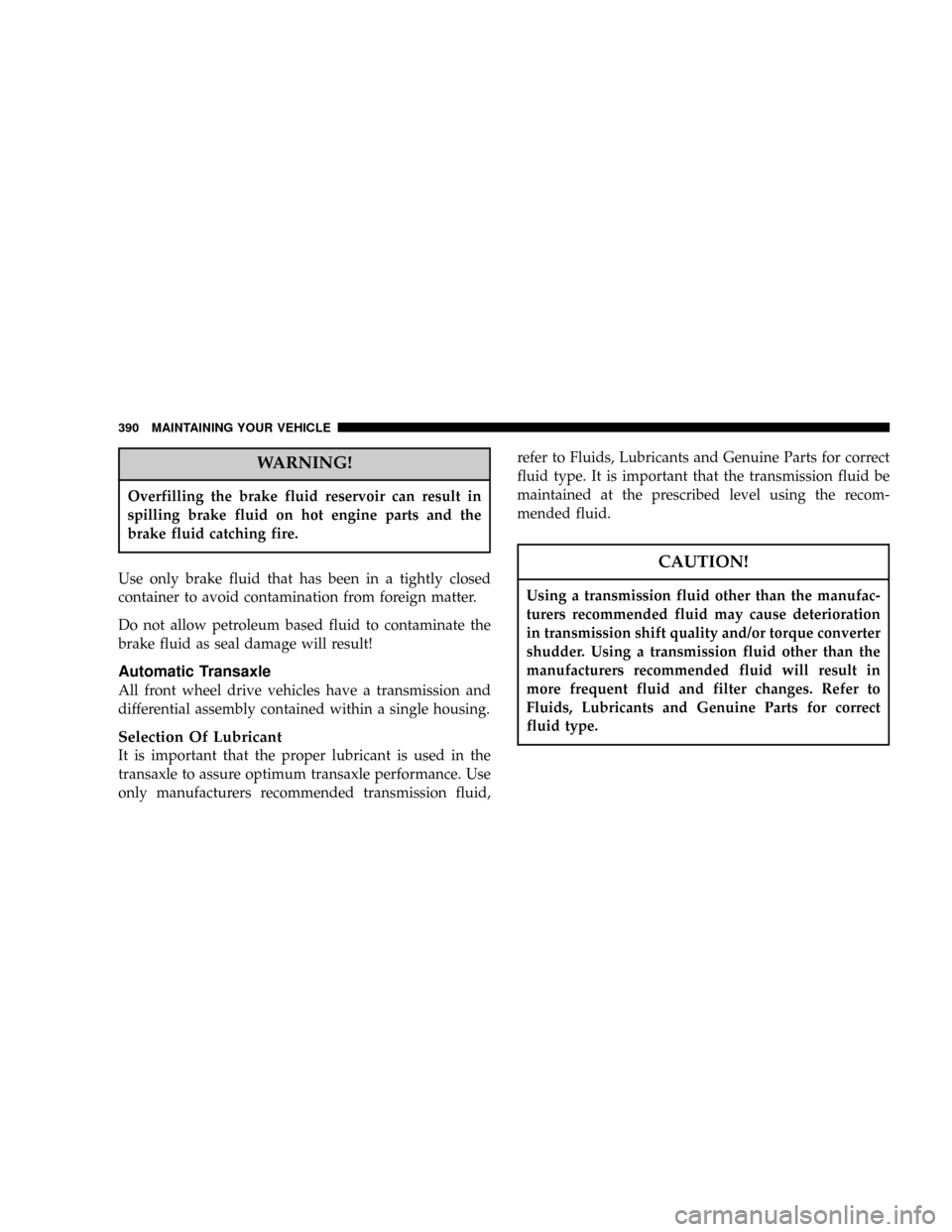
WARNING!
Overfilling the brake fluid reservoir can result in
spilling brake fluid on hot engine parts and the
brake fluid catching fire.
Use only brake fluid that has been in a tightly closed
container to avoid contamination from foreign matter.
Do not allow petroleum based fluid to contaminate the
brake fluid as seal damage will result!
Automatic Transaxle
All front wheel drive vehicles have a transmission and
differential assembly contained within a single housing.
Selection Of Lubricant
It is important that the proper lubricant is used in the
transaxle to assure optimum transaxle performance. Use
only manufacturers recommended transmission fluid,refer to Fluids, Lubricants and Genuine Parts for correct
fluid type. It is important that the transmission fluid be
maintained at the prescribed level using the recom-
mended fluid.
CAUTION!
Using a transmission fluid other than the manufac-
turers recommended fluid may cause deterioration
in transmission shift quality and/or torque converter
shudder. Using a transmission fluid other than the
manufacturers recommended fluid will result in
more frequent fluid and filter changes. Refer to
Fluids, Lubricants and Genuine Parts for correct
fluid type.
390 MAINTAINING YOUR VEHICLE
Page 391 of 467

Fluid Level Check
The fluid level in the automatic transaxle should be
checked whenever the vehicle is serviced. Operation with
an improper fluid level will greatly reduce the life of the
transaxle and of the fluid.
Procedure For Checking Fluid Level
To properly check the automatic transaxle fluid level, the
following procedure must be used:
1. The vehicle must be on level ground.
2. The engine should be running at curb idle speed for at
minimum of 60 seconds.
3. Fully apply parking brake.
4. Depress the brake pedal and place the gear selector
momentarily in each gear position ending with the lever
in P (PARK).5. Remove the dipstick and determine if the fluid is hot
or warm. Hot fluid is approximately 180ÉF (82ÉC), which
is the normal operating temperature after the vehicle has
been driven at least 24 km (15 miles). The fluid cannot be
comfortable held between the finger tips. Warm is when
the fluid is between 85É to 125ÉF (29É to 52ÉC).
6. Wipe the dipstick clean and reinsert until seated.
Remove dipstick and note reading.
If the fluid is hot, reading should be in the cross hatched
area marked ªHOTº between the upper two holes in the
dipstick.
If the fluid is cold, the fluid level should be between the
lower two holes, into the area marked ªLOWº.
If the fluid level shows low, add sufficient transmission
fluid to bring to the proper level.
MAINTAINING YOUR VEHICLE 391
7
Page 392 of 467

CAUTION!
Do not overfill. Dirt and water in the transaxle can
cause serious damage. To prevent dirt and water
from entering the transaxle after checking or replen-
ishing fluid, make certain that the dipstick cap is
seated properly.
Fluid And Filter Changes
Automatic transmission fluid and filter should be
changed as follows:
Maintenance schedule ªAºÐNon Turbo Charged En-
gines± No change necessary.
Maintenance schedule ªAºÐTurbo Charged Engines±
No change necessary.Maintenance schedule ªBºÐAll Engines± Every 60,000
miles (100 000 km) change fluid and filter under the
following conditions:
²Police, taxi, limousine, commercial type operation, or
trailer towing where the vehicle is drivenregularlyfor
more than 45 minutes of continuous operation.
NOTE:Refer to Section 8 of this manual for mainte-
nance schedules.
If the transaxle is disassembled for any reason, the fluid
and filter should be changed.
Special Additives
Do not add any materials (other than leak detection dyes)
to Automatic Transmission Fluid (ATF). ATF is an engi-
neered product and its performance may be impaired by
supplemental additives.
392 MAINTAINING YOUR VEHICLE
Page 412 of 467
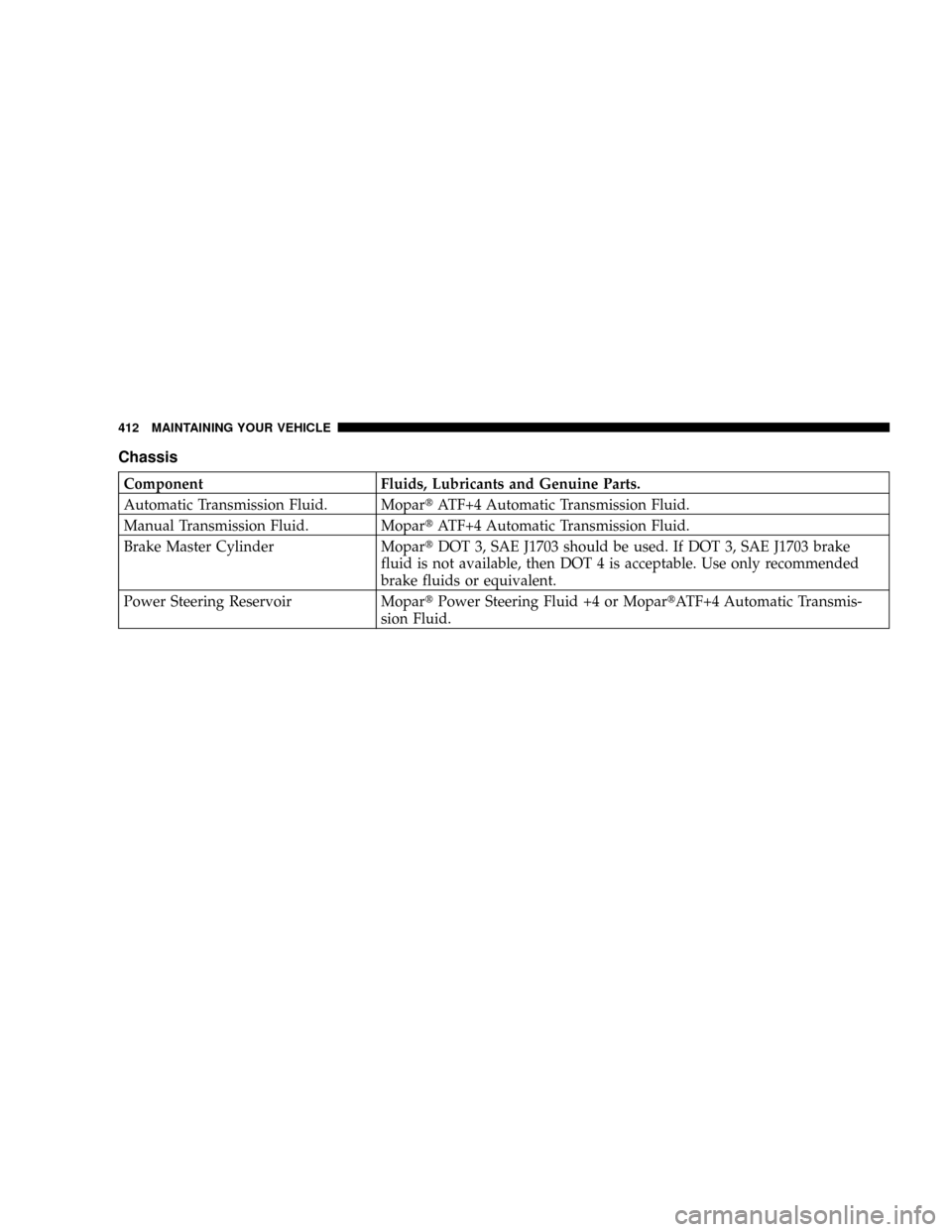
Chassis
Component Fluids, Lubricants and Genuine Parts.
Automatic Transmission Fluid. MopartATF+4 Automatic Transmission Fluid.
Manual Transmission Fluid. MopartATF+4 Automatic Transmission Fluid.
Brake Master Cylinder MopartDOT 3, SAE J1703 should be used. If DOT 3, SAE J1703 brake
fluid is not available, then DOT 4 is acceptable. Use only recommended
brake fluids or equivalent.
Power Steering Reservoir MopartPower Steering Fluid +4 or MopartATF+4 Automatic Transmis-
sion Fluid.
412 MAINTAINING YOUR VEHICLE