child seat CHRYSLER PT CRUISER 2007 1.G Owner's Manual
[x] Cancel search | Manufacturer: CHRYSLER, Model Year: 2007, Model line: PT CRUISER, Model: CHRYSLER PT CRUISER 2007 1.GPages: 467, PDF Size: 7.57 MB
Page 80 of 467
OCCUPANT RESTRAINTS (CONVERTIBLE)
Some of the most important safety features in your
vehicle are the restraint systems. These include the front
and rear seat belts for the driver and all passengers, front
airbags for both the driver and front passenger and if
equipped, side airbags for both the driver and front
passenger. If you will be carrying children too small for
adult-size seat belts, your seat belts or the LATCH feature
also, can be used to hold infant and child restraint
systems.
Please pay close attention to the information in this
section. It tells you how to use your restraint system
properly to keep you and your passengers as safe as
possible.WARNING!
In a collision, you and your passengers can suffer
much greater injuries if you are not properly buck-
led up. You can strike the interior of your vehicle or
other passengers, or you can be thrown out of the
vehicle. Always be sure you and others in your
vehicle are buckled up properly.
Buckle up even though you are an excellent driver, even
on short trips. Someone on the road may be a poor driver
and cause a collision that includes you. This can happen
far away from home or on your own street.
Research has shown that seat belts save lives, and they
can reduce the seriousness of injuries in a collision. Some
of the worst injuries happen when people are thrown
from the vehicle. Seat belts reduce the possibility of
80 THINGS TO KNOW BEFORE STARTING YOUR VEHICLE
Page 86 of 467

Lap/Shoulder Belt Untwisting Procedure
Use the following procedure to untwist a twisted lap/
shoulder belt.
1. Position the latch plate as close as possible to the
anchor point.
2. At about 6 to 12 inches (15 to 30 cm) above the latch
plate, grasp and twist the belt webbing 180É to create a
fold that begins immediately above the latch plate.
3. Slide the latch plate upward over the folded webbing.
The folded webbing must enter the slot at the top of the
latch plate.
4. Continue to slide the latch plate up until it clears the
folded webbing.
Seat Belt Pretensioners
The seat belts for both front seating positions are
equipped with pretensioning devices that are designed to
remove slack from the seat belt in the event of a collision.
These devices improve the performance of the seat belt
by assuring that the belt is tight about the occupant early
in a collision. Pretensioners work for all size occupants,
including those in child restraints.
NOTE:These devices are not a substitute for proper seat
belt placement by the occupant. The seat belt still must be
worn snugly and positioned properly.
The pretensioners are triggered by the front airbag con-
trol module (see Airbag Section). Like the front airbags,
the pretensioners are single use items. After a collision
that is severe enough to deploy the airbags and preten-
sioners, both must be replaced.
86 THINGS TO KNOW BEFORE STARTING YOUR VEHICLE
Page 91 of 467

empty or is occupied by someone that is classified in the
ªchildº category. This could be a child, a teenager, or
even a small adult.
Here are some simple steps you can take to minimize the
risk of harm from a deploying airbag.
1.Children 12 years old and under should always ride
buckled up in a rear seat.
Infants in rear facing child restraints shouldNEVERride
in the front seat of a vehicle with a passenger front airbag.
An airbag deployment can cause severe injury or death to
infants in that position.
Children that are not big enough to properly wear the
vehicle seat belt (see Section on Child Restraints) should be
secured in the rear seat in child restraints or belt-positioning
booster seats. Older children who do not use child restraints
or belt-positioning booster seats should ride properly buck-
led up in the rear seat. Never allow children to slide the
shoulder belt behind them or under their arm.
If a child from 1 to 12 years old must ride in the front
passenger seat because the vehicle is crowded, move the
seat as far back as possible, and use the proper child
restraint. Refer to the section on Child Restraint.
You should read the instructions provided with your
child restraint to make sure that you are using it properly.
2.All occupants should wear their lap and shoulder
belts properly.
3.The driver and front passenger seats should be
moved back as far as practical to allow the front airbags
room to inflate.
4.If your vehicle has side airbags, do not lean against
the door, airbags will inflate forcefully into the space
between you and the door.
5.If the airbag system in this vehicle needs to be
modified to accomodate a disabled person, contact the
Customer Center. Phone numbers are provided under
(If You Need Assistance(in Section 9 of this manual.
THINGS TO KNOW BEFORE STARTING YOUR VEHICLE 91
2
Page 94 of 467
WARNING!
Ignoring the AIRBAG light in your instrument panel
could mean you won't have the airbags to protect
you in a collision. If the light does not come on, stays
on after you start the vehicle, or if it comes on as you
drive, have the airbag system checked right away.
²TheOccupant Classification System (OCS)is part of
a Federally regulated safety system required for this
vehicle. It is designed to turn off the front passenger
airbag for occupants that weigh less than a very small
adult.
NOTE:Children 12 years and under should always ride
buckled up in a rear seat in an appropriate child restraint.
²The OCS classifies an occupant using weight sensors
mounted in the base of the front passenger seat. Any
weight on the seat will be sensed by the system.Objects hanging on the seat or other passengers push-
ing down on the seat will also be sensed. The weight of
an adult will cause the system to turn the airbag on. In
this case, the OCS has classified the occupant of the
seat as an adult. An adult occupant needs to sit in a
normal position (with their feet on or near the floor) in
order to be properly classified. Reclining the seat back
too far may change how an occupant is classified by
the OCS.
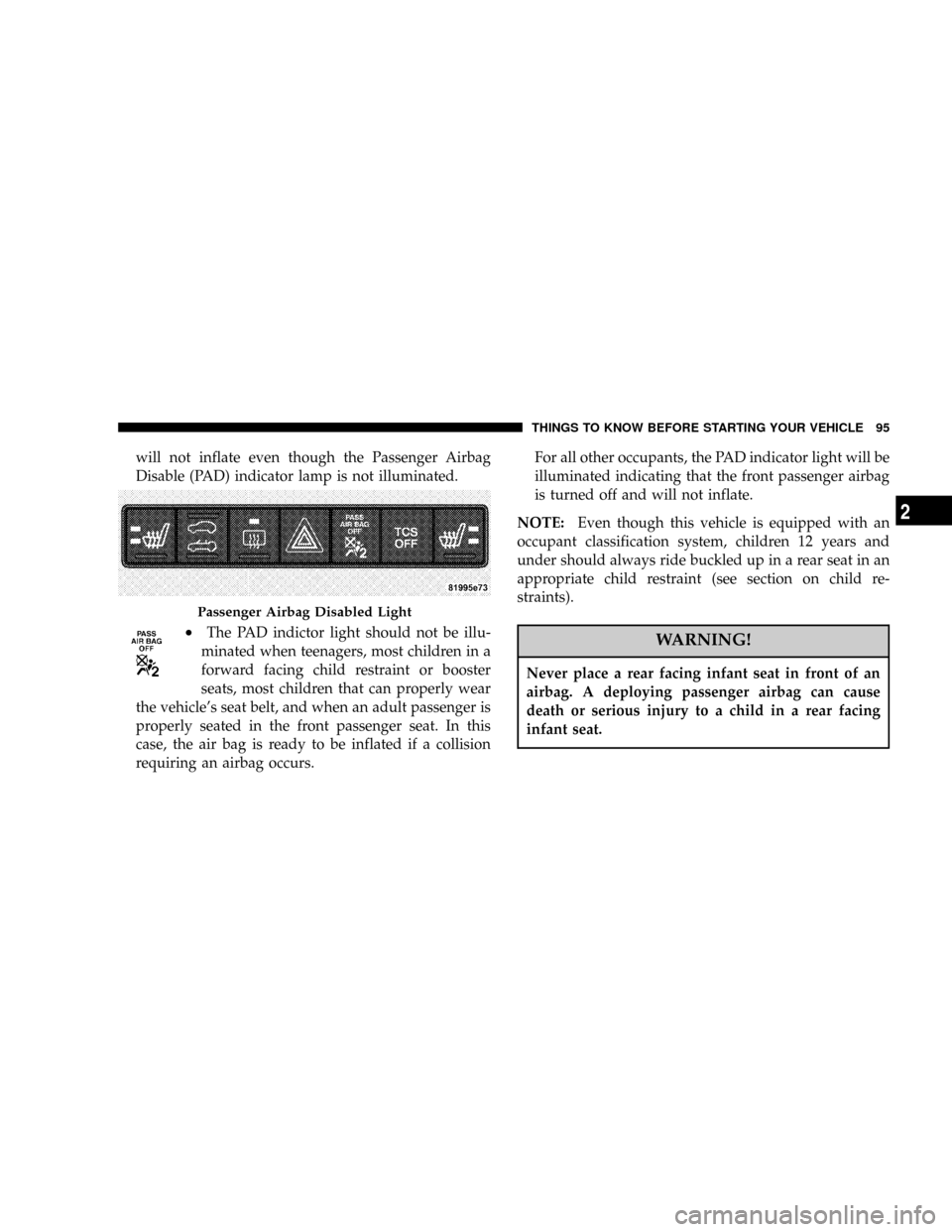
²ThePassenger Airbag Disable (PAD) Indicator Light
(an amber light located in the center of the instrument
panel) tells the driver and front passenger when the
front passenger airbag is turned off. The PAD Indica-
tor lamp illuminates the words9PASS AIR BAG OFF9
to show that the front passenger airbag will not inflate
during a collision requiring airbags. When the right
front passenger seat is empty or when very light
objects are placed on the seat, the passenger air bag
94 THINGS TO KNOW BEFORE STARTING YOUR VEHICLE
Page 95 of 467
will not inflate even though the Passenger Airbag
Disable (PAD) indicator lamp is not illuminated.
²The PAD indictor light should not be illu-
minated when teenagers, most children in a
forward facing child restraint or booster
seats, most children that can properly wear
the vehicle's seat belt, and when an adult passenger is
properly seated in the front passenger seat. In this
case, the air bag is ready to be inflated if a collision
requiring an airbag occurs.For all other occupants, the PAD indicator light will be
illuminated indicating that the front passenger airbag
is turned off and will not inflate.
NOTE:Even though this vehicle is equipped with an
occupant classification system, children 12 years and
under should always ride buckled up in a rear seat in an
appropriate child restraint (see section on child re-
straints).WARNING!
Never place a rear facing infant seat in front of an
airbag. A deploying passenger airbag can cause
death or serious injury to a child in a rear facing
infant seat.
Passenger Airbag Disabled Light
THINGS TO KNOW BEFORE STARTING YOUR VEHICLE 95
2
Page 96 of 467
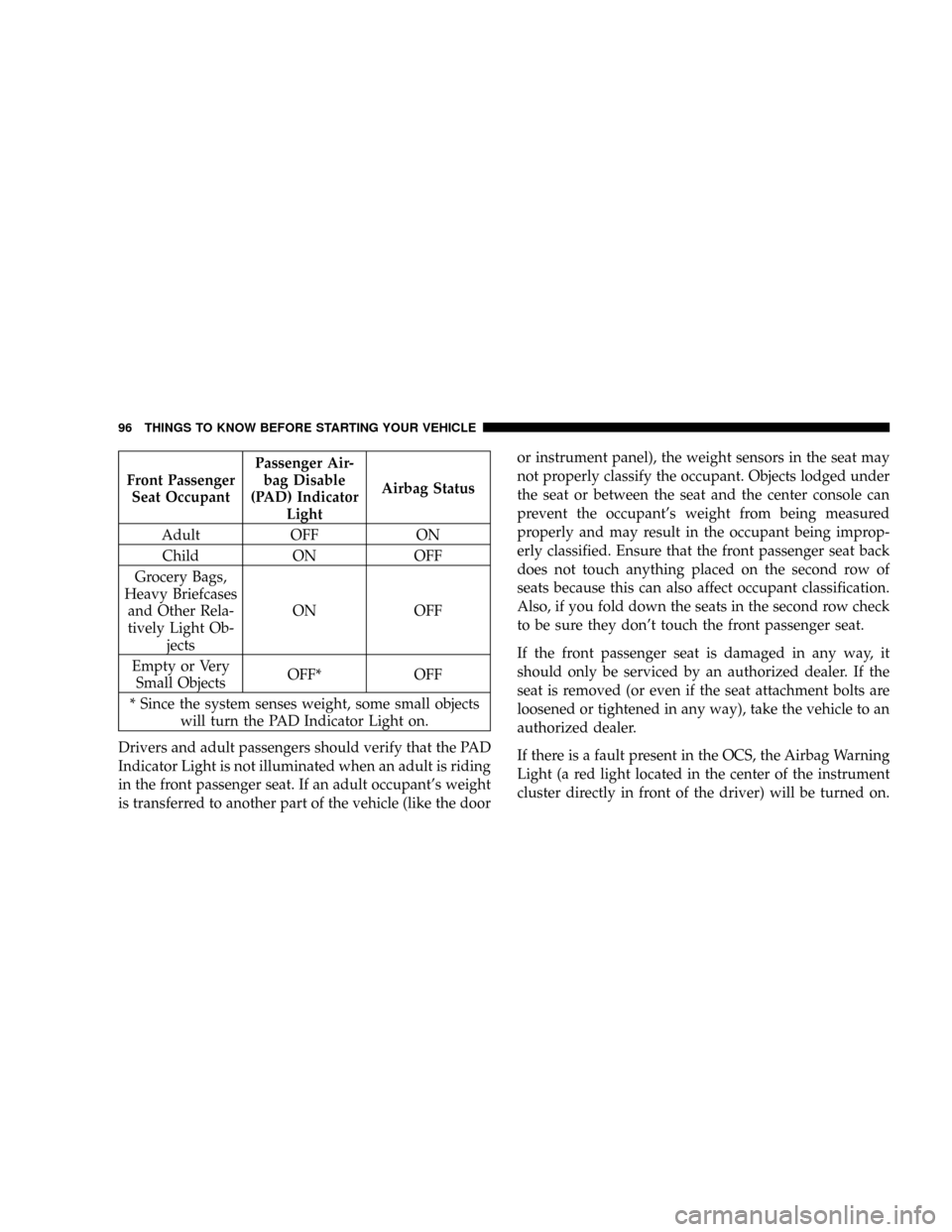
Front Passenger
Seat OccupantPassenger Air-
bag Disable
(PAD) Indicator
LightAirbag Status
Adult OFF ON
Child ON OFF
Grocery Bags,
Heavy Briefcases
and Other Rela-
tively Light Ob-
jectsON OFF
Empty or Very
Small ObjectsOFF* OFF
* Since the system senses weight, some small objects
will turn the PAD Indicator Light on.
Drivers and adult passengers should verify that the PAD
Indicator Light is not illuminated when an adult is riding
in the front passenger seat. If an adult occupant's weight
is transferred to another part of the vehicle (like the dooror instrument panel), the weight sensors in the seat may
not properly classify the occupant. Objects lodged under
the seat or between the seat and the center console can
prevent the occupant's weight from being measured
properly and may result in the occupant being improp-
erly classified. Ensure that the front passenger seat back
does not touch anything placed on the second row of
seats because this can also affect occupant classification.
Also, if you fold down the seats in the second row check
to be sure they don't touch the front passenger seat.
If the front passenger seat is damaged in any way, it
should only be serviced by an authorized dealer. If the
seat is removed (or even if the seat attachment bolts are
loosened or tightened in any way), take the vehicle to an
authorized dealer.
If there is a fault present in the OCS, the Airbag Warning
Light (a red light located in the center of the instrument
cluster directly in front of the driver) will be turned on.
96 THINGS TO KNOW BEFORE STARTING YOUR VEHICLE
Page 98 of 467
determine whether the front passenger airbag should
be turned off. It also determines the rate of airbag
inflation during a collision.
²Your vehicle has fourWeight Sensorslocated between
the seat and the floor pan. The weight sensors measure
applied weight and transfers that information to the
OCM.
²TheSide Impact (SRS) Seat Mounted Side Airbags
(If equipped)are designed to activate only in certain
side collisions. The ORC module determines if a side
collision is severe enough to require the side airbags to
inflate. The side airbag control module will not detect
roll over, front or rear collisions.
The ORC Module monitors the readiness of the elec-
tronic parts of the system whenever the ignition switch
is in the START or ON positions. These include all of
the items previously mentioned.In moderate to severe side collisions, the side airbag
inflator on the crash side of the vehicle is triggered,
releasing a quantity of nontoxic gas. The inflating side
airbag exits through the seat seam into the space between
the occupant and the door. The side airbag moves at a
very high speed and with such a high force, that it could
injure you if you are not seated properly, or if items are
positioned in the area where the side airbag inflates. This
especially applies to children.
²When the ORC and the impact sensors detect a
collision requiring theDriver Inflatable Knee Blocker
, it signals the inflator unit. A quantity of nontoxic gas
is generated to inflate the Driver Inflatable Knee
Blocker. The Driver Inflatable Knee Blocker inflates
rearward towards the driver's knees to help protect
the knees and position you for the best interaction
with the front airbag. The Driver Inflatable Knee
Blocker fully inflates in about 50 milliseconds, this is
98 THINGS TO KNOW BEFORE STARTING YOUR VEHICLE
Page 104 of 467
²Airbag disable lamp status (if equipped)
²9Time9of airbag deployment (in terms of ignition
cycles and vehicle mileage)
²Airbag deployment level (if applicable)
²Impact acceleration and angle
²Seatbelt status
²Brake status (service and parking brakes)
²Accelerator status (including vehicle speed)
²Engine control status (including engine speed)
²Transmission gear selection
²Cruise control status
²Traction/stability control status
²Tire pressure monitoring system status
Child Restraint
Everyone in your vehicle needs to be buckled up at all
times Ð babies and children, too. Every state in the
United States and all Canadian provinces require that
small children ride in proper restraint systems. This is the
law, and you can be prosecuted for ignoring it.
Children 12 years and under should ride properly buck-
led up in a rear seat, if available. According to crash
statistics, children are safer when properly restrained in
the rear seats, rather than in the front.
104 THINGS TO KNOW BEFORE STARTING YOUR VEHICLE
Page 105 of 467

WARNING!
In a collision, an unrestrained child, even a tiny
baby, can become a missile inside the vehicle. The
force required to hold even an infant on your lap
could become so great that you could not hold the
child, no matter how strong you are. The child and
others could be badly injured. Any child riding in
your vehicle should be in a proper restraint for the
child's size.
Infants And Small Children
There are different sizes and types of restraints for
children from newborn size to the child almost large
enough for an adult safety belt. Always check the child
seat owner's manual to ensure you have the correct seat
for your child. Use the restraint that is correct for your
child:
²Safety experts recommend that children ride
rearward-facing in the vehicle until they are at least
one year old and weigh at least 20 lbs (9 kg). Two types
of child restraints can be used rearward-facing: infant
carriers and9convertible9child seats. Both types of
child restraints are held in the vehicle by the lap/
shoulder belt or the LATCH child restraint anchorage
system.
²This vehicle is not capable of accommodating the
installation of a car bed used for carrying newborn
babies at the right front passenger seat position. If a car
bed must be used to transport a newborn baby, the car
bed must be installed in the second seating row only.
²The infant carrier is only used rearward-facing in the
vehicle. It is recommended for children who weigh up
to about 20 lbs (9 kg).9Convertible9child seats can be
used either rearward-facing or forward-facing in the
vehicle. Convertible child seats often have a higher
THINGS TO KNOW BEFORE STARTING YOUR VEHICLE 105
2
Page 106 of 467
weight limit in the rearward-facing direction than
infant carriers do, so they can be used rearward-facing
by children who weigh more than 9 kg (20 lbs) but are
less than one year old.
²Rearward-facing child seats mustNEVERbe used in
the front seat of a vehicle with a front passenger
airbag. An airbag deployment could cause severe
injury or death to infants in this position.
²Children who weigh more than 20 lbs (9 kg) and who
are older than one year can ride forward-facing in the
vehicle. Forward-facing child seats and convertible
child seats used in the forward-facing direction are for
children who weigh 20 to 40 lbs (9 to 18 kg) and who
are older than one year. These child seats are also held
in the vehicle by the lap/shoulder belt or the LATCH
child restraint anchorage system.
²The belt-positioning booster seat is for children weigh-
ing more than 40 lbs (18 kg), but who are still too small
to fit the vehicle's seat belts properly. If the child
cannot sit with knees bent over the vehicle's cushion
while the child's back is against the seat back; they
should use a Belt Positioning Booster Seat. The child
and booster seat are held in the vehicle by the lap/
shoulder belt. (Some booster seats are equipped with a
front shield and are held in the vehicle by the lap
portion.)
NOTE:For additional information refer to
www.nhtsa.dot.gov or www.seatcheck.org.
106 THINGS TO KNOW BEFORE STARTING YOUR VEHICLE