tow hook CHRYSLER PT CRUISER 2007 1.G Owners Manual
[x] Cancel search | Manufacturer: CHRYSLER, Model Year: 2007, Model line: PT CRUISER, Model: CHRYSLER PT CRUISER 2007 1.GPages: 467, PDF Size: 7.57 MB
Page 77 of 467
provide add-on tether strap kits for some of their older
products. Tether anchorage kits are also available for
most older vehicles.
Because the lower anchorages are to be introduced to
passenger carrying vehicles over a period of years, child
restraint systems having attachments for those anchor-
ages will continue to have features for installation in
vehicles using the lap or lap/shoulder belt. They will also
have tether straps, and you are urged to take advantage
of all of the available attachments provided with your
child restraint in any vehicle.
NOTE:When using the LATCH attaching system to
install a child restraint, please ensure that all seat belts
not being used for occupant restraints are stowed and out
of reach of children. It is recommended that before
installing the child restraint, buckle the seat belt so the
seat belt is tucked behind the child restraint and out of
reach. If the buckled seat belt interferes with the childrestraint installation, instead of tucking the seat belt
behind the child restraint, route the seat belt through the
child restraint belt path and then buckle it. This should
stow the seat belt out of the reach of an inquisitive child.
Remind all children in the vehicle that the seat belts are
not toys and should not be played with, and never leave
your child unattended in the vehicle.
Installing the Child Restraint System
We urge that you carefully follow the directions of the
manufacturer when installing your child restraint. Many,
but not all, restraint systems will be equipped with
separate straps on each side, with each having a hook or
connector and a means for adjusting the tension in the
strap. Forward-facing toddler restraints and some
rearward-facing infant restraints will also be equipped
with a tether strap with a hook and means for adjusting
the tension in the strap.
THINGS TO KNOW BEFORE STARTING YOUR VEHICLE 77
2
Page 109 of 467
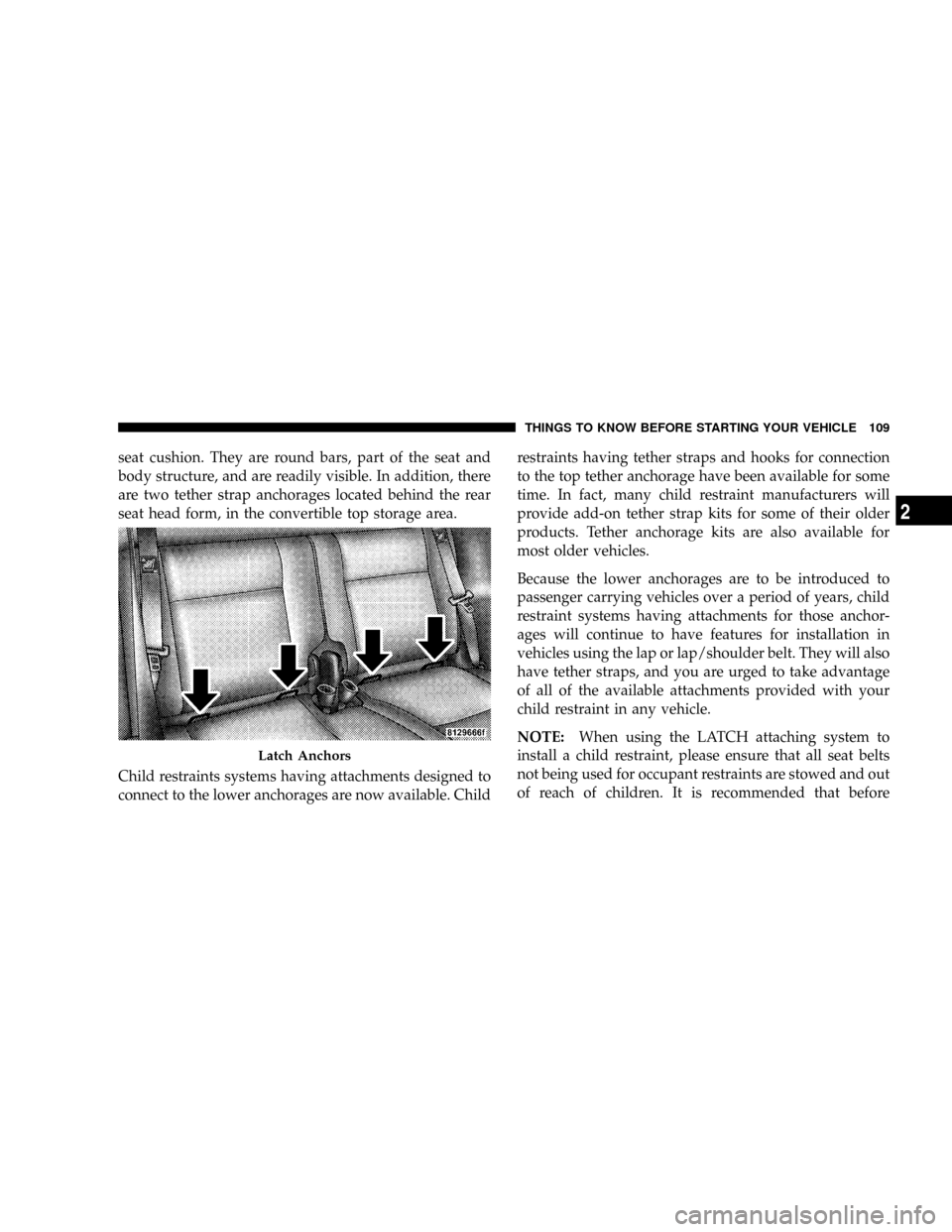
seat cushion. They are round bars, part of the seat and
body structure, and are readily visible. In addition, there
are two tether strap anchorages located behind the rear
seat head form, in the convertible top storage area.
Child restraints systems having attachments designed to
connect to the lower anchorages are now available. Childrestraints having tether straps and hooks for connection
to the top tether anchorage have been available for some
time. In fact, many child restraint manufacturers will
provide add-on tether strap kits for some of their older
products. Tether anchorage kits are also available for
most older vehicles.
Because the lower anchorages are to be introduced to
passenger carrying vehicles over a period of years, child
restraint systems having attachments for those anchor-
ages will continue to have features for installation in
vehicles using the lap or lap/shoulder belt. They will also
have tether straps, and you are urged to take advantage
of all of the available attachments provided with your
child restraint in any vehicle.
NOTE:When using the LATCH attaching system to
install a child restraint, please ensure that all seat belts
not being used for occupant restraints are stowed and out
of reach of children. It is recommended that before
Latch Anchors
THINGS TO KNOW BEFORE STARTING YOUR VEHICLE 109
2
Page 110 of 467
installing the child restraint, buckle the seat belt so the
seat belt is tucked behind the child restraint and out of
reach. If the buckled seat belt interferes with the child
restraint installation, instead of tucking the seat belt
behind the child restraint, route the seat belt through the
child restraint belt path and then buckle it. This should
stow the seat belt out of the reach of an inquisitive child.
Remind all children in the vehicle that the seat belts are
not toys and should not be played with, and never leave
your child unattended in the vehicle.
Installing the Child Restraint System
We urge that you carefully follow the directions of the
manufacturer when installing your child restraint. Many,
but not all, restraint systems will be equipped with
separate straps on each side, with each having a hook or
connector and a means for adjusting the tension in the
strap. Forward-facing toddler restraints and somerearward-facing infant restraints will also be equipped
with a tether strap with a hook and means for adjusting
the tension in the strap.
In general, you will first loosen the adjusters on the lower
and tether straps so that you can more easily attach the
hook or connector to the lower and tether anchorages.
The tether strap should be routed over the center of the
head form and attached to the tether anchor, located
behind the rear seat head form, in the convertible top
storage area. Then tighten all three straps as you push the
child restraint rearward and downward into the seat.
NOTE:To gain access to the achorages, locate the child
tether anchorage decals on the carpet behind the rear seat
head forms and use a small screwdriver to pry the carpet
flap open. The carpet flap is attached in two different
places.
110 THINGS TO KNOW BEFORE STARTING YOUR VEHICLE
Page 336 of 467
²Safety chains must always be used between your
vehicle and trailer. Always connect the chains to the
frame or hook retainers of the vehicle hitch. Cross the
chains under the trailer tongue and allow enough
slack for turning corners.
²Vehicles with trailers should not be parked on a grade.
When parking, apply the parking brake on the tow
vehicle. Put the tow vehicle automatic transmission in
P for Park. Always, block or9chock9the trailer wheels.
²GCWR must not be exceeded.
²Total weight must be distributed between the tow
vehicle and the trailer such that the following four
ratings are not exceeded:
1. GVWR
2. GTW
3. GAWR4. Tongue weight rating for the trailer hitch utilized
(This requirement may limit the ability to always
achieve the 10% to 15% range of tongue weight as a
percentage of total trailer weight).
Towing Requirements Ð Tires
þ
Do not attempt to tow a trailer while using a compact
spare tire.
þProper tire inflation pressures are essential to the safe
and satisfactory operation of your vehicle. Refer to the
Tires±General Information section of this manual on
Tire Pressures for proper tire inflation procedures.
þAlso, check the trailer tires for proper tire inflation
pressures before trailer usage.
þCheck for signs of tire wear or visible tire damage
before towing a trailer. Refer to the Tires±General
Information section of this manual on Tread Wear
Indicators for the proper inspection procedure.
336 STARTING AND OPERATING
Page 345 of 467
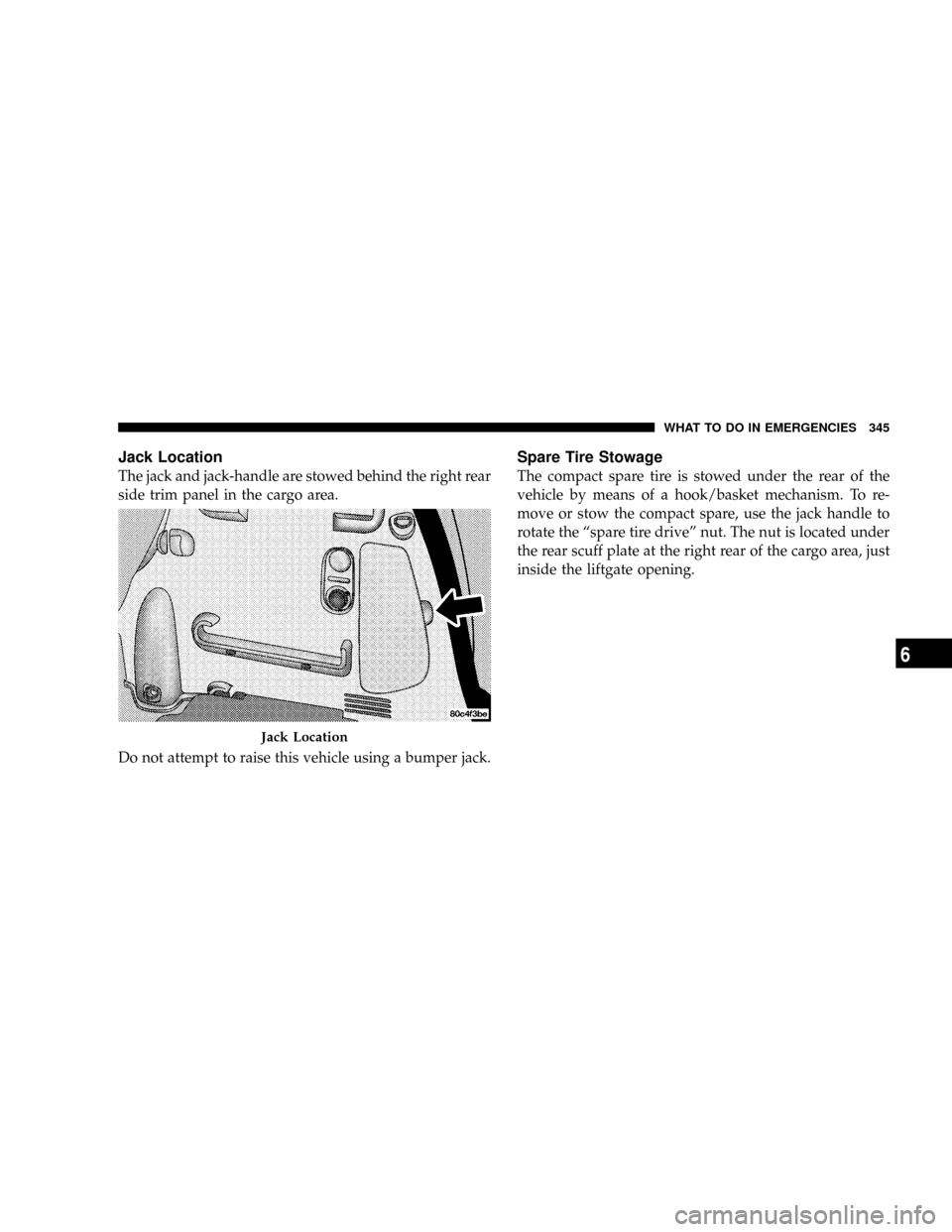
Jack Location
The jack and jack-handle are stowed behind the right rear
side trim panel in the cargo area.
Do not attempt to raise this vehicle using a bumper jack.
Spare Tire Stowage
The compact spare tire is stowed under the rear of the
vehicle by means of a hook/basket mechanism. To re-
move or stow the compact spare, use the jack handle to
rotate the ªspare tire driveº nut. The nut is located under
the rear scuff plate at the right rear of the cargo area, just
inside the liftgate opening.
Jack Location
WHAT TO DO IN EMERGENCIES 345
6
Page 346 of 467
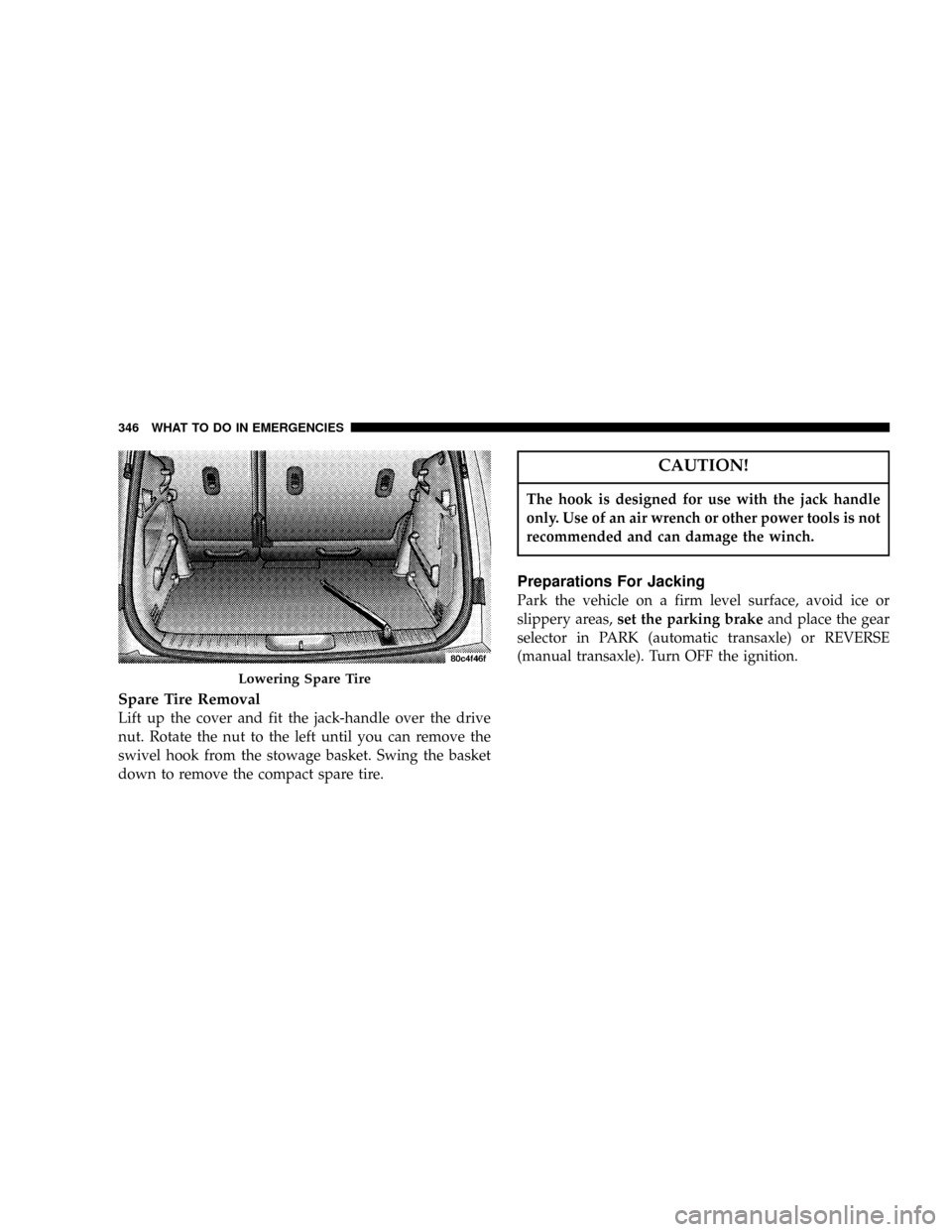
Spare Tire Removal
Lift up the cover and fit the jack-handle over the drive
nut. Rotate the nut to the left until you can remove the
swivel hook from the stowage basket. Swing the basket
down to remove the compact spare tire.
CAUTION!
The hook is designed for use with the jack handle
only. Use of an air wrench or other power tools is not
recommended and can damage the winch.
Preparations For Jacking
Park the vehicle on a firm level surface, avoid ice or
slippery areas,set the parking brakeand place the gear
selector in PARK (automatic transaxle) or REVERSE
(manual transaxle). Turn OFF the ignition.
Lowering Spare Tire
346 WHAT TO DO IN EMERGENCIES