lock CHRYSLER PT CRUISER 2008 1.G Owners Manual
[x] Cancel search | Manufacturer: CHRYSLER, Model Year: 2008, Model line: PT CRUISER, Model: CHRYSLER PT CRUISER 2008 1.GPages: 488, PDF Size: 7.43 MB
Page 363 of 488
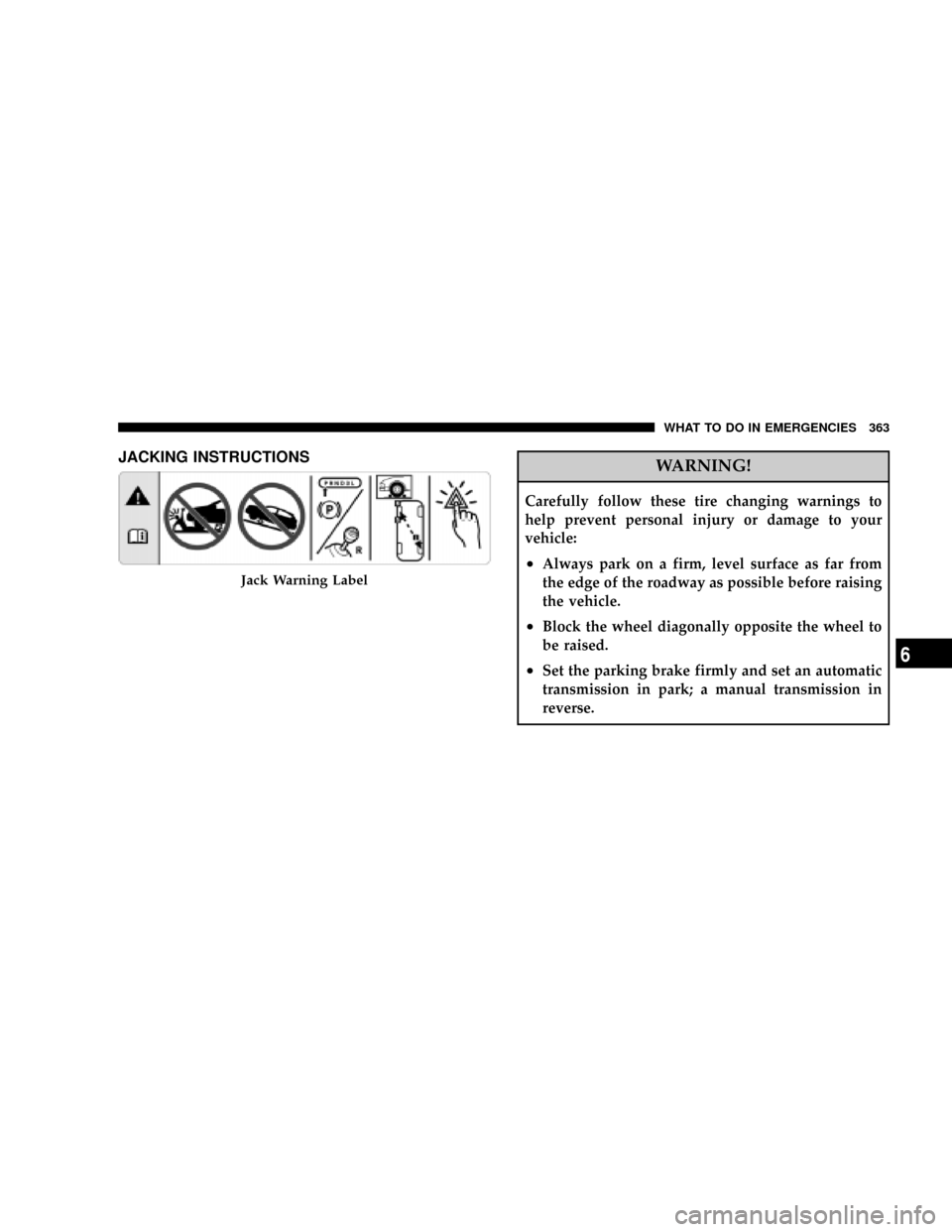
JACKING INSTRUCTIONSWARNING!
Carefully follow these tire changing warnings to
help prevent personal injury or damage to your
vehicle:
²Always park on a firm, level surface as far from
the edge of the roadway as possible before raising
the vehicle.
²Block the wheel diagonally opposite the wheel to
be raised.
²Set the parking brake firmly and set an automatic
transmission in park; a manual transmission in
reverse.
Jack Warning Label
WHAT TO DO IN EMERGENCIES 363
6
Page 367 of 488

8. Remove the wheel blocks and lower the jack until it is
free. Stow the lug wrench, and jack in their designated
location. Secure all parts using the means provided.
WARNING!
A loose tire or jack thrown forward in a collision or
hard stop could endanger the occupants of the ve-
hicle. Always stow the jack parts and the spare tire in
the places provided. Have the deflated (flat) tire
repaired or replaced immediately.
9. Place the deflated (flat) tire in the cargo area,have the
tire repaired or replaced as soon as possible.
10. Check the tire pressure as soon as possible. Correct
pressure as required.
JUMP-STARTING PROCEDURES DUE TO A LOW
BATTERY
WARNING!
Take care to avoid the radiator cooling fan whenever
the hood is raised. It can start anytime the ignition
switch is on. You can be hurt by the fan.
WHAT TO DO IN EMERGENCIES 367
6
Page 371 of 488

WARNING!
Fast spinning tires can be dangerous. Forces gener-
ated by excessive wheel speeds may cause tire dam-
age or failure. A tire could explode and injure some-
one. Do not spin your vehicle's wheels faster than 30
mph (48 km/h) when you are stuck. And don't let
anyone near a spinning wheel, no matter what the
speed.
CAUTION!
Racing the engine or spinning the wheels too fast
may lead to transaxle overheating and failure. It can
also damage the tires. Do not spin the wheels above
30 mph (48 km/h).
TOWING A DISABLED VEHICLE
With Ignition Key
Four Speed Automatic Transaxle
Your vehicle may be towed under the following condi-
tions: The steering column must be unlocked and the
gear selector must be in NEUTRAL, the distance to be
towed must not exceed 100 miles (160 km), and the
towing speed must not exceed 44 mph (72 km/h). If the
transaxle is not operative, or if the vehicle is to be towed
more than 100 miles (160 km), the vehicle must be towed
with the front wheels off the ground to avoid damage to
the transaxle.
Manual Transaxle
Your vehicle may be towed in a forward direction, with
all 4 wheels on the ground, and the gearshift lever is in
NEUTRAL. If the transaxle is not operative, the vehicle
must be towed with the front wheels off the ground.
WHAT TO DO IN EMERGENCIES 371
6
Page 372 of 488

All Transaxles
CAUTION!
If the vehicle being towed requires steering, the
ignition switch must be in the ACC position, not in
the LOCK positions.
Do not attempt to use sling type equipment when
towing. When securing vehicle to flat bed truck, do
not attach to front or rear suspension components.
Damage to your vehicle may result from improper
towing.
If it is necessary to use the accessories while being towed
(wipers, defrosters, etc.), the key must be in the ON
position, not the ACC position. Make certain the trans-
axle remains in NEUTRAL.
Without The Ignition Key
Special care must be taken when the vehicle is towed
with the ignition in the LOCK position. A dolly should be
used under the front wheels if the rear wheels are raised.
Proper towing equipment is necessary to prevent dam-
age to the vehicle.
Towing This Vehicle Behind Another Vehicle (Flat
Towing With All Four Wheels On The Ground)
If your vehicle is equipped with a manual transaxle, it
may be towed in a forward direction, at any legal
highway speed, for any distance, if the transaxle is in
NEUTRAL.
If the ignition key is not available, vehicles with auto-
matic transaxles can not be flat towed at any time.
372 WHAT TO DO IN EMERGENCIES
Page 373 of 488

CONVERTIBLE TOP MANUAL OVERRIDE
If your vehicle is experiencing electrical failure (low
battery, etc.) and it is necessary to raise the convertible
top, perform the following steps:
1. Locate the convertible top motor bypass screw, which
is found in the trunk under the convertible top storage
area.
2. Turn the screw counterclockwise until the screw stops.
This will relieve the hydraulic pressure and allow the
convertible top to be raised manually.
Bleeder Screw
WHAT TO DO IN EMERGENCIES 373
6
Page 374 of 488

3. Using the latch handle raise the top until the two pins
seat themselves in the windshield header.
4. Rotate the latch handle clockwise to open the latches.
5. Pull down and rotate the handle counterclockwise to
engage the latches.6. Raise the handle into the stowed position.
7. Close the convertible top motor bypass screw by
turning the screw clockwise until it stops. Tighten the
screw securely.
NOTE:Failure to tighten the bypass screw securely can
cause convertible top operating concerns.
Engaging Convertible Top
374 WHAT TO DO IN EMERGENCIES
Page 395 of 488

WARNING!
Fluid level should be checked on a level surface and
with the engine off to prevent injury from moving
parts and to insure accurate fluid level reading. Do
not overfill. Use only manufacturers recommended
power steering fluid.
If necessary, add fluid to restore to the proper indicated
level. With a clean cloth, wipe any spilled fluid from all
surfaces. Refer to Fluids, Lubricants, and Genuine Parts
for correct fluid types.
FRONT SUSPENSION BALL JOINTS
There are two front suspension lower ball joints that are
permanently lubricated. Inspect these ball joints when-
ever under vehicle service is done. Damaged seals and
their corresponding potentially damaged ball joints must
be replaced.
STEERING LINKAGE
The tie rod end ball joints should be inspected for
external leakage and damage when other maintenance is
performed.
BODY LUBRICATION
Locks and all body pivot points, including such items as
seat tracks, doors, liftgate and hood hinges, should be
lubricated periodically to assure quiet, easy operation
and to protect against rust and wear. Prior to the appli-
cation of any lubricant, the parts concerned should be
wiped clean to remove dust and grit; after lubricating
excess oil and grease should be removed. Particular
attention should also be given to hood latching compo-
nents to insure proper function. When performing other
underhood services, the hood latch, release mechanism
and safety catch should be cleaned and lubricated.
The external lock cylinders should be lubricated twice a
year, preferably in the fall and spring. Apply a small
MAINTAINING YOUR VEHICLE 395
7
Page 396 of 488

amount of a high quality lubricant such as MopartLock
Cylinder Lubricant directly into the lock cylinder.
WINDSHIELD WIPER BLADES
Clean the rubber edges of the wiper blades and the
windshield periodically with a sponge or soft cloth and a
mild non abrasive cleaner or use the washer solvent. This
will remove accumulations of salt, waxes or road film
and help reduce streaking and smearing.
Operation of the wipers on dry glass for long periods
may cause deterioration of the wiper blades. Always use
washer fluid when using the wipers to remove salt or dirt
from a dry windshield. Avoid using the wiper blades to
remove frost or ice from the windshield. make sure that
they are not frozen to the glass before turning them on to
avoid damaging the blade. Keep the blade rubber out of
contact with petroleum products such as engine oil,
gasoline, etc.
Windshield Wiper Blade Replacement
1. Lift the wiper arm away from the glass.
2. Push the release tab shown in the illustration and slide
the wiper blade assembly down along the arm. Gently
place the wiper arm on the windshield.
3. Install the new blade assembly onto the wiper arm tip
until it locks in place.
NOTE:Always refer to the wiper blade packaging for
specific installation instructions. Many wiper blade re-
placements fit multiple vehicles.
WINDSHIELD WASHER RESERVOIR
NOTE:Always refer to the wiper blade packaging for
specific installation instructions. Many wiper blade re-
placements fit multiple vehicles.
The washer fluid reservoir is located in the rear of the
engine compartment on the passenger side and should be
396 MAINTAINING YOUR VEHICLE
Page 420 of 488
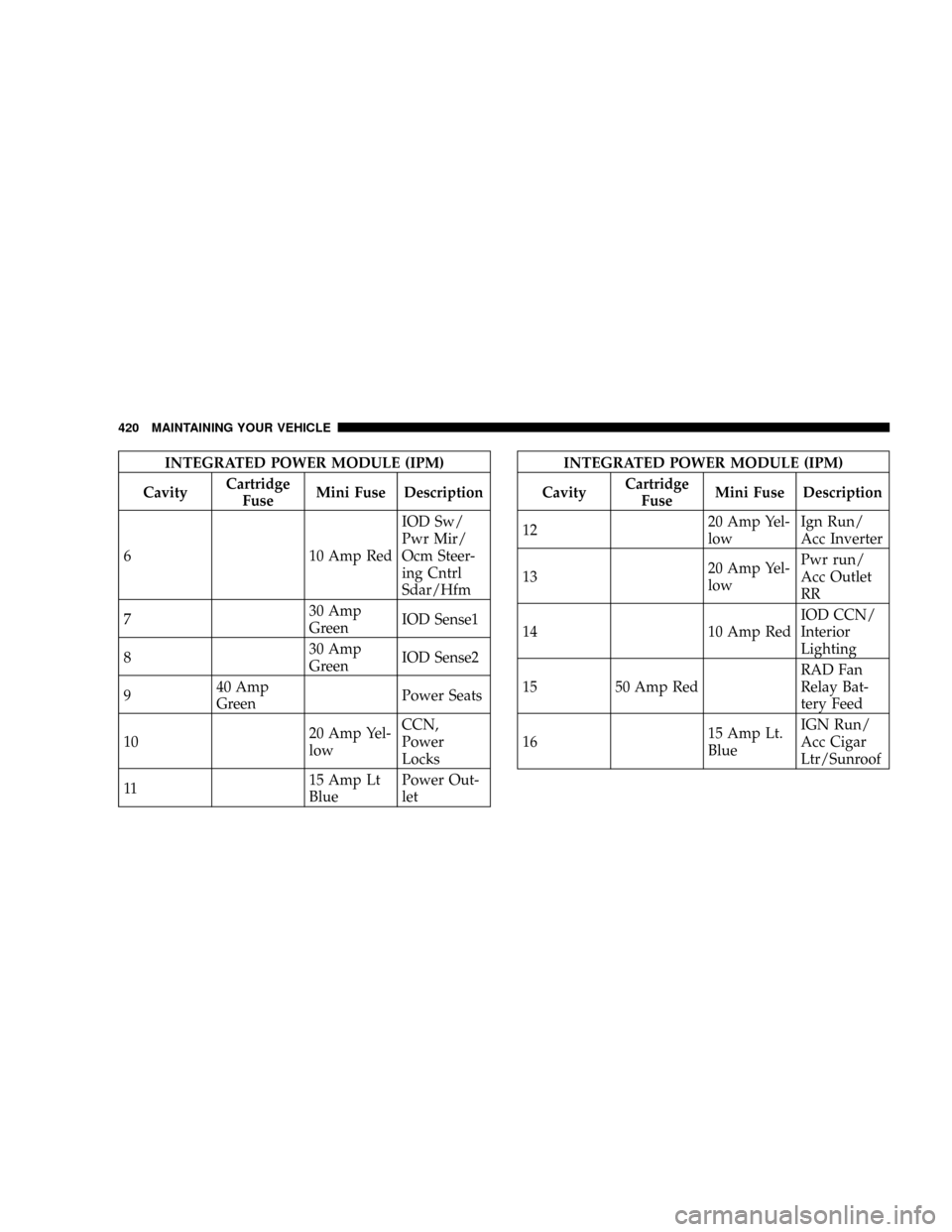
INTEGRATED POWER MODULE (IPM)
CavityCartridge
FuseMini Fuse Description
6 10 Amp RedIOD Sw/
Pwr Mir/
Ocm Steer-
ing Cntrl
Sdar/Hfm
730 Amp
GreenIOD Sense1
830 Amp
GreenIOD Sense2
940 Amp
GreenPower Seats
1020 Amp Yel-
lowCCN,
Power
Locks
1115 Amp Lt
BluePower Out-
letINTEGRATED POWER MODULE (IPM)
CavityCartridge
FuseMini Fuse Description
1220 Amp Yel-
lowIgn Run/
Acc Inverter
1320 Amp Yel-
lowPwr run/
Acc Outlet
RR
14 10 Amp RedIOD CCN/
Interior
Lighting
15 50 Amp RedRAD Fan
Relay Bat-
tery Feed
1615 Amp Lt.
BlueIGN Run/
Acc Cigar
Ltr/Sunroof
420 MAINTAINING YOUR VEHICLE
Page 470 of 488

ABS (Anti-Lock Brake System).............. 308
Adding Engine Coolant (Antifreeze).......... 400
Adding Fuel........................... 340
Adding Washer Fluid..................... 218
Additives, Fuel......................... 338
Air Cleaner, Engine (Engine Air Cleaner Filter) . . . 391
Air Conditioner Maintenance............... 393
Air Conditioning Controls................. 277
Air Conditioning, Operating Tips............ 283
Air Conditioning Refrigerant.............393,394
Air Conditioning System................277,393
Air Pressure, Tires....................... 322
Airbag..............................55,90
Airbag Deployment....................66,101
Airbag Light....................70,104,116,234
Airbag Maintenance....................68,103
Airbag, Side.........................65,100
Alarm, Panic..........................26,32
Alarm System (Security Alarm)............36,233Alignment and Balance................... 329
Alterations/Modifications, Vehicle............. 7
Antenna, Satellite Radio................... 276
Antifreeze (Engine Coolant)........399,400,429,430
Capacities........................... 429
Disposal............................ 401
Anti-Lock Brake System (ABS).............. 308
Anti-Lock Warning Light.................. 233
Anti-Theft Security Alarm (Theft Alarm)........ 36
Appearance Care........................ 411
Auto Down Power Windows................ 43
Automatic Door Locks..................... 21
Automatic Transaxle..............13,291,294,408
Adding Fluid......................... 408
Filter............................... 409
Fluid and Filter Changes................. 409
Fluid Level Check...................... 408
Interlock System.....................19,295
Reset Mode.......................... 296
470 INDEX