change wheel CHRYSLER PT CRUISER 2009 1.G Owners Manual
[x] Cancel search | Manufacturer: CHRYSLER, Model Year: 2009, Model line: PT CRUISER, Model: CHRYSLER PT CRUISER 2009 1.GPages: 410, PDF Size: 5.24 MB
Page 169 of 410
CAUTION!
The TPMS has been optimized for the original
equipment tires and wheels. TPMS pressures and
warning have been established for the tire size
equipped on your vehicle. Undesirable system opera-
tion or sensor damage may result when using re-
placement equipment that is not of the same size,
type, and/or style. Aftermarket wheels can cause
sensor damage. Do not use tire sealant from a can, or
balance beads if your vehicle is equipped with a
TPMS, as damage to the sensors may result.
8. Odometer/Trip Odometer
The odometer shows the total distance the vehicle has
been driven. U.S. federal regulations require that upon
transfer of vehicle ownership, the seller certify to the
purchaser the correct mileage that the vehicle has been
driven. Therefore, if the odometer reading is changed during repair or replacement, be sure to keep a record of
the reading before and after the service so that the correct
mileage can be determined.
Vehicle Warning Messages
When the appropriate conditions exist, “door,” “gate,”
“LoW TirE,” “CHAngE OIL”or “GASCAP” will display
in the odometer.
NOTE:
If the instrument cluster is equipped with the
optional Electronic Vehicle Information Center (EVIC),
then all warnings including ”Low Tire,” “Door Ajar” and
“Liftgate Ajar” will only display in the EVIC. (Refer to
“Electronic Vehicle Information Center (EVIC)” in this
section for specific messages).
LoW TirE
When the appropriate condition exists, the odometer
display will toggle between LoW and TirE for three
cycles.
4
UNDERSTANDING YOUR INSTRUMENT PANEL 167
Page 265 of 410
WARNING!
•Do not use a tire, wheel size or rating other than
that specified for your vehicle. Some combinations
of unapproved tires and wheels may change sus-
pension dimensions and performance characteris-
tics, resulting in changes to steering, handling, and
braking of your vehicle. This can cause unpredict-
able handling and stress to steering and suspen-
sion components. You could lose control and have
an accident resulting in serious injury or death.
Use only the tire and wheel sizes with load ratings
approved for your vehicle.
•Never use a tire with a smaller load index or
capacity, other than what was originally equipped
on your vehicle. Using a tire with a smaller load
index could result in tire overloading and failure.
You could lose control and have an accident.(Continued)
WARNING! (Continued)
•Failure to equip your vehicle with tires having
adequate speed capability can result in sudden tire
failure and loss of vehicle control.
CAUTION!
Replacing original tires with tires of a different size
may result in false speedometer and odometer read-
ings.
TIRE CHAINS
Due to limited clearance, tire chains are not recom-
mended.
5
STARTING AND OPERATING 263
Page 269 of 410
CAUTION!
After inspecting or adjusting the tire pressure, al-
ways reinstall the valve stem cap. This will prevent
moisture and dirt from entering the valve stem,
which could damage the Tire Pressure Monitoring
Sensor.
NOTE:
•TPMS is not intended to replace normal tire care and
maintenance, or to provide warning of a tire failure or
condition.
•TPMS should not be used as a tire pressure gauge
while adjusting your tire pressure.
•Driving on a significantly under-inflated tire causes
the tire to overheat and can lead to tire failure.
Under-inflation also reduces fuel efficiency and tire
tread life, and may affect the vehicle’s handling and
stopping ability.
•TPMS is not a substitute for proper tire maintenance,
and it is the driver ’s responsibility to maintain correct
tire pressure using an accurate tire pressure gauge,
even if under-inflation has not reached the level to
trigger illumination of the TPMS Telltale Light.
•Seasonal temperature changes will affect tire pressure,
and the TPMS will monitor the actual tire pressure in
the tire.
Base System
The TPMS uses wireless technology with wheel rim-
mounted electronic sensors to monitor tire pressure lev-
els. Sensors, mounted to each wheel as part of the valve
stem, transmit tire pressure readings to the Receiver
Module.
NOTE: It is particularly important for you to perform a
monthly tire pressure check on, and to maintain the
proper pressure of all the tires on your vehicle.
5
STARTING AND OPERATING 267
Page 298 of 410
Preparations For Jacking
1. Park the vehicle on a firm, level surface. Avoid ice or
slippery areas.
WARNING!
Do not attempt to change a tire on the side of the
vehicle close to moving traffic. Pull far enough off
the road to avoid the danger of being hit when
operating the jack or changing the wheel.
2. Set the parking brake.
3. Place the shift lever in PARK (automatic transaxle) or
REVERSE (manual transaxle).
4. Turn OFF the ignition.
5. Turn on the Hazard Warning flasher. 6. Block both the front and rear of the
wheel diagonally opposite the jacking
position. For example, if changing the
right front tire, block the left rear
wheel.
NOTE: Passengers should not remain in the vehicle
while the vehicle is being jacked.
Jacking Instructions
WARNING!
Carefully follow these tire changing warnings to
help prevent personal injury or damage to your
vehicle:
(Continued)
296 WHAT TO DO IN EMERGENCIES
Page 299 of 410
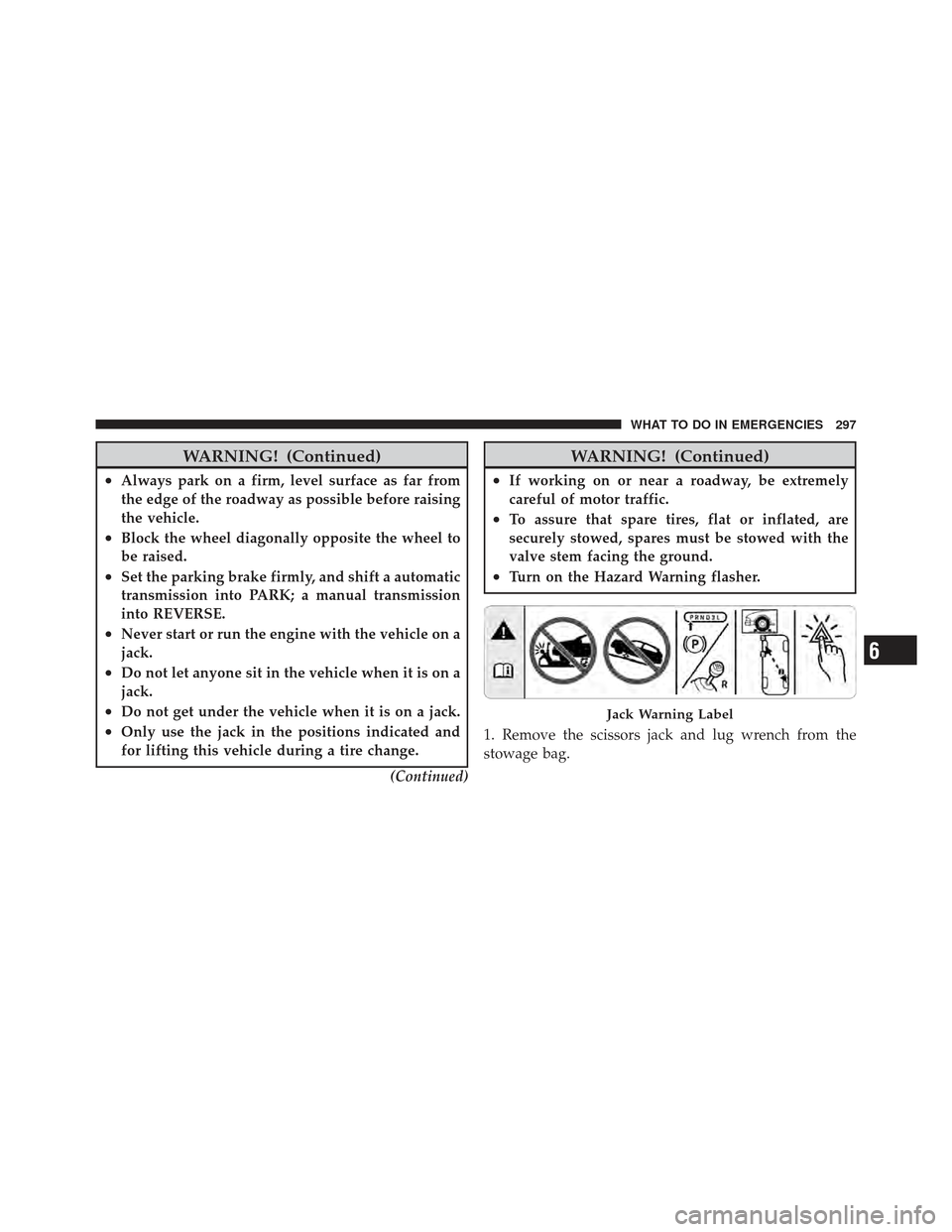
WARNING! (Continued)
•Always park on a firm, level surface as far from
the edge of the roadway as possible before raising
the vehicle.
•Block the wheel diagonally opposite the wheel to
be raised.
•Set the parking brake firmly, and shift a automatic
transmission into PARK; a manual transmission
into REVERSE.
•Never start or run the engine with the vehicle on a
jack.
•Do not let anyone sit in the vehicle when it is on a
jack.
•Do not get under the vehicle when it is on a jack.
•Only use the jack in the positions indicated and
for lifting this vehicle during a tire change.(Continued)
WARNING! (Continued)
•If working on or near a roadway, be extremely
careful of motor traffic.
•To assure that spare tires, flat or inflated, are
securely stowed, spares must be stowed with the
valve stem facing the ground.
•Turn on the Hazard Warning flasher.
1. Remove the scissors jack and lug wrench from the
stowage bag.
Jack Warning Label
6
WHAT TO DO IN EMERGENCIES 297
Page 300 of 410
NOTE:If equipped with a center cap that covers the
wheel nuts, pry off the cap using the small end of the lug
wrench. To reinstall the cap, make sure it is properly
lined up before pushing it onto the wheel.
Loosen, but do not remove, the wheel nuts by turning
them to the left one turn while the wheel is still on the
ground.
CAUTION!
Do not attempt to raise the vehicle by jacking on the
cross-member below the radiator, on the front sus-
pension cross-member, or on the rear axle assembly.
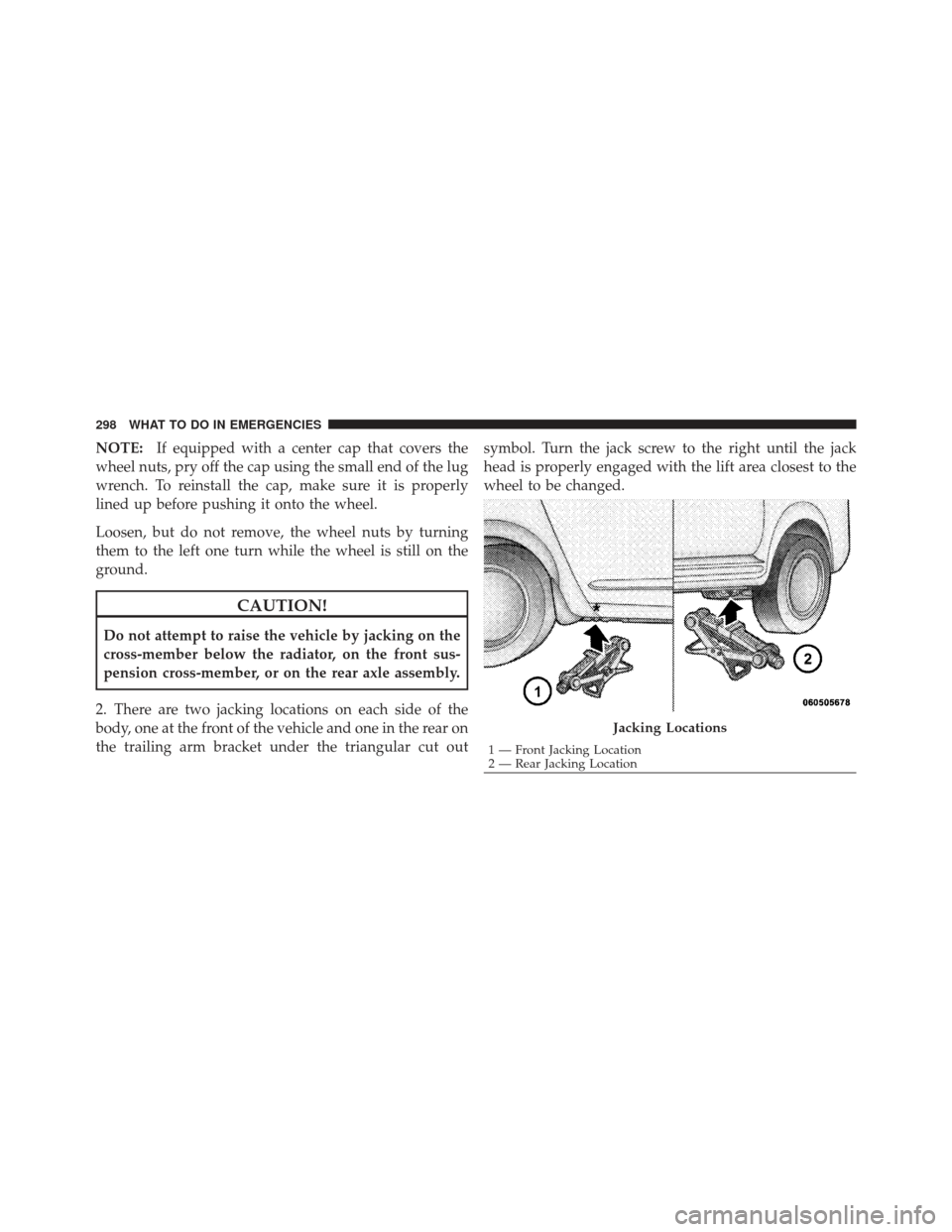
2. There are two jacking locations on each side of the
body, one at the front of the vehicle and one in the rear on
the trailing arm bracket under the triangular cut out symbol. Turn the jack screw to the right until the jack
head is properly engaged with the lift area closest to the
wheel to be changed.
Jacking Locations
1 — Front Jacking Location
2 — Rear Jacking Location
298 WHAT TO DO IN EMERGENCIES
Page 362 of 410
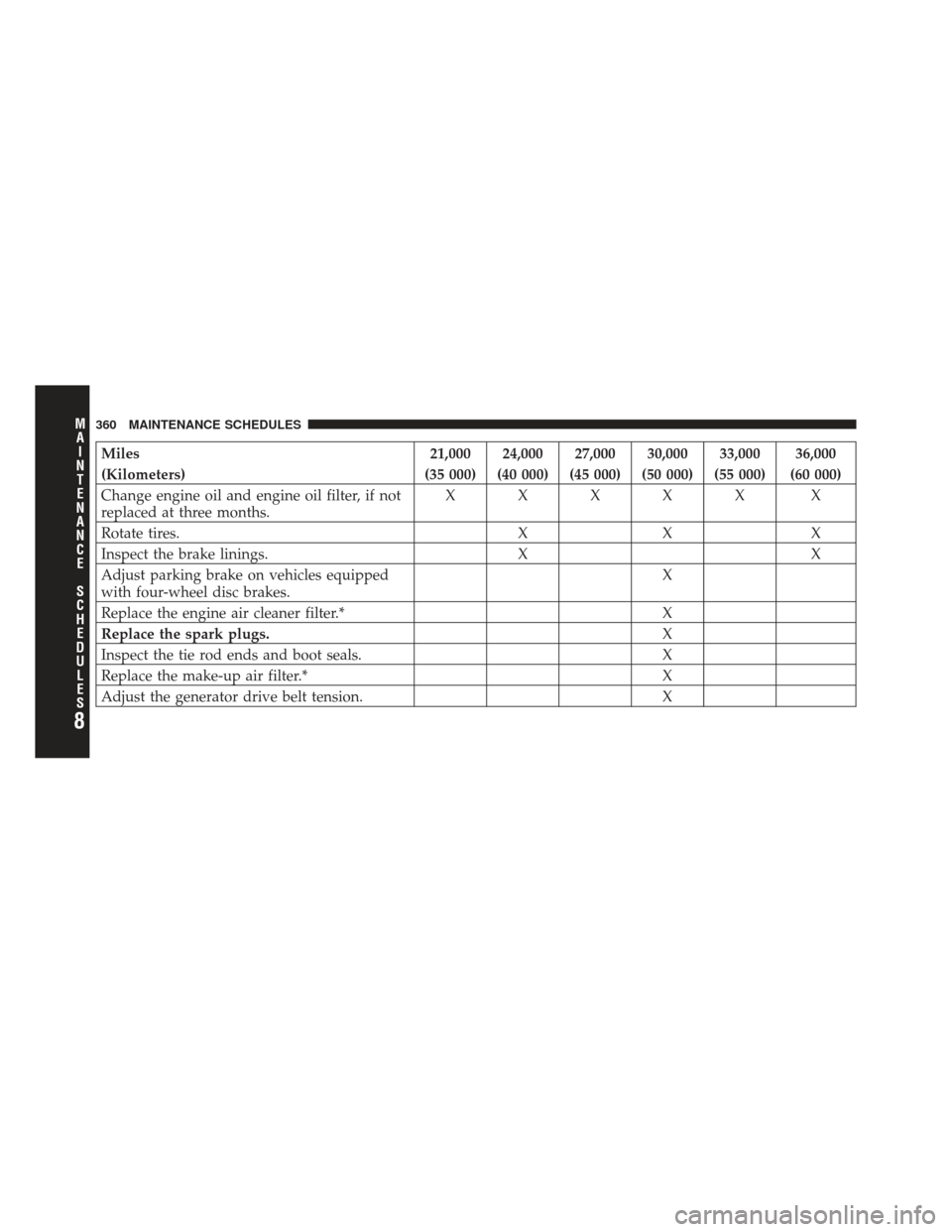
Miles21,000 24,000 27,000 30,000 33,000 36,000
(Kilometers) (35 000) (40 000) (45 000) (50 000) (55 000) (60 000)
Change engine oil and engine oil filter, if not
replaced at three months. XXXXX X
Rotate tires. XX X
Inspect the brake linings. XX
Adjust parking brake on vehicles equipped
with four-wheel disc brakes. X
Replace the engine air cleaner filter.* X
Replace the spark plugs. X
Inspect the tie rod ends and boot seals. X
Replace the make-up air filter.* X
Adjust the generator drive belt tension. X
8
M
A I
N T
E
N A
N CE
S
C
H E
D
U L
E
S360 MAINTENANCE SCHEDULES
Page 364 of 410
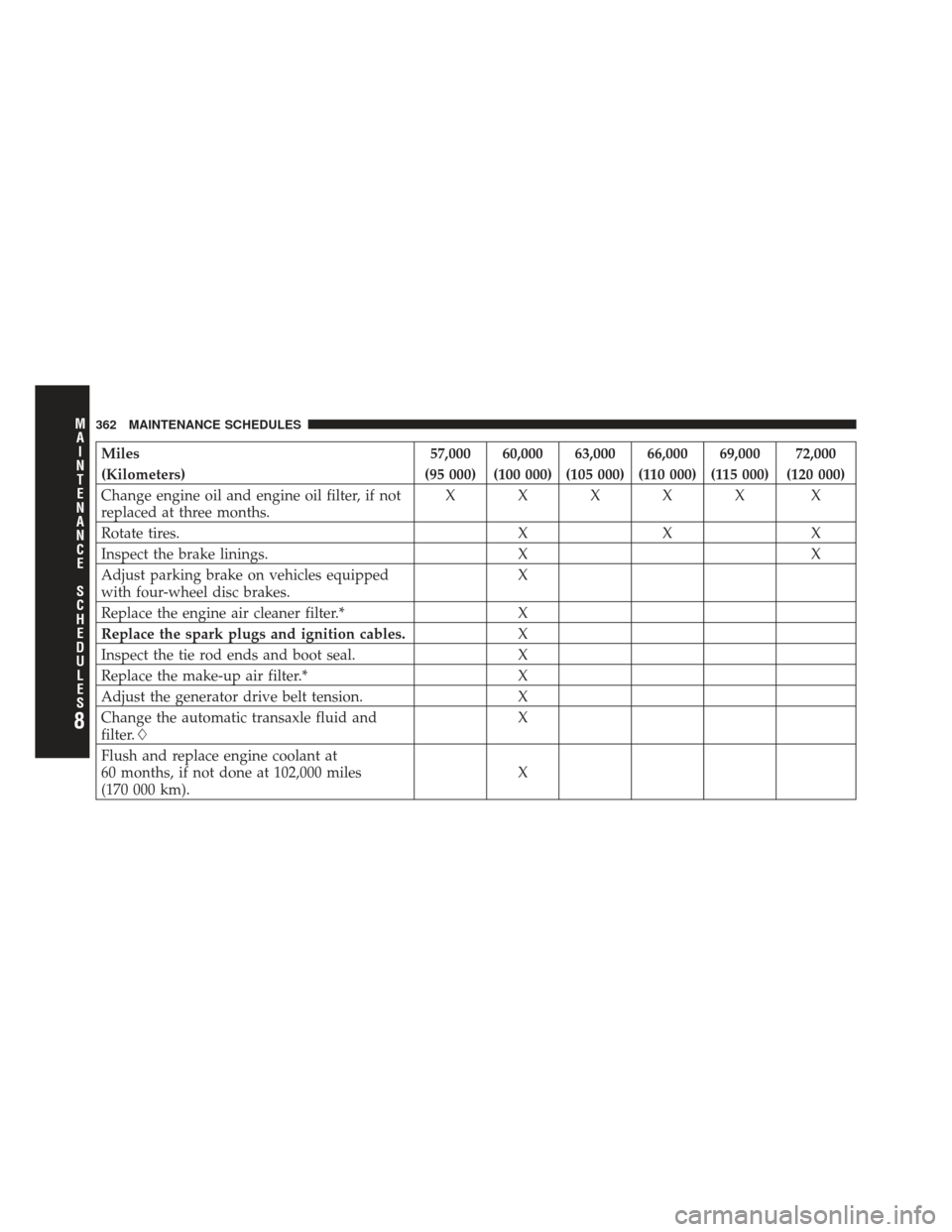
Miles57,000 60,000 63,000 66,000 69,000 72,000
(Kilometers) (95 000) (100 000) (105 000) (110 000) (115 000) (120 000)
Change engine oil and engine oil filter, if not
replaced at three months. XXXXX X
Rotate tires. XX X
Inspect the brake linings. XX
Adjust parking brake on vehicles equipped
with four-wheel disc brakes. X
Replace the engine air cleaner filter.* X
Replace the spark plugs and ignition cables. X
Inspect the tie rod ends and boot seal. X
Replace the make-up air filter.* X
Adjust the generator drive belt tension. X
Change the automatic transaxle fluid and
filter. X
Flush and replace engine coolant at
60 months, if not done at 102,000 miles
(170 000 km). X
8
M
A I
N T
E
N A
N CE
S
C
H E
D
U L
E
S362 MAINTENANCE SCHEDULES
Page 365 of 410
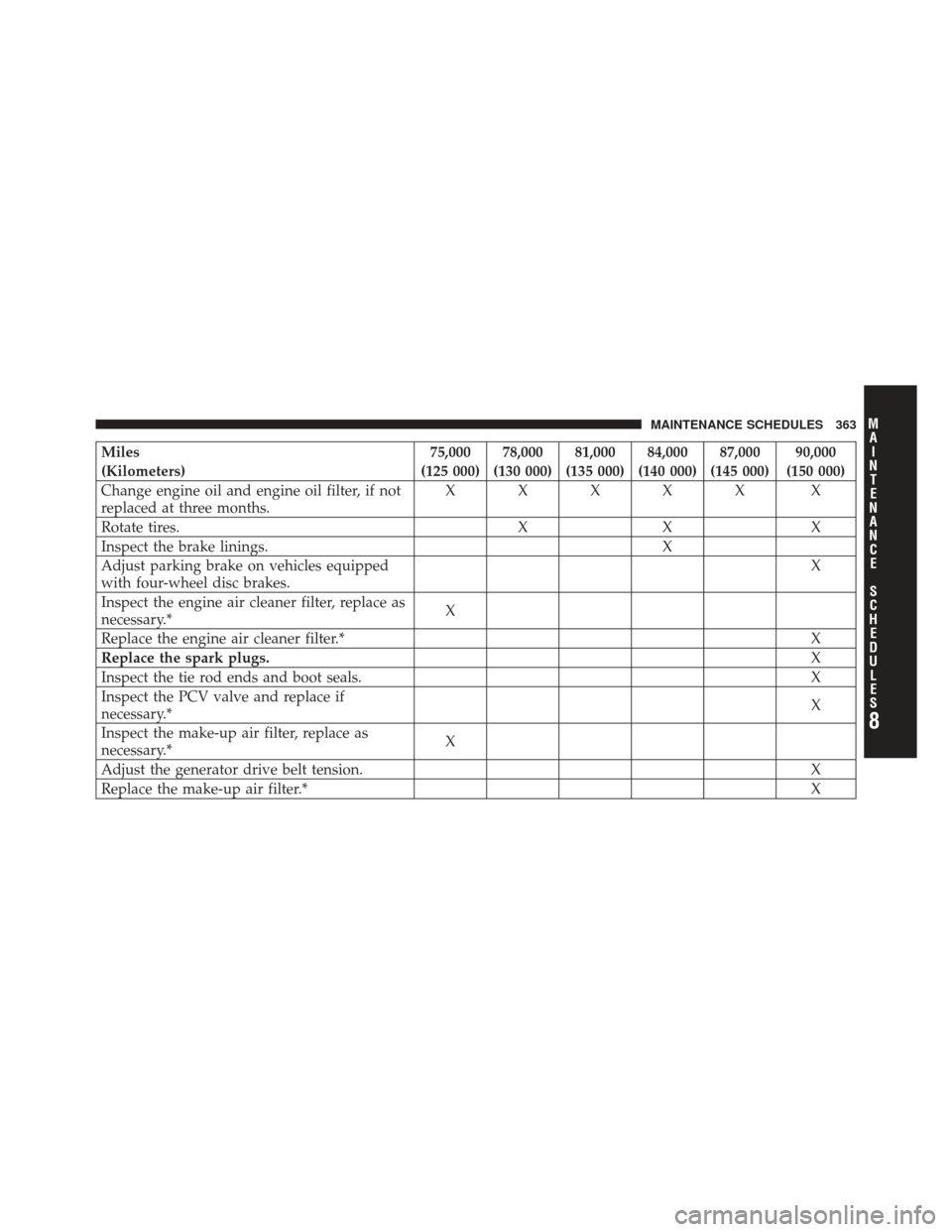
Miles75,000 78,000 81,000 84,000 87,000 90,000
(Kilometers) (125 000) (130 000) (135 000) (140 000) (145 000) (150 000)
Change engine oil and engine oil filter, if not
replaced at three months. XXXXX X
Rotate tires. XX X
Inspect the brake linings. X
Adjust parking brake on vehicles equipped
with four-wheel disc brakes. X
Inspect the engine air cleaner filter, replace as
necessary.* X
Replace the engine air cleaner filter.* X
Replace the spark plugs. X
Inspect the tie rod ends and boot seals. X
Inspect the PCV valve and replace if
necessary.* X
Inspect the make-up air filter, replace as
necessary.* X
Adjust the generator drive belt tension. X
Replace the make-up air filter.* X
8
M
A I
N T
E
N A
N CE
S
C
H E
D
U L
E
SMAINTENANCE SCHEDULES 363
Page 367 of 410
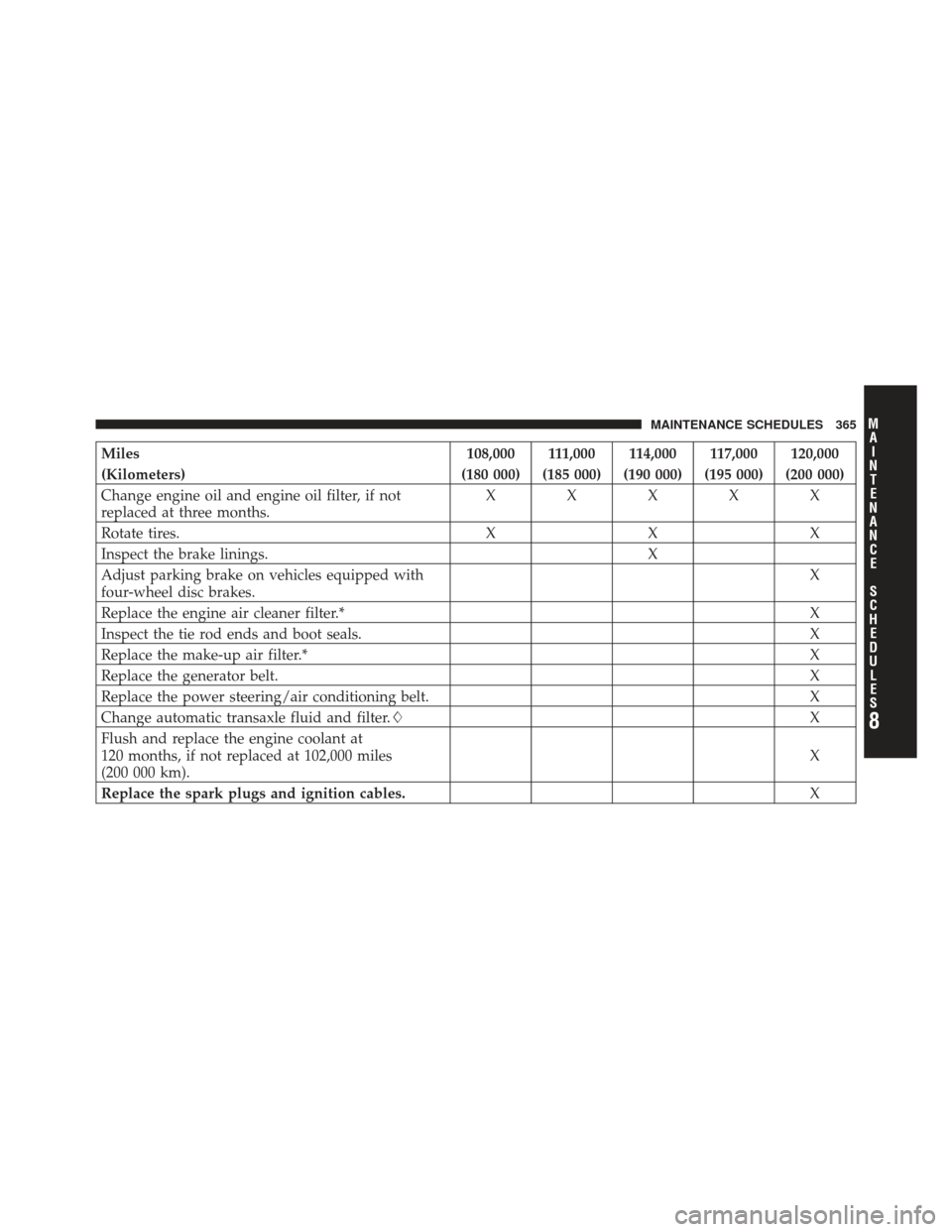
Miles108,000 111,000 114,000 117,000 120,000
(Kilometers) (180 000) (185 000) (190 000) (195 000) (200 000)
Change engine oil and engine oil filter, if not
replaced at three months. XXXXX
Rotate tires. XXX
Inspect the brake linings. X
Adjust parking brake on vehicles equipped with
four-wheel disc brakes. X
Replace the engine air cleaner filter.* X
Inspect the tie rod ends and boot seals. X
Replace the make-up air filter.* X
Replace the generator belt. X
Replace the power steering/air conditioning belt. X
Change automatic transaxle fluid and filter. X
Flush and replace the engine coolant at
120 months, if not replaced at 102,000 miles
(200 000 km). X
Replace the spark plugs and ignition cables. X
8
M
A I
N T
E
N A
N CE
S
C
H E
D
U L
E
SMAINTENANCE SCHEDULES 365