battery CHRYSLER SEBRING 2004 2.G User Guide
[x] Cancel search | Manufacturer: CHRYSLER, Model Year: 2004, Model line: SEBRING, Model: CHRYSLER SEBRING 2004 2.GPages: 273, PDF Size: 4.88 MB
Page 179 of 273
JUMP-STARTING THE BATTERY
WARNING!
²Do not attempt to push or tow your vehicle to get
it started. Vehicles equipped with an automatic
transaxle cannot be started this way. Unburned
fuel could enter the catalytic converter and once
the engine has started, ignite and damage the
converter and vehicle. If the vehicle has a dis-
charged battery, booster cables may be used to
obtain a start from another vehicle. This type of
start can be dangerous if done improperly, so
follow this procedure carefully.
²Take care to avoid the radiator cooling fan when-
ever the hood is raised. It can start anytime the
ignition switch is on. You can be hurt by the fan.
NOTE:The battery is stored in a compartment behind
the left front fender and is accessible without removing
the tire and wheel. Remote battery terminals are located
in the engine compartment for jump starting.1. Wear eye protection and remove any metal jewelry
such as watch bands or bracelets that might make an
inadvertent electrical contact.
2. When boosting from a battery in another vehicle, park
that vehicle within booster cable reach but without
letting the vehicles touch. Set parking brake, place auto-
matic transaxle in PARK and turn ignition to OFF for
both vehicles.
3. Turn off the heater, radio and all unnecessary electrical
loads.
4. Connect one end of a jumper cable to the positive
terminal of the booster battery. Connect the other end to
the positive jump start attachment of the discharged
battery.
WHAT TO DO IN EMERGENCIES 179
6
Page 180 of 273
WARNING!
Do not permit vehicles to touch each other as this
could establish a ground connection and person
injury could result.
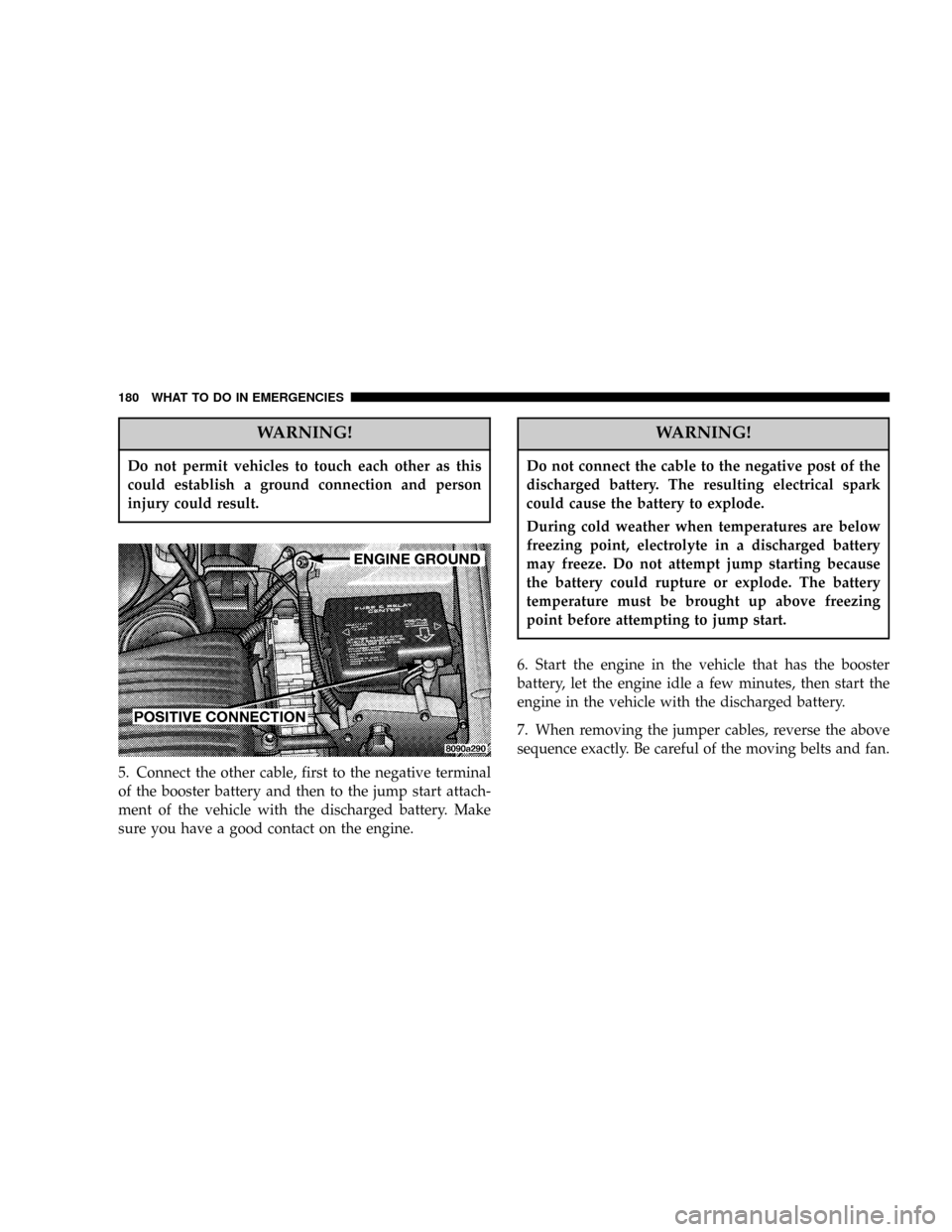
5. Connect the other cable, first to the negative terminal
of the booster battery and then to the jump start attach-
ment of the vehicle with the discharged battery. Make
sure you have a good contact on the engine.
WARNING!
Do not connect the cable to the negative post of the
discharged battery. The resulting electrical spark
could cause the battery to explode.
During cold weather when temperatures are below
freezing point, electrolyte in a discharged battery
may freeze. Do not attempt jump starting because
the battery could rupture or explode. The battery
temperature must be brought up above freezing
point before attempting to jump start.
6. Start the engine in the vehicle that has the booster
battery, let the engine idle a few minutes, then start the
engine in the vehicle with the discharged battery.
7. When removing the jumper cables, reverse the above
sequence exactly. Be careful of the moving belts and fan.
180 WHAT TO DO IN EMERGENCIES
Page 181 of 273
WARNING!
Any procedure other than above could result in:
1. Personal injury caused by electrolyte squirting
out the battery vent;
2. Personal injury or property damage due to battery
explosion;
3. Damage to charging system of booster vehicle or
of immobilized vehicle.
WARNING!
Battery fluid is a corrosive acid solution; do not
allow battery fluid to contact eyes, skin or clothing.
Don't lean over battery when attaching clamps or
allow the clamps to touch each other. If acid splashes
in eyes or on skin, flush the contaminated area
immediately with large quantities of water.
A battery generates hydrogen gas which is flam-
mable and explosive. Keep flame or spark away
from the battery. Do not use a booster battery or any
other booster source with an output that exceeds 12
volts.
WARNING!
Battery posts, terminals and related accessories con-
tain lead and lead compounds. Wash hands after
handling.
WHAT TO DO IN EMERGENCIES 181
6
Page 185 of 273

MAINTAINING YOUR VEHICLE
CONTENTS
m2.4L Engine..........................187
m2.7L Engine..........................188
mOnboard Diagnostic System Ð OBD II......189
mEmissions Inspection And Maintenance
Programs
............................190
mReplacement Parts.....................191
mDealer Service........................191
mMaintenance Procedures.................192
NEngine Oil..........................192
NCrankcase Emission Control System........198
NMaintenance-Free Battery................198
NAir Conditioner......................199NPower Steering Fluid Check..............200
NSuspension Ball Joints..................201
NBody Mechanism Lubrication.............201
NWindshield Wiper Blades................203
NWindshield Washers...................203
NExhaust System......................204
NCooling System.......................205
NHoses And Vacuum/Vapor Harnesses.......209
NBrakes.............................209
NFuel System Hoses....................211
NAutomatic Transmission................211
7
Page 190 of 273

EMISSIONS INSPECTION AND MAINTENANCE
PROGRAMS
In some localities, it may be a legal requirement to pass
an inspection of your vehicle's emissions control system.
Failure to pass could prevent vehicle registration.
For states which have an I/M (Inspection and
Maintenance) requirement, this check verifies the
following: the MIL (Malfunction Indicator Lamp)
is functioning and is not on when the engine is running,
and that the OBD (On Board Diagnostic) system is ready
for testing.
Normally, the OBD system will be ready. The OBD
system maynotbe ready if your vehicle was recently
serviced, if you recently had a dead battery, or a battery
replacement. If the OBD system should be determined
not ready for the I/M test, your vehicle may fail the test.
Your vehicle has a simple ignition key actuated test
which you can use prior to going to the test station. To
check if your vehicle's OBD system is ready, you must do
the following:
1. Insert your ignition key into the ignition switch.2. Turn the ignition to the ON position, but do not crank
or start the engine.
3. If you crank or start the engine, you will have to start
this test over.
4. As soon as you turn your key to the ON position, you
will see your MIL symbol come on as part of a normal
bulb check.
5. Approximately 15 seconds later, one of two things will
happen:
a. The MIL will flash for about 10 seconds and then
return to being fully illuminated until you turn off
the ignition key or start the engine. This means that
your vehicle's OBD system isnot readyand you
shouldnotproceed to the I/M station.
b. The MIL will not flash at all and will remain fully
illuminated until you turn off the ignition key or
start the engine. This means that your vehicle's OBD
system isreadyand you can proceed to the I/M
station.
190 MAINTAINING YOUR VEHICLE
Page 191 of 273

If your OBD system isnot ready,you should see your
authorized dealer or repair facility. If your vehicle was
recently serviced or had a battery failure or replacement,
you may need to do nothing more than drive your
vehicle as you normally would in order for your OBD
system to update. A recheck with the above test routine
may then indicate that the system is now ready.
Regardless of whether your vehicle's OBD system is
ready or not ready, if the MIL symbol is illuminated
during normal vehicle operation, you should have your
vehicle serviced before going to the I/M station. The I/M
station can fail your vehicle because the MIL symbol is on
with the engine running.REPLACEMENT PARTS
Use of genuine Mopar parts for normal/scheduled main-
tenance and repairs is highly recommended to insure the
designed performance. Damage or failures caused by the
use of non-Mopar parts for maintenance and repairs will
not be covered by the manufacturer's warranty.
DEALER SERVICE
Your dealer has the qualified service personnel, special
tools and equipment to perform all service operations in
an expert manner. Service manuals are available which
include detailed service information for your vehicle.
Refer to these manuals before attempting any procedure
yourself.
NOTE:Intentional tampering with emissions control
systems can result in civil penalties being assessed
against you.
MAINTAINING YOUR VEHICLE 191
7
Page 198 of 273

²Do not idle the engine with any spark plug wires
disconnected for prolonged period.
Engine Timing Belt
Replace the engine timing belt (2.4L Only) at the intervals
described in the appropriate maintenance schedule.
Crankcase Emission Control System
Proper operation of this system depends on freedom
from sticking or plugging due to deposits. As vehicle
mileage builds up, the Positive Crankshaft Ventilation
(PCV) valve and passages may accumulate deposits. If a
valve is not working properly, replace it with a new
valve. DO NOT ATTEMPT TO CLEAN THE OLD PCV
VALVE!
Check ventilation hose for indication of damage or
plugging deposits. Replace if necessary.
Maintenance-Free Battery
The top of the MAINTENANCE-FREE battery is perma-
nently sealed. You will never have to add water, nor is
periodic maintenance required.
NOTE:The battery is stored in a compartment behind
the left front fender and is accessible without removing
the tire and wheel. Remote battery terminals are located
in the engine compartment for jump starting.
To access the battery, turn the steering wheel fully to the
right and remove the inner fender shield.
198 MAINTAINING YOUR VEHICLE
Page 199 of 273
WARNING!
Battery posts, terminals and related accessories con-
tain lead and lead compounds. Wash hands after
handling. Battery fluid is a corrosive acid solution
and can burn or even blind you. Don't allow battery
fluid to contact your eyes, skin or clothing. Don't
lean over a battery when attaching clamps. If acid
splashes in eyes or on skin, flush the area immedi-
ately with large amounts of water. Battery gas is
flammable and explosive. Keep flame or sparks
away from the battery. Don't use a booster battery or
any other booster source with an output greater than
12 volts. Don't allow cable clamps to touch each
other.
CAUTION!
It is essential when replacing the cables on the
battery that the positive cable is attached to the
positive post and the negative cable is attached to the
negative post. Battery posts are marked positive (+)
and negative (-) and identified on the battery case.
Cable clamps should be tight on the terminal posts
and free of corrosion. Apply grease to posts and
clamps after tightening. If a ªfast chargerº is used
while the battery is in the vehicle, disconnect both
vehicle battery cables before connecting the charger
to battery. Do not use a ªfast chargerº to provide
starting voltage as battery damage can result.
Air Conditioner
Check the air conditioning system at the start of the
warm weather season.
NOTE:If your air conditioning performance seems
lower than expected, check the front of the A/C con-
denser for an accumulation of dirt or insects. Clean with
a gentle water spray from behind the radiator and
MAINTAINING YOUR VEHICLE 199
7
Page 235 of 273

Once a Month
²
Check tire pressure and look for unusual wear or
damage.
²Inspect the battery and clean and tighten the terminals
as required.
²Check the fluid levels of coolant reservoir, brake
master cylinder, and transaxle and add as needed.
²Check all lights and all other electrical items for correct
operation.
²Check rubber seals on each side of the radiator for
proper fit.
At Each Oil Change
²
Change the engine oil filter.
²Inspect the exhaust system.
²Inspect the brake linings, hoses and calipers.
²Inspect the CV joints and front and rear suspension
components.
²Check the automatic transmission fluid level.
²Check the brake master cylinder fluid level.
²Check the manual transmission fluid level.
²Check the coolant level, hoses, and clamps.
²Rotate the tires at each oil change interval shown on
Schedule ªAº 6,000 miles (10 000 km) or every other
interval shown on Schedule ªBº 6,000 miles (10 000
km).
NOTE:In 2.7L Engines equipped with Flex Fuel Engine
(FFV), change engine oil every 5 months or 5,000 miles,
whichever comes first. This applies to both Maintenance
Schedule A and B.
MAINTENANCE SCHEDULES 235
8
M
A
I
N
T
E
N
A
N
C
E
S
C
H
E
D
U
L
E
S
Page 262 of 273

About Your Brakes...................... 141
Adding Engine Coolant (Antifreeze)......... 206
Adding Fuel.......................... 164
Aiming Headlights...................... 227
Air Cleaner, Engine..................... 196
Air Conditioning....................... 121
Air Conditioning, Operating Tips........... 126
Air Conditioning Refrigerant.............. 200
Air Conditioning System..............121,199
Air Pressure, Tires...................... 152
Airbag................................ 32
Airbag Deployment....................35,36
Airbag Light.....................36,39,48,86
Airbag Maintenance...................... 38
Airbag, Side........................... 37
Airbag, Window......................32,37
Alarm Light............................ 91
Alarm, Panic........................... 20
Alarm System.......................... 22
Alignment and Balance.................. 157
Alterations/Modifications, Vehicle............ 7
Antifreeze Disposal..................... 207
Antifreeze (Engine Coolant)............... 206Capacities........................... 227
Anti-Lock Brake System.................. 141
Anti-Lock Warning Light.................. 89
Anti-Theft Security Alarm................. 22
Appearance Care....................... 214
Automatic Door Locks.................... 16
Automatic Transaxle..................135,211
Filter.............................. 213
Fluid and Filter Changes................ 213
Fluid Level Check..................... 212
Interlock System....................12,136
Reset Mode......................... 137
Selection Of Lubricant................. 212
Shifting............................ 137
Special Additives..................... 213
Autostick............................. 159
Auxiliary Power Outlet................... 77
Ball Joints............................ 201
Battery............................... 198
Emergency Starting.................... 179
Gas Caution......................181,199
Heater............................. 134
262 INDEX