light CHRYSLER SEBRING 2004 2.G User Guide
[x] Cancel search | Manufacturer: CHRYSLER, Model Year: 2004, Model line: SEBRING, Model: CHRYSLER SEBRING 2004 2.GPages: 273, PDF Size: 4.88 MB
Page 36 of 273
²The airbag control module also turns on the
AIRBAGlight in the instrument panel for 6 to
8 seconds when the ignition is first turned on,
then turns the light off. If it detects a malfunction in
any part of the system, it turns on the light either
momentarily or continuously.
WARNING!
Ignoring the AIRBAG light in your instrument panel
could mean you won't have the airbags to protect
you in a collision. If the light does not come on, stays
on after you start the vehicle, or if it comes on as you
drive, have the airbag system checked right away.
²When the airbag control module detects a collision
requiring the airbags, it signals the inflator units. A
large quantity of nontoxic gas is generated to inflate
the airbags. Three levels of airbag inflation rates are
possible. These rates are determined by the airbag
control module based on collision severity. The airbag
covers separate and fold out of the way as the airbags
inflate to their full size. The airbags fully inflate inabout 60 milliseconds. This is only about half of the
time it takes you to blink your eyes. The airbags then
quickly deflate while helping to restrain the driver and
front passenger. The driver's front airbag gas is vented
through a vent hole in the rear of the airbag. The
passenger's front airbag gas is vented through vent
holes in the sides of the airbag. In this way the airbags
do not interfere with your control of the vehicle.
²The Knee Impact Bolsters help protect the knees and
position you for the best interaction with the front
airbag.
If A Deployment Occurs
The airbag system is designed to deploy when the airbag
control module detects a moderate-to-severe collision, to
help restrain the driver and front passenger, and then to
immediately deflate.
NOTE:A collision that is not severe enough to need
airbag protection will not activate the system. This does
not mean something is wrong with the airbag system.
If you do have a collision which deploys the airbags, any
or all of the following may occur:
36 THINGS TO KNOW BEFORE STARTING YOUR VEHICLE
Page 39 of 273
Airbag Light
You will want to have the airbags ready for your protec-
tion in an impact. While the airbag system is designed to
be maintenance free, if any of the following occurs, have
an authorized dealer service the system promptly:
²TheAIRBAGlight does not come on or flickers during
the 6 to 8 seconds when the ignition switch is first
turned on.
²The light remains on or flickers after the 6 to 8 second
interval.
²The light flickers or comes on and remains on while
driving.
Child Restraint
Everyone in your vehicle needs to be buckled up all the
time, babies and children, too. Every state in the United
States and all Canadian provinces require that small
children ride in proper restraint systems. This is the law,
and you can be prosecuted for ignoring it.Children 12 years and under should ride properly buck-
led up in a rear seat, if available. According to crash
statistics, children are safer when properly restrained in
the rear seats rather than in the front.
WARNING!
In a collision, an unrestrained child, even a tiny
baby, can become a missile inside the vehicle. The
force required to hold even an infant on your lap
could become so great that you could not hold the
child, no matter how strong you are. The child and
others could be badly injured. Any child riding in
your vehicle should be in a proper restraint for the
child's size.
There are different sizes and types of restraints for
children from newborn size to the child almost large
enough for an adult safety belt. Always check the child
seat Owner's Manual to ensure you have the right seat
for your child. Use the restraint that is correct for your
child:
THINGS TO KNOW BEFORE STARTING YOUR VEHICLE 39
2
Page 48 of 273
SAFETY TIPS
Exhaust Gas
WARNING!
Exhaust gases can injure or kill. They contain carbon
monoxide (CO) which is colorless and odorless.
Breathing it can make you unconscious and can
eventually poison you. To avoid breathing (CO)
follow the safety tips below.
²Do not run the engine in a closed garage or in confined
areas any longer than needed to move your vehicle in
or out of the area.
²If it is necessary to sit in a parked vehicle with the
engine running, adjust your heating or cooling con-
trols to force outside air into the vehicle. Set the blower
at high speed.
²To avoid drawing exhaust gases into the vehicle, close
the trunk while driving. However, if for some reason itmust remain open, close all windows. Adjust the
heating or cooling system to force outside air into the
vehicle. Set the blower at high speed.
Safety Checks You Should Make Inside the
Vehicle
Seat Belts
Inspect the belt system periodically, checking for cuts,
frays and loose parts. Damaged parts must be replaced
immediately. Do not disassemble or modify the system.
Safety belt assemblies must be replaced after a collision if
they have been damaged (bent retractor, torn webbing,
etc.). If there is any question regarding belt or retractor
condition, replace the belt.
Airbag Light
The light should come on and remain on for 6 to
8 seconds as a bulb check when the ignition
switch is first turned ON. If the bulb is not lit
during starting, have it replaced. If the light stays on or
comes on while driving, have the system checked by an
authorized dealer.
48 THINGS TO KNOW BEFORE STARTING YOUR VEHICLE
Page 49 of 273

Defrosters
Check operation by selecting the defrost mode and place
the blower control on high speed. You should be able to
feel the air directed against the windshield.
Periodic Safety Checks You Should Make Outside
the Vehicle
Tires
Examine tires for excessive tread wear or uneven wear
patterns. Check for stones, nails, glass, or other objects
lodged in the tread. Inspect for tread cuts or sidewall
cracks. Check wheel nuts for tightness, and tires (includ-
ing spare) for proper pressure.
Lights
Have someone observe the operation of exterior lights
while you work the controls. Check turn signal and high
beam indicator lights on the instrument panel.
Fluid Leaks
Check area under vehicle after overnight parking for fuel,
water, oil, or other fluid leaks. Also, if gasoline fumes are
present, the cause should be corrected immediately.
THINGS TO KNOW BEFORE STARTING YOUR VEHICLE 49
2
Page 51 of 273

UNDERSTANDING THE FEATURES OF YOUR VEHICLE
CONTENTS
mConsole Features.......................53
NConsole Features Ð Without Heated Seats....53
NConsole Features Ð With Heated Seats.......54
mMirrors..............................55
NInside Day/Night MirrorÐ If Equipped......55
NElectric Remote-Control MirrorsÐ If
Equipped............................55
NOutside Mirror Ð Driver's Side............56
NOutside Mirror Ð Passenger's Side..........56
NIlluminated Vanity Mirrors Ð If Equipped....56
mSeats................................57
NManual Front Seat Adjustments............57NPower Seats Ð If Equipped...............58
NHeated Seats Ð If Equipped..............58
NAdjustable Head Restraints...............59
NFolding Rear Seat......................59
mTo Open And Close The Hood.............60
mLights...............................61
NInterior Lights........................61
NFront Map/Reading Lights Ð If Equipped....62
NMulti-Function Control Lever..............63
NHeadlights, Parking Lights, Instrument Panel
Lights..............................64
NDaytime Running Lights (Canada Only)......64
3
Page 52 of 273

NLights-On Reminder....................64
NFog Lights Ð If Equipped................64
NTurn Signals..........................65
NHeadlight Beam Select Switch.............65
NPassing Light.........................65
NHeadlight Time Delay...................65
mWindshield Wipers And Washers...........65
NMist................................66
NSpeed Sensitive Intermittent Wiper System....66
mTilt Steering Column.....................66
mTraction ControlÐ If Equipped.............67
mElectronic Speed ControlÐ If Equipped......68
NTo Activate...........................68
NTo Set At A Desired Speed................68
NTo Deactivate.........................69NTo Resume Speed......................69
NTo Vary The Speed Setting................69
NTo Accelerate For Passing................69
NUsing Speed Control On Hills.............69
mGarage Door Opener Ð If Equipped.........71
NProgramming The Universal Transceiver......71
NªRolling Codeº Programming.............73
NCanadian Programming/Gate Programming . . .74
NOperation............................74
NReprogramming A Single Button...........75
NSecurity.............................75
mPower Sunroof Ð If Equipped.............76
NSunroof Maintenance....................77
NWind Buffeting........................77
mElectrical Power Outlet...................77
52 UNDERSTANDING THE FEATURES OF YOUR VEHICLE
Page 55 of 273

MIRRORS
Inside Day/Night MirrorÐ If Equipped
Adjust the mirror to center on the view through the rear
window. A two point pivot system allows for horizontal
and vertical mirror adjustment.
Annoying headlight glare can be reduced by moving the
small control under the mirror to the night position
(toward rear of vehicle). The mirror should be adjusted
while set in the day position (toward windshield).
Electric Remote-Control MirrorsÐ If Equipped
Both of the outside mirrors can be adjusted by using the
remote controls mounted on the instrument panel to the
left of the steering wheel.
NOTE:Place the mirror selector switch in the center
(neutral) position to prevent accidental movement of the
mirrors.
UNDERSTANDING THE FEATURES OF YOUR VEHICLE 55
3
Page 56 of 273

Outside Mirror Ð Driver's Side
Adjust the outside mirror to center on the adjacent lane of
traffic, with a slight overlap of the view obtained on the
inside mirror.
Outside Mirror Ð Passenger's Side
Adjust the convex outside mirror so you can just see the
side of your vehicle in the part of the mirror closest to the
vehicle.
WARNING!
Vehicles and other objects seen in the right side
convex mirror will look smaller and farther away
than they really are. Relying too much on your right
side mirror could cause you to collide with another
vehicle or other object. Use your inside mirror when
judging the size or distance of a vehicle seen in this
convex mirror.
Illuminated Vanity Mirrors Ð If Equipped
An illuminated vanity mirror is on each sun visor. To use
the mirror, rotate the sun visor down and swing the
mirror cover upward. The lights will turn on automati-
cally. Closing the mirror cover turns off the lights.
56 UNDERSTANDING THE FEATURES OF YOUR VEHICLE
Page 57 of 273
SEATS
Manual Front Seat Adjustments
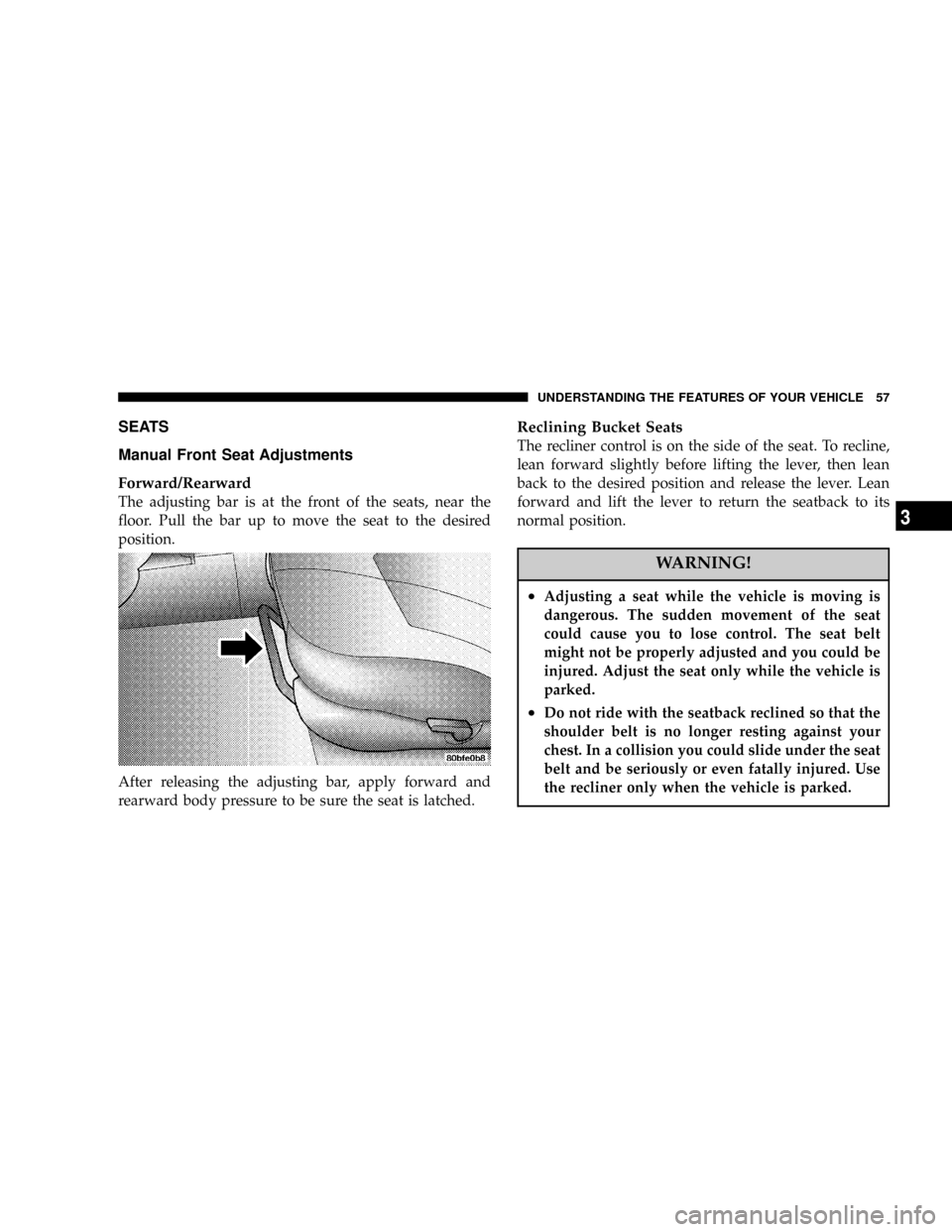
Forward/Rearward
The adjusting bar is at the front of the seats, near the
floor. Pull the bar up to move the seat to the desired
position.
After releasing the adjusting bar, apply forward and
rearward body pressure to be sure the seat is latched.
Reclining Bucket Seats
The recliner control is on the side of the seat. To recline,
lean forward slightly before lifting the lever, then lean
back to the desired position and release the lever. Lean
forward and lift the lever to return the seatback to its
normal position.
WARNING!
²Adjusting a seat while the vehicle is moving is
dangerous. The sudden movement of the seat
could cause you to lose control. The seat belt
might not be properly adjusted and you could be
injured. Adjust the seat only while the vehicle is
parked.
²Do not ride with the seatback reclined so that the
shoulder belt is no longer resting against your
chest. In a collision you could slide under the seat
belt and be seriously or even fatally injured. Use
the recliner only when the vehicle is parked.
UNDERSTANDING THE FEATURES OF YOUR VEHICLE 57
3
Page 61 of 273
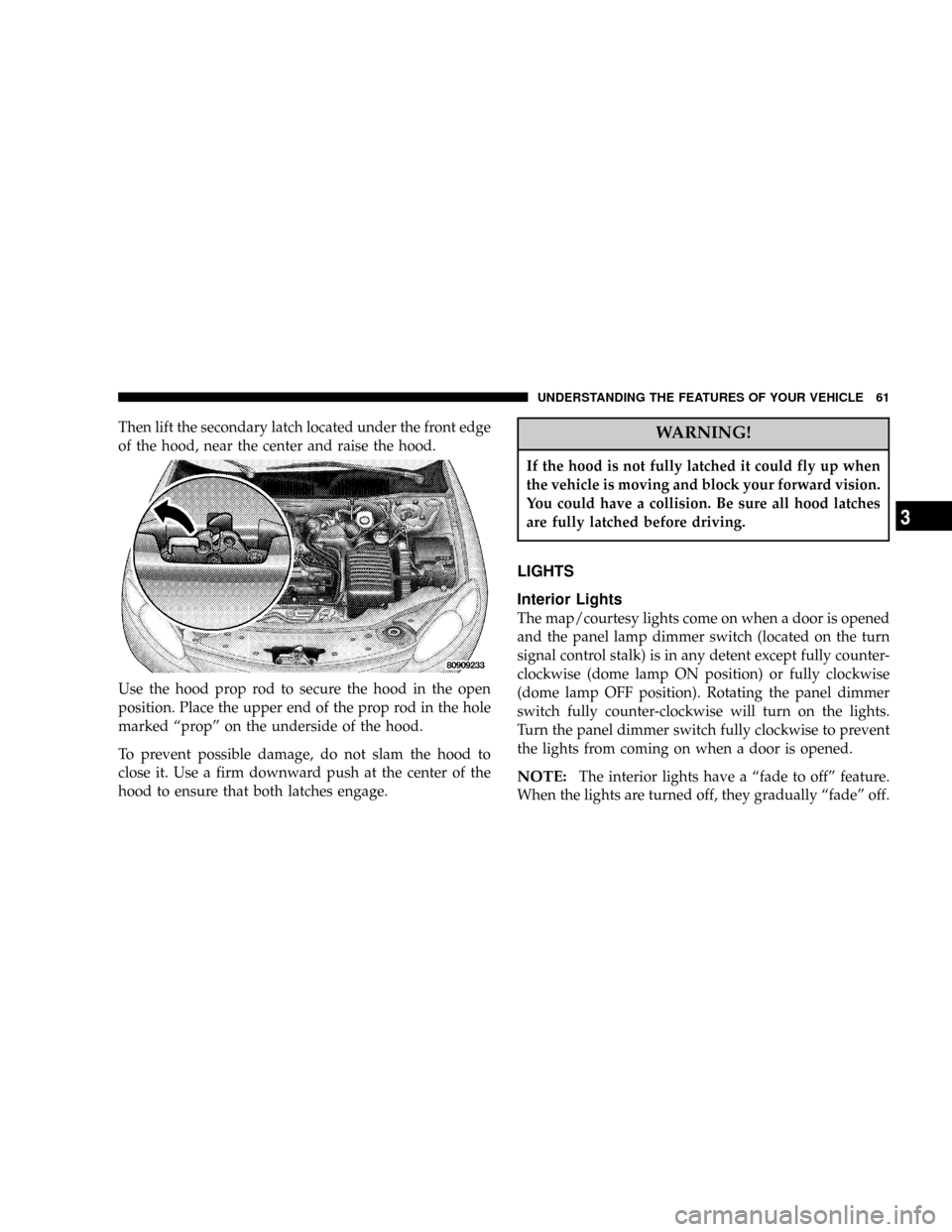
Then lift the secondary latch located under the front edge
of the hood, near the center and raise the hood.
Use the hood prop rod to secure the hood in the open
position. Place the upper end of the prop rod in the hole
marked ªpropº on the underside of the hood.
To prevent possible damage, do not slam the hood to
close it. Use a firm downward push at the center of the
hood to ensure that both latches engage.WARNING!
If the hood is not fully latched it could fly up when
the vehicle is moving and block your forward vision.
You could have a collision. Be sure all hood latches
are fully latched before driving.
LIGHTS
Interior Lights
The map/courtesy lights come on when a door is opened
and the panel lamp dimmer switch (located on the turn
signal control stalk) is in any detent except fully counter-
clockwise (dome lamp ON position) or fully clockwise
(dome lamp OFF position). Rotating the panel dimmer
switch fully counter-clockwise will turn on the lights.
Turn the panel dimmer switch fully clockwise to prevent
the lights from coming on when a door is opened.
NOTE:The interior lights have a ªfade to offº feature.
When the lights are turned off, they gradually ªfadeº off.
UNDERSTANDING THE FEATURES OF YOUR VEHICLE 61
3