brake CHRYSLER SEBRING 2004 2.G Owner's Manual
[x] Cancel search | Manufacturer: CHRYSLER, Model Year: 2004, Model line: SEBRING, Model: CHRYSLER SEBRING 2004 2.GPages: 273, PDF Size: 4.88 MB
Page 174 of 273
JACKING AND TIRE CHANGING
WARNING!
²Getting under a jacked-up vehicle is dangerous.
The vehicle could slip off the jack and fall on you.
You could be crushed. Never get any part of your
body under a vehicle that is on a jack. Never start
or run the engine while the vehicle is on a jack. If
you need to get under a raised vehicle, take it to a
service center where it can be raised on a lift.
²Do not attempt to change a tire on the side of the
vehicle close to moving traffic. Pull far enough off
the road to avoid the danger of being hit when
operating the jack or changing the wheel.
²The jack is designed to use as a tool for changing
tires only. The jack should not be used to lift the
vehicle for service purposes. The vehicle should
be jacked on a firm level surface only. Avoid ice or
slippery areas.
Preparations for Jacking
Park the vehicle on a firm level surface, avoid ice or
slippery areas, and set the parking brake. Place the gear
selector in PARK.
²Turn on the Hazard Warning Flasher, park vehicle on
firm, level surface.
²Put gear shift in park (automatic transmission) or
reverse (manual transmission).
²Set parking brake and turn off engine.
²Passengers should not remain in the vehicle while the
vehicle is being jacked.
Changing a Tire
The spare wheel, scissors jack, and lug wrench are
stowed under the spare tire cover in the rear cargo area.
Do not attempt to raise this vehicle using a bumper jack.
174 WHAT TO DO IN EMERGENCIES
Page 179 of 273
JUMP-STARTING THE BATTERY
WARNING!
²Do not attempt to push or tow your vehicle to get
it started. Vehicles equipped with an automatic
transaxle cannot be started this way. Unburned
fuel could enter the catalytic converter and once
the engine has started, ignite and damage the
converter and vehicle. If the vehicle has a dis-
charged battery, booster cables may be used to
obtain a start from another vehicle. This type of
start can be dangerous if done improperly, so
follow this procedure carefully.
²Take care to avoid the radiator cooling fan when-
ever the hood is raised. It can start anytime the
ignition switch is on. You can be hurt by the fan.
NOTE:The battery is stored in a compartment behind
the left front fender and is accessible without removing
the tire and wheel. Remote battery terminals are located
in the engine compartment for jump starting.1. Wear eye protection and remove any metal jewelry
such as watch bands or bracelets that might make an
inadvertent electrical contact.
2. When boosting from a battery in another vehicle, park
that vehicle within booster cable reach but without
letting the vehicles touch. Set parking brake, place auto-
matic transaxle in PARK and turn ignition to OFF for
both vehicles.
3. Turn off the heater, radio and all unnecessary electrical
loads.
4. Connect one end of a jumper cable to the positive
terminal of the booster battery. Connect the other end to
the positive jump start attachment of the discharged
battery.
WHAT TO DO IN EMERGENCIES 179
6
Page 185 of 273
MAINTAINING YOUR VEHICLE
CONTENTS
m2.4L Engine..........................187
m2.7L Engine..........................188
mOnboard Diagnostic System Ð OBD II......189
mEmissions Inspection And Maintenance
Programs
............................190
mReplacement Parts.....................191
mDealer Service........................191
mMaintenance Procedures.................192
NEngine Oil..........................192
NCrankcase Emission Control System........198
NMaintenance-Free Battery................198
NAir Conditioner......................199NPower Steering Fluid Check..............200
NSuspension Ball Joints..................201
NBody Mechanism Lubrication.............201
NWindshield Wiper Blades................203
NWindshield Washers...................203
NExhaust System......................204
NCooling System.......................205
NHoses And Vacuum/Vapor Harnesses.......209
NBrakes.............................209
NFuel System Hoses....................211
NAutomatic Transmission................211
7
Page 202 of 273

Multi-Purpose Lubricant, NLGI Grade 2, should be ap-
plied sparingly to all pivot and sliding contact areas.
External Lock Cylinders
Lubricate the external lock cylinders twice a year, prefer-
ably in the fall and spring. Apply a small amount of
lubricant, such as Mopar Lock Cylinder Lubricant di-
rectly into the lock cylinder (avoid excess lubricant).
Insert the key into the lock cylinder and rotate from the
unlocked to the locked position; without adding more
lubricant. Repeat this procedure three or four times. Wipe
all the lubricant off the key with a clean cloth, to avoid
soiling clothing.
If you use a lubricant that cannot be dispensed directly
into the lock cylinder, apply a small amount of the
lubricant to the key. Insert the key into the lock cylinder,
then proceed as described above, to distribute the lubri-
cant within the lock cylinder. Pay attention to trunk
hinges, especially during cold weather, to ensure ease of
trunk operation.
Other Body Mechanisms
The following body mechanisms should be inspected
and, if necessary, all pivot and sliding contact areas of
these components should be lubricated with the lubricant
specified as follows:
Engine Oil
²
Door hinges
²Hood hinges
²Trunk hinges
Smooth White Body Lubricant - Such as Mopar
Spray White Lube:
²
Hood hinge springs and links
²Lock cylinders
²Parking brake mechanism
²Trunk latches
²Ash tray
202 MAINTAINING YOUR VEHICLE
Page 209 of 273
ONLY the correct type thermostat. Other designs may
result in unsatisfactory cooling performance, poor gas
mileage, and increased emissions.
Hoses and Vacuum/Vapor Harnesses
Inspect surfaces of hoses and nylon tubing for evidence
of heat and mechanical damage. Hard or soft spots,
brittle rubber, cracking, checking, tears, cuts, abrasions,
and excessive swelling indicate deterioration of the rub-
ber.
Pay particular attention to those hoses nearest to high
heat sources such as the exhaust manifold. Inspect hose
routing to be sure hoses do not touch any heat source or
moving component that may cause heat damage or
mechanical wear.
Insure nylon tubing in these areas has not melted or
collapsed. Inspect all hose connections such as clamps
and couplings to make sure they are secure and no leaks
are present. Components should be replaced immedi-
ately if there is any evidence of degradation that could
cause failure.
Brakes
In order to assure brake system performance, all brake
system components should be inspected periodically.
Suggested service intervals can be found in section 8.
WARNING!
Riding the brakes can lead to brake failure and
possibly an accident. Driving with your foot resting
or riding on the brake pedal can result in abnormally
high brake temperatures, excessive lining wear, and
possible brake damage. You may not have your full
braking capacity in an emergency.
Brake and Power Steering System Hoses
When servicing the vehicle for scheduled maintenance,
inspect surface of hoses and nylon tubing for evidence of
heat and mechanical damage. Hard and brittle rubber,
cracking, checking, tears, cuts, abrasion, and excessive
swelling suggest deterioration of the rubber. Particular
attention should be made to examining those hose sur-
faces nearest to high heat sources, such as the exhaust
manifold.
MAINTAINING YOUR VEHICLE 209
7
Page 210 of 273
Inspect all hose clamps and couplings to make sure they
are secure and no leaks are present.
Insure nylon tubing in these areas has not melted or
collapsed.
NOTE:Often, fluids such as oil, power steering fluid,
and brake fluid are used during assembly plant opera-
tions to ease the assembly of hoses to couplings. There-
fore, oil wetness at the hose-coupling area is not neces-
sarily an indication of leakage. Actual dripping of hot
fluid when systems are under pressure (during vehicle
operation) should be noted before hose is replaced based
on leakage.
NOTE:Inspection of brake hoses should be done
whenever the brake system is serviced and every engine
oil change.
WARNING!
Worn brake hoses can burst and cause brake failure.
You could have an accident. If you see any signs of
cracking, scuffing, or worn spots, have the brake
hoses replaced immediately.
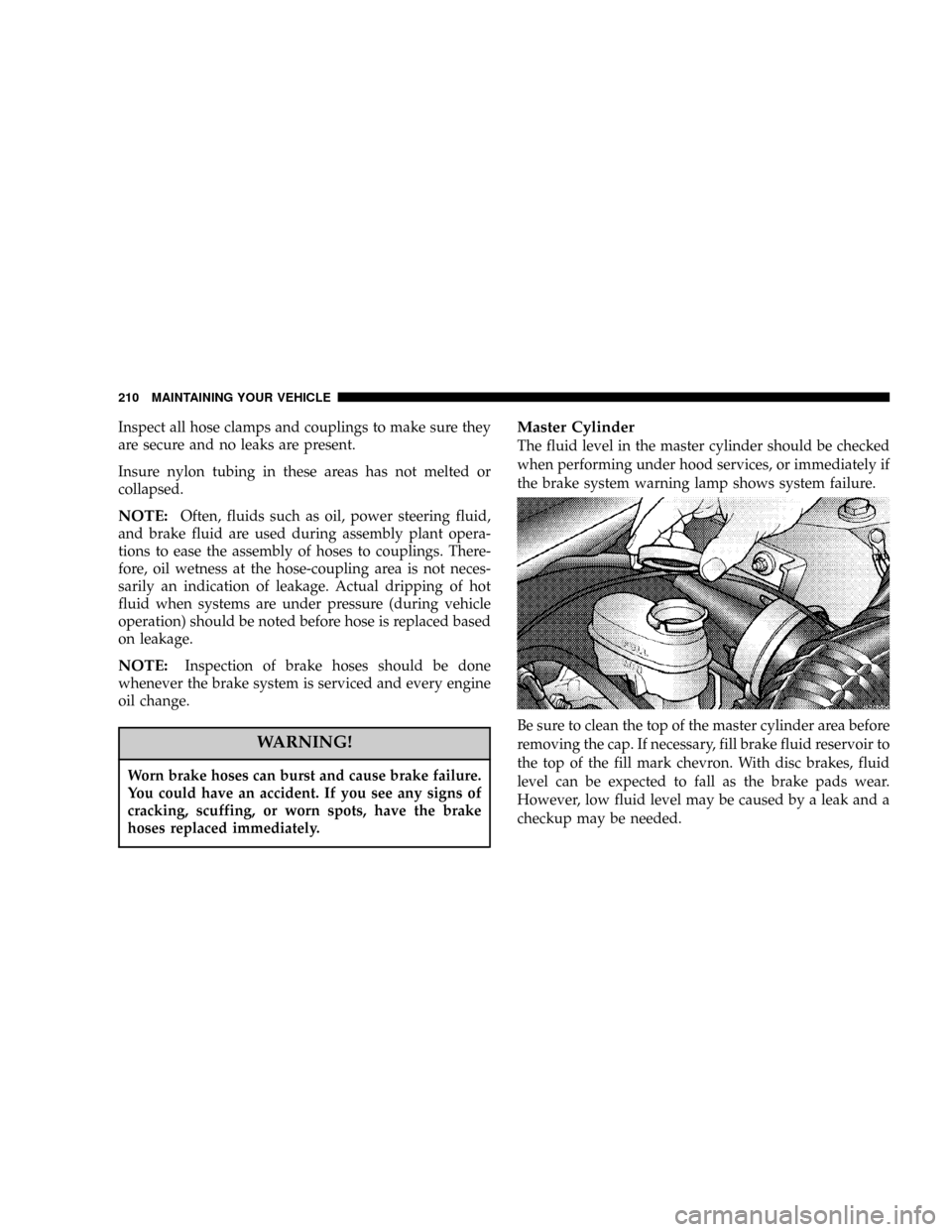
Master Cylinder
The fluid level in the master cylinder should be checked
when performing under hood services, or immediately if
the brake system warning lamp shows system failure.
Be sure to clean the top of the master cylinder area before
removing the cap. If necessary, fill brake fluid reservoir to
the top of the fill mark chevron. With disc brakes, fluid
level can be expected to fall as the brake pads wear.
However, low fluid level may be caused by a leak and a
checkup may be needed.
210 MAINTAINING YOUR VEHICLE
Page 211 of 273
Use only manufacturer's recommended brake fluid, refer
to Recommended Fluids, Lubricants and Genuine Parts
for correct fluid type.
WARNING!
Use of a brake fluid that has a lower initial boiling
point than MOPAR DOT 3 Brake Fluid or that is
unidentified as to DOT FMVSS specification may
result in sudden brake failure during hard or pro-
longed braking. You could have an accident.
WARNING!
Overfilling the brake fluid reservoir can result in
spilling brake fluid on hot engine parts and the
brake fluid catching fire.
Use only brake fluid that has been in a tightly closed
container to avoid contamination from foreign matter.Do not allow petroleum base fluid to contaminate the
brake fluid as seal damage will result!
Fuel System Hoses
Electronic Fuel Injection high pressure fuel systems are
designed with hoses and clamps which have unique
material characteristics to provide adequate sealing and
resist attack by deteriorated gasoline.
You are urged to use only manufacturer specified hoses
and clamps, or their equivalent in material and specifi-
cation, in any fuel system servicing. It is mandatory to
replace all clamps that have been loosened or removed
during service. Care should be taken in installing new
clamps to insure they are properly torqued.
Automatic Transmission
Your front wheel drive vehicle has a transmission and
differential assembly contained within a single housing.
This is referred to as a ªTransaxle.º
MAINTAINING YOUR VEHICLE 211
7
Page 212 of 273

Selection of Lubricant
It is important that the proper lubricant is used in the
transmission to assure optimum transmission perfor-
mance. Use only manufacturers recommended transmis-
sion fluid, refer to Recommended Fluids, Lubricants and
Genuine Parts for correct fluid type. It is important that
the transmission fluid be maintained at the prescribed
level using the recommended fluid.
CAUTION!
Using a transmission fluid other than the manufac-
turers recommended fluid may cause deterioration
in transmission shift quality and/or torque converter
shudder. Using a transmission fluid other than the
manufacturers recommended fluid will result in
more frequent fluid and filter changes. Refer to
Recommended Fluids, Lubricants and Genuine Parts
for correct fluid type.
Procedure For Checking Fluid Level
The fluid level in the automatic transaxle should be
checked whenever the vehicle is serviced. Operation with
an improper fluid level will greatly reduce the life of the
transaxle and of the fluid.
To properly check the automatic transaxle fluid level, the
following procedure must be used:
²The vehicle must be on level ground.
²The engine should be running at curb idle speed for a
minimum of 60 seconds.
²Fully apply parking brake.
²Place the gear selector momentarily in each gear
position ending with the lever in P (PARK).
²Wipe the dipstick clean and reinsert until seated.
Remove dipstick and note reading.
²If the fluid is cold (80ÉF / 27ÉC), the reading should be
in the cross hatched area marked ªCOLDº (between
the lower two holes in the dipstick).
212 MAINTAINING YOUR VEHICLE
Page 220 of 273
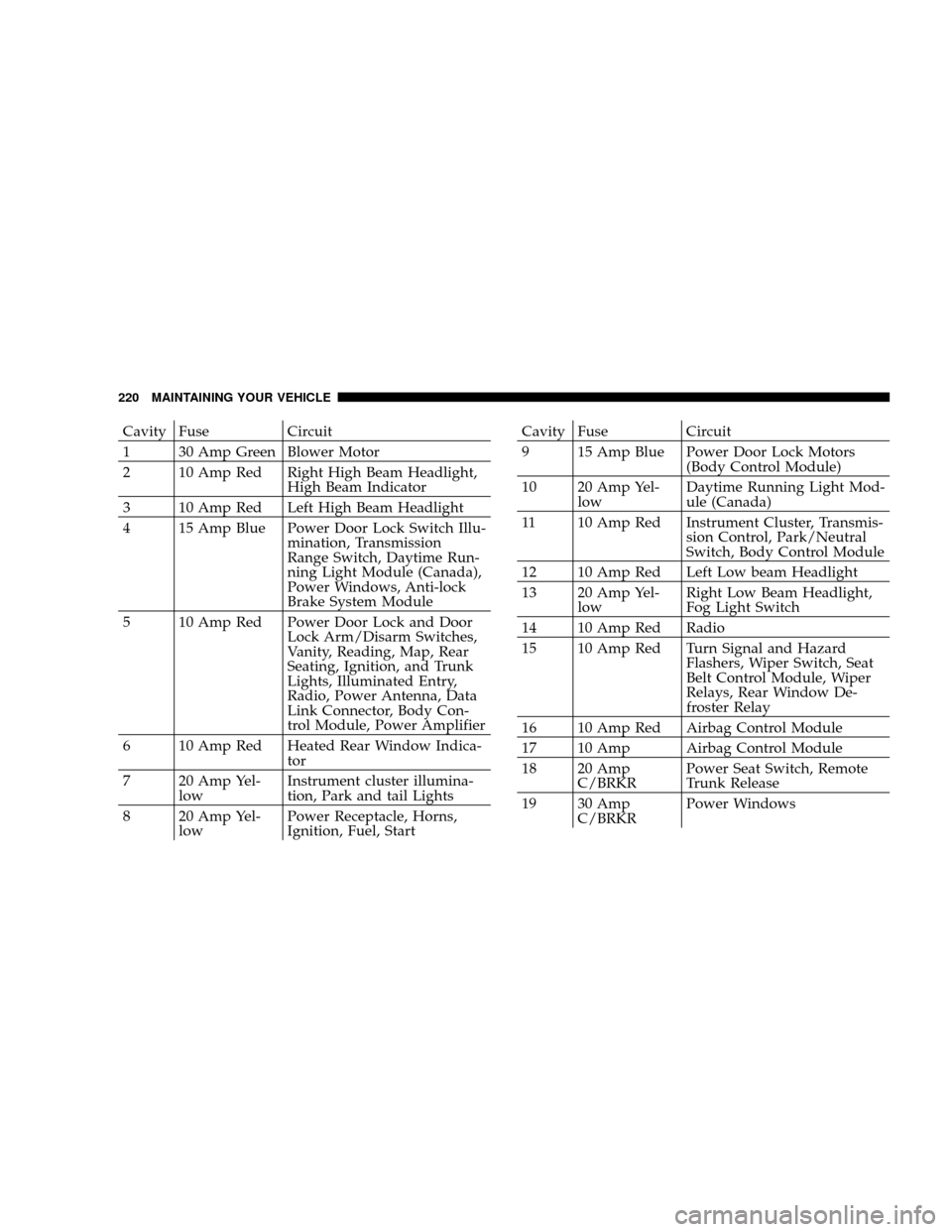
Cavity Fuse Circuit
1 30 Amp Green Blower Motor
2 10 Amp Red Right High Beam Headlight,
High Beam Indicator
3 10 Amp Red Left High Beam Headlight
4 15 Amp Blue Power Door Lock Switch Illu-
mination, Transmission
Range Switch, Daytime Run-
ning Light Module (Canada),
Power Windows, Anti-lock
Brake System Module
5 10 Amp Red Power Door Lock and Door
Lock Arm/Disarm Switches,
Vanity, Reading, Map, Rear
Seating, Ignition, and Trunk
Lights, Illuminated Entry,
Radio, Power Antenna, Data
Link Connector, Body Con-
trol Module, Power Amplifier
6 10 Amp Red Heated Rear Window Indica-
tor
7 20 Amp Yel-
lowInstrument cluster illumina-
tion, Park and tail Lights
8 20 Amp Yel-
lowPower Receptacle, Horns,
Ignition, Fuel, StartCavity Fuse Circuit
9 15 Amp Blue Power Door Lock Motors
(Body Control Module)
10 20 Amp Yel-
lowDaytime Running Light Mod-
ule (Canada)
11 10 Amp Red Instrument Cluster, Transmis-
sion Control, Park/Neutral
Switch, Body Control Module
12 10 Amp Red Left Low beam Headlight
13 20 Amp Yel-
lowRight Low Beam Headlight,
Fog Light Switch
14 10 Amp Red Radio
15 10 Amp Red Turn Signal and Hazard
Flashers, Wiper Switch, Seat
Belt Control Module, Wiper
Relays, Rear Window De-
froster Relay
16 10 Amp Red Airbag Control Module
17 10 Amp Airbag Control Module
18 20 Amp
C/BRKRPower Seat Switch, Remote
Trunk Release
19 30 Amp
C/BRKRPower Windows
220 MAINTAINING YOUR VEHICLE
Page 229 of 273
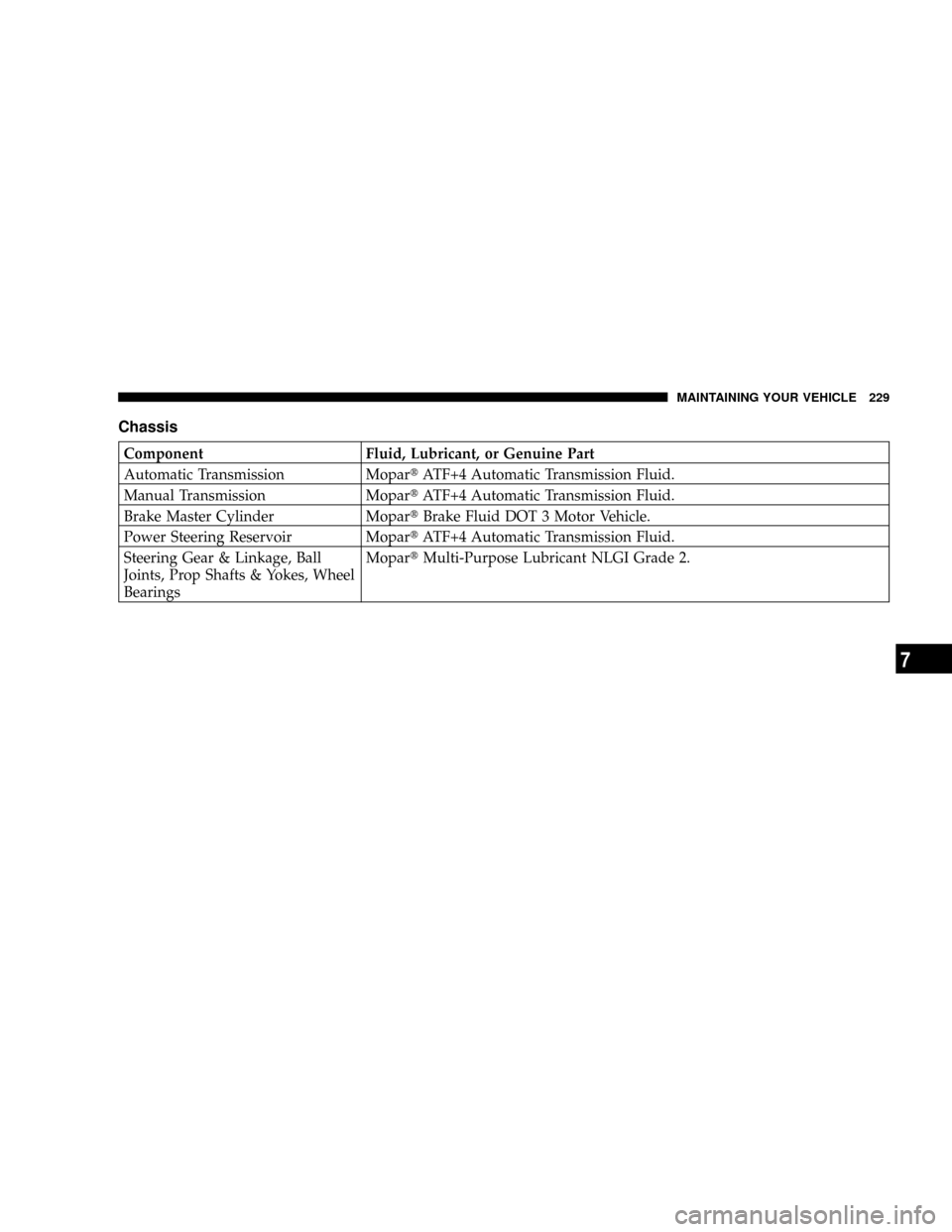
Chassis
Component Fluid, Lubricant, or Genuine Part
Automatic Transmission MopartATF+4 Automatic Transmission Fluid.
Manual Transmission MopartATF+4 Automatic Transmission Fluid.
Brake Master Cylinder MopartBrake Fluid DOT 3 Motor Vehicle.
Power Steering Reservoir MopartATF+4 Automatic Transmission Fluid.
Steering Gear & Linkage, Ball
Joints, Prop Shafts & Yokes, Wheel
BearingsMopartMulti-Purpose Lubricant NLGI Grade 2.
MAINTAINING YOUR VEHICLE 229
7