airbag CHRYSLER SEBRING 2010 3.G Owner's Manual
[x] Cancel search | Manufacturer: CHRYSLER, Model Year: 2010, Model line: SEBRING, Model: CHRYSLER SEBRING 2010 3.GPages: 444, PDF Size: 7.84 MB
Page 71 of 444
There are different sizes and types of restraints for
children from newborn size to the child almost large
enough for an adult safety belt. Always check the child
seat owner’s manual to ensure you have the correct seat
for your child. Use the restraint that is correct for your
child.
Infants and Small Children
•
Safety experts recommend that children ride
rearward-facing in the vehicle until they are at least
one year old and weigh at least 20 lbs (9 kg). Two types
of child restraints can be used rearward-facing: infant
carriers and convertible child seats. Both types of child
restraints are held in the vehicle by the lap/shoulder
belt or the LATCH child restraint anchorage system.
•The infant carrier is only used rearward-facing in the
vehicle. It is recommended for children who weigh up
to about 20 lbs (9 kg). Convertible child seats can be
used either rearward-facing or forward-facing in the
vehicle. Convertible child seats often have a higher
weight limit in the rearward-facing direction than
infant carriers do, so they can be used rearward-facing
by children who weigh more than 20 lbs (9 kg) but are
less than one year old.
WARNING!
Rearward-facing child seats must NEVER be used in
the front seat of a vehicle with a front passenger
airbag. An airbag deployment could cause severe
injury or death to infants in this position.
70 THINGS TO KNOW BEFORE STARTING YOUR VEHICLE
Page 72 of 444
Older Children and Child Restraints
Children who weigh more than 20 lbs (9 kg) and who are
older than one year can ride forward-facing in the
vehicle. Forward-facing child seats and convertible child
seats used in the forward-facing direction are for children
who weigh 20 to 40 lbs (9 to 18 kg) and who are older
than one year. These child seats are also held in the
vehicle by the lap/shoulder belt or the LATCH child
restraint anchorage system. Refer to “LATCH — Child
Seat Anchorage System (Lower Anchors and Tether for
CHildren)”.
The belt-positioning booster seat is for children weighing
more than 40 lbs (18 kg), but who are still too small to fit
the vehicle’s seat belts properly. If the child cannot sit
with knees bent over the vehicle’s cushion while the
child’s back is against the seatback, then the child should
use a belt-positioning booster seat. The child and booster
seat are held in the vehicle by the lap/shoulder belt.
WARNING!
•Improper installation can lead to failure of an
infant or child restraint. It could come loose in a
collision. The child could be badly injured or
killed. Follow the manufacturer’s directions ex-
actly when installing an infant or child restraint.
•A rearward-facing child restraint should only be
used in a rear seat. A rearward-facing child re-
straint in the front seat may be struck by a deploy-
ing passenger airbag which may cause severe or
fatal injury to the infant.
Here are some tips on getting the most out of your
child restraints:
•
Children who are large enough to wear the shoulder
belt comfortably, and whose legs are long enough to
2
THINGS TO KNOW BEFORE STARTING YOUR VEHICLE 71
Page 80 of 444
Children Too Large for Booster Seats
Children who are large enough to wear the shoulder belt
comfortably, and whose legs are long enough to bend
over the front of the seat when their back is against the
seatback, should use the lap/shoulder belt in a rear seat.
Make sure that:
•The child is upright in the seat.
•The lap portion should be low on the hips and as snug
as possible.
•Check belt fit periodically. A child’s squirming or
slouching can move the belt out of position.
•If the shoulder belt contacts the face or neck, move the
child closer to the center of the vehicle. Never allow a
child to put the shoulder belt under an arm or behind
their back.
Transporting Pets
Airbags deploying in the front seat could harm your pet.
An unrestrained pet will be thrown about and possibly
injured, or injure a passenger during panic braking or in
a collision.
Pets should be restrained in the rear seat in pet harnesses
or pet carriers that are secured by seat belts.
ENGINE BREAK-IN RECOMMENDATIONS
A long break-in period is not required for the engine and
drivetrain (transmission and axle) in your vehicle.
Drive moderately during the first 300 miles (500 km).
After the initial 60 miles (100 km), speeds up to 50 or
55 mph (80 or 90 km/h) are desirable.
While cruising, brief full-throttle acceleration within the
limits of local traffic laws, contributes to a good break-in.
Wide-open throttle acceleration in low gear can be detri-
mental and should be avoided.
2
THINGS TO KNOW BEFORE STARTING YOUR VEHICLE 79
Page 83 of 444
Safety Checks You Should Make Inside the
Vehicle
Seat Belts
Inspect the belt system periodically, checking for cuts,
frays, and loose parts. Damaged parts must be replaced
immediately. Do not disassemble or modify the system.
Front seat belt assemblies must be replaced after a
collision. Rear seat belt assemblies must be replaced after
a collision if they have been damaged (i.e., bent retractor,
torn webbing, etc.). If there is any question regarding belt
or retractor condition, replace the belt.
Airbag Warning Light
The light should come on and remain on for four to eight
seconds as a bulb check when the ignition switch is first
turned ON. If the light is not lit during starting, see your
authorized dealer. If the light stays on, flickers, or comes
on while driving, have the system checked by an autho-
rized dealer.
Defroster
Check operation by selecting the defrost mode and place
the blower control on high speed. You should be able to
feel the air directed against the windshield. See your
authorized dealer for service if your defroster is
inoperable.
Floor Mat Safety Information
Always use floor mats designed to fit the foot well of
your vehicle. Use only floor mats that leave the pedal
area unobstructed and that are firmly secured so that
they cannot slip out of position and interfere with the
pedals or impair safe operation of your vehicle in other
ways.
82 THINGS TO KNOW BEFORE STARTING YOUR VEHICLE
Page 144 of 444
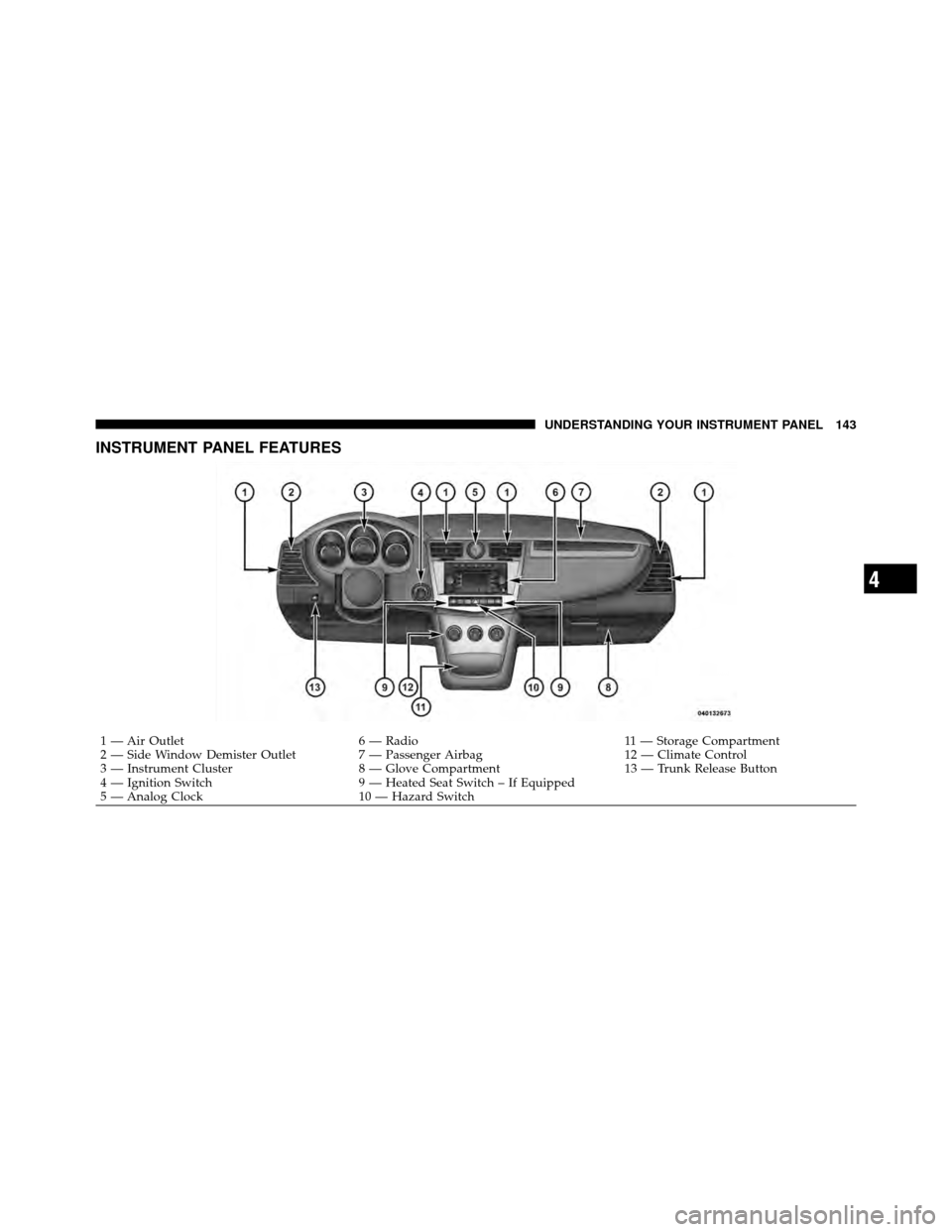
INSTRUMENT PANEL FEATURES
1 — Air Outlet6 — Radio 11 — Storage Compartment
2 — Side Window Demister Outlet 7 — Passenger Airbag 12 — Climate Control
3 — Instrument Cluster 8 — Glove Compartment 13 — Trunk Release Button
4 — Ignition Switch 9 — Heated Seat Switch – If Equipped
5 — Analog Clock 10 — Hazard Switch
4
UNDERSTANDING YOUR INSTRUMENT PANEL 143
Page 147 of 444
5. Low Fuel LightWhen the fuel level drops to approximately 2.0 gal-
lons (7.6 Liters), the fuel symbol will light and a
single chime will sound.
NOTE: This light will remain on until a minimum of
approximately 3.0 gallons of fuel is added.
6. Charging System Light This light shows the status of the electrical charg-
ing system. The light should come on briefly when
the ignition is first turned on and remain on briefly as a
bulb check. If the light stays on or comes on while
driving, turn off some of the vehicle’s electrical devices,
such as the Front Fog Lights or Rear Window Defroster.
If the Charging System Light remains on, it means that
the vehicle is experiencing a problem with the charging
system. Obtain SERVICE IMMEDIATELY. See your local
authorized dealer. If jump starting is required, refer to “Jump Starting
Procedures” in “What To Do In Emergencies”.
7. Airbag Warning Light
The light comes on and remains on for six to
eight seconds as a bulb check when the ignition
switch is first turned ON. If the light does not
turn on during starting, stays on, or turns on
while driving, have the system inspected by an autho-
rized dealer. Refer to “Occupant Restraints” in “Things
To Know Before Starting Your Vehicle” for further infor-
mation.
8. Seat Belt Reminder Light When the ignition switch is first turned ON, this
light will come on for about six seconds. A chime
will sound if you have not pulled the shoulder belt
out of the retractor. This is a reminder to “buckle up”. If
146 UNDERSTANDING YOUR INSTRUMENT PANEL
Page 425 of 444
About Your Brakes....................... 254
ABS (Anti-Lock Brake System) .............. 256
Adding Engine Coolant (Antifreeze) .......... 362
Adding Fuel ........................... 303
Adding Washer Fluid ..................... 358
Additives, Fuel ......................... 297
Air Cleaner, Engine (Engine Air Cleaner Filter) . . . 352
Air Conditioner Maintenance ............... 354
Air Conditioning ........................ 219
Air Conditioning Controls ................. 219
Air Conditioning Filter .................230,355
Air Conditioning, Operating Tips ............ 231
Air Conditioning Refrigerant .............354,355
Air Conditioning System .............219,223,354
Air Pressure, Tires ....................... 277
Airbag .............................. 53,63
Airbag Deployment ....................... 64
Airbag Light ..................... 62,67,82,146
Airbag Maintenance ....................... 66 Airbag, Side
........................ 56,60,63
Airbag, Window (Side Curtain) ...........57,60,63
Alarm System (Security Alarm) ............18,153
Alterations/Modifications, Vehicle ............. 7
Antenna, Satellite Radio ................... 212
Antifreeze (Engine Coolant) ..............362,392
Disposal ............................ 364
Anti-Lock Brake System (ABS) .............. 256
Anti-Lock Warning Light .................. 256
Anti-Theft Security Alarm (Theft Alarm) ........ 18
Appearance Care ........................ 371
Ashtray ............................... 131
Auto Down Power Windows ................ 34
Auto Unlock, Doors ....................... 31
Auto Up Power Windows ................35,128
Automatic Dimming Mirror ................. 90
Automatic Door Locks ................... 30,31
Automatic Oil Change Indicator ........151,161,396
Automatic Temperature Control (ATC) ......... 223
424 INDEX
Page 434 of 444
LATCH
(Lower Anchors and Tether for CHildren)....... 75
Latches ................................ 84
Hood .............................. 104
Lead Free Gasoline ...................... 294
Leaks, Fluid ............................ 84
Life of Tires ............................ 282
Light Bulbs .......................... 84,382
Lights .............................. 84,105
Airbag ........................ 62,67,82,146
Back-Up ............................ 387
Brake Warning ........................ 147
Bulb Replacement ...................... 383
Center Mounted Stop ................... 391
Daytime Running ...................... 109
Electronic Stability Program (ESP) Indicator . . . 263
Engine Temperature Warning .............. 147
Exterior .............................. 84
Fog .......................... 109,153,385Headlight Switch
...................... 106
Headlights ........................... 106
Headlights On With Wipers ............... 115
High Beam Indicator .................... 158
Illuminated Entry ....................... 20
Instrument Cluster ..................... 106
Interior ............................. 111
License ............................. 390
Lights On Reminder .................... 110
Low Fuel ............................ 146
Malfunction Indicator (Check Engine) ........ 156
Map Reading ......................... 111
Oil Pressure .......................... 147
Passing ............................. 108
Rear Tail ............................ 387
Seat Belt Reminder ..................... 146
Security Alarm (Theft Alarm) .............. 18
Theft Alarm (Security Alarm) .............. 153
Tire Pressure Monitoring (TPMS) ........155,285
10
INDEX 433
Page 439 of 444
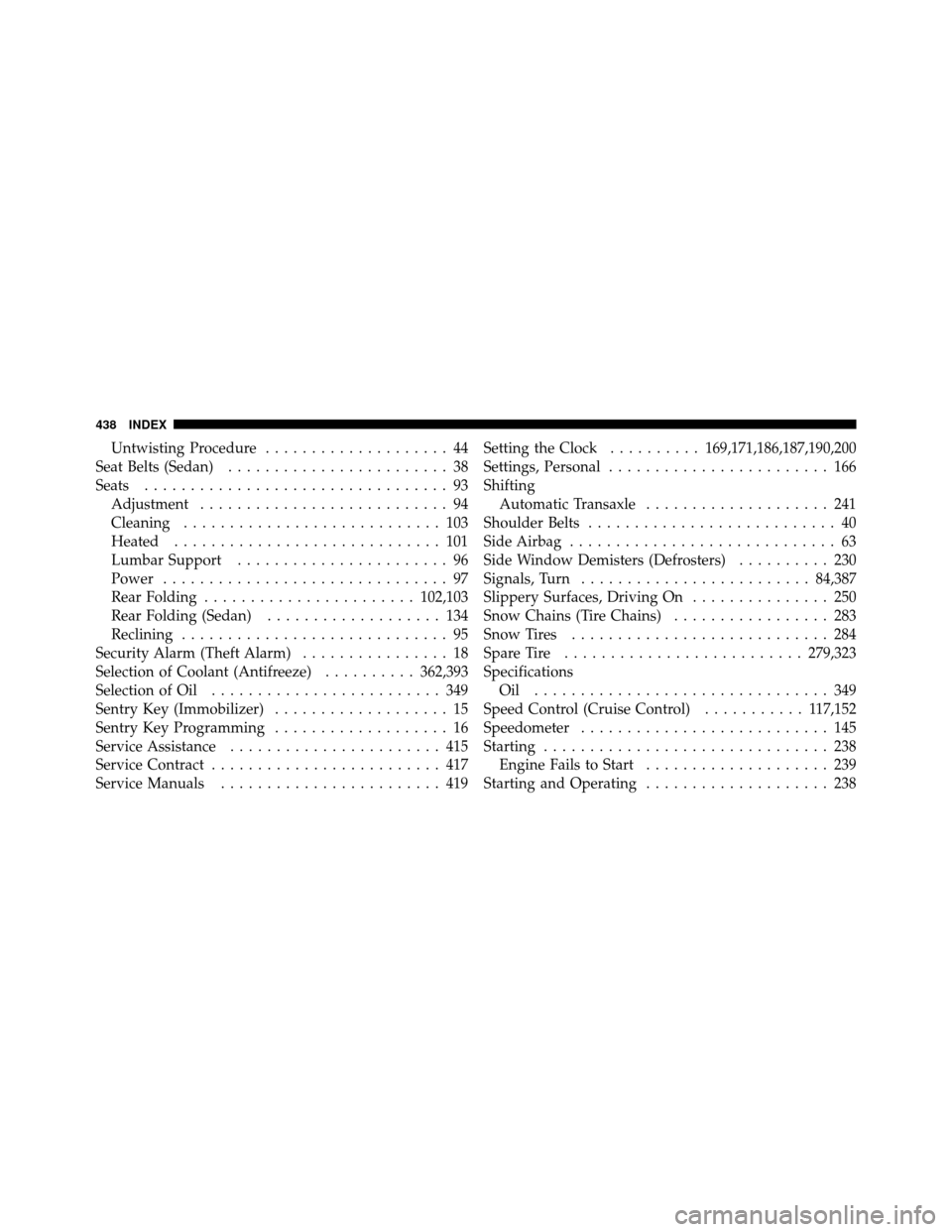
Untwisting Procedure.................... 44
Seat Belts (Sedan) ........................ 38
Seats ................................. 93
Adjustment ........................... 94
Cleaning ............................ 103
Heated ............................. 101
Lumbar Support ....................... 96
Power ............................... 97
Rear Folding ....................... 102,103
Rear Folding (Sedan) ................... 134
Reclining ............................. 95
Security Alarm (Theft Alarm) ................ 18
Selection of Coolant (Antifreeze) ..........362,393
Selection of Oil ......................... 349
Sentry Key (Immobilizer) ................... 15
Sentry Key Programming ................... 16
Service Assistance ....................... 415
Service Contract ......................... 417
Service Manuals ........................ 419 Setting the Clock
..........169,171,186,187,190,200
Settings, Personal ........................ 166
Shifting Automatic Transaxle .................... 241
Shoulder Belts ........................... 40
Side Airbag ............................. 63
Side Window Demisters (Defrosters) .......... 230
Signals, Turn ......................... 84,387
Slippery Surfaces, Driving On ............... 250
Snow Chains (Tire Chains) ................. 283
Snow Tires ............................ 284
Spare Tire .......................... 279,323
Specifications Oil ................................ 349
Speed Control (Cruise Control) ........... 117,152
Speedometer ........................... 145
Starting ............................... 238
Engine Fails to Start .................... 239
Starting and Operating .................... 238
438 INDEX
Page 440 of 444
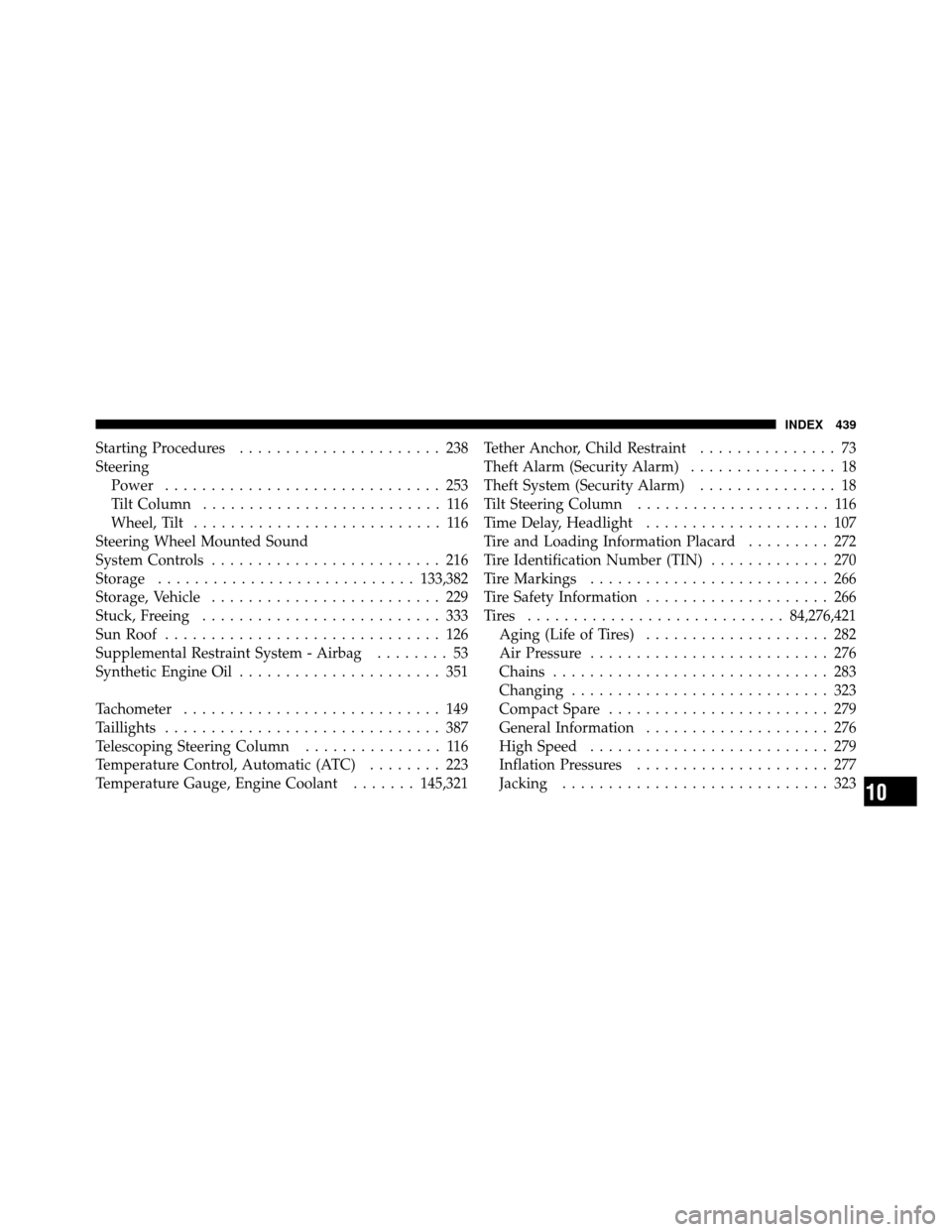
Starting Procedures...................... 238
Steering Power .............................. 253
Tilt Column .......................... 116
Wheel, Tilt ........................... 116
Steering Wheel Mounted Sound
System Controls ......................... 216
Storage ............................ 133,382
Storage, Vehicle ......................... 229
Stuck, Freeing .......................... 333
Sun Roof .............................. 126
Supplemental Restraint System - Airbag ........ 53
Synthetic Engine Oil ...................... 351
Tachometer ............................ 149
Taillights .............................. 387
Telescoping Steering Column ............... 116
Temperature Control, Automatic (ATC) ........ 223
Temperature Gauge, Engine Coolant .......145,321Tether Anchor, Child Restraint
............... 73
Theft Alarm (Security Alarm) ................ 18
Theft System (Security Alarm) ............... 18
Tilt Steering Column ..................... 116
Time Delay, Headlight .................... 107
Tire and Loading Information Placard ......... 272
Tire Identification Number (TIN) ............. 270
Tire Markings .......................... 266
Tire Safety Information .................... 266
Tires ............................ 84,276,421
Aging (Life of Tires) .................... 282
Air Pressure .......................... 276
Chains .............................. 283
Changing ............................ 323
Compact Spare ........................ 279
General Information .................... 276
High Speed .......................... 279
Inflation Pressures ..................... 277
Jacking ............................. 323
10
INDEX 439