transmission CHRYSLER SEBRING CONVERTIBLE 2004 2.G User Guide
[x] Cancel search | Manufacturer: CHRYSLER, Model Year: 2004, Model line: SEBRING CONVERTIBLE, Model: CHRYSLER SEBRING CONVERTIBLE 2004 2.GPages: 271, PDF Size: 5.31 MB
Page 141 of 271
PARKING BRAKE
When the parking brake is applied with the ignition on,
the brake light in the instrument cluster will come on.
NOTE:This light only shows that the parking brake is
on. It does not show the degree of brake application.
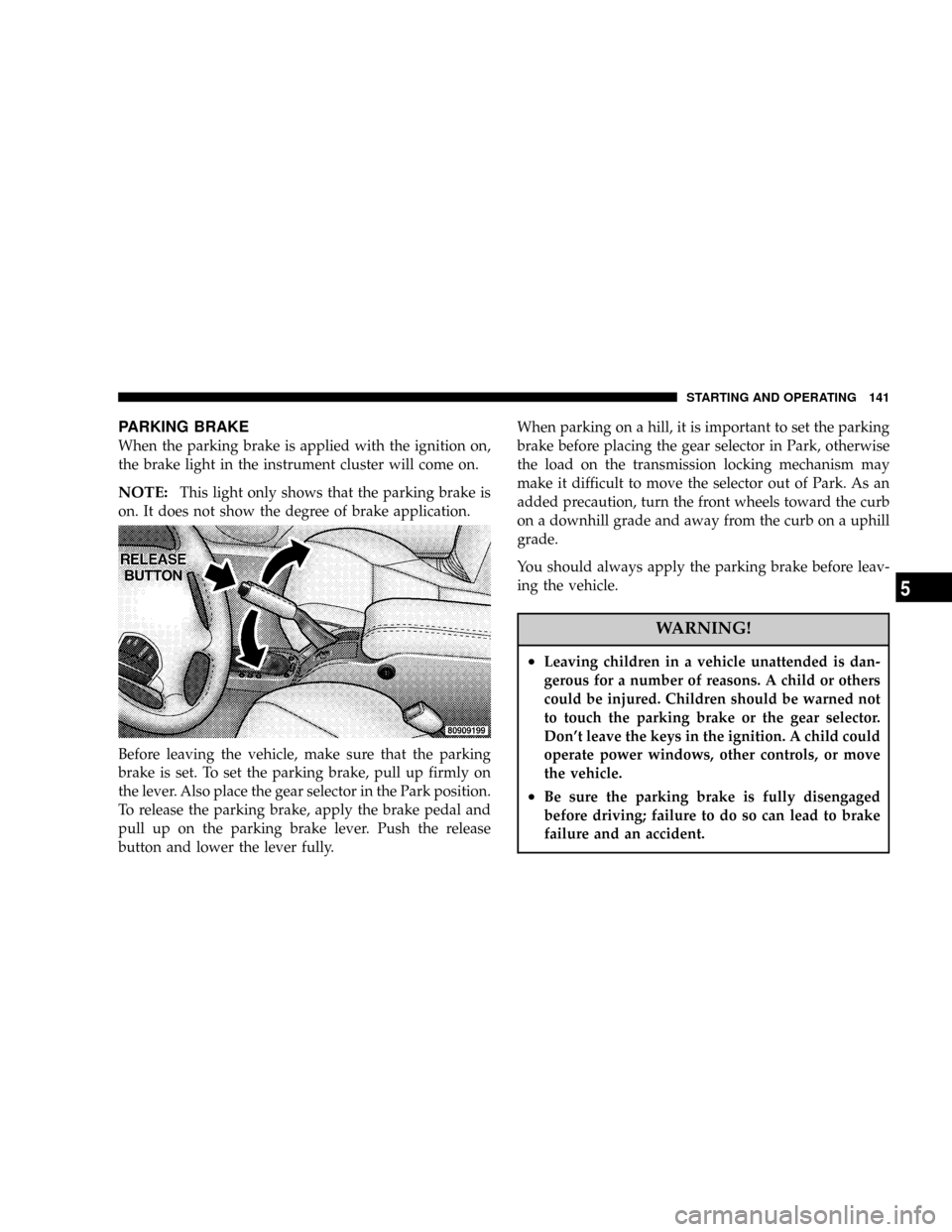
Before leaving the vehicle, make sure that the parking
brake is set. To set the parking brake, pull up firmly on
the lever. Also place the gear selector in the Park position.
To release the parking brake, apply the brake pedal and
pull up on the parking brake lever. Push the release
button and lower the lever fully.When parking on a hill, it is important to set the parking
brake before placing the gear selector in Park, otherwise
the load on the transmission locking mechanism may
make it difficult to move the selector out of Park. As an
added precaution, turn the front wheels toward the curb
on a downhill grade and away from the curb on a uphill
grade.
You should always apply the parking brake before leav-
ing the vehicle.
WARNING!
²Leaving children in a vehicle unattended is dan-
gerous for a number of reasons. A child or others
could be injured. Children should be warned not
to touch the parking brake or the gear selector.
Don't leave the keys in the ignition. A child could
operate power windows, other controls, or move
the vehicle.
²Be sure the parking brake is fully disengaged
before driving; failure to do so can lead to brake
failure and an accident.
STARTING AND OPERATING 141
5
Page 167 of 271
²The ªDº range can be selected when towing. However,
if frquent shifting occurs while in this range, the ª3º
range must be selected.
NOTE:Using the ª3º range while operating the vehicle
under heavy operating conditions will improve perfor-
mance and extend tranaxle life by reducing excessive
shifting and heat build up.
WARNING!
Connecting trailer brakes to your vehicle's hydraulic
brake lines can overload your brake system and
cause it to fail. You might not have brakes when you
need them and could have an accident.
²Do not attempt to tow a trailer while using a compact
spare tire.
²Whenever you pull a trailer, regardless of the trailer
size, stop lights and turn signals on the trailer are
recommended for motoring safety.
²The automatic transaxle fluid and filter should be
changed if you REGULARLY tow a trailer for more
than 45 minutes of continuous operation. See Schedule
ªBº in section 8 of this manual for transaxle fluid
change intervals.
NOTE:Check the automatic transaxle fluid level before
towing. Fluid discoloration, or a burnt odor, shows the
need for a transmission fluid and filter change.
NOTE:For vehicles equipped with Autostick. By using
the Autostick modes, and slecting a specific gear range,
frequent shifting can be avoided. The highest gear range
should be selected that allows for adequate performance.
For example, choose ª4º if the desired speed can be
maintaned. Choose ª3º or ª2º if needed to maintain the
desired speed.
NOTE:Extended driving at high RPM should be
avoided to prevent excess heat generation. A reduction in
vehicle speed may be required to avoid extended driving
at high RPM. Return to a higher gear range or vehicle
speed when road conditions and RPM level allows.
STARTING AND OPERATING 167
5
Page 168 of 271
FLEXIBLE FUEL ± (2.7L Engines with Automatic
Transmission Only)
E-85 General Information
The information in this section is for Flexible Fuel ve-
hicles only. These vehicles can be identified by the unique
fuel filler door label that statesEthanol (E-85) or Un-
leaded Gasoline Only.This section only covers those
subjects that are unique to these vehicles. Please refer to
the other sections of this manual for information on
features that are common between Flexible Fuel and
gasoline only powered vehicles.
CAUTION!
Only vehicles with the E-85 fuel filler door label can
operate on E-85.
ETHANOL FUEL (E-85)
E-85 is a mixture of approximately 85% fuel ethanol and
15% unleaded gasoline.
WARNING!
Ethanol vapors are extremely flammable and could
cause serious personal injury. Never have any smok-
ing materials lit in or near the vehicle when remov-
ing the fuel filler tube cap (gas cap) or filling the
tank. Do not use E-85 as a cleaning agent and never
use it near an open flame.
Fuel Requirements
Your vehicle will operate on both unleaded gasoline with
an octane rating of 87, or E-85 fuel, or any mixture of
these two.
For best results, a refueling pattern that alternates be-
tween E-85 and unleaded gasoline should be avoided.
When you do switch fuels, it is recommended that:
²you do not switch when the fuel gauge indicates less
than 1/4 full
²you do not add less than 5 gallons (19 liters) when
refueling
168 STARTING AND OPERATING
Page 176 of 271
JACKING AND TIRE CHANGING
WARNING!
²Getting under a jacked-up vehicle is dangerous.
The vehicle could slip off the jack and fall on you.
You could be crushed. Never get any part of your
body under a vehicle that is on a jack. Never start
or run the engine while the vehicle is on a jack. If
you need to get under a raised vehicle, take it to a
service center where it can be raised on a lift.
²Do not attempt to change a tire on the side of the
vehicle close to moving traffic. Pull far enough off
the road to avoid the danger of being hit when
operating the jack or changing the wheel.
²The jack is designed to use as a tool for changing
tires only. The jack should not be used to lift the
vehicle for service purposes. The vehicle should
be jacked on a firm level surface only. Avoid ice or
slippery areas.
Preparations for Jacking
Park the vehicle on a firm level surface, avoid ice or
slippery areas, and set the parking brake. Place the gear
selector in PARK.
²Turn on the Hazard Warning Flasher, park vehicle on
firm, level surface.
²Put gear shift in park (automatic transmission) or
reverse (manual transmission).
²Set parking brake and turn off engine.
²Passengers should not remain in the vehicle while the
vehicle is being jacked.
Changing a Tire
The spare wheel, scissors jack, and lug wrench are
stowed under the spare tire cover in the rear cargo area.
Do not attempt to raise this vehicle using a bumper jack.
176 WHAT TO DO IN EMERGENCIES
Page 187 of 271

MAINTAINING YOUR VEHICLE
CONTENTS
m2.4L Engine..........................189
m2.7L Engine..........................190
mOnboard Diagnostic System Ð OBD II......191
mEmissions Inspection And Maintenance
Programs
............................192
mReplacement Parts.....................193
mDealer Service........................193
mMaintenance Procedures.................194
NEngine Oil..........................194
NCrankcase Emission Control System........200
NMaintenance-Free Battery................200
NAir Conditioner......................201NPower Steering Fluid Check..............202
NSuspension Ball Joints..................203
NBody Mechanism Lubrication.............203
NWindshield Wiper Blades................205
NWindshield Washers...................205
NExhaust System......................206
NCooling System.......................207
NHoses And Vacuum/Vapor Harnesses.......211
NBrakes.............................211
NFuel System Hoses....................213
NAutomatic Transmission................213
7
Page 191 of 271

ONBOARD DIAGNOSTIC SYSTEM Ð OBD II
Your vehicle is equipped with a sophisticated onboard
diagnostic system called OBD II. This system monitors
the performance of the emissions, engine, and automatic
transmission control systems. When these systems are
operating properly, your vehicle will provide excellent
performance and fuel economy, as well as engine emis-
sions well within current government regulations.
If any of these systems require service, the OBD II system
will turn on the ªMalfunction Indicator Light.º It will
also store diagnostic codes and other information to
assist your service technician in making repairs. Al-
though your vehicle will usually be drivable and not
need towing, see your dealer for service as soon as
possible.CAUTION!
²Prolonged driving with the ªMalfunction Indica-
tor Lightº on could cause further damage to the
emission control system. It could also affect fuel
economy and driveability. The vehicle must be
serviced before any emissions tests can be per-
formed.
²If the ªMalfunction Indicator Lightº is flashing
while the engine is running, severe catalytic con-
verter damage and power loss will soon occur.
Immediate service is required.
MAINTAINING YOUR VEHICLE 191
7
Page 213 of 271
Use only manufacturer's recommended brake fluid, refer
to Recommended Fluids, Lubricants and Genuine Parts
for correct fluid type.
WARNING!
Use of a brake fluid that has a lower initial boiling
point than MOPAR DOT 3 Brake Fluid or that is
unidentified as to DOT FMVSS specification may
result in sudden brake failure during hard or pro-
longed braking. You could have an accident.
WARNING!
Overfilling the brake fluid reservoir can result in
spilling brake fluid on hot engine parts and the
brake fluid catching fire.
Use only brake fluid that has been in a tightly closed
container to avoid contamination from foreign matter.Do not allow petroleum base fluid to contaminate the
brake fluid as seal damage will result!
Fuel System Hoses
Electronic Fuel Injection high pressure fuel systems are
designed with hoses and clamps which have unique
material characteristics to provide adequate sealing and
resist attack by deteriorated gasoline.
You are urged to use only manufacturer specified hoses
and clamps, or their equivalent in material and specifi-
cation, in any fuel system servicing. It is mandatory to
replace all clamps that have been loosened or removed
during service. Care should be taken in installing new
clamps to insure they are properly torqued.
Automatic Transmission
Your front wheel drive vehicle has a transmission and
differential assembly contained within a single housing.
This is referred to as a ªTransaxle.º
MAINTAINING YOUR VEHICLE 213
7
Page 214 of 271

Selection of Lubricant
It is important that the proper lubricant is used in the
transmission to assure optimum transmission perfor-
mance. Use only manufacturers recommended transmis-
sion fluid, refer to Recommended Fluids, Lubricants and
Genuine Parts for correct fluid type. It is important that
the transmission fluid be maintained at the prescribed
level using the recommended fluid.
CAUTION!
Using a transmission fluid other than the manufac-
turers recommended fluid may cause deterioration
in transmission shift quality and/or torque converter
shudder. Using a transmission fluid other than the
manufacturers recommended fluid will result in
more frequent fluid and filter changes. Refer to
Recommended Fluids, Lubricants and Genuine Parts
for correct fluid type.
Procedure For Checking Fluid Level
The fluid level in the automatic transaxle should be
checked whenever the vehicle is serviced. Operation with
an improper fluid level will greatly reduce the life of the
transaxle and of the fluid.
To properly check the automatic transaxle fluid level, the
following procedure must be used:
²The vehicle must be on level ground.
²The engine should be running at curb idle speed for a
minimum of 60 seconds.
²Fully apply parking brake.
²Place the gear selector momentarily in each gear
position ending with the lever in P (PARK).
²Wipe the dipstick clean and reinsert until seated.
Remove dipstick and note reading.
²If the fluid is cold (80ÉF / 27ÉC), the reading should be
in the cross hatched area marked ªCOLDº (between
the lower two holes in the dipstick).
214 MAINTAINING YOUR VEHICLE
Page 215 of 271

²If the fluid is hot (180ÉF / 82ÉC), the reading should be
in the cross hatched area marked ºHOTº (between the
upper two holes in the dipstick).
²If the fluid level shows low, add sufficient transmis-
sion fluid to bring to the proper level.
CAUTION!
Do not overfill. Dirt and water in the transaxle can
cause serious damage. To prevent dirt and water
from entering the transaxle after checking or replen-
ishing fluid, make certain that the dipstick cap is
seated properly.
Fluid and Filter Changes
Automatic transmission fluid and filter should be
changed as follows:
Maintenance schedule ªAºÐ No change necessary.Maintenance schedule ªBºÐ Every 60,000 miles (96 000
km) change fluid and filter under the following condi-
tions:
²Police, taxi, limousine, commercial type operation, or
trailer towing where the vehicle is drivenregularlyfor
more than 45 minutes of continuous operation.
NOTE:Refer to Section 8 of this manual for mainte-
nance schedules.
If the transaxle is disassembled for any reason, the fluid
and filter should be changed.
Special Additives
The manufacturer recommends against the addition of
any fluid additives to the transaxle. The only exception to
this policy is the use of special dyes to aid in detecting
fluid leaks. The use of transmission sealers should be
avoided as they may adversely affect seals.
MAINTAINING YOUR VEHICLE 215
7
Page 216 of 271

Manual Transaxle
Use only the manufacturer's recommended transmission
fluid for the manual transaxle, NV-T350 or NV-T850, in
your vehicle. Refer to Recommended Fluids, Lubricants
and Genuine Parts section for correct fluid type. If it
becomes necessary to top off or replace completely, this
fluid should be used. The fill plug for the NV-T850 is
located on the aluminum rear end cover.
Fluid Level Check
Check the fluid level by removing the fill plug. The fluid
level should be between the bottom of the fill hole and apoint not more than 4.0 mm below the bottom of the hole.
Add fluid, if necessary, to maintain the proper level.
Frequency of Fluid Change
Under normal operating conditions, the fluid installed at
the factory will give satisfactory lubrication for the life of
the vehicle. Fluid changes are not necessary unless the
lubricant has become contaminated with water. If con-
taminated with water, the fluid should be changed im-
mediately.
Appearance Care And Protection From Corrosion
Protection of Body and Paint from Corrosion
Vehicle body care requirements vary according to geo-
graphic locations and usage. Chemicals that make roads
passable in snow and ice, and those that are sprayed on
trees and road surfaces during other seasons, are highly
corrosive to the metal in your vehicle. Outside parking,
which exposes your vehicle to airborne contaminants,
road surfaces on which the vehicle is operated, extreme
hot or cold weather and other extreme conditions will
have an adverse effect on paint, metal trim, and under-
body protection.
216 MAINTAINING YOUR VEHICLE