warning CHRYSLER SEBRING CONVERTIBLE 2004 2.G Owner's Manual
[x] Cancel search | Manufacturer: CHRYSLER, Model Year: 2004, Model line: SEBRING CONVERTIBLE, Model: CHRYSLER SEBRING CONVERTIBLE 2004 2.GPages: 271, PDF Size: 5.31 MB
Page 36 of 271
WARNING!
²Improper installation can lead to failure of an
infant or child restraint. It could come loose in a
collision. The child could be badly injured or
killed. Follow the manufacturer's directions ex-
actly when installing an infant or child restraint.
²A rearward facing infant restraint should only be
used in a rear seat. A rearward facing infant
restraint in the front seat may be struck by a
deploying passenger airbag which may cause se-
vere or fatal injury to the infant.
Here are some tips on getting the most out of your child
restraint:
²Before buying any restraint system, make sure that it
has a label certifying that it meets all applicable Safety
Standards. We also recommend that you make sure
that you can install the child restraint in the vehicle
where you will use it before you buy it.
²The restraint must be appropriate for your child's
weight and height. Check the label on the restraint for
weight and height limits.
²Carefully follow the instructions that come with the
restraint. If you install the restraint improperly, it may
not work when you need it.
²Buckle the child into the seat according to the child
restraint manufacturer's directions.
²When your child restraint is not in use, secure it in the
vehicle with the seat belt or remove it from the vehicle.
Do not leave it loose in the vehicle. In a sudden stop or
collision, it could strike the occupants or seat backs
and cause serious personal injury.
NOTE:For additional information, refer to
www.seatcheck.org or call 1±866±SEATCHECK.
Older Children and Child Restraints
Children who weigh more than 20 lbs (9 kg) and who are
older than one year can ride forward-facing in the
vehicle. Forward-facing child seats and convertible child
seats used in the forward-facing direction are for children
who weigh 20 to 40 lbs (9 to 18 kg) and who are older
36 THINGS TO KNOW BEFORE STARTING YOUR VEHICLE
Page 38 of 271
connection to the top tether anchorages have been avail-
able for some time. For some older child restraints, many
child restraint manufacturers offer add-on tether strap
kits or retro-fit kits. You are urged to take advantage of all
the available attachments provided with your child re-
straint in any vehicle.
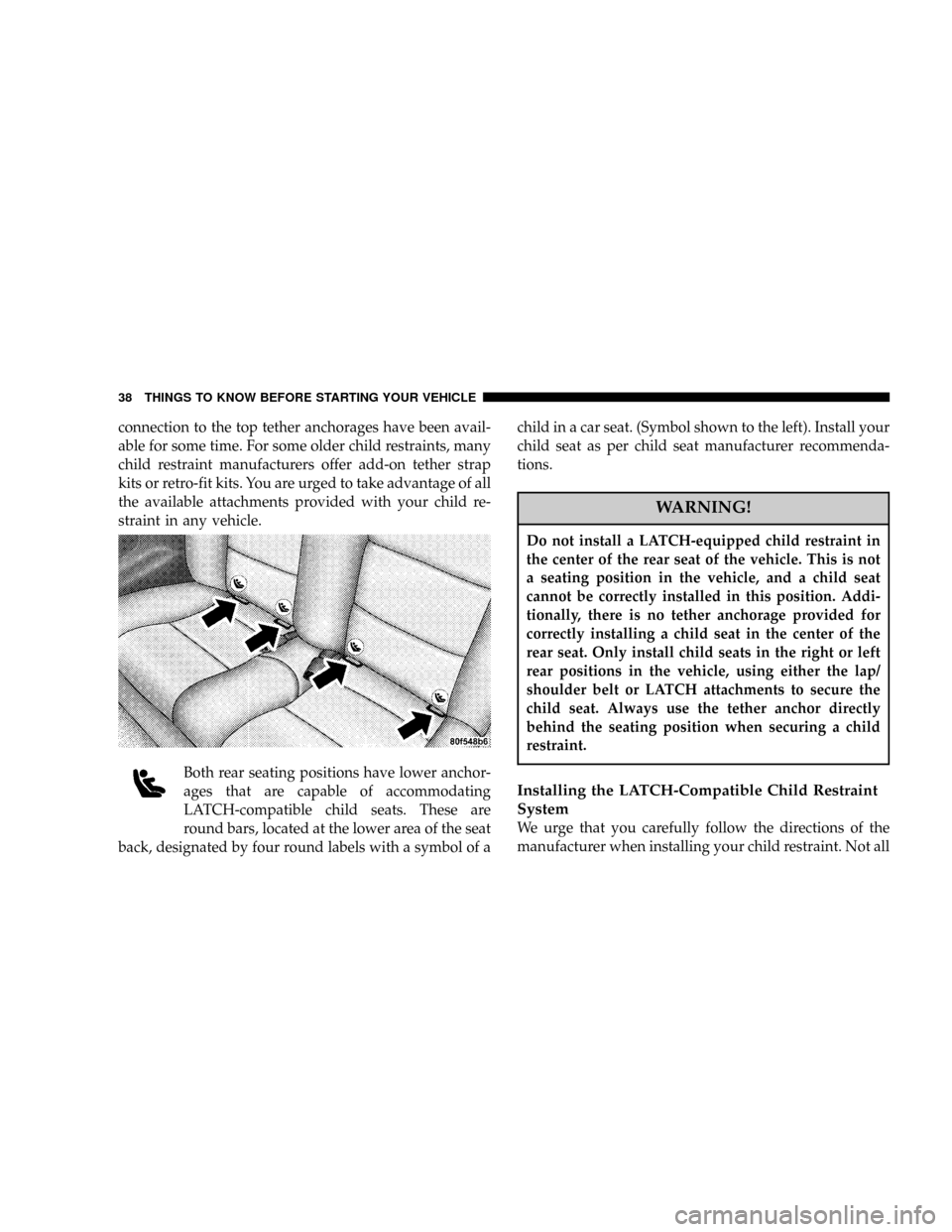
Both rear seating positions have lower anchor-
ages that are capable of accommodating
LATCH-compatible child seats. These are
round bars, located at the lower area of the seat
back, designated by four round labels with a symbol of achild in a car seat. (Symbol shown to the left). Install your
child seat as per child seat manufacturer recommenda-
tions.
WARNING!
Do not install a LATCH-equipped child restraint in
the center of the rear seat of the vehicle. This is not
a seating position in the vehicle, and a child seat
cannot be correctly installed in this position. Addi-
tionally, there is no tether anchorage provided for
correctly installing a child seat in the center of the
rear seat. Only install child seats in the right or left
rear positions in the vehicle, using either the lap/
shoulder belt or LATCH attachments to secure the
child seat. Always use the tether anchor directly
behind the seating position when securing a child
restraint.
Installing the LATCH-Compatible Child Restraint
System
We urge that you carefully follow the directions of the
manufacturer when installing your child restraint. Not all
38 THINGS TO KNOW BEFORE STARTING YOUR VEHICLE
Page 39 of 271
child restraint systems will be installed as described here.
Again, carefully follow the installation instructions that
were provided with the child restraint system.
The rear seat lower anchorages are round bars, located at
the rear of the seat cushion where it meets the seat back,
and are just visible when you lean into the rear seat to
install the child restraint. You will easily feel them if you
run your finger along the intersection of the seatback and
seat cushion surfaces.
In addition, there are tether strap anchorages
behind each rear seating position located in the
bottom of the convertible top well, behind the
seat back. The anchors are under the carpet
cutouts marked with this symbol. (Shown to the left).
Many, but not all restraint systems will be equipped with
separate straps on each side, with each having a hook or
connector for attachment to the lower anchorage and a
means of adjusting the tension in the strap. Forward-
facing toddler restraints and some rear-facing infant
restraints will also be equipped with a tether strap, a
hook for attachment to the tether strap anchorage and a
means of adjusting the tension of the strap.You will first loosen the adjusters on the lower straps and
on the tether strap so that you can more easily attach the
hooks or connectors to the vehicle anchorages. Next
attach the lower hooks or connectors over the top of the
anchorage bars, pushing aside the seat cover material.
Then lift the carpet flap to expose the tether anchor
directly behind the seat where you are placing the child
restraint and attach the tether strap to provide the most
direct path between the anchor and the child restraint.
Finally, tighten all three straps as you push the child
restraint rearward and downward into the seat, remov-
ing slack in the straps according to the child restraint
manufacturer's instructions.
WARNING!
Improper installation of a child restraint to the
LATCH anchorages can lead to failure of an infant or
child restraint. The child could be badly injured or
killed. Follow the manufacturer's directions exactly
when installing an infant or child restraint.
THINGS TO KNOW BEFORE STARTING YOUR VEHICLE 39
2
Page 41 of 271
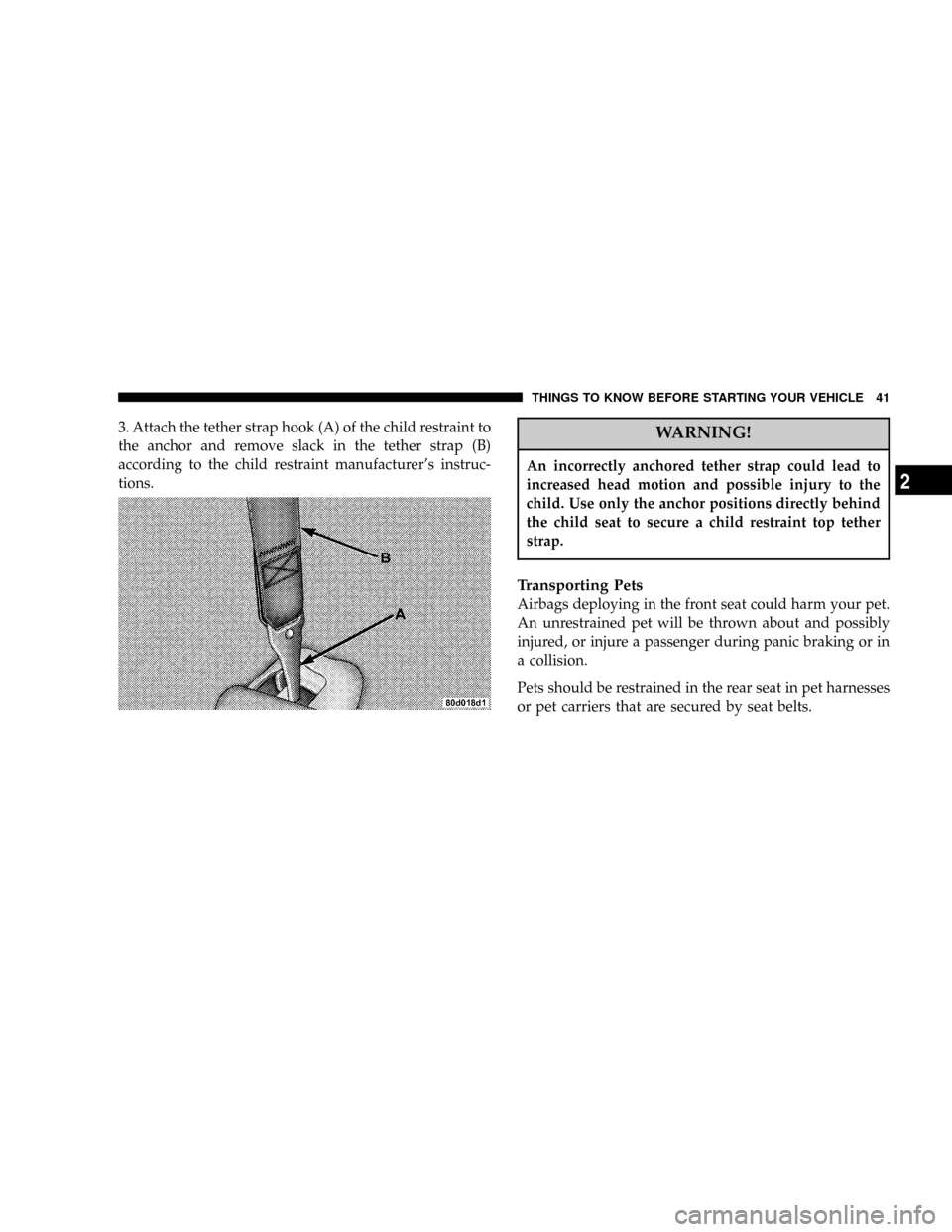
3. Attach the tether strap hook (A) of the child restraint to
the anchor and remove slack in the tether strap (B)
according to the child restraint manufacturer's instruc-
tions.WARNING!
An incorrectly anchored tether strap could lead to
increased head motion and possible injury to the
child. Use only the anchor positions directly behind
the child seat to secure a child restraint top tether
strap.
Transporting Pets
Airbags deploying in the front seat could harm your pet.
An unrestrained pet will be thrown about and possibly
injured, or injure a passenger during panic braking or in
a collision.
Pets should be restrained in the rear seat in pet harnesses
or pet carriers that are secured by seat belts.
THINGS TO KNOW BEFORE STARTING YOUR VEHICLE 41
2
Page 42 of 271
ENGINE BREAK-IN RECOMMENDATIONS
The engine in your new vehicle does not require a long
break-in period.
Drive moderately during the first 300 miles (500 km).
After the initial 60 miles (100 km), speeds up to 50 or 55
mph (80 or 90 km/h) are desirable.
While cruising, brief full-throttle acceleration, within the
limits of local traffic laws, contributes to a good break-in.
Wide open throttle acceleration in low gear can be
detrimental and should be avoided.
The crankcase oil installed in the engine at the factory is
a high quality energy conserving type lubricant. Oil
changes should be consistent with expected climate con-
ditions under which vehicle operations will occur. The
recommended viscosity and quality grades are in Section
7 of this manual.
Do not use non-detergent or straight mineral oils.
A new engine may consume some oil during its first few
thousand miles of operation. This is a normal part of the
break-in and not an indication of a problem.
SAFETY TIPS
Exhaust Gas
WARNING!
Exhaust gases can injure or kill. They contain carbon
monoxide (CO) which is colorless and odorless.
Breathing it can make you unconscious and can
eventually poison you. To avoid breathing (CO)
follow the safety tips below.
²Do not run the engine in a closed garage or in confined
areas any longer than needed to move your vehicle in
or out of the area.
²If it is necessary to sit in a parked vehicle with the
engine running, adjust your heating or cooling con-
trols to force outside air into the vehicle. Set the blower
at high speed.
²To avoid drawing exhaust gases into the vehicle, close
the trunk while driving. However, if for some reason it
42 THINGS TO KNOW BEFORE STARTING YOUR VEHICLE
Page 47 of 271
CONVERTIBLE TOP OPERATION
WARNING!
The convertible top does not provide the structural
protection that a reinforced metal roof does, and the
fabric top cannot be expected to prevent the ejection
of the occupants of a vehicle in a collision. Therefore
it is important that all occupants wear their seat belts
at all times when riding in a convertible. Studies
have shown that it is generally safer to remain inside
a vehicle during a collision, than to be ejected from
the vehicle.
NOTE:The top and top storage area should be thor-
oughly dry before lowering the top.
To Lower The Top:
NOTE:
To avoid damage to the convertible top or its
components, your vehicle is equipped with a feature that
prevents convertible top operation at speeds over 10 mph
(16 km/h).
CAUTION!
To fully insure that no damage occurs, be sure that
the vehicle is at a complete stop with the gear
selector in the Park position before lowering or
raising the top.
1. To avoid damage to either the top or the rear window,
check the top storage area at the rear of the vehicle
interior to be sure that it is clear of debris or other items.
Be sure that child seat flip up bars are lowered. Do not
use the top storage area for other storage purposes.
2. Turn the ignition key to the On position.
UNDERSTANDING THE FEATURES OF YOUR VEHICLE 47
3
Page 57 of 271
Exterior Mirrors Folding Feature Ð If Equipped
Both mirrors have hinges and can be folded either
forward or rearward to resist damage.
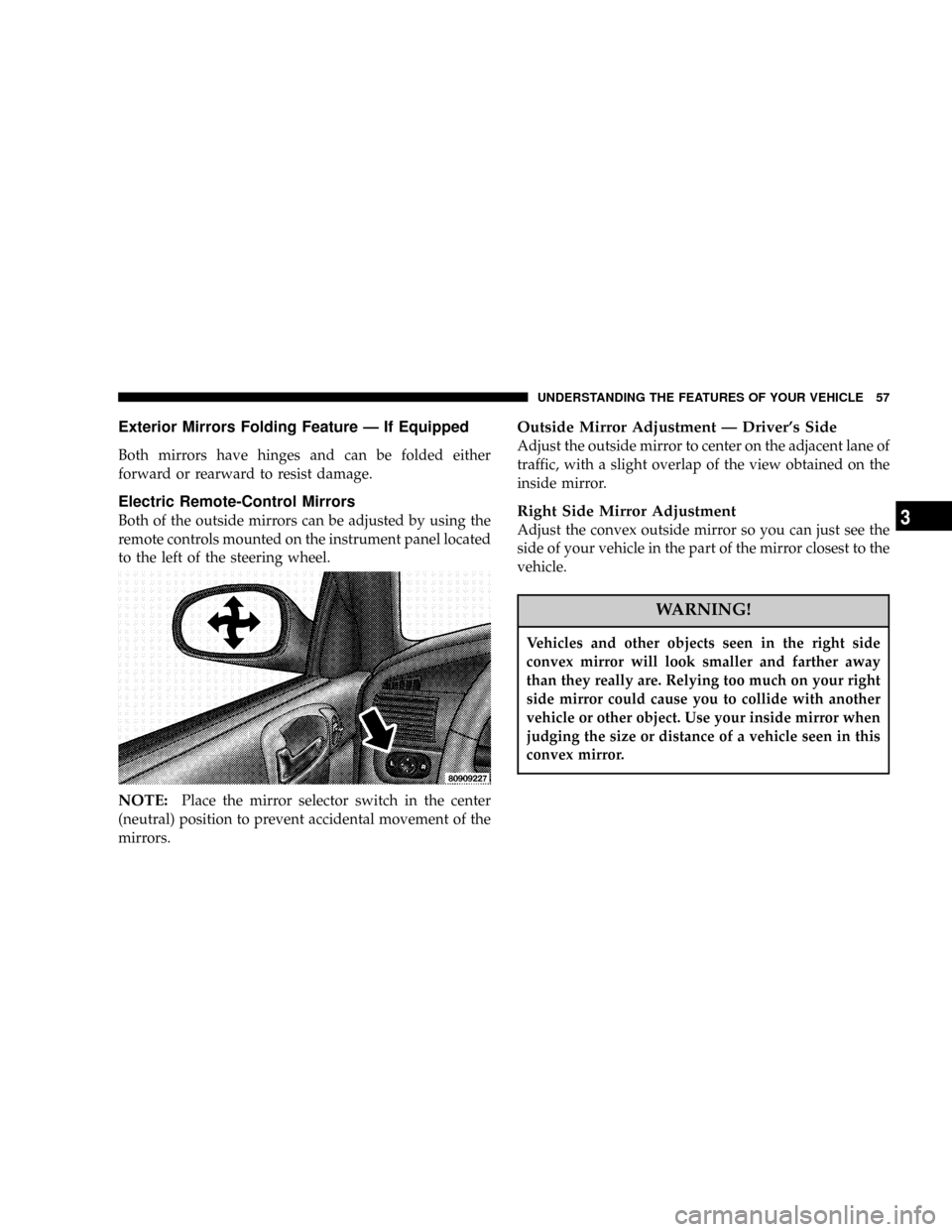
Electric Remote-Control Mirrors
Both of the outside mirrors can be adjusted by using the
remote controls mounted on the instrument panel located
to the left of the steering wheel.
NOTE:Place the mirror selector switch in the center
(neutral) position to prevent accidental movement of the
mirrors.
Outside Mirror Adjustment Ð Driver's Side
Adjust the outside mirror to center on the adjacent lane of
traffic, with a slight overlap of the view obtained on the
inside mirror.
Right Side Mirror Adjustment
Adjust the convex outside mirror so you can just see the
side of your vehicle in the part of the mirror closest to the
vehicle.
WARNING!
Vehicles and other objects seen in the right side
convex mirror will look smaller and farther away
than they really are. Relying too much on your right
side mirror could cause you to collide with another
vehicle or other object. Use your inside mirror when
judging the size or distance of a vehicle seen in this
convex mirror.
UNDERSTANDING THE FEATURES OF YOUR VEHICLE 57
3
Page 59 of 271
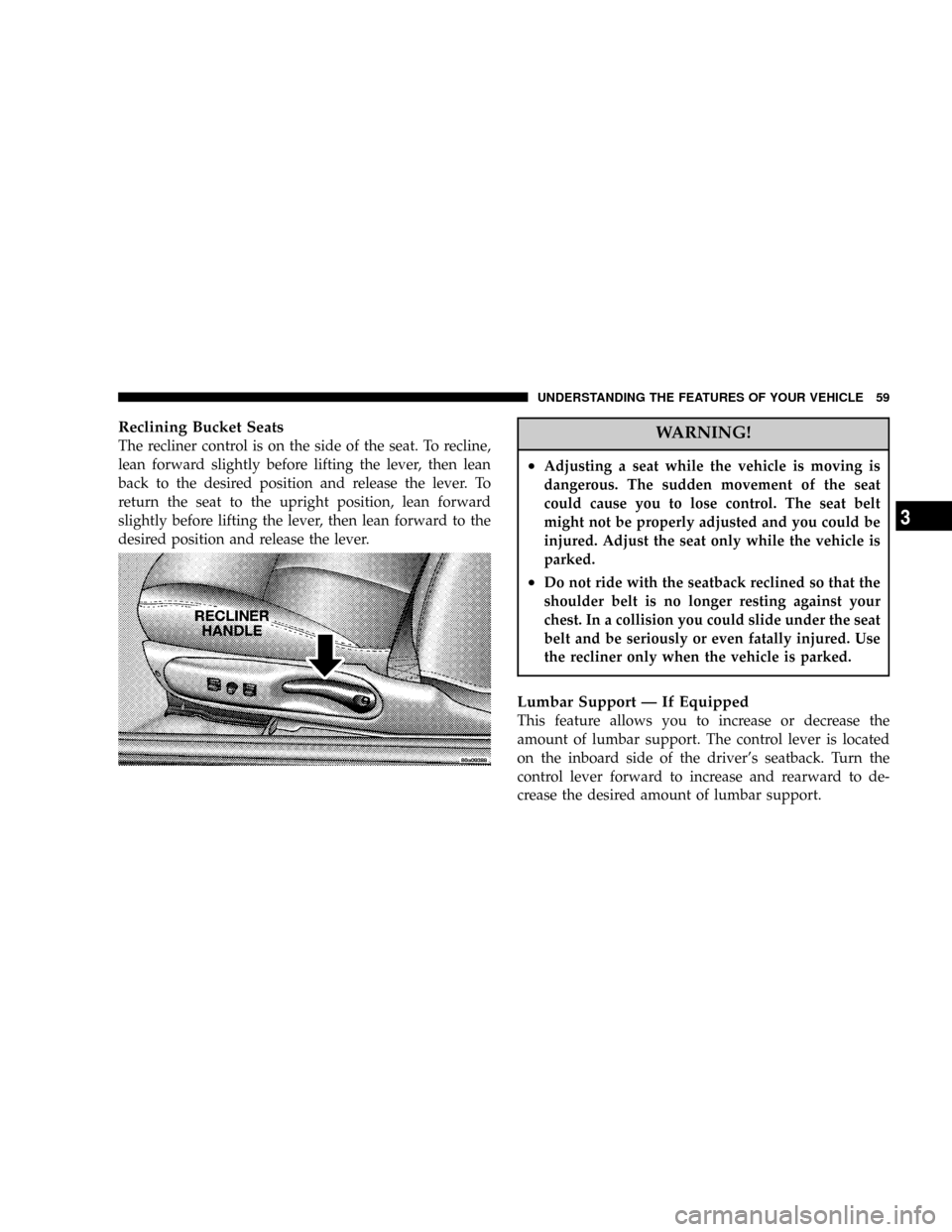
Reclining Bucket Seats
The recliner control is on the side of the seat. To recline,
lean forward slightly before lifting the lever, then lean
back to the desired position and release the lever. To
return the seat to the upright position, lean forward
slightly before lifting the lever, then lean forward to the
desired position and release the lever.WARNING!
²Adjusting a seat while the vehicle is moving is
dangerous. The sudden movement of the seat
could cause you to lose control. The seat belt
might not be properly adjusted and you could be
injured. Adjust the seat only while the vehicle is
parked.
²Do not ride with the seatback reclined so that the
shoulder belt is no longer resting against your
chest. In a collision you could slide under the seat
belt and be seriously or even fatally injured. Use
the recliner only when the vehicle is parked.
Lumbar Support Ð If Equipped
This feature allows you to increase or decrease the
amount of lumbar support. The control lever is located
on the inboard side of the driver's seatback. Turn the
control lever forward to increase and rearward to de-
crease the desired amount of lumbar support.
UNDERSTANDING THE FEATURES OF YOUR VEHICLE 59
3
Page 63 of 271
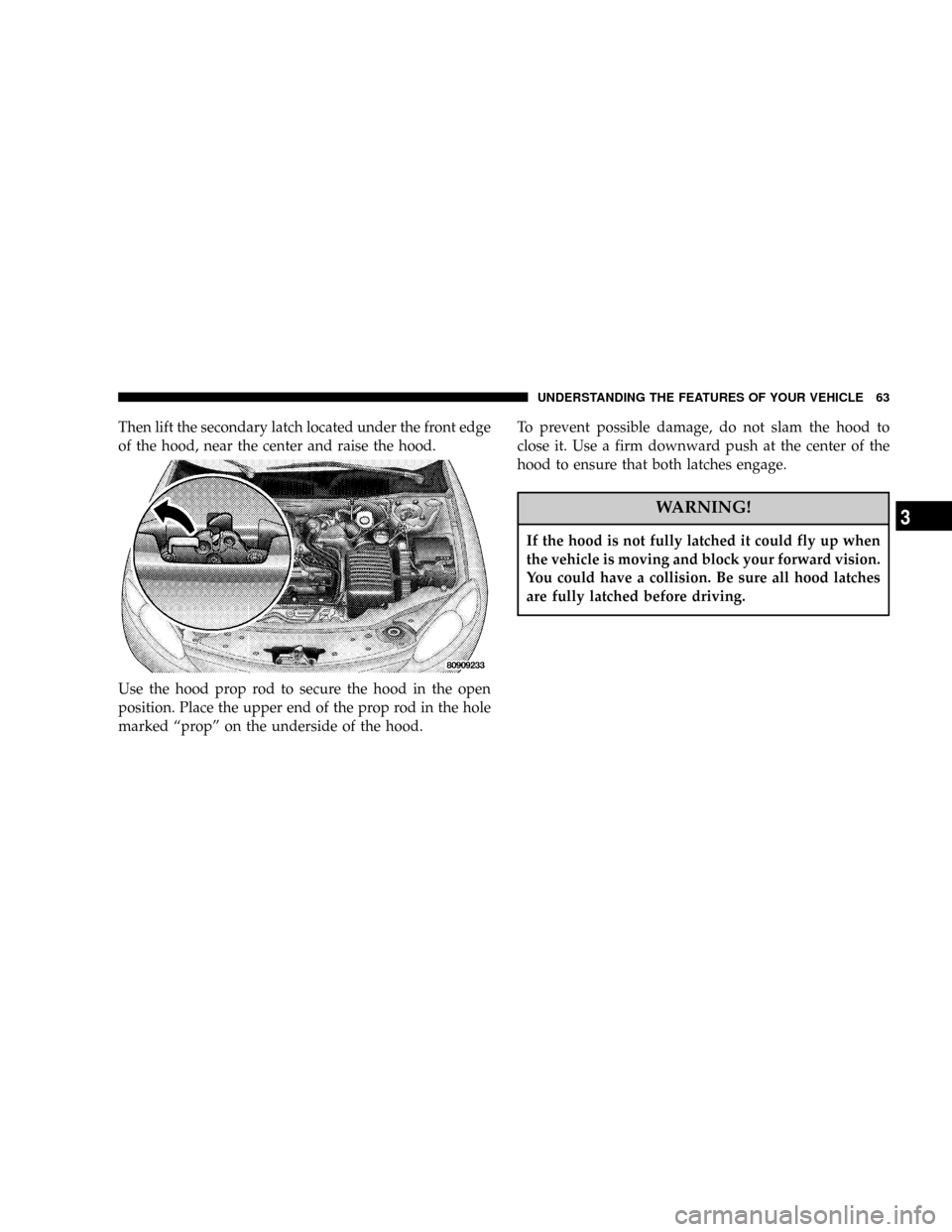
Then lift the secondary latch located under the front edge
of the hood, near the center and raise the hood.
Use the hood prop rod to secure the hood in the open
position. Place the upper end of the prop rod in the hole
marked ªpropº on the underside of the hood.To prevent possible damage, do not slam the hood to
close it. Use a firm downward push at the center of the
hood to ensure that both latches engage.
WARNING!
If the hood is not fully latched it could fly up when
the vehicle is moving and block your forward vision.
You could have a collision. Be sure all hood latches
are fully latched before driving.
UNDERSTANDING THE FEATURES OF YOUR VEHICLE 63
3
Page 68 of 271
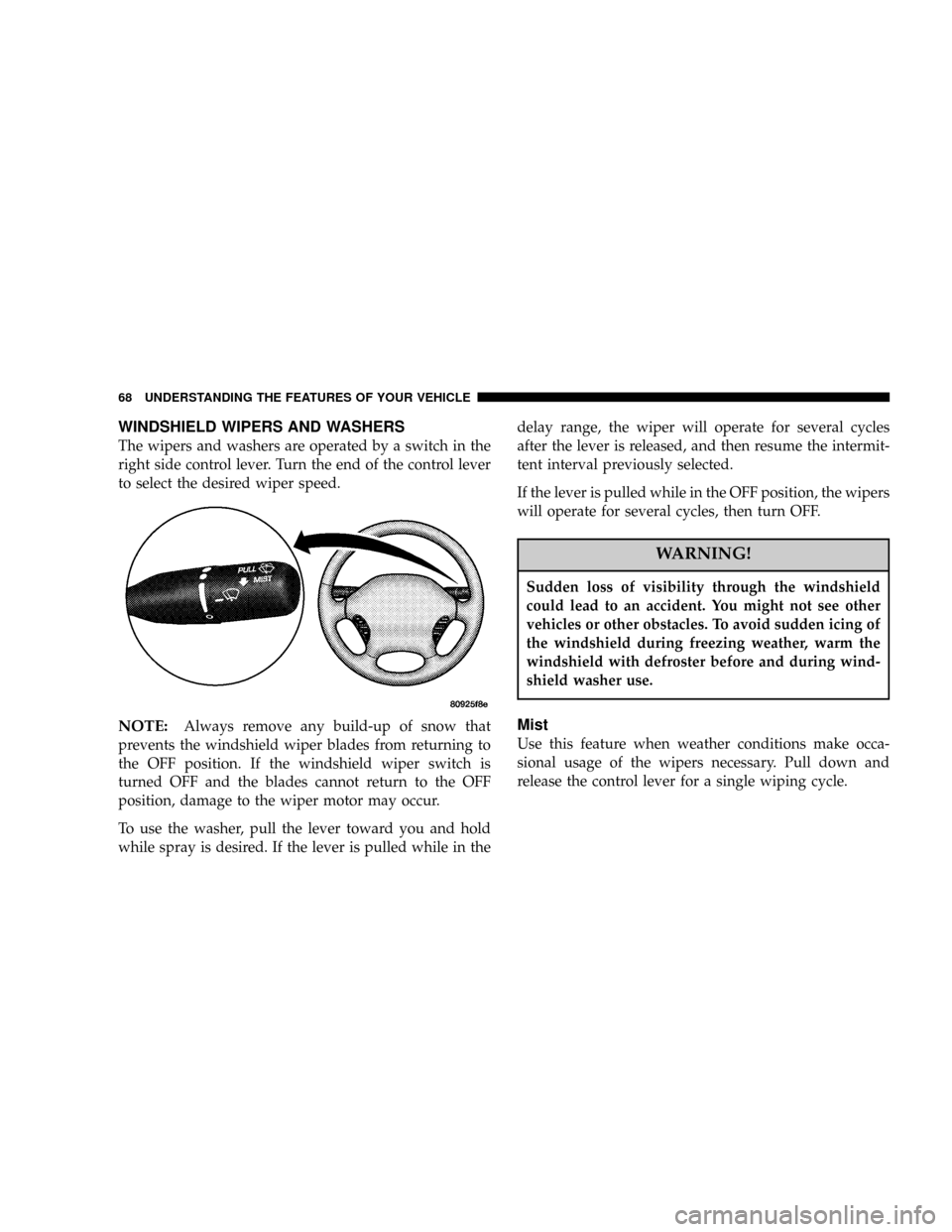
WINDSHIELD WIPERS AND WASHERS
The wipers and washers are operated by a switch in the
right side control lever. Turn the end of the control lever
to select the desired wiper speed.
NOTE:Always remove any build-up of snow that
prevents the windshield wiper blades from returning to
the OFF position. If the windshield wiper switch is
turned OFF and the blades cannot return to the OFF
position, damage to the wiper motor may occur.
To use the washer, pull the lever toward you and hold
while spray is desired. If the lever is pulled while in thedelay range, the wiper will operate for several cycles
after the lever is released, and then resume the intermit-
tent interval previously selected.
If the lever is pulled while in the OFF position, the wipers
will operate for several cycles, then turn OFF.
WARNING!
Sudden loss of visibility through the windshield
could lead to an accident. You might not see other
vehicles or other obstacles. To avoid sudden icing of
the windshield during freezing weather, warm the
windshield with defroster before and during wind-
shield washer use.
Mist
Use this feature when weather conditions make occa-
sional usage of the wipers necessary. Pull down and
release the control lever for a single wiping cycle.
68 UNDERSTANDING THE FEATURES OF YOUR VEHICLE