ECU CHRYSLER SEBRING CONVERTIBLE 2009 3.G User Guide
[x] Cancel search | Manufacturer: CHRYSLER, Model Year: 2009, Model line: SEBRING CONVERTIBLE, Model: CHRYSLER SEBRING CONVERTIBLE 2009 3.GPages: 475, PDF Size: 6.94 MB
Page 30 of 475
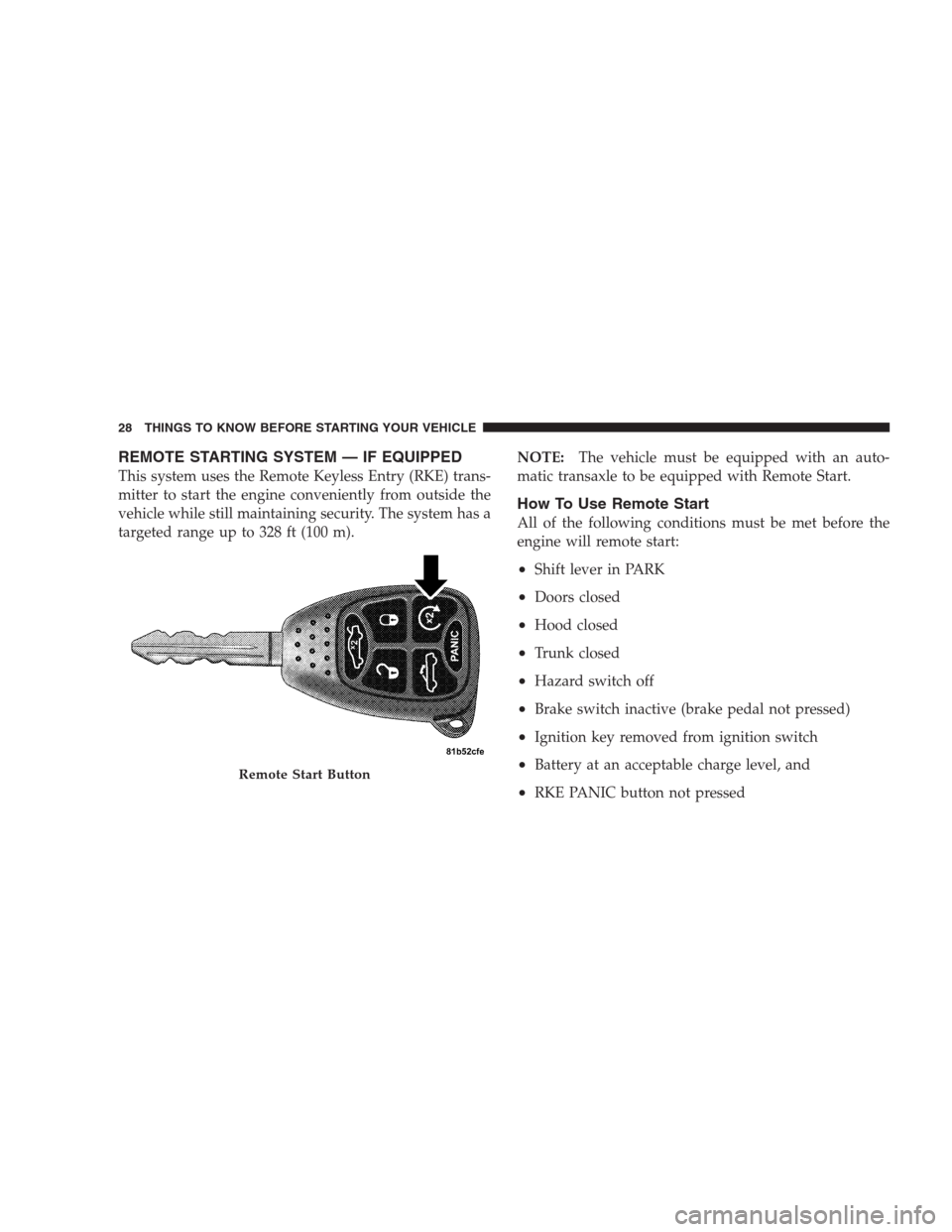
REMOTE STARTING SYSTEM — IF EQUIPPED
This system uses the Remote Keyless Entry (RKE) trans-
mitter to start the engine conveniently from outside the
vehicle while still maintaining security. The system has a
targeted range up to 328 ft (100 m).NOTE:The vehicle must be equipped with an auto-
matic transaxle to be equipped with Remote Start.
How To Use Remote Start
All of the following conditions must be met before the
engine will remote start:
•Shift lever in PARK
•Doors closed
•Hood closed
•Trunk closed
•Hazard switch off
•Brake switch inactive (brake pedal not pressed)
•Ignition key removed from ignition switch
•Battery at an acceptable charge level, and
•RKE PANIC button not pressed
Remote Start Button
28 THINGS TO KNOW BEFORE STARTING YOUR VEHICLE
Page 31 of 475
To Enter Remote Start Mode
Press and release the REMOTE START button
on the RKE transmitter twice. The engine will
start and the vehicle will remain in the Remote
Start mode for a 15 minute cycle.
NOTE:
•For security, power window operation is disabled
when the vehicle is in the Remote Start mode.
•The engine can be started two consecutive times (two
15 minute cycles) with the RKE transmitter. However,
the ignition switch must be cycled to the ON position
before you can repeat the start sequence for a third
cycle.
To Exit Remote Start Mode without Driving the
Vehicle
Allow the engine to run for the entire 15 minute cycle.
To Exit Remote Start Mode and Drive the Vehicle
Before the end of the 15 minute cycle, press and release
the UNLOCK button on the RKE transmitter to unlock
the doors and disarm the Vehicle Security Alarm (if
equipped). Then, within 15 minutes, insert the key into
the ignition switch and turn the switch to the ON
position. Then, insert the key into the ignition switch and
turn the switch to the ON position, otherwise the engine
will shut off at the end of 15 minute cycle.
NOTE:The ignition switch must be in the ON position
in order to drive the vehicle.
To Turn Off the Engine While in Remote Start
Mode
Press and release the REMOTE START button one time.
NOTE:To avoid inadvertent shut downs, the system
will disable the one-time press of the remote start button
for two seconds after receiving a valid remote start
request.
THINGS TO KNOW BEFORE STARTING YOUR VEHICLE 29
2
Page 32 of 475
DOOR LOCKS
Manual Door Locks
To lock each door, push the door lock plunger on each
door trim panel downward. To unlock each door, pull the
door lock plunger on each door trim panel upward.
If the door lock plunger is down when you shut the door,
the door will lock. Make sure the keys are not inside the
vehicle before closing the door.
WARNING!
•For personal security and safety in the event of an
accident, lock the vehicle doors as you drive as
well as when you park and leave the vehicle.
(Continued)
WARNING! (Continued)
•When leaving the vehicle always remove the key
from the ignition lock, and lock your vehicle.
Unsupervised use of vehicle equipment may cause
severe personal injuries and death.
•Never leave children alone in a vehicle. Leaving
children in a vehicle unattended is dangerous for a
number of reasons. A child or others could be
seriously or fatally injured. Don’t leave the keys in
the ignition. A child could operate power win-
dows, other controls, or move the vehicle.
30 THINGS TO KNOW BEFORE STARTING YOUR VEHICLE
Page 40 of 475
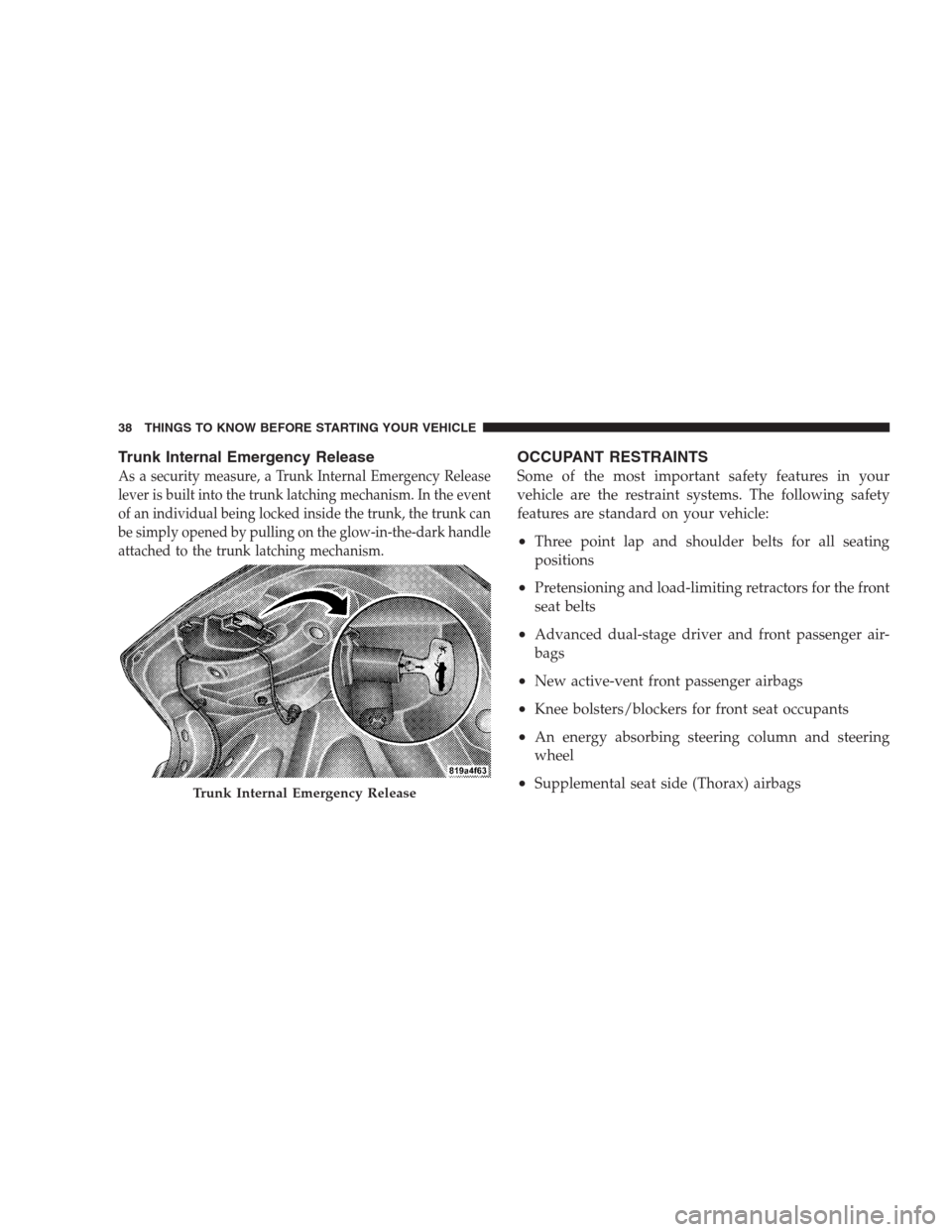
Trunk Internal Emergency Release
As a security measure, a Trunk Internal Emergency Release
lever is built into the trunk latching mechanism. In the event
of an individual being locked inside the trunk, the trunk can
be simply opened by pulling on the glow-in-the-dark handle
attached to the trunk latching mechanism.
OCCUPANT RESTRAINTS
Some of the most important safety features in your
vehicle are the restraint systems. The following safety
features are standard on your vehicle:
•Three point lap and shoulder belts for all seating
positions
•Pretensioning and load-limiting retractors for the front
seat belts
•Advanced dual-stage driver and front passenger air-
bags
•New active-vent front passenger airbags
•Knee bolsters/blockers for front seat occupants
•An energy absorbing steering column and steering
wheel
•Supplemental seat side (Thorax) airbagsTrunk Internal Emergency Release
38 THINGS TO KNOW BEFORE STARTING YOUR VEHICLE
Page 41 of 475
•Supplemental front seat side mounted head airbags
•Front seat belt retractors that incorporate pretension-
ers to enhance occupant protection by managing oc-
cupant energy during an impact event
•All seat belt systems (except the driver’s) include
Automatic Locking Retractors (ALRs), which lock the
seat belt webbing into position by extending the belt
all the way out and then adjusting the belt to the
desired length to restrain a child seat or secure a large
item in a seat
If you will be carrying children too small for adult-size
seat belts, your seat belts or the LATCH feature also can
be used to hold infant and child restraint systems. Refer
to “LATCH — Child Seat Anchorage System (Lower
Anchors and Tether for CHildren) in this section.
NOTE:The front airbags have a dual-stage inflator
design. This allows the airbag to have different rates of
inflation that are based on collision severity.
Please pay close attention to the information in this
section. It tells you how to use your restraint system
properly to keep you and your passengers as safe as
possible.
WARNING!
In a collision, you and your passengers can suffer
much greater injuries if you are not properly buckled
up. You can strike the interior of your vehicle or other
passengers, or you can be thrown out of the vehicle.
Always be sure you and others in your vehicle are
buckled up properly.
THINGS TO KNOW BEFORE STARTING YOUR VEHICLE 39
2
Page 52 of 475
WARNING! (Continued)
•Do not attach cup holders or any other objects on
or around the door. The inflating seat airbag could
drive the object into occupants, causing serious
injury.
•Do not drill, cut or tamper with the knee bolster in
any way.
•Do not mount any accessories to the knee bolster
such as alarm lights, stereos, citizens band radios
etc.
Along with seat belts and pretensioners, front airbags
work with the knee bolsters to provide improved protec-
tion for the driver and front passenger. Seat airbags also
work with seat belts to improve occupant protection.
While the seat belts are designed to protect you in many
types of collisions, the front airbags will deploy in
moderate to severe frontal collisions. In certain types ofcollisions, both the front and seat airbags may be trig-
gered. However, even in collisions where the airbags
work, you need the seat belts to keep you in the right
position for the airbags to protect you properly.
Here are some simple steps you can take to minimize the
risk of harm from a deploying airbag.
1.Children 12 years old and younger should always
ride buckled up in a rear seat.
WARNING!
Infants in rear facing child restraints should NEVER
ride in the front seat of a vehicle with a passenger
front airbag. An airbag deployment can cause severe
injury or death to infants in that position.
Children that are not big enough to wear the vehicle seat
belt properly (Refer to information on Child Restraints in
this section) should be secured in the rear seat in child
50 THINGS TO KNOW BEFORE STARTING YOUR VEHICLE
Page 64 of 475
•Airbag deployment level (if applicable)
•Impact acceleration and angle
•Seat belt status
•Brake status (service and parking brakes)
•Accelerator status (including vehicle speed)
•Engine control status (including engine speed)
•Transaxle gear selection
•Cruise control status
•Traction/stability control status
•Tire Pressure Monitoring System status (if equipped)
Child Restraints
Everyone in your vehicle needs to be buckled up all the
time, including babies and children. Every state in the
United States and all Canadian provinces require thatsmall children ride in proper restraint systems. This is the
law, and you can be prosecuted for ignoring it.
Children 12 years and younger should ride properly
buckled up in a rear seat, if available. According to crash
statistics, children are safer when properly restrained in
the rear seats, rather than in the front.
WARNING!
In a collision, an unrestrained child, even a tiny baby,
can become a missile inside the vehicle. The force
required to hold even an infant on your lap could
become so great that you could not hold the child, no
matter how strong you are. The child and others
could be badly injured. Any child riding in your
vehicle should be in a proper restraint for the child’s
size.
62 THINGS TO KNOW BEFORE STARTING YOUR VEHICLE
Page 68 of 475
•All passenger seating positions contain automatic
locking retractors. However, any seat belt system will
loosen with time, so check the belt occasionally and
pull it tight if necessary.
•Buckle the child into the seat according to the child
restraint manufacturer’s directions.
CAUTION!
When your child restraint is not in use, secure it in
the vehicle with the seat belt or remove it from the
vehicle. Do not leave it loose in the vehicle. In a
sudden stop or collision, it could strike the occupants
or seatbacks and cause serious personal injury.
LATCH — Child Seat Anchorage System (Lower
Anchors and Tether for CHildren)
Your vehicle is equipped with the child restraint anchor-
age system called LATCH. The LATCH system providesfor the installation of the child restraint without using the
vehicle’s seat belts. The two rear seating positions have
lower anchorages that are capable of accommodating
LATCH-compatible child seats having flexible, webbing-
mounted lower attachments or fixed lower attachments.
Regardless of the specific type of lower attachment,
NEVERinstall LATCH-compatible child seats such that
two seats share a common lower anchorage. If you are
installing LATCH-compatible child restraints in adjacent
rear seating positions, you can use the LATCH anchors or
the vehicle’s seat belts. If your child restraints are not
LATCH-compatible, you can only install the child re-
straints using the vehicle’s seat belts. For typical instal-
lation instructions, refer to “Installing the LATCH-
Compatible Child Restraint System”.
Rear Seat LATCH Anchors
Child restraints systems having attachments designed to
connect to the lower anchorages are now available. Child
restraints having tether straps and hooks for connection
66 THINGS TO KNOW BEFORE STARTING YOUR VEHICLE
Page 72 of 475
The seat belt must be in the Automatic Locking mode in
order to enable a child restraint to be tightly installed.
Refer to “Automatic Locking Mode” in this section for
details. A locking clip should not be necessary once the
automatic locking feature is enabled. Position the shoul-
der and lap belt on the child restraint. The Automatic
Locking Retractor (ALR) is activated by first attaching
the child seat, then pulling all of the webbing out of the
retractor, then allowing the webbing to retract. As the
webbing retracts, you will hear a clicking sound. This
indicates the safety belt is now in the Automatic Locking
mode. To release, simply unbuckle the seat belt by
depressing the button, and allow the webbing to retract
into the retractor.
In the rear seat, you may have trouble tightening the
lap/shoulder belt on the child restraint because the
buckle or latch plate is too close to the belt path opening
on the restraint. Disconnect the latch plate from thebuckle and twist the short buckle-end belt several times
to shorten it. Insert the latch plate into the buckle with the
release button facing out.
If the belt still can’t be tightened, or if by pulling and
pushing on the restraint loosens the belt, you may need
to do something more. Disconnect the latch plate from
the buckle, turn the buckle around, and insert the latch
plate into the buckle again. If you still can’t make the
child restraint secure, try a different seating position.
To attach a child restraint tether strap:
1. If lowered, raise the convertible top.
NOTE:The convertible top must be in the UP position
to access the tether anchor.
2. Open the access port cover (A) behind the seat where
you are placing the child restraint.
70 THINGS TO KNOW BEFORE STARTING YOUR VEHICLE
Page 74 of 475
WARNING!
An incorrectly anchored tether strap could lead to
increased head motion and possible injury to the
child. Use only the anchor positions directly behind
the child seat to secure a child restraint top tether
strap.
Transporting Pets
Airbags deploying in the front seat could harm your pet.
An unrestrained pet will be thrown about and possibly
injured, or injure a passenger during panic braking or in
a collision.
Pets should be restrained in the rear seat in pet harnesses
or pet carriers that are secured by seat belts.
ENGINE BREAK-IN RECOMMENDATIONS
A long break-in period is not required for the engine in
your vehicle.
Drive moderately during the first 300 miles (500 km).
After the initial 60 miles (100 km), speeds up to 50 or
55 mph (80 or 90 km/h) are desirable.
While cruising, brief full-throttle acceleration within the
limits of local traffic laws, contributes to a good break-in.
Wide-open throttle acceleration in low gear can be detri-
mental and should be avoided.
The engine oil installed in the engine at the factory is a
high-quality energy conserving type lubricant. Oil
changes should be consistent with anticipated climate
conditions under which vehicle operations will occur.
The recommended viscosity and quality grades are
72 THINGS TO KNOW BEFORE STARTING YOUR VEHICLE