ECU CHRYSLER SEBRING CONVERTIBLE 2010 3.G User Guide
[x] Cancel search | Manufacturer: CHRYSLER, Model Year: 2010, Model line: SEBRING CONVERTIBLE, Model: CHRYSLER SEBRING CONVERTIBLE 2010 3.GPages: 457, PDF Size: 8.76 MB
Page 28 of 457
General Information
This device complies with part 15 of FCC rules and with
RS-210 of Industry Canada. Operation is subject to the
following conditions:
1. This device may not cause harmful interference.
2. This device must accept any interference that may be
received including interference that may cause undesired
operation.
NOTE:Changes or modifications not expressly ap-
proved by the party responsible for compliance could
void the user’s authority to operate the equipment.
If your RKE transmitter fails to operate from a normal
distance, check for these two conditions:
1. Weak battery in the RKE transmitter. The expected life
of battery is five years. 2. Closeness to a radio transmitter such as a radio station
tower, airport transmitter, military base, and some mobile
or CB radios.
REMOTE STARTING SYSTEM — IF EQUIPPED
This system uses the Remote Keyless Entry
(RKE) transmitter to start the engine conve-
niently from outside the vehicle while still
maintaining security. The system has a range of
approximately 66 ft (20 m).
NOTE: The vehicle must be equipped with an auto-
matic transmission to be equipped with Remote Start.
How To Use Remote Start
All of the following conditions must be met before the
engine will remote start:
•Shift lever in PARK
•Doors closed
2
THINGS TO KNOW BEFORE STARTING YOUR VEHICLE 27
Page 29 of 457
•Hood closed
•Trunk closed
•Hazard switch off
•Brake switch inactive (brake pedal not pressed)
•Ignition key removed from ignition switch
•Battery at an acceptable charge level, and
•RKE PANIC button not pressed
WARNING!
•Do not start or run an engine in a closed garage or
confined area. Exhaust gas contains Carbon Mon-
oxide (CO) which is odorless and colorless. Car-
bon Monoxide is poisonous and can cause serious
injury or death when inhaled.(Continued)
WARNING! (Continued)
•Keep Remote Keyless Entry (RKE) transmitters
away from children. Operation of the Remote Start
System, windows, door locks or other controls
could cause serious injury or death.
To Enter Remote Start Mode
Press and release the REMOTE START button
on the RKE transmitter twice, within five sec-
onds. The parking lights will flash and the horn
will chirp twice (if programmed). Then, the
engine will start and the vehicle will remain in the
Remote Start mode for a 15-minute cycle.
NOTE:
•For security, power window operation is disabled
when the vehicle is in the Remote Start mode.
•The engine can be started two consecutive times (two
15 minute cycles) with the RKE transmitter. However,
28 THINGS TO KNOW BEFORE STARTING YOUR VEHICLE
Page 30 of 457
the ignition switch must be cycled to the ON position
before you can repeat the start sequence for a third cycle.
To Exit Remote Start Mode without Driving the
Vehicle
Press and release the REMOTE START button one time or
allow the engine to run for the entire 15 minute cycle.
NOTE:To avoid unintentional shut downs, the system
will disable the one-time press of the remote start button
for two seconds after receiving a valid remote start
request.
To Exit Remote Start Mode and Drive the Vehicle
Before the end of the 15 minute cycle, press and release
the UNLOCK button on the RKE transmitter to unlock
the doors and disarm the Vehicle Security Alarm (if
equipped).
NOTE: The ignition switch must be in the ON position
in order to drive the vehicle.
DOOR LOCKS
Manual Door Locks
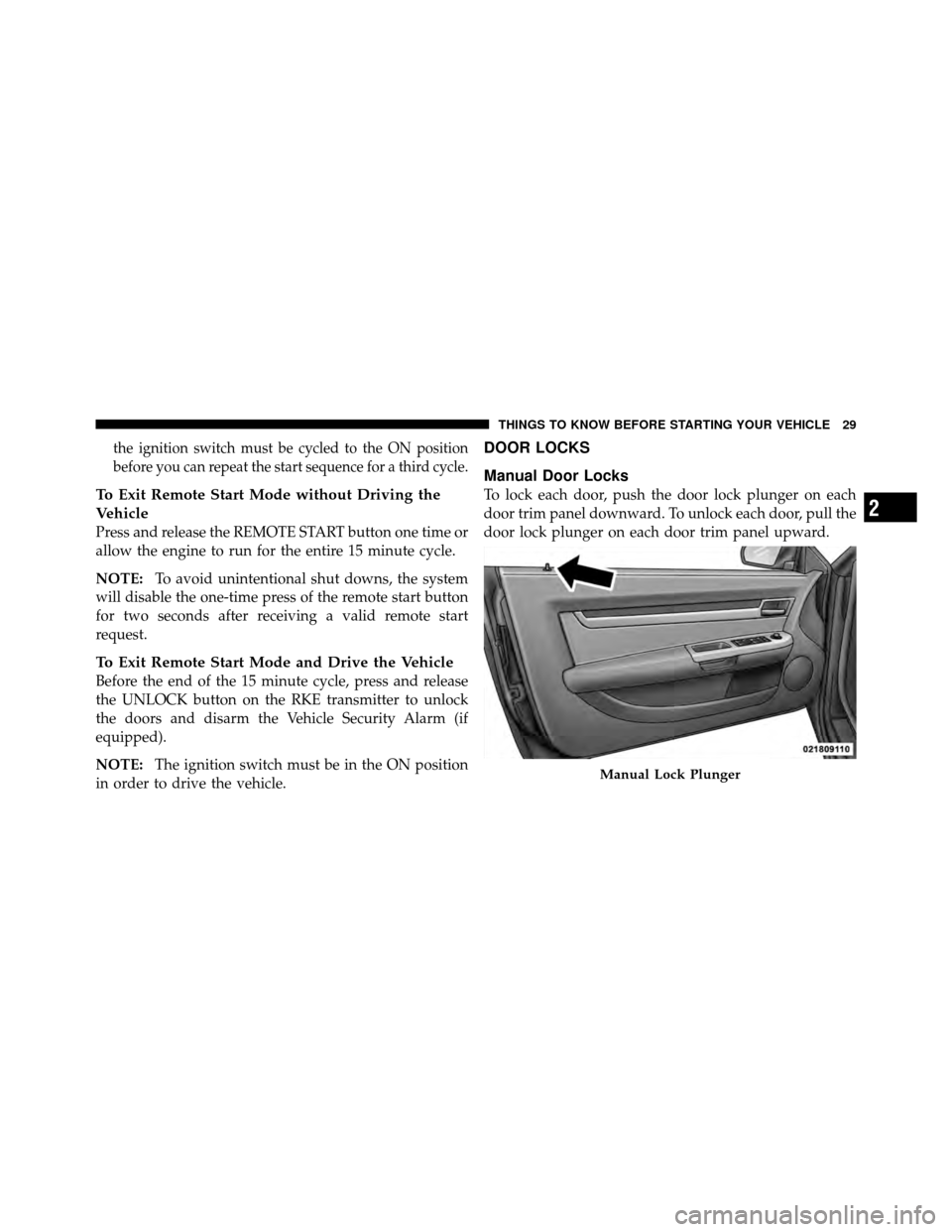
To lock each door, push the door lock plunger on each
door trim panel downward. To unlock each door, pull the
door lock plunger on each door trim panel upward.
Manual Lock Plunger
2
THINGS TO KNOW BEFORE STARTING YOUR VEHICLE 29
Page 31 of 457
If the door lock plunger is down when you shut the door,
the door will lock. Make sure the keys are not inside the
vehicle before closing the door.
WARNING!
•For personal security and safety in the event of an
accident, lock the vehicle doors as you drive as
well as when you park and leave the vehicle.
•When leaving the vehicle, always remove the key
from the ignition lock, and lock your vehicle.
Unsupervised use of vehicle equipment may cause
severe personal injuries and death.
•Never leave children alone in a vehicle. Leaving
children in a vehicle unattended is dangerous for a
number of reasons. A child or others could be
seriously or fatally injured. Don’t leave the keys in
the ignition. A child could operate power win-
dows, other controls, or move the vehicle.
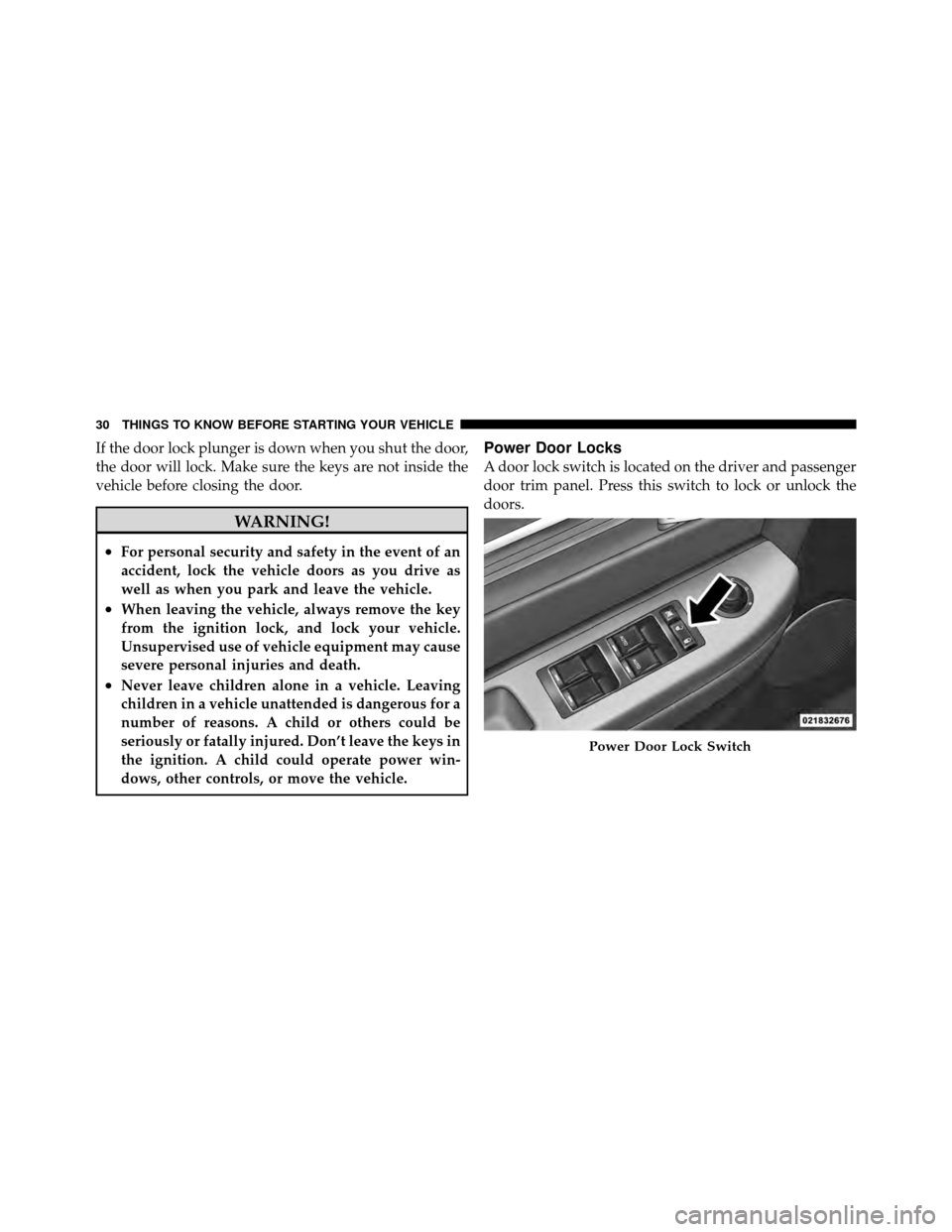
Power Door Locks
A door lock switch is located on the driver and passenger
door trim panel. Press this switch to lock or unlock the
doors.
Power Door Lock Switch
30 THINGS TO KNOW BEFORE STARTING YOUR VEHICLE
Page 38 of 457
TRUNK SAFETY WARNING
WARNING!
Do not allow children to have access to the trunk,
either by climbing into the trunk from outside, or
through the inside of the vehicle. Always close the
trunk lid when your vehicle is unattended. Once in
the trunk, young children may not be able to escape,
even if they entered through the rear seat. If trapped
in the trunk, children can die from suffocation or
heat stroke.
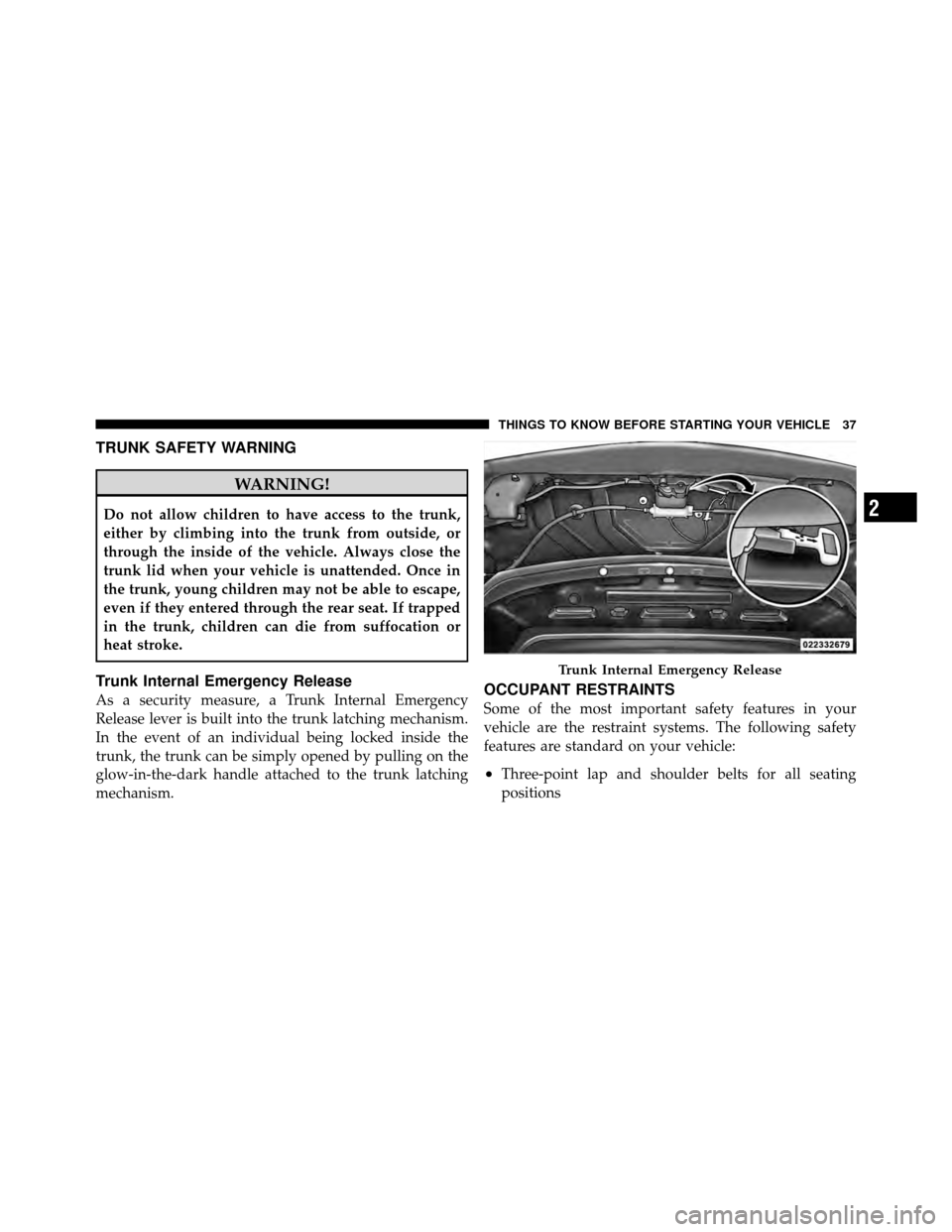
Trunk Internal Emergency Release
As a security measure, a Trunk Internal Emergency
Release lever is built into the trunk latching mechanism.
In the event of an individual being locked inside the
trunk, the trunk can be simply opened by pulling on the
glow-in-the-dark handle attached to the trunk latching
mechanism.OCCUPANT RESTRAINTS
Some of the most important safety features in your
vehicle are the restraint systems. The following safety
features are standard on your vehicle:
•Three-point lap and shoulder belts for all seating
positions
Trunk Internal Emergency Release
2
THINGS TO KNOW BEFORE STARTING YOUR VEHICLE 37
Page 39 of 457
•Advanced Front Airbags for driver and front passen-
ger
•Supplemental Active Head Restraints (AHR) located
on top of the front seats (integrated into the head
restraint)
•Supplemental Seat-Mounted Side Airbags (SAB) — if
equipped
•An energy-absorbing steering column and steering
wheel
•Knee bolsters/blockers for front seat occupants
•Front seat belts incorporate pretensioners to enhance
occupant protection by managing occupant energy
during an impact event — if equipped
•All seat belt systems (except the driver’s) include
Automatic Locking Retractors (ALRs), which lock the
seat belt webbing into position by extending the beltall the way out and then adjusting the belt to the
desired length to restrain a child seat or secure a large
item in a seat — if equipped
If you will be carrying children too small for adult-sized
seat belts, the seat belts or the Lower Anchors and Tether
for CHildren (LATCH) feature also can be used to hold
infant and child restraint systems. Refer to “LATCH —
Child Seat Anchorage System (Lower Anchors and Tether
for CHildren).
NOTE: The Advanced Front Airbags have a multistage
inflator design. This allows the airbag to have different
rates of inflation based on the severity and type of
collision.
Please pay close attention to the information in this
section. It tells you how to use your restraint system
properly, to keep you and your passengers as safe as
possible.
38 THINGS TO KNOW BEFORE STARTING YOUR VEHICLE
Page 57 of 457
WARNING!
•Do not use accessory seat covers or place objects
between you and the side airbags; the performance
could be adversely affected and/or objects could
be pushed into you, causing serious injury.
Knee Impact Bolsters
The Knee Impact Bolsters help protect the knees of the
driver and the front passenger, and position front occu-
pants for the best interaction with the Advanced Front
Airbags.
Along with seat belts and pretensioners, Advanced Front
Airbags work with the knee bolsters to provide improved
protection for the driver and front passenger. Side airbags
also work with seat belts to improve occupant protection.
Here are some simple steps you can take to minimize the
risk of harm from a deploying airbag:1.
Children 12 years old and under should always ride
buckled up in a rear seat.
WARNING!
Infants in rear facing child restraints should NEVER
ride in the front seat of a vehicle with a passenger
Advanced Front Airbag. An airbag deployment can
cause severe injury or death to infants in that posi-
tion.
Children that are not big enough to wear the vehicle seat
belt properly (see section on Child Restraints) should be
secured in the rear seat in child restraints or belt-
positioning booster seats. Older children who do not use
child restraints or belt-positioning booster seats should
ride properly buckled up in the rear seat. Never allow
children to slide the shoulder belt behind them or under
their arm.
56 THINGS TO KNOW BEFORE STARTING YOUR VEHICLE
Page 67 of 457
1. Used for research purposes, such as to match data
with a particular crash record in an aggregate database,
provided confidentiality of personal data is thereafter
preserved.
2. Used in defense of litigation involving a Chrysler
Group LLC product.
3. Requested by police under a legal warrant.
4. Otherwise required by law.
Data parameters that are recorded:
•Diagnostic trouble code(s) and warning light status for
electronically-controlled safety systems, including the
airbag system
•Vehicle speed
•Engine RPM
•Brake switch status
•Pedal position
•And other parameters depending on vehicle
configuration
Child Restraints
Everyone in your vehicle needs to be buckled up all the
time, including babies and children. Every state in the
United States and all Canadian provinces require that
small children ride in proper restraint systems. This is the
law, and you can be prosecuted for ignoring it.
Children 12 years and younger should ride properly
buckled up in a rear seat, if available. According to crash
statistics, children are safer when properly restrained in
the rear seats, rather than in the front.
66 THINGS TO KNOW BEFORE STARTING YOUR VEHICLE
Page 71 of 457
Here are some tips on getting the most out of your child
restraint:
•Children who are large enough to wear the shoulder
belt comfortably, and whose legs are long enough to
bend over the front of the seat when their back is
against the seatback, should use the lap/shoulder belt
in a rear seat.
•Before buying any restraint system, make sure that it
has a label certifying that it meets all applicable Safety
Standards. We also recommend that you make sure
that you can install the child restraint in the vehicle
where you will use it, before you buy it.
•The restraint must be appropriate for your child’s
weight and height. Check the label on the restraint for
weight and height limits.
•Carefully follow the instructions that come with the
restraint. If you install the restraint improperly, it may
not work when you need it.
•All passenger seating positions contain automatic
locking retractors. However, any seat belt system will
loosen with time, so check the belt occasionally and
pull it tight if necessary.
•Buckle the child into the seat according to the child
restraint manufacturer’s directions.
CAUTION!
When your child restraint is not in use, secure it in
the vehicle with the seat belt or remove it from the
vehicle. Do not leave it loose in the vehicle. In a
sudden stop or collision, it could strike the occupants
or seatbacks and cause serious personal injury.
LATCH — Child Seat Anchorage System (Lower
Anchors and Tether for CHildren)
Your vehicle is equipped with the child restraint anchor-
age system called LATCH. The LATCH system provides
70 THINGS TO KNOW BEFORE STARTING YOUR VEHICLE
Page 76 of 457
In the rear seat, you may have trouble tightening the
lap/shoulder belt on the child restraint because the
buckle or latch plate is too close to the belt path opening
on the restraint. Disconnect the latch plate from the
buckle and twist the short buckle-end belt several times
to shorten it. Insert the latch plate into the buckle with the
release button facing out.
If the belt still can’t be tightened, or if pulling and
pushing on the restraint loosens the belt, you may need
to do something more. Disconnect the latch plate from
the buckle, turn the buckle around, and insert the latch
plate into the buckle again. If you still can’t make the
child restraint secure, try a different seating position.
To attach a child restraint tether strap:
1. If lowered, raise the convertible top.
NOTE:The convertible top must be in the UP position
to access the tether anchor. 2. Open the access port cover (A) behind the seat where
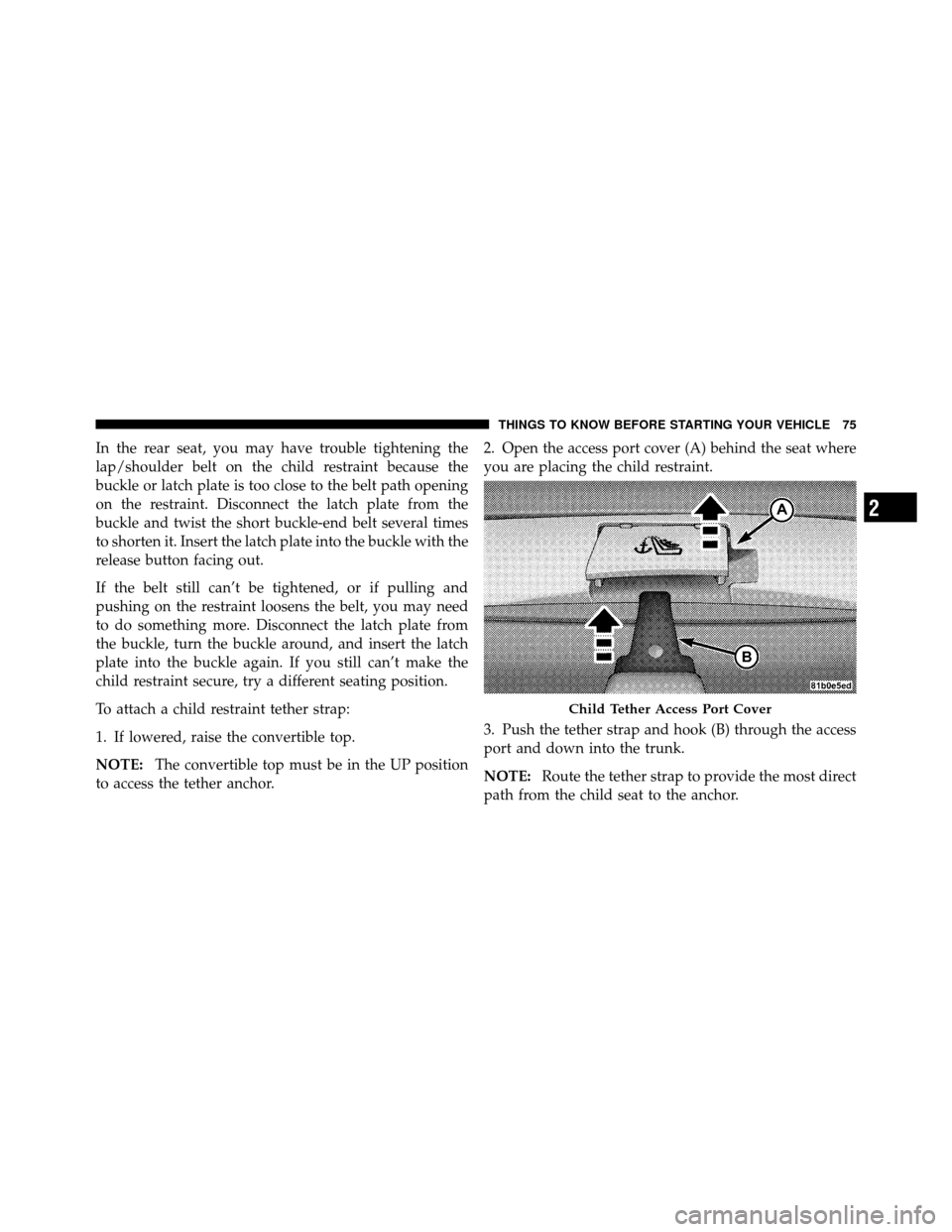
you are placing the child restraint.
3. Push the tether strap and hook (B) through the access
port and down into the trunk.
NOTE:
Route the tether strap to provide the most direct
path from the child seat to the anchor.
Child Tether Access Port Cover
2
THINGS TO KNOW BEFORE STARTING YOUR VEHICLE 75