lock CHRYSLER SEBRING COUPE 2004 2.G Owners Manual
[x] Cancel search | Manufacturer: CHRYSLER, Model Year: 2004, Model line: SEBRING COUPE, Model: CHRYSLER SEBRING COUPE 2004 2.GPages: 382, PDF Size: 2.23 MB
Page 242 of 382

How to use the controls
Heating
Set the mode selection dial to the position shown in the
illustration and set the air selection switch (A) to the
ªoutsideº position.
Adjust the temperature by turning the temperature con-
trol dial clockwise. Select the desired blower speed.
NOTE: When maximum heating is needed, set the
blower speed to the fourth position.
Defrosting or defogging of the windshield and
door windows
CAUTION!
For safety, make sure you have a clear view through
all windows before driving.
To remove frost or fog from the windshield and door
windows, use the mode selection dial (ª
ºorªº).
H03B0710
H03H0320
242 FOR PLEASANT DRIVING
Page 245 of 382

Adjust the temperature by turning the temperature con-
trol dial clockwise or counterclockwise.
Select the desired blower speed.
NOTE: If the outside air is dusty or otherwise contami-
nated, or if maximum cooling performance is desired, set
air selection switch (A) to the recirculation position and
the temperature control dial all the way to the left.
Introduce outside air from time to time for proper
ventilation.
Important operation tips for air conditioning
1. Park the vehicle in the shade whenever possible.
Parking under the hot sun makes the vehicle interior
extremely hot, which requires more time to cool the
interior. If it is necessary to park in the sun, open the
windows for the first few minutes of air conditioning
operation to expel hot air.
2. Close the windows when the air conditioning is in use.
The entry of outside air through open windows will
reduce cooling efficiency.
3. When operating the system, make sure the air intake,
which is located in front of the windshield, is free of
obstructions such as leaves. Leaves collected in the
air-intake plenum may reduce air flow and plug the
plenum water drains.
Air conditioning system refrigerant and lubricant
recommendations
If the air conditioning seems less effective than usual, the
cause might be a refrigerant leak.
Have the system inspected by your authorized dealer.
H04F0980
FOR PLEASANT DRIVING 245
6
Page 247 of 382

VEHICLE CARE
CONTENTS
mCleaning the inside of your vehicle.........249
NPlastic, vinyl leather, fabric, and flocked parts . . 249
NUpholstery..........................249
NGenuine leather (if so equipped)...........250
mCleaning the outside of your vehicle........250
NForeign material.......................250
NWashing............................251
NDuring cold weather...................252
NWaxing your vehicle....................253NPolishing your vehicle..................254
NDamaged paint.......................254
NCleaning plastic parts...................254
NChrome parts........................255
NAluminum wheels (if so equipped).........255
NWindow glass........................255
NWiper blades.........................255
NCleaning the sunroof (if so equipped).......255
NEngine compartment...................255
7
Page 249 of 382

CLEANING THE INSIDE OF YOUR VEHICLE
After cleaning the inside of your vehicle with cleaner,
wipe it dry in a shady, well ventilated area.
CAUTION!
Do not use organic substances (solvents, kerosene,
alcohol, gasoline, etc.) or alkaline or acidic solutions.
These chemicals can cause discoloring, staining or
cracking of the surface.
If you use cleaners or polishing agents, make sure
their ingredients do not include the substances men-
tioned above.
NOTE: Always read the instructions on the cleaner
label.
Plastic, vinyl leather, fabric, and flocked parts
1. Lightly wipe with a soft cloth soaked in a 3% solution
of neutral detergent and water.2. After using detergent, dip the cloth in fresh water and
wring out well. Using this cloth, wipe off the detergent
thoroughly.
NOTE: Cleaners, conditioners, and protectants contain-
ing silicons or waxes may cause annoying reflections and
obscure vision.
Upholstery
1. To maintain the value of your new vehicle, maintain
the upholstery carefully and keep the interior clean.
Use a vacuum cleaner and brush to clean the seats. If
stained, vinyl and synthetic leather should be cleaned
with an appropriate cleaner. Cloth fabrics can be cleaned
with either upholstery cleaner or a 3% solution of neutral
detergent in lukewarm water.
2. Clean the carpeting with a vacuum cleaner and re-
move any stains with carpet cleaner. Oil and grease can
be removed by lightly dabbing with a clean colorfast
cloth and spot remover.
NOTE: If fuzzing is difficult to remove from the seat
upholstery, draw a suitable defuzzing brush over the
surface in one direction.
VEHICLE CARE 249
7
Page 257 of 382

EMERGENCIES
CONTENTS
mIf the vehicle breaks down................259
NIf the engine quits.....................259
mOperation under adverse driving conditions...259
NIf your vehicle becomes stuck in sand, mud or
snow..............................259
NOnawetroad........................260
NOn snowy or icy roads..................261
mSpare tire, jack and tool set storage.........262
NHandling spare tire....................262
NJack...............................263
mCompact spare tire.....................263
mWheel covers (if so equipped).............264
mJacking and tire changing................266
NJacking up the vehicle..................266
mEngine overheating.....................274
mJump-starting the engine.................275
NIf your vehicle has anti-lock brakes.........280
mTowing..............................280
mFuses...............................282
NFuse block...........................282
mFusible links..........................283
NFuse load capacities....................283
mReplacement of light bulbs................288
NBulb capacity.........................288
8
Page 261 of 382

CAUTION!
²When driving in rain, a layer of water may form
between the tires and the road surface (hydroplan-
ing).
This reduces a tire's frictional resistance on the
road, resulting in loss of steering stability and
braking capability. When driving on a wet road,
observe the following:
(a) Drive your vehicle at a safe speed.
(b) Do not drive on worn tires.
(c) Always maintain the specified tire inflation
pressures.
On snowy or icy roads
1. When driving on a road covered by snow or ice, it is
recommended that you use snow tires.
CAUTION!
Tire chains are not recommended for your vehicle.
The clearance between the chains and the body is
small, and body damage may occur.
2. Drive slowly. Avoid any sudden starts or stops, abrupt
brake application or sharp cornering.
3. Depressing the brake pedal during travel on snowy or
icy roads may cause tire slippage and skidding. When a
skid occurs, take your foot off the accelerator. Steer gently
into the skid. Braking will differ, depending upon
whether you have anti-lock brakes (ABS). If you do have
ABS, brake by pressing the brake pedal firmly, and
keeping it pressed. If you do not have ABS (vehicles
without anti-lock braking system) pump the brake pedal
with short rapid jabs, each time fully applying and fully
releasing for greatest effect.
4. Allow extra distance between your vehicle and the
vehicle in front of you, and avoid sudden braking.
EMERGENCIES 261
8
Page 266 of 382

Before installing the wheel cover to the wheel, make sure
that the opening with the symbol mark is correctly
aligned with the air valve.
JACKING AND TIRE CHANGING
If a tire must be changed, do so only after making sure
the vehicle is stopped in a safe, flat location.
Jacking up the vehicle
1. Park the vehicle on level and stable ground.
2. Switch on the hazard warning flashers, set up a
warning triangle, flashing signal light, etc., at an ad-
equate distance from the vehicle, and have all passengers
leave the vehicle. Turn the ignition key to the ªLOCKº
position.
3. Set the parking brake firmly, and move the gearshift
lever (manual transaxle) to the ªNº (Neutral) position or
move the selector lever (automatic transaxle) to the ªPº
(PARK) position.4. Apply a chock or block (A) at the tire diagonally
opposite the tire (B) to be changed.
NOTE: The chock shown is not supplied with the ve-
hicle. It is recommended that you keep one in the vehicle
for use if required.
N24A0100
A
B
266 EMERGENCIES
Page 270 of 382

WARNING!
²Before using the jack, chock or block the wheel
that is tire diagonally opposite the jacking point.
²Stop jacking up the vehicle when the tire is raised
off the ground. It is dangerous to raise the vehicle
any higher.
²Do not get under the vehicle while using the jack.
²Avoid jarring the raised vehicle or leaving it
supported on the jack for extended periods. Both
are very dangerous.
²Do not use a jack other than the one provided
with your vehicle.
²The jack should not be used for any purpose other
than changing a tire.
²No one should stay in the vehicle while the jack is
used.
²Do not start or run the engine while the vehicle is
on the jack.
NOTE: Place the spare wheel under the vehicle body
near the jack; this helps to minimize danger should the
jack slip out of position.
N24A1500
270 EMERGENCIES
Page 276 of 382

WARNING!
When using jumper cables to start a vehicle, follow
procedures exactly and exercise extreme caution.
CAUTION!
Do not try to start your vehicle by pushing or towing.
Vehicles equipped with an automatic transaxle can-
not be started this way. Pushing or towing a vehicle
equipped with a manual transaxle may overheat and
damage the catalytic converter. Also, there is a
greater risk of an accident when a vehicle is being
pushed or towed.
1. Remove any metal jewelry such as watch bands or
bracelets that might make an inadvertent electrical con-
tact.
2. Position the vehicles close enough together so the
booster cables can reach, but be sure the vehicles aren't
touching each other. If they are, it could cause a groundconnection. You wouldn't be able to start your vehicle,
and the bad ground could damage the electrical systems.
CAUTION!
Check the other vehicle. It must have a 12-volt
battery. If the other system isn't 12-volts, both sys-
tems can be damaged.
3. You could be injured if the vehicles move. Set the
parking brake firmly on each vehicle. Put an automatic
transaxle in ªPº (PARK) or a manual transaxle in ªNº
(Neutral). Turn the ignition key to the ªLOCKº position.
WARNING!
Turn the ignition key to the ªLOCKº position on
both vehicles.
Use care to make sure that the cables or your clothes
are never caught by the fan or drive belt. Personal
injury could result.
276 EMERGENCIES
Page 278 of 382
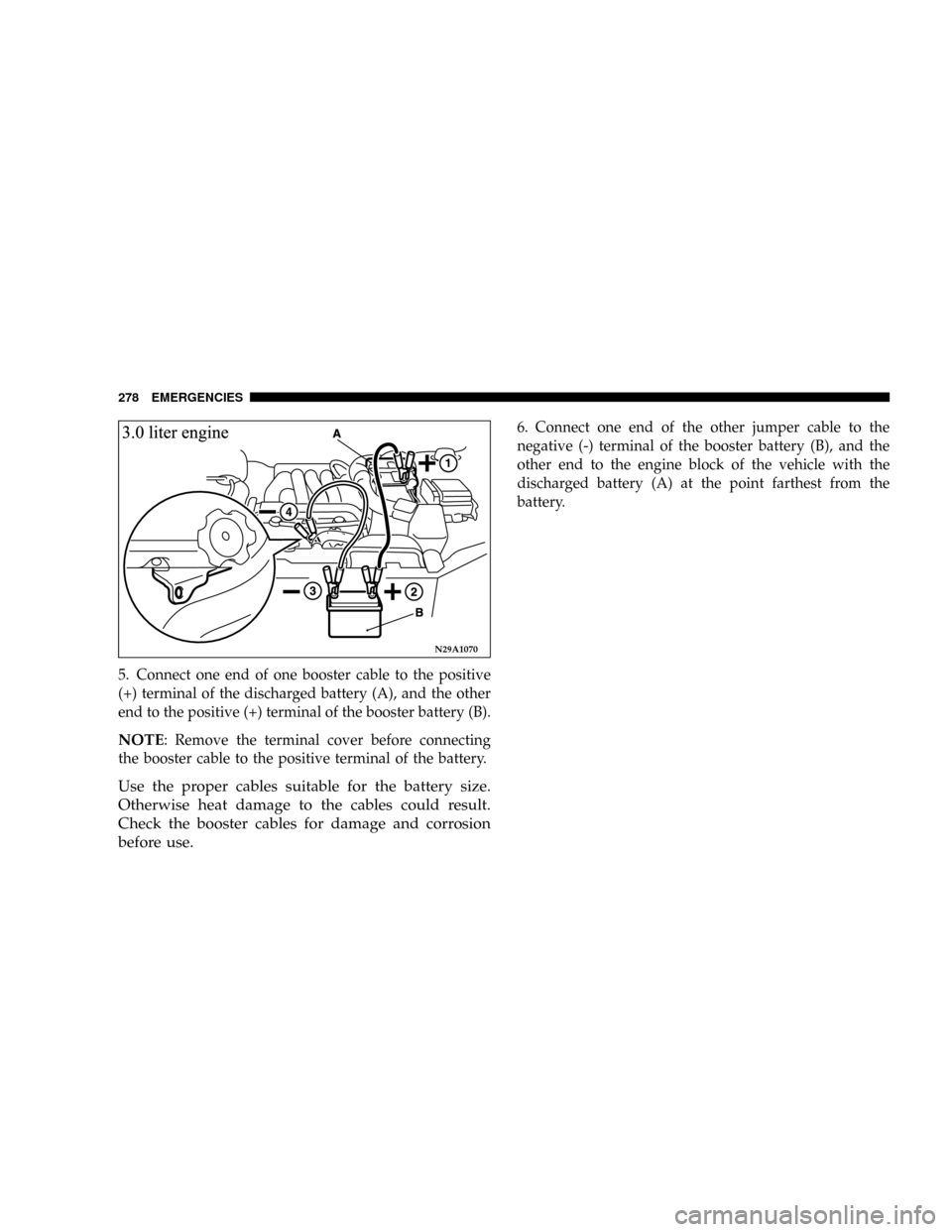
5. Connect one end of one booster cable to the positive
(+) terminal of the discharged battery (A), and the other
end to the positive (+) terminal of the booster battery (B).
NOTE: Remove the terminal cover before connecting
the booster cable to the positive terminal of the battery.
Use the proper cables suitable for the battery size.
Otherwise heat damage to the cables could result.
Check the booster cables for damage and corrosion
before use.
6. Connect one end of the other jumper cable to the
negative (-) terminal of the booster battery (B), and the
other end to the engine block of the vehicle with the
discharged battery (A) at the point farthest from the
battery.
N29A1070
278 EMERGENCIES