wheel CHRYSLER SEBRING COUPE 2004 2.G Owner's Guide
[x] Cancel search | Manufacturer: CHRYSLER, Model Year: 2004, Model line: SEBRING COUPE, Model: CHRYSLER SEBRING COUPE 2004 2.GPages: 382, PDF Size: 2.23 MB
Page 257 of 382

EMERGENCIES
CONTENTS
mIf the vehicle breaks down................259
NIf the engine quits.....................259
mOperation under adverse driving conditions...259
NIf your vehicle becomes stuck in sand, mud or
snow..............................259
NOnawetroad........................260
NOn snowy or icy roads..................261
mSpare tire, jack and tool set storage.........262
NHandling spare tire....................262
NJack...............................263
mCompact spare tire.....................263
mWheel covers (if so equipped).............264
mJacking and tire changing................266
NJacking up the vehicle..................266
mEngine overheating.....................274
mJump-starting the engine.................275
NIf your vehicle has anti-lock brakes.........280
mTowing..............................280
mFuses...............................282
NFuse block...........................282
mFusible links..........................283
NFuse load capacities....................283
mReplacement of light bulbs................288
NBulb capacity.........................288
8
Page 259 of 382

IF THE VEHICLE BREAKS DOWN
If the vehicle breaks down on the road, move to the
shoulder and activate the hazard warning flashers. If
there is no shoulder, or the shoulder is not safe, drive in
the right lane, slowly, with the hazard flashers activated,
until you reach a safe place to stop. Keep the flashers
activated.
If the engine quits
If the engine stops, power will be lost to the steering and
brakes, making steering and braking difficult.
1. The brake booster becomes inoperative and the brake
pedal will be harder to push than usual.
2. Since power steering system is not operative, the
steering wheel will be stiff when turning. Turn the wheel
with more effort than usual.
OPERATION UNDER ADVERSE DRIVING
CONDITIONS
If your vehicle becomes stuck in sand, mud or
snow
If the vehicle becomes stuck in snow, sand, or mud, it can
often be moved by a rocking motion. Turn your steering
wheel right and left to clear the area around the wheels.
Move the gearshift lever or selector lever rhythmically
between 1st and REVERSE position (with manual trans-
axle), ``L'' (Low) and ``R'' (REVERSE) position (with
automatic transaxle), Autostick and ``R'' (REVERSE) po-
sition (with automatic transaxle), while applying slight
pressure to the accelerator pedal.
Avoid racing the engine or spinning the wheels. Pro-
longed efforts to free a stuck vehicle may result in
overheating and transaxle failure.
Allow the engine to idle for a few minutes to let the
transaxle cool between rocking attempts.
If the vehicle remains stuck after several rocking at-
tempts, seek other assistance.
EMERGENCIES 259
8
Page 263 of 382

Jack
To remove
Turn the shaft end so that the jack contracts and detach it
from the storage bracket.
To store
Turn the shaft end by hand to expand the jack until it is
secured firmly in position.
COMPACT SPARE TIRE
The compact spare tire is designed to save space in the
trunk and its lighter weight makes it easier to use if a flat
tire occurs.
CAUTION!
²The tire pressure should be periodically checked
and maintained at the specified pressure while
the tire is stowed.
²Driving with an insufficient tire pressure can lead
to an accident. If you have no choice but to drive
with an insufficient tire pressure, keep your speed
down and adjust to the specified pressure [60 psi
(420 kPa)] as soon as possible.
²The compact spare should only be used temporarily
and should be returned to the trunk and the
original
tire repaired or replaced as soon as possible. If your
vehicle is equipped with aluminum type wheels, the
wheel nuts for aluminum type wheels can be used
temporarily on the compact spare tire wheel.
²Do not exceed 50 mph (80 km/h) while the com-
pact spare tire is installed on the vehicle.
N21C0010To removeTo storeStorage
bracket
EMERGENCIES 263
8
Page 264 of 382

CAUTION!
²Avoid rapid starting and braking with a compact
spare tire.
²Avoid driving through automatic vehicle washes
and over obstacles that could possibly damage the
vehicle's under-carriage. Because the tire is
smaller than the original tire, vehicle ground
clearance is slightly reduced.
²As the compact spare tire is specifically designed
for your vehicle, it should not be used on any
other vehicle.
²The compact spare tire should not be used on any
other wheels, nor should standard tires, snow tires,
wheel covers or trim rings be used with the compact
spare wheel. If such use is attempted, damage to
these items or other vehicle components may occur.
²Do not use snow chains with your compact spare
tire. Because of the smaller tire size, a snow chain
will not fit properly. This could cause damage to
the vehicle and could result in loss of the chains.
²The compact spare tire pressure should be
checked once a month while the tire is stowed.
WHEEL COVERS (IF SO EQUIPPED)
To remove
Wrap the tip of the bar with a cloth, insert it deeply into
the notch provided in the wheel cover, and pry the cover
away from the wheel.
Using the same procedure on the other side, work the
wheel cover away from the wheel to remove it com-
pletely.
N23B0630
264 EMERGENCIES
Page 265 of 382
NOTE: The wheel cover is made of plastic; use caution
when prying it off.
NOTE: Some styles of wheels will have bolt-on type
wheel covers. To remove this style, remove the bolts that
hold the cover to the wheel.
CAUTION!
Trying to simply remove the wheel cover with your
bare hands may severely injure your fingers.
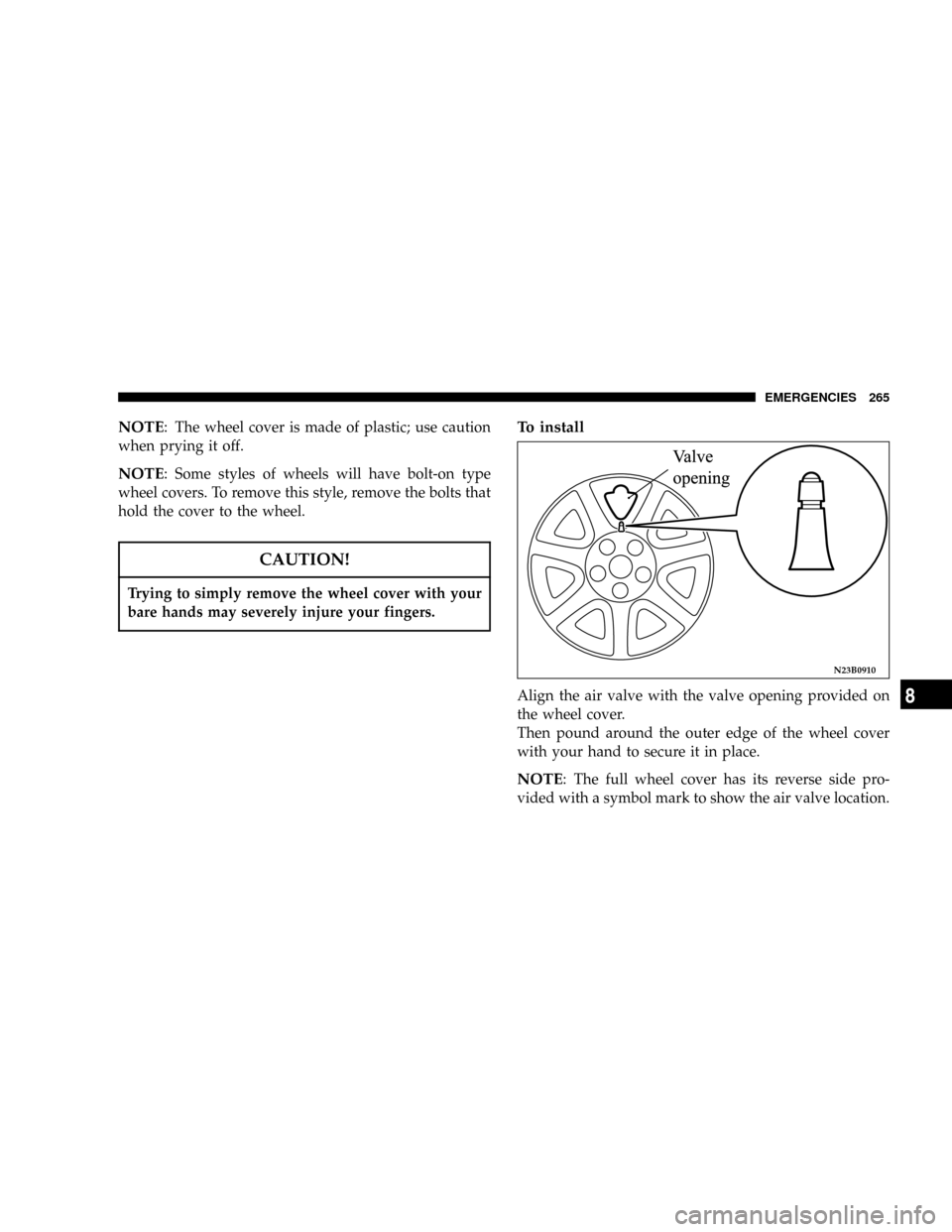
To install
Align the air valve with the valve opening provided on
the wheel cover.
Then pound around the outer edge of the wheel cover
with your hand to secure it in place.
NOTE: The full wheel cover has its reverse side pro-
vided with a symbol mark to show the air valve location.
N23B0910
EMERGENCIES 265
8
Page 266 of 382

Before installing the wheel cover to the wheel, make sure
that the opening with the symbol mark is correctly
aligned with the air valve.
JACKING AND TIRE CHANGING
If a tire must be changed, do so only after making sure
the vehicle is stopped in a safe, flat location.
Jacking up the vehicle
1. Park the vehicle on level and stable ground.
2. Switch on the hazard warning flashers, set up a
warning triangle, flashing signal light, etc., at an ad-
equate distance from the vehicle, and have all passengers
leave the vehicle. Turn the ignition key to the ªLOCKº
position.
3. Set the parking brake firmly, and move the gearshift
lever (manual transaxle) to the ªNº (Neutral) position or
move the selector lever (automatic transaxle) to the ªPº
(PARK) position.4. Apply a chock or block (A) at the tire diagonally
opposite the tire (B) to be changed.
NOTE: The chock shown is not supplied with the ve-
hicle. It is recommended that you keep one in the vehicle
for use if required.
N24A0100
A
B
266 EMERGENCIES
Page 269 of 382

7. Remove the wheel nut wrench and bar from the tool
bag (located inside the trunk).8. Insert the bar (E) into the wheel nut wrench (F). Then
attach the end of the bar to the jack end, as shown in the
illustration.
Slowly rotate the wheel nut wrench until the tire is
slightly raised off the ground surface.
N22A1830N22A0010
EMERGENCIES 269
8
Page 270 of 382

WARNING!
²Before using the jack, chock or block the wheel
that is tire diagonally opposite the jacking point.
²Stop jacking up the vehicle when the tire is raised
off the ground. It is dangerous to raise the vehicle
any higher.
²Do not get under the vehicle while using the jack.
²Avoid jarring the raised vehicle or leaving it
supported on the jack for extended periods. Both
are very dangerous.
²Do not use a jack other than the one provided
with your vehicle.
²The jack should not be used for any purpose other
than changing a tire.
²No one should stay in the vehicle while the jack is
used.
²Do not start or run the engine while the vehicle is
on the jack.
NOTE: Place the spare wheel under the vehicle body
near the jack; this helps to minimize danger should the
jack slip out of position.
N24A1500
270 EMERGENCIES
Page 271 of 382

9. Remove the wheel nuts with the wheel nut wrench,
then take the wheel off.
CAUTION!
Handle the wheel cover carefully when replacing the
flat tire, to avoid the wheel surface becoming
scratched and causing premature corrosion.
NOTE:Clear out any mud, etc. on the hub surface, hub
bolts or in the installation holes in the wheel.
10. Install the spare wheel with the nut's tapered end
facing inward, then tighten by hand until the wheel is no
longer loose.
N24A0210N24A1410
Tapered nut
Flange nut
EMERGENCIES 271
8
Page 272 of 382

CAUTION!
Never apply oil to either wheel bolts or nuts as it can
cause them to overtighten.
NOTE: Flange nuts can be temporarily used on the steel
wheel, but return to the original wheel and tire as soon as
possible.
If all four wheels are changed to steel wheels, use
tapered nuts.
11. Lower the vehicle slowly and then tighten the nuts in
the sequence shown in the illustration until each nut has
been tightened to the specified torque.
88 to 108 N·m (65 to 80 ft lb)
N24A0220
272 EMERGENCIES