lock CHRYSLER SEBRING COUPE 2004 2.G Service Manual
[x] Cancel search | Manufacturer: CHRYSLER, Model Year: 2004, Model line: SEBRING COUPE, Model: CHRYSLER SEBRING COUPE 2004 2.GPages: 382, PDF Size: 2.23 MB
Page 55 of 382
Your vehicle has seat belts and other features that help
protect you and your passengers in an accident.
Seat belts are the most important safety device. When
worn properly, seat belts can reduce the chance of serious
injury or death in various types of crashes. For added
protection during a severe frontal collision, your vehicle
has a Supplemental Restraint System (SRS) with air bags
for the driver and front seat passenger. The seats, head
restraints, and door locks also are safety equipment,
which must be used correctly.
Always check the following before you drive:
1. Everyone in the vehicle is properly wearing their seat
belt.
2. Infants and small children are properly secured in
appropriate child restraints in the rear seat.
3. All doors are closed and locked.
4. Seat backs are fully upright, with head restraints
properly adjusted.No safety equipment can prevent all injuries or deaths
that can occur in severe collisions, but by making sure all
your passengers follow the instructions in this manual,
you can help reduce the risk of injury.
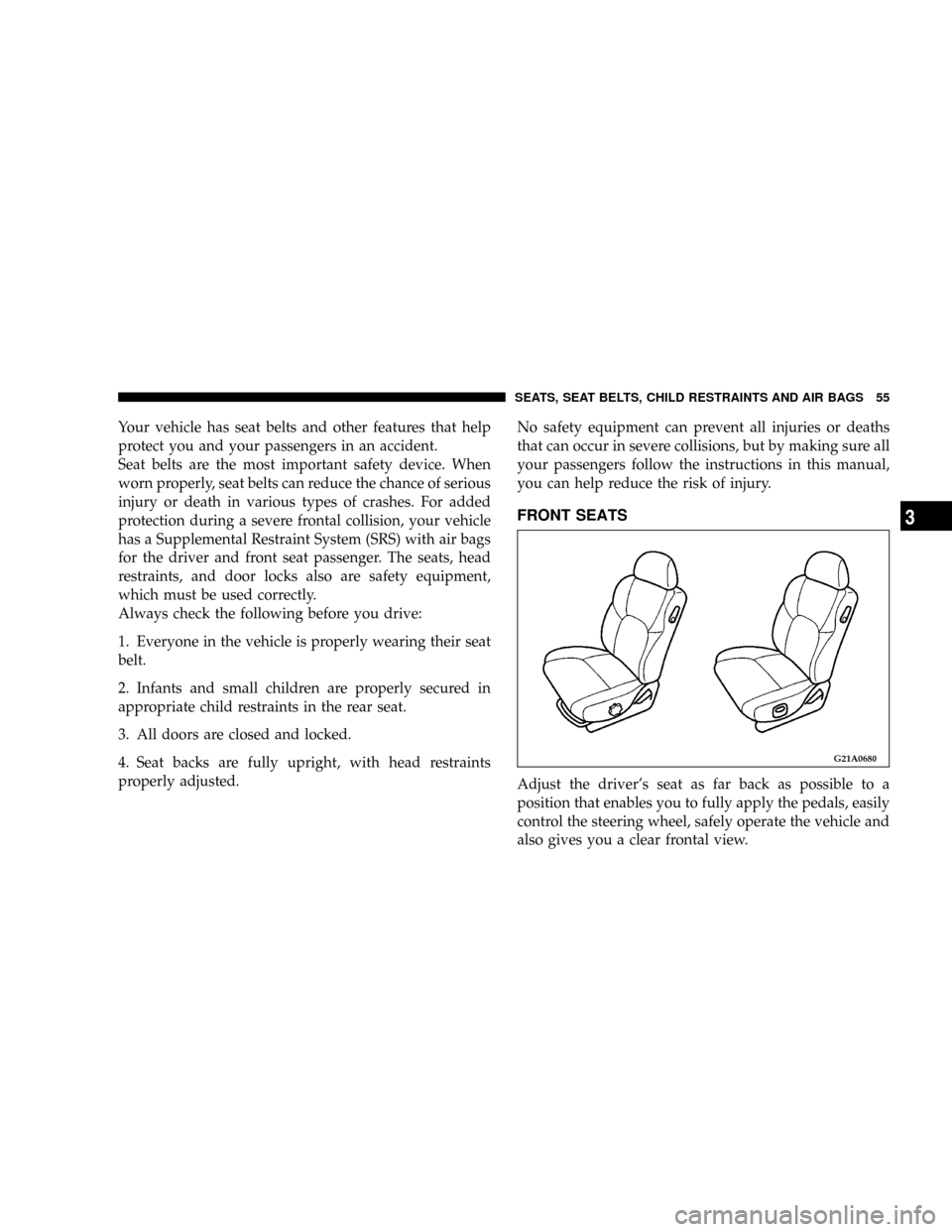
FRONT SEATS
Adjust the driver's seat as far back as possible to a
position that enables you to fully apply the pedals, easily
control the steering wheel, safely operate the vehicle and
also gives you a clear frontal view.
G21A0680
SEATS, SEAT BELTS, CHILD RESTRAINTS AND AIR BAGS 55
3
Page 56 of 382
WARNING!
²Do not attempt to adjust the seat while driving.
This can be dangerous.
²After adjusting the seat, make sure that the seat is
securely locked into position.
²Be sure to have the seat adjusted by an adult. If it
is adjusted by a child, the seat may not be prop-
erly locked into position.
WARNING!
²In order to reduce risk of serious or fatal injury in
a collision, including from a deploying front pas-
senger air bag, all front seat passengers should
move the front passenger seat as far back as
possible, all children 12 years old and under
should ride restrained in the rear seat, and all
children in rear-facing child restraints must ride
in the rear seat.
²In order to reduce risk of serious or fatal injury in
an accident, including from a deploying driver 's
side air bag, the driver should move the driver's
seat as far back as possible, while still maintain-
ing good visibility and good control of the steer-
ing wheel, accelerator and brake pedals.
NOTE: On vehicles with a power seat, to prevent the
battery from running down, operate the power seat with
the engine in operation.
56 SEATS, SEAT BELTS, CHILD RESTRAINTS AND AIR BAGS
Page 57 of 382
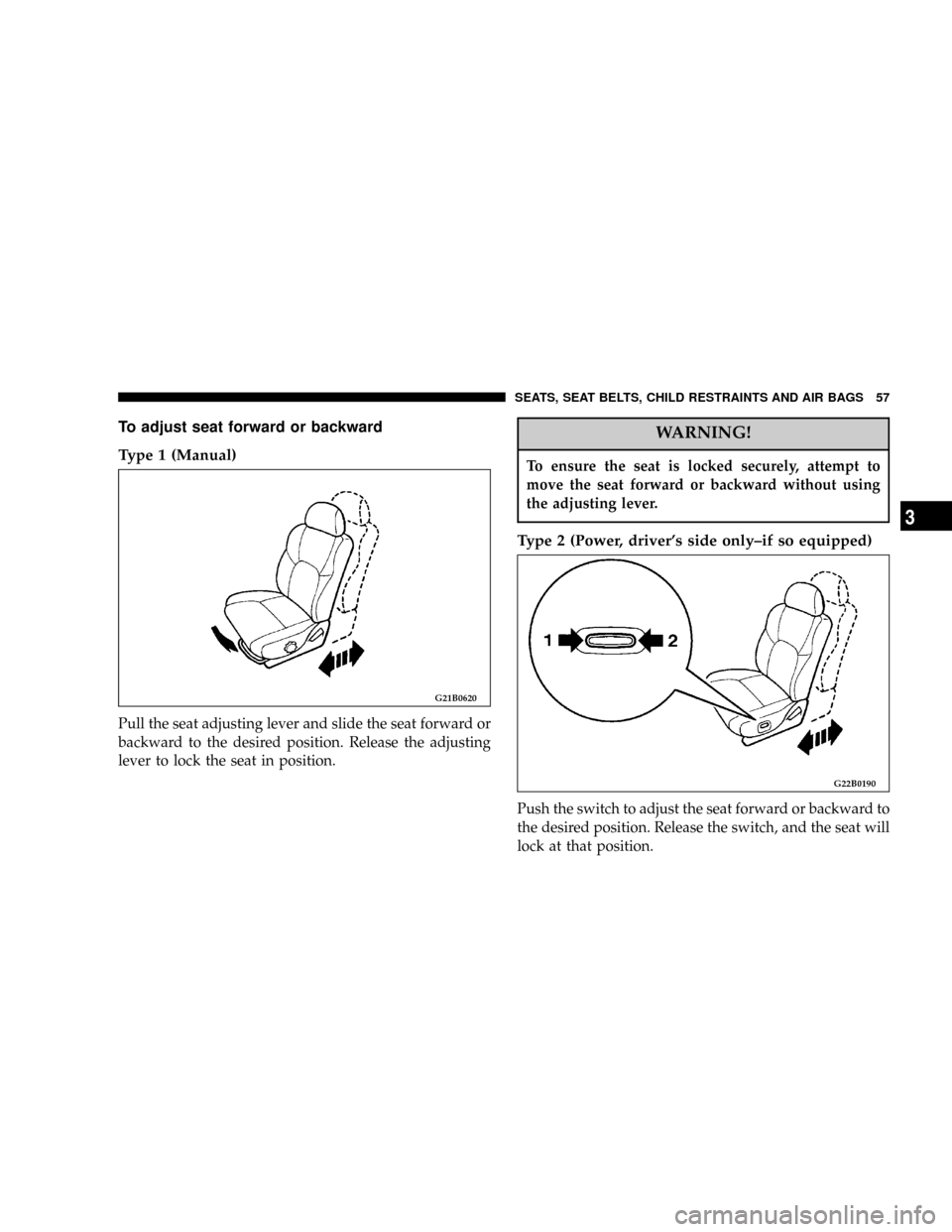
To adjust seat forward or backward
Type 1 (Manual)
Pull the seat adjusting lever and slide the seat forward or
backward to the desired position. Release the adjusting
lever to lock the seat in position.
WARNING!
To ensure the seat is locked securely, attempt to
move the seat forward or backward without using
the adjusting lever.
Type 2 (Power, driver's side only±if so equipped)
Push the switch to adjust the seat forward or backward to
the desired position. Release the switch, and the seat will
lock at that position.
G21B0620
G22B0190
SEATS, SEAT BELTS, CHILD RESTRAINTS AND AIR BAGS 57
3
Page 58 of 382
1. Backward
2. Forward
CAUTION!
Operate the power seat with care not to have the
hand or foot caught by the seat.
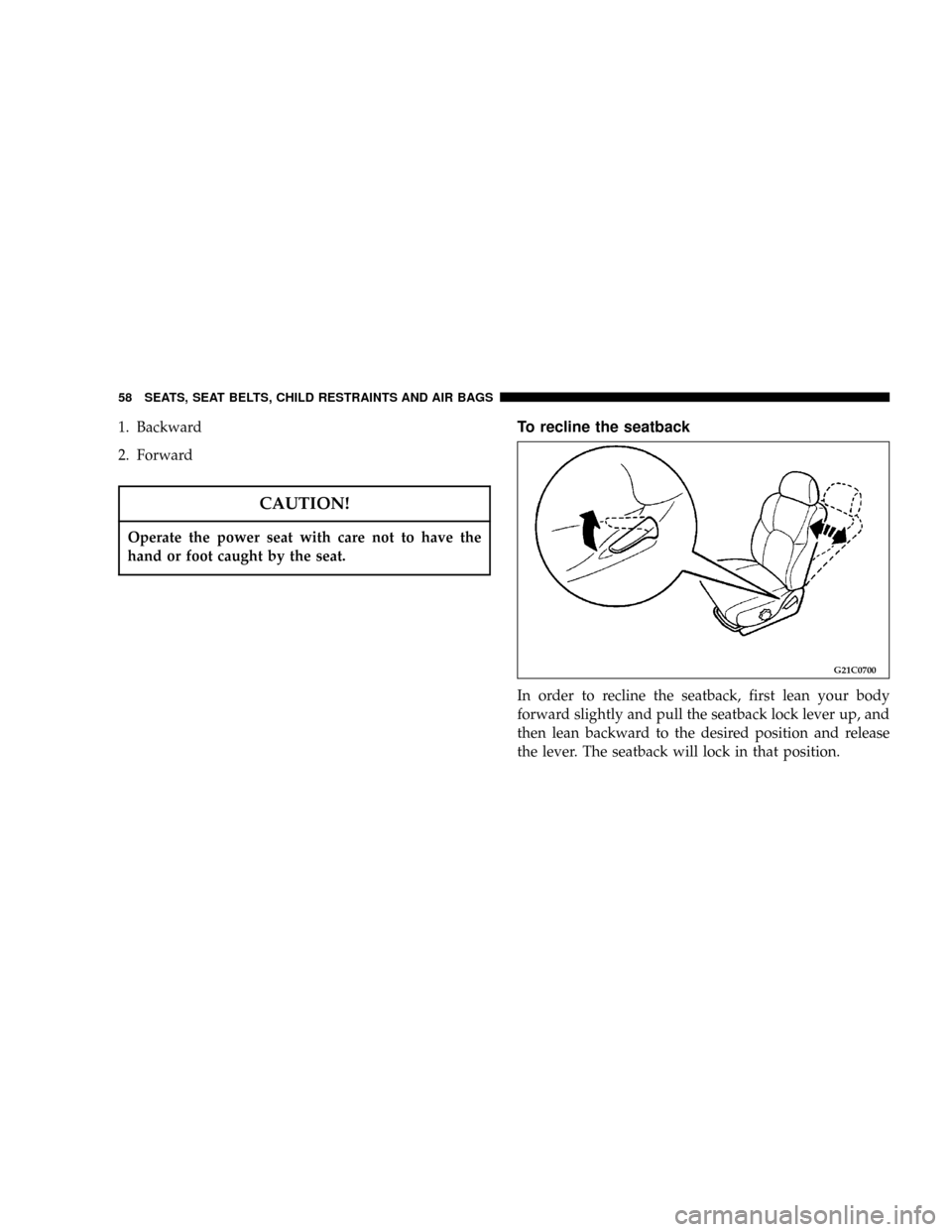
To recline the seatback
In order to recline the seatback, first lean your body
forward slightly and pull the seatback lock lever up, and
then lean backward to the desired position and release
the lever. The seatback will lock in that position.
G21C0700
58 SEATS, SEAT BELTS, CHILD RESTRAINTS AND AIR BAGS
Page 59 of 382
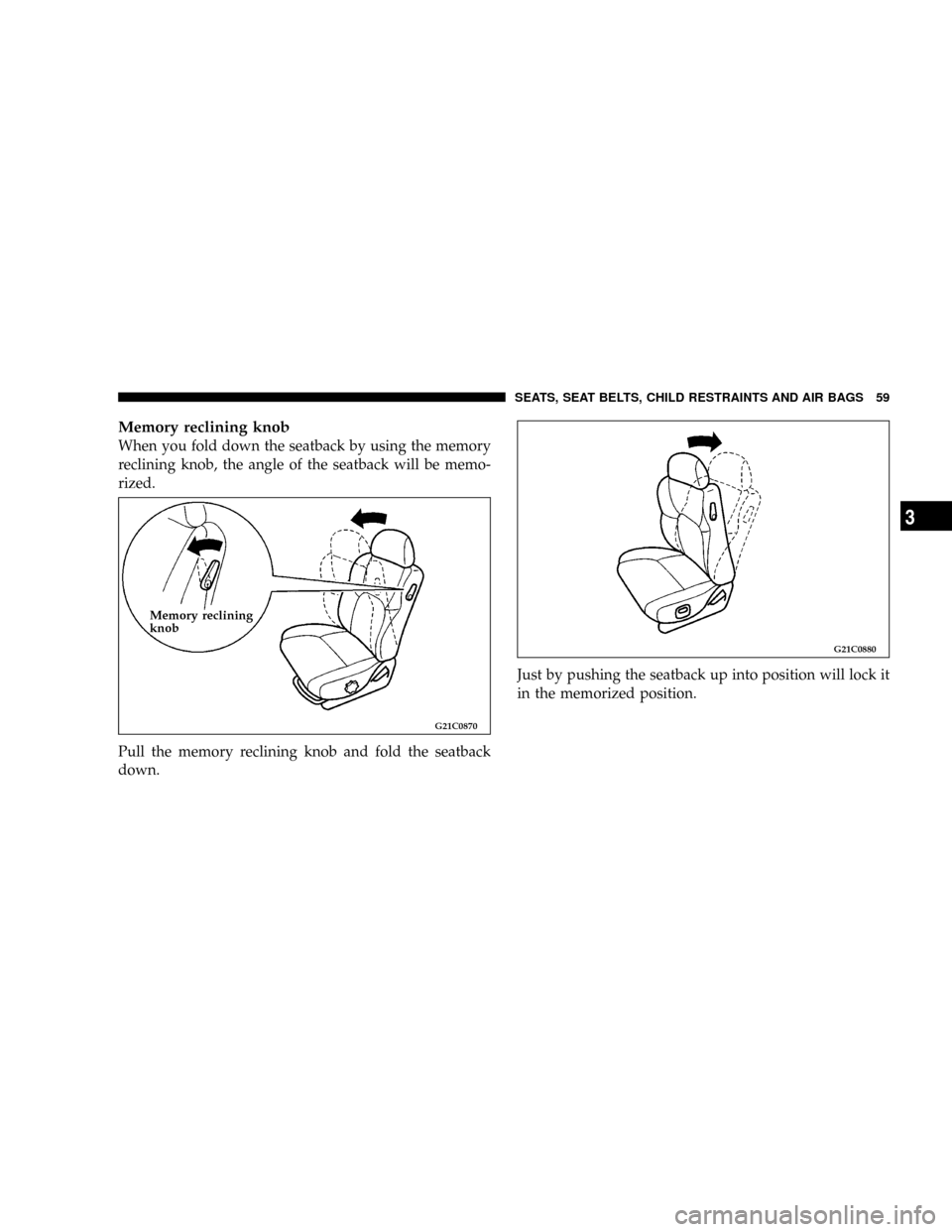
Memory reclining knob
When you fold down the seatback by using the memory
reclining knob, the angle of the seatback will be memo-
rized.
Pull the memory reclining knob and fold the seatback
down.Just by pushing the seatback up into position will lock it
in the memorized position.
G21C0870
Memory reclining
knob
G21C0880
SEATS, SEAT BELTS, CHILD RESTRAINTS AND AIR BAGS 59
3
Page 60 of 382
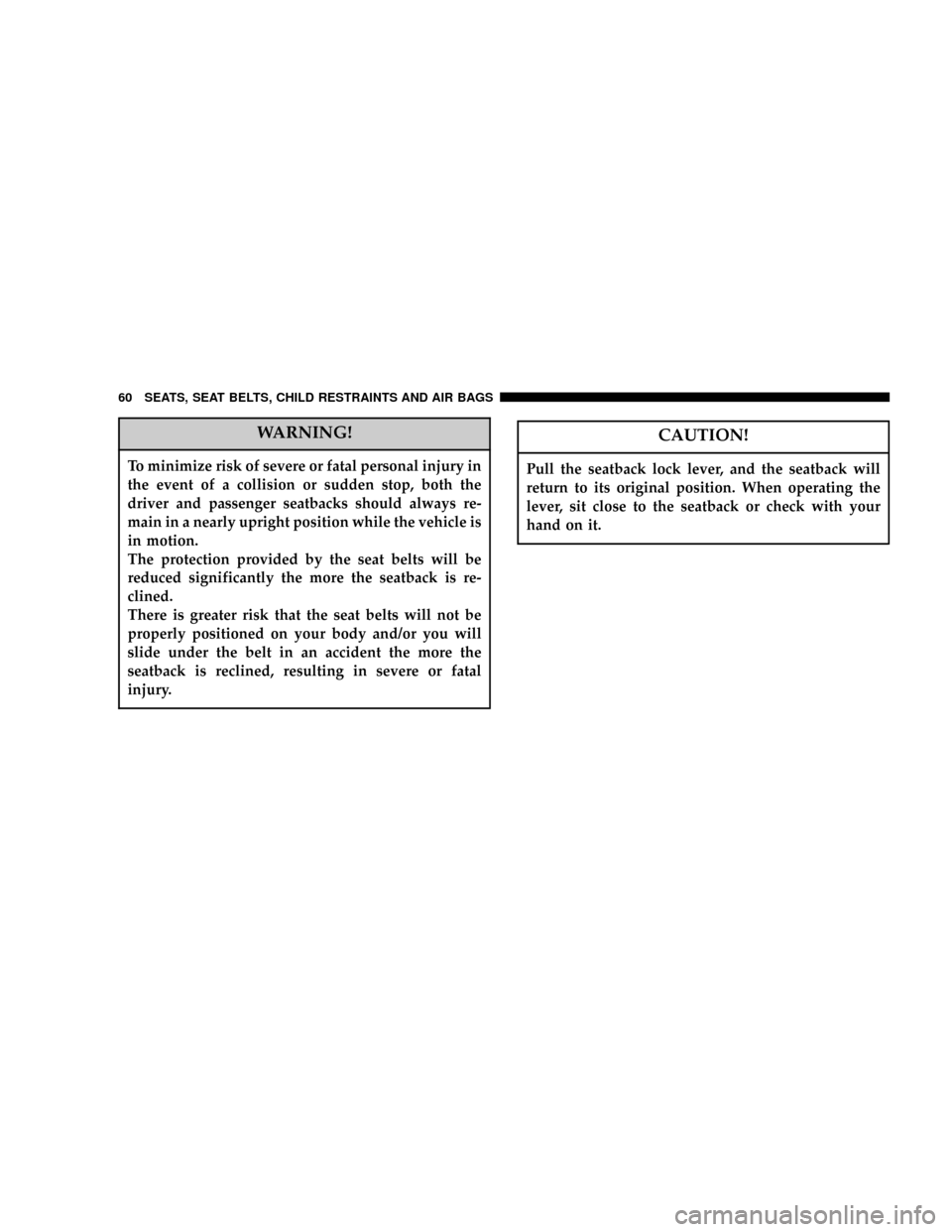
WARNING!
To minimize risk of severe or fatal personal injury in
the event of a collision or sudden stop, both the
driver and passenger seatbacks should always re-
main in a nearly upright position while the vehicle is
in motion.
The protection provided by the seat belts will be
reduced significantly the more the seatback is re-
clined.
There is greater risk that the seat belts will not be
properly positioned on your body and/or you will
slide under the belt in an accident the more the
seatback is reclined, resulting in severe or fatal
injury.
CAUTION!
Pull the seatback lock lever, and the seatback will
return to its original position. When operating the
lever, sit close to the seatback or check with your
hand on it.
60 SEATS, SEAT BELTS, CHILD RESTRAINTS AND AIR BAGS
Page 63 of 382
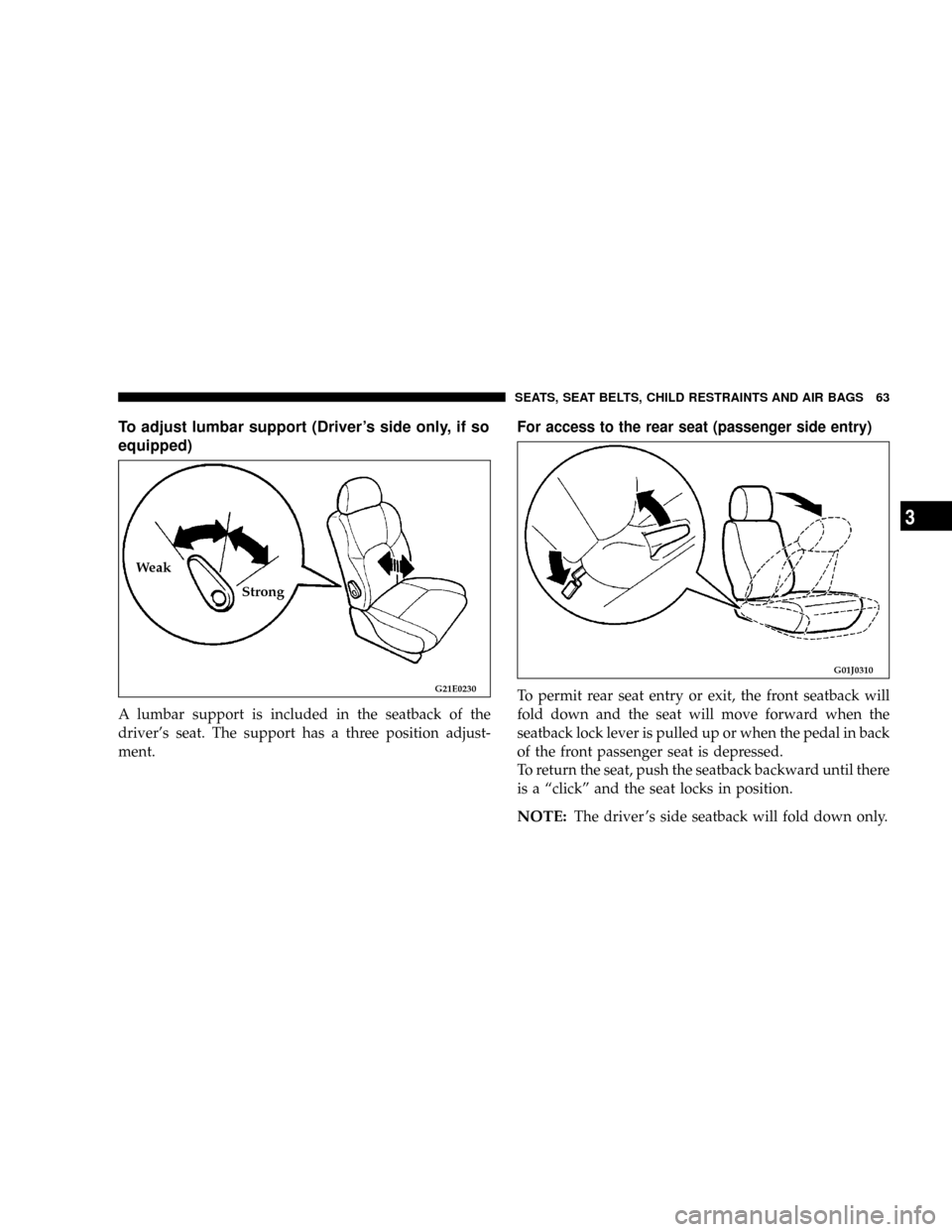
To adjust lumbar support (Driver's side only, if so
equipped)
A lumbar support is included in the seatback of the
driver's seat. The support has a three position adjust-
ment.For access to the rear seat (passenger side entry)
To permit rear seat entry or exit, the front seatback will
fold down and the seat will move forward when the
seatback lock lever is pulled up or when the pedal in back
of the front passenger seat is depressed.
To return the seat, push the seatback backward until there
is a ªclickº and the seat locks in position.
NOTE:The driver 's side seatback will fold down only.
G21E0230
Weak
Strong
G01J0310
SEATS, SEAT BELTS, CHILD RESTRAINTS AND AIR BAGS 63
3
Page 64 of 382
REAR SEATS
Rear seat capacity
WARNING!
²The rear seating capacity of this vehicle is three
people.
²The rear seat occupants should always wear their
seat belts when the vehicle is in motion.
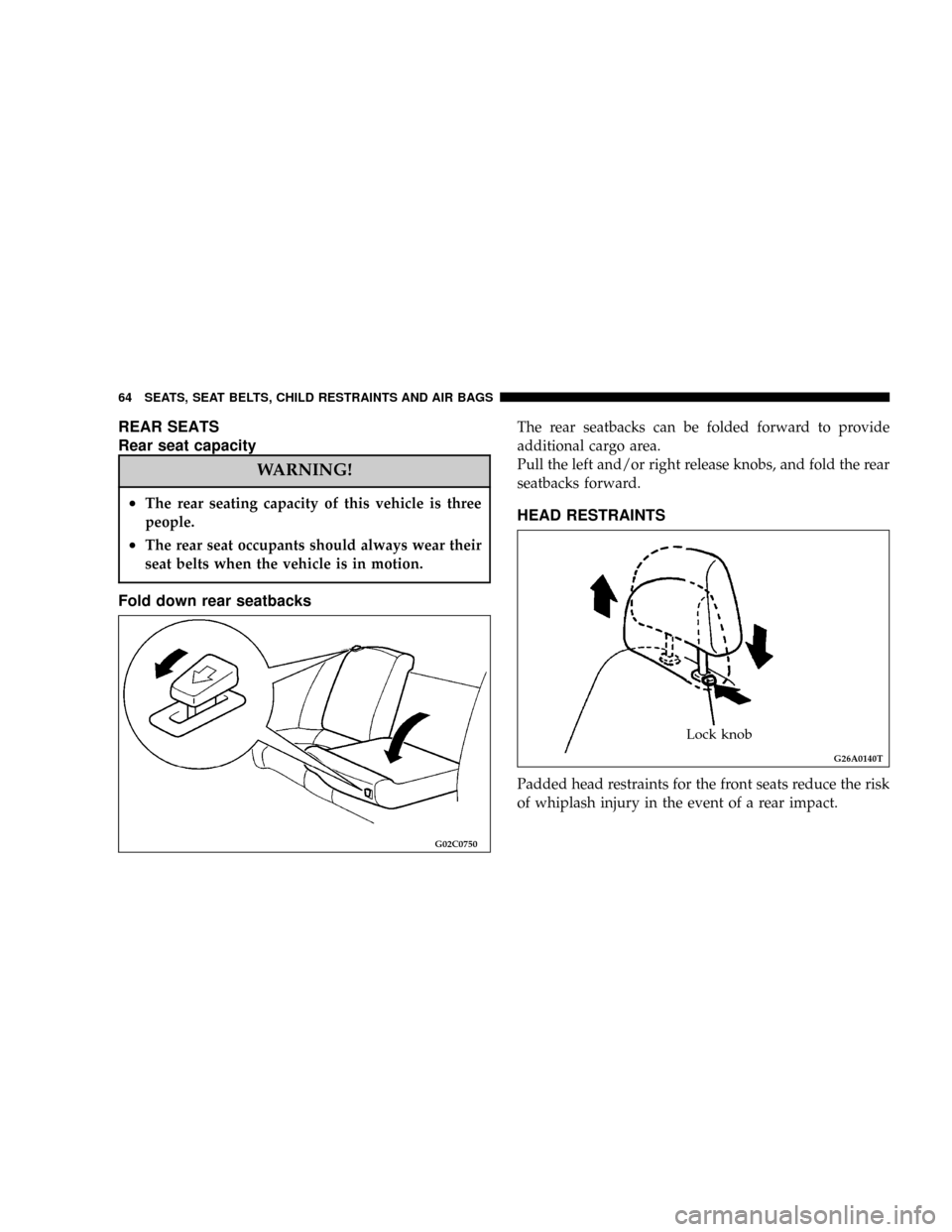
Fold down rear seatbacks
The rear seatbacks can be folded forward to provide
additional cargo area.
Pull the left and/or right release knobs, and fold the rear
seatbacks forward.
HEAD RESTRAINTS
Padded head restraints for the front seats reduce the risk
of whiplash injury in the event of a rear impact.
G02C0750
G26A0140T
Lock knob
64 SEATS, SEAT BELTS, CHILD RESTRAINTS AND AIR BAGS
Page 65 of 382
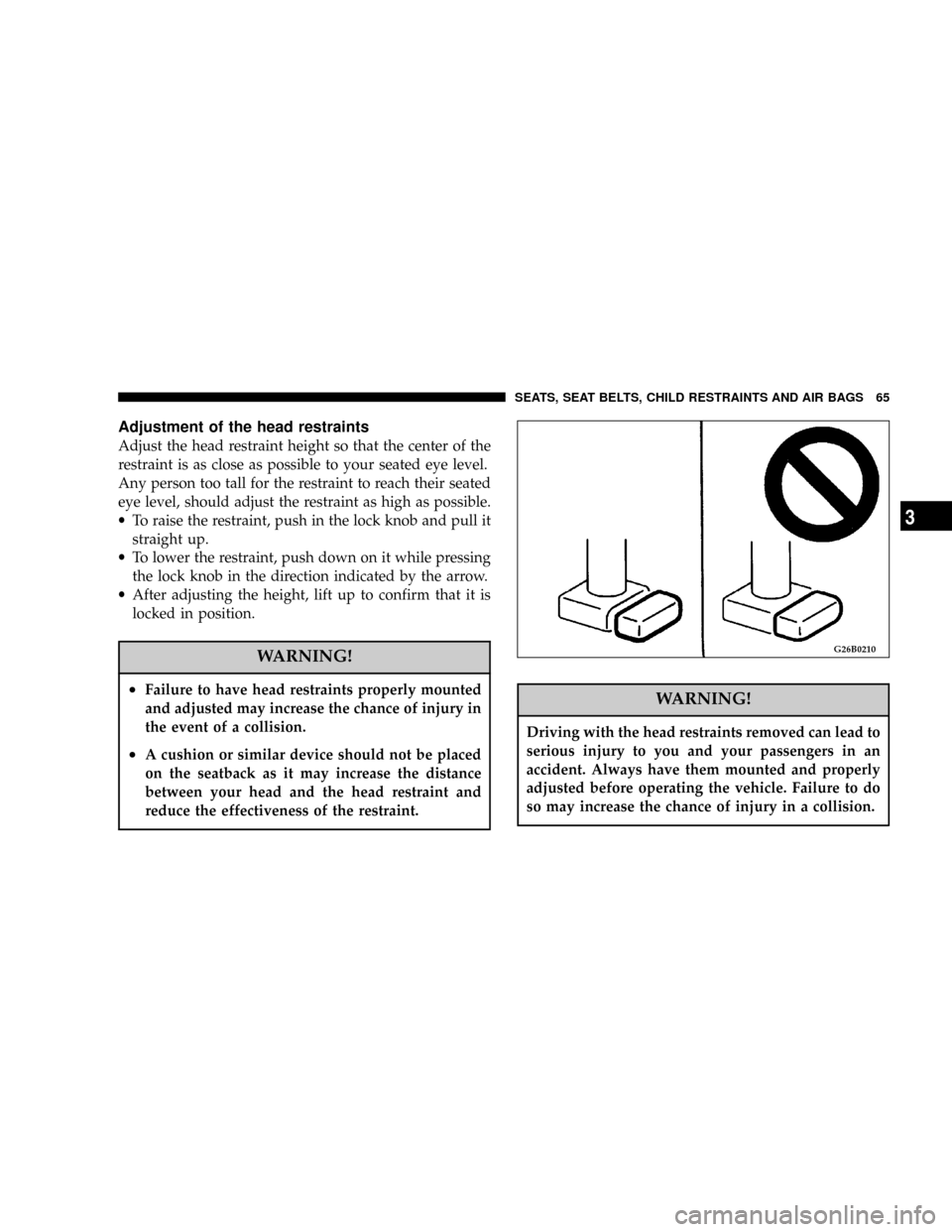
Adjustment of the head restraints
Adjust the head restraint height so that the center of the
restraint is as close as possible to your seated eye level.
Any person too tall for the restraint to reach their seated
eye level, should adjust the restraint as high as possible.
·To raise the restraint, push in the lock knob and pull it
straight up.
·To lower the restraint, push down on it while pressing
the lock knob in the direction indicated by the arrow.
·After adjusting the height, lift up to confirm that it is
locked in position.
WARNING!
²Failure to have head restraints properly mounted
and adjusted may increase the chance of injury in
the event of a collision.
²A cushion or similar device should not be placed
on the seatback as it may increase the distance
between your head and the head restraint and
reduce the effectiveness of the restraint.
WARNING!
Driving with the head restraints removed can lead to
serious injury to you and your passengers in an
accident. Always have them mounted and properly
adjusted before operating the vehicle. Failure to do
so may increase the chance of injury in a collision.
G26B0210
SEATS, SEAT BELTS, CHILD RESTRAINTS AND AIR BAGS 65
3
Page 66 of 382
SEAT BELTS
Seat belts are installed in your vehicle for the protection
of the driver and passengers.
Always use the seat belts. In an accident, injury to the
driver and passengers may be reduced if the seat belts are
properly used.
NOTE: Legislation in your state may require seat belt
usage; however, even if it is not required seat belts should
always be used.
WARNING!
²Lock all doors before driving to reduce the risk of
injury or ejection in a collision.
²Seat belts should always be worn by every adult who
drives or rides in this vehicle, and by all children
who are large enough to wear seat belts properly.
²Never use one seat belt for more than one occupant.
²Never carry more people in the vehicle than there
are seat belts.
²Always adjust the belt for a snug fit.
²Always route the shoulder belt over your shoulder
and across your chest. Never put it behind you or
under your arm.
²Always wear the lap belt as low as possible across
your hips, not around your waist.
²To reduce the risk of serious or fatal injury in a
collision, including from a deploying driver air
bag, the driver should adjust the driver's seat to
the rear most position that still allows good vis-
ibility and good control of the steering wheel, the
brake, accelerator, and vehicle controls.
66 SEATS, SEAT BELTS, CHILD RESTRAINTS AND AIR BAGS