engine CHRYSLER SEBRING COUPE 2005 2.G Owners Manual
[x] Cancel search | Manufacturer: CHRYSLER, Model Year: 2005, Model line: SEBRING COUPE, Model: CHRYSLER SEBRING COUPE 2005 2.GPages: 394, PDF Size: 2.47 MB
Page 323 of 394
WARNING!
²If the battery goes flat, be sure to check the battery
electrolyte level before connecting booster cables.
²After checking the battery electrolyte level, make
sure the caps are fitted securely.
²If any of the caps has a loose fit, replace the
battery.
During cold weather
The capacity of the battery is reduced at low tempera-
tures. This is the result of its chemical and physical
properties and this is why a very cold battery, particu-
larly one that is not fully charged, will only deliver a
fraction of the starter current that is normally available.
It is recommended that you have the battery checked by
an authorized dealer before the start of cold weather and,
if necessary, have it charged or replaced. This not only
ensures reliable starting, but prolongs battery life.
Disconnection and connection
To disconnect the battery cable, stop the engine, discon-
nect the negative terminal first, then the positive termi-
nal. To reconnect the battery, first connect the positive
terminal and then the negative terminal, before starting
the vehicle.
MAINTENANCE 323
9
Page 324 of 394
WARNING!
²Never disconnect the battery while the engine is
running; doing so could damage the vehicle's
electrical components.
²Never short-circuit the battery; doing so could
cause it to overheat and be damaged.
²Keep sparks, cigarettes and flames away from the
battery because the battery may produce an explo-
sion.
²Electrolyte (battery acid) is corrosive diluted sul-
furic acid. If electrolyte comes in contact with,
your hands, eyes, clothes, or the coated surface of
your vehicle, thoroughly flush the area with wa-
ter. If electrolyte gets in your eyes, flush them
with water immediately and get prompt medical
attention.
WARNING!
²Ventilate the area when charging or using the
battery in an enclosed space.
²Always wear protective clothing and goggles
when working with the battery, or have a skilled
technician do it.
²If the battery is to be quick-charged, first discon-
nect the battery cables from the vehicle.
²In order to prevent a short circuit, be sure to
disconnect the negative(-) terminal first, and re-
connect it last.
²If the electrolyte level is very low, have the battery
checked at an authorized dealer.
²Battery posts, terminals and related accessories
contain lead and lead compounds. Wash hands
after handling.
324 MAINTENANCE
Page 326 of 394

To check the fluid level
The fluid level should be checked when the engine
temperature gauge indicates a normal warmed up con-
dition and the fluid in the transaxle is heated to its
normal operating temperature. Operation with an im-
proper fluid level will greatly reduce the life of the
transaxle and the fluid.
Procedure for checking the fluid level
1. With the parking brake engaged and the engine idling,
select each gear momentarily, ending with the selector
lever in the ªNº (NEUTRAL) position.
2. The fluid level should be at the HOT mark, but never
above the HOT mark when the engine is at its normal
warmed up condition. Add or drain as necessary to bring
the fluid to this prescribed level.
3. Make certain that the dipstick cap is reseated properly
to prevent dirt and water from entering the transaxle.
WARNING!
Transaxle fluid is extremely flammable and poison-
ous. Do not spill fluid when adding or draining.
To add or change the fluid
Use only recommended Mopar ATF+4 automatic trans-
mission fluid to ensure optimum transaxle performance.
M05A0460
Drain plug
326 MAINTENANCE
Page 328 of 394
HOOD LOCK RELEASE MECHANISM AND
SAFETY CATCH
The hood lock release mechanism and hood safety catch
should be inspected, cleaned, and lubricated as required
to maintain ease of operation and to provide protection
against rust and wear. Apply Multipurpose Grease NLGI
Grade 2 sparingly to all sliding contact areas of the hood
latch and release lever. Work lubricant into the hood lock
mechanism until all frictional surfaces are covered.
Also, apply a film of the same lubricant to the pivot
contact areas of the safety catch.
EXHAUST SYSTEM
WARNING!
Carbon monoxide gas found in the vehicle's exhaust
is poisonous. Inhalation of exhaust fumes can cause
unconsciousness or death.
The best protection against carbon monoxide entry into
the vehicle interior is a properly maintained engine
exhaust system.Whenever a change is noticed in the sound of the exhaust
system; when exhaust fumes can be detected inside the
vehicle; or when the underside or rear of the vehicle is
damaged, have a competent technician inspect the com-
plete exhaust system and adjacent body areas for broken,
damaged, deteriorated, or mispositioned parts.
In addition inspect the exhaust system each time the
vehicle is raised for lubrication or oil change. Replace as
required.
Open seams or loose connections could permit danger-
ous exhaust fumes to seep into the trunk and passenger
compartments.
Do this service when performing underbody service.
Check for any of the following conditions:
1. Check for holes or exhaust gas leakage caused by
corrosion or damage.
2. Check the joints and connections for looseness or
exhaust gas leakage.
3. Check the rubber hangers and brackets for damage.
328 MAINTENANCE
Page 329 of 394
WINDSHIELD WIPER BLADES
Check the wiper blades occasionally. Periodic cleaning of
the wiper blades is suggested to remove the accumula-
tion of salt and road film. The wiper blade arms and glass
areas should be cleaned with a sponge or cloth and a
mild detergent or non-abrasive cleaner.
If the blades continue to streak or smear, they should be
replaced.
NOTE: Do not operate wipers for long periods on dry
glass; this accelerates deterioration of the rubber and
could scratch the glass.
Windshield washers
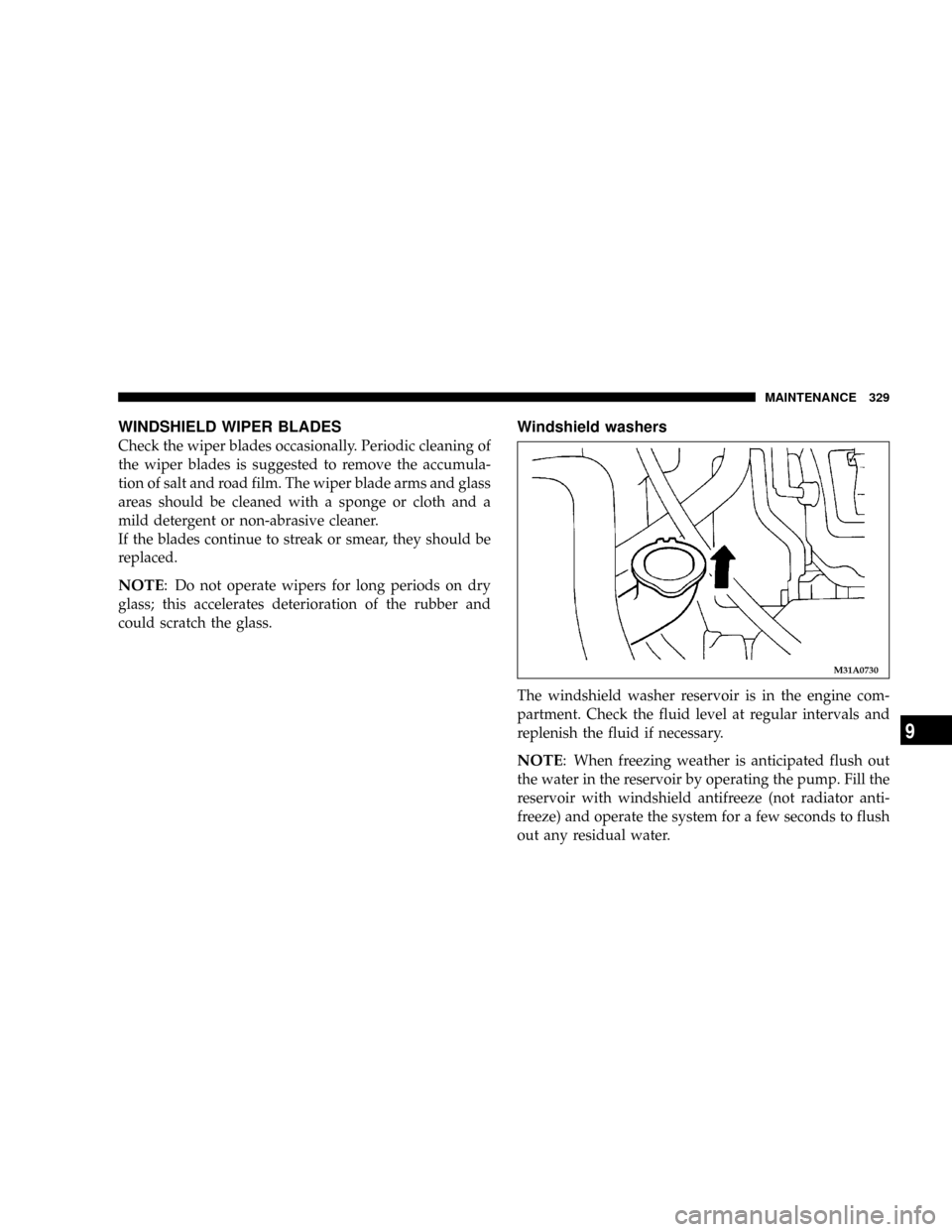
The windshield washer reservoir is in the engine com-
partment. Check the fluid level at regular intervals and
replenish the fluid if necessary.
NOTE: When freezing weather is anticipated flush out
the water in the reservoir by operating the pump. Fill the
reservoir with windshield antifreeze (not radiator anti-
freeze) and operate the system for a few seconds to flush
out any residual water.
M31A0730
MAINTENANCE 329
9
Page 331 of 394
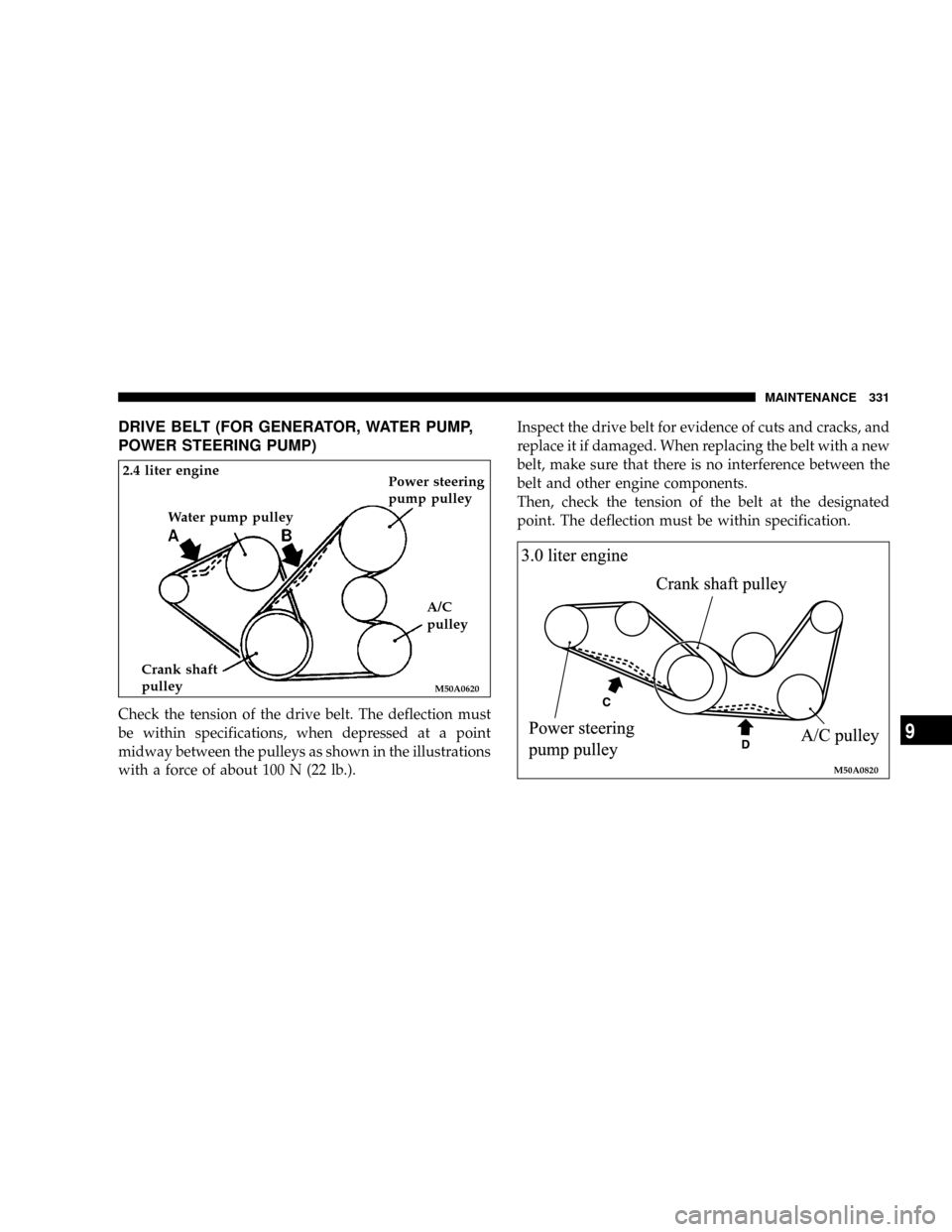
DRIVE BELT (FOR GENERATOR, WATER PUMP,
POWER STEERING PUMP)
Check the tension of the drive belt. The deflection must
be within specifications, when depressed at a point
midway between the pulleys as shown in the illustrations
with a force of about 100 N (22 lb.).Inspect the drive belt for evidence of cuts and cracks, and
replace it if damaged. When replacing the belt with a new
belt, make sure that there is no interference between the
belt and other engine components.
Then, check the tension of the belt at the designated
point. The deflection must be within specification.
M50A0620
Water pump pulley
Crank shaft
pulleyPower steering
pump pulley
A/C
pulley 2.4 liter engine
M50A0820
MAINTENANCE 331
9
Page 332 of 394
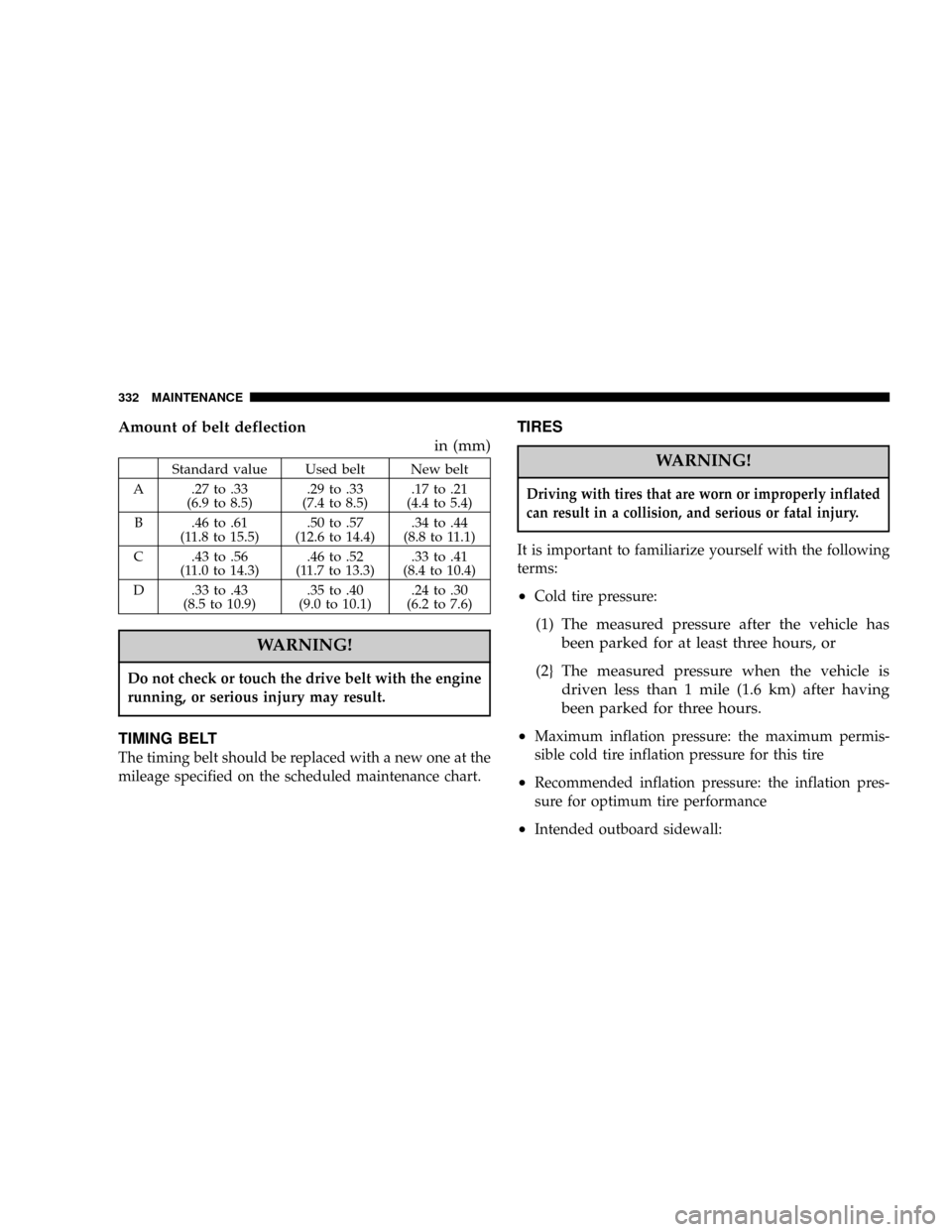
Amount of belt deflection
in (mm)
Standard value Used belt New belt
A .27 to .33
(6.9 to 8.5).29 to .33
(7.4 to 8.5).17 to .21
(4.4 to 5.4)
B .46 to .61
(11.8 to 15.5).50 to .57
(12.6 to 14.4).34 to .44
(8.8 to 11.1)
C .43 to .56
(11.0 to 14.3).46 to .52
(11.7 to 13.3).33 to .41
(8.4 to 10.4)
D .33 to .43
(8.5 to 10.9).35 to .40
(9.0 to 10.1).24 to .30
(6.2 to 7.6)
WARNING!
Do not check or touch the drive belt with the engine
running, or serious injury may result.
TIMING BELT
The timing belt should be replaced with a new one at the
mileage specified on the scheduled maintenance chart.
TIRES
WARNING!
Driving with tires that are worn or improperly inflated
can result in a collision, and serious or fatal injury.
It is important to familiarize yourself with the following
terms:
²Cold tire pressure:
(1) The measured pressure after the vehicle has
been parked for at least three hours, or
(2} The measured pressure when the vehicle is
driven less than 1 mile (1.6 km) after having
been parked for three hours.
²
Maximum inflation pressure: the maximum permis-
sible cold tire inflation pressure for this tire
²Recommended inflation pressure: the inflation pres-
sure for optimum tire performance
²Intended outboard sidewall:
332 MAINTENANCE
Page 339 of 394
2. Maintain wheel balance and front suspension align-
ment.
3. Rotate tires regularly in accordance with the recom-
mendation in the section ªTire rotationº on page 344.
Loading information
WARNING!
Overloading of your tire is dangerous. Overloading
can cause tire failure, affect vehicle handling, and
increase your stopping distance. Use tires of the
recommended load capacity for your vehicle. Never
overload them.
It is important to familiarize yourself with the following
terms before loading your vehicle:
²Vehicle maximum load on the tire : load on an
individual tire that is determined by distributing to
each axle its share of the maximum loaded vehicle
weight and dividing by two.
²Vehicle normal load on the tire : load on an indi-
vidual tire that is determined by distributing to each
axle its share of the curb weight, accessory weight,
and normal occupant weight and dividing by two.
²Maximum loaded vehicle weight : the sum of -
(a) Curb weight;
(b) Accessory weight
(c) Vehicle capacity weight; and
(d) Production option weight.
²Curb weight : the weight of a motor vehicle with
standard equipment including the maximum capac-
ity of fuel, oil, and coolant, and, if so equipped, air
conditioning and additional weight optional engine.
²Accessory weight : the combined weight (in excess
of those standard items which may be replaced) of
automatic transmission, power steering, power
brakes, power windows, power seats, radio, and
heater, to the extent that these items are available as
factory-installed equipment (whether installed or
not).
MAINTENANCE 339
9
Page 346 of 394
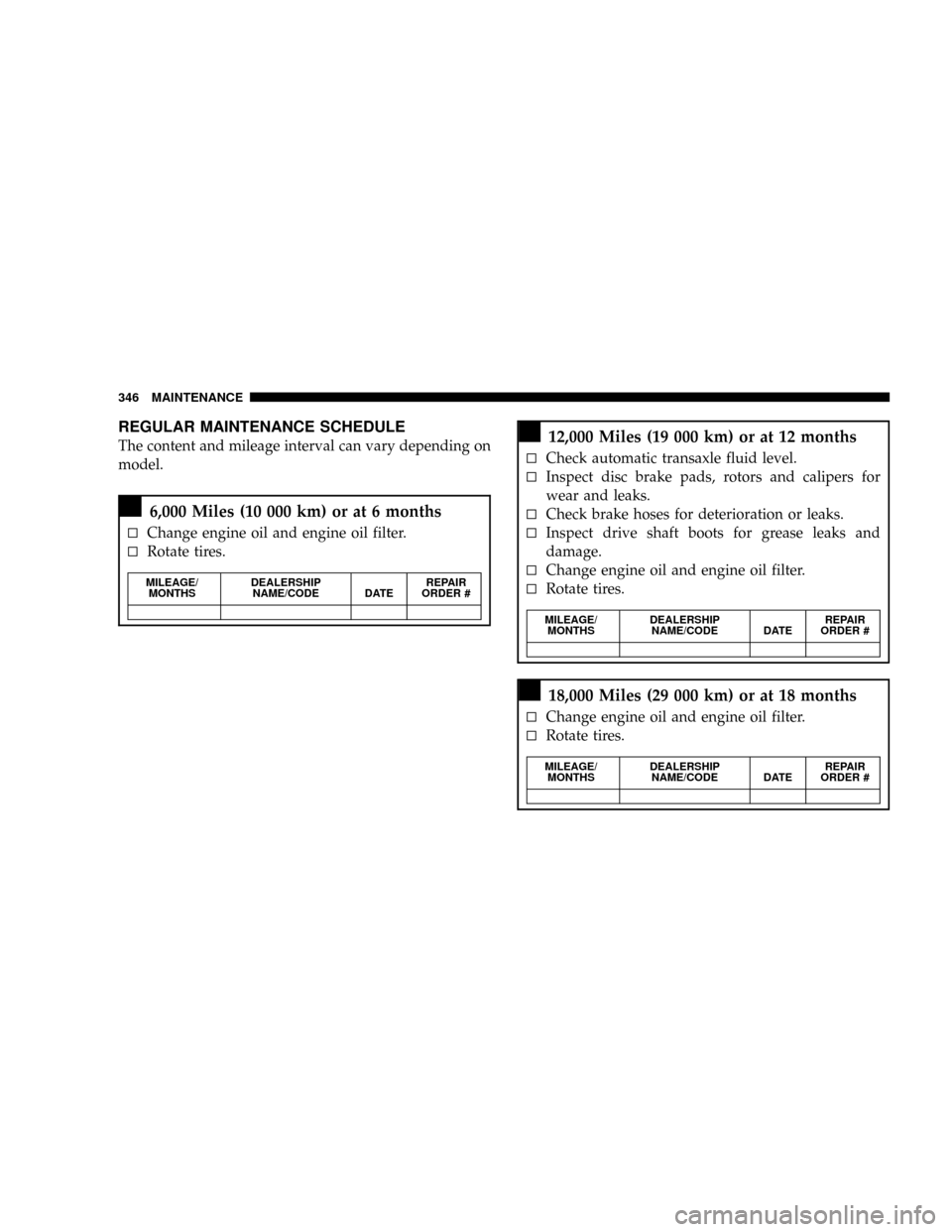
REGULAR MAINTENANCE SCHEDULE
The content and mileage interval can vary depending on
model.
!6,000 Miles (10 000 km) or at 6 months
NChange engine oil and engine oil filter.
NRotate tires.
MILEAGE/
MONTHSDEALERSHIP
NAME/CODE DATEREPAIR
ORDER #
!12,000 Miles (19 000 km) or at 12 months
NCheck automatic transaxle fluid level.
NInspect disc brake pads, rotors and calipers for
wear and leaks.
NCheck brake hoses for deterioration or leaks.
NInspect drive shaft boots for grease leaks and
damage.
NChange engine oil and engine oil filter.
NRotate tires.
MILEAGE/
MONTHSDEALERSHIP
NAME/CODE DATEREPAIR
ORDER #
!18,000 Miles (29 000 km) or at 18 months
NChange engine oil and engine oil filter.
NRotate tires.
MILEAGE/
MONTHSDEALERSHIP
NAME/CODE DATEREPAIR
ORDER #
346 MAINTENANCE
Page 347 of 394
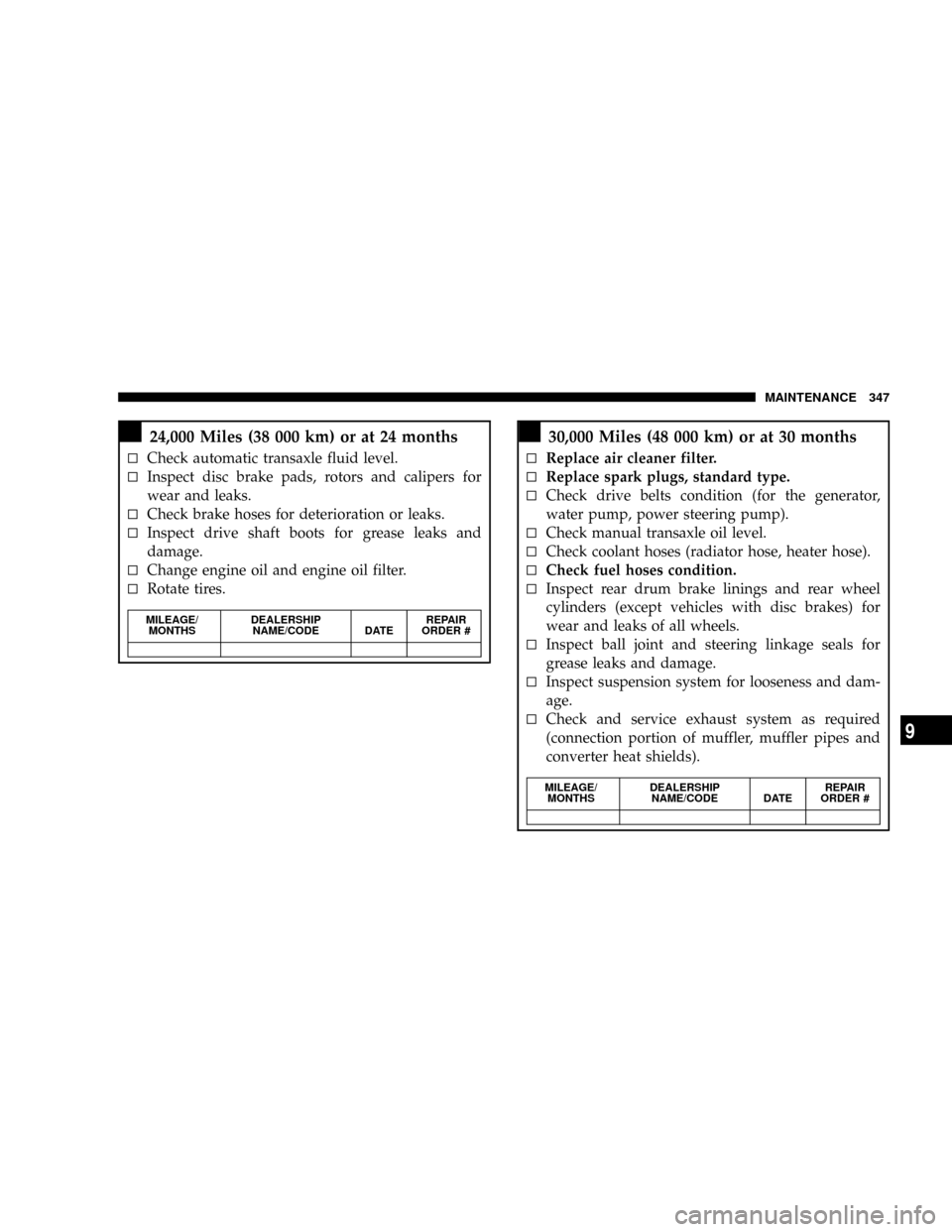
!24,000 Miles (38 000 km) or at 24 months
NCheck automatic transaxle fluid level.
NInspect disc brake pads, rotors and calipers for
wear and leaks.
NCheck brake hoses for deterioration or leaks.
NInspect drive shaft boots for grease leaks and
damage.
NChange engine oil and engine oil filter.
NRotate tires.
MILEAGE/
MONTHSDEALERSHIP
NAME/CODE DATEREPAIR
ORDER #
!30,000 Miles (48 000 km) or at 30 months
NReplace air cleaner filter.
NReplace spark plugs, standard type.
NCheck drive belts condition (for the generator,
water pump, power steering pump).
NCheck manual transaxle oil level.
NCheck coolant hoses (radiator hose, heater hose).
NCheck fuel hoses condition.
NInspect rear drum brake linings and rear wheel
cylinders (except vehicles with disc brakes) for
wear and leaks of all wheels.
NInspect ball joint and steering linkage seals for
grease leaks and damage.
NInspect suspension system for looseness and dam-
age.
NCheck and service exhaust system as required
(connection portion of muffler, muffler pipes and
converter heat shields).
MILEAGE/
MONTHSDEALERSHIP
NAME/CODE DATEREPAIR
ORDER #
MAINTENANCE 347
9