brake CHRYSLER SEBRING COUPE 2005 2.G User Guide
[x] Cancel search | Manufacturer: CHRYSLER, Model Year: 2005, Model line: SEBRING COUPE, Model: CHRYSLER SEBRING COUPE 2005 2.GPages: 394, PDF Size: 2.47 MB
Page 117 of 394
![CHRYSLER SEBRING COUPE 2005 2.G User Guide driving, take your vehicle to your authorized dealer and
have the system checked.
[See ªSupplemental Restraint System (SRS)º on page
116.]
Brake warning light
This light illuminates when the ignitio](/img/25/8546/w960_8546-116.png "CHRYSLER SEBRING COUPE 2005 2.G User Guide driving, take your vehicle to your authorized dealer and
have the system checked.
[See ªSupplemental Restraint System (SRS)º on page
116.]
Brake warning light
This light illuminates when the ignitio")
driving, take your vehicle to your authorized dealer and
have the system checked.
[See ªSupplemental Restraint System (SRS)º on page
116.]
Brake warning light
This light illuminates when the ignition key
is turned to the ªONº position (engine off).
When the engine is started, the light should go off. But
when the parking brake is applied or the brake fluid falls
below the prescribed level, the light illuminates.
Before driving your vehicle, release the parking brake
fully and make certain that the brake warning light has
gone out.
CAUTION!
If the brake warning light does not go on when you
pull the parking brake lever, or if it does not go out
when you release the lever, contact an authorized
dealer immediately.
If the brake warning light illuminates while driving, it
could mean braking performance deterioration. Park
your vehicle in a safe place using the following proce-
dures:
1. If, when pressing the brake pedal, braking is poor,
press your foot harder against the brake pedal.
2. Should the braking deteriorate, use engine braking by
shifting the transaxle into a lower gear (Manual transaxle
or Automatic transaxle autostick) or into the ``3'' (THIRD)
or the ``2'' (SECOND) or the ``L'' (LOW) position (Auto-
matic transaxle) to reduce the speed and slowly pull the
parking brake lever, while applying pressure against the
brake pedal.
Depress the brake pedal to turn on the stop light (brake
light) to alert the vehicles behind you.
CAUTION!
Suddenly applying the parking brake is dangerous,
the wheels may lock.
INSTRUMENTS AND CONTROLS 117
4
Page 142 of 394

NGear positions........................156
NDriving speed
(Vehicles with automatic transaxle).........157
NHolding on an upgrade.................157
NTransaxle reset mode...................158
mAutomatic transaxle Autostick
(if so equipped)
........................158
NSelector lever operation.................159
NIndicator lights.......................161
NSelector positions (Main gate).............162
NSelector positions Manual gate Autostick.....163
NHolding on an upgrade.................165
NTransaxle reset mode...................166
mManual transaxle (if so equipped)..........166
NTo start.............................167
NProper shift points.....................167NRecommended downshifting speed.........169
NDriving precautions....................169
mParking brake.........................169
mBrake pedal...........................171
mPower brakes.........................172
mBrake pad wear alarm...................172
mAnti-lock braking (ABS) system
(if so equipped)
........................173
NGeneral driving hints
(standard/anti-lock brakes)...............173
mSteering wheel tilt lock lever..............175
mPower steering........................176
mInside Day/Night rearview mirrors.........177
NElectrochromic inside rearview mirror
(if so equipped).......................178
NElectrochromic mirror operation
(if so equipped).......................179
142 STARTING AND DRIVING
Page 144 of 394

BREAK-IN RECOMMENDATIONS
Advanced automobile manufacturing techniques permit
you to operate your new vehicle without experiencing a
long break-in period of low-speed driving.
However, you can add to the future performance and
economy of your vehicle by observing the following
precautions during the first 300 miles (500 km).
It is recommended that you drive your vehicle at mod-
erate speeds during the break-in period.
1. Avoid racing the engine.
2. Avoid harsh driving such as fast starts, sudden accel-
eration, prolonged high-speed driving and abrupt appli-
cation of the brakes. These operations not only have a
detrimental effect on the engine but also cause increased
fuel and oil consumption, which could result in malfunc-
tion of engine components. Be particularly careful to
avoid wide-open throttle acceleration in low gear.
3. Do not overload the vehicle. Observe the seating
capacity. (See ªWeightsº page 373)
4. Do not use this vehicle for trailer towing during the
break-in period.
FUEL SELECTION
Your vehicle is designed to use unleaded gasoline only. It
is equipped with a fuel filler tube especially designed to
accept only the smaller diameter unleaded gasoline dis-
pensing nozzle.
WARNING!
Gasoline is highly flammable and explosive. You can
be burned or seriously injured when handling it.
When refueling this vehicle, always turn the engine
off and keep flames, sparks, and smoking materials
away. Always handle fuel in well-ventilated outdoor
areas.
144 STARTING AND DRIVING
Page 150 of 394

NOTE: For vehicles with an automatic transaxle, the key
cannot be removed unless the selector lever is set to the
ªPº (PARK) position.
ACC
Allows operation of electrical accessories with the engine
off.
START
Engages the starter. After the engine starts, release the
key and it will return automatically to the ªONº position.
ON
The engine runs and all accessories can be used.
NOTE:Do not use the ªONº position to operate acces-
sories.
CAUTION!
²Do not remove the ignition key from the ignition
switch while driving. The steering wheel will
lock, causing loss of control.
²If the engine is turned off while driving, the
power brake servomechanism will cease to func-
tion and braking efficiency will deteriorate. Also,
the power steering system will not function and it
will require greater effort to operate the steering.
²Do not leave the key in the ªONº position for a
long time when the engine is not running; doing
so will cause the battery to discharge.
²Do not turn the key to the ªSTARTº position
when the engine is running; doing so could dam-
age the starter motor.
KEY REMINDER CHIME
If the driver's door is opened while the ignition key is in
the ªLOCKº or ªACCº position, a warning chime
sounds.
150 STARTING AND DRIVING
Page 152 of 394
WARNING!
Never run the engine in a closed or poorly ventilated
area any longer than is needed to move your vehicle
in or out of the area. Carbon monoxide gas, which is
odorless, colorless and extremely poisonous, could
build up, and cause serious injury or death.
CAUTION!
²Do not start the vehicle by pushing or pulling.
²Do not run the engine at high rpm or drive the
vehicle at high speed until the engine has had a
chance to warm up.
²Release the ignition key as soon as the engine
starts to avoid damaging the starter motor.
This vehicle is equipped with an electronically controlled
fuel injection system that automatically controls fuel
quantity. When starting the engine, there is normally no
need to depress the accelerator pedal.
Normal conditions
The starting procedure is as follows:
1. Insert the ignition key and make sure all occupants are
properly seated with seat belts fastened.
2. Depress and hold the brake pedal down with your
right foot.
3. Set the gearshift selector lever (manual transaxle) in
the ªNº (NEUTRAL) position, or the selector lever (au-
tomatic transaxle) in the ªPº (PARK) position.
4. Fully depress the clutch pedal (manual transaxle).
NOTE: For models equipped with a manual trans-
axle, the starter will not operate unless the clutch
pedal is fully depressed (Clutch interlock).
5. After turning the ignition key to the ªONº position,
make certain that all warning lights are functioning
properly before starting the engine.
6. Turn the ignition key to the ªSTARTº position without
depressing the accelerator pedal, and release the key
when the engine starts.
152 STARTING AND DRIVING
Page 153 of 394

NOTE: Slight noises may be heard on engine start-up.
These noises will disappear as you continue warming up
the engine.
Flooded engine
If the engine has become flooded during starting, first
operate the starter for 5 to 6 seconds while fully depress-
ing the accelerator pedal (clear flood), then start the
engine without depressing the accelerator pedal at all.
At extremely cold ambient temperature
If the engine won't start, depress the accelerator pedal
about halfway while cranking the engine. Once the
engine starts, release the accelerator pedal.
CAUTION!
When starting the engine, make sure that you step on
the brake pedal. During very cold weather, when
you start the engine while putting your foot on the
accelerator pedal, move your foot to the brake pedal
immediately after the engine has started.
AUTOMATIC TRANSAXLE (IF SO EQUIPPED)
The automatic transaxle is designed for optimum control
and equipped with adaptive control capabilities. The
electronically controlled transaxle optimally matches
gear shifts to almost all driving and road conditions.
DRIVING UPHILL
The transaxle may not upshift to a higher gear if the
computer determines the current speed cannot be main-
tained once a higher gear is engaged.
For smoother vehicle performance, if you release the
throttle while climbing a steep grade, the transaxle may
not upshift. This is normal, as the computer is controlling
the shifting. After reaching the top of the hill, normal gear
shift function will resume.
DRIVING DOWNHILL
When traveling down steep grades and depressing the
brake pedal, the computer may automatically select a
lower gear. This function assists engine braking efforts,
reducing the need to use the brakes.
STARTING AND DRIVING 153
5
Page 154 of 394

CAUTION!
The electronically controlled transaxle system is
strictly intended to provide supplementary func-
tions. When driving downhill under certain condi-
tions, or immediately after starting when the auto-
matic transaxle is cold, no automatic shift-down may
be made. The driver should shift down to a low gear
(3rd gear or 2nd gear), which will permit the engine
to exert a braking effect.
NOTE: During the brake-in period or immediately after
re-connection of the battery cable, the vehicle may not
shift as smoothly. This does not indicate a faulty trans-
mission. The transaxle system must have a short period
to learn parameters for proper shifting. Shifting will
become smooth after the transaxle has been shifted
several times by the electronic control system.
Selector lever operation
As an additional safety precaution, models equipped
with an automatic transaxle have a shift-lock device that
holds the selector lever in the ªPº (PARK) position. To
move the selector lever from the ªPº (PARK) position to
another position, follow the steps below.
1. Depress and hold down the brake pedal.
2. Move the selector lever to the desired position.
NOTE: The selector lever cannot be moved from ªPº
(PARK) to another position if the ignition key is at the
ªLOCKº position, removed, or if the brake pedal is not
depressed and held down.
154 STARTING AND DRIVING
Page 155 of 394
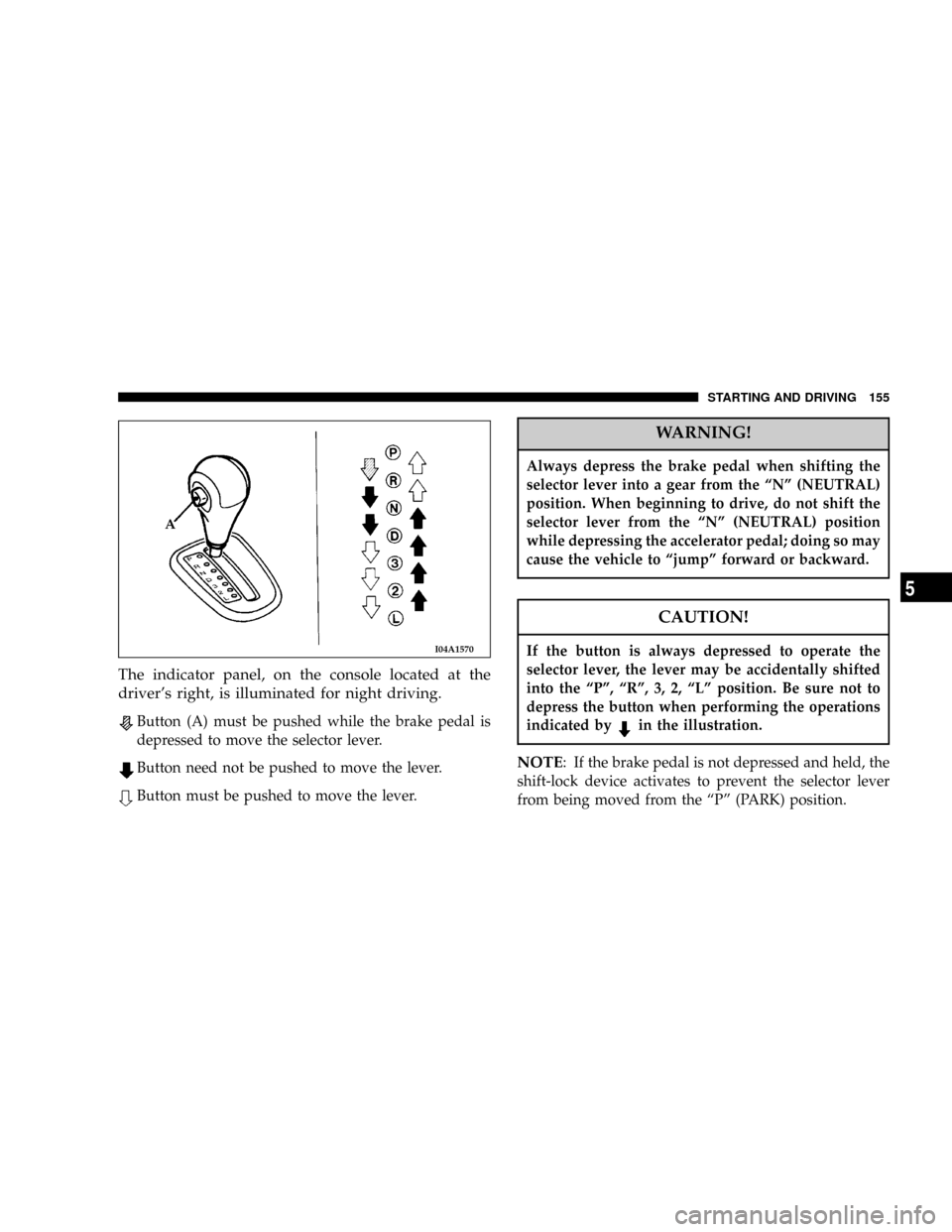
The indicator panel, on the console located at the
driver's right, is illuminated for night driving.
Button (A) must be pushed while the brake pedal is
depressed to move the selector lever.
Button need not be pushed to move the lever.
Button must be pushed to move the lever.
WARNING!
Always depress the brake pedal when shifting the
selector lever into a gear from the ªNº (NEUTRAL)
position. When beginning to drive, do not shift the
selector lever from the ªNº (NEUTRAL) position
while depressing the accelerator pedal; doing so may
cause the vehicle to ªjumpº forward or backward.
CAUTION!
If the button is always depressed to operate the
selector lever, the lever may be accidentally shifted
into the ªPº, ªRº, 3, 2, ªLº position. Be sure not to
depress the button when performing the operations
indicated by
in the illustration.
NOTE: If the brake pedal is not depressed and held, the
shift-lock device activates to prevent the selector lever
from being moved from the ªPº (PARK) position.
I04A1570
A
STARTING AND DRIVING 155
5
Page 156 of 394

Gear positions
ªPº PARK
The ªPº (PARK) position supplements the parking brake
by locking the transaxle while the vehicle is parked.
The engine can be started in this position.
Apply the parking brake before leaving the vehicle in this
position.
ªRº REVERSE
Shift into this position only after the vehicle has come to
a complete stop.
CAUTION!
Never shift into the ªPº (PARK) or ªRº (REVERSE)
position while the vehicle is in motion. If the lever is
shifted into the ªPº or ªRº position while the vehicle
is in motion, the transaxle may be damaged.
ªNº NEUTRAL
The engine may be started in this position.
WARNING!
²Never move the lever to the ªNº position while
driving since you could accidentally move the
lever into the(P(or(R(position, damaging the
transaxle.
²To prevent the vehicle from rolling when stopped
on a slope, the engine should be started in the ªPº
(PARK) position, not in ªNº (NEUTRAL).
²Always keep your foot on the brake pedal when
the vehicle is in ªNº (NEUTRAL), or when shift-
ing into or out of ªNº (NEUTRAL), to maintain
control.
ªDº DRIVE
This position is used for most city and highway driving.
Engine shifting is done automatically, depending on road
conditions.
156 STARTING AND DRIVING
Page 157 of 394
ª3º THIRD / ª2º SECOND
For driving slowly in heavy city traffic or on mountain
roads where more precise speed control is desired.
Also use it when climbing long grades, and for engine
braking when descending moderately steep grades.
Engine braking is automatically applied when necessary,
depending on road conditions.
ªLº LOW
This position is for driving up very steep hills and for
engine braking at low speeds when descending steep
gradients.
WARNING!
Be very careful not to shift into ªLº suddenly. Doing
so may cause the tires to slip.
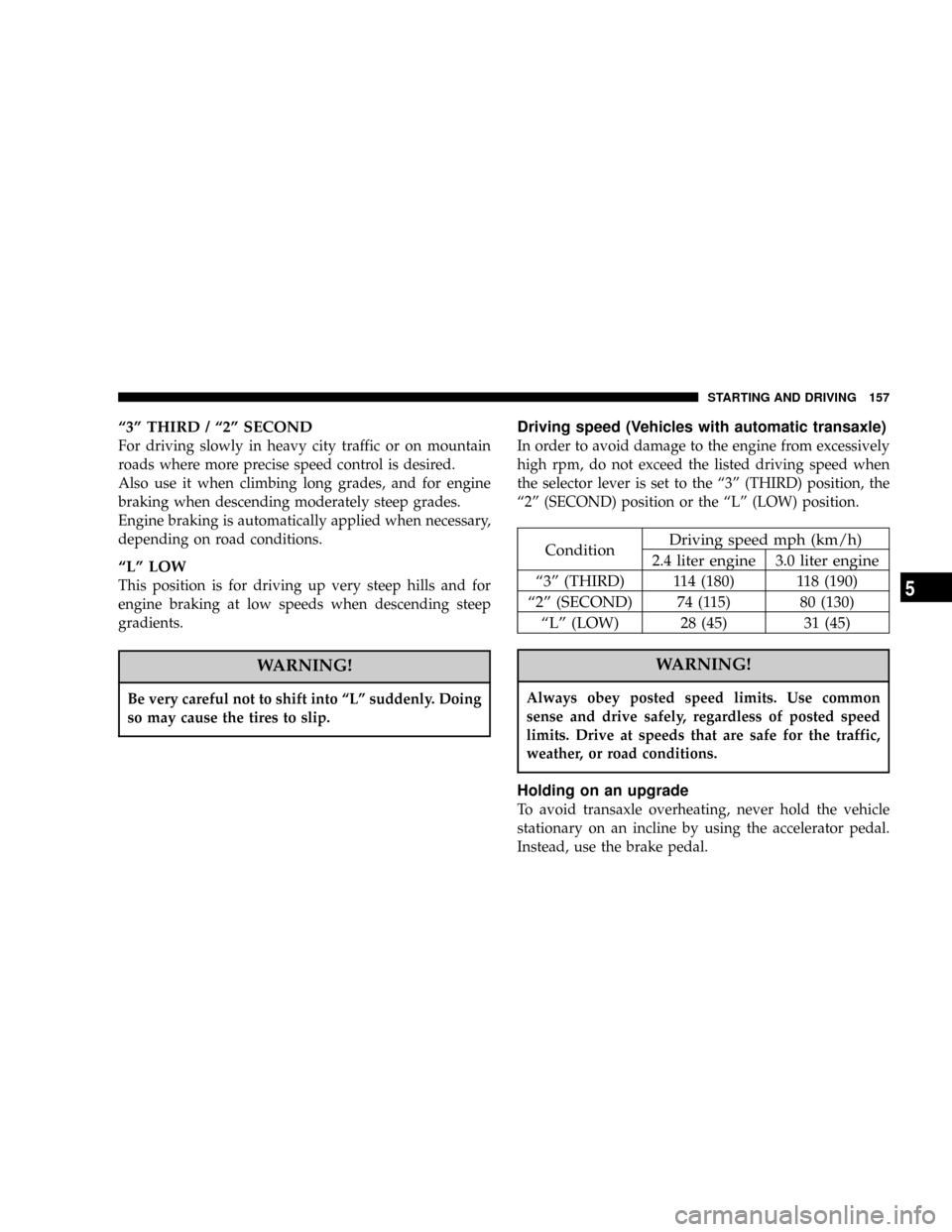
Driving speed (Vehicles with automatic transaxle)
In order to avoid damage to the engine from excessively
high rpm, do not exceed the listed driving speed when
the selector lever is set to the ª3º (THIRD) position, the
ª2º (SECOND) position or the ªLº (LOW) position.
ConditionDriving speed mph (km/h)
2.4 liter engine 3.0 liter engine
ª3º (THIRD) 114 (180) 118 (190)
ª2º (SECOND) 74 (115) 80 (130)
ªLº (LOW) 28 (45) 31 (45)
WARNING!
Always obey posted speed limits. Use common
sense and drive safely, regardless of posted speed
limits. Drive at speeds that are safe for the traffic,
weather, or road conditions.
Holding on an upgrade
To avoid transaxle overheating, never hold the vehicle
stationary on an incline by using the accelerator pedal.
Instead, use the brake pedal.
STARTING AND DRIVING 157
5