tire pressure CHRYSLER SEBRING COUPE 2005 2.G User Guide
[x] Cancel search | Manufacturer: CHRYSLER, Model Year: 2005, Model line: SEBRING COUPE, Model: CHRYSLER SEBRING COUPE 2005 2.GPages: 394, PDF Size: 2.47 MB
Page 335 of 394

Maximum Load
Maximum load indicates the maximum load this tire is
designed to carry.
Maximum pressure
Maximum Pressure indicates the maximum permissible
cold tire inflation pressure for this tire.
Tire Identification Number (TIN)
The TIN may be found on one or both sides of the tire, but
the date code may only be on one side. Tire with white
sidewalls will have the full TIN including date code located
on the white sidewall side of the tire. Look for the TIN on the
outboard side of black sidewall tires as mounted on the
vehicle. If the TIN is not found on the outboard side then
you will find it on the inboard side of the tire.
EXAMPLE : DOT MA L9 ABCD 1504
DOT Department of Transportation
This symbol certifies that the tire is in com-
pliance with U.S. Department of Transpor-
tation tire safety standards, and is ap-
proved for highway use
MA Code representing the tire manufacturing
location.(2 digits)
L9
ABCDCode representing the tire size. (2 digits)
Code used by tire manufacturer. (1 to 4
digits)
15 Number representing the week in which
the tire was manufactured. (2 digits)
04 Number representing the year in which the
tire was manufactured. (2 digits)
Treadwear, Traction and Temperature Grades
Treadwear
The treadwear grade is a comparative rating based on the
wear rate of the tire when tested under controlled con-
ditions on a specified government test course. For ex-
ample, a tire graded 150 would wear one and one half (1
1/2) times as well on the government course as a tire
graded 100. The relative performance of tires depends
upon the actual conditions of their use, however, and
may depart significantly from the norm due to variations
in driving habits, service practices and differences in road
characteristics and climate.
Traction
The traction grades, from highest to lowest, are AA, A, B
and C. Those grades represent the tire's ability to stop on
MAINTENANCE 335
9
Page 336 of 394

wet pavement as measured under controlled conditions
on specified government tests surfaces of asphalt and
concrete. A tire marked C may have poor traction perfor-
mance.
Temperature
The temperature grades are A (the highest), B, and C,
representing the tire's resistance to the generation of heat
and its ability to dissipate heat when tested under
controlled conditions on a specified indoor laboratory
test wheel. Sustained high temperature can cause the
material of the tire to degenerate and reduce tire life, and
excessive temperature can lead to sudden tire failure. The
grade C corresponds to a level of performance which all
passenger car tires must meet under the Federal Motor
Vehicle Safety Standard No. 109. Grades B and A repre-
sent higher levels of performance on the laboratory test
wheel than the minimum required by law.
Tire inflation pressures
Proper tire inflation pressure is essential to the safe and
satisfactory operation of your vehicle. Three primary
areas are affected by improper tire pressure:1. Safety
Under-inflation increases tire flexing and can result in tire
failure. Over-inflation results in a tire losing its ability to
cushion shock. Objects on the road and potholes could
cause tire damage that may result in tire failure.
2. Economy
Improper inflation pressures can cause uneven wear
patterns to develop across the tire tread. These abnormal
wear patterns will reduce tread life, resulting in a need
for earlier tire replacement.
Under-inflation also increases tire rolling resistance and
results in higher fuel consumption.
3. Ride comfort and vehicle stability
Proper tire inflation pressures contribute to the excellent
ride quality built into your vehicle. Over-inflation pro-
duces an uncomfortable and jarring ride.
Under-inflation can produce a feeling of sluggish re-
sponse.
Unequal inflation pressures can produce erratic and
unpredictable vehicle response to steering maneuvers.
The proper tire pressure for your vehicle is listed on a
placard attached near the door sill striker on the driver's
336 MAINTENANCE
Page 337 of 394

door.
The recommended inflation pressures should be followed
when the specified tires are installed.
Item Tire size Front Rear
Normal tire P205/60R16 91H 32 psi (220 kpa)
P215/50R17 90H 32 psi (220 kpa)
Compact spare tire T125/70D16 60 psi (420 kpa)
The pressures should be checked and adjusted, if neces-
sary, at least once a month.
Tire pressures should be checked more often when weather
temperatures vary widely, because tire pressures vary with
outdoor temperatures. Inflation pressures specified on the
placard are always ªcold inflation pressureº.
Cold inflation pressure can be measured after the vehicle
has been stationary for at least three hours or driven less
than one mile (1.6 km) after being stationary for three
hours.
Cold inflation pressure must not exceed the maximum
values molded into the tire sidewall. After driving sev-
eral miles, tire inflation pressure may increase 2 to 6 psi
(14 to 41 kPa) over the cold inflation pressure; do NOT letair out of the tires to match the specified cold pressure, or
your tires will be underinflated.
Check your tires each time you refuel. If one tire looks
lower than the others, check the tire inflation pressure for
all of them. The following precautions also should be
observed:
1. Keep your tires inflated to the pressures that are
recommended. (See the tire and loading information
placard attached on the latch on the driver's door.)
2. Stay within the load limits that are recommended.
3. Make sure that the weight of your vehicle load is
evenly distributed.
4. Drive at safe speeds.
5. After the tire inflation pressure has been adjusted,
check the tires for damage and air leaks. Be sure to
replace the rubber caps on the valve stems.
Radial ply tires
Radial ply tires provide improved tread life, road hazard
resistance and smoother high speed ride. The radial ply
MAINTENANCE 337
9
Page 338 of 394

factory-installed tires on this vehicle are of belted con-
struction and are selected to complement the ride and
handling characteristics of your vehicle.
Radial ply tires have the same load carrying capacity as
bias or bias-belted tires of the same letter size, and use the
same recommended inflation pressures.
Mixing of radial ply tires with bias or bias-belted tires is
not recommended. Combining radial ply and bias or
bias-belted tires on one vehicle will negatively affect
vehicle handling. It is recommended that radial ply tires
should always be used as a set of four.
As longer wearing tires can be more susceptible to
irregular tread wear, it is very important to follow the tire
rotation interval shown in the section ªTire rotationº to
achieve full tread life potential in these tires.
Cuts and punctures in radial ply tires are repairable only
in the tread area, because of sidewall flexing. Consult
your tire dealer for radial ply tire repairs.Tire pressure for sustained high-speed driving
For sustained high-speed driving, increase inflation pres-
sure 4 psi (28 kPa) above the recommended pressure but
do not exceed the maximum cold inflation pressure
molded into the tire sidewall.
Replacing tire and wheels
CAUTION!
²Avoid using different size tires from the one listed
and the combined use of different types of tires,
as this can affect driving safety.
Refer to the ``TIRES AND WHEELS'' on page 373.
²Even if a wheel has the same rim size and offset as
the specified type of wheel, its shape may prevent
it from being fitted correctly. Consult an autho-
rized dealer before using wheels that you have.
Tire maintenance
The following maintenance steps are recommended:
1. Check pressure regularly.
338 MAINTENANCE
Page 344 of 394

When the indicators appear in two or more adjacent
grooves, tire replacement is recommended.
NOTE: The mark and the location of the tire wear
indicator are different depending on tire manufacturers.
Tire rotation
To equalize wear and help extend tire life,
DaimlerChrysler recommends that you rotate your tires
at the mileage specified on the scheduled maintenance
chart.However, the timing for tire rotation may vary according
to your vehicle condition, road surface conditions and
each individual driver's driving habits. Any time you
notice unusual wear, rotate your tires as soon as possible.
When rotating tires, check for uneven wear, damage and
wheel alignment. Abnormal wear is usually caused by
incorrect tire pressure, improper wheel alignment, out-
of-balance wheel or severe braking. Consult an autho-
rized dealer to determine the cause of irregular tread
wear.
M40A0270
Type 1
M40A0490
Type 2
344 MAINTENANCE
Page 345 of 394

The first rotation is the most important to achieve more
uniform wear for all tires on the vehicle.
CAUTION!
Do not use the compact spare tire for tire rotation.
Tire chains
CAUTION!
Tire chains are not recommended for your vehicle.
The clearance between the chains and the body is
small, and the body might be damaged.
Snow tires
Some areas of the country require the use of snow tires
during winter. Standard tires are of the all season type
and satisfy this requirement as indicated by the M+S
designation on the tire side wall.
If you need snow tires, select tires equivalent in size and
type to the original equipment tires. Failure to do so may
adversely affect the safety and handling of your vehicle.Snow tires should be inflated 4 psi (28 kPa) higher than
the inflation pressure shown on the vehicle's tire placard.
Never inflate over the maximum pressure shown on the
tire sidewall.
Snow tires should not be operated at sustained speeds
over 75 mph (120 km/h).
NOTE: As flange nuts are used on your vehicle, change
to tapered nuts when snow tires (steel wheels) are used.
MAINTENANCE 345
9
Page 372 of 394
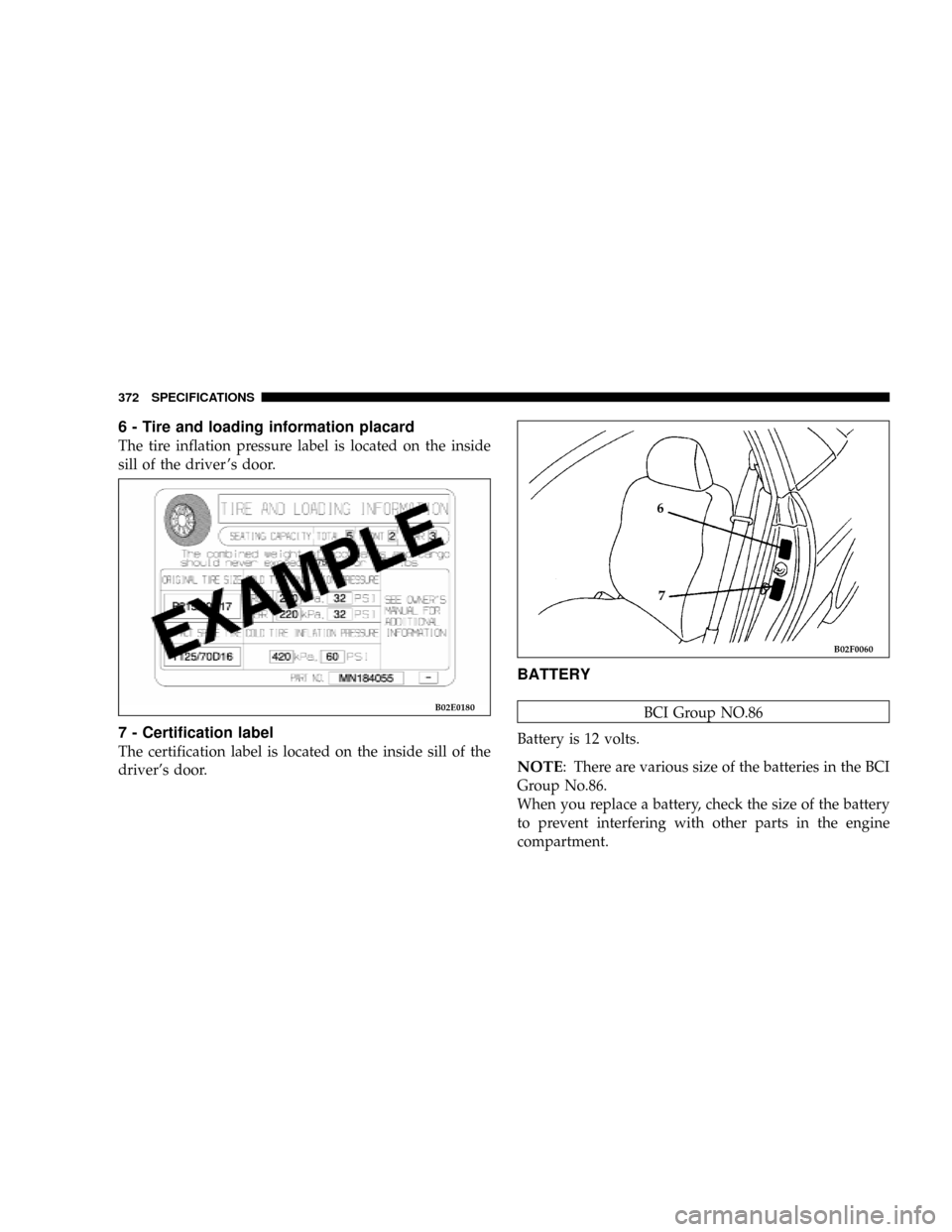
6 - Tire and loading information placard
The tire inflation pressure label is located on the inside
sill of the driver 's door.
7 - Certification label
The certification label is located on the inside sill of the
driver's door.
BATTERY
BCI Group NO.86
Battery is 12 volts.
NOTE: There are various size of the batteries in the BCI
Group No.86.
When you replace a battery, check the size of the battery
to prevent interfering with other parts in the engine
compartment.
B02E0180
B02F0060
6
7
372 SPECIFICATIONS
Page 392 of 394

Odometer..........................106,110
Oil pressure gauge...................... 106
Oil pressure warning light.............107,114
Oil
Engine oil........................... 314
Onboard Diagnostic System............... 310
Opener, Garage Door.................... 132
Operation during cold weather............. 202
Operation under adverse driving conditions . . . 261
Overdrive indicator..................... 107
Oversize tires.......................... 338
Owner 's Manual....................... 383
Parking brake
Operating method.................... 169
Parking brake lever stroke.............. 330
Polishing............................. 256
Power brakes.......................... 172
Power door locks........................ 34
Power windows......................... 43
Proper shift points...................... 167
Puncture (tire changing).................. 272Radial ply tires........................ 337
Radiator cap.....................307,318,319
Radio................................ 219
General information................... 216
Reading lamps......................... 131
Reading light.......................... 131
Rear seats............................. 66
Rear window defroster................... 125
Replacement of light bulbs................ 291
Reporting Safety Defects................. 381
Safe driving techniques.................. 200
Scheduled maintenance.................. 346
Seat belt extender....................... 75
Seat Belts
Adjustable seat belt anchor.............73,80
And Pregnant Women.................. 87
Child restraint........................ 76
Maintenance and inspection.............. 88
Seat belt extender...................... 75
Seat belt reminder/warning light......... 107
UNIBELT restraint system............... 69
Seatback.............................. 60
392 INDEX
Page 393 of 394

Seats
Front seats........................... 57
Rear seats............................ 66
SECURITY indicator................49,107,112
Service Assistance...................... 378
Service Manuals........................ 383
Setting the clock........................ 216
Severe maintenance schedule.............. 354
Snow tires............................ 345
Spare tire.......................264,265,373
Spark plugs........................313,375
Speedometer.......................106,108
Starting
At extremely cold ambient temperature..... 153
Flooded engine....................... 153
Normal conditions.................... 152
Steering system
Steering lock......................... 151
Tilt lock lever........................ 175
Sun visors............................ 209
Sunroof............................... 46
Supplemental Restraint System - Airbag
Maintenance......................... 327Warning light.....................107,116
Supplemental Restraint System (SRS) - Air bag . . 89
Supplemental Restraint System warning light . . 116
Tachometer........................106,108
Tape Player........................... 219
Temperature Gage, Engine Coolant.......... 277
Theft protection........................ 151
Theft-alarm
SECURITY indicator..............49,107,112
System.............................. 48
Timing belt........................... 332
Tips for driving in various conditions........ 201
Tire chains............................ 345
Ti re s
Compact spare tire.................... 265
Inflation pressure...............336,372,373
Maintenance......................332,338
Quality Grading...................... 385
Rotation............................ 344
Size (tire and wheels).................. 373
Snow tires.......................... 345
Spare tire........................... 264
INDEX 393