warning CHRYSLER SEBRING COUPE 2005 2.G User Guide
[x] Cancel search | Manufacturer: CHRYSLER, Model Year: 2005, Model line: SEBRING COUPE, Model: CHRYSLER SEBRING COUPE 2005 2.GPages: 394, PDF Size: 2.47 MB
Page 35 of 394

Locking and unlocking with key or inside lock
knob
Using the key to lock or unlock the driver 's door will
automatically lock or unlock all of the doors.
·Turn the key inserted in the driver 's door lock once in
the unlocking direction, and the front driver 's door
will be unlocked.
·Give another turn in the unlocking direction, and both
doors will be unlocked.
Locking by means of the inside lock knob
Place the inside lock knob of the driver's door in the
locked position, and both doors will be locked.
TRUNK LID
WARNING!
²It is dangerous to drive with the trunk lid open
since carbon monoxide (CO) gas can enter the
cabin. CO is an invisible, odorless gas that can
cause unconsciousness and even death.
²Do not allow children to have access to the trunk,
either by climbing into the trunk from outside or
through the inside of the vehicle. Always close the
trunk lid when your vehicle is unattended. If
trapped in the trunk, it is possible to escape from
the trunk by using the inside emergency trunk
release handle. (See ``Inside emergency trunk re-
lease'' on Page 37).
F12B0710
Lock Unlock
Lock
LOCKING AND UNLOCKING 35
2
Page 36 of 394

CAUTION!
Do not stand behind the exhaust pipe when loading
and unloading luggage. Heat from the exhaust could
lead to burns.
To open the trunk lid
Press the TRUNK button twice within five seconds.
(Refer to ``Keyless entry system'' on page 29.)
The trunk lid will unlock and rise slightly.
Lift it to open.
To close the trunk lid
Lower the trunk lid and push down with both hands
until it is locked.
Trunk-ajar warning chime
When the vehicle is moving at more than 5 mph (8 km/h)
and the trunk lid is open, a chime will sound to inform
the driver that the trunk lid is not properly shut.
Remote trunk lid release
Pull the trunk lid release lever, located to the left of the
driver's seat, up to open the trunk lid.
CAUTION!
Do not operate the trunk lid release lever while the
vehicle is moving. If the trunk lid opened, luggage
could fall onto the road and cause an accident.
F15A1770
36 LOCKING AND UNLOCKING
Page 37 of 394

Inside emergency trunk release
The emergency trunk release is designed to provide a way to
open the trunk lid from inside the trunk. It was developed to
help prevent death and serious heat-related injuries, includ-
ing brain damage, especially for children who might become
locked inside a vehicle trunk.
The illuminated9T9shaped yellow emergency trunk release
handle (see illustration) is mounted near the latch inside the
trunk lid. Velcro keeps the handle secure in its holder.The handle glows in the dark after exposure to sunlight.
You and your family should familiarize yourselves with the
location and operation of the emergency trunk release
handle. Children should be taught not to play in or around
vehicles.
WARNING!
²Children should never be left unsupervised in or
around vehicles.
²Unsupervised children could lock themselves in
an open vehicle or trunk.
²People trapped inside a vehicle, or trunk, even if
only for a short period of time, can quickly die
from suffocation or heat stroke, especially on hot
days. Interior temperatures in vehicles can rise in
minutes.
²Keep your vehicle doors locked and the trunk
closed when not in use. Keep your vehicle keys
away from children.
F15A2350
LOCKING AND UNLOCKING 37
2
Page 39 of 394
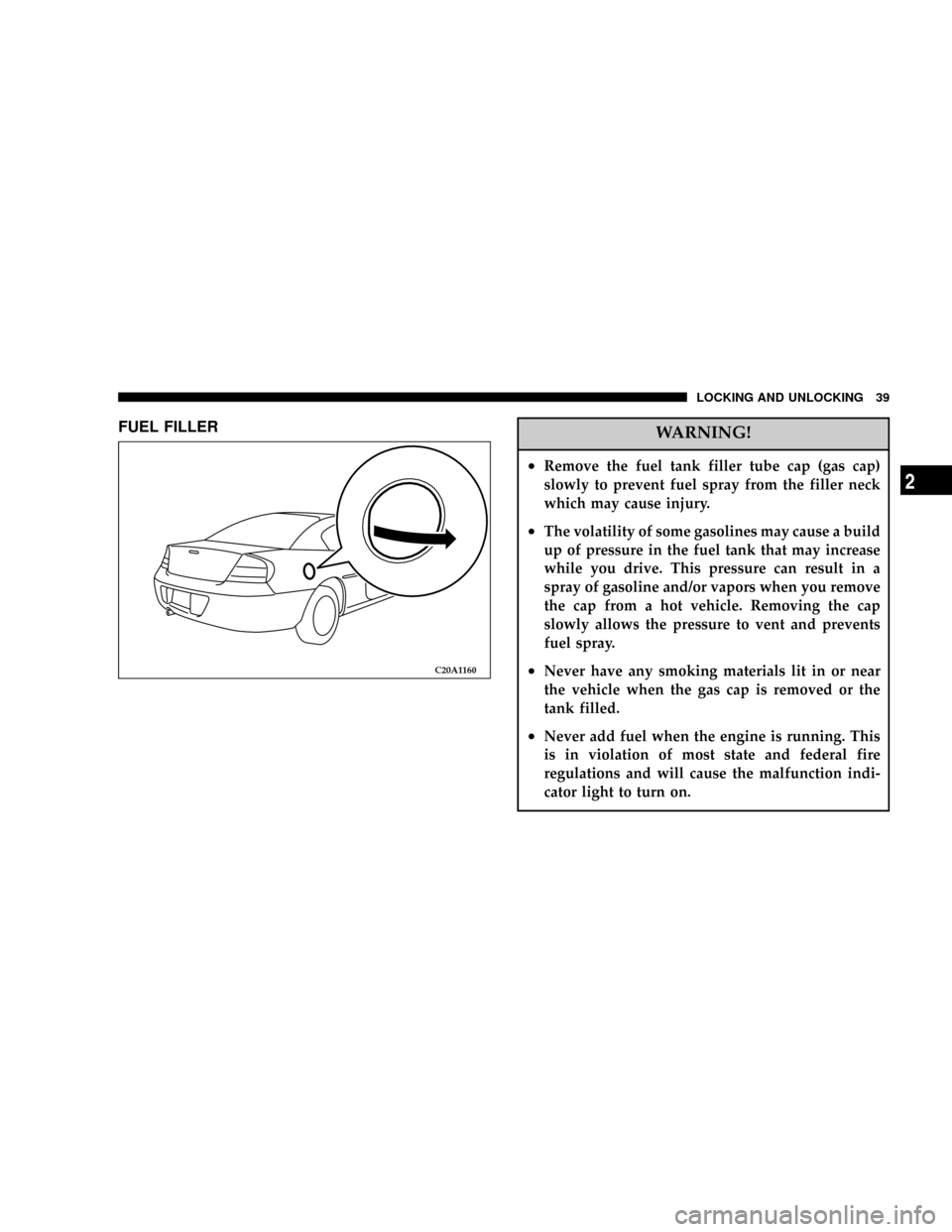
FUEL FILLERWARNING!
²Remove the fuel tank filler tube cap (gas cap)
slowly to prevent fuel spray from the filler neck
which may cause injury.
²The volatility of some gasolines may cause a build
up of pressure in the fuel tank that may increase
while you drive. This pressure can result in a
spray of gasoline and/or vapors when you remove
the cap from a hot vehicle. Removing the cap
slowly allows the pressure to vent and prevents
fuel spray.
²Never have any smoking materials lit in or near
the vehicle when the gas cap is removed or the
tank filled.
²Never add fuel when the engine is running. This
is in violation of most state and federal fire
regulations and will cause the malfunction indi-
cator light to turn on.
C20A1160
LOCKING AND UNLOCKING 39
2
Page 40 of 394

The fuel filler is located on the right rear of the body.
Hook a finger behind the fuel filler door, and pull the
door toward you.
Remove the fuel tank filler tube cap slowly by turning it
counterclockwise.
To close, securely turn the fuel tank filler tube cap
clockwise until you hear clicking sounds, and gently
push the fuel filler tank door into the closed position.Low fuel warning chime
If a chime sounds when the low fuel warning light is on,
that means the fuel is low.
NOTE: If the low fuel warning light goes off, then comes
back on again, the chime will not sound.
Fuel tank capacity 62 L (16.4 gal)
CAUTION!
²As the fuel system may be under pressure, remove the
fuel tank filler tube cap slowly. Removing the cap
slowly relieves any pressure or vacuum that might have
built up in the fuel tank. If the cap is venting vapor or
if you hear a hissing sound, wait until it stops before
completely removing the cap. Otherwise, fuel may
spray out and injure you or others.
²If you need to replace the fuel tank filler tube cap,
use only a cap specified for your model vehicle.
²To avoid fuel spillage and overfilling, do not ªtop-offº
the fuel tank again and again after filling.
C20A1140
RemoveClose
40 LOCKING AND UNLOCKING
Page 42 of 394
WARNING!
²Never release the engine hood using the release
lever while the vehicle is in motion.
²Do not operate the vehicle unless the engine hood
is latched.
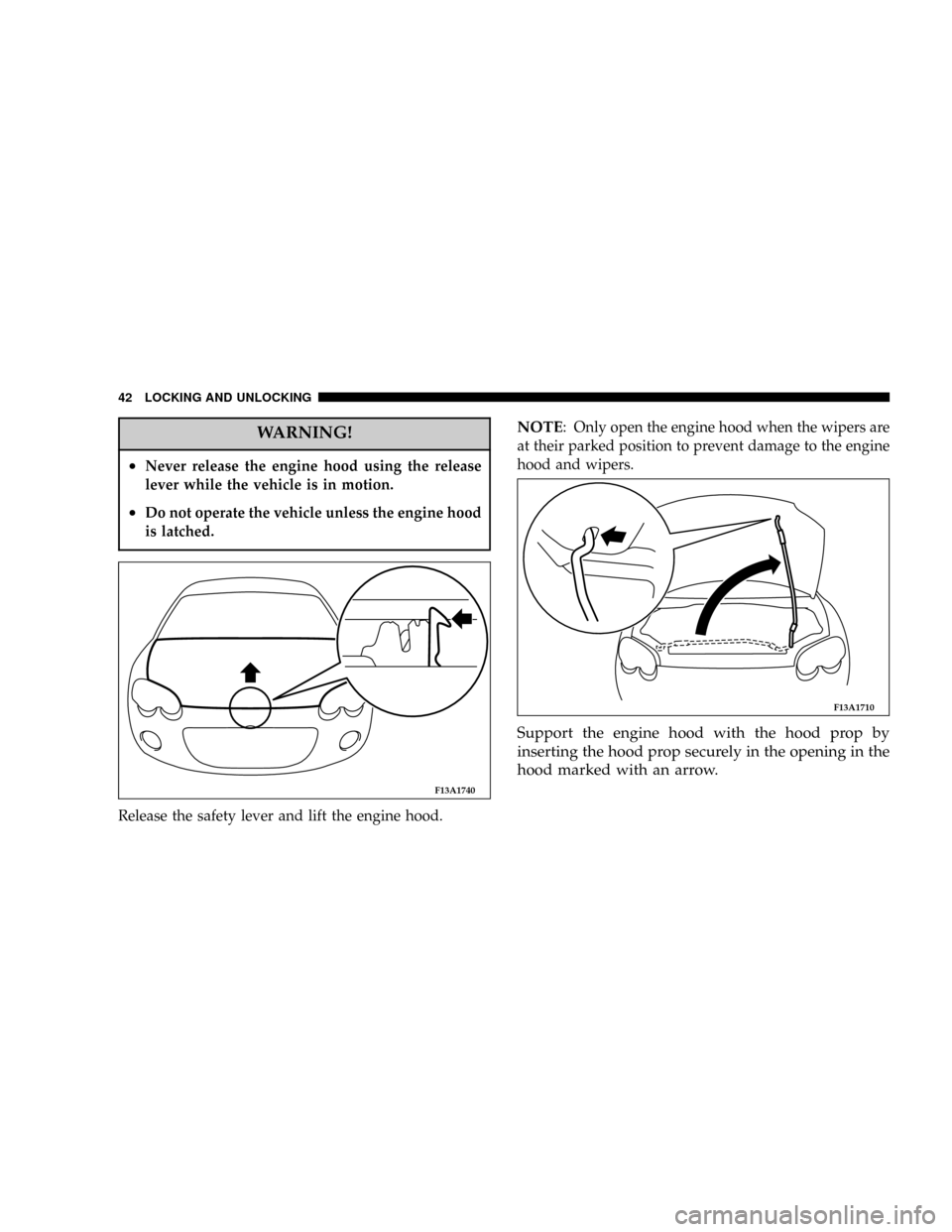
Release the safety lever and lift the engine hood.
NOTE: Only open the engine hood when the wipers are
at their parked position to prevent damage to the engine
hood and wipers.
Support the engine hood with the hood prop by
inserting the hood prop securely in the opening in the
hood marked with an arrow.
F13A1740
F13A1710
42 LOCKING AND UNLOCKING
Page 44 of 394
or closed for a 30-second period even after the ignition
switch is turned off. However, once the driver's door or
the front passenger's door is opened, the windows can-
not be operated until the ignition switch is turned on
again.
2. Never try to operate the driver switch and passenger
switch in opposing directions at the same time. Doing so
will cause the window to freeze in position.
3. Repeated operation with the engine stopped (key
ªONº) will run down the battery. Operate the window
switches while the engine is running.
WARNING!
²Before operating the power windows, make sure
that nothing can be trapped (head, hand, finger,
etc.) in the window.
²Never leave the vehicle without removing the key.
²Never leave a child in the vehicle alone.
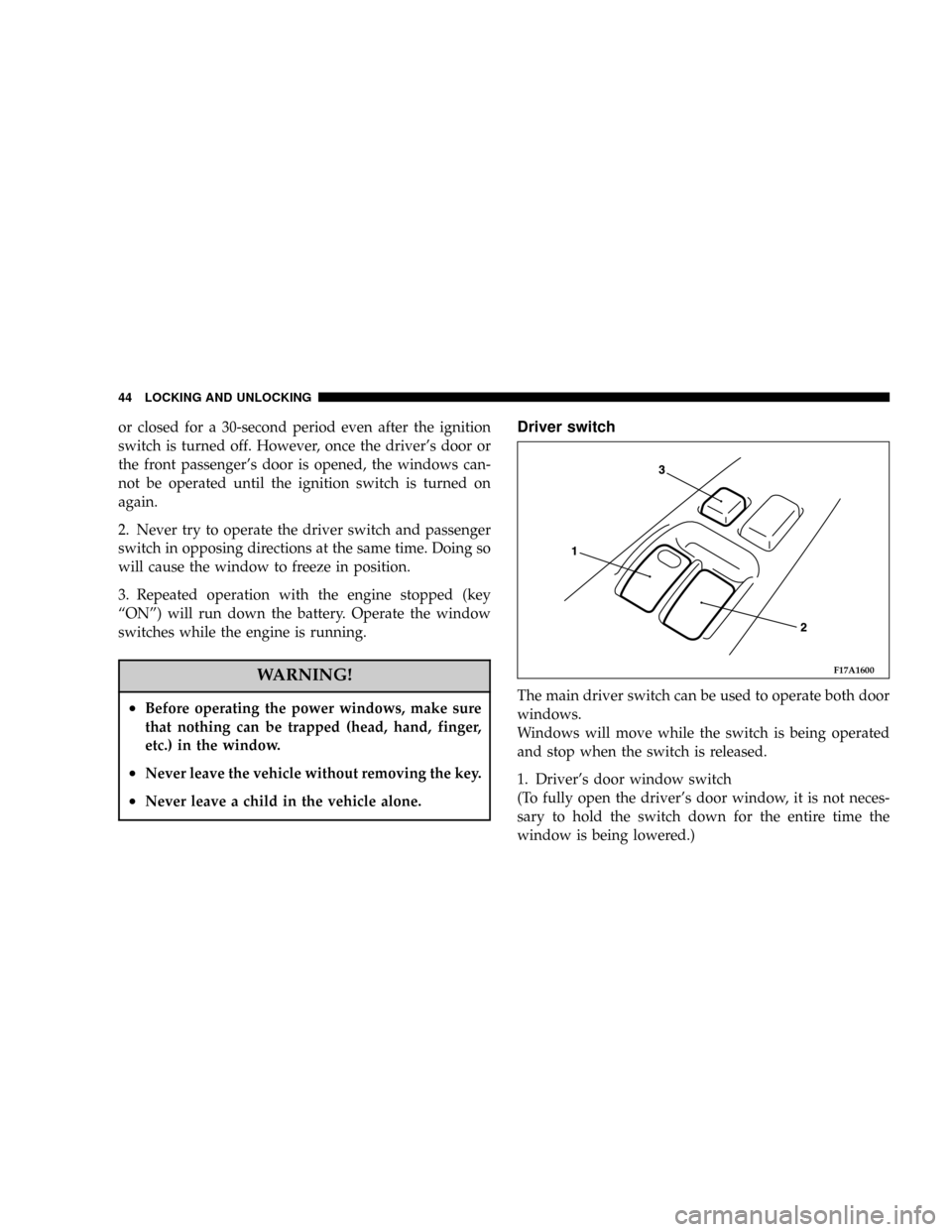
Driver switch
The main driver switch can be used to operate both door
windows.
Windows will move while the switch is being operated
and stop when the switch is released.
1. Driver's door window switch
(To fully open the driver's door window, it is not neces-
sary to hold the switch down for the entire time the
window is being lowered.)
F17A1600
44 LOCKING AND UNLOCKING
Page 45 of 394
2. Passenger 's door window switch
3. Window lock switch
(When this switch is pressed into lock mode, the passen-
ger switch cannot be used to open or close the door
window, and the driver switch can open or close either
window. To unlock, press the window lock switch again.)
WARNING!
Before driving with a child in the vehicle, be sure to
press the window lock switch to make the window
switches inoperative. A child may tamper with the
switch at the risk of their hands or head becoming
trapped by the window.
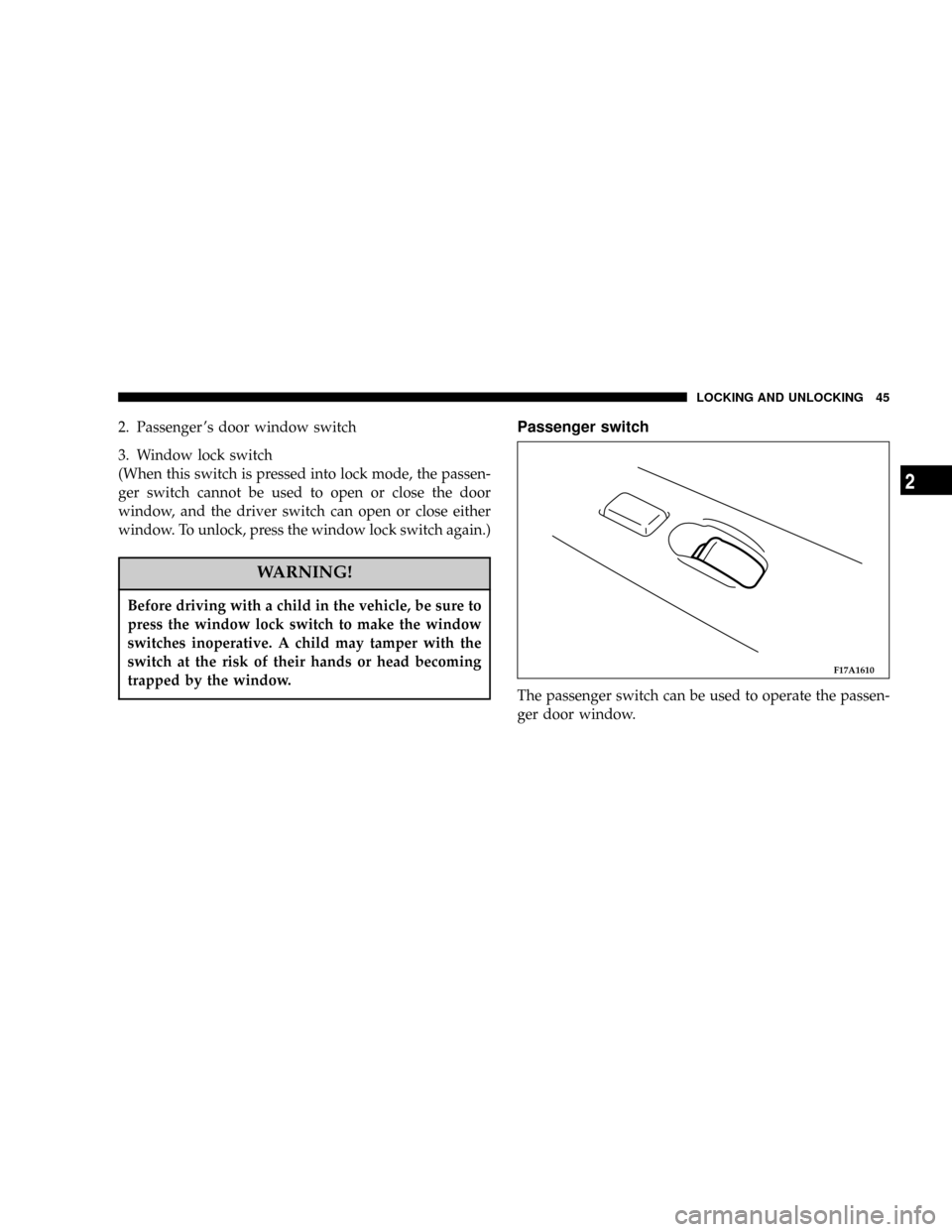
Passenger switch
The passenger switch can be used to operate the passen-
ger door window.
F17A1610
LOCKING AND UNLOCKING 45
2
Page 48 of 394

CAUTION!
Do not attempt to close the sunshade when the
sunroof is opened.
WARNING!
²When leaving the vehicle unattended, be sure to
close the sunroof and remove the ignition key.
²Before operating the sunroof, make sure that
nothing can be trapped (head, hand, finger, etc.).
²Never leave a child (or other person who is
incapable of safely operating the sunroof switch)
in the vehicle alone.
NOTE
1. Do not stick your head, hand or anything else out of
the sunroof opening.
2. After washing the vehicle or after there is rain, be sure
to wipe off any water that is on the sunroof before
operating it.3. Do not try to operate the sunroof if it is frozen closed
(after snowfall or during extreme cold).
4. Do not sit on or place heavy luggage on the sunroof or
roof opening edge.
5. Do not apply any force that may cause damage to the
sunroof.
6. When waxing your vehicle, be careful not to put any
wax on the weatherstrip (black rubber) around the sun-
roof opening. If stained with wax, the weatherstrip
cannot maintain a weatherproof seal with the sunroof.
7. Release the switch when the sunroof has reached a
completely open or completely closed position.
THEFT-ALARM SYSTEM
The theft-alarm system is designed to provide protection
from unauthorized entry into the vehicle. This system is
operated in three stages: the first is the ªarmedº stage, the
second is the ªalarmº stage, and third is the ªdisarmedº
stage. If triggered, the system provides both audible and
visual alarm signals.
48 LOCKING AND UNLOCKING
Page 58 of 394

WARNING!
²Do not attempt to adjust the seat while driving.
This can be dangerous.
²After adjusting the seat, make sure that the seat is
securely locked into position.
²Be sure to have the seat adjusted by an adult. If it
is adjusted by a child, the seat may not be prop-
erly locked into position.
WARNING!
²In order to reduce risk of serious or fatal injury in
a collision, including from a deploying front pas-
senger air bag, all front seat passengers should
move the front passenger seat as far back as
possible, all children 12 years old and under
should ride restrained in the rear seat, and all
children in rear-facing child restraints must ride
in the rear seat.
²In order to reduce risk of serious or fatal injury in
an accident, including from a deploying driver 's
side air bag, the driver should move the driver's
seat as far back as possible, while still maintain-
ing good visibility and good control of the steer-
ing wheel, accelerator and brake pedals.
NOTE: On vehicles with a power seat, to prevent the
battery from running down, operate the power seat with
the engine in operation.
58 SEATS, SEAT BELTS, CHILD RESTRAINTS AND AIR BAGS