ECU CHRYSLER SEBRING COUPE 2005 2.G Owner's Manual
[x] Cancel search | Manufacturer: CHRYSLER, Model Year: 2005, Model line: SEBRING COUPE, Model: CHRYSLER SEBRING COUPE 2005 2.GPages: 394, PDF Size: 2.47 MB
Page 158 of 394

Transaxle Reset Mode
The transaxle is monitored for abnormal conditions. If a
condition is detected that could cause damage, the trans-
axle automatically shifts into second gear. The transaxle
remains in second gear despite the forward gear selected.
Park (P), Reverse (R), and Neutral (N) will continue to
operate. This Reset feature allows the vehicle to be driven
to a dealer for service without damaging the transaxle.
If the problem has been momentary, the transaxle can be
reset to regain all forward gears.
²Stop the vehicle and shift into PARK (P).
²Turn the key to OFF then start the engine.
²Shift into ªDº and resume driving.
NOTE:Even if the transaxle can be reset, we recom-
mend that you visit a dealer at your earliest possible
convenience. Your dealer has diagnostic equipment to
determine if the problem could recur.
If the transaxle cannot be reset, dealer service is required.
AUTOMATIC TRANSAXLE AUTOSTICK
(IF SO EQUIPPED)
Designed for optimum control and equipped with adap-
tive control capabilities, the electronically controlled
transaxle optimally matches gear shifts to almost all
driving and road conditions.
DRIVING UPHILL
The transaxle may not upshift to a higher gear if the
computer determines the current speed cannot be main-
tained once a higher gear is engaged.
For smoother vehicle performance, if you release the
throttle while climbing a steep grade, the transaxle may
not upshift. This is normal, as the computer is controlling
the shifting. After reaching the top of the hill, normal gear
shift function will resume.
DRIVING DOWNHILL
When traveling down steep grades and depressing the
brake pedal, the computer may automatically select a
lower gear. This function assists engine braking efforts,
reducing the need to use the brakes.
158 STARTING AND DRIVING
Page 164 of 394

+ (UP) : Push the lever forward once to shift up one gear.
± (DOWN) : Pull the lever backward once to shift down
one gear.
CAUTION!
²Upward shifts do not take place automatically in
Autostick. The driver must execute upward shifts
in accordance with road conditions, make sure the
engine rpm remains below the red zone on the
tachometer.
²By rapidly moving the selector lever backwards
(DOWN) twice, it is possible to skip one gear, (i.e.
3rd to 1st or 4th to 2nd). Since sudden engine
de-acceleration or acceleration can cause a loss of
traction, downshifts must be made carefully in
accordance with the vehicle's speed.
NOTE
1. In Autostick, only the 4 forward gears can be selected.
To reverse or park the vehicle, move the selector lever to
the ªRº or ªPº position in the main gate.
2. To maintain the required levels of vehicle performance
and safety, the system may not allow certain gear shifts
when the selector lever is operated, such as 4th gear at
low speed.
I04S0170
164 STARTING AND DRIVING
Page 166 of 394

Transaxle Reset Mode
The transaxle is monitored for abnormal conditions. If a
condition is detected that could cause damage, the trans-
axle automatically shifts into second gear. The transaxle
remains in second gear despite the forward gear selected.
Park (P), Reverse (R), and Neutral (N) will continue to
operate. This Reset feature allows the vehicle to be driven
to a dealer for service without damaging the transaxle.
If the problem has been momentary, the transaxle can be
reset to regain all forward gears.
²Stop the vehicle and shift into PARK (P).
²Turn the key to OFF then start the engine.
²Shift into ªDº and resume driving.
NOTE:Even if the transaxle can be reset, we recom-
mend that you visit a dealer at your earliest possible
convenience. Your dealer has diagnostic equipment to
determine if the problem could recur.
If the transaxle cannot be reset, dealer service is required.
MANUAL TRANSAXLE (IF SO EQUIPPED)
The shift pattern is shown on the gearshift lever. Depress
the clutch pedal fully while shifting gears.
NOTE: During cold weather, shifting may be difficult/
stiff until the transaxle lubricant has warmed up. This is
normal and not a sign of a problem.
I29A0020
166 STARTING AND DRIVING
Page 175 of 394

6 mph (10 km/h). It stops operating when the vehicle
decelerates to a speed below approximately 3 mph (5
km/h).
3. After driving on snow or icy roads, remove any snow
and ice that may have adhered to the wheel areas. When
doing this be careful not to damage the wheel speed
sensors and cables located at each wheel on vehicles
equipped with an anti-lock braking system.STEERING WHEEL TILT LOCK LEVER
To adjust the steering wheel height, release the tilt lock
lever while raising or lowering the steering wheel to the
desired height.
After adjustment, securely lock the lever by pulling it
downward.
I24A0060
Wheel speed
sensorG09A0270
Unlock
Lock
STARTING AND DRIVING 175
5
Page 265 of 394

Jack
To remove
Turn the shaft end so that the jack contracts and detach it
from the storage bracket.
To store
Turn the shaft end by hand to expand the jack until it is
secured firmly in position.
COMPACT SPARE TIRE
The compact spare tire is designed to save space in the
trunk and its lighter weight makes it easier to use if a flat
tire occurs.
CAUTION!
²The tire pressure should be periodically checked
and maintained at the specified pressure while
the tire is stowed.
²Driving with an insufficient tire pressure can lead
to an accident. If you have no choice but to drive
with an insufficient tire pressure, keep your speed
down and adjust to the specified pressure [60 psi
(420 kPa)] as soon as possible.
²The compact spare should only be used temporarily
and should be returned to the trunk and the
original
tire repaired or replaced as soon as possible. If your
vehicle is equipped with aluminum type wheels, the
wheel nuts for aluminum type wheels can be used
temporarily on the compact spare tire wheel.
²Do not exceed 50 mph (80 km/h) while the com-
pact spare tire is installed on the vehicle.
N21C0010To removeTo storeStorage
bracket
EMERGENCIES 265
8
Page 267 of 394
NOTE: The wheel cover is made of plastic; use caution
when prying it off.
NOTE: Some styles of wheels will have bolt-on type
wheel covers. To remove this style, remove the bolts that
hold the cover to the wheel.
CAUTION!
Trying to simply remove the wheel cover with your
bare hands may severely injure your fingers.
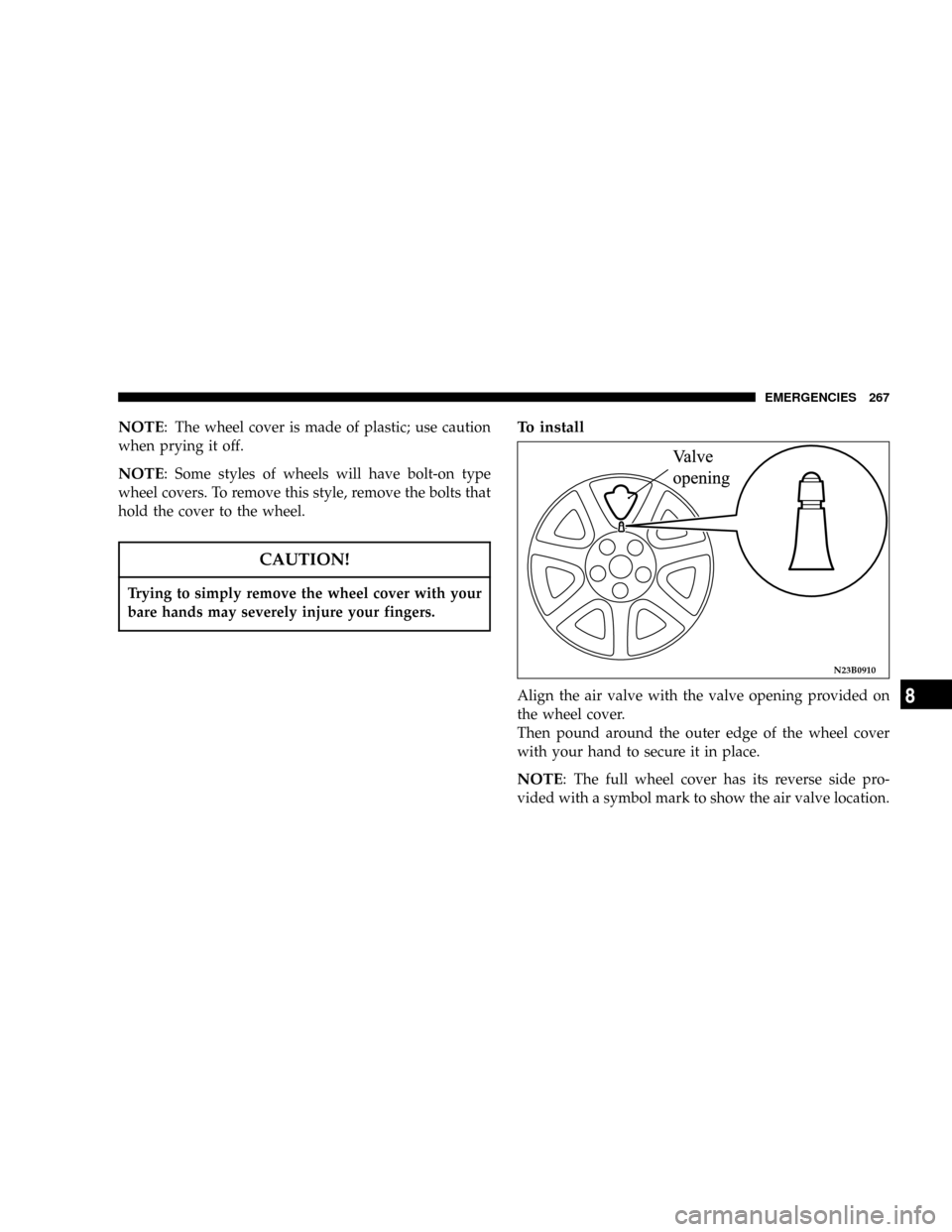
To install
Align the air valve with the valve opening provided on
the wheel cover.
Then pound around the outer edge of the wheel cover
with your hand to secure it in place.
NOTE: The full wheel cover has its reverse side pro-
vided with a symbol mark to show the air valve location.
N23B0910
EMERGENCIES 267
8
Page 284 of 394

CAUTION!
²Towing should only be done by a professional
tow service particularly if it will involve towing
on winding roads, hills or heavy traffic. If you
have any doubts, use a professional tow service.
TowingÐfront wheel lift
Place the gearshift lever (manual transaxle) to Neutral or
the selector lever (automatic transaxle) in the ªNº (NEU-
TRAL) position. Release the parking brake.
TowingÐrear wheel lift
Turn the ignition key to the ªACCº position and secure
the steering wheel in a straight-ahead position with a
rope or similar device. Never place the ignition key in the
ªLOCKº position. This will result in damage to the
steering lock mechanism.
If you have to tow an automatic transaxle model with the rear
wheels raised (with the front wheels on the ground):
Observe the following restricted towing speeds and distances.
·Speed: 30 mph (50 km/h)
·Distance: 18 miles (30 km)
CAUTION!
Never tow an automatic transaxle model with the
rear wheels raised (with the front wheels on the
ground) when the automatic transaxle fluid level is
low. This may cause serious and expensive damage
to the transaxle.
FUSES
N09A1230
Passenger compartment
284 EMERGENCIES
Page 290 of 394

4. There is a fuse puller in the cover of the instrument
panel (driver 's side). Remove the fuse puller, clamp it on
the fuse you wish to remove, and pull the fuse straight
out from the fuse block. If the fuse is not blown, some-
thing else must be causing the problem; contact an
authorized dealer to have the problem checked.5. Insert a new fuse of the same capacity securely into the
fuse block location.
N29C0200N29C0010
290 EMERGENCIES
Page 311 of 394

If the light is flashing, severe catalytic converter damage
and power loss will soon occur. Immediate service is
required.
If the gas cap is not tightened properly, the light may
come on. Be sure the gas cap is tightened every time you
add fuel. Tighten the cap until you hear it ªclick.º
REPLACEMENT PARTS
Use of genuine Mopar parts for normal/scheduled main-
tenance and repairs is highly recommended to insure the
designed performance. Damage or failures caused by the
use of non-Mopar parts for maintenance and repairs will
not be covered by the DaimlerChrysler Motors Corpora-
tion warranty.
Fuel system (tank, filler tube, connections, and
fuel tank filler cap)
Check periodically for damage or leakage in the fuel lines
and connections, and check for damage and looseness of
the fuel tank filler tube cap. Particular attention should be
paid to examining those fuel lines nearest to high heat
sources such as the exhaust manifold.
WARNING!
If you see a fuel leak or if you smell fuel, do not
operate the vehicle. Any spark (including from the
ignition ), flame or smoking material could cause an
explosion or fire. Call an authorized dealer for
assistance.
Fuel hoses
Inspect the surfaces of hoses for evidence of heat and
mechanical damage, hard and brittle rubber, cracking,
tears, cuts and abrasions. Particular attention should be
paid to examining those hose surfaces nearest to high
heat sources such as the exhaust manifold. Inspect all
hose connections, such as clamps and couplings, to make
sure they are secure and that no leaks exist. If there is any
evidence of deterioration or damage, hoses should be
replaced immediately.
MAINTENANCE 311
9
Page 323 of 394
WARNING!
²If the battery goes flat, be sure to check the battery
electrolyte level before connecting booster cables.
²After checking the battery electrolyte level, make
sure the caps are fitted securely.
²If any of the caps has a loose fit, replace the
battery.
During cold weather
The capacity of the battery is reduced at low tempera-
tures. This is the result of its chemical and physical
properties and this is why a very cold battery, particu-
larly one that is not fully charged, will only deliver a
fraction of the starter current that is normally available.
It is recommended that you have the battery checked by
an authorized dealer before the start of cold weather and,
if necessary, have it charged or replaced. This not only
ensures reliable starting, but prolongs battery life.
Disconnection and connection
To disconnect the battery cable, stop the engine, discon-
nect the negative terminal first, then the positive termi-
nal. To reconnect the battery, first connect the positive
terminal and then the negative terminal, before starting
the vehicle.
MAINTENANCE 323
9