service CHRYSLER SEBRING COUPE 2005 2.G Owner's Manual
[x] Cancel search | Manufacturer: CHRYSLER, Model Year: 2005, Model line: SEBRING COUPE, Model: CHRYSLER SEBRING COUPE 2005 2.GPages: 394, PDF Size: 2.47 MB
Page 284 of 394

CAUTION!
²Towing should only be done by a professional
tow service particularly if it will involve towing
on winding roads, hills or heavy traffic. If you
have any doubts, use a professional tow service.
TowingÐfront wheel lift
Place the gearshift lever (manual transaxle) to Neutral or
the selector lever (automatic transaxle) in the ªNº (NEU-
TRAL) position. Release the parking brake.
TowingÐrear wheel lift
Turn the ignition key to the ªACCº position and secure
the steering wheel in a straight-ahead position with a
rope or similar device. Never place the ignition key in the
ªLOCKº position. This will result in damage to the
steering lock mechanism.
If you have to tow an automatic transaxle model with the rear
wheels raised (with the front wheels on the ground):
Observe the following restricted towing speeds and distances.
·Speed: 30 mph (50 km/h)
·Distance: 18 miles (30 km)
CAUTION!
Never tow an automatic transaxle model with the
rear wheels raised (with the front wheels on the
ground) when the automatic transaxle fluid level is
low. This may cause serious and expensive damage
to the transaxle.
FUSES
N09A1230
Passenger compartment
284 EMERGENCIES
Page 305 of 394

MAINTENANCE
CONTENTS
mView of engine compartment..............307
mService precautions.....................308
mEmission-control system maintenance.......309
mEmissions Testing......................310
mOnboard Diagnostic System (OBD II)........310
mReplacement Parts......................311
NFuel system (tank, filler tube, connections,
and fuel tank filler cap).................311
NFuel hoses...........................311
NAir cleaner filter......................312
NEvaporative emission control system
(except evaporative emission canister).......312
NSpark plugs..........................313
NIgnition cables........................313NDistributor cap and rotor................313
mGeneral maintenance....................314
NEngine oil and oil filter..................314
mEngine coolant.........................318
NTo check the coolant level................318
NTo add coolant........................318
mBrake fluid...........................319
mClutch fluid (manual transaxle)............320
NTo check the clutch fluid.................320
NTo replace the fluid....................320
mBattery..............................321
NDuring cold weather...................323
9
Page 308 of 394
NOTE: The Scheduled Maintenance Charts are located
in the rear of this maintenance section. Always refer to
the schedules for proper service intervals.
SERVICE PRECAUTIONS
Adequate care of your vehicle at regular intervals serves
to preserve the value and appearance as long as possible.
Some maintenance items can be performed by the owner,
while others should be done only by an authorized
dealer.
This section describes only those items which can be
performed by the owner. In the event a malfunction or
other problem is discovered, have it corrected by an
authorized dealer.
This section contains information on inspection mainte-
nance procedures that you can do yourself, if you so
desire. Follow the instructions and precautions for each
of the various procedures.
WARNING!
²When checking or servicing the inside of the
engine compartment, be sure the engine is
stopped and has had a chance to cool down.
²If it is necessary to do work in the engine com-
partment with the engine running, be especially
careful that your clothing, hair, etc. does not
become caught by the fan, drive belts, or other
moving parts.
308 MAINTENANCE
Page 309 of 394
WARNING!
²The fan may turn on automatically even if the
engine is not running; turn the ignition key to the
ªLOCKº position and remove the key to ensure
safety while you work in the engine compartment.
²Do not smoke, or allow open flames around fuel
or the battery. The fumes are flammable.
²Be extremely cautious when working around the
battery. It contains poisonous and corrosive sulfu-
ric acid.
²Do not get under your vehicle with just the car's
jack supporting it.
Always use properly rated automotive jack
stands.
²Improper handling of components and materials
used in the vehicle can endanger your personal
safety. Consult an authorized dealer if you have
questions.
EMISSION-CONTROL SYSTEM MAINTENANCE
Your vehicle is equipped with an emission-control sys-
tem which satisfies all requirements of the U.S. Environ-
mental Protection Agency. The emission-control system
consists of:
(1) a positive crankcase ventilation system
(2) an evaporative emission-control system
(3) an exhaust emission- control system.
The9Scheduled9maintenance services listed must be
performed at the times or mileages specified to assure the
continued proper functioning of the emission-control
system. These, and all other ªGeneralº maintenance
services included in this manual, should be performed to
provide the best vehicle performance and reliability.
More frequent maintenance may be needed for vehicles
driven under severe operating conditions such as dusty
areas and frequent start and stop driving.
In order to assure the proper function of the emission-
control system, it is recommended that you have your
vehicle inspected and maintained by an authorized
dealer in accordance with the schedule in this manual.
Inspection and service should also be performed any
time a malfunction is suspected.
MAINTENANCE 309
9
Page 310 of 394
EMISSIONS TESTING
In some localities, it may be or will become a legal
requirement to ensure that all emissions components and
systems are functioning properly as a part of the test
procedure. The test center accomplishes this by checking
the On Board Diagnostic System system (OBD) with an
electronic scan tool. If your vehicle has recently been
serviced, the OBD system may have been reset to a9not
ready9condition because the OBD system has not had
sufficient time since the servicing to reconfirm that
emissions components are operating properly. In most
cases, a reasonable mix and amount of normal city and
highway driving and at least one overnight-off period
will be required to prepare your vehicle for this check;
however your DaimlerChrysler Motors Corporation
dealer has the equipment and procedures required to
make certain that the OBD system of your vehicle is
ready for the required testing.
ONBOARD DIAGNOSTIC SYSTEM (OBD II)
To meet new government regulations and promote
cleaner air, your vehicle is equipped with a sophisticated
onboard diagnostic system called OBD II. This systemmonitors the performance of the emissions, engine, and
automatic transaxle control systems. When these systems
are operating properly, your vehicle will provide excel-
lent performance and fuel economy, as well as engine
emissions well within current government regulations.
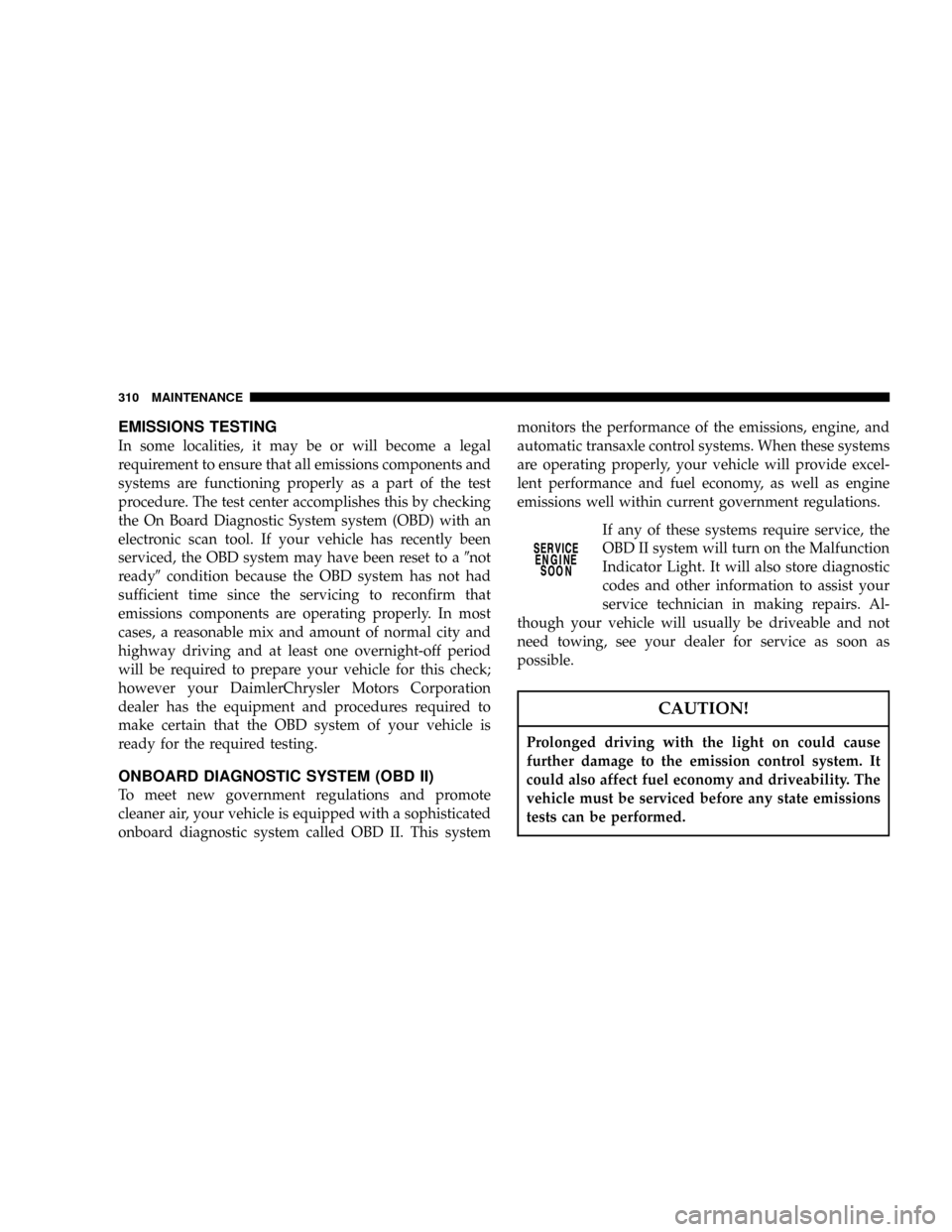
If any of these systems require service, the
OBD II system will turn on the Malfunction
Indicator Light. It will also store diagnostic
codes and other information to assist your
service technician in making repairs. Al-
though your vehicle will usually be driveable and not
need towing, see your dealer for service as soon as
possible.
CAUTION!
Prolonged driving with the light on could cause
further damage to the emission control system. It
could also affect fuel economy and driveability. The
vehicle must be serviced before any state emissions
tests can be performed.
310 MAINTENANCE
Page 311 of 394
If the light is flashing, severe catalytic converter damage
and power loss will soon occur. Immediate service is
required.
If the gas cap is not tightened properly, the light may
come on. Be sure the gas cap is tightened every time you
add fuel. Tighten the cap until you hear it ªclick.º
REPLACEMENT PARTS
Use of genuine Mopar parts for normal/scheduled main-
tenance and repairs is highly recommended to insure the
designed performance. Damage or failures caused by the
use of non-Mopar parts for maintenance and repairs will
not be covered by the DaimlerChrysler Motors Corpora-
tion warranty.
Fuel system (tank, filler tube, connections, and
fuel tank filler cap)
Check periodically for damage or leakage in the fuel lines
and connections, and check for damage and looseness of
the fuel tank filler tube cap. Particular attention should be
paid to examining those fuel lines nearest to high heat
sources such as the exhaust manifold.
WARNING!
If you see a fuel leak or if you smell fuel, do not
operate the vehicle. Any spark (including from the
ignition ), flame or smoking material could cause an
explosion or fire. Call an authorized dealer for
assistance.
Fuel hoses
Inspect the surfaces of hoses for evidence of heat and
mechanical damage, hard and brittle rubber, cracking,
tears, cuts and abrasions. Particular attention should be
paid to examining those hose surfaces nearest to high
heat sources such as the exhaust manifold. Inspect all
hose connections, such as clamps and couplings, to make
sure they are secure and that no leaks exist. If there is any
evidence of deterioration or damage, hoses should be
replaced immediately.
MAINTENANCE 311
9
Page 314 of 394

GENERAL MAINTENANCE
The following pages contain the maintenance service
recommended by DaimlerChrysler. In addition to the
general maintenance items for which fixed maintenance
intervals have been specified, there are other items which
are expected to operate satisfactorily without periodic
maintenance.
However, if a malfunction of these items does occur, it
could adversely affect the engine or vehicle performance.
These items should be inspected if a malfunction is
observed or suspected.
See your authorized dealer for assistance, if you have any
questions.
Engine oil and oil filter
M03A0700
2.4 liter engine
Good
314 MAINTENANCE
Page 317 of 394
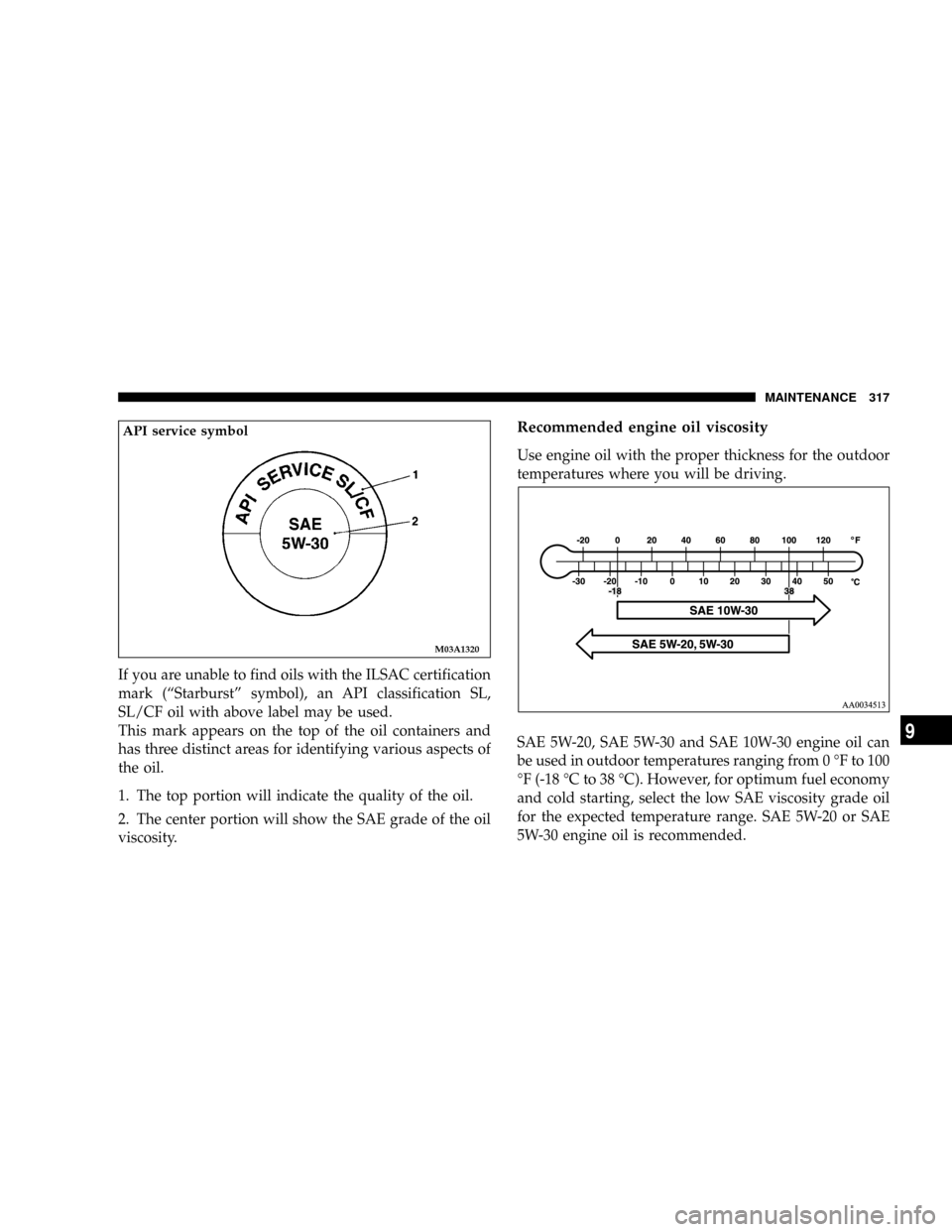
If you are unable to find oils with the ILSAC certification
mark (ªStarburstº symbol), an API classification SL,
SL/CF oil with above label may be used.
This mark appears on the top of the oil containers and
has three distinct areas for identifying various aspects of
the oil.
1. The top portion will indicate the quality of the oil.
2. The center portion will show the SAE grade of the oil
viscosity.
Recommended engine oil viscosity
Use engine oil with the proper thickness for the outdoor
temperatures where you will be driving.
SAE 5W-20, SAE 5W-30 and SAE 10W-30 engine oil can
be used in outdoor temperatures ranging from 0 ÉF to 100
ÉF (-18 ÉC to 38 ÉC). However, for optimum fuel economy
and cold starting, select the low SAE viscosity grade oil
for the expected temperature range. SAE 5W-20 or SAE
5W-30 engine oil is recommended.
M03A1320
API service symbol
MAINTENANCE 317
9
Page 318 of 394

ENGINE COOLANT
To check the coolant level
The coolant reserve system provides a quick visual
method for determining the coolant level. When the
engine is cold, the level of the coolant in the reserve tank
should be between the FULL and LOW marks. The
radiator normally remains completely full so there is no
need to remove the radiator cap except for checking the
coolant freeze point or replacing the antifreeze coolant.
To add coolant
Use DaimlerChrysler Genuine Coolant or an equivalent.
Genuine Coolant provides excellent protection against
corrosion and rust formation of all metals, including
aluminum, and prevents clogs in the radiator, heater,
cylinder head, engine block, etc.
If frequent coolant additions are required, or if the level
in the reserve tank does not drop when the engine cools,
the system should be pressure-tested for leaks. Take your
vehicle to an authorized dealer for inspection of the
cooling system.
CAUTION!
²Do not use alcohol or methanol anti-freeze or any
engine coolants mixed with alcohol or methanol
anti-freeze. The use of an improper anti-freeze can
cause corrosion of aluminum components.
²When additional coolant is needed to maintain
the proper level, a minimum of 50% concentration
of ethylene-glycol antifreeze in water should be
added to the reserve tank. Do not overfill. A
higher concentration (not to exceed 60%) should
be used if a lower freezing point is required. The
concentration level can be checked using instru-
ments available at automotive supply stores, or
can be done by your authorized dealer or service
station. Use only high quality ethylene-glycol
antifreeze coolant formulated to prevent corrosion
of all cooling system metals.
²Do not top off with water only. Water by itself
reduces the rust-protective and anti-freeze quali-
ties of the coolant and has a lower boiling point. It
can also cause damage to the cooling system if it
should freeze. Do not use tap water, as it may
cause corrosion and rust formation.
318 MAINTENANCE
Page 320 of 394

CLUTCH FLUID (MANUAL TRANSAXLE)
To check the clutch fluid
The clutch fluid in the clutch master cylinder should be
checked when performing other underhood services. In
addition, the system should be checked for leakage at the
same time. Check to make certain that the clutch fluid
level is always between the MAX and MIN level mark-
ings on the fluid reservoir and refill the fluid, if necessary.
A rapid fluid loss indicates a leak in the clutch system
which should be inspected by an authorized dealer and
repaired immediately.
To replace the fluid
Recommended brake fluid conforming to DOT 3 or DOT 4
should be used.
The reservoir cap must be fully tightened to avoid contami-
nation from foreign matter or moisture.
CAUTION!
²Do not allow petroleum-based fluid to contact,
mix with, or otherwise contaminate the clutch
fluid. Seal damage will result.
²Take care in handling clutch fluid as it may cause
damage to painted surfaces.
²Use only the specified clutch fluid.
Also, the additives in different brands may result
in a chemical reaction when mixed together, so
avoid mixing different brands if possible.
²Keep the reservoir tank cap closed to prevent the
clutch fluid from deteriorating due to moisture or
air exposure.
M10A0040
Good
320 MAINTENANCE