ignition CHRYSLER SEBRING COUPE 2005 2.G Service Manual
[x] Cancel search | Manufacturer: CHRYSLER, Model Year: 2005, Model line: SEBRING COUPE, Model: CHRYSLER SEBRING COUPE 2005 2.GPages: 394, PDF Size: 2.47 MB
Page 149 of 394

FUEL ECONOMY
Fuel economy is dependent on many factors. Your per-
sonal driving habits can have a significant effect on your
fuel economy. Several recommendations for achieving
maximum fuel economy are listed below.
1. When pulling away from traffic lights or stop signs,
accelerate slowly and smoothly.
2. When parked for even a short period, do not idle the
engine. Shut it off.
3. Plan your trips to avoid unnecessary stops.
4. Keep your tires inflated to the recommended pres-
sures.
5. For freeway driving, maintain a constant speed within
the posted limits when traffic, roadway and weather
conditions safely permit, for the best fuel economy.
6. Keep your air filter clean and your vehicle lubricated
according to the recommendations in this manual.
7. Keep your vehicle ªtuned-upº.
An out-of-tune engine wastes fuel and costs money.
8. Reduce excess vehicle load.
IGNITION SWITCH
LOCK
For vehicles with a manual transaxle, when removing the
key, push the key in at the ªACCº position and keep it
depressed until it is turned to the ªLOCKº position, and
remove the key.
For vehicles with an automatic transaxle: When remov-
ing the key, first set the gear selector lever to the ªPº
(PARK) position, and then turn the key to ªLOCKº and
remove it.
I21A0230
STARTING AND DRIVING 149
5
Page 150 of 394

NOTE: For vehicles with an automatic transaxle, the key
cannot be removed unless the selector lever is set to the
ªPº (PARK) position.
ACC
Allows operation of electrical accessories with the engine
off.
START
Engages the starter. After the engine starts, release the
key and it will return automatically to the ªONº position.
ON
The engine runs and all accessories can be used.
NOTE:Do not use the ªONº position to operate acces-
sories.
CAUTION!
²Do not remove the ignition key from the ignition
switch while driving. The steering wheel will
lock, causing loss of control.
²If the engine is turned off while driving, the
power brake servomechanism will cease to func-
tion and braking efficiency will deteriorate. Also,
the power steering system will not function and it
will require greater effort to operate the steering.
²Do not leave the key in the ªONº position for a
long time when the engine is not running; doing
so will cause the battery to discharge.
²Do not turn the key to the ªSTARTº position
when the engine is running; doing so could dam-
age the starter motor.
KEY REMINDER CHIME
If the driver's door is opened while the ignition key is in
the ªLOCKº or ªACCº position, a warning chime
sounds.
150 STARTING AND DRIVING
Page 151 of 394

THEFT PROTECTION
CAUTION!
Always remove the key from the ignition switch and
lock all doors when leaving the vehicle unattended.
Always try to park your vehicle in a well lighted
area.
The ignition key can only be removed in the ªLOCKº
position. If the key is left in the lock cylinder, a warning
chime sounds when the driver's door is opened.
NOTE: If your vehicle is equipped with a Theft-alarm
system, refer to ªTheft-alarm systemº.
STEERING LOCK
Withdraw the key and the steering wheel will be locked.
Turn the steering wheel to confirm that it is locked.
CAUTION!
If your vehicle needs to be towed, turn the key to the
(ACC(position to unlock the steering wheel.
STARTING
Tips for starting
1. Do not operate the starter motor continuously for
longer than 15 seconds at a time; doing so could run
down the battery. If the engine does not start, turn the
ignition switch back to ªLOCKº, wait a few seconds, and
then try again.
2. If the engine will not start because the battery is weak
or dead, refer to ªJump-starting the engineº section (page
278) for instructions on starting the engine.
3. The engine is well warmed up if the pointer of the
coolant temperature gauge starts to move. Extended
warm up operation will result in excessive fuel consump-
tion.
STARTING AND DRIVING 151
5
Page 152 of 394

WARNING!
Never run the engine in a closed or poorly ventilated
area any longer than is needed to move your vehicle
in or out of the area. Carbon monoxide gas, which is
odorless, colorless and extremely poisonous, could
build up, and cause serious injury or death.
CAUTION!
²Do not start the vehicle by pushing or pulling.
²Do not run the engine at high rpm or drive the
vehicle at high speed until the engine has had a
chance to warm up.
²Release the ignition key as soon as the engine
starts to avoid damaging the starter motor.
This vehicle is equipped with an electronically controlled
fuel injection system that automatically controls fuel
quantity. When starting the engine, there is normally no
need to depress the accelerator pedal.
Normal conditions
The starting procedure is as follows:
1. Insert the ignition key and make sure all occupants are
properly seated with seat belts fastened.
2. Depress and hold the brake pedal down with your
right foot.
3. Set the gearshift selector lever (manual transaxle) in
the ªNº (NEUTRAL) position, or the selector lever (au-
tomatic transaxle) in the ªPº (PARK) position.
4. Fully depress the clutch pedal (manual transaxle).
NOTE: For models equipped with a manual trans-
axle, the starter will not operate unless the clutch
pedal is fully depressed (Clutch interlock).
5. After turning the ignition key to the ªONº position,
make certain that all warning lights are functioning
properly before starting the engine.
6. Turn the ignition key to the ªSTARTº position without
depressing the accelerator pedal, and release the key
when the engine starts.
152 STARTING AND DRIVING
Page 154 of 394

CAUTION!
The electronically controlled transaxle system is
strictly intended to provide supplementary func-
tions. When driving downhill under certain condi-
tions, or immediately after starting when the auto-
matic transaxle is cold, no automatic shift-down may
be made. The driver should shift down to a low gear
(3rd gear or 2nd gear), which will permit the engine
to exert a braking effect.
NOTE: During the brake-in period or immediately after
re-connection of the battery cable, the vehicle may not
shift as smoothly. This does not indicate a faulty trans-
mission. The transaxle system must have a short period
to learn parameters for proper shifting. Shifting will
become smooth after the transaxle has been shifted
several times by the electronic control system.
Selector lever operation
As an additional safety precaution, models equipped
with an automatic transaxle have a shift-lock device that
holds the selector lever in the ªPº (PARK) position. To
move the selector lever from the ªPº (PARK) position to
another position, follow the steps below.
1. Depress and hold down the brake pedal.
2. Move the selector lever to the desired position.
NOTE: The selector lever cannot be moved from ªPº
(PARK) to another position if the ignition key is at the
ªLOCKº position, removed, or if the brake pedal is not
depressed and held down.
154 STARTING AND DRIVING
Page 169 of 394

Recommended downshifting speed
Downshifting speed
mph (km/h)Condition
Under 20 (30)3rd to 2nd
4th to 2nd
5th to 2nd
20 to 30 (30 to 45)4th to 3rd
5th to 3rd
Driving precautions
1. The table below indicates the driving speed ranges
that may be driven in each gear without causing the
engine to operate in excessive engine speeds.
Possible driving speed
Condition 2.4 liter engine 3.0 liter engine
Vehicles with Vehicles with
205/60R16 215/50R17
tire tire
1st 31 mph
(50 km/h)34 mph (55 km/h)
2nd 59 mph
(95 km/h)55 mph (90 km/h)
3rd 83 mph 86 mph 83 mph
(135 km/h) (140 km/h) (135 km/h)
4th 114 mph
(185 km/h)118 mph (190 km/h)
PARKING BRAKE
When the parking brake is applied with the ignition on,
the Brake Light in the instrument cluster will come on.
NOTE:This light only shows that the parking brake is
on. It does not show the degree of brake application.
STARTING AND DRIVING 169
5
Page 171 of 394

You should always apply the parking brake before leav-
ing the vehicle.
WARNING!
²Leaving children in a vehicle unattended is dan-
gerous for a number of reasons. A child or others
could be injured. Children should be warned not
to touch the parking brake or the gear selector.
Don't leave the keys in the ignition. A child could
operate power windows, other controls, or move
the vehicle.
²Be sure the parking brake is fully disengaged
before driving; failure to do so can lead to brake
failure and an accident.
BRAKE PEDAL
Excessive use of the brake can cause fading, resulting in
poor brake response and premature wear of brake lin-
ings.
When driving down a long or steep grade, use engine
braking by shifting the transaxle into a lower gear
(manual transaxle and Autostick A/T) or ª3º (THIRD) or
ª2º (SECOND) or ªLº (LOW) position (except Autostick
A/T).
WARNING!
Do not leave any objects on the floor near the brake
pedal or permit a floor mat to interfere with the
brake pedal. Doing so could prevent proper depres-
sion of the pedal. Make sure that the pedal can be
operated freely at all times.
STARTING AND DRIVING 171
5
Page 178 of 394
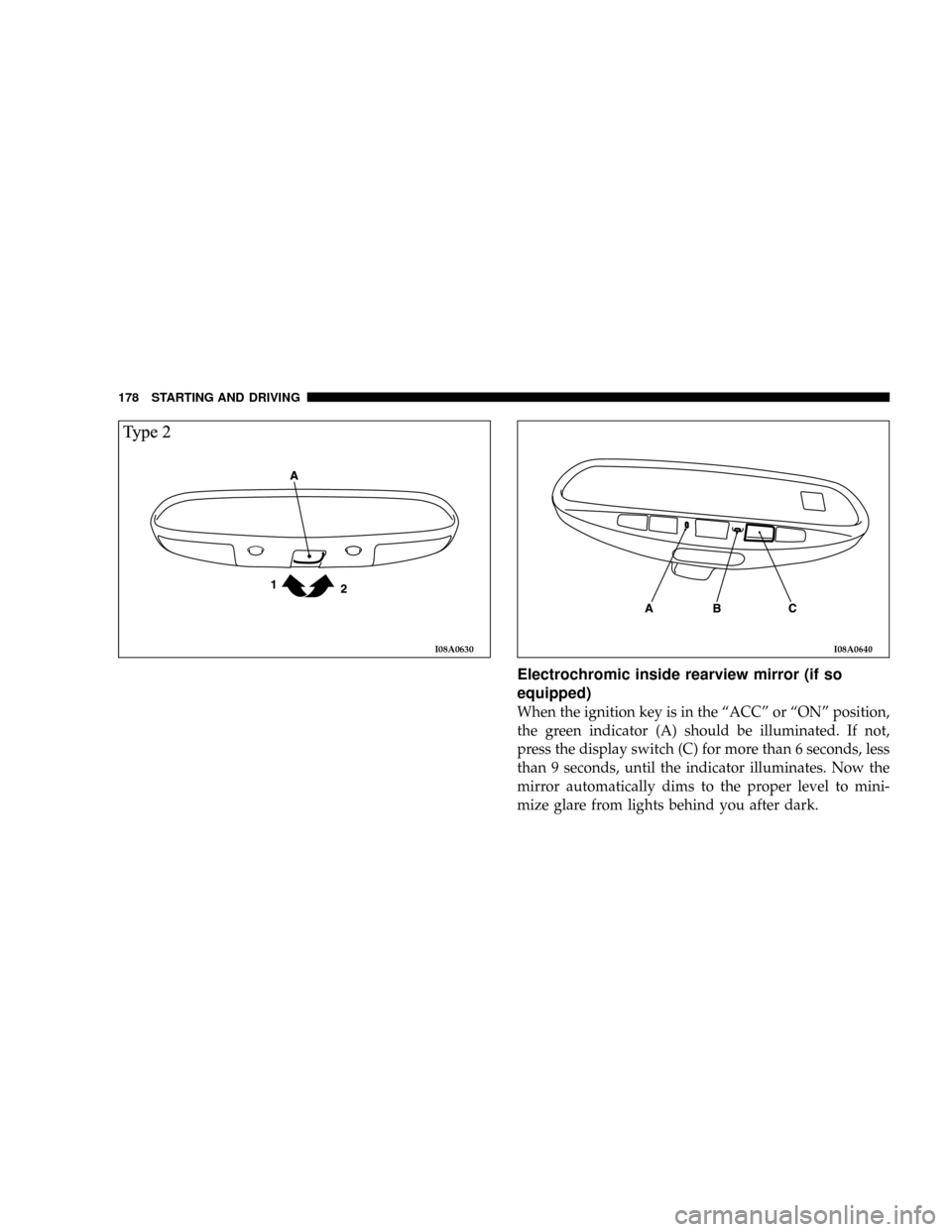
Electrochromic inside rearview mirror (if so
equipped)
When the ignition key is in the ªACCº or ªONº position,
the green indicator (A) should be illuminated. If not,
press the display switch (C) for more than 6 seconds, less
than 9 seconds, until the indicator illuminates. Now the
mirror automatically dims to the proper level to mini-
mize glare from lights behind you after dark.
I08A0630I08A0640
178 STARTING AND DRIVING
Page 180 of 394
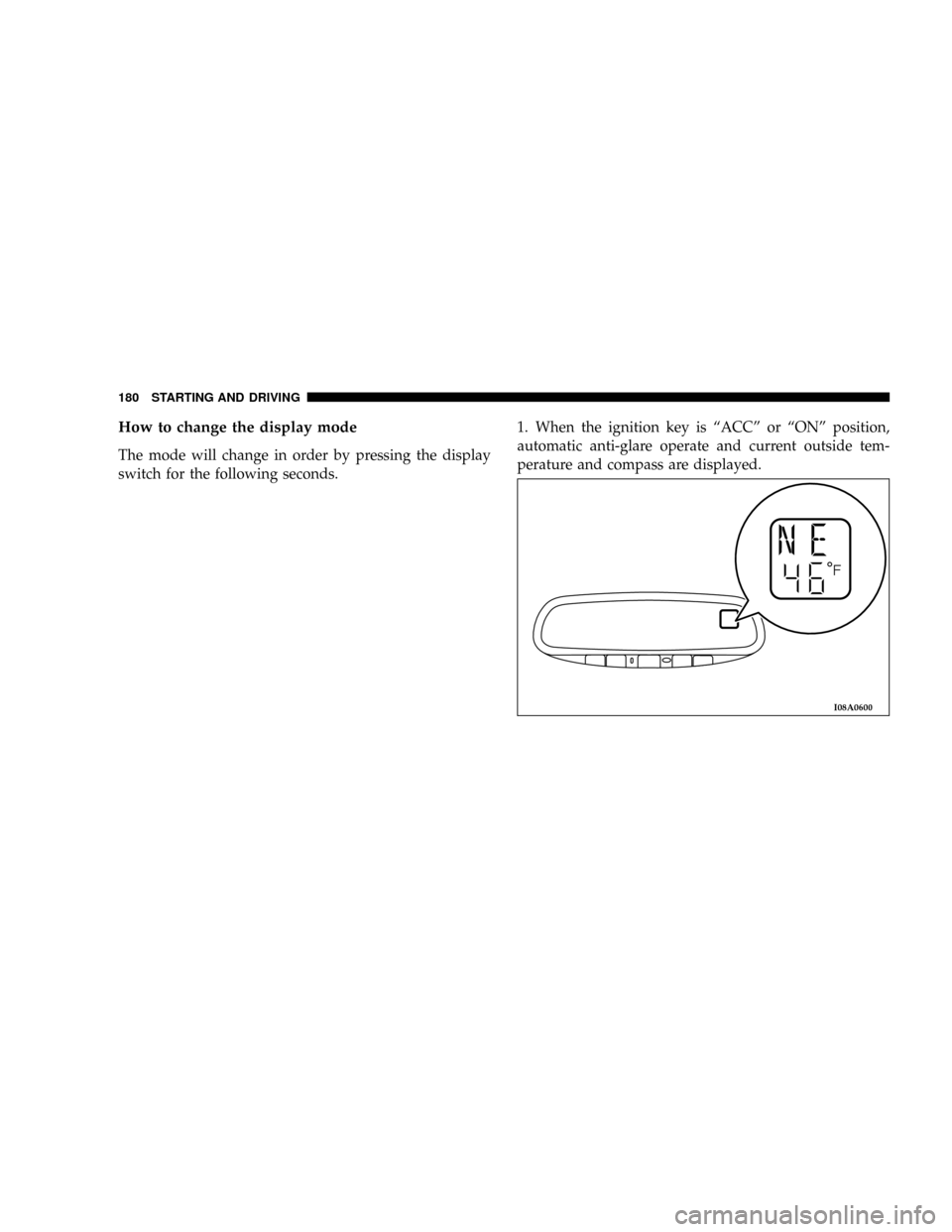
How to change the display mode
The mode will change in order by pressing the display
switch for the following seconds.1. When the ignition key is ªACCº or ªONº position,
automatic anti-glare operate and current outside tem-
perature and compass are displayed.
I08A0600
180 STARTING AND DRIVING
Page 183 of 394
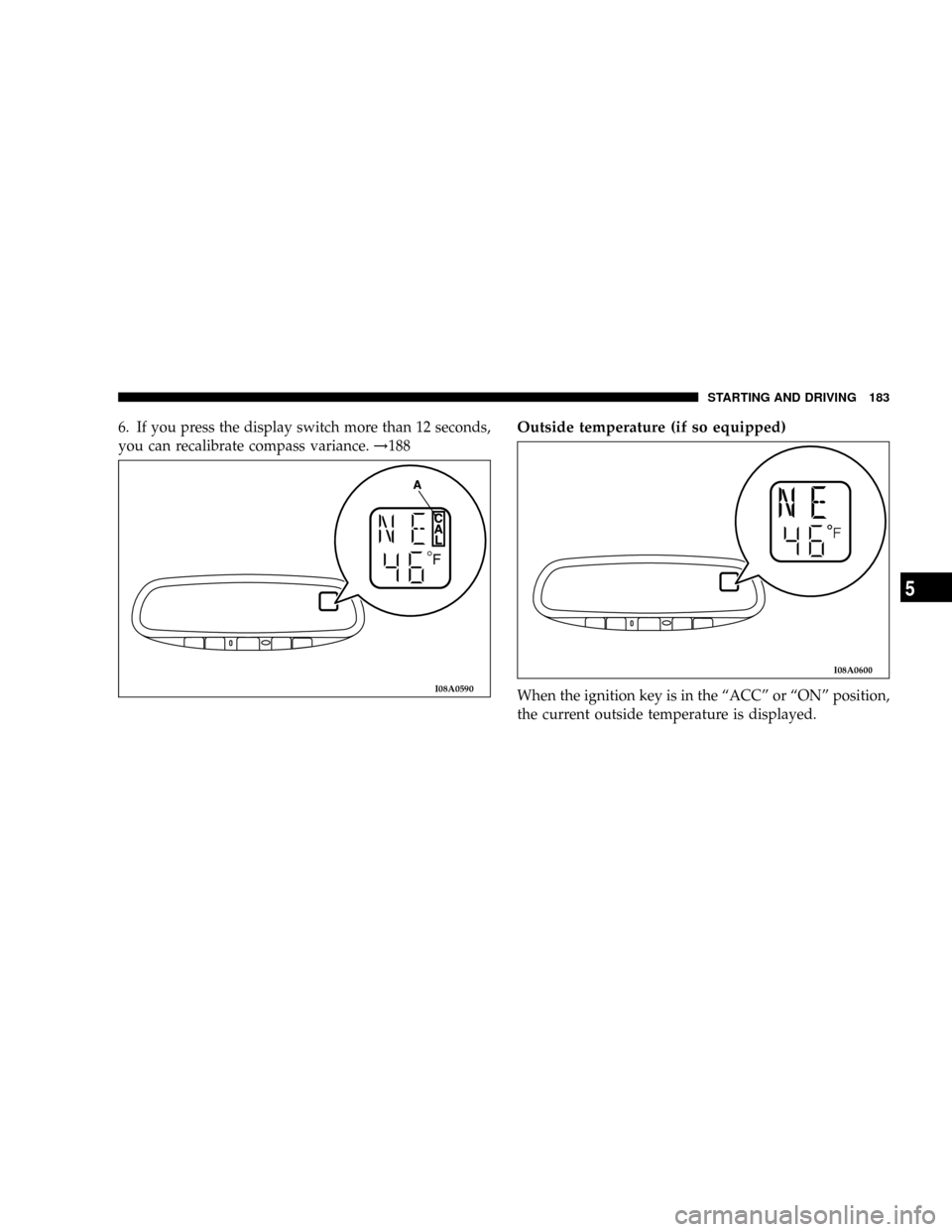
6. If you press the display switch more than 12 seconds,
you can recalibrate compass variance.!188Outside temperature (if so equipped)
When the ignition key is in the ªACCº or ªONº position,
the current outside temperature is displayed.I08A0590
I08A0600
STARTING AND DRIVING 183
5