key CHRYSLER SEBRING COUPE 2005 2.G Repair Manual
[x] Cancel search | Manufacturer: CHRYSLER, Model Year: 2005, Model line: SEBRING COUPE, Model: CHRYSLER SEBRING COUPE 2005 2.GPages: 394, PDF Size: 2.47 MB
Page 185 of 394
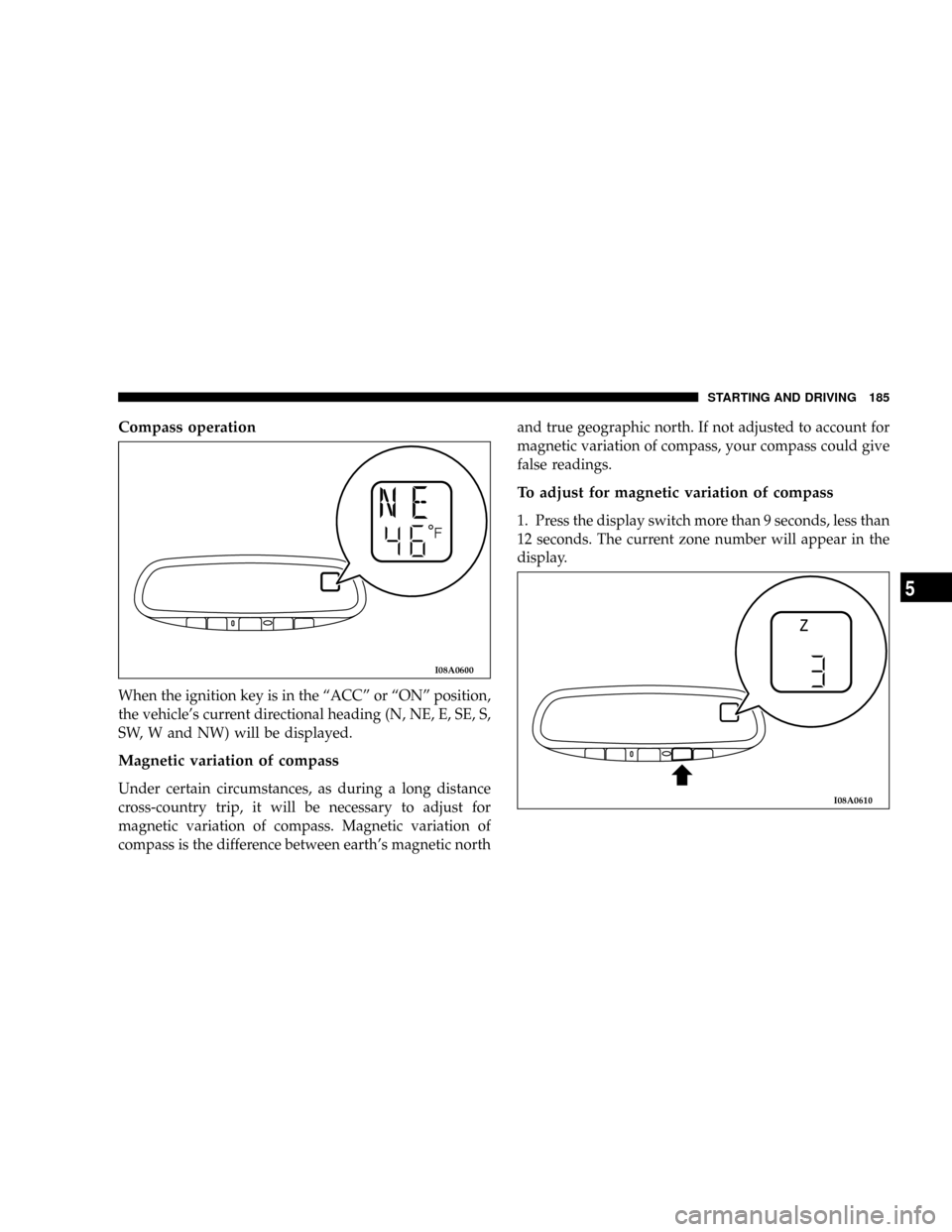
Compass operation
When the ignition key is in the ªACCº or ªONº position,
the vehicle's current directional heading (N, NE, E, SE, S,
SW, W and NW) will be displayed.
Magnetic variation of compass
Under certain circumstances, as during a long distance
cross-country trip, it will be necessary to adjust for
magnetic variation of compass. Magnetic variation of
compass is the difference between earth's magnetic northand true geographic north. If not adjusted to account for
magnetic variation of compass, your compass could give
false readings.
To adjust for magnetic variation of compass
1. Press the display switch more than 9 seconds, less than
12 seconds. The current zone number will appear in the
display.
I08A0600
I08A0610
STARTING AND DRIVING 185
5
Page 188 of 394
If the ªCALº is not displayed, but compass calibration is
required, press and hold the display switch for 12 sec-
onds, or until ªCALº is displayed. With ªCALº dis-
played, drive the vehicle in a circle at less than 5mph
(8km/h) or less until the ªCALº goes off.
Cleaning of the mirror
When cleaning the mirror, use a paper towel or similar
material dampened with glass cleaner. Do not spray glass
cleaner directly on the mirror as that may cause the liquid
cleaner to enter the mirror housing.
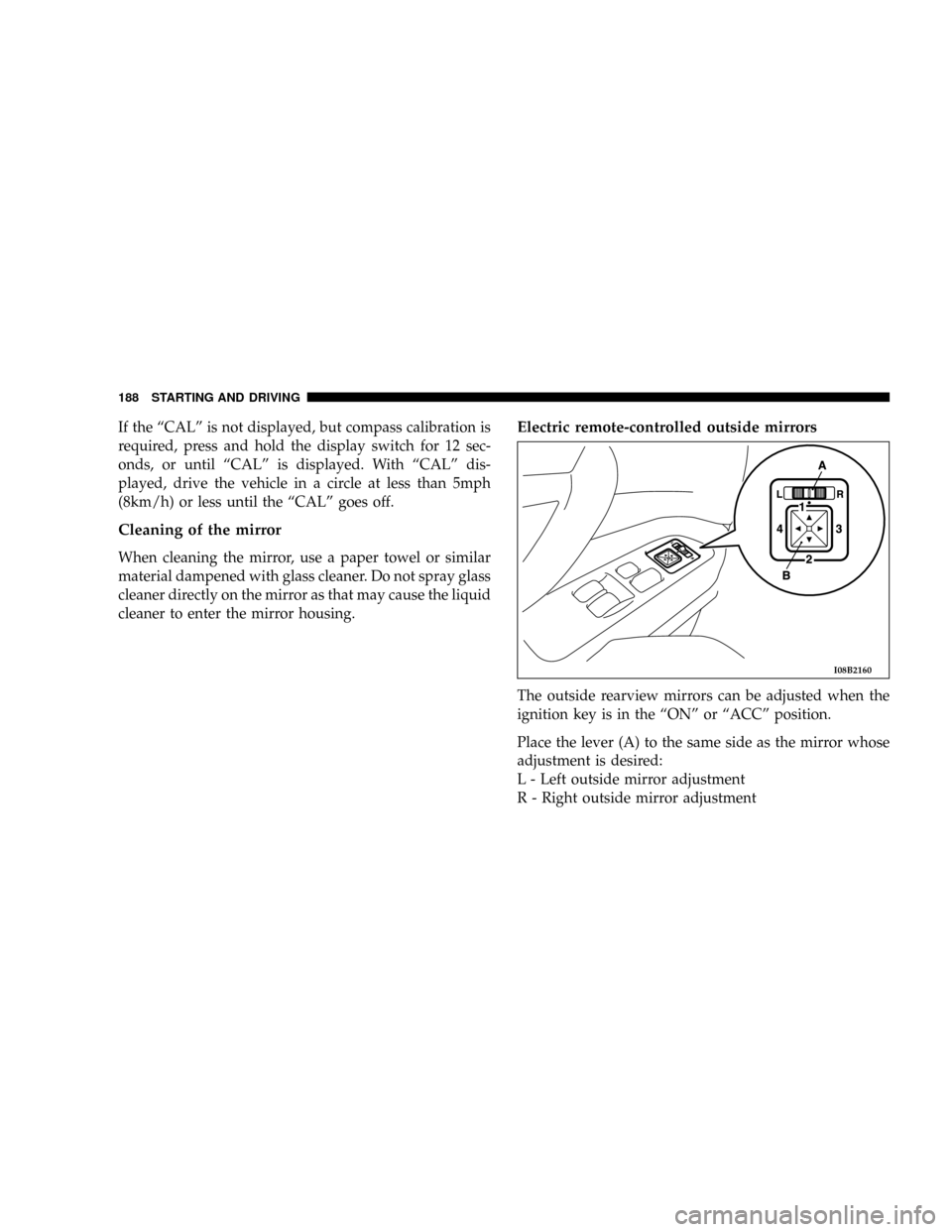
Electric remote-controlled outside mirrors
The outside rearview mirrors can be adjusted when the
ignition key is in the ªONº or ªACCº position.
Place the lever (A) to the same side as the mirror whose
adjustment is desired:
L - Left outside mirror adjustment
R - Right outside mirror adjustment
I08B2160
188 STARTING AND DRIVING
Page 196 of 394

procedure:
(1) The ignition key is turned OFF.
(2) The main switch is turned OFF.
TRACTION CONTROL (IF SO EQUIPPED)
On slippery surfaces, traction control system prevents the
drive wheels (front wheels) from excessive spinning,
during starting or while accelerating in turns on slippery
roads.
NOTE
²
The traction control system functions at speeds
below about 25mph (40km/h).
²Some vibration will be felt in the vehicle body and a
whining sound of a motor will be heard from the
engine compartment when the traction control sys-
tem functions. This is a normal result of the traction
control system operation, and does not indicate a
malfunction.
Driving hints
1. Traction control system does not actively apply brakes.
Always decelerate the vehicle sufficiently before entering
corners or bends.
2. On snowy or icy roads, drive slowly using tire chains
or snow tires.
3. Never mix or use tires of different size since the
traction control system could function incorrectly and
make safe driving difficult.
196 STARTING AND DRIVING
Page 197 of 394
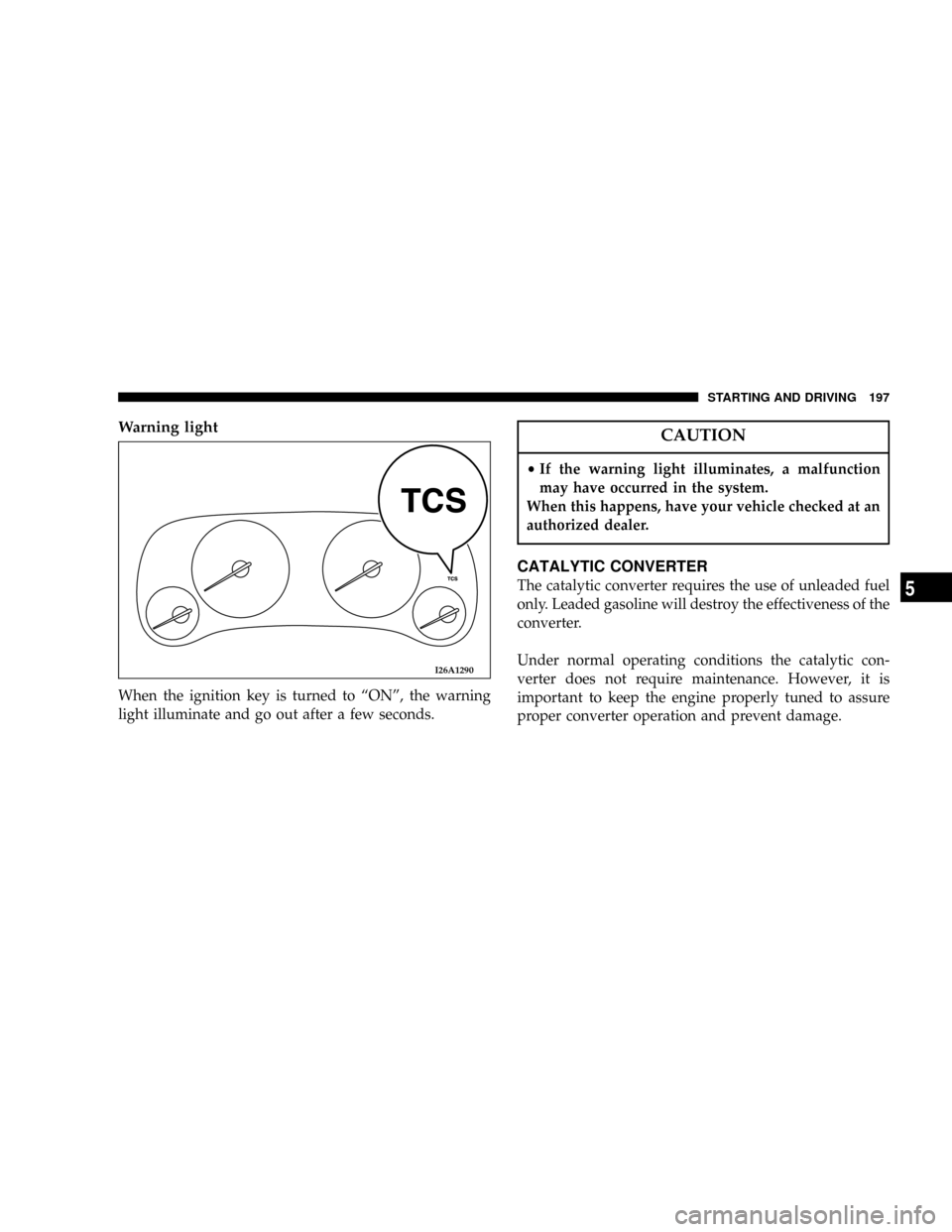
Warning light
When the ignition key is turned to ªONº, the warning
light illuminate and go out after a few seconds.
CAUTION
²If the warning light illuminates, a malfunction
may have occurred in the system.
When this happens, have your vehicle checked at an
authorized dealer.
CATALYTIC CONVERTER
The catalytic converter requires the use of unleaded fuel
only. Leaded gasoline will destroy the effectiveness of the
converter.
Under normal operating conditions the catalytic con-
verter does not require maintenance. However, it is
important to keep the engine properly tuned to assure
proper converter operation and prevent damage.
I26A1290
STARTING AND DRIVING 197
5
Page 200 of 394

Check wheel nuts for tightness and tires (including spare
tire) for proper pressure. Maintain specified tire inflation
pressures. Replace tires before they are excessively worn.
Lights
Have someone observe the operation of all exterior lights
while you activate the controls. Check the turn signals
and highbeam indicators on the instrument panel.
Fluid leaks
Check the area under the vehicle after overnight parking
for fuel, water, oil, or other fluid leaks. Make sure all fluid
levels are at the proper levels. Also, if fuel leaks are
detected, the cause should be located and corrected
immediately.
Driver
Do not drive if you are tired or sleepy. Do not drive if you
have been drinking or taking drugs. Unless you are alert
and able to concentrate on your driving, you could have
an accident, resulting in serious or fatal injury to yourself
and others.
SAFE DRIVING TECHNIQUES
Even this vehicle's safety equipment, and your safest
driving, cannot guarantee that you can avoid accident or
injury. However, we recommend that you give extra
attention to the following, to help maximize the safety of
you and your passengers:
1. Drive defensively. Be aware of traffic, road and
weather conditions. Leave adequate stopping distance
for your vehicle.
2. Before changing lanes, check your mirrors and flash
the proper turn-signal light.
3. While driving, watch the behavior of other drivers,
bicyclists and pedestrians.
4. During an emergency stop, switch on the hazard
warning flasher.
5. When leaving the vehicle, set the parking brake and
place the gearshift lever into low gear.
In vehicles with an automatic transaxle, place the selector
lever in the ªPº (PARK) position. Remove the key.
200 STARTING AND DRIVING
Page 211 of 394
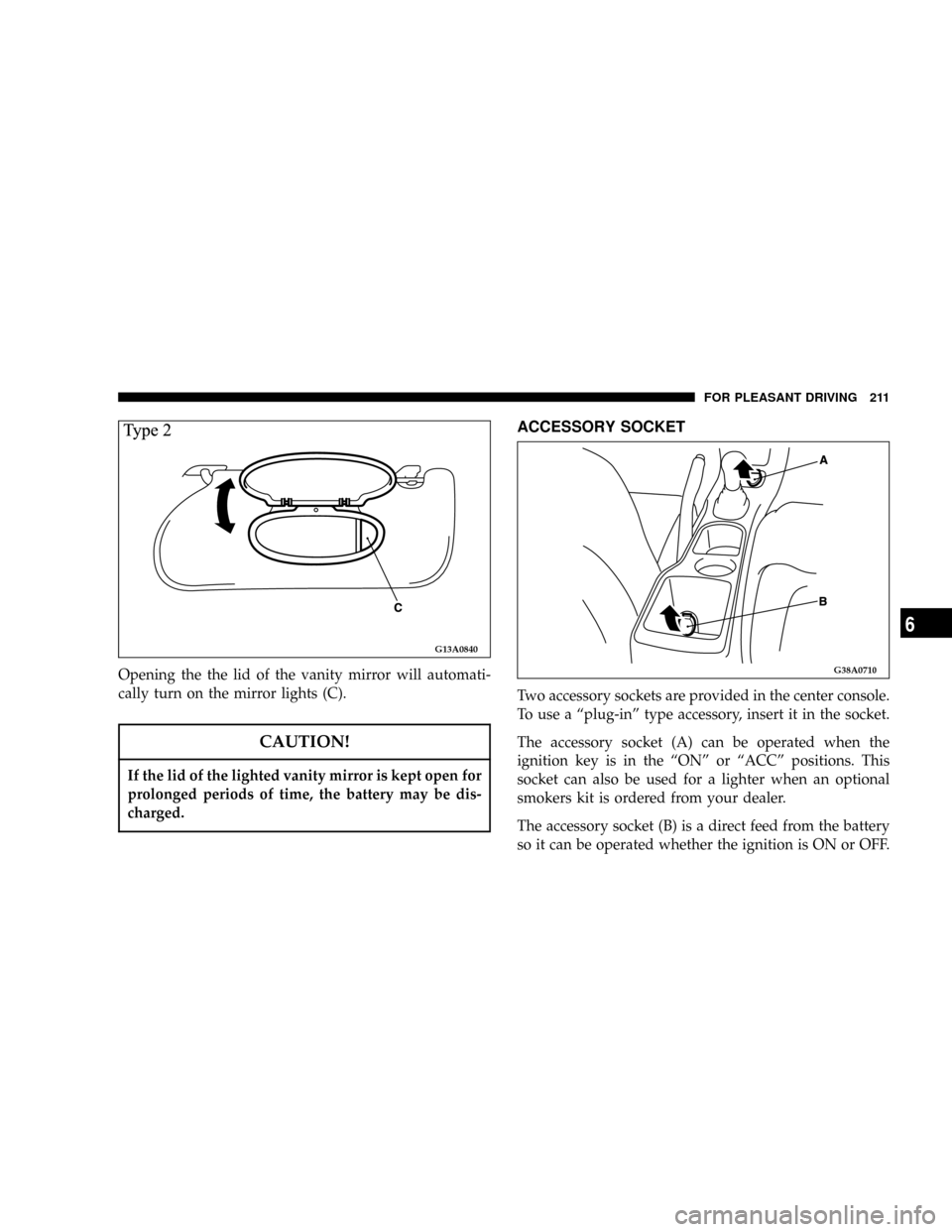
Opening the the lid of the vanity mirror will automati-
cally turn on the mirror lights (C).
CAUTION!
If the lid of the lighted vanity mirror is kept open for
prolonged periods of time, the battery may be dis-
charged.
ACCESSORY SOCKET
Two accessory sockets are provided in the center console.
To use a ªplug-inº type accessory, insert it in the socket.
The accessory socket (A) can be operated when the
ignition key is in the ªONº or ªACCº positions. This
socket can also be used for a lighter when an optional
smokers kit is ordered from your dealer.
The accessory socket (B) is a direct feed from the battery
so it can be operated whether the ignition is ON or OFF.
G13A0840
G38A0710
FOR PLEASANT DRIVING 211
6
Page 237 of 394

Changing the blower speed
The blower may be operated (when the ignition key is in
the ON position) at 4 different speeds. Select the best
speed to fit your needs. When the blower switch is set to
the ``O'' position, all air conditioning functions will stop.
Changing the temperature
Select the desired temperature level by turning the tem-
perature control dial either clockwise or counterclock-
wise. Turning the temperature control dial clockwise
makes the air warmer.
NOTE: When the engine coolant temperature is low, the
temperature of air introduced into the passenger com-
partment does not change even if the temperature control
dial is moved to the high temperature side.
H23A2860H23A2870
FOR PLEASANT DRIVING 237
6
Page 268 of 394

Before installing the wheel cover to the wheel, make sure
that the opening with the symbol mark is correctly
aligned with the air valve.
JACKING AND TIRE CHANGING
If a tire must be changed, do so only after making sure
the vehicle is stopped in a safe, flat location.
Jacking up the vehicle
1. Park the vehicle on level and stable ground.
2. Switch on the hazard warning flashers, set up a
warning triangle, flashing signal light, etc., at an ad-
equate distance from the vehicle, and have all passengers
leave the vehicle. Turn the ignition key to the ªLOCKº
position.
3. Set the parking brake firmly, and move the gearshift
lever (manual transaxle) to the ªNº (Neutral) position or
move the selector lever (automatic transaxle) to the ªPº
(PARK) position.4. Apply a chock or block (A) at the tire diagonally
opposite the tire (B) to be changed.
NOTE: The chock shown is not supplied with the ve-
hicle. It is recommended that you keep one in the vehicle
for use if required.
N24A0100
A
B
268 EMERGENCIES
Page 278 of 394

WARNING!
²When working near the radiator cooling fan, dis-
connect the fan motor lead or turn the ignition key
to the OFF position. The fan is temperature con-
trolled and can start at any time the ignition key is
in the ON position.
²You or others can be badly burned by hot coolant
or steam from your radiator. If you see or hear
steam coming from under the hood, don't open
the hood until the radiator has had time to cool.
Never try to open a cooling system pressure cap
when the radiator is hot.
JUMP-STARTING THE ENGINE
If the engine cannot be started because the battery is
weak or dead, the battery from another vehicle can be
used with booster cables to start the engine.
WARNING!
When using jumper cables to start a vehicle, follow
procedures exactly and exercise extreme caution.
CAUTION!
Do not try to start your vehicle by pushing or towing.
Vehicles equipped with an automatic transaxle can-
not be started this way. Pushing or towing a vehicle
equipped with a manual transaxle may overheat and
damage the catalytic converter. Also, there is a
greater risk of an accident when a vehicle is being
pushed or towed.
1. Remove any metal jewelry such as watch bands or
bracelets that might make an inadvertent electrical con-
tact.
2. Position the vehicles close enough together so the
booster cables can reach, but be sure the vehicles aren't
touching each other. If they are, it could cause a ground
278 EMERGENCIES
Page 279 of 394

connection. You wouldn't be able to start your vehicle,
and the bad ground could damage the electrical systems.
CAUTION!
Check the other vehicle. It must have a 12-volt
battery. If the other system isn't 12-volts, both sys-
tems can be damaged.
3. You could be injured if the vehicles move. Set the
parking brake firmly on each vehicle. Put an automatic
transaxle in ªPº (PARK) or a manual transaxle in ªNº
(Neutral). Turn the ignition key to the ªLOCKº position.
WARNING!
Turn the ignition key to the ªLOCKº position on
both vehicles.
Use care to make sure that the cables or your clothes
are never caught by the fan or drive belt. Personal
injury could result.
NOTE: Turn off all lights, heater and other electrical
loads. This will avoid sparks and help save both batter-
ies.
4. Make sure battery electrolyte is at the proper level.
(See ªBatteryº on page 321.)
WARNING!
If electrolyte fluid is not visible, or appears to be
frozen, do not attempt jump starting.
The battery might rupture or explode if the tempera-
ture is below the freezing point or if it is not filled to
the proper level.
EMERGENCIES 279
8