child lock CHRYSLER SEBRING SEDAN 2010 3.G User Guide
[x] Cancel search | Manufacturer: CHRYSLER, Model Year: 2010, Model line: SEBRING SEDAN, Model: CHRYSLER SEBRING SEDAN 2010 3.GPages: 436
Page 47 of 436
Rear Seat Belts
The shoulder belt anchorages of the rear three-point belts
are nonadjustable for outboard and center rear passen-
gers on sedans. The center belt is mounted to the rear
shelf panel and exits through a bezel in the panel.
Automatic Locking Retractors (ALR) Mode — If
Equipped
In this mode, the shoulder belt is automatically pre-
locked. The belt will still retract to remove any slack in
the shoulder belt. The Automatic Locking Mode is avail-
able on all passenger-seating positions with a combina-
tion lap/shoulder belt.
When to Use the Automatic Locking Mode
Use the Automatic Locking Mode anytime a child safety
seat is installed in a passenger seating position. Children
12 years old and younger should always ride buckled up
in the rear seat.
How to Use the Automatic Locking Mode
1. Buckle the combination lap/shoulder belt.
2. Grasp the shoulder portion and pull downward until
the entire belt is extracted.
3. Allow the belt to retract. As the belt retracts, you will
hear a clicking sound. This indicates the safety belt is
now in the Automatic Locking Mode.
How to Disengage the Automatic Locking Mode
Disconnect the combination lap/shoulder belt and allow
it to retract completely to disengage the Automatic
Locking Mode and activate the Vehicle Sensitive (Emer-
gency) Locking mode.
2
THINGS TO KNOW BEFORE STARTING YOUR VEHICLE 47
Page 59 of 436
The system includes sensors adjacent to both front and
rear seat occupants that are calibrated to deploy the
SABIC airbags during impacts that require airbag occu-
pant protection.
WARNING!
•If your vehicle is equipped with left and right Side
Airbag Inflatable Curtain (SABIC), do not stack
luggage or other cargo up high enough to block
the location of the SABIC. The area where the side
curtain airbag is located should remain free from
any obstructions.
•Do not use accessory seat covers or place objects
between you and the side airbags; the performance
could be adversely affected and/or objects could
be pushed into you, causing serious injury.
Along with seat belts and pretensioners, Advanced Front
Airbags work with the knee bolsters to provide improved protection for the driver and front passenger. Side airbags
also work with seat belts to improve occupant protection.
Knee Impact Bolsters
The Knee Impact Bolsters help protect the knees of the
driver and the front passenger, and position everyone for
the best interaction with the Advanced Front airbag.
Here are some simple steps you can take to minimize the
risk of harm from a deploying airbag:
1.
Children 12 years old and younger should always
ride buckled up in a rear seat.
WARNING!
Infants in rear facing child restraints should NEVER
ride in the front seat of a vehicle with a passenger
front airbag. An airbag deployment can cause severe
injury or death to infants in that position.
2
THINGS TO KNOW BEFORE STARTING YOUR VEHICLE 59
Page 65 of 436

where the side curtain airbag inflates. This especially
applies to children. The side curtain airbag is only about
3-1/2 in (9 cm) thick when it is inflated.
Because airbag sensors estimate deceleration over time,
vehicle speed and damage are not good indicators of
whether or not an airbag should have deployed.
NOTE:In a rollover the pretensioners and/or SABIC
airbags may deploy on both sides of the vehicle.
Front and Side Impact Sensors
In front and side impacts, impact sensors aid the ORC in
determining appropriate response to impact events. Ad-
ditional sensors in the ORC determine the level of airbag
deployment and provide verification.
Enhanced Accident Response System
In the event of an impact causing airbag deployment, if
the communication network remains intact, and the
power remains intact, depending on the nature of the event the ORC will determine whether to have the
Enhanced Accident Response System to perform the
following functions:
•Cut off fuel to the engine.
•Flash hazard lights as long as the battery has power or
until the ignition key is turned off.
•Turn on the interior lights, which remain on as long as
the battery has power or until the ignition key is
removed.
•Unlock the doors automatically.
If a Deployment Occurs
The airbags are designed to deflate immediately after
deployment.
NOTE:
Front and/or side airbags will not deploy in all
collisions. This does not mean something is wrong with
the airbag system.
2
THINGS TO KNOW BEFORE STARTING YOUR VEHICLE 65
Page 73 of 436
Here are some tips on getting the most out of your
child restraints:
•
Children who are large enough to wear the shoulder
belt comfortably, and whose legs are long enough to
bend over the front of the seat when their back is
against the seatback, should use the lap/shoulder belt
in a rear seat.
•Before buying any restraint system, make sure that it
has a label certifying that it meets all applicable Safety
Standards. We also recommend that you make sure
that you can install the child restraint in the vehicle
where you will use it, before you buy it.
•The restraint must be appropriate for your child’s
weight and height. Check the label on the restraint for
weight and height limits.
•Carefully follow the instructions that come with the
restraint. If you install the restraint improperly, it may
not work when you need it.
•All passenger seating positions contain automatic
locking retractors. However, any seat belt system will
loosen with time, so check the belt occasionally and
pull it tight if necessary.
•In the rear seat, you may have trouble tightening the
lap/shoulder belt on the child restraint because the
buckle or latch plate is too close to the belt path
opening on the restraint. Disconnect the latch plate
from the buckle and twist the short buckle end of the
belt several times to shorten it. Insert the latch plate
into the buckle with the release button facing out.
2
THINGS TO KNOW BEFORE STARTING YOUR VEHICLE 73
Page 79 of 436
route the tether strap under the head restraint and
between the two posts. If not possible, lower the head
restraint and pass the tether strap around the outboard
side of the head restraint.
3. Attach the tether strap hook (A) of the child restraint
to the anchor (B) and remove slack in the tether strap
according to the child restraint manufacturer’s
instructions.
WARNING!
An incorrectly anchored tether strap could lead to
increased head motion and possible injury to the
child. Use only the anchor positions directly behind
the child seat to secure a child restraint top tether
strap.
Installing Child Restraints Using the Vehicle Seat
Belts
The passenger seat belts are equipped with Automatic
Locking Retractors (ALRs), which are designed to keep
the lap portion tight around the child restraint.
The seat belt must be in the Automatic Locking Mode in
order to enable a child restraint to be tightly installed.
Refer to “Automatic Locking Mode” in this section for
details. A locking clip should not be necessary once the
automatic locking feature is enabled. Position the shoul-
der and lap belt on the child restraint. The Automatic
Locking Retractor (ALR) is activated by first attaching
the child seat, then pulling all of the webbing out of the
retractor, then allowing the webbing to retract. As the
webbing retracts, you will hear a clicking sound. This
indicates the safety belt is now in the Automatic Locking
Mode. To release, simply unbuckle the seat belt by
depressing the button, and allow the webbing to retract
into the retractor.
2
THINGS TO KNOW BEFORE STARTING YOUR VEHICLE 79
Page 103 of 436
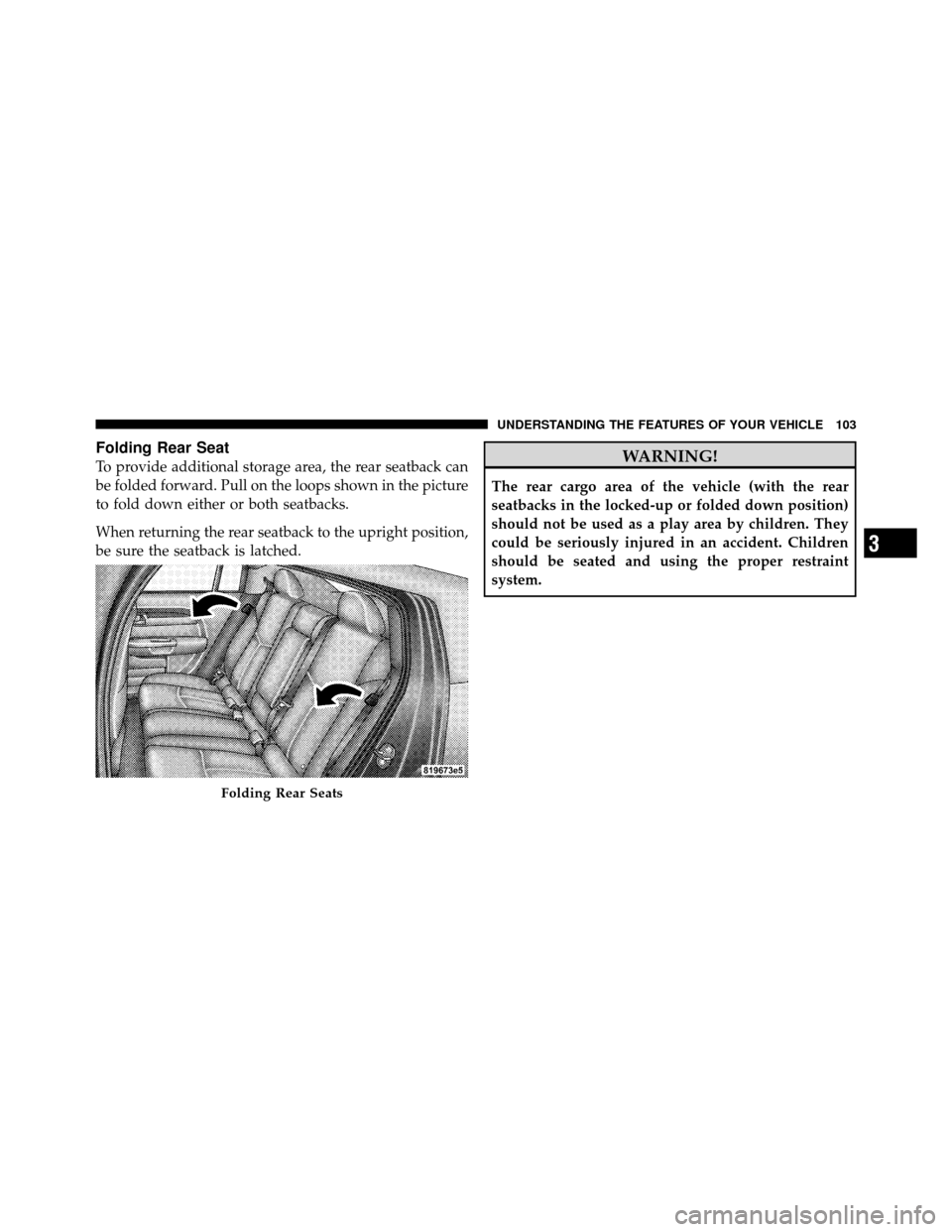
Folding Rear Seat
To provide additional storage area, the rear seatback can
be folded forward. Pull on the loops shown in the picture
to fold down either or both seatbacks.
When returning the rear seatback to the upright position,
be sure the seatback is latched.WARNING!
The rear cargo area of the vehicle (with the rear
seatbacks in the locked-up or folded down position)
should not be used as a play area by children. They
could be seriously injured in an accident. Children
should be seated and using the proper restraint
system.
Folding Rear Seats
3
UNDERSTANDING THE FEATURES OF YOUR VEHICLE 103
Page 135 of 436
When the seatback is folded to the upright position, make
sure it is latched by strongly pulling on the top of the
seatback above the seat strap.
WARNING!
•Be certain that the seatback is securely locked into
position. If the seatback in not securely locked
into position, the seat will not provide the proper
stability for child seats and/or passengers. An
improperly latched seat could cause serious injury.
•The cargo area in the rear of the vehicle (with the
rear seatbacks in the locked-up or folded down
position) should not be used as a play area by
children when the vehicle is in motion. They could
be seriously injured in an accident. Children
should be seated and using the proper restraint
system.(Continued)
WARNING! (Continued)
•To help protect against personal injury, passengers
should not be seated in the rear cargo area. The
rear cargo space is intended for load carrying
purposes only, not for passengers, who should sit
in seats and use seat belts.
•The weight and position of cargo and passengers
can change the vehicle center of gravity and ve-
hicle handling. To avoid loss of control resulting
in personal injury, follow these guidelines for
loading your vehicle:
Always place cargo evenly on the cargo floor. Put heavier
objects as low and as far forward as possible.
Place as much cargo as possible in front of the rear axle.
Too much weight or improperly placed weight over or
behind the rear axle can cause the rear of the vehicle to
sway.
3
UNDERSTANDING THE FEATURES OF YOUR VEHICLE 135
Page 235 of 436
STARTING PROCEDURES
Before starting your vehicle, adjust your seat, adjust the
inside and outside mirrors, fasten your seat belt, and if
present, instruct all other occupants to buckle their seat
belts.
WARNING!
•Never leave children alone in a vehicle. Leaving
children in a vehicle unattended is dangerous for a
number of reasons. A child or others could be
seriously or fatally injured. Do not leave the keys
in the ignition. A child could operate power win-
dows, other controls, or move the vehicle.
•Do not leave animals or children inside parked
vehicles in hot weather; interior heat build up may
cause serious injury or death.
Automatic Transaxle
The shift lever must be in the PARK or NEUTRAL
position before you can start the engine. Apply the brakes
before shifting to any driving gear.
NOTE:The ignition switch must be in the ON position,
and you must press the brake pedal before shifting out of
PARK.
Normal Starting
NOTE: Normal starting of either a cold or a warm
engine is obtained without pumping or pressing the
accelerator pedal.
For vehicles not equipped with Tip Start (Four-Speed
Transaxle), turn the ignition switch to the START posi-
tion and release it when the engine starts. If the engine
fails to start within 10 seconds, turn the ignition switch to
the LOCK position, wait 10 to 15 seconds, then repeat the
“Normal Starting” procedure.5
STARTING AND OPERATING 235
Page 240 of 436
WARNING! (Continued)
•Unintended movement of a vehicle could injure
those in and near the vehicle. As with all vehicles,
you should never exit a vehicle while the engine is
running. Before exiting a vehicle, you should
always shift the vehicle into PARK, remove the
key from the ignition, and apply the parking
brake. Once the key is removed from the ignition,
the shift lever is locked in the PARK position,
securing the vehicle against unwanted movement.
Furthermore, you should never leave children un-
attended inside a vehicle.
Key Ignition Park Interlock
This vehicle is equipped with a Key Ignition Park Inter-
lock which requires the shift lever to be placed in PARK
prior to rotating the key to the LOCK position. The keycan only be removed from the ignition when the ignition
is in the LOCK position and once removed the shift lever
is locked in PARK.
Brake/Transaxle Interlock System
This vehicle is equipped with a Brake Transmission Shift
Interlock System (BTSI) that holds the shift lever in the
PARK position when the ignition switch is in the LOCK
position. To move the shift lever out of the PARK
position, the ignition switch must be turned to any other
switch position (ACC, ON, or START) (engine running or
not) and the brake pedal must be pressed.
NOTE:
If a malfunction occurs, the transaxle will not
shift out of PARK. Battery power is required to release the
Brake/Transaxle Interlock system. However, an override
system allows you to shift out of PARK in case of loss of
power. To activate the override system:
•Firmly apply the parking brake.
240 STARTING AND OPERATING
Page 254 of 436
WARNING!
•Never leave children alone in a vehicle. Leaving
children in a vehicle unattended is dangerous for a
number of reasons. A child or others could be
seriously or fatally injured. Do not leave the key in
the ignition. A child could operate power win-
dows, other controls, or move the vehicle.
•Be sure the parking brake is fully disengaged
before driving: failure to do so can lead to brake
failure, and an accident.
ANTI-LOCK BRAKE SYSTEM (ABS)
The Anti-Lock Brake System (ABS) provides increased
vehicle stability and brake performance under most
braking conditions. The system operates with a separate
computer to modulate the hydraulic pressure to prevent
wheel lock-up and avoid skidding on slippery surfaces.
WARNING!
•Pumping of the anti-lock brakes will diminish
their effectiveness and may lead to an accident.
Pumping makes the stopping distance longer. Just
press firmly on your brake pedal when you need
to slow down or stop.
•The ABS cannot prevent the natural laws of phys-
ics from acting on the vehicle, nor can it increase
braking or steering efficiency beyond that af-
forded by the condition of the vehicle brakes and
tires or the traction afforded.
•The ABS cannot prevent accidents, including
those resulting from excessive speed in turns,
following another vehicle too closely, or hydro-
planing. Only a safe, attentive, and skillful driver
can prevent accidents.(Continued)
254 STARTING AND OPERATING