engine CHRYSLER TOWN AND COUNTRY 2008 5.G Repair Manual
[x] Cancel search | Manufacturer: CHRYSLER, Model Year: 2008, Model line: TOWN AND COUNTRY, Model: CHRYSLER TOWN AND COUNTRY 2008 5.GPages: 531, PDF Size: 4.51 MB
Page 364 of 531
Tire Pressures for High-Speed Operation
The manufacturer advocates driving at safe speeds
within posted speed limits. Where speed limits or condi-
tions are such that the vehicle can be driven at high
speeds, maintaining correct tire inflation pressure is very
important. Increased tire pressure and reduced vehicle
loading may be required for high-speed vehicle opera-
tion. Refer to original equipment information or an
authorized tire dealer for recommended safe operating
speeds, loading and cold tire inflation pressures.
WARNING!
High-speed driving with your vehicle at or above
maximum load is dangerous. The added strain on
your tires could cause them to fail. You could have a
serious accident. Don't drive a vehicle loaded to the
maximum capacity at continuous speeds above 75
mph (120 km/h).
Radial-Ply Tires
WARNING!
Combining radial ply tires with other types of tires
on your vehicle will cause your vehicle to handle
poorly. The instability could cause an accident. Al-
ways use radial ply tires in sets of four (or 6, in case
of trucks with dual rear wheels). NEVER combine
them with other types of tires.
Cuts and punctures in radial tires are repairable only in
the tread area because of sidewall flexing. Consult your
authorized tire dealer for radial tire repairs.
Compact Spare Tire Ð If Equipped
The compact spare is for temporary emergency use with
radial tires. It is engineered to be used on your style
362 STARTING AND OPERATING
Page 381 of 531
FUEL REQUIREMENTS
3.3L & 3.8L Gasoline Engine
All engines are designed to meet all emis-
sions regulations and provide excellent
fuel economy and performance when us-
ing high-quality unleaded ªregularº gaso-
line having an octane rating of 87. The use
of premium gasoline is not recommended.
Under normal conditions, the use of premium gasoline
will not provide a benefit over high-quality regular
gasolines, and in some circumstances may result in
poorer performance.
4.0L Gasoline Engine
The 4.0L engine is designed to meet all
emissions regulations and provide satisfac-
tory fuel economy and performance whenusing high-quality unleaded gasoline having an octane
range of 87 to 89. The manufacturer recommends the use
of 89 octane for optimum performance. The use of
premium gasoline is not recommended. Under normal
conditions, the use of premium gasoline will not provide
a benefit over high-quality regular and mid-grade gaso-
lines, and in some circumstances may result in poorer
performance.
Light spark knock at low engine speeds is not harmful to
your engine. However, continued heavy spark knock at
high speeds can cause damage and immediate service is
required.
Poor quality gasoline can cause problems such as hard
starting, stalling and hesitations. If you experience these
symptoms, try another brand of ªregularº gasoline be-
fore considering service for the vehicle.
STARTING AND OPERATING 379
5
Page 382 of 531
Over 40 automobile manufacturers around the world
have issued and endorsed consistent gasoline specifica-
tions (the World Wide Fuel Charter, WWFC) to define
fuel properties necessary to deliver enhanced emissions,
engine performance, and durability for your vehicle. The
manufacturer recommends the use of gasolines that meet
the WWFC specifications if they are available.
Reformulated Gasoline
Many areas of the country require the use of cleaner
burning gasoline referred to as ªReformulated Gasolineº.
Reformulated gasolines contain oxygenates, and are spe-
cifically blended to reduce vehicle emissions and im-
prove air quality.
The manufacturer supports the use of reformulated gaso-
lines. Properly blended reformulated gasolines will pro-
vide excellent performance and durability of engine and
fuel system components.
Gasoline/Oxygenate Blends
Some fuel suppliers blend unleaded gasoline with oxy-
genates such as 10% ethanol, MTBE, and ETBE. Oxygen-
ates are required in some areas of the country during the
winter months to reduce carbon monoxide emissions.
Fuels blended with these oxygenates may be used in
your vehicle.
CAUTION!
DO NOT use gasolines containing Methanol or E85
Ethanol. Use of these blends may result in starting
and driveability problems and may damage critical
fuel system components.
Problems that result from using methanol/gasoline or
E85 Ethanol blends are not the responsibility of the
380 STARTING AND OPERATING
Page 384 of 531
Fuel System Cautions
CAUTION!
Follow these guidelines to maintain your vehicle's
performance:
²The use of leaded gas is prohibited by Federal law.
Using leaded gasoline can impair engine performance
and damage the emission control system.
²An out-of-tune engine, or certain fuel or ignition
malfunctions, can cause the catalytic converter to
overheat. If you notice a pungent burning odor orsome light smoke, your engine may be out of tune or
malfunctioning and may require immediate service.
Contact your authorized dealer for service assistance.
²The use of fuel additives which are now being sold as
octane enhancers is not recommended. Most of these
products contain high concentrations of methanol.
Fuel system damage or vehicle performance problems
resulting from the use of such fuels or additives is not
the responsibility of the manufacturer.
NOTE:Intentional tampering with emissions control
systems can result in civil penalties being assessed
against you.
382 STARTING AND OPERATING
Page 385 of 531
Carbon Monoxide Warnings
WARNING!
Carbon monoxide (CO) in exhaust gases is deadly.
²To prevent carbon monoxide poisoning DO NOT inhale
exhaust gases. They contain carbon monoxide, a colorless and
odorless gas which can kill.
²NEVER run the engine in a closed area, such as a garage, and
NEVER sit in a parked vehicle with the engine running for an
extended period. If the vehicle is stopped in an open area with
the engine running for more than a short period, adjust the
ventilation system to force fresh, outside air into the vehicle.
²Guard against carbon monoxide with proper maintenance.
Have the exhaust system inspected every time the vehicle is
raised. Have any abnormal conditions repaired promptly.
Until repaired, drive with all side windows fully open.
²Keep the liftgate closed when driving your vehicle to prevent
carbon monoxide and other poisonous exhaust gases from
entering the vehicle.
ADDING FUEL
Fuel Filler Cap (Gas Cap)
As a reminder, a fuel icon with an arrow
indicating which side of the vehicle the fuel
filler door is located on, is located in the
instrument cluster, just below the Fuel Gage.
The gas cap is located behind the fuel filler door on the
left side of the vehicle. If the gas cap is lost or damaged,
be sure the replacement cap is for use with this vehicle.
NOTE:The driver's side sliding door cannot be opened
while the fuel door is open. This feature operates only
when the sliding door is fully closed prior to opening the
fuel door.
STARTING AND OPERATING 383
5
Page 386 of 531
CAUTION!
Damage to the fuel system or emission control sys-
tem could result from using an improper fuel tank
filler tube cap (gas cap). A poorly fitting cap could let
impurities into the fuel system and may cause the
Malfunction Indicator Light (MIL) to turn on due to
fuel vapors escaping from the system.
CAUTION!
To avoid fuel spillage and overfilling, do not ªtop
offº the fuel tank after filling.NOTE:When the fuel nozzle ªclicksº or shuts off, the
fuel tank is full.
WARNING!
²Never have any smoking materials lit in or near
the vehicle when the gas cap is removed or the
tank filled.
²Never add fuel when the engine is running. This is
in violation of most state and federal fire regula-
tions and will cause the malfunction indicator
light to turn on.
384 STARTING AND OPERATING
Page 388 of 531
FLEXIBLE FUEL Ð 3.3L ENGINES ONLY
E-85 General Information
The information in this section is for Flexible Fuel Ve-
hicles (FFV) only. These vehicles can be identified by the
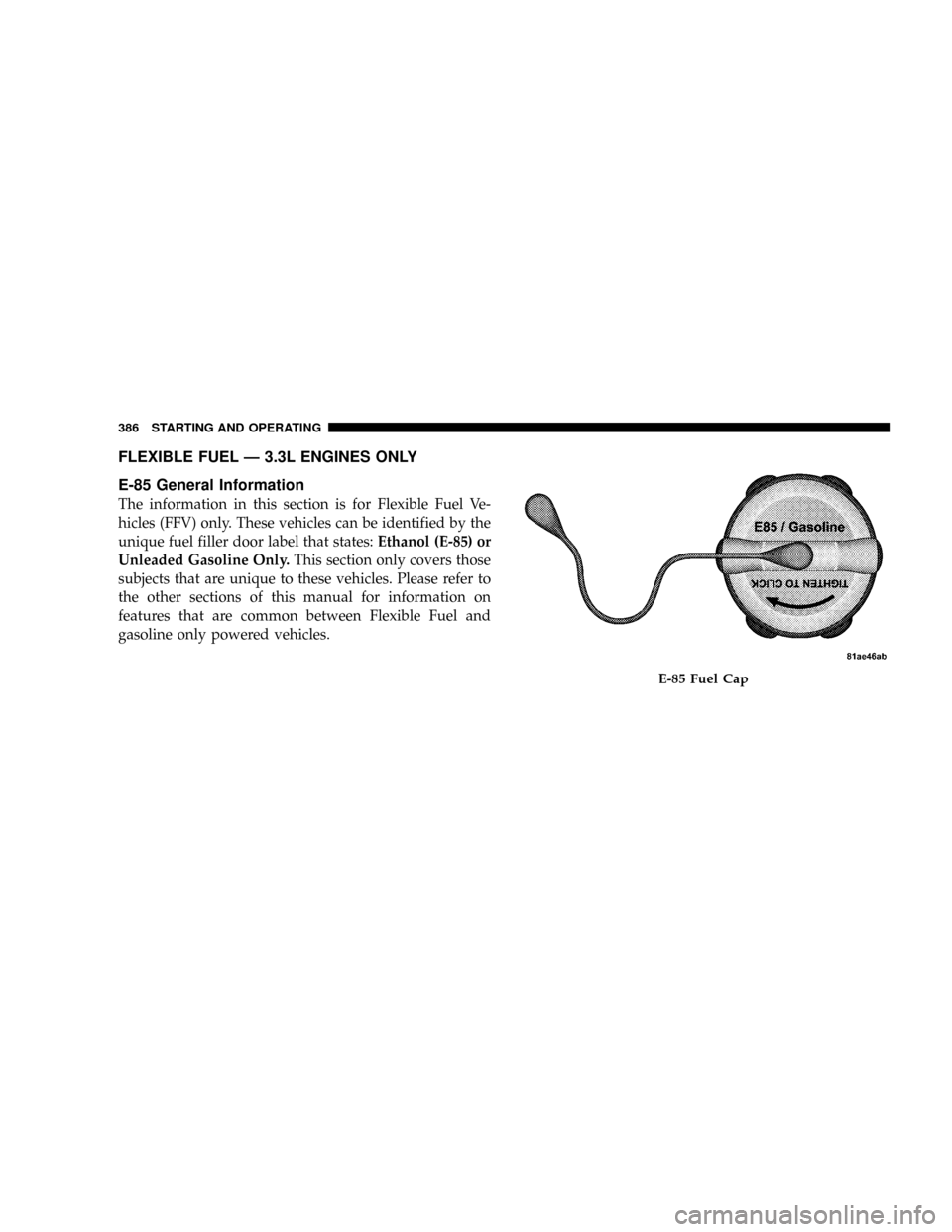
unique fuel filler door label that states:Ethanol (E-85) or
Unleaded Gasoline Only.This section only covers those
subjects that are unique to these vehicles. Please refer to
the other sections of this manual for information on
features that are common between Flexible Fuel and
gasoline only powered vehicles.
E-85 Fuel Cap
386 STARTING AND OPERATING
Page 390 of 531
For best results, a refueling pattern that alternates be-
tween E-85 and unleaded gasoline should be avoided.
When you do switch fuels, it is recommended that:
²you do not switch when the fuel gauge indicates less
than one-quarter full
²you do not add less than 5 gal (19 L) when refueling
²you operate the vehicle immediately after refueling for
a period of at least five minutes
Observing these precautions will avoid possible hard
starting and/or significant deterioration in driveability
during warm up.
NOTE:When the ambient temperature is above 90ÉF
(32ÉC), you may experience hard starting and rough idle
following start-up even if the above recommendations
are followed.
Selection Of Engine Oil For Flexible Fuel Vehicles
(FFV) E-85 and Gasoline Vehicles
FFV vehicles operated on E85 require specially formu-
lated engine oils. These special requirements are included
in Mopartengine oils, and in equivalent oils meeting
DaimlerChrysler Specification MS-6395. The manufac-
turer only recommends engine oils that are API Certified
and meet the requirements of Material Standard MS-
6395. MS-6395 contains additional requirements, devel-
oped during extensive fleet testing, to provide additional
protection to DaimlerChrysler Corporation engines. Use
Mopartor an equivalent oil meeting the specification
MS-6395.
Starting
The characteristics of E-85 fuel make it unsuitable for use
when ambient temperatures fall below 0ÉF (-18ÉC). In the
range of 0ÉF (-18ÉC) to 32ÉF (0ÉC), you may experience an
388 STARTING AND OPERATING
Page 391 of 531
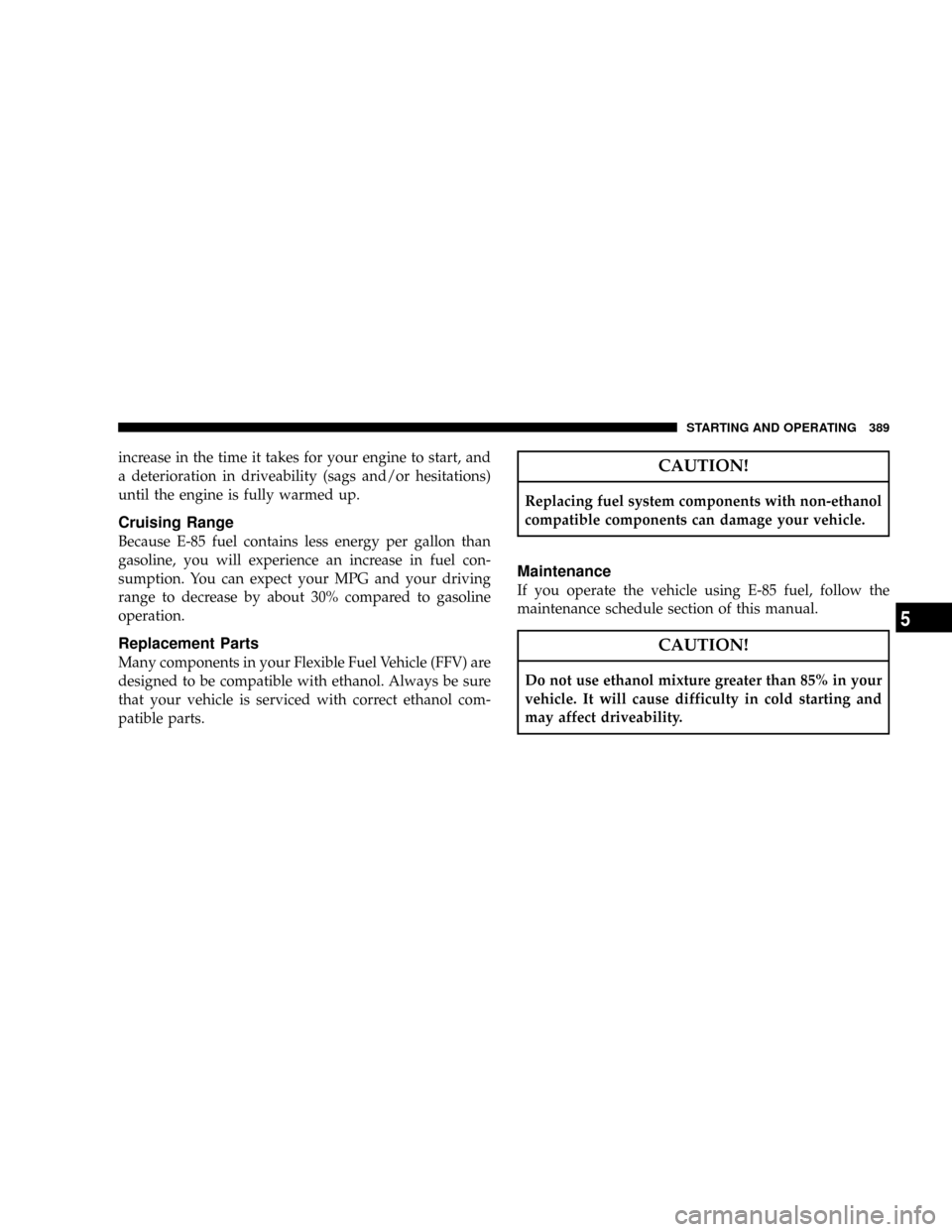
increase in the time it takes for your engine to start, and
a deterioration in driveability (sags and/or hesitations)
until the engine is fully warmed up.
Cruising Range
Because E-85 fuel contains less energy per gallon than
gasoline, you will experience an increase in fuel con-
sumption. You can expect your MPG and your driving
range to decrease by about 30% compared to gasoline
operation.
Replacement Parts
Many components in your Flexible Fuel Vehicle (FFV) are
designed to be compatible with ethanol. Always be sure
that your vehicle is serviced with correct ethanol com-
patible parts.
CAUTION!
Replacing fuel system components with non-ethanol
compatible components can damage your vehicle.
Maintenance
If you operate the vehicle using E-85 fuel, follow the
maintenance schedule section of this manual.
CAUTION!
Do not use ethanol mixture greater than 85% in your
vehicle. It will cause difficulty in cold starting and
may affect driveability.
STARTING AND OPERATING 389
5
Page 401 of 531
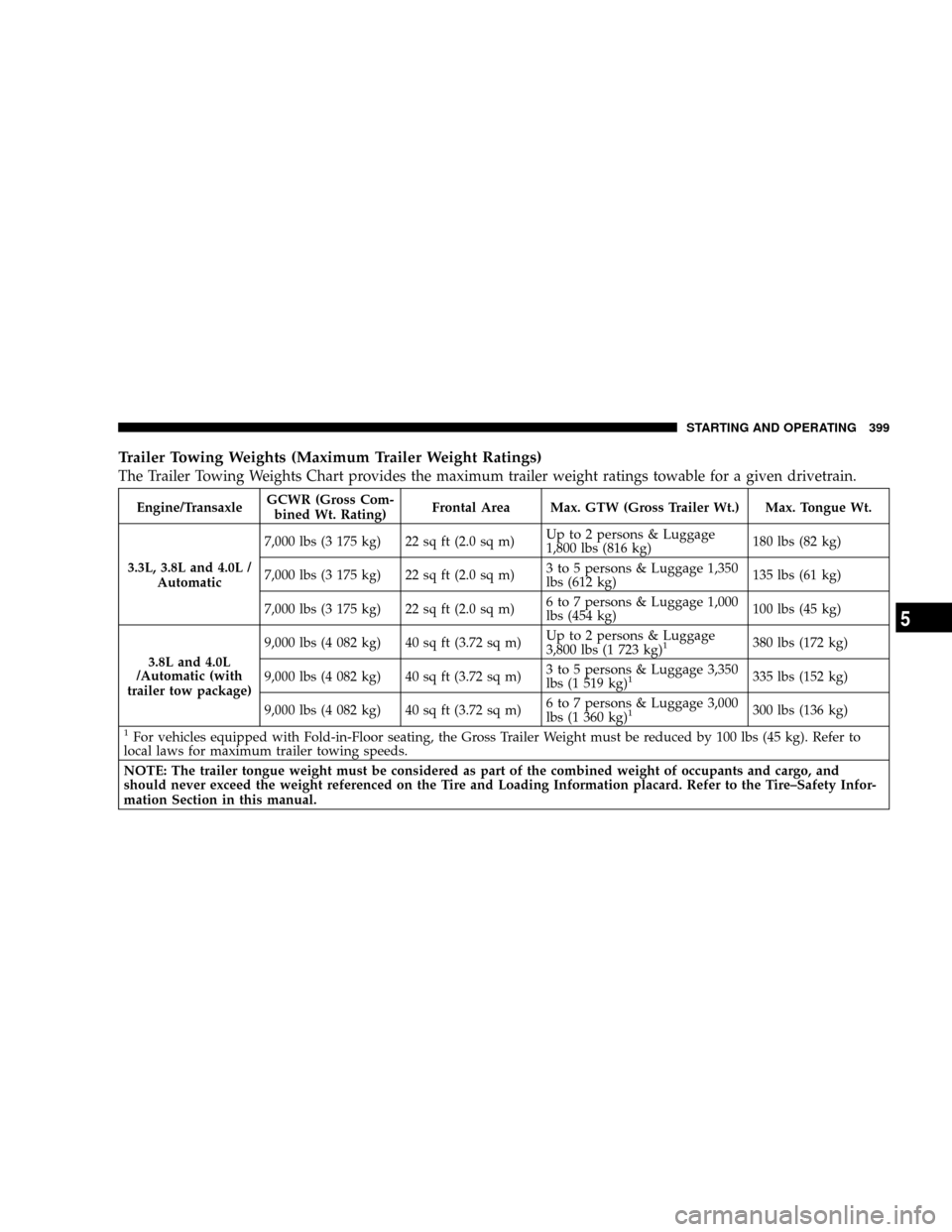
Trailer Towing Weights (Maximum Trailer Weight Ratings)
The Trailer Towing Weights Chart provides the maximum trailer weight ratings towable for a given drivetrain.
Engine/TransaxleGCWR (Gross Com-
bined Wt. Rating)Frontal Area Max. GTW (Gross Trailer Wt.) Max. Tongue Wt.
3.3L, 3.8L and 4.0L /
Automatic7,000 lbs (3 175 kg) 22 sq ft (2.0 sq m)Up to 2 persons & Luggage
1,800 lbs (816 kg)180 lbs (82 kg)
7,000 lbs (3 175 kg) 22 sq ft (2.0 sq m)3 to 5 persons & Luggage 1,350
lbs (612 kg)135 lbs (61 kg)
7,000 lbs (3 175 kg) 22 sq ft (2.0 sq m)6 to 7 persons & Luggage 1,000
lbs (454 kg)100 lbs (45 kg)
3.8L and 4.0L
/Automatic (with
trailer tow package)9,000 lbs (4 082 kg) 40 sq ft (3.72 sq m)Up to 2 persons & Luggage
3,800 lbs (1 723 kg)
1380 lbs (172 kg)
9,000 lbs (4 082 kg) 40 sq ft (3.72 sq m)3 to 5 persons & Luggage 3,350
lbs (1 519 kg)
1335 lbs (152 kg)
9,000 lbs (4 082 kg) 40 sq ft (3.72 sq m)6 to 7 persons & Luggage 3,000
lbs (1 360 kg)
1300 lbs (136 kg)
1For vehicles equipped with Fold-in-Floor seating, the Gross Trailer Weight must be reduced by 100 lbs (45 kg). Refer to
local laws for maximum trailer towing speeds.
NOTE: The trailer tongue weight must be considered as part of the combined weight of occupants and cargo, and
should never exceed the weight referenced on the Tire and Loading Information placard. Refer to the Tire±Safety Infor-
mation Section in this manual.
STARTING AND OPERATING 399
5