ECU CHRYSLER TOWN AND COUNTRY 2014 5.G Owner's Manual
[x] Cancel search | Manufacturer: CHRYSLER, Model Year: 2014, Model line: TOWN AND COUNTRY, Model: CHRYSLER TOWN AND COUNTRY 2014 5.GPages: 148, PDF Size: 4.26 MB
Page 89 of 148
Programming A Non-Rolling Code
NOTE:
For programming Garage Door Openers manufactured before 1995.
1. Turn the ignition switch to the ON/RUN position.
2. Place the hand-held transmitter 1 to 3 inches (3 to 8 cm) away from the HomeLink® button youwish to program while keeping the HomeLink® indicator light in view.
3. Simultaneously press and hold both the HomeLink® button you want to program and the hand-held transmitter button.
4. Continue to hold both buttons and observe the indicator light. The HomeLink® indicator will flash slowly and then rapidly after HomeLink® has received the frequency signal from the
hand-held transmitter. Release both buttons after the indicator light changes from slow to
rapid.
5. Press and hold the programmed HomeLink® button and observe the indicator light. If the indicator light stays on constantly, programming is complete and the garage door (or device)
should activate when the HomeLink® button is pressed.
6. To program the two remaining HomeLink® buttons, repeat each step for each remaining button. DO NOT erase the channels.
Using HomeLink®
• To operate, press and release the programmed HomeLink® button. Activation will now occurfor the programmed device (e.g., garage door opener, gate operator, security system, entry
door lock, home/office lighting, etc.,). The hand-held transmitter of the device may also be
used at any time.
WARNING!
• Your motorized door or gate will open and close while you are programming the universal
transceiver. Do not program the transceiver if people or pets are in the path of the door or
gate.
• Do not run your vehicle in a closed garage or confined area while programming the
transceiver. Exhaust gas from your vehicle contains Carbon Monoxide (CO) which is
odorless and colorless. Carbon Monoxide is poisonous when inhaled and can cause you
and others to be severely injured or killed.
ELECTRONICS
87
Page 93 of 148

TRAILER TOWING WEIGHTS
(MAXIMUM TRAILER WEIGHT RATINGS)
Engine/
TransmissionGCWR
(Gross Combined Wt. Rating)FrontalArea Max. GTW
(Gross Trailer Wt.) Max.
Tongue Wt.
3.6L/
Automatic 8,750 lbs
(3,969 kg) 40 sq ft
(3.72 sq m)
Up to 2 persons & Lug-
gage 3,600 lbs (1,633 kg) *360 lbs
(163 kg)
8,750 lbs
(3,969 kg) 40 sq ft
(3.72 sq m) 3 to 5 persons & Luggage
3,350 lbs (1,519 kg) * 335 lbs
(152 kg)
8,750 lbs
(3,969 kg) 40 sq ft
(3.72 sq m) 6 to 7 persons & Luggage
3,000 lbs (1,360 kg) * 300 lbs
(136 kg)
* For vehicles equipped with Fold-in-Floor seating, the Gross Trailer Weight must be reduced by 100 lbs (45 kg). Refer to local laws for maximum trailer towing speeds.
NOTE: The trailer tongue weight must be considered as part of the combined weight of occupants and cargo, and should never exceed the weight referenced on the Tire and Loading Information placard.
RECREATIONAL TOWING
(BEHIND MOTORHOME, ETC.)
Towing Condition Wheels OFF the Ground All Models
Flat Tow NONE
NOT ALLOWED
Dolly Tow Front
OK
Rear NOT ALLOWED
On Trailer ALLOK
Recreational Towing — All Models
• Recreational towing is allowed ONLY if the front wheels are OFF the ground. This may be
accomplished using a tow dolly or vehicle trailer. If using a tow dolly, follow this procedure:
1.
Properly secure the dolly to the tow vehicle, following the dolly manufacturer's instructions.
2. Drive the front wheels onto the tow dolly.
3. Firmly apply the parking brake. Place the transmission in PARK.
4.
Properly secure the front wheels to the dolly, following the dolly manufacturer's instructions.
5. Release the parking brake.
CAUTION!
• DO NOT flat tow this vehicle. Damage to the drivetrain will result.
• Towing this vehicle in violation of the above requirements can cause severe transmission damage. Damage from improper towing is not covered under the New Vehicle Limited
Warranty.
UTILITY
91
Page 109 of 148
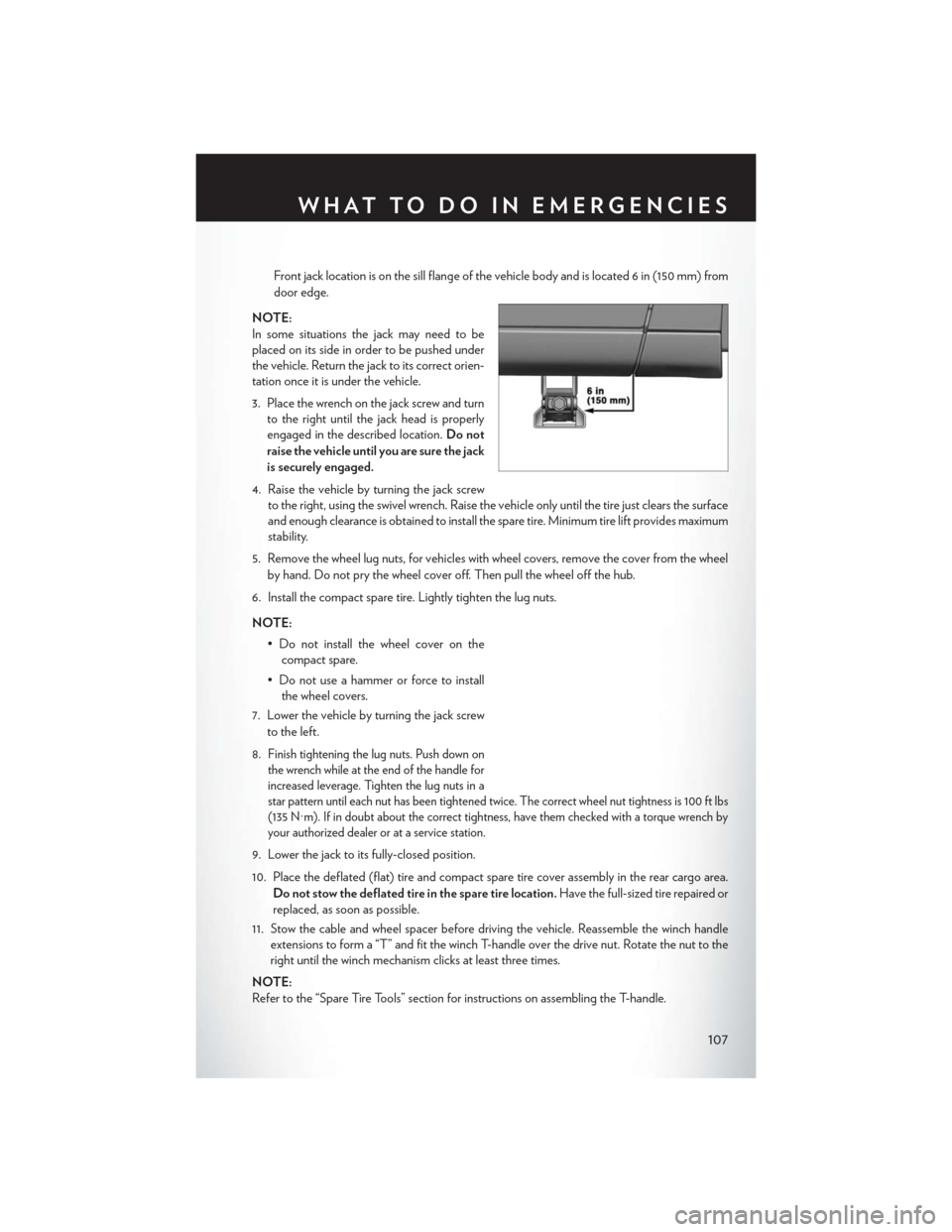
Front jack location is on the sill flange of the vehicle body and is located 6 in (150 mm) from
door edge.
NOTE:
In some situations the jack may need to be
placed on its side in order to be pushed under
the vehicle. Return the jack to its correct orien-
tation once it is under the vehicle.
3. Place the wrench on the jack screw and turn to the right until the jack head is properly
engaged in the described location. Do not
raise the vehicle until you are sure the jack
is securely engaged.
4. Raise the vehicle by turning the jack screw to the right, using the swivel wrench. Raise the vehicle only until the tire just clears the surface
and enough clearance is obtained to install the spare tire. Minimum tire lift provides maximum
stability.
5. Remove the wheel lug nuts, for vehicles with wheel covers, remove the cover from the wheel by hand. Do not pry the wheel cover off. Then pull the wheel off the hub.
6. Install the compact spare tire. Lightly tighten the lug nuts.
NOTE: • Do not install the wheel cover on thecompact spare.
• Do not use a hammer or force to install the wheel covers.
7. Lower the vehicle by turning the jack screw to the left.
8.
Finish tightening the lug nuts. Push down on
the wrench while at the end of the handle for
increased leverage. Tighten the lug nuts in a
star pattern until each nut has been tightened twice. The correct wheel nut tightness is 100 ft lbs
(135 N·m). If in doubt about the correct tightness, have them checked with a torque wrench by
your authorized dealer or at a service station.
9. Lower the jack to its fully-closed position.
10. Place the deflated (flat) tire and compact spare tire cover assembly in the rear cargo area.
Do not stow the deflated tire in the spare tire location. Have the full-sized tire repaired or
replaced, as soon as possible.
11. Stow the cable and wheel spacer before driving the vehicle. Reassemble the winch handle extensions to form a “T” and fit the winch T-handle over the drive nut. Rotate the nut to the
right until the winch mechanism clicks at least three times.
NOTE:
Refer to the “Spare Tire Tools” section for instructions on assembling the T-handle.
WHAT TO DO IN EMERGENCIES
107
Page 110 of 148
12. Stow the jack, jack handle and winch handle tools back in the stowage compartment.
13. Check the compact spare tire pressure as soon as possible. Correct the tire pressure, asrequired.
Securing The Spare Tire
1. Assemble the winch handle extensions to form a T-handle and fit the winch T-handle over thedrive nut. Rotate the nut to the left until the winch mechanism stops turning freely. This will
allow enough slack in the cable to allow you to pull the wheel spacer out from under the vehicle.
2. Assemble the winch handle extensions to form the spare tire hook, and pull the wheel spacer from under the vehicle.
3. Turn the compact spare tire so that the valve stem is down, and place the tire into the spare tire/cover assembly. Slide the wheel spacer through the center of the wheel and spare
tire/cover assembly, so that the two retainer tabs snap out and engage the spare tire cover on
the opposite side.
4. Using the winch T-handle, rotate the drive nut to the right until the compact spare tire/cover assembly is drawn into place against the underside of the vehicle.
5. Continue to rotate the nut to the right until you hear the winch mechanism click three times. It cannot be overtightened. Check under the vehicle to ensure the compact spare tire/cover
assembly is positioned correctly against the underside of the vehicle.
Road Tire Installation
Vehicles Equipped With Wheel Covers
1. Mount the road tire on the axle.
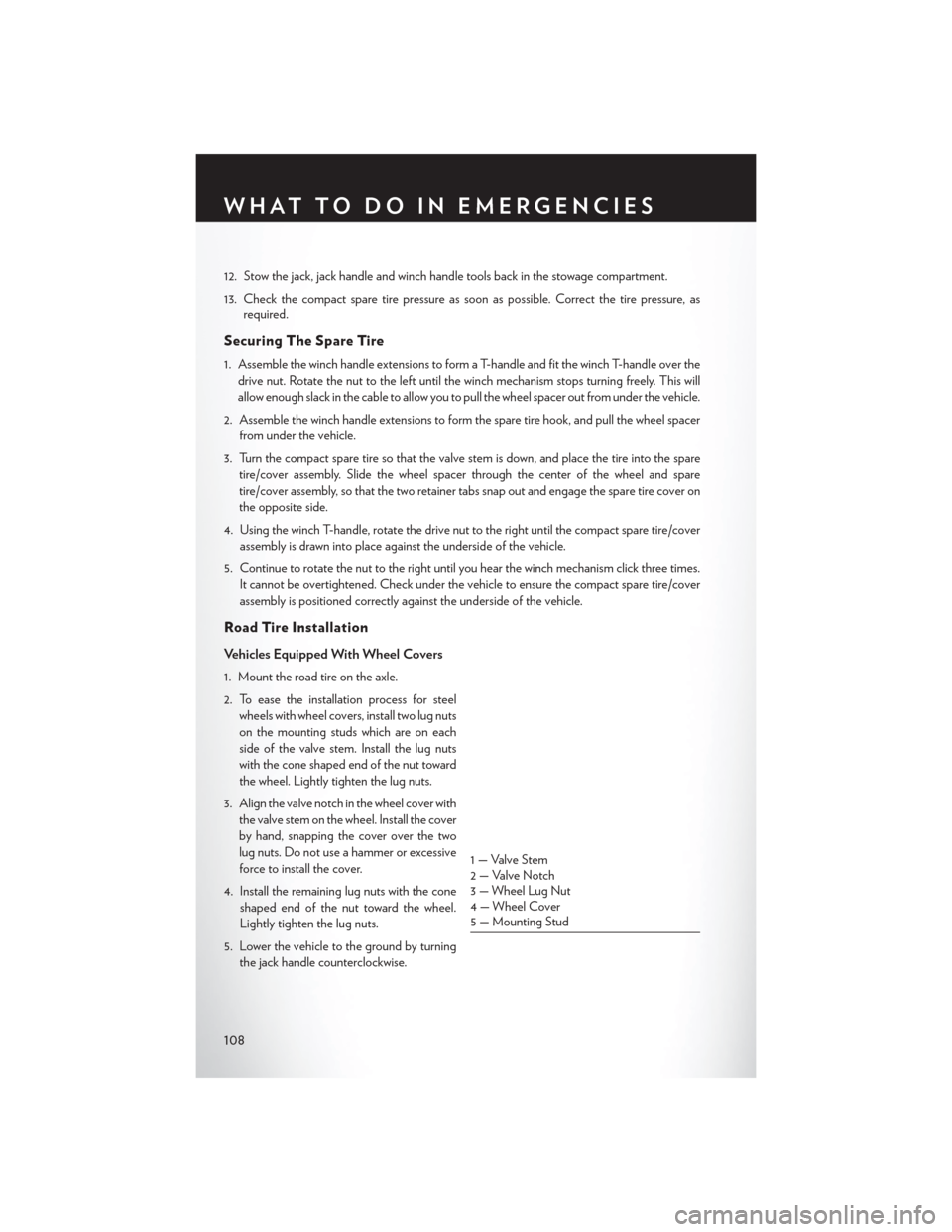
2. To ease the installation process for steelwheels with wheel covers, install two lug nuts
on the mounting studs which are on each
side of the valve stem. Install the lug nuts
with the cone shaped end of the nut toward
the wheel. Lightly tighten the lug nuts.
3. Align the valve notch in the wheel cover with the valve stem on the wheel. Install the cover
by hand, snapping the cover over the two
lug nuts. Do not use a hammer or excessive
force to install the cover.
4. Install the remaining lug nuts with the cone shaped end of the nut toward the wheel.
Lightly tighten the lug nuts.
5. Lower the vehicle to the ground by turning the jack handle counterclockwise.
1 — Valve Stem
2 — Valve Notch
3 — Wheel Lug Nut
4 — Wheel Cover
5 — Mounting Stud
WHAT TO DO IN EMERGENCIES
108
Page 112 of 148
WARNING!
• Do not attempt to change a tire on the side of the vehicle close to moving traffic. Pull farenough off the road to avoid the danger of being hit when operating the jack or changing
the wheel.
• Being under a jacked-up vehicle is dangerous. The vehicle could slip off the jack and fall on
you. You could be crushed. Never put any part of your body under a vehicle that is on a
jack. If you need to get under a raised vehicle, take it to a service center where it can be
raised on a lift.
• Never start or run the engine while the vehicle is on a jack.
• The jack is designed to be used as a tool for changing tires only. The jack should not be
used to lift the vehicle for service purposes. The vehicle should be jacked on a firm level
surface only. Avoid ice or slippery areas.
• Carefully follow these tire changing warnings to help prevent personal injury or damage to
your vehicle:
• Always park on a firm, level surface as far from the edge of the roadway as possible before
raising the vehicle.
• Turn on the Hazard Warning flasher.
• Block the wheel diagonally opposite the wheel to be raised.
• Set the parking brake firmly and set an automatic transmission in PARK; a manual
transmission in REVERSE.
• Do not let anyone sit in the vehicle when it is on a jack.
• Do not get under the vehicle when it is on a jack.
• Only use the jack in the positions indicated and for lifting this vehicle during a tire change.
• If working on or near a roadway, be extremely careful of motor traffic.
• To assure that spare tires, flat or inflated, are securely stowed, spares must be stowed with
the valve stem facing the ground.
• Raising the vehicle higher than necessary can make the vehicle less stable. It could slip off
the jack and hurt someone near it. Raise the vehicle only enough to remove the tire.
• To avoid the risk of forcing the vehicle off the jack, do not tighten the wheel nuts fully until
the vehicle has been lowered. Failure to follow this warning may result in personal injury.
• A loose tire or jack thrown forward in a collision or hard stop could endanger the occupants
of the vehicle. Always stow the jack parts and the spare tire in the places provided. Have
the deflated (flat) tire repaired or replaced immediately.
• Verify that both retainer tabs of the wheel spacer have been properly extended through
the center of the wheel and spare tire/cover assembly. Failure to properly engage both
retainer tabs could result in loss of the spare tire and cover assembly, which will cause
vehicle damage and may cause loss of vehicle control.
WHAT TO DO IN EMERGENCIES
110
Page 133 of 148

NOTE:
• A street address is required when ordering manuals (no P.O. Boxes).
• The Owner's Manual and User Guide electronic files are also available on the Chrysler, Jeep,Ram Truck, Dodge and SRT websites.
• Click on the “For Owners” tab, select “Owner/Service Manuals”, then select your desired model year and vehicle from the drop down lists.
REPORTING SAFETY DEFECTS IN THE
UNITED STATES
If you believe that your vehicle has a defect that could cause a collision or cause injury or death,
you should immediately inform the National Highway Traffic Safety Administration (NHTSA) in
addition to notifying the manufacturer.
If NHTSA receives similar complaints, it may open an investigation, and if it finds that a safety
defect exists in a group of vehicles, it may order a recall and remedy campaign. However, NHTSA
cannot become involved in individual problems between you, your authorized dealer and the
manufacturer.
To contact NHTSA, you may either call the Auto Safety Hotline toll free at 1–888–327–4236
(TTY: 1–800–424–9153), or go to http://www.safercar.gov; or write to: Administrator, NHTSA,
1200 New Jersey Avenue, SE., West Building, Washington, D.C. 20590. You can also obtain
other information about motor vehicle safety from http://www.safercar.gov.
In Canada
If you believe that your vehicle has a safety defect, you should contact the Customer Service
Department immediately. Canadian customers who wish to report a safety defect to the Canadian
government should contact Transport Canada, Motor Vehicle Defect Investigations and Recalls at
1-800-333-0510 or go to http://www.tc.gc.ca/eng/roadsafety/safedrivers-childsafety-index-53.htm
French Canadian customers who wish to report a safety defect to the Canadian government should
contact Transport Canada, Motor Vehicle Defect Investigations and Recalls at 1-800-333-0510 or go
to http://www.tc.gc.ca/securiteroutiere/
CONSUMER ASSISTANCE
131
Page 137 of 148
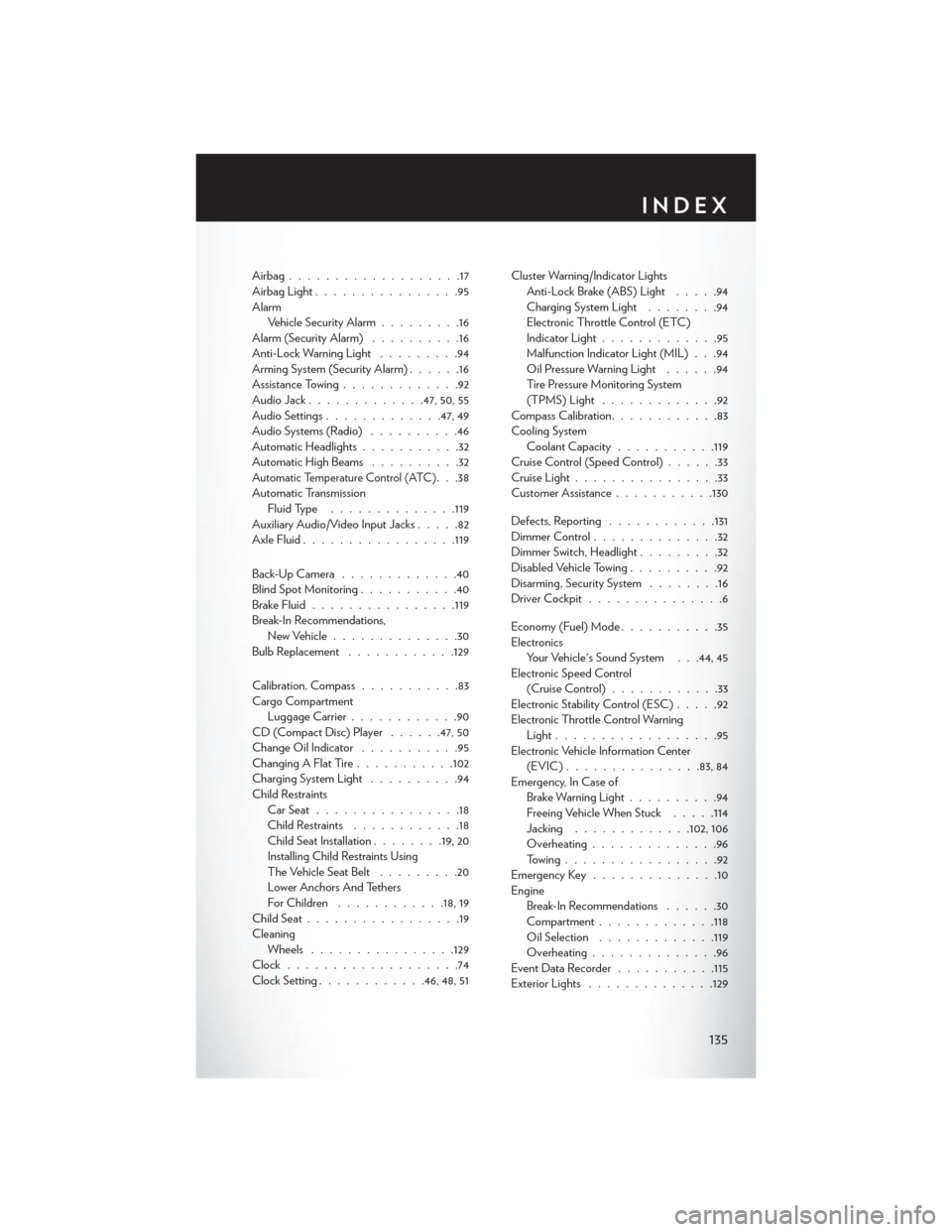
Airbag...................17
Airbag Light................95
Alarm Vehicle Security Alarm .........16
Alarm (Security Alarm) ..........16
Anti-Lock Warning Light .........94
Arming System (Security Alarm) ......16
Assistance Towing .............92
AudioJack.............47, 50, 55
Audio Settings .............47, 49
Audio Systems (Radio) ..........46
Automatic Headlights ...........32
Automatic High Beams ..........32
Automatic Temperature Control (ATC). . .38
Automatic Transmission Fluid Type ............. .119
Auxiliary Audio/Video Input Jacks .....82
Axle Fluid ................ .119
Back-UpCamera .............40
Blind Spot Monitoring ...........40
Brake Fluid ............... .119
Break-In Recommendations, New Vehicle ..............30
Bulb Replacement ............129
Calibration, Compass ...........83
Cargo Compartment Luggage Carrier ............90
CD (Compact Disc) Player ......47, 50
Change Oil Indicator ...........95
ChangingAFlatTire...........102
Charging System Light ..........94
Child Restraints CarSeat................18
Child Restraints ............18
Child Seat Installation ........19, 20
Installing Child Restraints Using
The Vehicle Seat Belt .........20
Lower Anchors And Tethers
For Children ............18, 19
ChildSeat.................19
Cleaning Wheels ............... .129
Clock ...................74
Clock Setting ............46, 48, 51 Cluster Warning/Indicator Lights
Anti-Lock Brake (ABS) Light .....94
Charging System Light ........94
Electronic Throttle Control (ETC)
Indicator Light .............95
Malfunction Indicator Light (MIL) . . .94
Oil Pressure Warning Light ......94
Tire Pressure Monitoring System
(TPMS) Light .............92
Compass Calibration ............83
Cooling System Coolant Capacity ...........119
Cruise Control (Speed Control) ......33
Cruise Light ................33
Customer Assistance ...........130
Defects, Reporting ............131
Dimmer Control ..............32
Dimmer Switch, Headlight .........32
Disabled Vehicle Towing ..........92
Disarming, Security System ........16
Driver Cockpit ...............6
Economy (Fuel) Mode ...........35
Electronics Your Vehicle's Sound System . . .44, 45
Electronic Speed Control (Cruise Control) ............33
Electronic Stability Control (ESC) .....92
Electronic Throttle Control Warning Light ..................
95
Electronic Vehicle Information Center (EVIC)...............83, 84
Emergency, In Case of Brake Warning Light ..........94
Freeing Vehicle When Stuck .....114
Jacking .............102,106
Overheating ..............96
Towing.................92
Emergency Key ..............10
Engine Break-In Recommendations ......30
Compartment ............ .118
Oil Selection .............119
Overheating ..............96
EventDataRecorder.......... .115
Exterior Lights ............. .129
INDEX
135
Page 139 of 148
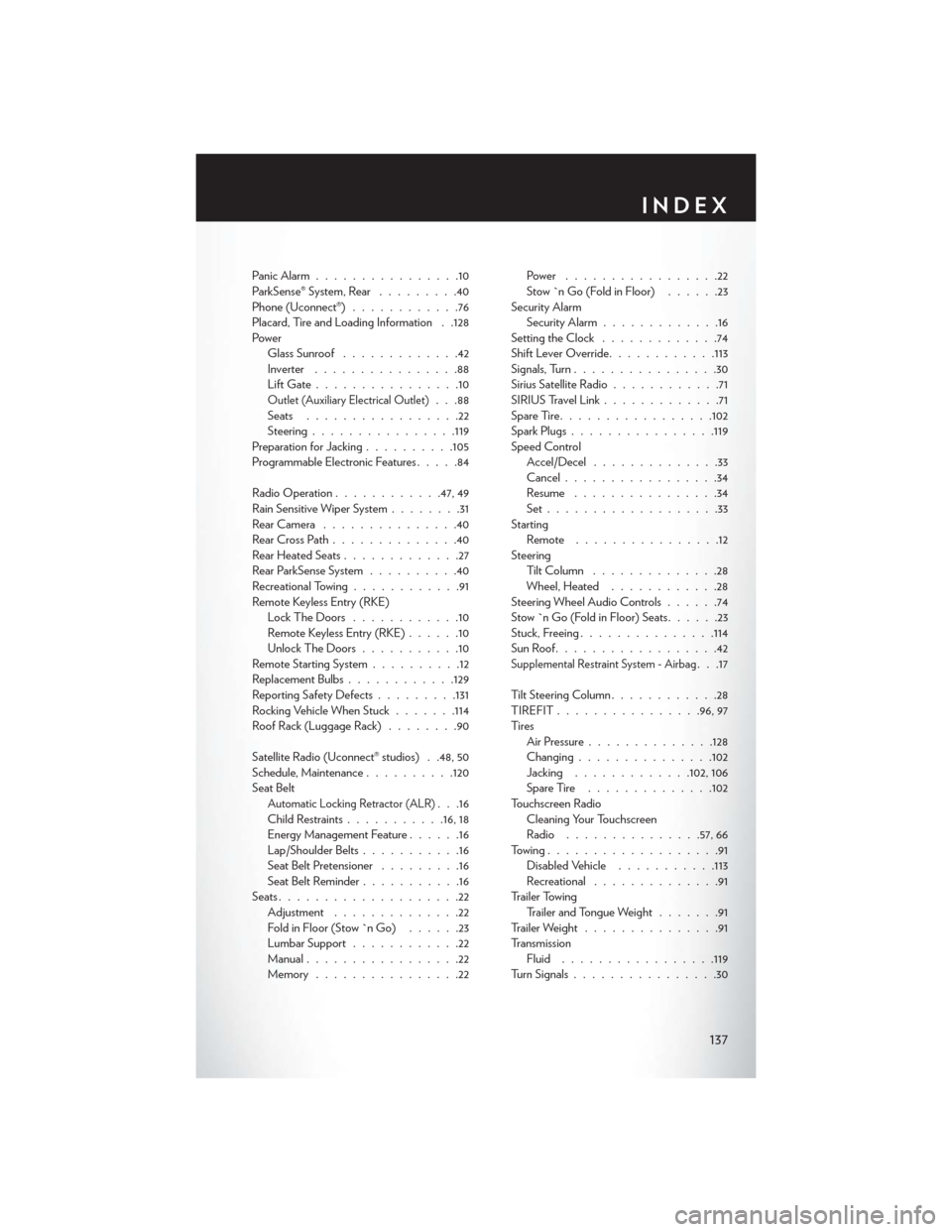
Panic Alarm................10
ParkSense® System, Rear .........40
Phone (Uconnect®) ............76
Placard, Tire and Loading Information . .128
Power Glass Sunroof .............42
Inverter ................88
LiftGate................10
Outlet (Auxiliary Electrical Outlet). . .88
Seats .................22
Steering ............... .119
Preparation for Jacking ..........105
Programmable Electronic Features .....84
Radio Operation ............47, 49
Rain Sensitive Wiper System ........31
RearCamera ...............40
RearCrossPath..............40
Rear Heated Seats .............27
Rear ParkSense System ..........40
Recreational Towing ............91
Remote Keyless Entry (RKE) Lock The Doors ............10
Remote Keyless Entry (RKE) ......10
Unlock The Doors ...........10
Remote Starting System ..........12
Replacement Bulbs ............129
Reporting Safety Defects .........131
Rocking Vehicle When Stuck .......114
Roof Rack (Luggage Rack) ........90
Satellite Radio (Uconnect® studios) . .48, 50
Schedule, Maintenance ..........120
Seat Belt
Automatic Locking Retractor (ALR). . .16
Child Restraints ...........16, 18
Energy Management Feature ......16
Lap/Shoulder Belts ...........16
Seat Belt Pretensioner .........16
SeatBeltReminder...........16
Seats ....................22
Adjustment ..............22
Fold in Floor (Stow `n Go) ......23
LumbarSupport ............22
Manual .................22
Memory ................22 Power .................22
Stow `n Go (Fold in Floor)
......23
Security Alarm Security Alarm .............16
Setting the Clock .............74
Shift Lever Override ............113
Signals, Turn ................30
Sirius Satellite Radio ............71
SIRIUSTravelLink.............71
SpareTire.................102
Spark Plugs ............... .119
Speed Control Accel/Decel ..............33
Cancel .................34
Resume ................34
Set...................33
Starting Remote ................12
Steering TiltColumn ..............28
Wheel, Heated ............28
Steering Wheel Audio Controls ......74
Stow `n Go (Fold in Floor) Seats ......23
Stuck, Freeing .............. .114
SunRoof..................42
Supplemental Restraint System - Airbag. . .17
Tilt Steering Column ............28
TIREFIT ............... .96, 97
Ti re s Air Pressure ............. .128
Changing .............. .102
Jacking .............102,106
SpareTire ..............102
Touchscreen Radio Cleaning Your Touchscreen
Radio .............. .57, 66
Towing...................91 Disabled Vehicle ...........113
Recreational ..............91
Trailer Towing Trailer and Tongue Weight .......91
Trailer Weight ...............91
Transmission Fluid ................ .119
Turn Signals ................30
INDEX
137