oil temperature CHRYSLER VOYAGER 2001 Service Manual
[x] Cancel search | Manufacturer: CHRYSLER, Model Year: 2001, Model line: VOYAGER, Model: CHRYSLER VOYAGER 2001Pages: 4284, PDF Size: 83.53 MB
Page 4109 of 4284
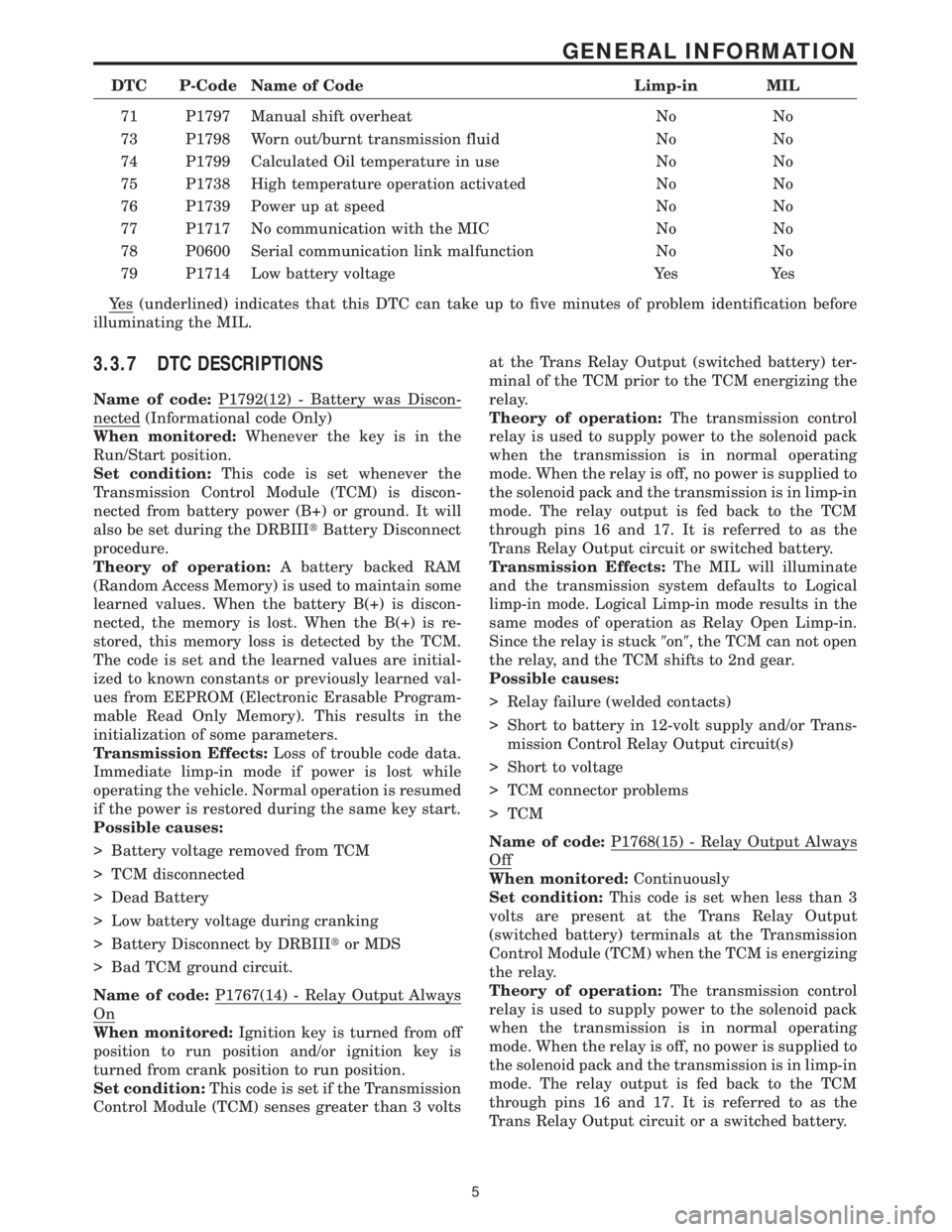
DTC P-Code Name of Code Limp-in MIL
71 P1797 Manual shift overheat No No
73 P1798 Worn out/burnt transmission fluid No No
74 P1799 Calculated Oil temperature in use No No
75 P1738 High temperature operation activated No No
76 P1739 Power up at speed No No
77 P1717 No communication with the MIC No No
78 P0600 Serial communication link malfunction No No
79 P1714 Low battery voltage Yes Yes
Yes (underlined) indicates that this DTC can take up to five minutes of problem identification before
illuminating the MIL.
3.3.7 DTC DESCRIPTIONS
Name of code:P1792(12) - Battery was Discon-
nected (Informational code Only)
When monitored:Whenever the key is in the
Run/Start position.
Set condition:This code is set whenever the
Transmission Control Module (TCM) is discon-
nected from battery power (B+) or ground. It will
also be set during the DRBIIItBattery Disconnect
procedure.
Theory of operation:A battery backed RAM
(Random Access Memory) is used to maintain some
learned values. When the battery B(+) is discon-
nected, the memory is lost. When the B(+) is re-
stored, this memory loss is detected by the TCM.
The code is set and the learned values are initial-
ized to known constants or previously learned val-
ues from EEPROM (Electronic Erasable Program-
mable Read Only Memory). This results in the
initialization of some parameters.
Transmission Effects:Loss of trouble code data.
Immediate limp-in mode if power is lost while
operating the vehicle. Normal operation is resumed
if the power is restored during the same key start.
Possible causes:
> Battery voltage removed from TCM
> TCM disconnected
> Dead Battery
> Low battery voltage during cranking
> Battery Disconnect by DRBIIItor MDS
> Bad TCM ground circuit.
Name of code:P1767(14) - Relay Output Always
On
When monitored:Ignition key is turned from off
position to run position and/or ignition key is
turned from crank position to run position.
Set condition:This code is set if the Transmission
Control Module (TCM) senses greater than 3 voltsat the Trans Relay Output (switched battery) ter-
minal of the TCM prior to the TCM energizing the
relay.
Theory of operation:The transmission control
relay is used to supply power to the solenoid pack
when the transmission is in normal operating
mode. When the relay is off, no power is supplied to
the solenoid pack and the transmission is in limp-in
mode. The relay output is fed back to the TCM
through pins 16 and 17. It is referred to as the
Trans Relay Output circuit or switched battery.
Transmission Effects:The MIL will illuminate
and the transmission system defaults to Logical
limp-in mode. Logical Limp-in mode results in the
same modes of operation as Relay Open Limp-in.
Since the relay is stuck9on9, the TCM can not open
the relay, and the TCM shifts to 2nd gear.
Possible causes:
> Relay failure (welded contacts)
> Short to battery in 12-volt supply and/or Trans-
mission Control Relay Output circuit(s)
> Short to voltage
> TCM connector problems
> TCM
Name of code:P1768(15) - Relay Output Always
Off
When monitored:Continuously
Set condition:This code is set when less than 3
volts are present at the Trans Relay Output
(switched battery) terminals at the Transmission
Control Module (TCM) when the TCM is energizing
the relay.
Theory of operation:The transmission control
relay is used to supply power to the solenoid pack
when the transmission is in normal operating
mode. When the relay is off, no power is supplied to
the solenoid pack and the transmission is in limp-in
mode. The relay output is fed back to the TCM
through pins 16 and 17. It is referred to as the
Trans Relay Output circuit or a switched battery.
5
GENERAL INFORMATION
Page 4119 of 4284

then notice harsh bumps when the A/C clutch is
being cycled, but vehicle shudder will be elimi-
nated. After 35 OBDII (EURO STAGE III OBD)
warm-up starts or if the code is cleared, PEMCC
will be reactivated to see if shudder is still present.
If one shudder event occurs, the code will be reset.
Clearing the code and running battery disconnect
with the DRBIIItis the only way to reset the
shudder counter from 20 back to zero.
Transmission Effects:This code does not cause
the transmission to go into limp-in mode. However,
once the code is set, FEMCC to PEMCC operation
before the A/C clutch engagement will be disabled
for 35 OBDII (EURO STAGE III OBD) warm up
starts.
Possible causes:
> Degraded transmission fluid
> Wheels severely out of alignment
> Internal torque converter problem
Name of Code:P1799(74) - Calculated Oil Temper-
ature in Use
When Monitored:When ever the Engine is run-
ning.
Set condition:The code is set if any of the follow-
ing conditions exist for three consecutive key starts:
> The Temperature Sensor voltage is out of range
(below 0.07 volts or greater than 4.94 volts)
> If continuous erratic Temperature Sensor voltage
is sensed.
> The Temperature Sensor temperature stays be-
low 27C (80ÉF) for an extended period of time.
Theory of Operation:The TCM uses a Tempera-
ture Sensor to monitor the transmission sump tem-
perature. This temperature is used to determine
which shift schedule the TCM is to use. (See Trans-
mission Operation and Shift Scheduling at Various
Sump Temperatures in this diagnostic manual) If
the Temperature Sensor circuit fails to operate
properly the TCM will use the calculated oil tem-
perature routine found in prior model year TCM. If
this occurs for three consecutive key starts, the code
will be set. The TCM will then test the Temperature
Sensor circuit after every 35 OBDII (EURO STAGE
III OBD) warm-up starts. If the Temperature Sen-
sor circuit is OK, the Temperature Sensor data is
used in place of the Calculated Oil Temperature
data.
Transmission Effects:If the Temperature Sensor
indicates a temperature below -18C (0É F) or above
115C (240É F) at start up, The TCM compares the
calculated oil temperature to the indicated Temper-
ature Sensor oil temperature. If the calculated oil
temperature differs significantly from the Temper-
ature Sensor value, the calculated oil temperature
will be used for that key start.Possible Causes:
> Wiring or Connector problems in the transmis-
sion temperature sensor signal circuit.
> TRS
> TCM
Name of Code:P1738(75) - High Temperature
Operation Activated.
When Monitored:Whenever the engine is running.
Set Condition:Immediately once the Overheat
Shift Schedule is activated.
Theory of Operation:If the transmission oil tem-
perature rises above 115C (240ÉF), the overheat
shift schedule is activated refer to Transmission
Operation as a function of Transmission Oil Tem-
perature and the code is set. The DTC is an infor-
mation code only and is being set to aid the techni-
cian in determining root cause of a customer
driveability issue. The code is also intended to alert
the technician to determine if a cooling system
malfunction has occurred or if an additional trans-
mission air to oil cooler should be added to the
vehicle if the customer regularly drives in a manner
that overheats the transmission. Extended opera-
tion above 115C (240ÉF) will reduce the durability of
the transmission and should be avoided. Correcting
the cooling system malfunction or installing an
additional transmission oil cooler will improve
transmission durability especially for customers
who operate in city/construction stop and go traffic,
tow trailers regularly, drive aggressively in low gear
or drive regularly in mountainous areas.
Transmission Effects:Information only code. -
Overheat shift schedule was activated, no limp-in
condition occurs. 2nd gear partial EMCC above 40
Km/h (25 MPH), 3rd gear EMCC from 45-69 Km/h
(28-43 MPH), delayed 3-4 upshift at 69 Km/h (43
MPH), early 4-3 coastdown at 66 Km/h (41 MPH),
EMCC operation under all conditions above 40
Km/h (25 MPH) except at closed throttle or 1st gear.
Possible Causes:
± Transmission Overfilled with Oil
± Engine cooling fan failure
± Engine thermostat stuck closed
± Radiator corroded or packed with dirt
± Transmission Oil Cooler Plugged
± Customer driving pattern requires additional
transmission cooling
Name Of Code:P1739(76) - Power-Up at Speed
When Monitored:When TCM (transmission con-
trol module) initially powers-up.
Set Condition:If the TCM powers up while in the
9Drive9position and the vehicle is going above 32
Km/h (20 MPH), the code is set.
Theory of Operation:If a vehicle loses power to
the TCM, the vehicle will go to the 2nd gear mode
15
GENERAL INFORMATION
Page 4121 of 4284

> Quick Learn should generally not be used as a
repair procedure unless directed by a repair or
diagnostic procedure. If the transmission system
is exhibiting a problem that you think is caused
by an invalid CVI, you should try to relearn the
value by performing the appropriate driving ma-
neuver. In most cases, if a quick learn makes a
vehicle shift better, the vehicle will return with
the same problem.
> Before performing Quick Learn, it is imperative
that the vehicle be shifted into OD with the
engine running and the oil level set to the correct
level. This step will purge air from the clutch
circuits to prevent erroneous clutch volume val-
ues which could cause poor initial shift quality.
> If an unused TCM is installed on a vehicle with a
HOT engine, Quick Learn will cause the TCM to
report a cold calculated oil temperature. This
requires monitoring the calculated oil tempera-
ture using the DRBIIIt. If the temperature is
below 15C (60É F), the transmission must be run
at idle or driven in gear until it goes above 15C
(60ÉF). If the temperature is above 93C (200ÉF),
the transmission must cool to below 93C (200ÉF).
> First gear is engaged in overdrive after Quick
Learn is completed. Place the vehicle in park
after performing Quick Learn.
The Quick Learn function should be performed:
± Upon installation of a new service TCM
± After replacement or rebuild of internal trans-
mission components or the torque converter
± If one or more of the clutch volumes indexes
(CVI's) contain skewed readings because of
abnormal conditions.
To perform the Quick Learn procedure, the fol-
lowing conditions must be met.
± It is imperative that the vehicle be shifted into
OD with the engine running and the oil level
set to the correct level. This step will purge the
air in the clutch circuits to prevent erroneous
clutch volume values, which could cause poor
initial shift quality.
± The brakes must be applied.
± The engine must be idling.
± The throttle angle (TP sensor) must be less
than 3 degrees.
± The shift lever position must stay in neutral
until prompted to shift into OD.
± The shift lever must stay in OD after the9Shift
to Overdrive9prompt until the DRBIIItindi-
cates the procedure is complete.
± The oil temperature must be between 15C
(60ÉF) and 93C (200ÉF).NOTE:The above conditions must be maintained
during the procedure to keep the procedure from
being aborted.
The Quick Learn procedure is performed with the
DRBIIItby selecting9Transmission9system then
9Miscellaneous9functions, then9Quick Learn9. Follow
the procedure instructions displayed on the DRBIIIt.
3.3.9 CLUTCH VOLUMES
The L-R clutch volume is updated when doing a
2-1 or 3-1 coast down shift. The transmission tem-
perature must be between 21-49C (70-120É F). The
clutch volume should be between 35 and 83.
The 2-4 clutch volume is updated when doing a
1-2 shift. The transmission temperature must be
above 43C (110ÉF). The clutch volume should be
between 20 and 77.
The OD clutch volume is updated when doing a
2-3 shift. The transmission temperature must be
above 43C (110ÉF). The clutch volume should be
between 40 and 150.
The UD clutch volume is updated when doing a
4-3 or 4-2 shift. The transmission temperature must
be above 43C (110ÉF). The clutch volume should be
between 24 and 70.
3.3.10 ELECTRONIC PINION FACTOR
The transmission output speed signal supplies
distance pulses to the powertrain control module
(PCM), which are used to calculate speed and
mileage. A pinion factor is stored in the transmis-
sion control module (TCM) in order to provide the
appropriate distance pulses for the vehicle. The
pinion factor is programmed into the TCM at the
assembly plant.
Using the following steps, the pinion factor can be
checked and/or reset using the DRBIIIt:
1. Select Transmission system, then Miscellaneous
functions, then Pinion Factor. The DRBIIItwill
display the current tire size.
2. If the tire size is incorrect, depress the Enter key
and then select the correct size.
3. Depress the Page Back key to exit the reset
procedure.
Notes About Electronic Pinion Factor Features
The nature of the electronic pinion factor requires that
certain features must be taken into consideration.
> If no pinion factor is stored in an installed TCM,
the vehicle speedometer will not operate, engine
speed will be limited to 2300 RPM, and catalyst
damage may occur.
> Selecting a wrong tire size will cause the speed-
ometer to be inaccurate and will also cause any
speed related features to operate improperly.
Note: After replacing the TCM, you must
reprogram pinion factor
17
GENERAL INFORMATION
Page 4123 of 4284
information at the time of publication. The right is
reserved to make changes at any time without
notice.
4.2.1 TECHNICIAN SAFETY INFORMATION
WARNING: ENGINES PRODUCE CARBON
MONOXIDE THAT IS ODORLESS, CAUSES
SLOWER REACTION TIMES AND CAN LEAD
TO SERIOUS INJURY. WHEN THE ENGINE IS
OPERATING, KEEP SERVICE AREAS WELL
VENTILATED OR ATTACH THE VEHICLE
EXHAUST SYSTEM TO THE SHOP EXHAUST
REMOVAL SYSTEM.
Some operations in this manual require that
hydraulic tubes, hoses, and fittings, disconnected
for inspection or testing purposes. These systems,
when fully charged contains fluid at high pressure.
Before disconnecting any hydraulic tubes, hoses or
fittings, be sure that the system is fully depressur-
ized.
When servicing a vehicle, always wear eye pro-
tection and remove any metal jewelry such as
watchbands or bracelets that might make an inad-
vertent electrical contact.
When diagnosing a transmission system problem,
it is important to follow approved procedures where
applicable. Following these procedures is very im-
portant to the safety of individuals performing
diagnostic tests.
4.2.2 VEHICLE PREPARATION FOR
TESTING
Make sure the vehicle being tested has a fully
charged battery. If it does not, false diagnostic codes
or error messages may occur. It is extremely impor-
tant that accurate shift lever position data be avail-
able to the TCM. The accuracy of any diagnostic
trouble code found in memory is doubtful unless the
Shift Lever Test, performed on the DRBtScan Tool,
passes.
4.2.3 SERVICING SUB-ASSEMBLIES
Some components of the powertrain system are
intended to be serviced in assembly only. Attempt-
ing to remove or repair certain system subcompo-
nents may result in personal injury and/or im-
proper system operation. Only those components
with approved repair and installation procedures in
the service instructions should be serviced.
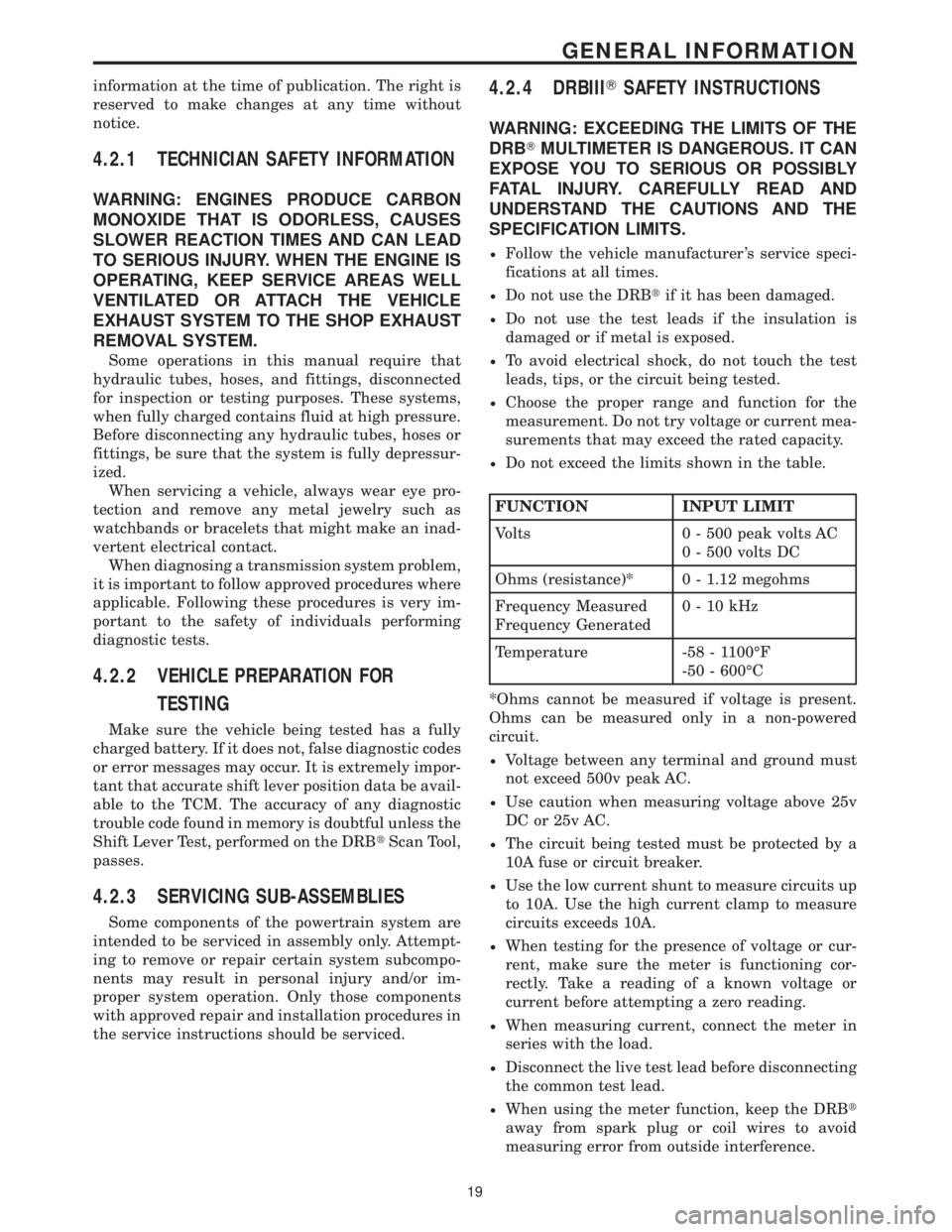
4.2.4 DRBIIITSAFETY INSTRUCTIONS
WARNING: EXCEEDING THE LIMITS OF THE
DRBTMULTIMETER IS DANGEROUS. IT CAN
EXPOSE YOU TO SERIOUS OR POSSIBLY
FATAL INJURY. CAREFULLY READ AND
UNDERSTAND THE CAUTIONS AND THE
SPECIFICATION LIMITS.
²Follow the vehicle manufacturer 's service speci-
fications at all times.
²Do not use the DRBtif it has been damaged.
²Do not use the test leads if the insulation is
damaged or if metal is exposed.
²To avoid electrical shock, do not touch the test
leads, tips, or the circuit being tested.
²Choose the proper range and function for the
measurement. Do not try voltage or current mea-
surements that may exceed the rated capacity.
²Do not exceed the limits shown in the table.
FUNCTION INPUT LIMIT
Volts 0 - 500 peak volts AC
0 - 500 volts DC
Ohms (resistance)* 0 - 1.12 megohms
Frequency Measured
Frequency Generated0-10kHz
Temperature -58 - 1100ÉF
-50 - 600ÉC
*Ohms cannot be measured if voltage is present.
Ohms can be measured only in a non-powered
circuit.
²Voltage between any terminal and ground must
not exceed 500v peak AC.
²Use caution when measuring voltage above 25v
DC or 25v AC.
²The circuit being tested must be protected by a
10A fuse or circuit breaker.
²Use the low current shunt to measure circuits up
to 10A. Use the high current clamp to measure
circuits exceeds 10A.
²When testing for the presence of voltage or cur-
rent, make sure the meter is functioning cor-
rectly. Take a reading of a known voltage or
current before attempting a zero reading.
²When measuring current, connect the meter in
series with the load.
²Disconnect the live test lead before disconnecting
the common test lead.
²When using the meter function, keep the DRBt
away from spark plug or coil wires to avoid
measuring error from outside interference.
19
GENERAL INFORMATION
Page 4156 of 4284
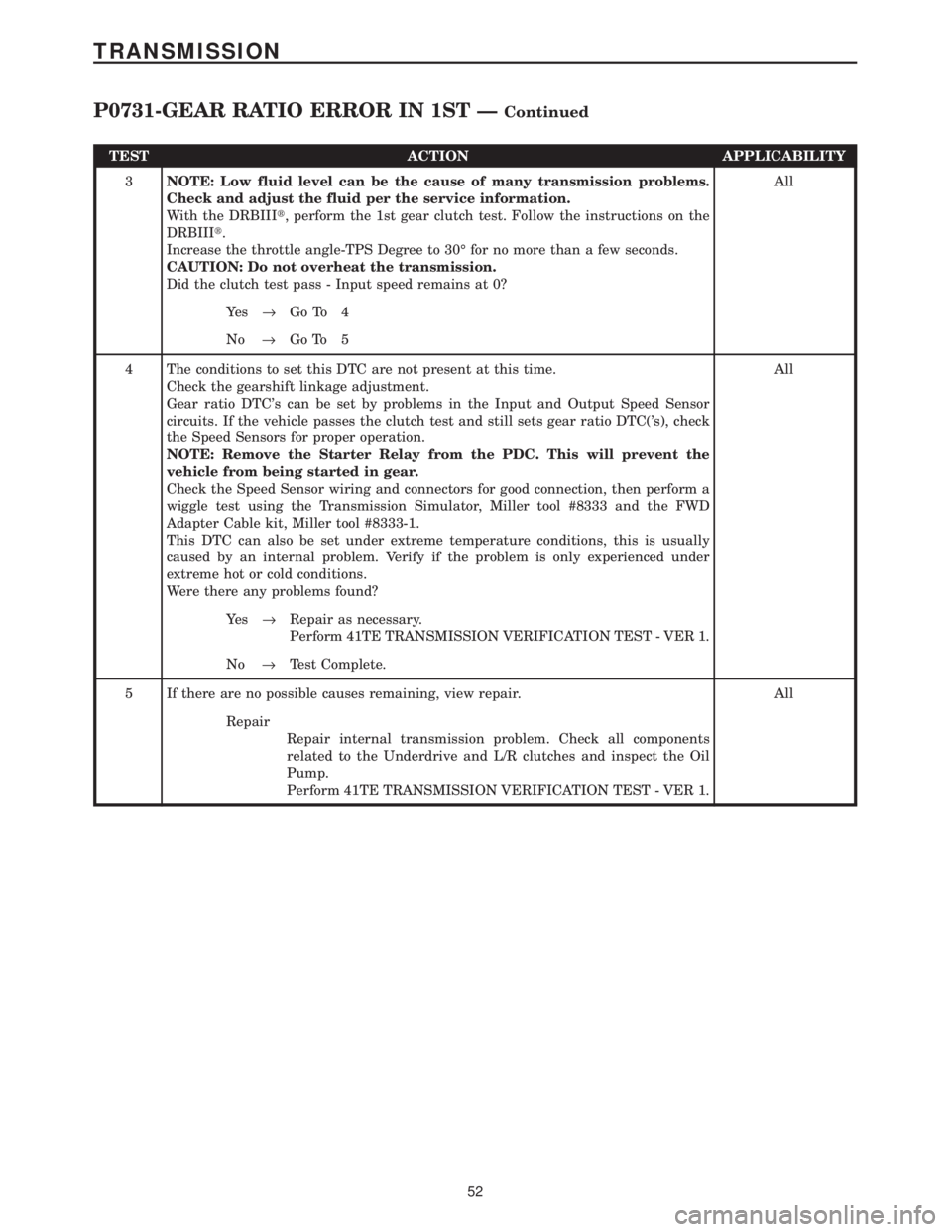
TEST ACTION APPLICABILITY
3NOTE: Low fluid level can be the cause of many transmission problems.
Check and adjust the fluid per the service information.
With the DRBIIIt, perform the 1st gear clutch test. Follow the instructions on the
DRBIIIt.
Increase the throttle angle-TPS Degree to 30É for no more than a few seconds.
CAUTION: Do not overheat the transmission.
Did the clutch test pass - Input speed remains at 0?All
Ye s®Go To 4
No®Go To 5
4 The conditions to set this DTC are not present at this time.
Check the gearshift linkage adjustment.
Gear ratio DTC's can be set by problems in the Input and Output Speed Sensor
circuits. If the vehicle passes the clutch test and still sets gear ratio DTC('s), check
the Speed Sensors for proper operation.
NOTE: Remove the Starter Relay from the PDC. This will prevent the
vehicle from being started in gear.
Check the Speed Sensor wiring and connectors for good connection, then perform a
wiggle test using the Transmission Simulator, Miller tool #8333 and the FWD
Adapter Cable kit, Miller tool #8333-1.
This DTC can also be set under extreme temperature conditions, this is usually
caused by an internal problem. Verify if the problem is only experienced under
extreme hot or cold conditions.
Were there any problems found?All
Ye s®Repair as necessary.
Perform 41TE TRANSMISSION VERIFICATION TEST - VER 1.
No®Test Complete.
5 If there are no possible causes remaining, view repair. All
Repair
Repair internal transmission problem. Check all components
related to the Underdrive and L/R clutches and inspect the Oil
Pump.
Perform 41TE TRANSMISSION VERIFICATION TEST - VER 1.
52
TRANSMISSION
P0731-GEAR RATIO ERROR IN 1ST ÐContinued
Page 4187 of 4284

Symptom:
P1738-HIGH TEMPERATURE OPERATION ACTIVATED
When Monitored and Set Condition:
P1738-HIGH TEMPERATURE OPERATION ACTIVATED
When Monitored: Whenever the engine is running.
Set Condition: Immediately when the Overheat shift schedule is activated (240 degrees
Trans oil temp).
POSSIBLE CAUSES
ENGINE COOLING SYSTEM MALFUNCTION
INCORRECT FLUID LEVEL
TRANSMISSION OIL COOLER PLUGGED
HIGH TEMPERATURE OPERATIONS ACTIVATED
TEST ACTION APPLICABILITY
1 Perform Engine Cooling System diagnostics per Service Information
Is the engine cooling system functioning properly?All
Ye s®Go To 2
No®Repair cause of engine overheating. Refer to Service Information
for additional repair information.
Perform 41TE TRANSMISSION VERIFICATION TEST - VER 1.
2 Check the Transmission Fluid level per the Service Information.
Is the Transmission Fluid Level at the proper level?All
Ye s®Go To 3
No®Repair any Transmission Fluid leak as necessary and adjust the
Transmission Fluid Level in accordance with the Service Infor-
mation.
Perform 41TE TRANSMISSION VERIFICATION TEST - VER 1.
3 Perform Cooler Flow Check per Service Information.
Did the cooler flow test pass?All
Ye s®Go To 4
No®Repair cause of plugged Transmission Oil Cooler. Flush or replace
Transmission Oil Cooler(s) as necessary per Service Information.
Perform 41TE TRANSMISSION VERIFICATION TEST - VER 1.
83
TRANSMISSION
Page 4188 of 4284
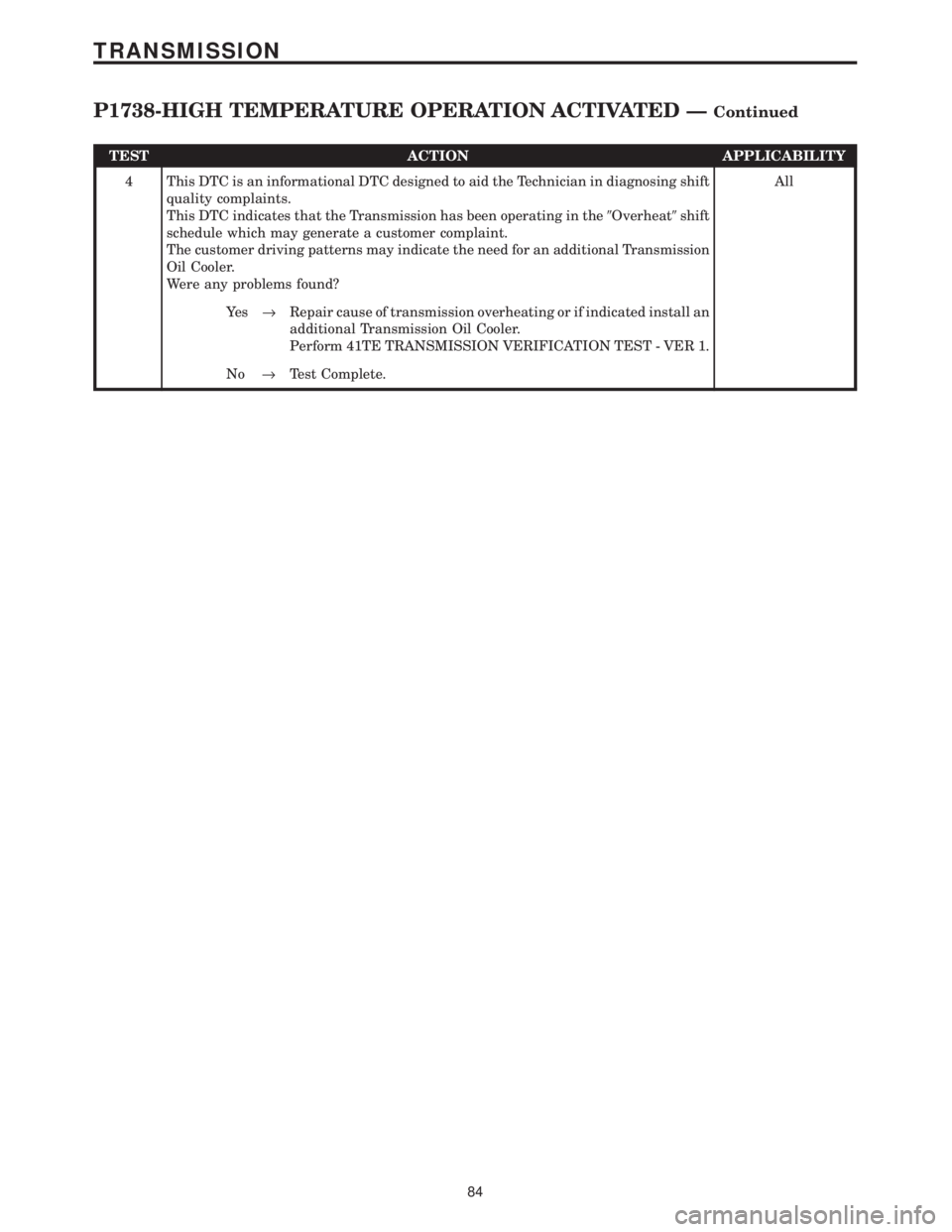
TEST ACTION APPLICABILITY
4 This DTC is an informational DTC designed to aid the Technician in diagnosing shift
quality complaints.
This DTC indicates that the Transmission has been operating in the9Overheat9shift
schedule which may generate a customer complaint.
The customer driving patterns may indicate the need for an additional Transmission
Oil Cooler.
Were any problems found?All
Ye s®Repair cause of transmission overheating or if indicated install an
additional Transmission Oil Cooler.
Perform 41TE TRANSMISSION VERIFICATION TEST - VER 1.
No®Test Complete.
84
TRANSMISSION
P1738-HIGH TEMPERATURE OPERATION ACTIVATED ÐContinued
Page 4229 of 4284

TEST ACTION APPLICABILITY
2 The Transmission Fluid temperature must be above 21É C or 70É F prior to checking
fluid level. Adjusting fluid level on a cold transmission will result in an overfilled
transmission.
Check the Transmission Fluid Level per the Service Information.
Is the Transmission Fluid Level at the proper level?All
Ye s®Go To 3
No®If the Transmission Fluid is low, repair any Transmission Fluid
leak as necessary and adjust the Transmission Fluid Level in
accordance with the Service Information.
Perform 41TE TRANSMISSION VERIFICATION TEST - VER 1.
3 Place the gear selector in park.
Start the engine.
The Transmission must be at operating temperature prior to checking pressure. A
cold Transmission will give higher readings.
Place the Transmission in Reverse.
With the DRBIIIt, observe the Transmission Pressure Switch states.
Are any of the Pressure Switches closed?All
Ye s®Go To 4
No®Go To 6
4 The conditions necessary to set this DTC are not present at this time.
Test drive the vehicle. Allow the Transmission to shift through all gears and ranges.
Did you experience any Delayed Engagement and/ or No Drive condition?All
Ye s®Go To 6
No®Go To 5
5 The conditions necessary to set this DTC are not present at this time.
Using the schematics as a guide, inspect the wiring and connectors specific to this
circuit.
Wiggle the wiring while checking for shorts and open circuits.
Were there any problems found?All
Ye s®Repair as necessary.
Perform 41TE TRANSMISSION VERIFICATION TEST - VER 1.
No®Test Complete.
6 Remove and inspect the Transmission Oil Pan and Transmission Oil Filter per the
Service Information.
Does the Transmission Oil Pan contain excessive debris and/or is the Oil Filter
plugged?All
Ye s®Repair the cause of plugged Transmission Oil Filter. Refer to the
Service Information for repair procedures.
Perform 41TE TRANSMISSION VERIFICATION TEST - VER 1.
No®Go To 7
7 With the DRBIIIt, perform a Shift Lever Position test. Follow the instructions on the
DRBIIIt.
Did the Shift Lever Position Test pass?All
Ye s®Go To 8
No®Refer to symptom list and perform test for DTC P0705.
Perform 41TE TRANSMISSION VERIFICATION TEST - VER 1.
125
TRANSMISSION
P1791-LOSS OF PRIME ÐContinued
Page 4246 of 4284
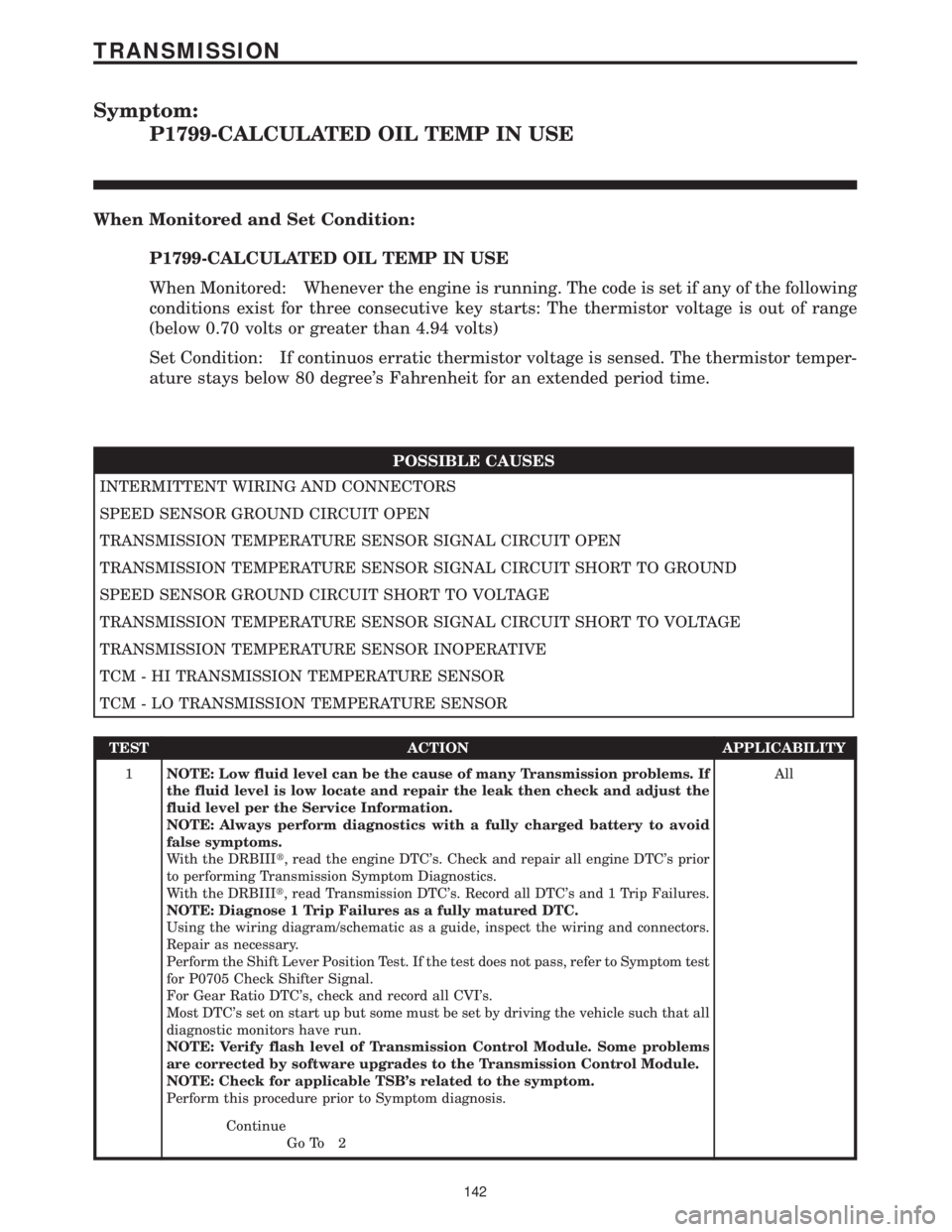
Symptom:
P1799-CALCULATED OIL TEMP IN USE
When Monitored and Set Condition:
P1799-CALCULATED OIL TEMP IN USE
When Monitored: Whenever the engine is running. The code is set if any of the following
conditions exist for three consecutive key starts: The thermistor voltage is out of range
(below 0.70 volts or greater than 4.94 volts)
Set Condition: If continuos erratic thermistor voltage is sensed. The thermistor temper-
ature stays below 80 degree's Fahrenheit for an extended period time.
POSSIBLE CAUSES
INTERMITTENT WIRING AND CONNECTORS
SPEED SENSOR GROUND CIRCUIT OPEN
TRANSMISSION TEMPERATURE SENSOR SIGNAL CIRCUIT OPEN
TRANSMISSION TEMPERATURE SENSOR SIGNAL CIRCUIT SHORT TO GROUND
SPEED SENSOR GROUND CIRCUIT SHORT TO VOLTAGE
TRANSMISSION TEMPERATURE SENSOR SIGNAL CIRCUIT SHORT TO VOLTAGE
TRANSMISSION TEMPERATURE SENSOR INOPERATIVE
TCM - HI TRANSMISSION TEMPERATURE SENSOR
TCM - LO TRANSMISSION TEMPERATURE SENSOR
TEST ACTION APPLICABILITY
1NOTE: Low fluid level can be the cause of many Transmission problems. If
the fluid level is low locate and repair the leak then check and adjust the
fluid level per the Service Information.
NOTE: Always perform diagnostics with a fully charged battery to avoid
false symptoms.
With the DRBIIIt, read the engine DTC's. Check and repair all engine DTC's prior
to performing Transmission Symptom Diagnostics.
With the DRBIIIt, read Transmission DTC's. Record all DTC's and 1 Trip Failures.
NOTE: Diagnose 1 Trip Failures as a fully matured DTC.
Using the wiring diagram/schematic as a guide, inspect the wiring and connectors.
Repair as necessary.
Perform the Shift Lever Position Test. If the test does not pass, refer to Symptom test
for P0705 Check Shifter Signal.
For Gear Ratio DTC's, check and record all CVI's.
Most DTC's set on start up but some must be set by driving the vehicle such that all
diagnostic monitors have run.
NOTE: Verify flash level of Transmission Control Module. Some problems
are corrected by software upgrades to the Transmission Control Module.
NOTE: Check for applicable TSB's related to the symptom.
Perform this procedure prior to Symptom diagnosis.All
Continue
Go To 2
142
TRANSMISSION
Page 4247 of 4284
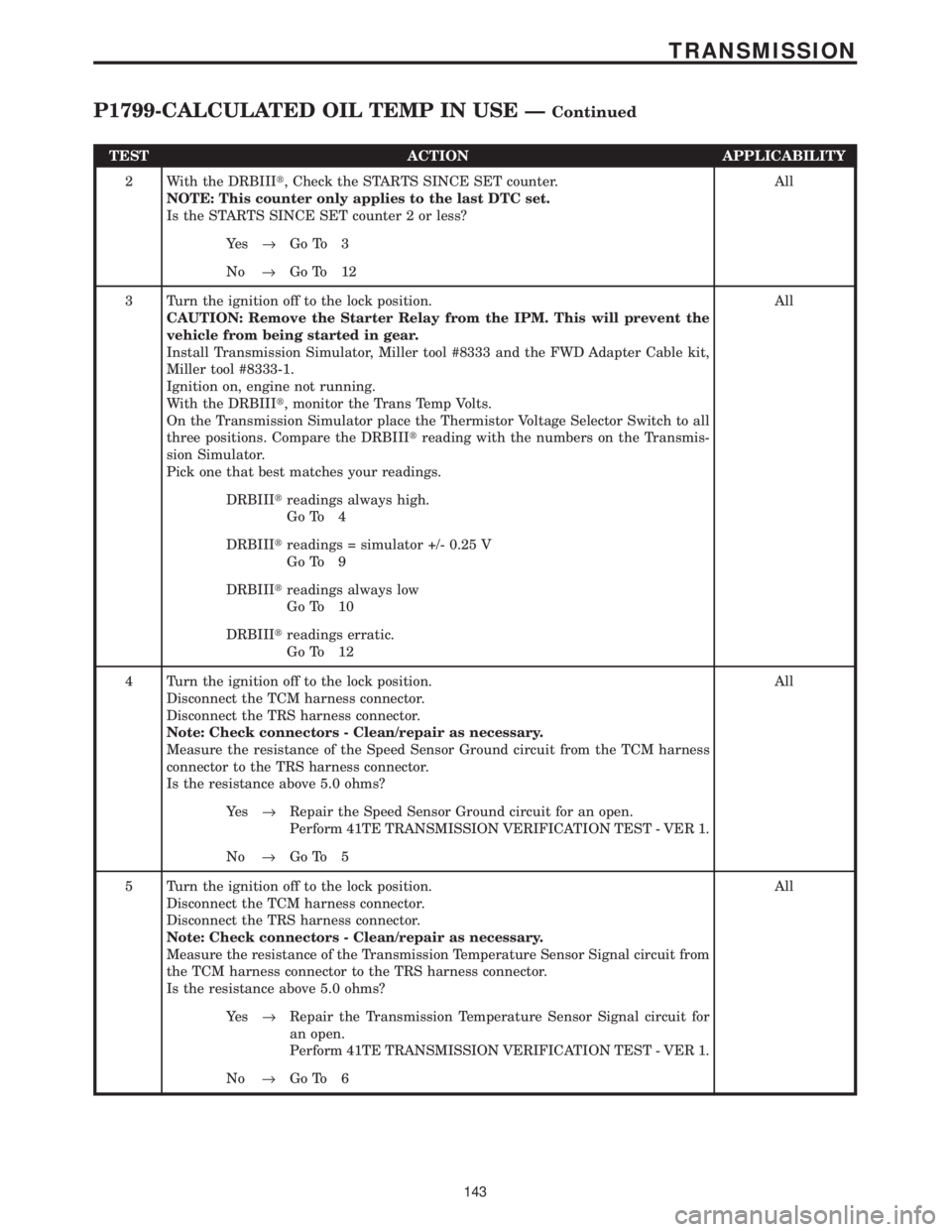
TEST ACTION APPLICABILITY
2 With the DRBIIIt, Check the STARTS SINCE SET counter.
NOTE: This counter only applies to the last DTC set.
Is the STARTS SINCE SET counter 2 or less?All
Ye s®Go To 3
No®Go To 12
3 Turn the ignition off to the lock position.
CAUTION: Remove the Starter Relay from the IPM. This will prevent the
vehicle from being started in gear.
Install Transmission Simulator, Miller tool #8333 and the FWD Adapter Cable kit,
Miller tool #8333-1.
Ignition on, engine not running.
With the DRBIIIt, monitor the Trans Temp Volts.
On the Transmission Simulator place the Thermistor Voltage Selector Switch to all
three positions. Compare the DRBIIItreading with the numbers on the Transmis-
sion Simulator.
Pick one that best matches your readings.All
DRBIIItreadings always high.
Go To 4
DRBIIItreadings = simulator +/- 0.25 V
Go To 9
DRBIIItreadings always low
Go To 10
DRBIIItreadings erratic.
Go To 12
4 Turn the ignition off to the lock position.
Disconnect the TCM harness connector.
Disconnect the TRS harness connector.
Note: Check connectors - Clean/repair as necessary.
Measure the resistance of the Speed Sensor Ground circuit from the TCM harness
connector to the TRS harness connector.
Is the resistance above 5.0 ohms?All
Ye s®Repair the Speed Sensor Ground circuit for an open.
Perform 41TE TRANSMISSION VERIFICATION TEST - VER 1.
No®Go To 5
5 Turn the ignition off to the lock position.
Disconnect the TCM harness connector.
Disconnect the TRS harness connector.
Note: Check connectors - Clean/repair as necessary.
Measure the resistance of the Transmission Temperature Sensor Signal circuit from
the TCM harness connector to the TRS harness connector.
Is the resistance above 5.0 ohms?All
Ye s®Repair the Transmission Temperature Sensor Signal circuit for
an open.
Perform 41TE TRANSMISSION VERIFICATION TEST - VER 1.
No®Go To 6
143
TRANSMISSION
P1799-CALCULATED OIL TEMP IN USE ÐContinued