alarm CHRYSLER VOYAGER 2001 User Guide
[x] Cancel search | Manufacturer: CHRYSLER, Model Year: 2001, Model line: VOYAGER, Model: CHRYSLER VOYAGER 2001Pages: 4284, PDF Size: 83.53 MB
Page 55 of 4284
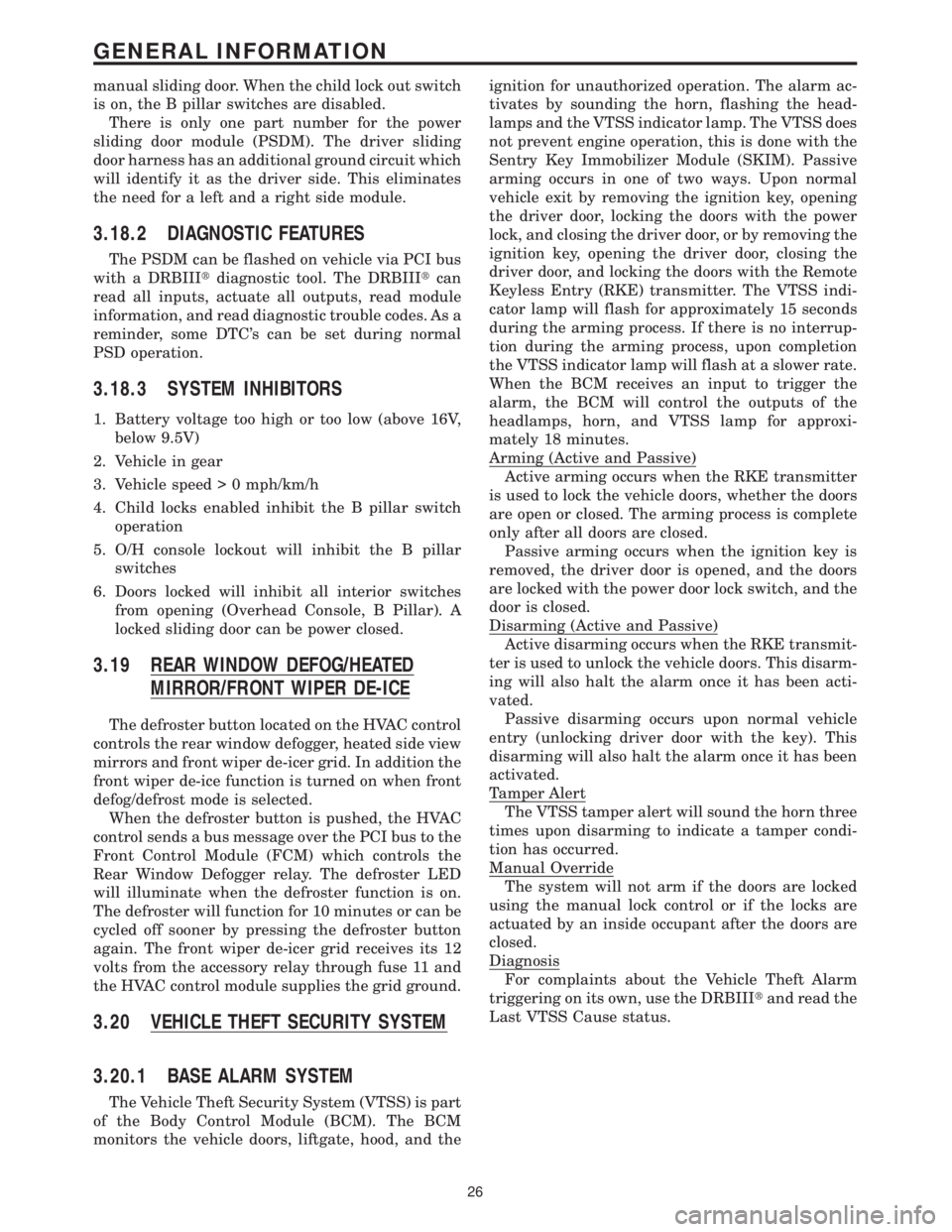
manual sliding door. When the child lock out switch
is on, the B pillar switches are disabled.
There is only one part number for the power
sliding door module (PSDM). The driver sliding
door harness has an additional ground circuit which
will identify it as the driver side. This eliminates
the need for a left and a right side module.
3.18.2 DIAGNOSTIC FEATURES
The PSDM can be flashed on vehicle via PCI bus
with a DRBIIItdiagnostic tool. The DRBIIItcan
read all inputs, actuate all outputs, read module
information, and read diagnostic trouble codes. As a
reminder, some DTC's can be set during normal
PSD operation.
3.18.3 SYSTEM INHIBITORS
1. Battery voltage too high or too low (above 16V,
below 9.5V)
2. Vehicle in gear
3. Vehicle speed > 0 mph/km/h
4. Child locks enabled inhibit the B pillar switch
operation
5. O/H console lockout will inhibit the B pillar
switches
6. Doors locked will inhibit all interior switches
from opening (Overhead Console, B Pillar). A
locked sliding door can be power closed.
3.19 REAR WINDOW DEFOG/HEATED
MIRROR/FRONT WIPER DE-ICE
The defroster button located on the HVAC control
controls the rear window defogger, heated side view
mirrors and front wiper de-icer grid. In addition the
front wiper de-ice function is turned on when front
defog/defrost mode is selected.
When the defroster button is pushed, the HVAC
control sends a bus message over the PCI bus to the
Front Control Module (FCM) which controls the
Rear Window Defogger relay. The defroster LED
will illuminate when the defroster function is on.
The defroster will function for 10 minutes or can be
cycled off sooner by pressing the defroster button
again. The front wiper de-icer grid receives its 12
volts from the accessory relay through fuse 11 and
the HVAC control module supplies the grid ground.
3.20 VEHICLE THEFT SECURITY SYSTEM
3.20.1 BASE ALARM SYSTEM
The Vehicle Theft Security System (VTSS) is part
of the Body Control Module (BCM). The BCM
monitors the vehicle doors, liftgate, hood, and theignition for unauthorized operation. The alarm ac-
tivates by sounding the horn, flashing the head-
lamps and the VTSS indicator lamp. The VTSS does
not prevent engine operation, this is done with the
Sentry Key Immobilizer Module (SKIM). Passive
arming occurs in one of two ways. Upon normal
vehicle exit by removing the ignition key, opening
the driver door, locking the doors with the power
lock, and closing the driver door, or by removing the
ignition key, opening the driver door, closing the
driver door, and locking the doors with the Remote
Keyless Entry (RKE) transmitter. The VTSS indi-
cator lamp will flash for approximately 15 seconds
during the arming process. If there is no interrup-
tion during the arming process, upon completion
the VTSS indicator lamp will flash at a slower rate.
When the BCM receives an input to trigger the
alarm, the BCM will control the outputs of the
headlamps, horn, and VTSS lamp for approxi-
mately 18 minutes.
Arming (Active and Passive)
Active arming occurs when the RKE transmitter
is used to lock the vehicle doors, whether the doors
are open or closed. The arming process is complete
only after all doors are closed.
Passive arming occurs when the ignition key is
removed, the driver door is opened, and the doors
are locked with the power door lock switch, and the
door is closed.
Disarming (Active and Passive)
Active disarming occurs when the RKE transmit-
ter is used to unlock the vehicle doors. This disarm-
ing will also halt the alarm once it has been acti-
vated.
Passive disarming occurs upon normal vehicle
entry (unlocking driver door with the key). This
disarming will also halt the alarm once it has been
activated.
Tamper Alert
The VTSS tamper alert will sound the horn three
times upon disarming to indicate a tamper condi-
tion has occurred.
Manual Override
The system will not arm if the doors are locked
using the manual lock control or if the locks are
actuated by an inside occupant after the doors are
closed.
Diagnosis
For complaints about the Vehicle Theft Alarm
triggering on its own, use the DRBIIItand read the
Last VTSS Cause status.
26
GENERAL INFORMATION
Page 56 of 4284

NOTE: A POWERTRAIN CONTROL MODULE
FROM A VEHICLE EQUIPPED WITH A
VEHICLE THEFT SECURITY SYSTEM
CANNOT BE USED IN A VEHICLE THAT IS
NOT EQUIPPED WITH A VEHICLE THEFT
SECURITY SYSTEM IF THE VTSS INDICATOR
LAMP COMES ON AFTER IGNITION ON AND
STAYS ON, THE PCI BUS COMMUNICATION
WITH THE POWERTRAIN CONTROL
MODULE HAS POSSIBLY BEEN LOST.
3.20.2 THATCHAM ALARM SYSTEM
The Thatcham Alarm Module monitors the vehi-
cle doors, liftgate, hood and the interior of the
vehicle for unauthorized operation. The vehicle
doors, liftgate, and hood use ajar switches as inputs
to the BCM to indicate their current status. The
interior of the vehicle is secured by the use of
Intrusion Sensors. The Intrusion Sensors are used
as inputs to the RKE/Thatcham Alarm Module to
report any motion in the interior of the vehicle. The
alarm activates by sounding the siren, flashing the
hazard lamps, and the VTSS Indicator Lamp.
Arming
Before arming, all doors, liftgate, and the hood
must be completely closed. The system can then be
armed by following a normal exit sequence, of
opening the door and then locking the doors with
the door lock switch and then closing the door. The
system can also be armed by opening the door,
closing the door and then locking the doors with the
RKE transmitter.
Disarming
To disarm the alarm system, the RKE transmit-
ter is used. The RKE transmitter will unlock the
vehicle doors and disarm the alarm system. The
RKE transmitter can also be used to halt the alarm
once it has been activated.
3.21 WIPER SYSTEM
3.21.1 FRONT WIPER
The front wiper/washer system consists of the
following features: lo-hi-speed, mist wipers, inter-
mittent wipers and wipe after wash. The front
wiper system is only active when the ignition switch
is in the RUN/ACC position. The vehicle operator
selects the front wiper function using the front
wiper switch (a resistive multiplexed stalk switch)
which is integral to the Multi-Function Switch. The
front wiper switch is hardwired to the Body Control
Module (BCM). Upon receiving a wiper switch sig-
nal, the BCM sends a PCI Bus message to the Front
Control Module (FCM). The FCM controls the ON/OFF relay, the HIGH/LOW relay and the front and
rear washer pump motors.
The Wiper system utilizes the BCM to control the
on/off and hi/low relays for the low and hi speed
wiper functions, intermittent wiper delay as the
switch position changes, pulse wipe, wipe after
wash mode and wiper motor functions. The BCM
uses the vehicle speed input to double the usual
delay time below 10 MPH (6 KPH).
3.21.2 SPEED SENSITIVE INTERMITTENT
WIPE MODE
There are 5 individual delay time settings with a
minimum delay of 1.7 seconds to a maximum of 18.4
seconds. When the vehicle speed is under 10 MPH
(6 KPM), the delay time is doubled, providing a
delay range of 3.4 seconds to 36.8 seconds.
3.21.3 PULSE WIPE
When the wiper is in the off position and the
driver presses the wash button for more than .062
seconds, but less than .5 seconds, 2 wipe cycles in
low speed mode will be provided.
3.21.4 PARK AFTER IGNITION OFF
Because the wiper relays are powered from the
battery, the BCM can run the wipers to park after
the ignition is turned off.
3.21.5 WIPE AFTER WASH
When the driver presses the wash button for over
.5 seconds and releases it, the wiper will continue to
run for 2 additional wipe cycles.
3.21.6 REAR WIPER
The rear wiper/washer system consists of the
following features: mist wipers, intermittent wipers
and wipe after wash. The rear wiper system is only
active when the ignition switch is in the RUN/ACC
position. The vehicle operator selects the rear wiper
function using one of the three buttons on the dash
mounted rear wiper switch. The rear wiper switch
is hardwired to the Body Control Module (BCM).
Upon receiving a wiper switch signal, the BCM
provides 12 volts to the rear wiper motor. Rear
washer occurs when the BCM receives a rear
washer switch ON input. The BCM sends a PCI Bus
message to the FCM requesting rear washer on.
The FCM activates the rear washer by providing a
ground for the rear washer motor.
3.21.7 SPEED SENSITIVE INTERMITTENT
WIPE MODE
The delay setting of the rear wiper system is
based solely on the vehicle speed. The delay time is
27
GENERAL INFORMATION
Page 424 of 4284
Symptom:
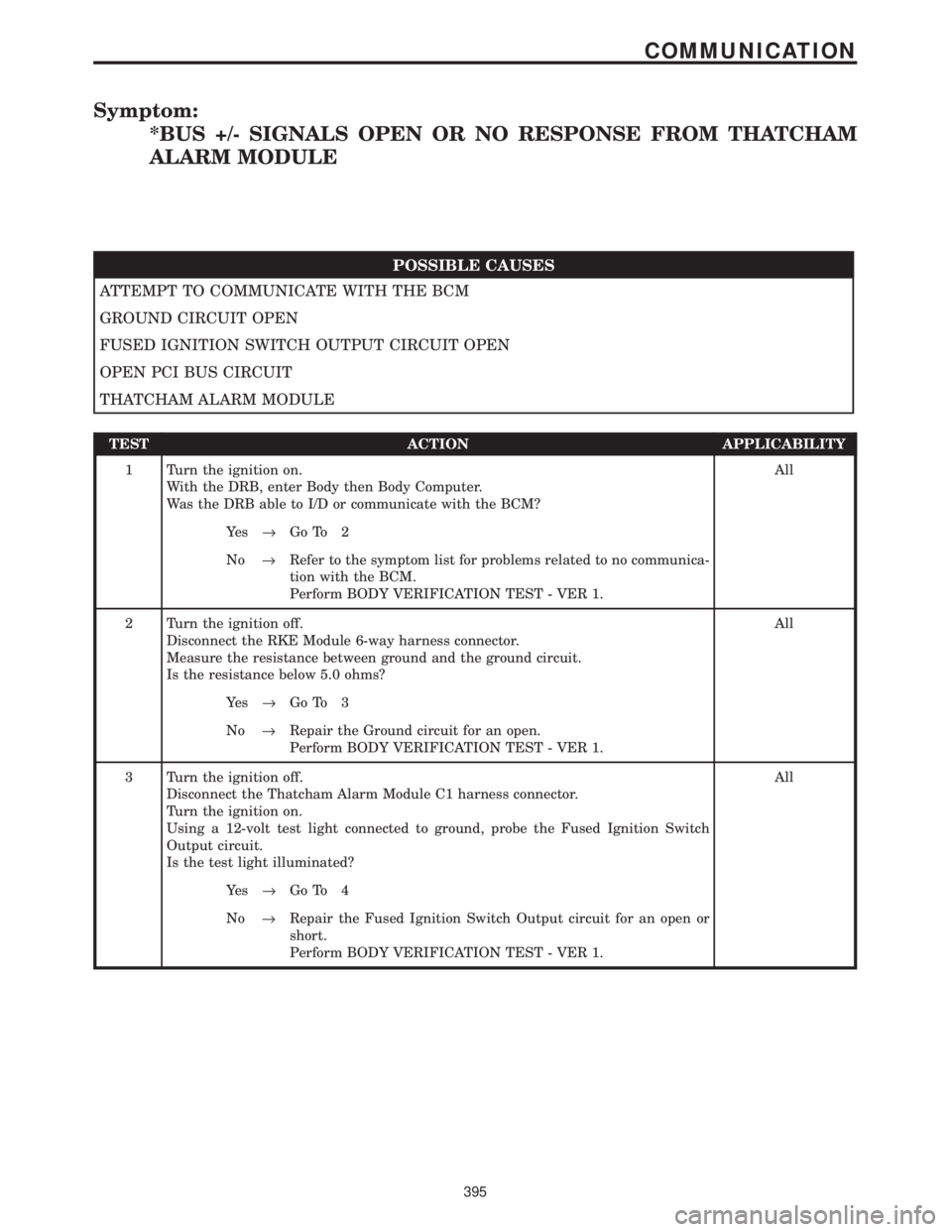
*BUS +/- SIGNALS OPEN OR NO RESPONSE FROM THATCHAM
ALARM MODULE
POSSIBLE CAUSES
ATTEMPT TO COMMUNICATE WITH THE BCM
GROUND CIRCUIT OPEN
FUSED IGNITION SWITCH OUTPUT CIRCUIT OPEN
OPEN PCI BUS CIRCUIT
THATCHAM ALARM MODULE
TEST ACTION APPLICABILITY
1 Turn the ignition on.
With the DRB, enter Body then Body Computer.
Was the DRB able to I/D or communicate with the BCM?All
Ye s®Go To 2
No®Refer to the symptom list for problems related to no communica-
tion with the BCM.
Perform BODY VERIFICATION TEST - VER 1.
2 Turn the ignition off.
Disconnect the RKE Module 6-way harness connector.
Measure the resistance between ground and the ground circuit.
Is the resistance below 5.0 ohms?All
Ye s®Go To 3
No®Repair the Ground circuit for an open.
Perform BODY VERIFICATION TEST - VER 1.
3 Turn the ignition off.
Disconnect the Thatcham Alarm Module C1 harness connector.
Turn the ignition on.
Using a 12-volt test light connected to ground, probe the Fused Ignition Switch
Output circuit.
Is the test light illuminated?All
Ye s®Go To 4
No®Repair the Fused Ignition Switch Output circuit for an open or
short.
Perform BODY VERIFICATION TEST - VER 1.
395
COMMUNICATION
Page 425 of 4284
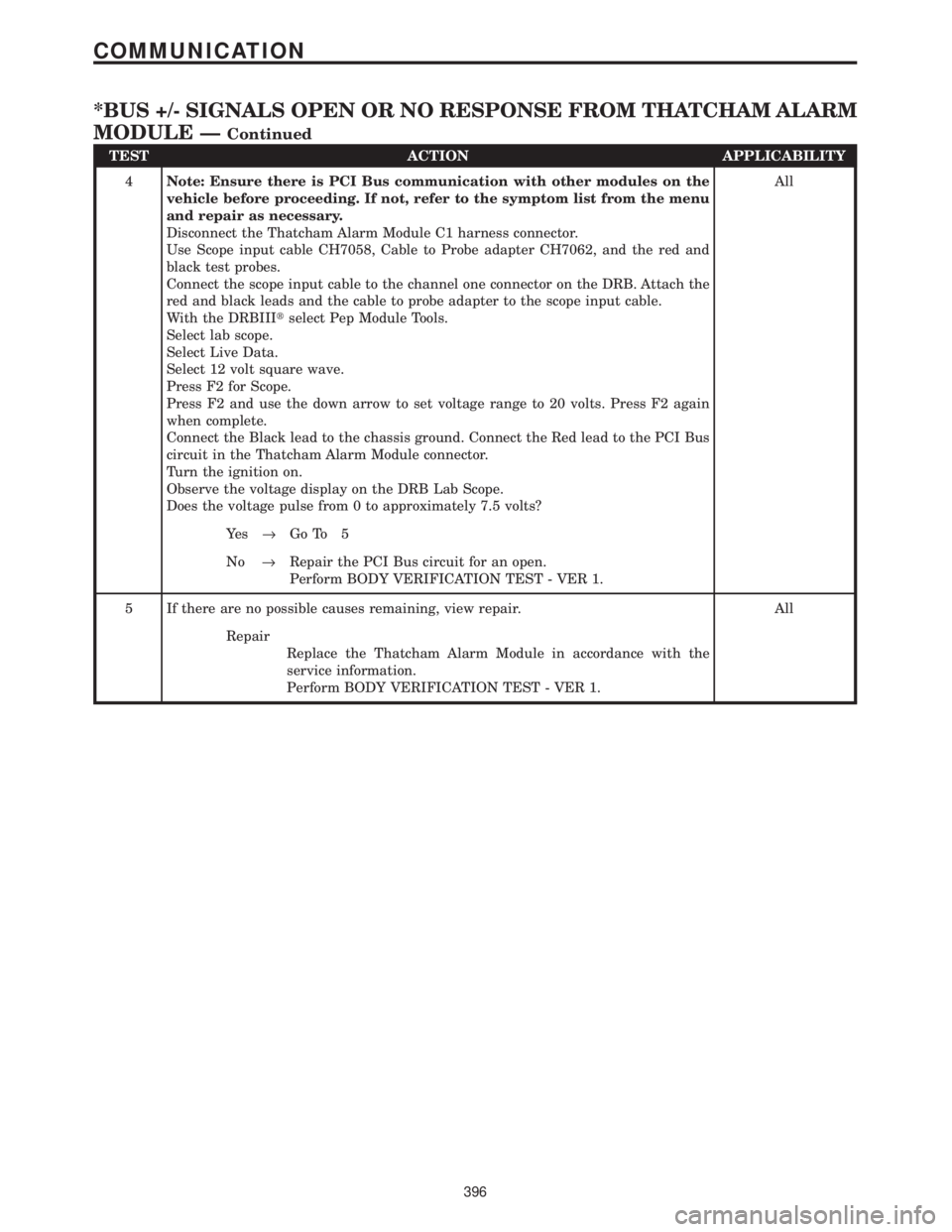
TEST ACTION APPLICABILITY
4Note: Ensure there is PCI Bus communication with other modules on the
vehicle before proceeding. If not, refer to the symptom list from the menu
and repair as necessary.
Disconnect the Thatcham Alarm Module C1 harness connector.
Use Scope input cable CH7058, Cable to Probe adapter CH7062, and the red and
black test probes.
Connect the scope input cable to the channel one connector on the DRB. Attach the
red and black leads and the cable to probe adapter to the scope input cable.
With the DRBIIItselect Pep Module Tools.
Select lab scope.
Select Live Data.
Select 12 volt square wave.
Press F2 for Scope.
Press F2 and use the down arrow to set voltage range to 20 volts. Press F2 again
when complete.
Connect the Black lead to the chassis ground. Connect the Red lead to the PCI Bus
circuit in the Thatcham Alarm Module connector.
Turn the ignition on.
Observe the voltage display on the DRB Lab Scope.
Does the voltage pulse from 0 to approximately 7.5 volts?All
Ye s®Go To 5
No®Repair the PCI Bus circuit for an open.
Perform BODY VERIFICATION TEST - VER 1.
5 If there are no possible causes remaining, view repair. All
Repair
Replace the Thatcham Alarm Module in accordance with the
service information.
Perform BODY VERIFICATION TEST - VER 1.
396
COMMUNICATION
*BUS +/- SIGNALS OPEN OR NO RESPONSE FROM THATCHAM ALARM
MODULE Ð
Continued
Page 951 of 4284
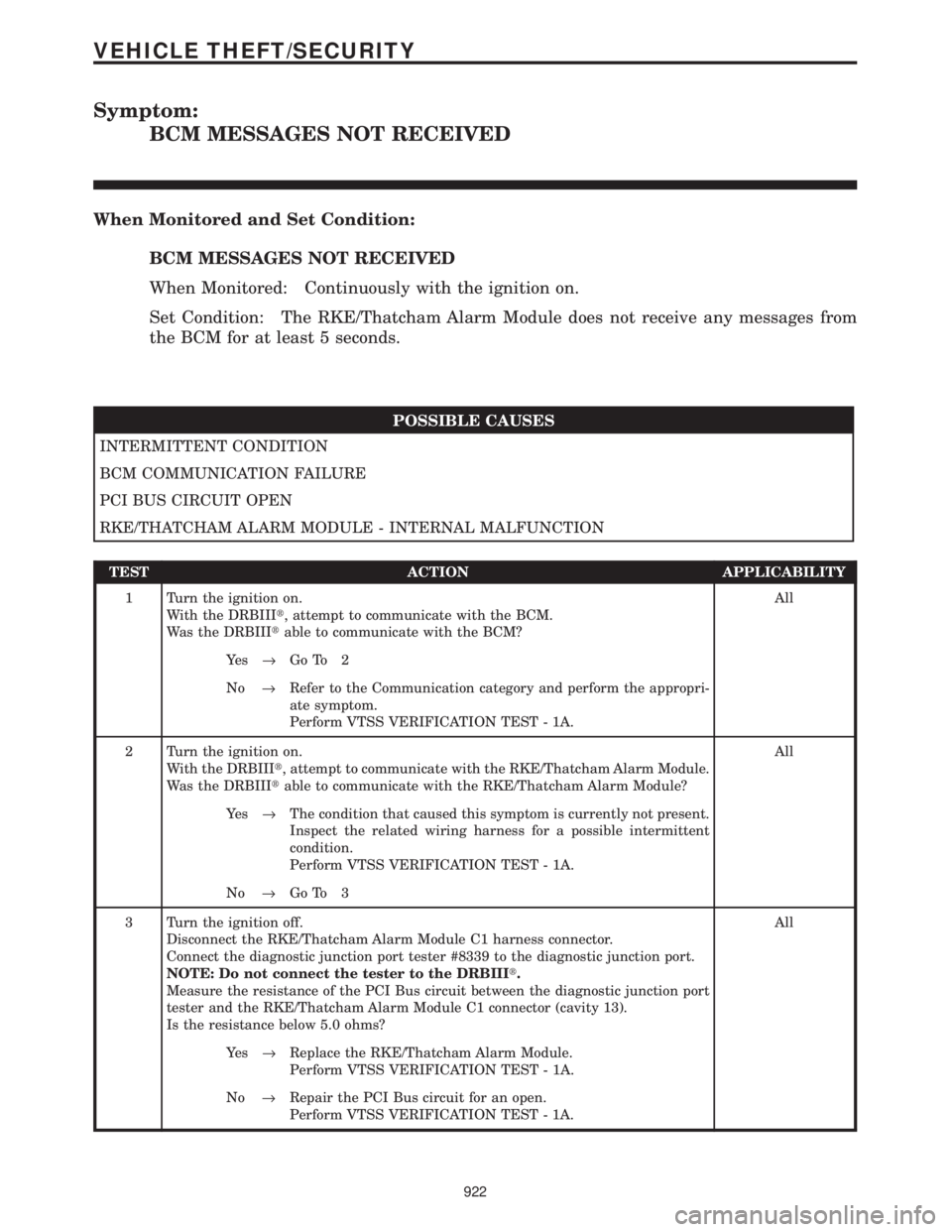
Symptom:
BCM MESSAGES NOT RECEIVED
When Monitored and Set Condition:
BCM MESSAGES NOT RECEIVED
When Monitored: Continuously with the ignition on.
Set Condition: The RKE/Thatcham Alarm Module does not receive any messages from
the BCM for at least 5 seconds.
POSSIBLE CAUSES
INTERMITTENT CONDITION
BCM COMMUNICATION FAILURE
PCI BUS CIRCUIT OPEN
RKE/THATCHAM ALARM MODULE - INTERNAL MALFUNCTION
TEST ACTION APPLICABILITY
1 Turn the ignition on.
With the DRBIIIt, attempt to communicate with the BCM.
Was the DRBIIItable to communicate with the BCM?All
Ye s®Go To 2
No®Refer to the Communication category and perform the appropri-
ate symptom.
Perform VTSS VERIFICATION TEST - 1A.
2 Turn the ignition on.
With the DRBIIIt, attempt to communicate with the RKE/Thatcham Alarm Module.
Was the DRBIIItable to communicate with the RKE/Thatcham Alarm Module?All
Ye s®The condition that caused this symptom is currently not present.
Inspect the related wiring harness for a possible intermittent
condition.
Perform VTSS VERIFICATION TEST - 1A.
No®Go To 3
3 Turn the ignition off.
Disconnect the RKE/Thatcham Alarm Module C1 harness connector.
Connect the diagnostic junction port tester #8339 to the diagnostic junction port.
NOTE: Do not connect the tester to the DRBIIIt.
Measure the resistance of the PCI Bus circuit between the diagnostic junction port
tester and the RKE/Thatcham Alarm Module C1 connector (cavity 13).
Is the resistance below 5.0 ohms?All
Ye s®Replace the RKE/Thatcham Alarm Module.
Perform VTSS VERIFICATION TEST - 1A.
No®Repair the PCI Bus circuit for an open.
Perform VTSS VERIFICATION TEST - 1A.
922
VEHICLE THEFT/SECURITY
Page 956 of 4284
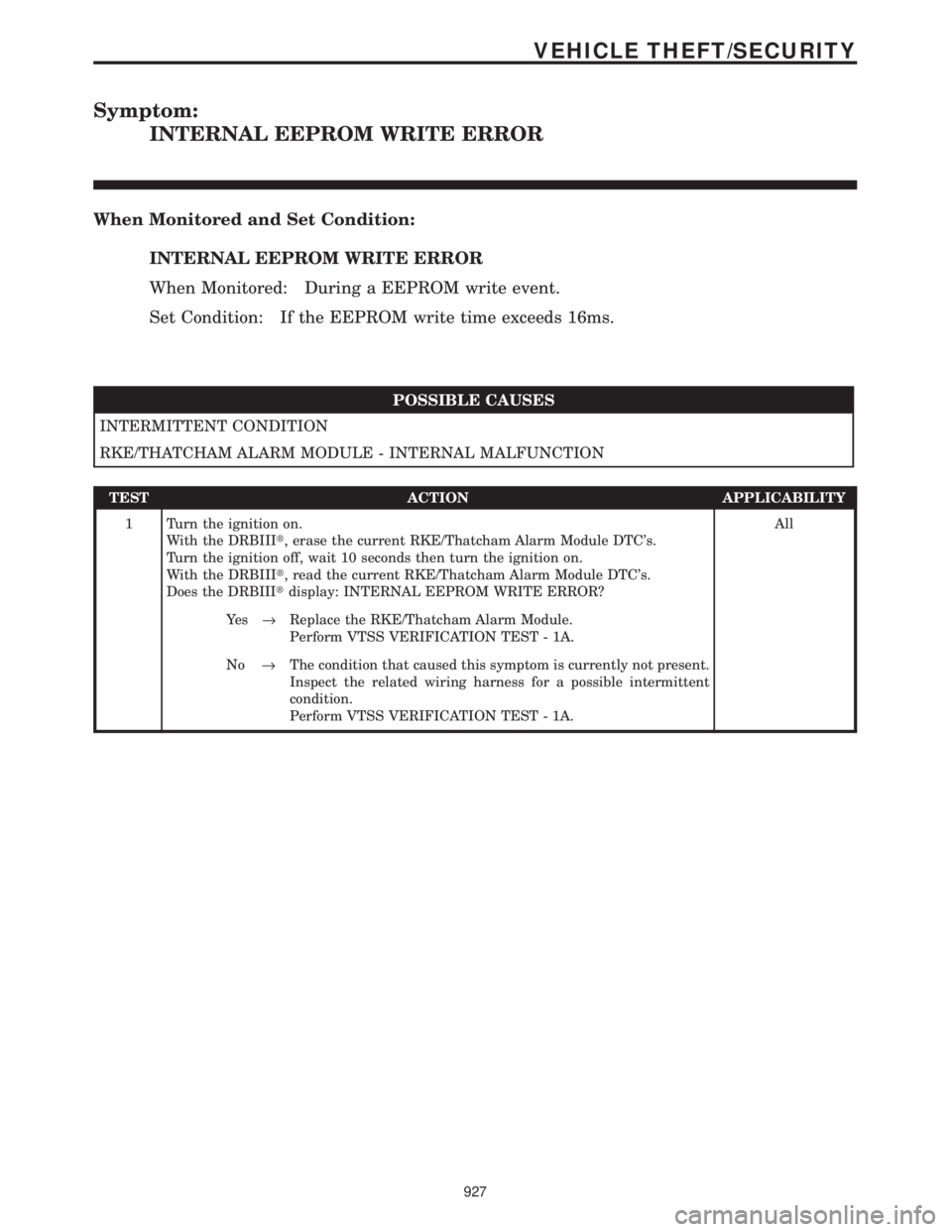
Symptom:
INTERNAL EEPROM WRITE ERROR
When Monitored and Set Condition:
INTERNAL EEPROM WRITE ERROR
When Monitored: During a EEPROM write event.
Set Condition: If the EEPROM write time exceeds 16ms.
POSSIBLE CAUSES
INTERMITTENT CONDITION
RKE/THATCHAM ALARM MODULE - INTERNAL MALFUNCTION
TEST ACTION APPLICABILITY
1 Turn the ignition on.
With the DRBIIIt, erase the current RKE/Thatcham Alarm Module DTC's.
Turn the ignition off, wait 10 seconds then turn the ignition on.
With the DRBIIIt, read the current RKE/Thatcham Alarm Module DTC's.
Does the DRBIIItdisplay: INTERNAL EEPROM WRITE ERROR?All
Ye s®Replace the RKE/Thatcham Alarm Module.
Perform VTSS VERIFICATION TEST - 1A.
No®The condition that caused this symptom is currently not present.
Inspect the related wiring harness for a possible intermittent
condition.
Perform VTSS VERIFICATION TEST - 1A.
927
VEHICLE THEFT/SECURITY
Page 957 of 4284
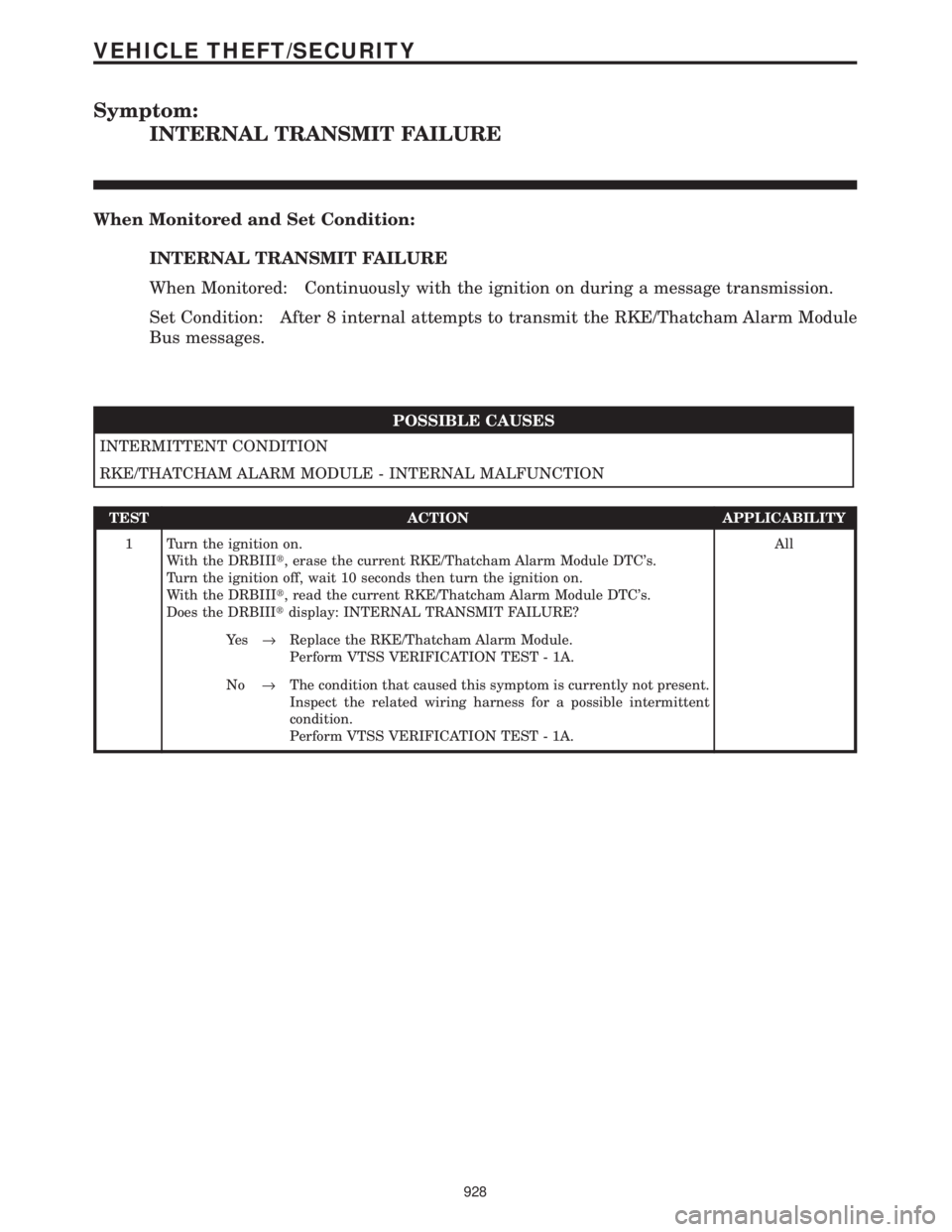
Symptom:
INTERNAL TRANSMIT FAILURE
When Monitored and Set Condition:
INTERNAL TRANSMIT FAILURE
When Monitored: Continuously with the ignition on during a message transmission.
Set Condition: After 8 internal attempts to transmit the RKE/Thatcham Alarm Module
Bus messages.
POSSIBLE CAUSES
INTERMITTENT CONDITION
RKE/THATCHAM ALARM MODULE - INTERNAL MALFUNCTION
TEST ACTION APPLICABILITY
1 Turn the ignition on.
With the DRBIIIt, erase the current RKE/Thatcham Alarm Module DTC's.
Turn the ignition off, wait 10 seconds then turn the ignition on.
With the DRBIIIt, read the current RKE/Thatcham Alarm Module DTC's.
Does the DRBIIItdisplay: INTERNAL TRANSMIT FAILURE?All
Ye s®Replace the RKE/Thatcham Alarm Module.
Perform VTSS VERIFICATION TEST - 1A.
No®The condition that caused this symptom is currently not present.
Inspect the related wiring harness for a possible intermittent
condition.
Perform VTSS VERIFICATION TEST - 1A.
928
VEHICLE THEFT/SECURITY
Page 958 of 4284
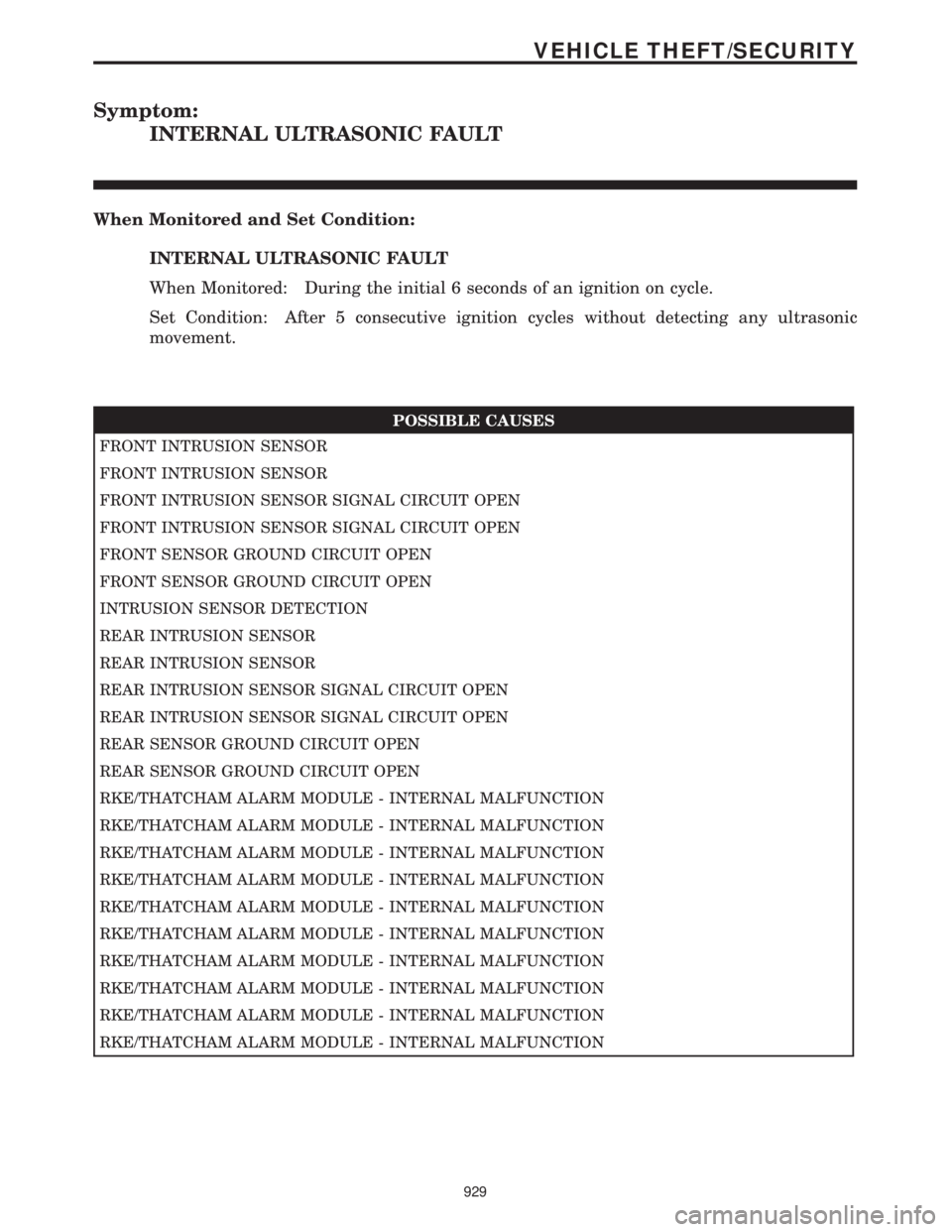
Symptom:
INTERNAL ULTRASONIC FAULT
When Monitored and Set Condition:
INTERNAL ULTRASONIC FAULT
When Monitored: During the initial 6 seconds of an ignition on cycle.
Set Condition: After 5 consecutive ignition cycles without detecting any ultrasonic
movement.
POSSIBLE CAUSES
FRONT INTRUSION SENSOR
FRONT INTRUSION SENSOR
FRONT INTRUSION SENSOR SIGNAL CIRCUIT OPEN
FRONT INTRUSION SENSOR SIGNAL CIRCUIT OPEN
FRONT SENSOR GROUND CIRCUIT OPEN
FRONT SENSOR GROUND CIRCUIT OPEN
INTRUSION SENSOR DETECTION
REAR INTRUSION SENSOR
REAR INTRUSION SENSOR
REAR INTRUSION SENSOR SIGNAL CIRCUIT OPEN
REAR INTRUSION SENSOR SIGNAL CIRCUIT OPEN
REAR SENSOR GROUND CIRCUIT OPEN
REAR SENSOR GROUND CIRCUIT OPEN
RKE/THATCHAM ALARM MODULE - INTERNAL MALFUNCTION
RKE/THATCHAM ALARM MODULE - INTERNAL MALFUNCTION
RKE/THATCHAM ALARM MODULE - INTERNAL MALFUNCTION
RKE/THATCHAM ALARM MODULE - INTERNAL MALFUNCTION
RKE/THATCHAM ALARM MODULE - INTERNAL MALFUNCTION
RKE/THATCHAM ALARM MODULE - INTERNAL MALFUNCTION
RKE/THATCHAM ALARM MODULE - INTERNAL MALFUNCTION
RKE/THATCHAM ALARM MODULE - INTERNAL MALFUNCTION
RKE/THATCHAM ALARM MODULE - INTERNAL MALFUNCTION
RKE/THATCHAM ALARM MODULE - INTERNAL MALFUNCTION
929
VEHICLE THEFT/SECURITY
Page 959 of 4284
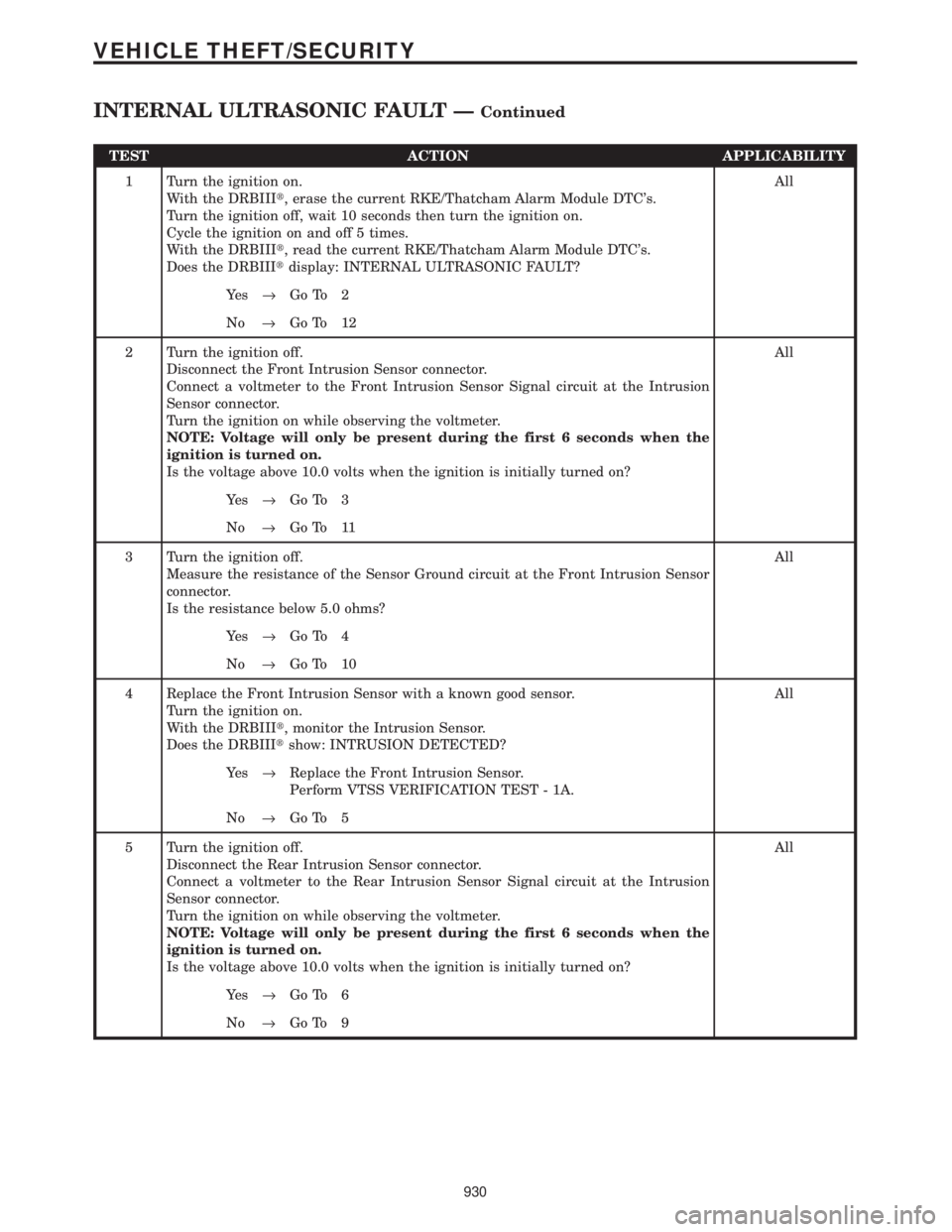
TEST ACTION APPLICABILITY
1 Turn the ignition on.
With the DRBIIIt, erase the current RKE/Thatcham Alarm Module DTC's.
Turn the ignition off, wait 10 seconds then turn the ignition on.
Cycle the ignition on and off 5 times.
With the DRBIIIt, read the current RKE/Thatcham Alarm Module DTC's.
Does the DRBIIItdisplay: INTERNAL ULTRASONIC FAULT?All
Ye s®Go To 2
No®Go To 12
2 Turn the ignition off.
Disconnect the Front Intrusion Sensor connector.
Connect a voltmeter to the Front Intrusion Sensor Signal circuit at the Intrusion
Sensor connector.
Turn the ignition on while observing the voltmeter.
NOTE: Voltage will only be present during the first 6 seconds when the
ignition is turned on.
Is the voltage above 10.0 volts when the ignition is initially turned on?All
Ye s®Go To 3
No®Go To 11
3 Turn the ignition off.
Measure the resistance of the Sensor Ground circuit at the Front Intrusion Sensor
connector.
Is the resistance below 5.0 ohms?All
Ye s®Go To 4
No®Go To 10
4 Replace the Front Intrusion Sensor with a known good sensor.
Turn the ignition on.
With the DRBIIIt, monitor the Intrusion Sensor.
Does the DRBIIItshow: INTRUSION DETECTED?All
Ye s®Replace the Front Intrusion Sensor.
Perform VTSS VERIFICATION TEST - 1A.
No®Go To 5
5 Turn the ignition off.
Disconnect the Rear Intrusion Sensor connector.
Connect a voltmeter to the Rear Intrusion Sensor Signal circuit at the Intrusion
Sensor connector.
Turn the ignition on while observing the voltmeter.
NOTE: Voltage will only be present during the first 6 seconds when the
ignition is turned on.
Is the voltage above 10.0 volts when the ignition is initially turned on?All
Ye s®Go To 6
No®Go To 9
930
VEHICLE THEFT/SECURITY
INTERNAL ULTRASONIC FAULT ÐContinued
Page 960 of 4284
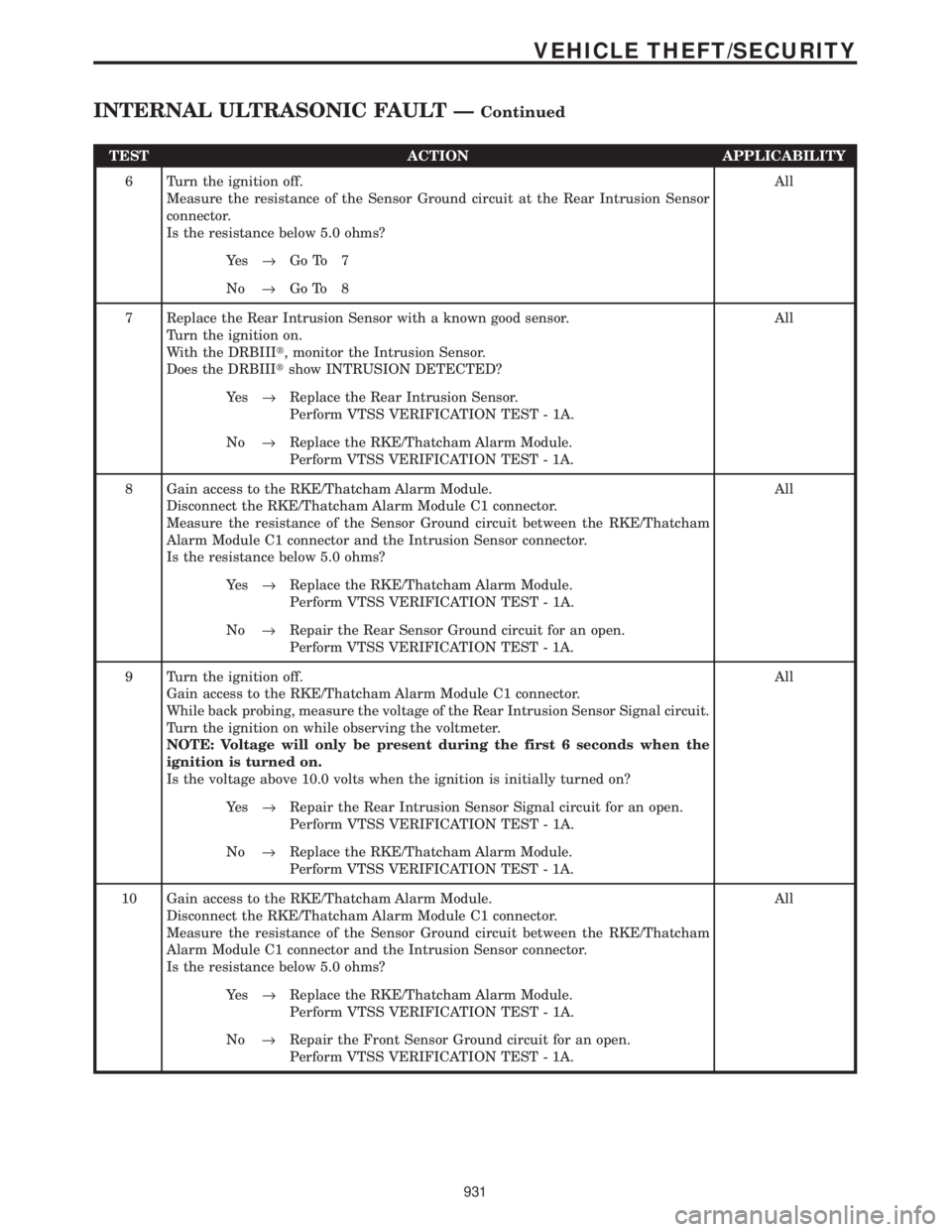
TEST ACTION APPLICABILITY
6 Turn the ignition off.
Measure the resistance of the Sensor Ground circuit at the Rear Intrusion Sensor
connector.
Is the resistance below 5.0 ohms?All
Ye s®Go To 7
No®Go To 8
7 Replace the Rear Intrusion Sensor with a known good sensor.
Turn the ignition on.
With the DRBIIIt, monitor the Intrusion Sensor.
Does the DRBIIItshow INTRUSION DETECTED?All
Ye s®Replace the Rear Intrusion Sensor.
Perform VTSS VERIFICATION TEST - 1A.
No®Replace the RKE/Thatcham Alarm Module.
Perform VTSS VERIFICATION TEST - 1A.
8 Gain access to the RKE/Thatcham Alarm Module.
Disconnect the RKE/Thatcham Alarm Module C1 connector.
Measure the resistance of the Sensor Ground circuit between the RKE/Thatcham
Alarm Module C1 connector and the Intrusion Sensor connector.
Is the resistance below 5.0 ohms?All
Ye s®Replace the RKE/Thatcham Alarm Module.
Perform VTSS VERIFICATION TEST - 1A.
No®Repair the Rear Sensor Ground circuit for an open.
Perform VTSS VERIFICATION TEST - 1A.
9 Turn the ignition off.
Gain access to the RKE/Thatcham Alarm Module C1 connector.
While back probing, measure the voltage of the Rear Intrusion Sensor Signal circuit.
Turn the ignition on while observing the voltmeter.
NOTE: Voltage will only be present during the first 6 seconds when the
ignition is turned on.
Is the voltage above 10.0 volts when the ignition is initially turned on?All
Ye s®Repair the Rear Intrusion Sensor Signal circuit for an open.
Perform VTSS VERIFICATION TEST - 1A.
No®Replace the RKE/Thatcham Alarm Module.
Perform VTSS VERIFICATION TEST - 1A.
10 Gain access to the RKE/Thatcham Alarm Module.
Disconnect the RKE/Thatcham Alarm Module C1 connector.
Measure the resistance of the Sensor Ground circuit between the RKE/Thatcham
Alarm Module C1 connector and the Intrusion Sensor connector.
Is the resistance below 5.0 ohms?All
Ye s®Replace the RKE/Thatcham Alarm Module.
Perform VTSS VERIFICATION TEST - 1A.
No®Repair the Front Sensor Ground circuit for an open.
Perform VTSS VERIFICATION TEST - 1A.
931
VEHICLE THEFT/SECURITY
INTERNAL ULTRASONIC FAULT ÐContinued