bulb CHRYSLER VOYAGER 2001 Owner's Manual
[x] Cancel search | Manufacturer: CHRYSLER, Model Year: 2001, Model line: VOYAGER, Model: CHRYSLER VOYAGER 2001Pages: 4284, PDF Size: 83.53 MB
Page 616 of 4284
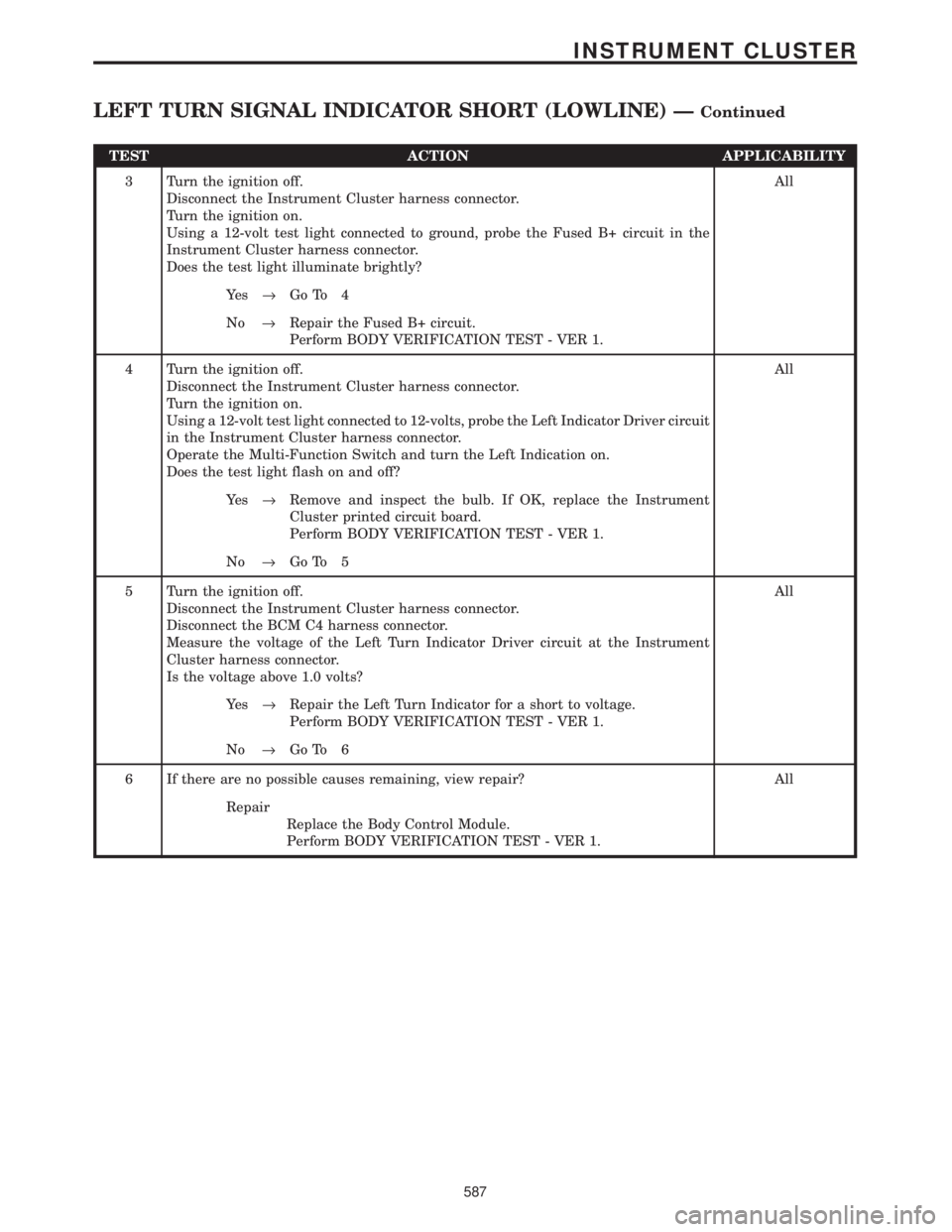
TEST ACTION APPLICABILITY
3 Turn the ignition off.
Disconnect the Instrument Cluster harness connector.
Turn the ignition on.
Using a 12-volt test light connected to ground, probe the Fused B+ circuit in the
Instrument Cluster harness connector.
Does the test light illuminate brightly?All
Ye s®Go To 4
No®Repair the Fused B+ circuit.
Perform BODY VERIFICATION TEST - VER 1.
4 Turn the ignition off.
Disconnect the Instrument Cluster harness connector.
Turn the ignition on.
Using a 12-volt test light connected to 12-volts, probe the Left Indicator Driver circuit
in the Instrument Cluster harness connector.
Operate the Multi-Function Switch and turn the Left Indication on.
Does the test light flash on and off?All
Ye s®Remove and inspect the bulb. If OK, replace the Instrument
Cluster printed circuit board.
Perform BODY VERIFICATION TEST - VER 1.
No®Go To 5
5 Turn the ignition off.
Disconnect the Instrument Cluster harness connector.
Disconnect the BCM C4 harness connector.
Measure the voltage of the Left Turn Indicator Driver circuit at the Instrument
Cluster harness connector.
Is the voltage above 1.0 volts?All
Ye s®Repair the Left Turn Indicator for a short to voltage.
Perform BODY VERIFICATION TEST - VER 1.
No®Go To 6
6 If there are no possible causes remaining, view repair? All
Repair
Replace the Body Control Module.
Perform BODY VERIFICATION TEST - VER 1.
587
INSTRUMENT CLUSTER
LEFT TURN SIGNAL INDICATOR SHORT (LOWLINE) ÐContinued
Page 634 of 4284
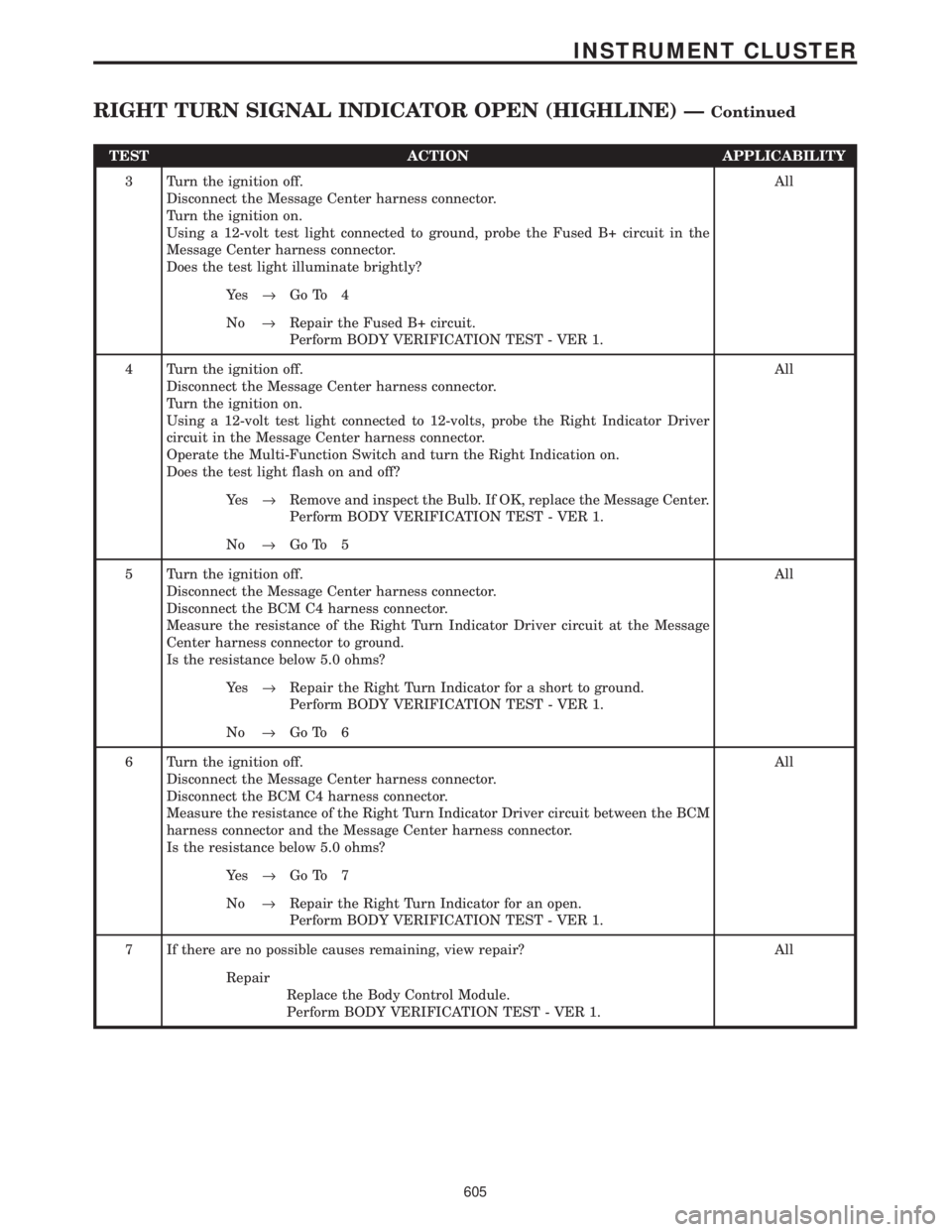
TEST ACTION APPLICABILITY
3 Turn the ignition off.
Disconnect the Message Center harness connector.
Turn the ignition on.
Using a 12-volt test light connected to ground, probe the Fused B+ circuit in the
Message Center harness connector.
Does the test light illuminate brightly?All
Ye s®Go To 4
No®Repair the Fused B+ circuit.
Perform BODY VERIFICATION TEST - VER 1.
4 Turn the ignition off.
Disconnect the Message Center harness connector.
Turn the ignition on.
Using a 12-volt test light connected to 12-volts, probe the Right Indicator Driver
circuit in the Message Center harness connector.
Operate the Multi-Function Switch and turn the Right Indication on.
Does the test light flash on and off?All
Ye s®Remove and inspect the Bulb. If OK, replace the Message Center.
Perform BODY VERIFICATION TEST - VER 1.
No®Go To 5
5 Turn the ignition off.
Disconnect the Message Center harness connector.
Disconnect the BCM C4 harness connector.
Measure the resistance of the Right Turn Indicator Driver circuit at the Message
Center harness connector to ground.
Is the resistance below 5.0 ohms?All
Ye s®Repair the Right Turn Indicator for a short to ground.
Perform BODY VERIFICATION TEST - VER 1.
No®Go To 6
6 Turn the ignition off.
Disconnect the Message Center harness connector.
Disconnect the BCM C4 harness connector.
Measure the resistance of the Right Turn Indicator Driver circuit between the BCM
harness connector and the Message Center harness connector.
Is the resistance below 5.0 ohms?All
Ye s®Go To 7
No®Repair the Right Turn Indicator for an open.
Perform BODY VERIFICATION TEST - VER 1.
7 If there are no possible causes remaining, view repair? All
Repair
Replace the Body Control Module.
Perform BODY VERIFICATION TEST - VER 1.
605
INSTRUMENT CLUSTER
RIGHT TURN SIGNAL INDICATOR OPEN (HIGHLINE) ÐContinued
Page 636 of 4284
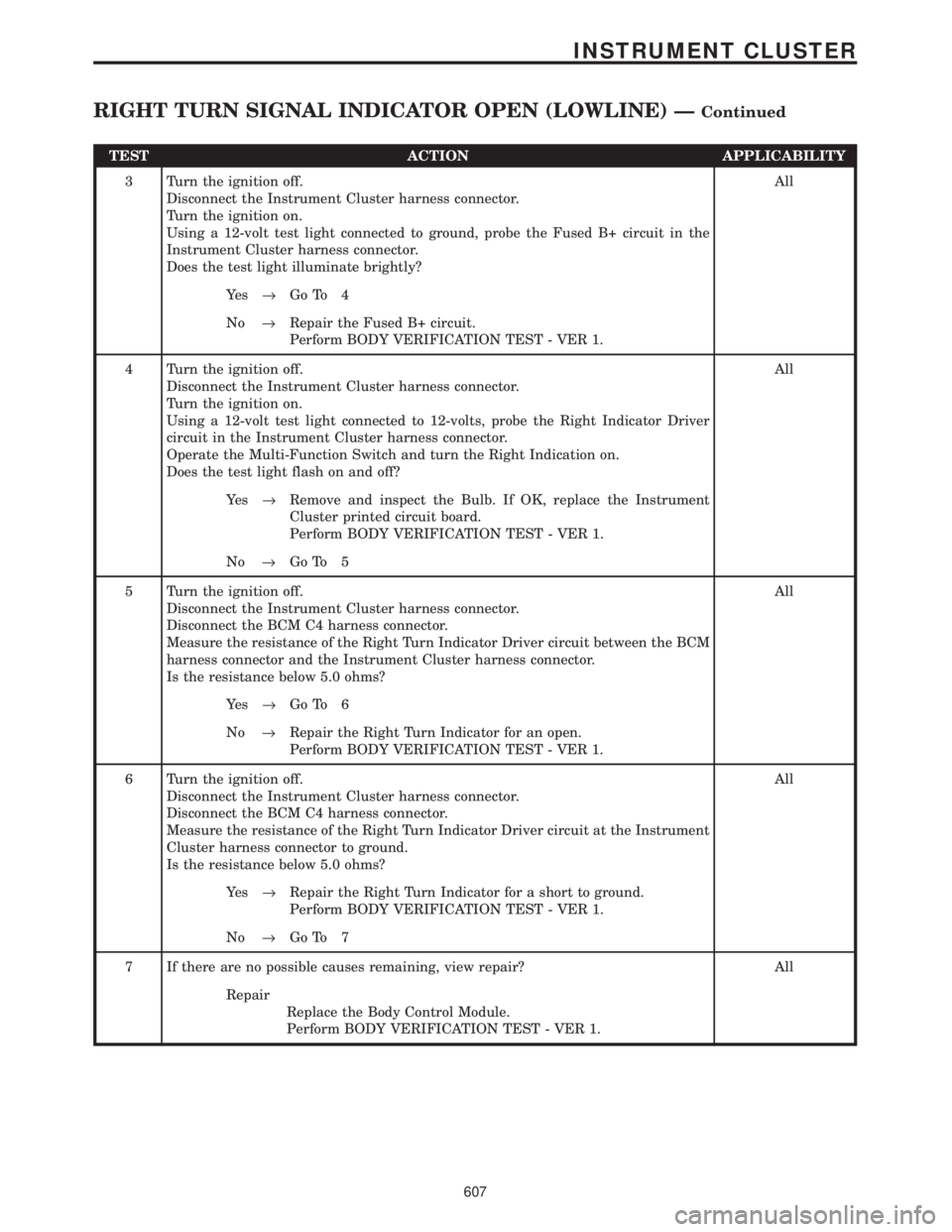
TEST ACTION APPLICABILITY
3 Turn the ignition off.
Disconnect the Instrument Cluster harness connector.
Turn the ignition on.
Using a 12-volt test light connected to ground, probe the Fused B+ circuit in the
Instrument Cluster harness connector.
Does the test light illuminate brightly?All
Ye s®Go To 4
No®Repair the Fused B+ circuit.
Perform BODY VERIFICATION TEST - VER 1.
4 Turn the ignition off.
Disconnect the Instrument Cluster harness connector.
Turn the ignition on.
Using a 12-volt test light connected to 12-volts, probe the Right Indicator Driver
circuit in the Instrument Cluster harness connector.
Operate the Multi-Function Switch and turn the Right Indication on.
Does the test light flash on and off?All
Ye s®Remove and inspect the Bulb. If OK, replace the Instrument
Cluster printed circuit board.
Perform BODY VERIFICATION TEST - VER 1.
No®Go To 5
5 Turn the ignition off.
Disconnect the Instrument Cluster harness connector.
Disconnect the BCM C4 harness connector.
Measure the resistance of the Right Turn Indicator Driver circuit between the BCM
harness connector and the Instrument Cluster harness connector.
Is the resistance below 5.0 ohms?All
Ye s®Go To 6
No®Repair the Right Turn Indicator for an open.
Perform BODY VERIFICATION TEST - VER 1.
6 Turn the ignition off.
Disconnect the Instrument Cluster harness connector.
Disconnect the BCM C4 harness connector.
Measure the resistance of the Right Turn Indicator Driver circuit at the Instrument
Cluster harness connector to ground.
Is the resistance below 5.0 ohms?All
Ye s®Repair the Right Turn Indicator for a short to ground.
Perform BODY VERIFICATION TEST - VER 1.
No®Go To 7
7 If there are no possible causes remaining, view repair? All
Repair
Replace the Body Control Module.
Perform BODY VERIFICATION TEST - VER 1.
607
INSTRUMENT CLUSTER
RIGHT TURN SIGNAL INDICATOR OPEN (LOWLINE) ÐContinued
Page 638 of 4284
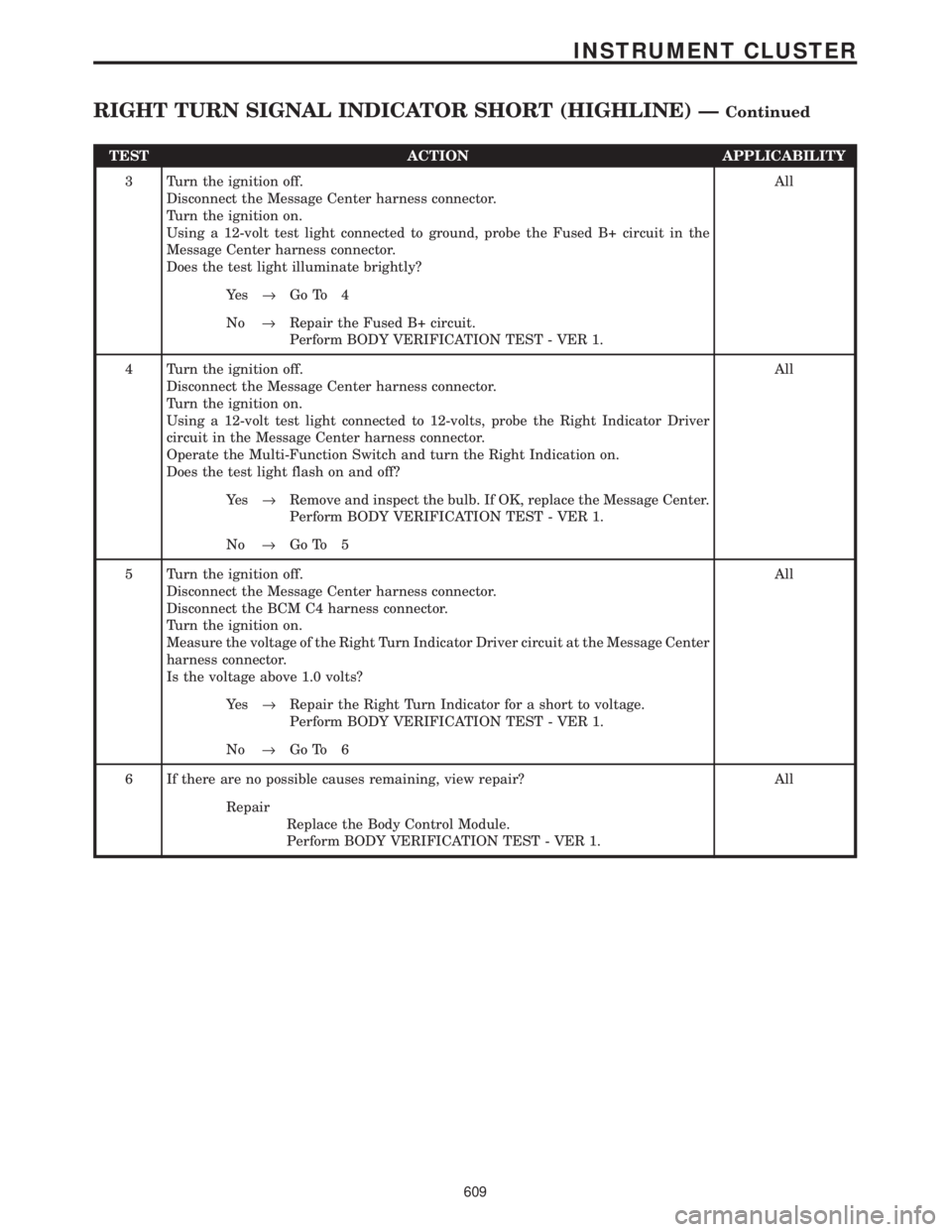
TEST ACTION APPLICABILITY
3 Turn the ignition off.
Disconnect the Message Center harness connector.
Turn the ignition on.
Using a 12-volt test light connected to ground, probe the Fused B+ circuit in the
Message Center harness connector.
Does the test light illuminate brightly?All
Ye s®Go To 4
No®Repair the Fused B+ circuit.
Perform BODY VERIFICATION TEST - VER 1.
4 Turn the ignition off.
Disconnect the Message Center harness connector.
Turn the ignition on.
Using a 12-volt test light connected to 12-volts, probe the Right Indicator Driver
circuit in the Message Center harness connector.
Operate the Multi-Function Switch and turn the Right Indication on.
Does the test light flash on and off?All
Ye s®Remove and inspect the bulb. If OK, replace the Message Center.
Perform BODY VERIFICATION TEST - VER 1.
No®Go To 5
5 Turn the ignition off.
Disconnect the Message Center harness connector.
Disconnect the BCM C4 harness connector.
Turn the ignition on.
Measure the voltage of the Right Turn Indicator Driver circuit at the Message Center
harness connector.
Is the voltage above 1.0 volts?All
Ye s®Repair the Right Turn Indicator for a short to voltage.
Perform BODY VERIFICATION TEST - VER 1.
No®Go To 6
6 If there are no possible causes remaining, view repair? All
Repair
Replace the Body Control Module.
Perform BODY VERIFICATION TEST - VER 1.
609
INSTRUMENT CLUSTER
RIGHT TURN SIGNAL INDICATOR SHORT (HIGHLINE) ÐContinued
Page 640 of 4284
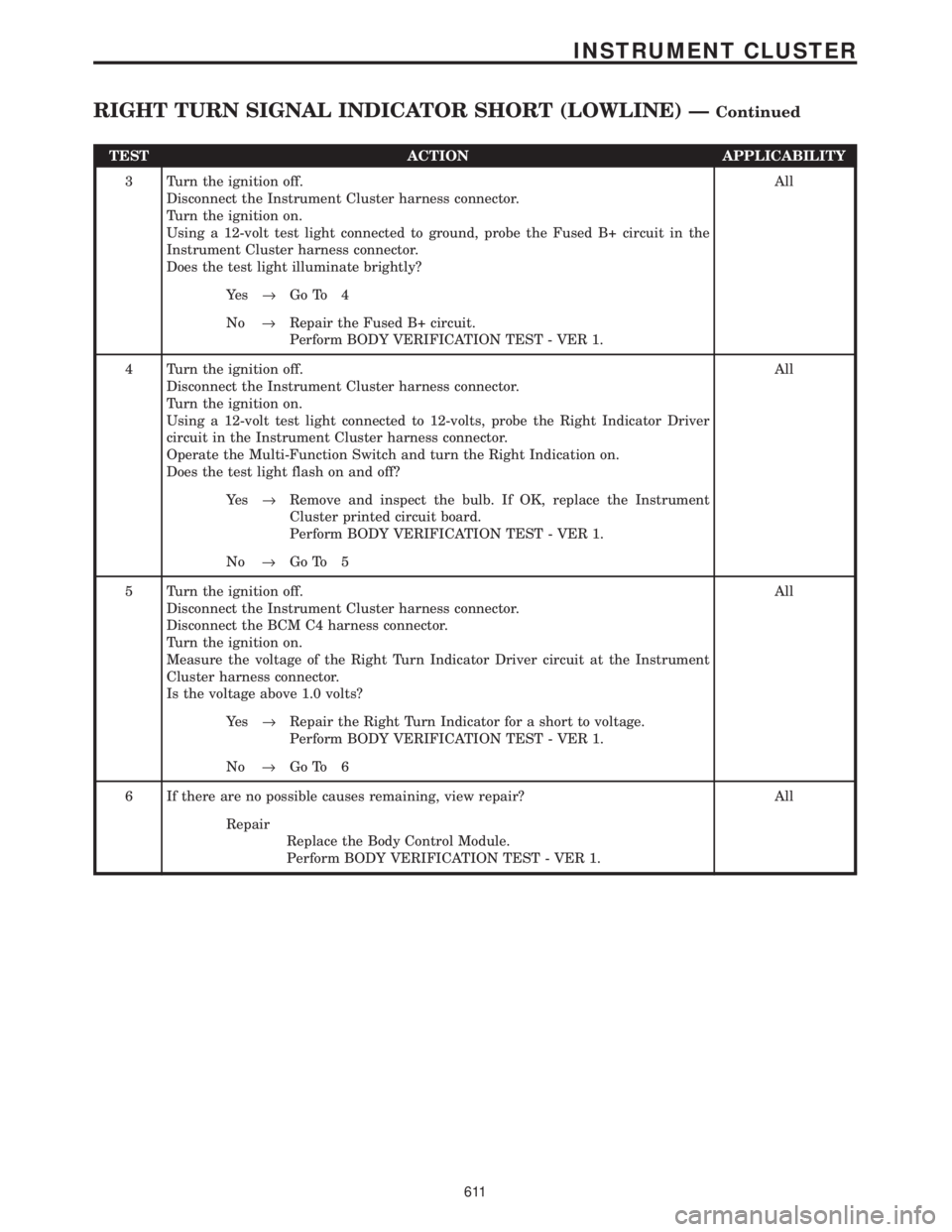
TEST ACTION APPLICABILITY
3 Turn the ignition off.
Disconnect the Instrument Cluster harness connector.
Turn the ignition on.
Using a 12-volt test light connected to ground, probe the Fused B+ circuit in the
Instrument Cluster harness connector.
Does the test light illuminate brightly?All
Ye s®Go To 4
No®Repair the Fused B+ circuit.
Perform BODY VERIFICATION TEST - VER 1.
4 Turn the ignition off.
Disconnect the Instrument Cluster harness connector.
Turn the ignition on.
Using a 12-volt test light connected to 12-volts, probe the Right Indicator Driver
circuit in the Instrument Cluster harness connector.
Operate the Multi-Function Switch and turn the Right Indication on.
Does the test light flash on and off?All
Ye s®Remove and inspect the bulb. If OK, replace the Instrument
Cluster printed circuit board.
Perform BODY VERIFICATION TEST - VER 1.
No®Go To 5
5 Turn the ignition off.
Disconnect the Instrument Cluster harness connector.
Disconnect the BCM C4 harness connector.
Turn the ignition on.
Measure the voltage of the Right Turn Indicator Driver circuit at the Instrument
Cluster harness connector.
Is the voltage above 1.0 volts?All
Ye s®Repair the Right Turn Indicator for a short to voltage.
Perform BODY VERIFICATION TEST - VER 1.
No®Go To 6
6 If there are no possible causes remaining, view repair? All
Repair
Replace the Body Control Module.
Perform BODY VERIFICATION TEST - VER 1.
611
INSTRUMENT CLUSTER
RIGHT TURN SIGNAL INDICATOR SHORT (LOWLINE) ÐContinued
Page 667 of 4284

Symptom:
FRONT COURTESY LAMPS OUTPUT SHORT
When Monitored and Set Condition:
FRONT COURTESY LAMPS OUTPUT SHORT
When Monitored: Anytime the Body Control Module is active.
Set Condition: When the voltage of the Headlamp Switch MUX Return Circuit falls below
5.0 volts for 10 seconds.
POSSIBLE CAUSES
HEALAMP SWITCH MUX RETURN CIRCUIT SHORT TO GROUND
COURTESY LAMPS DRIVER CIRCUIT OPEN
PANEL LAMPS DIMMER SIGNAL CIRCUIT OPEN
BODY CONTROL MODULE
HEADLAMP SWITCH
TEST ACTION APPLICABILITY
1 Turn the ignition on.
With the DRBIIIt, clear all BCM DTC's.
Turn the courtesy lamps on.
With the DRBIIIt, read the DTC information.
Does the DRBIIItread: Front Courtesy Lamps Output Short?All
Ye s®Repair the Headlamp Switch MUX Return Circuit for a short to
ground condition.
Perform BODY VERIFICATION TEST - VER 1.
No®Go To 2
2 Turn the ignition off.
Remove and inspect the inoperative courtesy lamp bulb.
With the DRBIIIt, measure the resistance of the Courtesy Lamps Driver- Dome
Circuit.
Is the resistance above 1000 ohms?All
Ye s®Go To 3
No®Repair the Open Courtesy Lamps Driver-Dome Circuit and re-
place the bulb.
Perform BODY VERIFICATION TEST - VER 1.
3 Turn the ignition off.
Disconnect the Headlamp Switch harness connector.
Disconnect the Body Control Module harness connector.
Measure the resistance of the Panel Lamps Dimmer Signal Circuit.
Is the resistance below 5.0 ohms?All
Ye s®Go To 4
No®Repair the Open Panel Lamps Dimmer Signal Circuit.
Perform BODY VERIFICATION TEST - VER 1.
638
INTERIOR LIGHTING
Page 1169 of 4284

Symptom:
CLUSTER LAMP FAILURE
When Monitored and Set Condition:
CLUSTER LAMP FAILURE
When Monitored: Key ON. After Key-ON bulb check.
Set Condition: When the instrument cluster informs the CAB that the cluster cannot
turn on the ABS Lamp.
POSSIBLE CAUSES
CLUSTER DTC PRESENT
CLUSTER INTERNAL FAULT
CAB -- NO ABS INDICATOR MESSAGE
CAB -- ABS INDICATOR FAULT
TEST ACTION APPLICABILITY
1 Turn the ignition on.
With the DRBIIIt, read DTCs.
Are there any Instrument Cluster DTCs present?All
Ye s®Refer to the INSTRUMENT CLUSTER category for the related
symptom(s).
Perform ABS VERIFICATION TEST - VER 1.
No®Go To 2
2 Turn the ignition off.
Observe the instrument cluster indicators.
Turn the ignition on.
Did the ABS Indicator illuminate for several seconds and then go out?All
Ye s®Go To 3
No®Go To 4
3NOTE: The DRBIIItcommunication with the CAB must be operational for
the result of this test to be valid.
Turn the ignition off.
Remove Fuse 21 (ABS valve power) from the IPM.
Perform the Key-on Bulb Check.
Does the ABS Indicator remain on after the bulb check?All
Ye s®Test Complete.
No®Replace the Controller Antilock Brake in accordance with the
Service Information.
Perform ABS VERIFICATION TEST - VER 1.
12
BRAKES (CAB)
Page 1196 of 4284

Symptom:
*TRAC ON INDICATOR NEVER/ALWAYS ON
POSSIBLE CAUSES
CAB -- INTERNAL FAULT
CHECK TRACTION CONTROL SYSTEM
CLUSTER FAILS SELF TEST
CAB - NO TRAC MESSAGE
TEST ACTION APPLICABILITY
1NOTE: The DRBIIItmust be able to communicate with the CAB prior to
performing this test.
NOTE: Note: If any CAB DTC's are present, they must be repaired prior to
performing this test.
Perform the KEY-ON bulb test.
Did the TRAC Indicator illuminate and then go out?All
Ye s®Go To 2
No®Go To 3
2 Make sure the Traction Control system has not been deactivated with the TRAC OFF
switch.
NOTE: The purpose of this test is to determine if the Traction Control
system is operating.
With the DRBIIItin Inputs/Outputs, read the ABS Pump Motor voltage state.
Accelerate sufficient to cause drive wheel slip.
Does the TRAC Indicator illuminate and the DRBIIItdisplay approximately 9 volts?All
Ye s®The traction control system is functioning normally.
Perform ABS VERIFICATION TEST - VER 1.
No®Replace the Controller Antilock Brake in accordance with the
Service Information.
Perform ABS VERIFICATION TEST - VER 1.
3NOTE: The purpose of this test is to perform the Instrument Cluster self
test.
Depress and hold the Odometer Reset Button.
Turn the Key from OFF to ON and then back to OFF.
Release the Odometer Reset Button.
Do the Instrument Cluster Indicators and Gauges activate and deactivate?All
Ye s®Replace the Controller Antilock Brake in accordance with the
Service Information.
Perform ABS VERIFICATION TEST - VER 1.
No®Replace the Instrument Cluster in accordance with the Service
Information.
Perform ABS VERIFICATION TEST - VER 1.
39
BRAKES (CAB)
Page 1222 of 4284
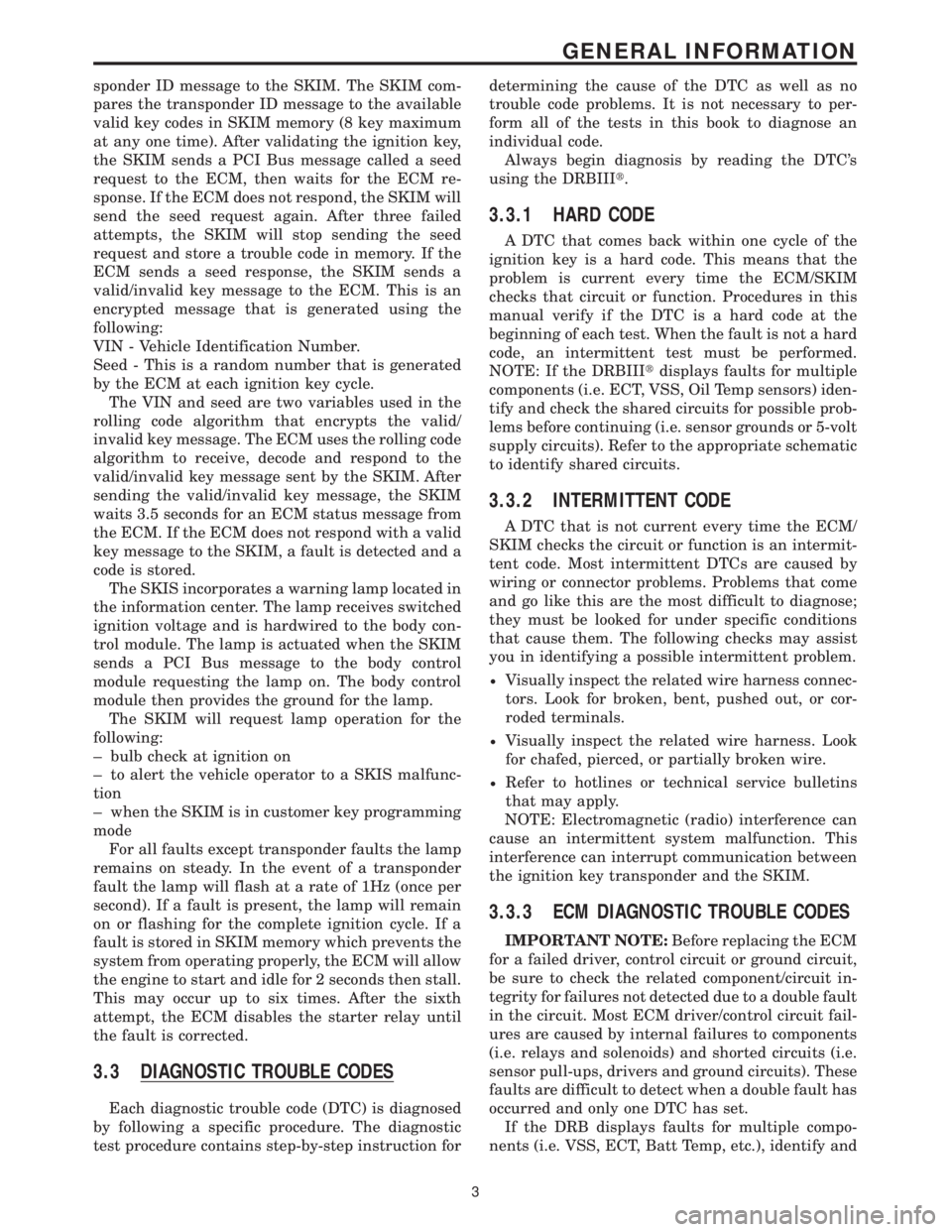
sponder ID message to the SKIM. The SKIM com-
pares the transponder ID message to the available
valid key codes in SKIM memory (8 key maximum
at any one time). After validating the ignition key,
the SKIM sends a PCI Bus message called a seed
request to the ECM, then waits for the ECM re-
sponse. If the ECM does not respond, the SKIM will
send the seed request again. After three failed
attempts, the SKIM will stop sending the seed
request and store a trouble code in memory. If the
ECM sends a seed response, the SKIM sends a
valid/invalid key message to the ECM. This is an
encrypted message that is generated using the
following:
VIN - Vehicle Identification Number.
Seed - This is a random number that is generated
by the ECM at each ignition key cycle.
The VIN and seed are two variables used in the
rolling code algorithm that encrypts the valid/
invalid key message. The ECM uses the rolling code
algorithm to receive, decode and respond to the
valid/invalid key message sent by the SKIM. After
sending the valid/invalid key message, the SKIM
waits 3.5 seconds for an ECM status message from
the ECM. If the ECM does not respond with a valid
key message to the SKIM, a fault is detected and a
code is stored.
The SKIS incorporates a warning lamp located in
the information center. The lamp receives switched
ignition voltage and is hardwired to the body con-
trol module. The lamp is actuated when the SKIM
sends a PCI Bus message to the body control
module requesting the lamp on. The body control
module then provides the ground for the lamp.
The SKIM will request lamp operation for the
following:
± bulb check at ignition on
± to alert the vehicle operator to a SKIS malfunc-
tion
± when the SKIM is in customer key programming
mode
For all faults except transponder faults the lamp
remains on steady. In the event of a transponder
fault the lamp will flash at a rate of 1Hz (once per
second). If a fault is present, the lamp will remain
on or flashing for the complete ignition cycle. If a
fault is stored in SKIM memory which prevents the
system from operating properly, the ECM will allow
the engine to start and idle for 2 seconds then stall.
This may occur up to six times. After the sixth
attempt, the ECM disables the starter relay until
the fault is corrected.
3.3 DIAGNOSTIC TROUBLE CODES
Each diagnostic trouble code (DTC) is diagnosed
by following a specific procedure. The diagnostic
test procedure contains step-by-step instruction fordetermining the cause of the DTC as well as no
trouble code problems. It is not necessary to per-
form all of the tests in this book to diagnose an
individual code.
Always begin diagnosis by reading the DTC's
using the DRBIIIt.
3.3.1 HARD CODE
A DTC that comes back within one cycle of the
ignition key is a hard code. This means that the
problem is current every time the ECM/SKIM
checks that circuit or function. Procedures in this
manual verify if the DTC is a hard code at the
beginning of each test. When the fault is not a hard
code, an intermittent test must be performed.
NOTE: If the DRBIIItdisplays faults for multiple
components (i.e. ECT, VSS, Oil Temp sensors) iden-
tify and check the shared circuits for possible prob-
lems before continuing (i.e. sensor grounds or 5-volt
supply circuits). Refer to the appropriate schematic
to identify shared circuits.
3.3.2 INTERMITTENT CODE
A DTC that is not current every time the ECM/
SKIM checks the circuit or function is an intermit-
tent code. Most intermittent DTCs are caused by
wiring or connector problems. Problems that come
and go like this are the most difficult to diagnose;
they must be looked for under specific conditions
that cause them. The following checks may assist
you in identifying a possible intermittent problem.
²Visually inspect the related wire harness connec-
tors. Look for broken, bent, pushed out, or cor-
roded terminals.
²Visually inspect the related wire harness. Look
for chafed, pierced, or partially broken wire.
²Refer to hotlines or technical service bulletins
that may apply.
NOTE: Electromagnetic (radio) interference can
cause an intermittent system malfunction. This
interference can interrupt communication between
the ignition key transponder and the SKIM.
3.3.3 ECM DIAGNOSTIC TROUBLE CODES
IMPORTANT NOTE:Before replacing the ECM
for a failed driver, control circuit or ground circuit,
be sure to check the related component/circuit in-
tegrity for failures not detected due to a double fault
in the circuit. Most ECM driver/control circuit fail-
ures are caused by internal failures to components
(i.e. relays and solenoids) and shorted circuits (i.e.
sensor pull-ups, drivers and ground circuits). These
faults are difficult to detect when a double fault has
occurred and only one DTC has set.
If the DRB displays faults for multiple compo-
nents (i.e. VSS, ECT, Batt Temp, etc.), identify and
3
GENERAL INFORMATION
Page 1821 of 4284

²Engine running at 420 to 480 rpm for 10 sec-
onds
²Oil pressure switch closed to ground for (1 sec-
ond minimum, 2 seconds maximum)
Chime rate: 168 to 192 chimes per minute.
DIAGNOSIS AND TESTING - SEAT BELT CHIME
The seat belt chime will sound for 4 to 8 seconds,
when the ignition is turned on and the driver's seat
belt is not buckled (seat belt switch is closed to
ground). This is a reminder to the driver to buckle
the seat belt. The seat belt lamp is controlled by the
ORC. The cluster will also bulb check the seat belt
warning lamp for 6 seconds. Buckling the driver's
seat belt before the time out has expired will cause
the chime to stop immediately. Chime rate: 38 to 62
chimes per minute but the lamp will remain on until
6 seconds have expired.
To test the seat belt warning system, the ignition
switch must be in the OFF position for 1 minute
before starting the test. Turn the ignition switch to
the on position with the driver's seat belt not buck-
led. The seat belt warning lamp should light and the
chime should sound 4 to 8 seconds.
DIAGNOSIS AND TESTING - SEAT BELT LAMP
The seat belt lamp in the instrument cluster sig-
nals the vehicle passengers to fasten their seat belts.
The seat belt lamp is illuminated directly by the
instrument cluster for 6 seconds after the instrument
cluster receives the message from the ORC. The seat
belt lamp is therefore illuminated for 6 seconds
whenever the ignition switch is moved to run/start
position.
(1) While ignition is off, the seat belt lamp will not
be illuminated.
(2) The ignition power feed status will be updated
every 250 milliseconds or on change.
(3) This lamp will be checked by the instrument
cluster for 6 seconds with every run/start cycle of the
ignition switch.
DIAGNOSIS AND TESTING - TURN SIGNAL ON
CHIME
The turn signal on chime will warn the driver that
the turn signals have been left on. When the body
control module receives a turn signal input for 1/4.0
mile, vehicle speed is greater than 24 km/h (15 mph),
the chime will sound continuously until the turn sig-nal is turned OFF. If vehicle speed drops below 24
km/h (15 mph) prior to the warning being activated,
the accumulated distance traveled will be reset. The
turn signal chime is not activated when the emer-
gency flashers are turned on. Chime rate: 50612
chimes per minute.
For the turn signal warning system to operate:
²Must have input from either the right or left
turn signal lamps. Creates a voltage change between
0 and battery voltage.
²The vehicle speed sensor sends a message to the
Powertrain Control Module that vehicle has exceeded
24 km/h (15 mph) for 1/4.0 mile).
²When the above two conditions are met, the
chime will sound. The chime will stop when no fur-
ther voltage change is detected.
²If hazard warning signals are pulsing, no chime
will sound.
²If speed drops below 24 km/h (15 mph) before
the warning is issued, the warning will not be issued
and the distance counter will be reset.
²If turn signal lamps are not working properly,
the chime will not sound.
²When using the scan tool, refer to the proper
Body Diagnostic Manual for the procedure.
DIAGNOSIS AND TESTING - WARNING LAMP
ANNOUNCEMENT CHIME
The warning lamp announcement chime will warn
the driver to scan the instrument cluster to observe
which warning lamp is illuminated. Whenever the
volts, low fuel, airbag, door ajar or gate ajar lamps
are first illuminated, the chime will sound one tone.
The door/liftgate ajar warning lamp announcement
chime sounds only if the vehicle speed is above 4
m.p.h.
Two seconds after ignition switch is turned ON or
until the seat belt warning chime ends, all warning
announcement chimes will be consolidated into one
warning announcement. This will occur 2 seconds
after the seat belt warning chime ends. If a warning
announcement should occur while another warning
chime in progress (turn signal, low oil pressure or
high speed warnings), no additional chimes will
sound after the chime in progress ends. All associ-
ated lamps will be illuminated, and the active chime
will be the warning announcement.
RSCHIME/BUZZER8B-3
CHIME/BUZZER (Continued)