immobilizer CHRYSLER VOYAGER 2001 Workshop Manual
[x] Cancel search | Manufacturer: CHRYSLER, Model Year: 2001, Model line: VOYAGER, Model: CHRYSLER VOYAGER 2001Pages: 4284, PDF Size: 83.53 MB
Page 3789 of 4284
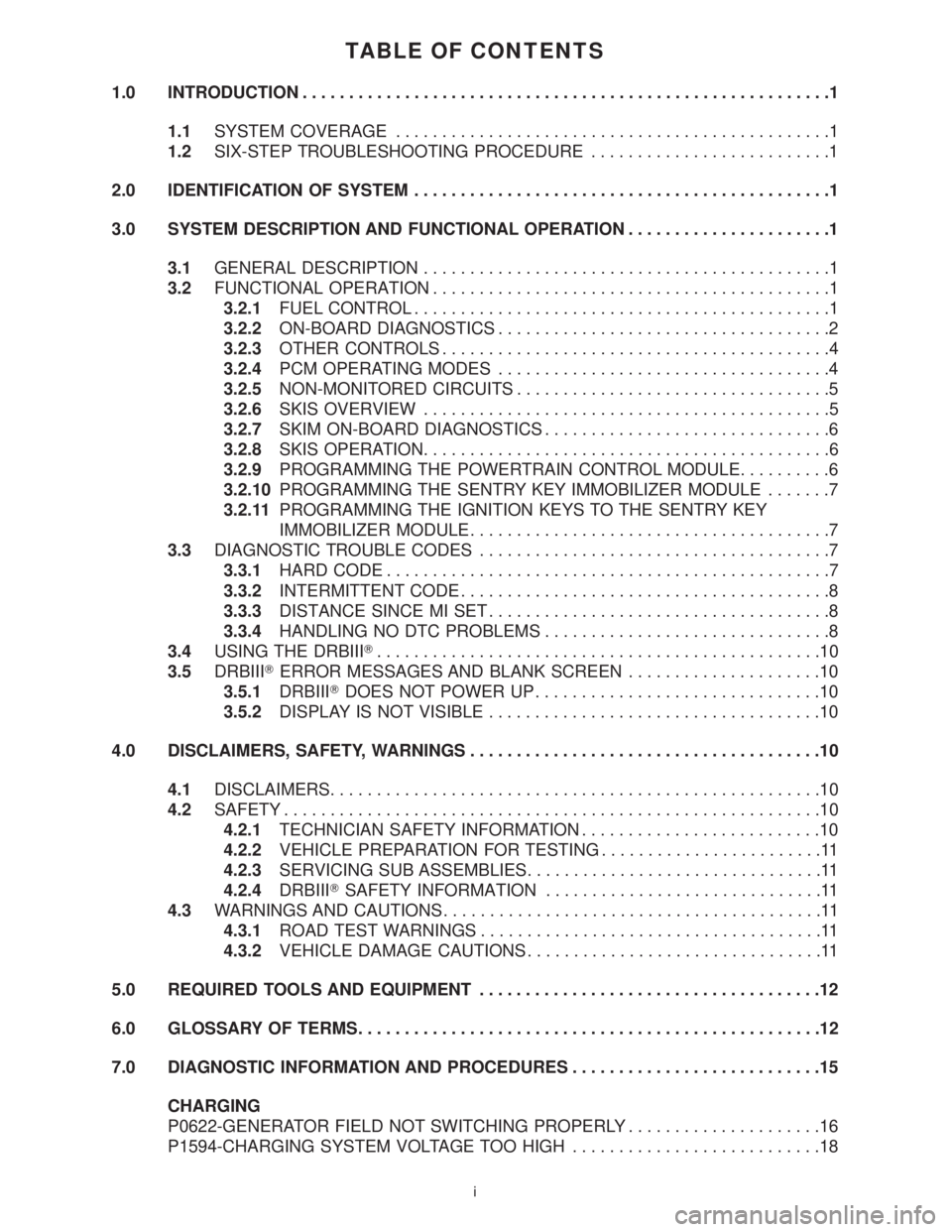
TABLE OF CONTENTS
1.0 INTRODUCTION.........................................................1
1.1SYSTEM COVERAGE...............................................1
1.2SIX-STEP TROUBLESHOOTING PROCEDURE..........................1
2.0 IDENTIFICATION OF SYSTEM.............................................1
3.0 SYSTEM DESCRIPTION AND FUNCTIONAL OPERATION......................1
3.1GENERAL DESCRIPTION............................................1
3.2FUNCTIONAL OPERATION...........................................1
3.2.1FUEL CONTROL.............................................1
3.2.2ON-BOARD DIAGNOSTICS....................................2
3.2.3OTHER CONTROLS..........................................4
3.2.4PCM OPERATING MODES....................................4
3.2.5NON-MONITORED CIRCUITS..................................5
3.2.6SKIS OVERVIEW............................................5
3.2.7SKIM ON-BOARD DIAGNOSTICS...............................6
3.2.8SKIS OPERATION............................................6
3.2.9PROGRAMMING THE POWERTRAIN CONTROL MODULE..........6
3.2.10PROGRAMMING THE SENTRY KEY IMMOBILIZER MODULE.......7
3.2.11PROGRAMMING THE IGNITION KEYS TO THE SENTRY KEY
IMMOBILIZER MODULE.......................................7
3.3DIAGNOSTIC TROUBLE CODES......................................7
3.3.1HARD CODE................................................7
3.3.2INTERMITTENT CODE........................................8
3.3.3DISTANCE SINCE MI SET.....................................8
3.3.4HANDLING NO DTC PROBLEMS...............................8
3.4USING THE DRBIIIT................................................10
3.5DRBIIITERROR MESSAGES AND BLANK SCREEN.....................10
3.5.1DRBIIITDOES NOT POWER UP...............................10
3.5.2DISPLAY IS NOT VISIBLE....................................10
4.0 DISCLAIMERS, SAFETY, WARNINGS......................................10
4.1DISCLAIMERS.....................................................10
4.2SAFETY..........................................................10
4.2.1TECHNICIAN SAFETY INFORMATION..........................10
4.2.2VEHICLE PREPARATION FOR TESTING........................11
4.2.3SERVICING SUB ASSEMBLIES................................11
4.2.4DRBIIITSAFETY INFORMATION..............................11
4.3WARNINGS AND CAUTIONS.........................................11
4.3.1ROAD TEST WARNINGS.....................................11
4.3.2VEHICLE DAMAGE CAUTIONS................................11
5.0 REQUIRED TOOLS AND EQUIPMENT.....................................12
6.0 GLOSSARY OF TERMS..................................................12
7.0 DIAGNOSTIC INFORMATION AND PROCEDURES...........................15
CHARGING
P0622-GENERATOR FIELD NOT SWITCHING PROPERLY.....................16
P1594-CHARGING SYSTEM VOLTAGE TOO HIGH...........................18
i
Page 3790 of 4284
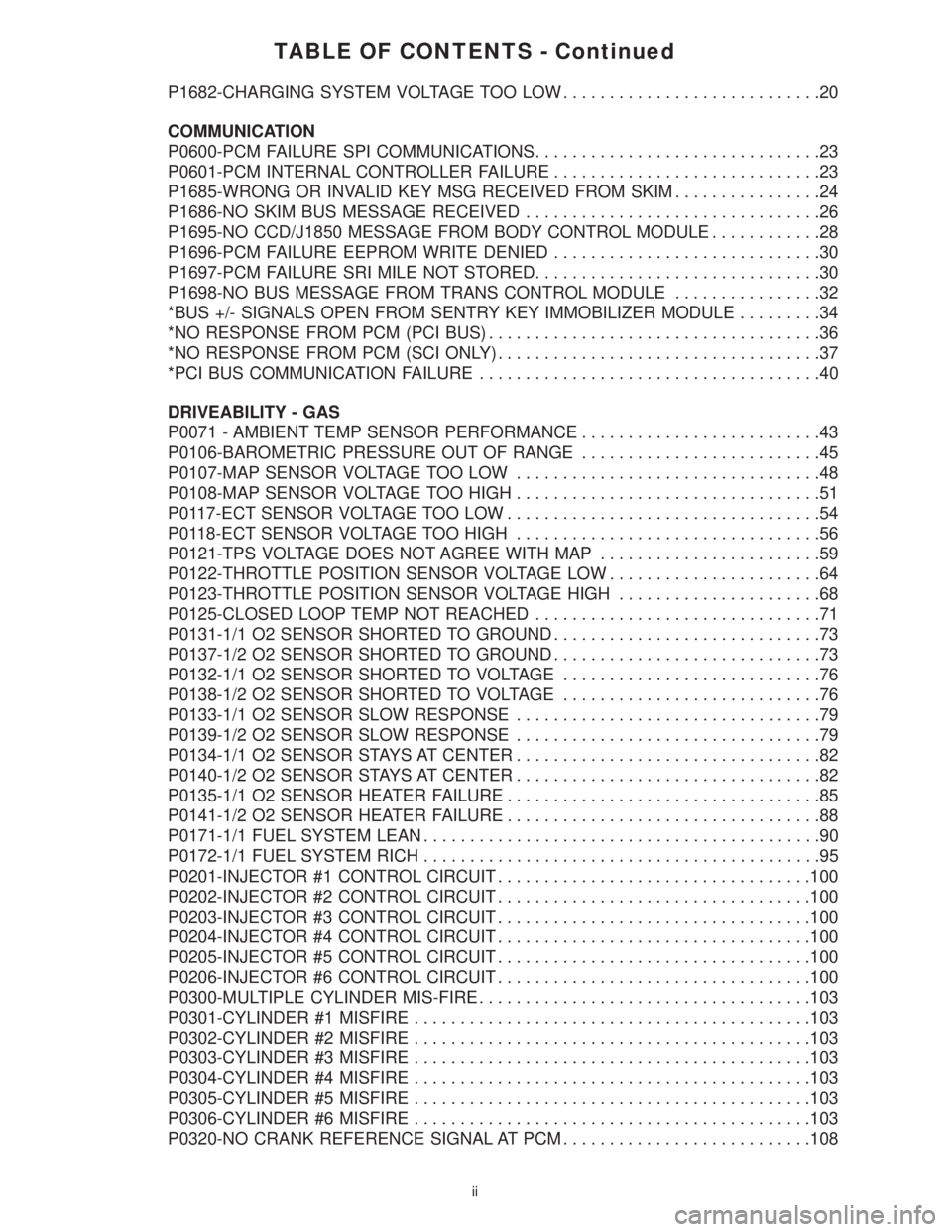
TABLE OF CONTENTS - Continued
P1682-CHARGING SYSTEM VOLTAGE TOO LOW............................20
COMMUNICATION
P0600-PCM FAILURE SPI COMMUNICATIONS...............................23
P0601-PCM INTERNAL CONTROLLER FAILURE.............................23
P1685-WRONG OR INVALID KEY MSG RECEIVED FROM SKIM................24
P1686-NO SKIM BUS MESSAGE RECEIVED................................26
P1695-NO CCD/J1850 MESSAGE FROM BODY CONTROL MODULE............28
P1696-PCM FAILURE EEPROM WRITE DENIED.............................30
P1697-PCM FAILURE SRI MILE NOT STORED...............................30
P1698-NO BUS MESSAGE FROM TRANS CONTROL MODULE................32
*BUS +/- SIGNALS OPEN FROM SENTRY KEY IMMOBILIZER MODULE.........34
*NO RESPONSE FROM PCM (PCI BUS)....................................36
*NO RESPONSE FROM PCM (SCI ONLY)...................................37
*PCI BUS COMMUNICATION FAILURE.....................................40
DRIVEABILITY - GAS
P0071 - AMBIENT TEMP SENSOR PERFORMANCE..........................43
P0106-BAROMETRIC PRESSURE OUT OF RANGE..........................45
P0107-MAP SENSOR VOLTAGE TOO LOW.................................48
P0108-MAP SENSOR VOLTAGE TOO HIGH.................................51
P0117-ECT SENSOR VOLTAGE TOO LOW..................................54
P0118-ECT SENSOR VOLTAGE TOO HIGH.................................56
P0121-TPS VOLTAGE DOES NOT AGREE WITH MAP........................59
P0122-THROTTLE POSITION SENSOR VOLTAGE LOW.......................64
P0123-THROTTLE POSITION SENSOR VOLTAGE HIGH......................68
P0125-CLOSED LOOP TEMP NOT REACHED...............................71
P0131-1/1 O2 SENSOR SHORTED TO GROUND.............................73
P0137-1/2 O2 SENSOR SHORTED TO GROUND.............................73
P0132-1/1 O2 SENSOR SHORTED TO VOLTAGE............................76
P0138-1/2 O2 SENSOR SHORTED TO VOLTAGE............................76
P0133-1/1 O2 SENSOR SLOW RESPONSE.................................79
P0139-1/2 O2 SENSOR SLOW RESPONSE.................................79
P0134-1/1 O2 SENSOR STAYS AT CENTER.................................82
P0140-1/2 O2 SENSOR STAYS AT CENTER.................................82
P0135-1/1 O2 SENSOR HEATER FAILURE..................................85
P0141-1/2 O2 SENSOR HEATER FAILURE..................................88
P0171-1/1 FUEL SYSTEM LEAN...........................................90
P0172-1/1 FUEL SYSTEM RICH...........................................95
P0201-INJECTOR #1 CONTROL CIRCUIT..................................100
P0202-INJECTOR #2 CONTROL CIRCUIT..................................100
P0203-INJECTOR #3 CONTROL CIRCUIT..................................100
P0204-INJECTOR #4 CONTROL CIRCUIT..................................100
P0205-INJECTOR #5 CONTROL CIRCUIT..................................100
P0206-INJECTOR #6 CONTROL CIRCUIT..................................100
P0300-MULTIPLE CYLINDER MIS-FIRE....................................103
P0301-CYLINDER #1 MISFIRE...........................................103
P0302-CYLINDER #2 MISFIRE...........................................103
P0303-CYLINDER #3 MISFIRE...........................................103
P0304-CYLINDER #4 MISFIRE...........................................103
P0305-CYLINDER #5 MISFIRE...........................................103
P0306-CYLINDER #6 MISFIRE...........................................103
P0320-NO CRANK REFERENCE SIGNAL AT PCM...........................108
ii
Page 3799 of 4284
Once the auto shutdown and fuel pump relays
have been energized, the PCM determines the fuel
injector pulse width based on the following:
± engine coolant temperature
± manifold absolute pressure
± intake air temperature
± engine revolutions
± throttle position
The PCM determines the spark advance based on
the following:
± engine coolant temperature
± crankshaft position
± intake air temperature
± manifold absolute pressure
± throttle position
Engine Warm-Up Modeþ This is an open loop
mode. The PCM adjusts injector pulse width and
controls injector synchronization by controlling the
fuel injectors' ground paths. The PCM adjusts igni-
tion timing and engine idle speed. The PCM adjusts
the idle speed by controlling the idle air control
motor.
Cruise or Idle Modeþ When the engine is at
normal operating temperature, this is a closed loop
mode.
Acceleration Modeþ This is a closed loop mode.
The PCM recognizes an increase in throttle position
and a decrease in Manifold Vacuum as engine load
increases. In response, the PCM increases the in-
jector pulse width to meet the increased load. The
A/C compressor may be de-energized for a short
period of time.
Decelerationþ This is a closed loop mode. The
PCM recognizes a decrease in throttle position and
an increase in Manifold Vacuum as engine load
decreases. In response, the PCM decreases the
injector pulse width to meet the decreased load.
Full injector shut off may be obtained during high
speed deceleration.
Wide Open Throttle Modeþ This is an open
loop mode. The throttle position sensor notifies the
PCM of a wide open throttle condition. Once a wide
open throttle is sensed, the PCM de-energizes the
A/C compressor clutch relay for 20 seconds.
3.2.5 NON-MONITORED CIRCUITS
The PCM does not monitor the following circuits,
systems, and conditions even though they could
have malfunctions that result in driveability prob-
lems. A diagnostic code may not be displayed for the
following conditions. However, problems with these
systems may cause a diagnostic code to be displayed
for other systems. For example, a fuel pressure
problem will not register a diagnostic code directly,
but could cause a rich or lean condition. This couldcause an oxygen sensor, fuel system, or misfire
monitor trouble code to be stored in the PCM.
Engine Timingþ The PCM cannot detect an
incorrectly indexed timing chain, camshaft
sprocket, or crankshaft sprocket. The PCM also
cannot detect an incorrectly indexed distributor.(*)
Fuel Pressureþ Fuel pressure is controlled by
the fuel pressure regulator. The PCM cannot detect
a clogged fuel pump inlet filter, clogged in-line filter,
or a pinched fuel supply.(*)
Fuel Injectorsþ The PCM cannot detect if a fuel
injector is clogged, the pintle is sticking, or the
wrong injectors are installed.(*)
Fuel Requirementsþ Poor quality gasoline can
cause problems such as hard starting, stalling, and
stumble. Use of methanol-gasoline blends may re-
sult in starting and driveability problems. See indi-
vidual symptoms and their definitions in Section
6.0 (Glossary of Terms).
PCM Groundsþ The PCM cannot detect a poor
system ground. However, a diagnostic trouble code
may be stored in the PCM as a result of this
condition.
Throttle Body Air Flowþ The PCM cannot
detect a clogged or restricted air cleaner inlet or
filter element.(*)
Exhaust Systemþ The PCM cannot detect a
plugged, restricted, or leaking exhaust system.(*)
Cylinder Compressionþ The PCM cannot de-
tect uneven, low, or high engine cylinder compres-
sion.(*)
Excessive Oil Consumptionþ Although the
PCM monitors the exhaust stream oxygen content
through the oxygen sensor when the system is in a
closed loop, it cannot determine excessive oil con-
sumption.
NOTE: ANY OF THESE CONDITIONS
COULD RESULT IN A RICH OR LEAN
CONDITION CAUSING AN OXYGEN SENSOR
TROUBLE CODE TO BE STORED IN THE
PCM, OR THE VEHICLE MAY EXHIBIT ONE
OR MORE OF THE DRIVEABILITY
SYMPTOMS LISTED IN THE TABLE OF
CONTENTS.
3.2.6 SKIS OVERVIEW
The Sentry Key Immobilizer System (SKIS) is
designed to prevent unauthorized vehicle opera-
tion. The system consists of a Sentry Key Immobi-
lizer Module (SKIM), ignition key(s) equipped with
a transponder chip and PCM. When the ignition
switch is turned on, the SKIM interrogates the
ignition key. If the ignition key is Valid or Invalid,
the SKIM sends a PCI Bus message to the PCM
indicating ignition key status. Upon receiving this
5
GENERAL INFORMATION
Page 3801 of 4284
3. Select PCM REPLACED.
4. Enter secured access mode by entering the vehi-
cle four-digit PIN.
NOTE: IF THREE ATTEMPTS ARE MADE TO
ENTER THE SECURE ACCESS MODE USING
AN INCORRECT PIN, SECURED ACCESS
MODE WILL BE LOCKED OUT FOR ONE
HOUR. TO EXIT THIS LOCKOUT MODE,
TURN THE IGNITION TO THE RUN POSITION
FOR ONE HOUR THEN ENTER THE
CORRECT PIN. (ENSURE ALL ACCESSORIES
ARE TURNED OFF. ALSO MONITOR THE
BATTERY STATE AND CONNECT A BATTERY
CHARGER IF NECESSARY).
5. Press ENTER to transfer the secret key (the
SKIM will send the secret key to the PCM).
3.2.10 PROGRAMMING THE SENTRY KEY
IMMOBILIZER MODULE
NOTE: IF THE PCM AND THE SKIM ARE
REPLACED AT THE SAME TIME, PROGRAM
THE VIN INTO THE PCM FIRST. ALL VEHICLE
KEYS WILL THEN NEED TO BE REPLACED
AND PROGRAMMED TO THE NEW SKIM.
1. Turn the ignition on (transmission in park/
neutral).
2. Use the DRB and select THEFT ALARM, SKIM
then MISCELLANEOUS.
3. Select SKIM MODULE REPLACEMENT (GAS-
OLINE).
4. Program the vehicle four-digit PIN into the
SKIM.
5. Select COUNTRY CODE and enter the correct
country.
NOTE: BE SURE TO ENTER THE CORRECT
COUNTRY CODE. IF THE INCORRECT
COUNTRY CODE IS PROGRAMMED INTO
SKIM, THE SKIM MUST BE REPLACED.
6. Select UPDATE VIN (the SKIM will learn the
VIN from the PCM).
7. Press ENTER to transfer the VIN (the PCM will
send the VIN to the SKIM).
8. The DRB will ask if you want to transfer the
secret key. Select ENTER to transfer secret key
from the PCM. This will ensure the current
vehicle ignition keys will still operate the SKIS
system.
3.2.11 PROGRAMMING THE IGNITION
KEYS TO THE SENTRY KEY
IMMOBILIZER MODULE
1. Turn the ignition on (transmission in park/
neutral).
2. Use the DRB and select THEFT ALARM, SKIM,
then MISCELLANEOUS.
3. Select PROGRAM IGNITION KEYS.
4. Enter secured access mode by entering the vehi-
cle four-digit PIN.
NOTE: A MAXIMUM OF EIGHT KEYS CAN BE
LEARNED TO EACH SKIM AT ONE TIME.
ONCE A KEY IS LEARNED TO A SKIM IT (THE
KEY) CANNOT BE TRANSFERRED TO
ANOTHER VEHICLE.
If ignition key programming is unsuccessful, the
DRB will display one of the following messages:
Programming Not Attempted- The DRB at-
tempts to read the programmed key status and
there are no keys programmed in the SKIM mem-
ory.
Programming Key Failed -(Possible Used Key
From Wrong Vehicle) - SKIM is unable to program
key due to one of the following:
± faulty ignition key transponder
± ignition key is programmed to another vehicle.
8 Keys Already Learned, Programming Not
Done- SKIM transponder ID memory is full.
1. Obtain ignition keys to be programmed from
customer (8 keys maximum)
2. Using the DRB, erase all ignition keys by select-
ing MISCELLANEOUS and ERASE ALL CUR-
RENT IGN. KEYS
3. Program all ignition keys.
Learned Key In Ignition- Ignition key transpon-
der ID is currently programmed in SKIM memory.
3.3 DIAGNOSTIC TROUBLE CODES
Each diagnostic trouble code is diagnosed by
following a specific testing procedure. The diagnos-
tic test procedures contain step-by-step instructions
for determining the cause of trouble codes as well as
no trouble code problems. It is not necessary to
perform all of the tests in this book to diagnose an
individual code.
Always begin by reading the diagnostic trouble
codes using the DRBIIIt.
3.3.1 HARD CODE
A diagnostic trouble code that comes back within
one cycle of the ignition key is a hard code. This
means that the defect is there every time the
7
GENERAL INFORMATION
Page 3807 of 4284

rough,
unstable,
or er-
ratic idle
stallingThe engine runs unevenly at idle
and causes the engine to shake if it
is severe enough. The engine idle
rpm may vary (called hunting). This
condition may cause stalling if it is
severe enough.
SBECsingle board engine controller
SKIMsentry key immobilizer module
SKISsentry key immobilizer systemstart &
stallThe engine starts but immediately
dies.
surgeengine rpm fluctuation without cor-
responding change in throttle posi-
tion sensor
TPSthrottle position sensor
TRStransmission range sensor
VSSvehicle speed sensor/signal
13
GENERAL INFORMATION
Page 3819 of 4284

TEST ACTION APPLICABILITY
5 Turn the ignition on.
With the DRB III, display the VIN that is programmed in the PCM.
Was the correct VIN programmed into the PCM?All
Ye s®Go To 6
No®Replace and program the Powertrain Control Module in accor-
dance with the Service Information.
Perform SKIS VERIFICATION TEST.
6 Turn the ignition off.
Replace and program the Sentry Key Immobilizer Module in accordance with the
Service Information.
Turn the ignition on.
With the DRB III, erase all SKIM and PCM DTCs.
Attempt to start and idle the engine.
With the DRB III, read the PCM DTCs.
Does the DRB III display this code?All
Ye s®Replace and program the Powertrain Control Module in accor-
dance with the Service Information.
Perform SKIS VERIFICATION TEST.
No®Test Complete.
7NOTE: This DTC could have been set if the SKIM harness connector was
disconnected, or if the SKIM was replaced recently.
NOTE: All keys that the customer uses for this vehicle must be tested to
verify they are operating properly.
Turn the ignition on.
Verify the correct VIN is programmed into the PCM and SKIM.
Turn the ignition off.
With the next customer key turn the ignition key on and crank the engine to start.
With the DRB III, read the PCM DTCs. Look for P1685
Is the Starts Since Set counter for DTC P1685 displayed and equal to 0?All
Ye s®Replace the Ignition Key.
Perform SKIS VERIFICATION TEST.
No®Test Complete.
NOTE: If this DTC cannot be reset, it could have been an actual theft
attempt.
25
COMMUNICATION
P1685-WRONG OR INVALID KEY MSG RECEIVED FROM SKIM Ð
Continued
Page 3821 of 4284

TEST ACTION APPLICABILITY
4 Turn the ignition off.
Replace the Sentry Key Immobilizer Module in accordance with the Service Infor-
mation.
Turn the ignition on.
Display and erase all PCM and SKIM DTCs.
Perform 5 ignition key cycles leaving the ignition key on for 90 seconds per cycle.
With the DRB, display PCM DTCs.
Does the DRB display the same DTC?All
Ye s®Replace and program the PCM in accordance with the Service
Information.
Perform SKIS VERIFICATION TEST.
No®Test Complete.
5WARNING: KEEP CLEAR OF THE ENGINE'S MOVING PARTS.
NOTE: The conditions that set the DTC are not present at this time. The
following list may help in identifying the intermittent condition.
With the engine running and at normal operating temperature, monitor the DRB
parameters related to the DTC while wiggling the wiring harness. Look for param-
eter values to change and/or a DTC to set.
Review the DTC When Monitored and Set Conditions. If possible, try to duplicate the
conditions under which the DTC was set.
Refer to any Technical Service Bulletins (TSB) that may apply.
Visually inspect the related wiring harness. Look for any chafed, pierced, pinched, or
partially broken wires.
Visually inspect the related wiring harness connectors. Look for broken, bent, pushed
out, or corroded terminals.
Were any of the above conditions present?All
Ye s®Repair as necessary
Perform SKIS VERIFICATION TEST.
No®Test Complete.
27
COMMUNICATION
P1686-NO SKIM BUS MESSAGE RECEIVED ÐContinued
Page 3828 of 4284
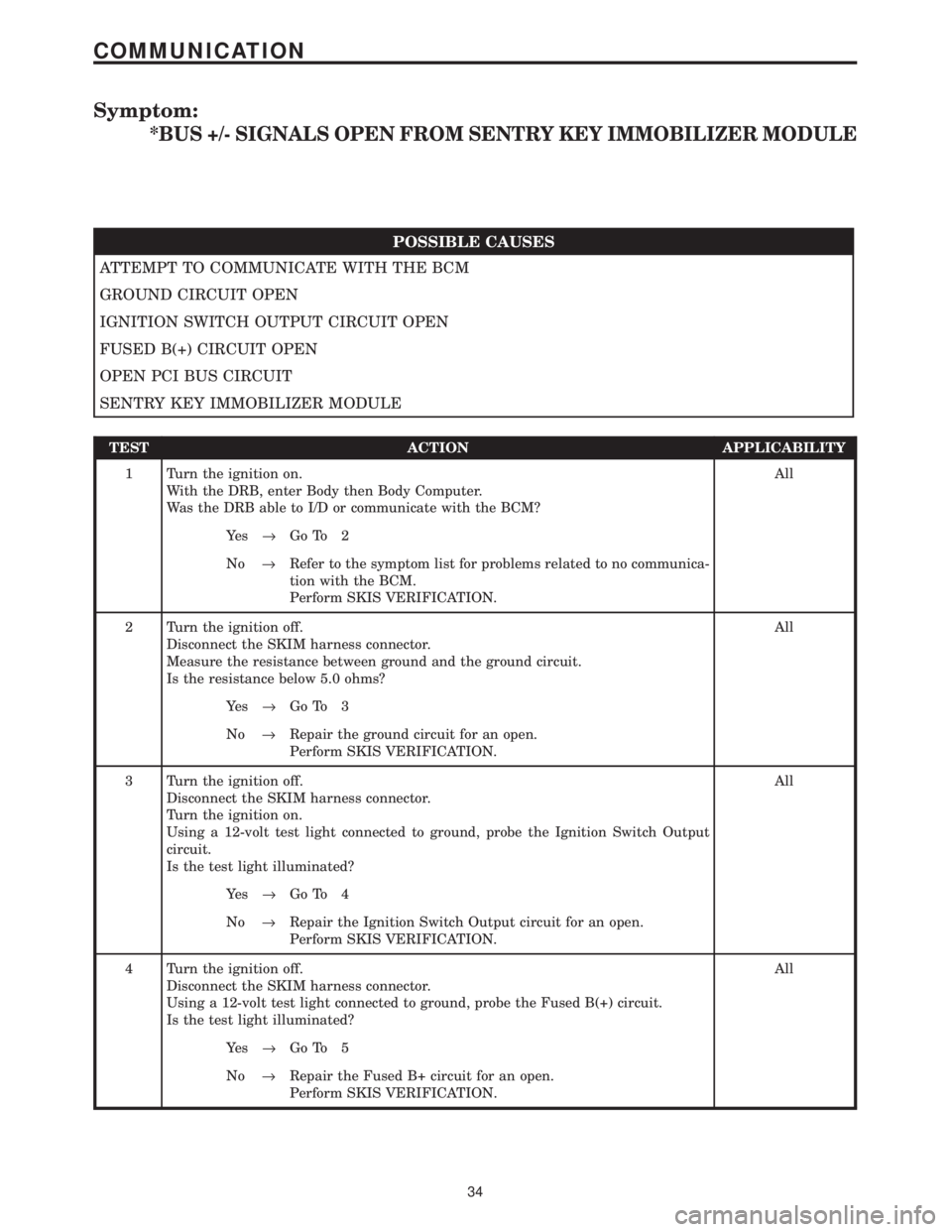
Symptom:
*BUS +/- SIGNALS OPEN FROM SENTRY KEY IMMOBILIZER MODULE
POSSIBLE CAUSES
ATTEMPT TO COMMUNICATE WITH THE BCM
GROUND CIRCUIT OPEN
IGNITION SWITCH OUTPUT CIRCUIT OPEN
FUSED B(+) CIRCUIT OPEN
OPEN PCI BUS CIRCUIT
SENTRY KEY IMMOBILIZER MODULE
TEST ACTION APPLICABILITY
1 Turn the ignition on.
With the DRB, enter Body then Body Computer.
Was the DRB able to I/D or communicate with the BCM?All
Ye s®Go To 2
No®Refer to the symptom list for problems related to no communica-
tion with the BCM.
Perform SKIS VERIFICATION.
2 Turn the ignition off.
Disconnect the SKIM harness connector.
Measure the resistance between ground and the ground circuit.
Is the resistance below 5.0 ohms?All
Ye s®Go To 3
No®Repair the ground circuit for an open.
Perform SKIS VERIFICATION.
3 Turn the ignition off.
Disconnect the SKIM harness connector.
Turn the ignition on.
Using a 12-volt test light connected to ground, probe the Ignition Switch Output
circuit.
Is the test light illuminated?All
Ye s®Go To 4
No®Repair the Ignition Switch Output circuit for an open.
Perform SKIS VERIFICATION.
4 Turn the ignition off.
Disconnect the SKIM harness connector.
Using a 12-volt test light connected to ground, probe the Fused B(+) circuit.
Is the test light illuminated?All
Ye s®Go To 5
No®Repair the Fused B+ circuit for an open.
Perform SKIS VERIFICATION.
34
COMMUNICATION
Page 3829 of 4284
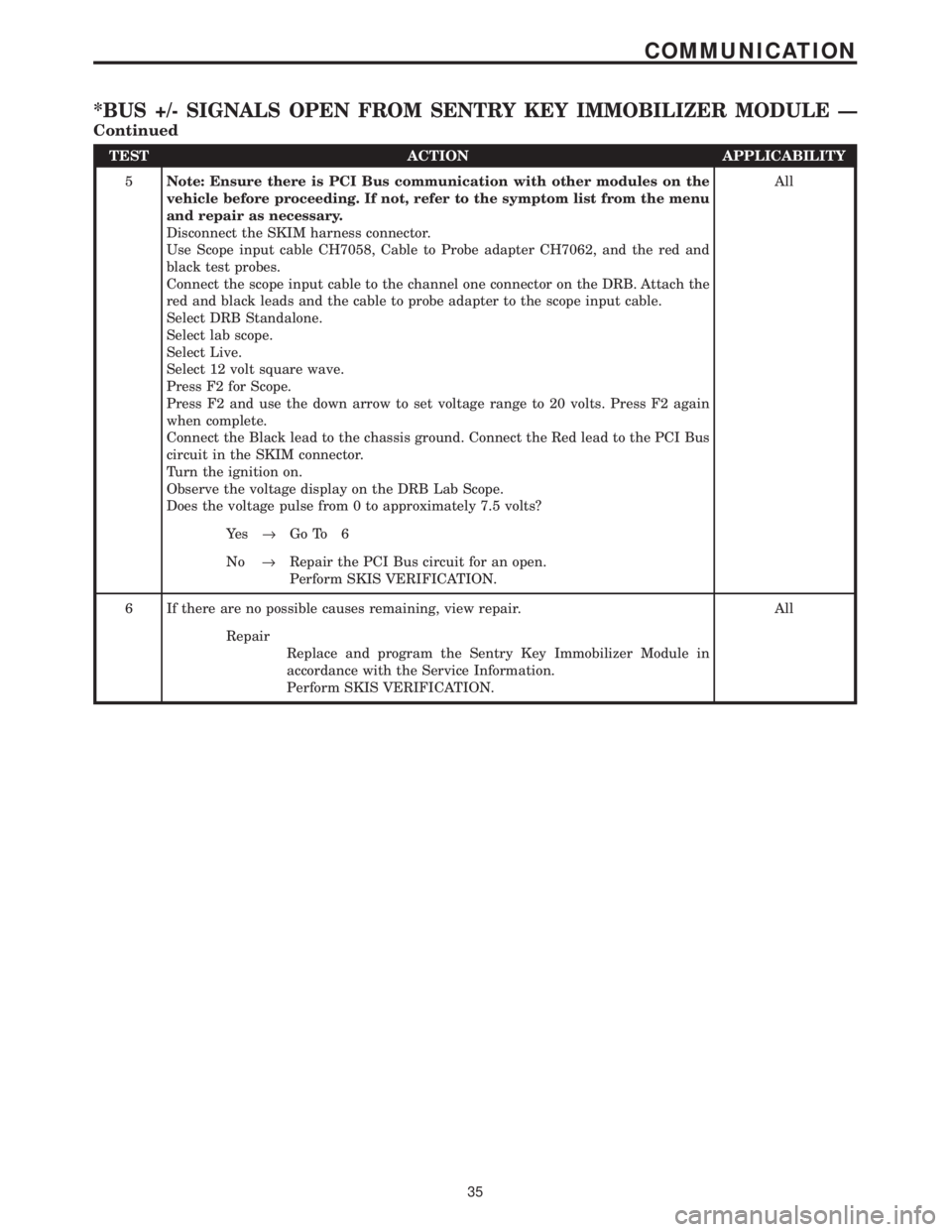
TEST ACTION APPLICABILITY
5Note: Ensure there is PCI Bus communication with other modules on the
vehicle before proceeding. If not, refer to the symptom list from the menu
and repair as necessary.
Disconnect the SKIM harness connector.
Use Scope input cable CH7058, Cable to Probe adapter CH7062, and the red and
black test probes.
Connect the scope input cable to the channel one connector on the DRB. Attach the
red and black leads and the cable to probe adapter to the scope input cable.
Select DRB Standalone.
Select lab scope.
Select Live.
Select 12 volt square wave.
Press F2 for Scope.
Press F2 and use the down arrow to set voltage range to 20 volts. Press F2 again
when complete.
Connect the Black lead to the chassis ground. Connect the Red lead to the PCI Bus
circuit in the SKIM connector.
Turn the ignition on.
Observe the voltage display on the DRB Lab Scope.
Does the voltage pulse from 0 to approximately 7.5 volts?All
Ye s®Go To 6
No®Repair the PCI Bus circuit for an open.
Perform SKIS VERIFICATION.
6 If there are no possible causes remaining, view repair. All
Repair
Replace and program the Sentry Key Immobilizer Module in
accordance with the Service Information.
Perform SKIS VERIFICATION.
35
COMMUNICATION
*BUS +/- SIGNALS OPEN FROM SENTRY KEY IMMOBILIZER MODULE Ð
Continued
Page 4047 of 4284

Symptom:
*ENGINE CRANKS DOES NOT START
POSSIBLE CAUSES
FUEL PUMP RELAY
NO START PRE-TEST
POWERTRAIN FUSES OPEN
FUEL PRESSURE OUT OF SPECS
RESTRICTED FUEL SUPPLY LINE
FUEL PUMP INLET STRAINER PLUGGED
FUEL PUMP MODULE
FUEL PUMP CAPACITY (VOLUME) OUT OF SPECS
FUEL PUMP RELAY FUSED B+ CIRCUIT
OTHER POSSIBLE CAUSES FOR NO START
FUEL PUMP RELAY OUTPUT CIRCUIT OPEN
FUEL PUMP GROUND CIRCUIT OPEN/HIGH RESISTANCE
IPM FUSE & RELAY CENTER
FUEL PUMP MODULE
TEST ACTION APPLICABILITY
1Note: The following list of items must be checked before continuing with
any no start tests.
The battery must be fully charged and in good condition. A low charged battery may
produce invalid test results. If the battery is low, charge the battery and then attempt
to start the vehicle by cranking the engine for 15 seconds, 3 consecutive times.
This will allow any DTC's to set that may have been erased due to a dead battery.
Ensure the Powers and Ground to the PCM are ok.
Make sure the PCM communicates with the DRB and that there are no DTC's stored
in the PCM memory. If the PCM reports a No Response condition, refer to the
Communication category for the proper tests.
Read the PCM DTC's with the DRB. If any DTC's are present, they must be repaired
before continuing with any other No Start diagnostic tests. Refer to the Symptom list
for the related P-code that is reported by the PCM.
Ensure that the PCI bus is functional. Attempt to communicate with the Instrument
Cluster and SKIM, If you are unable to establish communicate refer to the
Communication category for the proper symptoms.
The Sentry Key Immobilizer System must be operating properly. Check for proper
communication with the DRB and check for DTC's that may be stored in the Sentry
Key Immobilizer Module (SKIM). repair the DTC(s) before continuing.
If no DTC's are found, using the DRB select Clear PCM (Batt Disconnect).
Crank the engine several times. Using the DRB, read DTC's. If a DTC is present
perform the DTC diagnostics before continuing.
Were any problems found?All
Ye s®Repair as necessary.
Perform POWERTRAIN VERIFICATION TEST VER-1.
No®Go To 2
253
STARTING