clutch CHRYSLER VOYAGER 2003 Repair Manual
[x] Cancel search | Manufacturer: CHRYSLER, Model Year: 2003, Model line: VOYAGER, Model: CHRYSLER VOYAGER 2003Pages: 2177, PDF Size: 59.81 MB
Page 368 of 2177

the battery, if required. Refer to the Battery section
for more information.
²Ignition Switch- Visually inspect the ignition
switch for indications of physical damage and loose
or corroded wire harness connections.
²Transmission Range Sensor or Park/Neu-
tral Switch- Visually inspect the transmission
range sensor for indications of physical damage and
loose or corroded wire harness connections.
²Starter Relay- Visually inspect the starter
relay for indications of physical damage and loose or
corroded wire harness connections.
²Starter Motor- Visually inspect the starter
motor for indications of physical damage and loose or
corroded wire harness connections.²Starter Solenoid- Visually inspect the starter
solenoid for indications of physical damage and loose
or corroded wire harness connections.
²Wiring- Visually inspect the wire harness for
damage. Repair or replace any faulty wiring, as
required. Check for loose or corroded wire harness
connections at main engine ground and remote jump
post.
²Power Distribution Center (PDC)- Visually
inspect the B+ connections at the PDC for physical
damage and loose or corroded harness connections.
STARTING SYSTEM DIAGNOSIS
CONDITION POSSIBLE CAUSE CORRECTION
STARTER FAILS
TO ENGAGE.1. BATTERY
DISCHARGED OR
FAULTY.1. REFER TO THE BATTERY SECTION FOR MORE
INFORMATION. CHARGE OR REPLACE BATTERY, IF
REQUIRED.
2. STARTING CIRCUIT
WIRING FAULTY.2. REFER TO FEED CIRCUIT RESISTANCE TEST AND FEED
CIRCUIT TEST IN THIS SECTION.
3. STARTER RELAY
FAULTY.3. REFER TO RELAY TEST, IN THIS SECTION. REPLACE
RELAY, IF NECESSARY.
4. IGNITION SWITCH
FAULTY.4. REFER TO IGNITION SWITCH TEST, IN THE STEERING
SECTION OR 8 WIRING DIAGRAMS. REPLACE SWITCH, IF
NECESSARY.
5. PARK/NEUTRAL
POSITION SWITCH
(AUTO TRANS) FAULTY
OR MIS-ADJUSTED.5. REFER PARK/NEUTRAL POSITION SWITCH TEST, IN THE
TRANSAXLE. SECTION FOR MORE INFORMATION. REPLACE
SWITCH, IF NECESSARY.
6. CLUTCH INTERLOCK
SWITCH (MAN TRANS)
FAULTY.6. REFER TO CLUTCH PEDAL POSITION SWITCH TEST, IN
THE CLUTCH. SECTION. REPLACE SWITCH, IF NECESSARY.
7. STARTER SOLENOID
FAULTY.7. REFER TO SOLENOID TEST, IN THIS SECTION. REPLACE
STARTER ASSEMBLY, IF NECESSARY.
8. STARTER ASSEMBLY
FAULTY.8. IF ALL OTHER STARTING SYSTEM COMPONENTS AND
CIRCUITS CHECK OK, REPLACE STARTER ASSEMBLY.
9. FAULTY TEETH ON
RING GEAR.9. ROTATE FLYWHEEL 360É, AND INSPECT TEETH AND RING
GEAR REPLACED IF DAMAGED.
10. PCM DOUBLE
START OVERRIDE
OUTPUT FAILURE.10. REFER TO PCM DIAGNOSTIC. CHECK FOR CONTINUITY
BETWEEN PCM AND TERMINAL 85. REPAIR OPEN CIRCUIT
AS REQUIRED. IF OK, PCM MAY BE DEFECTIVE.
STARTER
ENGAGES,
FAILS TO TURN
ENGINE.1. BATTERY
DISCHARGED OR
FAULTY.1. REFER TO THE BATTERY SECTION FOR MORE
INFORMATION. CHARGE OR REPLACE BATTERY AS
NECESSARY.
RSSTARTING8F-29
STARTING (Continued)
ProCarManuals.com
Page 371 of 2177

RELAY CIRCUIT TEST
(1) The relay common feed terminal cavity (30) is
connected to battery voltage and should be hot at all
times. If OK, go to Step 2. If not OK, repair the open
circuit to the PDC fuse as required.
(2) The relay normally closed terminal (87A) is
connected to terminal 30 in the de-energized position,
but is not used for this application. Go to Step 3.
(3) The relay normally open terminal (87) is con-
nected to the common feed terminal (30) in the ener-
gized position. This terminal supplies battery voltage
to the starter solenoid field coils. There should be
continuity between the cavity for relay terminal 87
and the starter solenoid terminal at all times. If OK,
go to Step 4. If not OK, repair the open circuit to the
starter solenoid as required.
(4) The coil battery terminal (85) is connected to
the electromagnet in the relay. It is energized when
the ignition switch is held in the Start position and
the clutch pedal is depressed (manual trans). Check
for battery voltage at the cavity for relay terminal 86
with the ignition switch in the Start position and the
clutch pedal is depressed (manual trans), and no
voltage when the ignition switch is released to the
On position. If OK, go to Step 5. If not OK, check for
an open or short circuit to the ignition switch and
repair, if required. If the circuit to the ignition switch
is OK, see the Ignition Switch Test procedure in this
group.
(5) The coil ground terminal (86) is connected to
the electromagnet in the relay. It is grounded by the
PCM if the conditions are right to start the car. For
automatic trans. cars the PCM must see Park Neu-
tral switch low and near zero engine speed (rpm).
For manual trans. cars the PCM only needs to see
near zero engine speed (rpm) and low clutch inter-
lock input and see near zero engine speed (rpm). To
diagnose the Park Neutral switch of the trans range
sensor refer to the transaxle section. Check for conti-
nuity to ground while the ignition switch is in the
start position and if equipped the clutch pedal
depressed. If not OK and the vehicle has an auto-
matic trans. verify Park Neutral switch operation. If
that checks OK check for continuity between PCM
and the terminal 86. Repair open circuit as required.
Also check the clutch interlock switch operation if
equipped with a manual transmission. If OK, the
PCM may be defective.
SAFETY SWITCHES
For diagnostics of the Transmission Range Sensor,
refer to the Transaxle section for more information.
If equipped with Clutch Interlock/Upstop Switch,
refer to Diagnosis and Testing in the Clutch section.
IGNITION SWITCH
After testing starter solenoid and relay, test igni-
tion switch and wiring. Refer to the Ignition Section
or Wiring Diagrams for more information. Check all
wiring for opens or shorts, and all connectors for
being loose or corroded.
BATTERY
For battery diagnosis and testing, refer to the Bat-
tery section for procedures.
ALL RELATED WIRING AND CONNECTORS
Refer to Wiring Diagrams for more information.
DIAGNOSIS AND TESTING - FEED CIRCUIT
RESISTANCE TEST
Before proceeding with this operation, review Diag-
nostic Preparation and Starter Feed Circuit Tests.
The following operation will require a voltmeter,
accurate to 1/10 of a volt.
CAUTION: Ignition and Fuel systems must be dis-
abled to prevent engine start while performing the
following tests.
(1) To disable the Ignition and Fuel systems, dis-
connect the Automatic Shutdown Relay (ASD). The
ASD relay is located in the Power Distribution Cen-
ter (PDC). Refer to the PDC cover for proper relay
location.
(2) Gain access to battery terminals.
(3) With all wiring harnesses and components
properly connected, perform the following:
(a) Connect the negative lead of the voltmeter to
the battery negative post, and positive lead to the
battery negative cable clamp. Rotate and hold the
ignition switch in the START position. Observe the
voltmeter. If voltage is detected, correct poor con-
tact between cable clamp and post.
(b) Connect positive lead of the voltmeter to the
battery positive post, and negative lead to the bat-
tery positive cable clamp. Rotate and hold the igni-
tion switch key in the START position. Observe the
voltmeter. If voltage is detected, correct poor con-
tact between the cable clamp and post.
(c) Connect negative lead of voltmeter to battery
negative terminal, and positive lead to engine
block near the battery cable attaching point.
Rotate and hold the ignition switch in the START
position. If voltage reads above 0.2 volt, correct
poor contact at ground cable attaching point. If
voltage reading is still above 0.2 volt after correct-
ing poor contacts, replace ground cable.
(4) Connect positive voltmeter lead to the starter
motor housing and the negative lead to the battery
negative terminal. Hold the ignition switch key in
8F - 32 STARTINGRS
STARTING (Continued)
ProCarManuals.com
Page 462 of 2177

CONDITION POSSIBLE CAUSES CORRECTION
Key fob, Outside Handle or
overhead console switches
do not power operate
liftgateBlown Fuse Check fuse and replace
Battery voltage low Charge or replace battery in key fob or
vehicle
Failure of latch assembly Check for foreign matter preventing the
operation of latch assembly
Check wire connection
Pawl and/or ratchet switch inoperative
Replace latch if necessary
Wiring problems (system or vehicle) Troubleshoot using electrical schematics.
Refer to wiring diagrams
Failure of Body Control Module
(BCM)Check electrical connections
Refer to the Body electrical troubleshooting
guide for additional checks
Replace BCM if necessary
Failure of key fob Reprogram key fob
Replace key fob if necessary
Failure of Power Liftgate Module Disconnect then reconnect battery to reset
module, function liftgate, if no function
exists check for loose wire connections,
see Body Diagnostic Manual for detailed
procedures
Failure of liftgate motor assembly Check for foreign matter preventing the
operation of gear motor assembly
Check wire connections
Motor clutch does not engage, replace
assembly
Full open switch inoperative, replace
switch, if necessary
Troubleshoot using Body Diagnostic
Manual Replace motor, if necessary
Liftgate does not stay open Failure of liftgate prop rods Replace prop rods, if necessary
Check for broken attachments
High inside/outside opening
effortFailure of liftgate prop rods Replace prop rods, if necessary
Check for broken attachments
Gear motor did not disengage Troubleshoot using Body Diagnostic
Manual Replace components, if necessary
Binding or sticking of components Establish location of binding and replace
necessary components
RSPOWER LIFTGATE SYSTEM8N-7
POWER LIFTGATE SYSTEM (Continued)
ProCarManuals.com
Page 481 of 2177

CONDITION POSSIBLE CAUSES CORRECTION
Failure of sliding door control or
body control moduleDisconnect then reconnect battery to reset
module, function door, if no function exists
check for loose wire connections, see Body
Diagnostic Manual for detailed procedures
Failure of striker Striker misaligned or loose
Striker damaged
Replace striker if necessary
Cables worn and stretched Replace cables as necessary
Binding or sticking of components Establish location of binding and replace
necessary components
Key fob, B-pillar or
overhead console switch
does not power operate
doorBlown Fuse Check fuse and replace
Battery voltage low Charge or replace battery
Failure of latch assembly Check for foreign matter preventing the
operation of latch assembly
Check wire connection
Pawl and/or ratchet switch inoperative
Replace latch if necessary
Wiring problems (system or
vehicle)Troubleshoot using electrical schematics.
Refer to wiring diagrams
Failure of body control module Check electrical connections
Refer to the body diagnostic manual for
additional checks
Replace BCM if necessary
Failure of key fob Replace key fob battery
Replace key fob if necessary
Failure of sliding door control
moduleDisconnect then reconnect battery to reset
module, function door, if no function exists
check for loose wire connections, see Body
Diagnostic Manual for detailed procedures
Failure of door motor assembly Check for foreign matter preventing the
operation of gear motor assembly
Check wire connections
Gear motor clutch does not engage, replace
assembly
Full open switch inoperative, replace hold
open latch assembly
Replace motor assembly. if necessary
Door does not stay open Failure of hold open latch assembly Check wire/cable connections
Replace hold open latch, if necessary
Failure of hold open latch striker Replace hold open latch striker, if necessary
8N - 26 POWER SLIDING DOOR SYSTEMRS
POWER SLIDING DOOR SYSTEM (Continued)
ProCarManuals.com
Page 485 of 2177
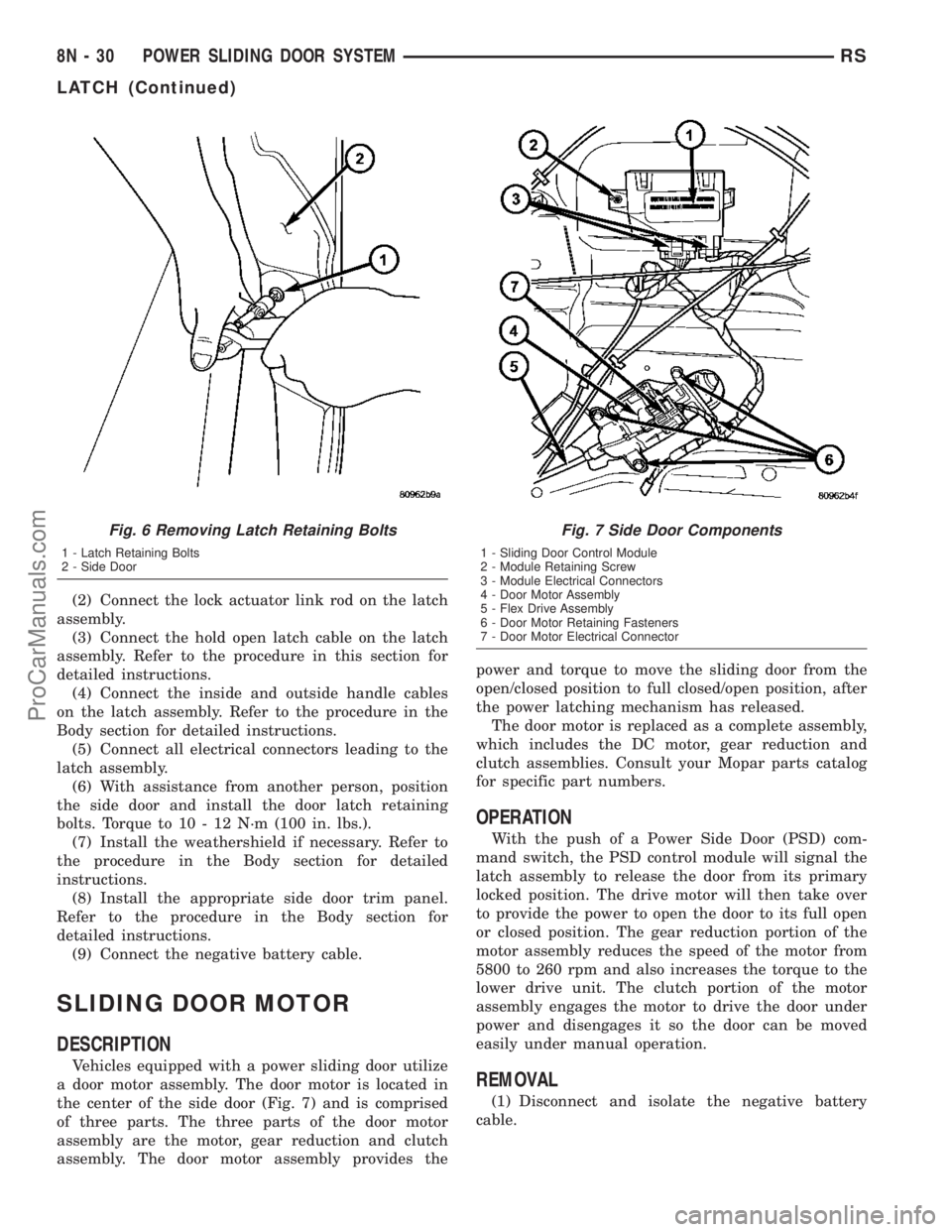
(2) Connect the lock actuator link rod on the latch
assembly.
(3) Connect the hold open latch cable on the latch
assembly. Refer to the procedure in this section for
detailed instructions.
(4) Connect the inside and outside handle cables
on the latch assembly. Refer to the procedure in the
Body section for detailed instructions.
(5) Connect all electrical connectors leading to the
latch assembly.
(6) With assistance from another person, position
the side door and install the door latch retaining
bolts. Torque to 10 - 12 N´m (100 in. lbs.).
(7) Install the weathershield if necessary. Refer to
the procedure in the Body section for detailed
instructions.
(8) Install the appropriate side door trim panel.
Refer to the procedure in the Body section for
detailed instructions.
(9) Connect the negative battery cable.
SLIDING DOOR MOTOR
DESCRIPTION
Vehicles equipped with a power sliding door utilize
a door motor assembly. The door motor is located in
the center of the side door (Fig. 7) and is comprised
of three parts. The three parts of the door motor
assembly are the motor, gear reduction and clutch
assembly. The door motor assembly provides thepower and torque to move the sliding door from the
open/closed position to full closed/open position, after
the power latching mechanism has released.
The door motor is replaced as a complete assembly,
which includes the DC motor, gear reduction and
clutch assemblies. Consult your Mopar parts catalog
for specific part numbers.
OPERATION
With the push of a Power Side Door (PSD) com-
mand switch, the PSD control module will signal the
latch assembly to release the door from its primary
locked position. The drive motor will then take over
to provide the power to open the door to its full open
or closed position. The gear reduction portion of the
motor assembly reduces the speed of the motor from
5800 to 260 rpm and also increases the torque to the
lower drive unit. The clutch portion of the motor
assembly engages the motor to drive the door under
power and disengages it so the door can be moved
easily under manual operation.
REMOVAL
(1) Disconnect and isolate the negative battery
cable.
Fig. 6 Removing Latch Retaining Bolts
1 - Latch Retaining Bolts
2 - Side Door
Fig. 7 Side Door Components
1 - Sliding Door Control Module
2 - Module Retaining Screw
3 - Module Electrical Connectors
4 - Door Motor Assembly
5 - Flex Drive Assembly
6 - Door Motor Retaining Fasteners
7 - Door Motor Electrical Connector
8N - 30 POWER SLIDING DOOR SYSTEMRS
LATCH (Continued)
ProCarManuals.com
Page 486 of 2177
(2) Remove the door trim panel from the appropri-
ate side door. Refer to the Body section for the pro-
cedure.
(3) Remove water shield as necessary to gain
access to motor assembly.
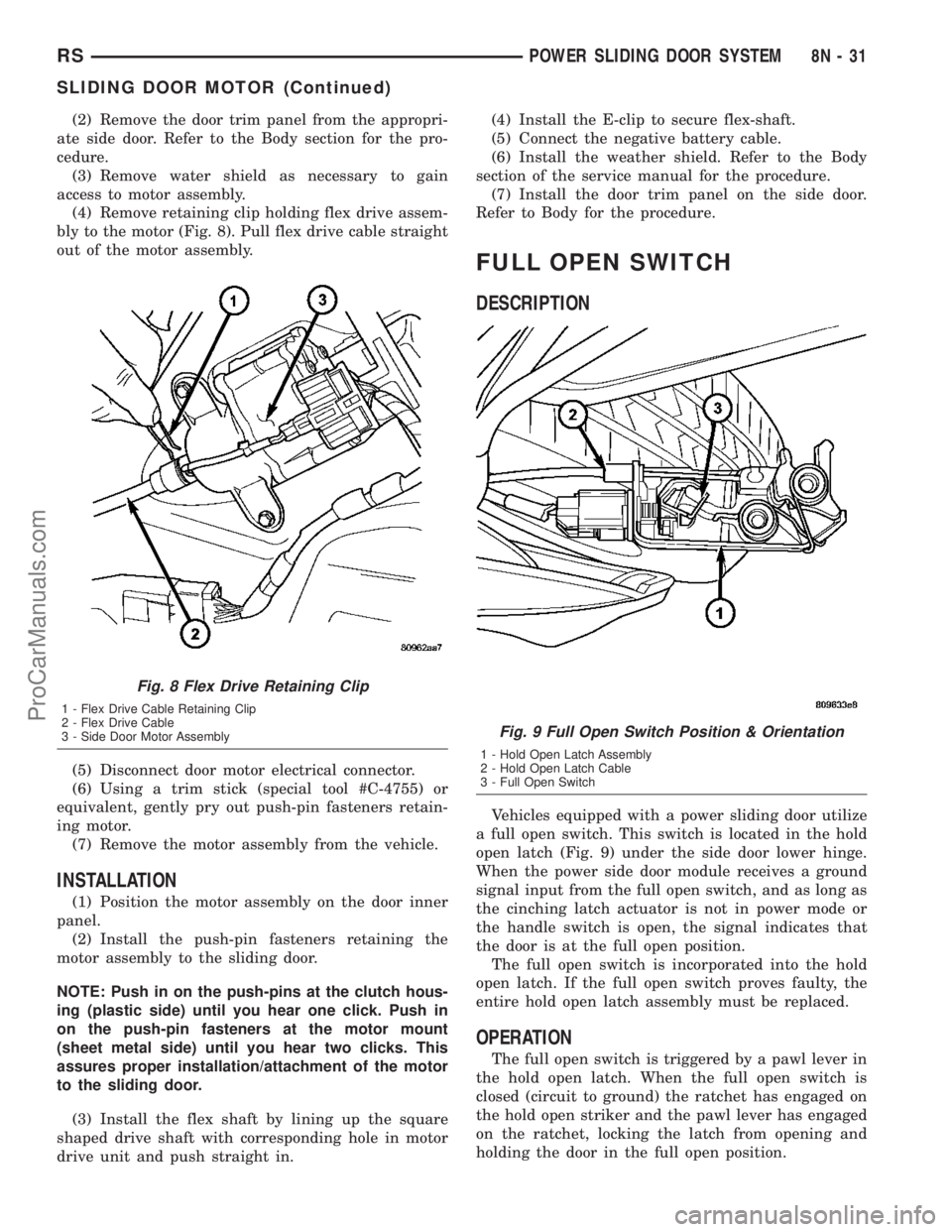
(4) Remove retaining clip holding flex drive assem-
bly to the motor (Fig. 8). Pull flex drive cable straight
out of the motor assembly.
(5) Disconnect door motor electrical connector.
(6) Using a trim stick (special tool #C-4755) or
equivalent, gently pry out push-pin fasteners retain-
ing motor.
(7) Remove the motor assembly from the vehicle.
INSTALLATION
(1) Position the motor assembly on the door inner
panel.
(2) Install the push-pin fasteners retaining the
motor assembly to the sliding door.
NOTE: Push in on the push-pins at the clutch hous-
ing (plastic side) until you hear one click. Push in
on the push-pin fasteners at the motor mount
(sheet metal side) until you hear two clicks. This
assures proper installation/attachment of the motor
to the sliding door.
(3) Install the flex shaft by lining up the square
shaped drive shaft with corresponding hole in motor
drive unit and push straight in.(4) Install the E-clip to secure flex-shaft.
(5) Connect the negative battery cable.
(6) Install the weather shield. Refer to the Body
section of the service manual for the procedure.
(7) Install the door trim panel on the side door.
Refer to Body for the procedure.
FULL OPEN SWITCH
DESCRIPTION
Vehicles equipped with a power sliding door utilize
a full open switch. This switch is located in the hold
open latch (Fig. 9) under the side door lower hinge.
When the power side door module receives a ground
signal input from the full open switch, and as long as
the cinching latch actuator is not in power mode or
the handle switch is open, the signal indicates that
the door is at the full open position.
The full open switch is incorporated into the hold
open latch. If the full open switch proves faulty, the
entire hold open latch assembly must be replaced.
OPERATION
The full open switch is triggered by a pawl lever in
the hold open latch. When the full open switch is
closed (circuit to ground) the ratchet has engaged on
the hold open striker and the pawl lever has engaged
on the ratchet, locking the latch from opening and
holding the door in the full open position.
Fig. 8 Flex Drive Retaining Clip
1 - Flex Drive Cable Retaining Clip
2 - Flex Drive Cable
3 - Side Door Motor Assembly
Fig. 9 Full Open Switch Position & Orientation
1 - Hold Open Latch Assembly
2 - Hold Open Latch Cable
3 - Full Open Switch
RSPOWER SLIDING DOOR SYSTEM8N-31
SLIDING DOOR MOTOR (Continued)
ProCarManuals.com
Page 540 of 2177

SPEED CONTROL
TABLE OF CONTENTS
page page
SPEED CONTROL
DESCRIPTION..........................1
OPERATION
OPERATION..........................1
OPERATION - INTERACTIVE SPEED
CONTROL (4 Speed EATX Only)...........2
DIAGNOSIS AND TESTING - ROAD TEST.....3
SPECIFICATIONS - TORQUE...............3
CABLE
DESCRIPTION..........................4
OPERATION............................4
REMOVAL.............................4
INSTALLATION..........................4
SERVO
DESCRIPTION..........................4OPERATION............................4
REMOVAL.............................5
INSTALLATION..........................5
SWITCH
DESCRIPTION..........................6
OPERATION............................6
REMOVAL.............................6
INSTALLATION..........................6
VACUUM RESERVOIR
DESCRIPTION..........................6
OPERATION............................6
REMOVAL.............................6
INSTALLATION..........................6
SPEED CONTROL
DESCRIPTION
The speed control system is electronically con-
trolled and vacuum operated. The electronic control
is integrated into the Powertrain Control Module.
The controls are located on the steering wheel. The
ON/OFF, and SET buttons are located on the left side
of the airbag module. The RESUME/ACCEL, CAN-
CEL and COAST buttons are located on the right
side of the airbag module (Fig. 1).The system is designed to operate at speeds above
30 mph (48 km/h).
WARNING: THE USE OF SPEED CONTROL IS NOT
RECOMMENDED WHEN DRIVING CONDITIONS DO
NOT PERMIT MAINTAINING A CONSTANT SPEED,
SUCH AS IN HEAVY TRAFFIC OR ON ROADS THAT
ARE WINDING, ICY, SNOW COVERED, OR SLIP-
PERY.
OPERATION
OPERATION
When speed control is activated by depressing the
ON switch, the PCM allows a set speed to be stored
in RAM for speed control. To store a set speed,
depress and release the SET switch while the vehicle
is moving at a speed between 30 and 85 mph. In
order for the speed control to engage, the brakes can-
not be applied, nor can the gear selector be indicat-
ing the transmission is in Park or Neutral (ATX) or
1st/2nd gear (MTX). The speed control can be disen-
gaged manually by:
²Stepping on the brake pedal
²Depressing the OFF switch
²Depressing the CANCEL switch.
²Depressing the clutch pedal
²Operating in 1st or 2nd gear (autostick, if
equipped)
Fig. 1 SPEED CONTROL SWITCHES - Typical
RSSPEED CONTROL8P-1
ProCarManuals.com
Page 541 of 2177

NOTE: Turning the system off by depressing the
OFF switch or turning off the ignition switch will
erase the set speed stored in the PCM.
For added safety, the speed control system is pro-
grammed to disengage for any of the following condi-
tions:
²An indication of Park or Neutral
²A rapid increase rpm (indicates that the clutch
has been disengaged)
²Excessive engine rpm (indicates that the trans-
mission may be in a low gear)
²The speed signal increases at a rate of 10 mph
per second (indicates that the co-efficient of friction
between the road surface and tires is extremely low)
²The speed signal decreases at a rate of 10 mph
per second (indicates that the vehicle may have
decelerated at an extremely high rate)
²If the actual speed is greater than 20 mph over
the set speed.
²Autostick shifts into 1st or 2nd gear (autostick,
if equipped)
Once the speed control has been disengaged,
depressing the RESUME switch when speed is
greater than 20 mph allows the vehicle to resume
control to the target speed that was stored in the
PCM.
While the speed control is engaged, the driver can
increase the vehicle speed by depressing the ACCEL
switch. The new target speed is stored in the PCM
when the ACCEL switch is released. The PCM also
has a9tap-up9feature in which target speed
increases by 2 mph for each momentary switch acti-
vation of the ACCEL switch. The PCM also provides
a means to decelerate to a new lower target speed
without disengaging speed control. Depress and hold
the COAST switch until the desired speed is reached,
then release the switch.
The PCM also has a ªTap Downº feature in which
target speed decreases at 1 mph for each momentary
switch activation of the coast switch.
OPERATION - INTERACTIVE SPEED CONTROL
(4 Speed EATX Only)
Interactive means that communication between the
PCM and the TCM is taking place, this communica-
tion is internal to the PCM on NGC vehicles. Inter-
active speed control avoids unnecessary shifting for
smoother, quieter operation and when downshifts are
required, makes the shifts smoother.
CLIMBING A GRADE
DESCRIPTION
When climbing a grade the interactive speed con-
trol tries to maintain the set speed by increasing the
throttle opening, while inhibiting/delaying down-
shifts.
OPERATION
If opening the throttle alone cannot maintain the
set speed and the vehicle speed drops more than
three mph below the set speed, the transmission will
downshift to third gear. If the vehicle continues to
lose speed, by more than 6 mph, the transmission
will downshift again to maintain the set speed. After
the vehicle encounters a less-steep grade, or has
crested the grade (reduced the load on the power-
train) and can maintain the set speed at a reduced
throttle position, the transmission will upshift, as
appropriate, until the set speed can be maintained in
Overdrive.
GRADE HUNTING
DESCRIPTION
All vehicles equipped with a four speed automatic
transmission have a grade hunting feature for the
2nd to 3rd gear upshift and the 3rd to Overdrive
upshift.
OPERATION
The TCM (on SBEC vehicles) (PCM on NGC vehi-
cles) identifies the powertrain loading conditions and
selects the proper gear to maintain the current vehi-
cle speed. Under moderate loading conditions the
transaxle will stay in 3rd gear until the top of the
grade is reached or the powertrain loading is
reduced.
If powertrain loading is severe, the transaxle may
shift into 2nd gear and remain there until power-
train loading is reduced, then a 2nd to 3rd gear
upshift will be scheduled. Grade hunting features
always operate regardless of whether or not the
interactive speed control is engaged.If the interac-
tive speed control is not engaged and power-
train loading is not reduced, the driver may
have to completely lift off of the throttle before
an upshift will occur. If the driver does lift off the
throttle to induce an upshift under these conditions,
vehicle speed will reduce and the Overdrive to 3rd
and 3rd to 2nd gear downshifts will reoccur when the
throttle is reapplied. If grade hunting is repeatedly
induced by the driver, transaxle damage may result.
8P - 2 SPEED CONTROLRS
SPEED CONTROL (Continued)
ProCarManuals.com
Page 588 of 2177

8W-02 COMPONENT INDEX
Component Page
A/C Compressor Clutch Relay............. 8W-42
A/C Compressor Clutch.................. 8W-42
A/C-Heater Control..................... 8W-42
A/C Pressure Sensor.................... 8W-42
Accelerator Pedal Position Sensor.......... 8W-30
Accessory Relay........................ 8W-10
Adjustable Pedals Module................ 8W-30
Adjustable Pedals Relay................. 8W-30
Adjustable Pedals Switch................. 8W-30
Airbag Control Module.................. 8W-43
Ambient Temperature Sensor.............. 8W-49
Antenna............................. 8W-47
ATC Remote Sensor..................... 8W-42
Auto Shut Down Relay.................. 8W-30
Auto Temp Control..................... 8W-42
Automatic Day/Night Mirror.............. 8W-49
Back-Up Lamp Switch................... 8W-51
Battery Temperature Sensor.............. 8W-20
Battery.............................. 8W-20
Blend Door Actuators................... 8W-42
Blower Motor Resistor................... 8W-42
Body Control Module.................... 8W-45
Boost Pressure Sensor................... 8W-30
B-Pillar Switches....................... 8W-61
Brake Fluid Level Switch................ 8W-40
Brake Lamp Switch.................. 8W-30, 51
Brake Transmission Shift Interlock Solenoid . . 8W-31
Cabin Heater Assist..................... 8W-30
Camshaft Position Sensor................ 8W-30
CD Changer.......................... 8W-47
Center Dome Lamp..................... 8W-44
Center High Mounted Stop Lamp........... 8W-51
Cinch/Release Motors................... 8W-61
Clockspring................ 8W-30, 33, 41, 43, 47
Clutch Pedal Interlock Switch.......... 8W-10, 30
Clutch Pedal Upstop Switch............... 8W-30
Combination Relays..................... 8W-54
Controller Antilock Brake................ 8W-35
Crank Case Ventilation Heater............ 8W-30
Crankshaft Position Sensor............... 8W-30
Cylinder Lock Switches.................. 8W-39
Data Link Connector.................... 8W-18
Defogger Relay........................ 8W-48
Door Ajar Switches..................... 8W-39
Door Lock Motor/Ajar Switches............ 8W-61
Door Courtesy Lamps................... 8W-44
Door Lock Switches..................... 8W-61
Dosing Pump......................... 8W-30
Driver Airbag Squibs.................... 8W-43
Driver Seat Belt Switch.................. 8W-43
DVD Screen.......................... 8W-47
DVD/CD Changer...................... 8W-47
ECM/PCM Relay....................... 8W-30
EGR Solenoid......................... 8W-30
Electronic Control Unit.................. 8W-64
Engine Control Module.................. 8W-30
Component Page
Engine Coolant Temp Sensor.............. 8W-30
Engine Oil Pressure Sensor............... 8W-30
Engine Oil Pressure Switch............... 8W-30
EVAP/Purge Solenoid.................... 8W-30
Evaporator Temperature Sensor............ 8W-42
Floor Console Lamp..................... 8W-44
Floor Console Power Outlet............... 8W-41
Fog Lamps........................... 8W-50
Front Blower Module.................... 8W-42
Front Blower Motor Relay................ 8W-42
Front Blower Motor..................... 8W-42
Front Cigar Lighter..................... 8W-41
Front Control Module................... 8W-10
Front Fog Lamp Relay................... 8W-50
Front Intrusion Sensor.................. 8W-39
Front Reading Lamps/Switch.............. 8W-44
Front Washer Pump Motor............... 8W-53
Front Wiper High/Low Relay.............. 8W-53
Front Wiper On/Off Relay................ 8W-53
Fuel Heater Relay...................... 8W-30
Fuel Heater.......................... 8W-30
Fuel Injectors......................... 8W-30
Fuel Pressure Sensor.................... 8W-30
Fuel Pressure Solenoid.................. 8W-30
Fuel Pump Module..................... 8W-30
Fuel Pump Relay....................... 8W-30
Full Open Switches..................... 8W-61
Fuses............................... 8W-10
Fuselink............................. 8W-10
Grounds............................. 8W-15
Generator............................ 8W-20
Glow Plugs........................... 8W-30
Glow Plug Relay....................... 8W-30
Headlamp Leveling Motors............... 8W-50
Headlamp Switch...................... 8W-50
Headlamp Washer Pump Motor............ 8W-53
Headlamp Washer Relay................. 8W-53
Headlamps........................... 8W-50
Heated Seat Backs..................... 8W-63
Heated Seat Cushions................... 8W-63
Heated Seat Modules.................... 8W-63
High Beam Lamps...................... 8W-50
Hood Ajar Switch...................... 8W-39
Horn Relay........................... 8W-41
Horn Switch.......................... 8W-41
Horns............................... 8W-41
Idle Air Control Motor................... 8W-30
Ignition Coil.......................... 8W-30
Ignition Switch........................ 8W-10
Inlet Air Temperature Sensor.............. 8W-30
Input Speed Sensor..................... 8W-31
Instrument Cluster..................... 8W-40
Instrument Panel Switch Bank.... 8W-44, 52, 53, 63
Integrated Power Module................. 8W-10
Knock Sensor......................... 8W-30
Lamp Assemblies...................... 8W-51
RS8W-02 COMPONENT INDEX8W-02-1
ProCarManuals.com
Page 590 of 2177

8W-10 POWER DISTRIBUTION
Component Page
A/C Compressor Clutch . . . 8W-10-22, 24, 47, 48, 51
A/C Compressor Clutch
Relay............ 8W-10-22, 24, 46, 47, 48, 51
Accessory Relay............... 8W-10-16, 31, 68
Adjustable Pedals Relay.............. 8W-10-50
Airbag Control Module............ 8W-10-67, 72
Ambient Temperature Sensor.......... 8W-10-65
Auto Shut Down Relay......... 8W-10-21, 42, 43
Auto Temp Control.................. 8W-10-41
Back-Up Lamp Switch............... 8W-10-69
Battery............ 8W-10-13, 14, 15, 42, 43, 51
Blower Motor Resistor............ 8W-10-19, 39
Body Control Module.... 8W-10-25, 41, 47, 48, 52,
53, 55, 57, 58, 59, 60, 72
Brake Fluid Level Switch............. 8W-10-68
Brake Lamp Switch........... 8W-10-26, 55, 70
Brake Transmission Shift Interlock
Solenoid........................ 8W-10-66
Cabin Heater Assist........... 8W-10-23, 45, 63
Camshaft Position Sensor............. 8W-10-46
Center High Mounted Stop Lamp....... 8W-10-70
Clockspring........................ 8W-10-64
Clutch Pedal Interlock
Switch.............. 8W-10-18, 38, 57, 58, 64
Controller Antilock
Brake...... 8W-10-18, 25, 37, 38, 53, 59, 65, 70
Crank Case Ventilation Heater......... 8W-10-52
Data Link Connector........... 8W-10-36, 65, 72
Defogger Relay............ 8W-10-19, 20, 40, 67
Driver Door Lock Switch........ 8W-10-33, 34, 35
Driver Heated Seat Module........... 8W-10-53
Driver Power Seat Switch............ 8W-10-53
Driver Power Window Switch....... 8W-10-34, 35
DVD/DV Changer................... 8W-10-41
ECM/PCM Relay................. 8W-10-23, 45
EGR Solenoid................... 8W-10-46, 50
Engine Control
Module . . 8W-10-18, 23, 24, 38, 45, 46, 51, 65, 70
Floor Console Lamp................. 8W-10-32
Floor Console Power Outlet........ 8W-10-32, 36
Front Blower Module................ 8W-10-19
Front Blower Module................ 8W-10-39
Front Blower Motor Relay.... 8W-10-18, 19, 39, 67
Front Cigar Lighter.............. 8W-10-16, 32
Front Control Module....... 8W-10-15, 16, 17, 18,
19, 20, 22, 24, 26, 27,
28, 29, 30, 31, 36, 40,
47, 48, 50, 51, 56, 57,
58, 61, 62, 63, 64, 65,
66, 67, 68, 69, 70, 72
Front Fog Lamp Relay......... 8W-10-15, 27, 67
Front Washer Pump Motor...... 8W-10-16, 31, 72Component Page
Front Wiper High/Low Relay.... 8W-10-16, 30, 68
Front Wiper On/Off Relay....... 8W-10-16, 30, 63
Fuel Heater....................... 8W-10-52
Fuel Heater Relay............. 8W-10-24, 51, 68
Fuel Injector No. 1.................. 8W-10-44
Fuel Injector No. 2.................. 8W-10-44
Fuel Injector No. 3.................. 8W-10-44
Fuel Injector No. 4.................. 8W-10-44
Fuel Injector No. 5.................. 8W-10-44
Fuel Injector No. 6.................. 8W-10-44
Fuel Pressure Solenoid............... 8W-10-46
Fuel Pump Module............ 8W-10-22, 47, 48
Fuel Pump Relay........... 8W-10-22, 47, 48, 68
Fuse 1...................... 8W-10-15, 16, 27
Fuse 2...................... 8W-10-15, 28, 29
Fuse 3...................... 8W-10-15, 28, 29
Fuse 4................... 8W-10-15, 16, 17, 30
Fuse 5......................... 8W-10-16, 31
Fuse 6......................... 8W-10-16, 31
Fuse 8......................... 8W-10-17, 36
Fuse 9................ 8W-10-17, 18, 19, 37, 38
Fuse 10........................ 8W-10-19, 39
Fuse 11........................ 8W-10-16, 31
Fuse 12........................ 8W-10-19, 39
Fuse 13........................ 8W-10-20, 40
Fuse 14............... 8W-10-20, 21, 23, 40, 63
Fuse 15...... 8W-10-20, 21, 22, 23, 24, 42, 43, 45
Fuse 16............... 8W-10-21, 23, 42, 43, 45
Fuse 17......... 8W-10-21, 22, 23, 24, 47, 48, 51
Fuse 18............ 8W-10-22, 24, 25, 47, 48, 51
Fuse 19.................. 8W-10-22, 24, 26, 53
Fuse 20........................ 8W-10-25, 53
Fuse 21........................ 8W-10-25, 53
Fuse 22........................ 8W-10-25, 53
Fuse 23..................... 8W-10-25, 57, 58
Fuse 24........................ 8W-10-25, 55
Fuse 26..................... 8W-10-25, 26, 55
Fuse 27........................ 8W-10-26, 55
Fuse 28........................ 8W-10-16, 31
Fuse 30........................ 8W-10-26, 56
Fuse 31........................ 8W-10-26, 56
Fuse 32........................ 8W-10-26, 56
Fuse 33........................ 8W-10-16, 31
Fuselink....................... 8W-10-13, 14
G100............................. 8W-10-59
G101....................... 8W-10-42, 43, 51
G103............................. 8W-10-72
G300.......................... 8W-10-61, 62
Generator................ 8W-10-13, 14, 44, 46
Glow Plug Relay................. 8W-10-13, 46
Headlamp Switch................ 8W-10-29, 66
Headlamp Washer Pump Motor..... 8W-10-26, 56
RS8W-10 POWER DISTRIBUTION8W-10-1
ProCarManuals.com