ABS CHRYSLER VOYAGER 2021 User Guide
[x] Cancel search | Manufacturer: CHRYSLER, Model Year: 2021, Model line: VOYAGER, Model: CHRYSLER VOYAGER 2021Pages: 348, PDF Size: 18.73 MB
Page 260 of 348

258IN CASE OF EMERGENCY
(Continued)
Tire Service Kit Usage Precautions
Replace the Tire Service Kit Sealant Bottle prior
to the expiration date (printed at the lower right
hand corner on the bottle label) to assure
optimum operation of the system. See the
Sealant Bottle Replacement in this section for
further information.
The Sealant Bottle is a one tire application use
and needs to be replaced after each use. Always
replace these components immediately at your
original equipment vehicle dealer.
When the Tire Service Kit sealant is in a liquid
form, clean water, and a damp cloth will remove
the material from the vehicle or tire and wheel
components. Once the sealant dries, it can
easily be peeled off and properly discarded.
For optimum performance, make sure the valve
stem on the wheel is free of debris before
connecting the Tire Service Kit.
The Tire Service Kit Sealant is only intended to
seal punctures less than 1/4 inch (6 mm) diam
-
eter in the tread/contact surface of your
vehicle’s tires.
The Tire Service Kit Sealant is not intended to
seal punctures on the tires' side walls.
You can use the Tire Service Kit air pump to
inflate bicycle tires. The kit also comes with two
needles, located in the Accessory Storage
Compartment (on the bottom of the air pump) for inflating sport balls, rafts, or similar inflat
-
able items. However, use only the Air Pump and
make sure the Mode Select Knob is in the Air
Mode when inflating such items to avoid
injecting sealant into them.
Do not lift or carry the Tire Service Kit by the
hoses.
WARNING!
Do not attempt to seal a tire on the side of the
vehicle closest to traffic. Pull far enough off
the road to avoid the danger of being hit when
using the Tire Service Kit.
Do not use Tire Service Kit or drive the vehicle
under the following circumstances:
If the puncture in the tire tread is approxi -
mately 1/4 inch (6 mm) or larger.
If the tire has any sidewall damage.
If the tire has any damage from driving
with extremely low tire pressure.
If the tire has any damage from driving on
a flat tire.
If the wheel has any damage.
If you are unsure of the condition of the
tire or the wheel.
Keep Tire Service Kit away from open flames
or heat source.
A loose Tire Service Kit thrown forward in a
collision or hard stop could endanger the
occupants of the vehicle. Always stow the Tire
Service Kit in the place provided. Failure to
follow these warnings can result in injuries
that are serious or fatal to you, your passen -
gers, and others around you.
Take care not to allow the contents of Tire
Service Kit to come in contact with hair, eyes,
or clothing. Tire Service Kit sealant is harmful
if inhaled, swallowed, or absorbed through the
skin. It causes skin, eye, and respiratory irrita -
tion. Flush immediately with plenty of water if
there is any contact with eyes or skin. Change
clothing as soon as possible, if there is any
contact with clothing.
Tire Service Kit Sealant solution contains
latex. In case of an allergic reaction or rash,
consult a physician immediately. Keep Tire
Service Kit out of reach of children. If swal -
lowed, rinse mouth immediately with plenty of
water and drink plenty of water. Do not induce
vomiting! Consult a physician immediately.
WARNING!
21_RUV_OM_EN_USC_t.book Page 258
Page 283 of 348
SERVICING AND MAINTENANCE281
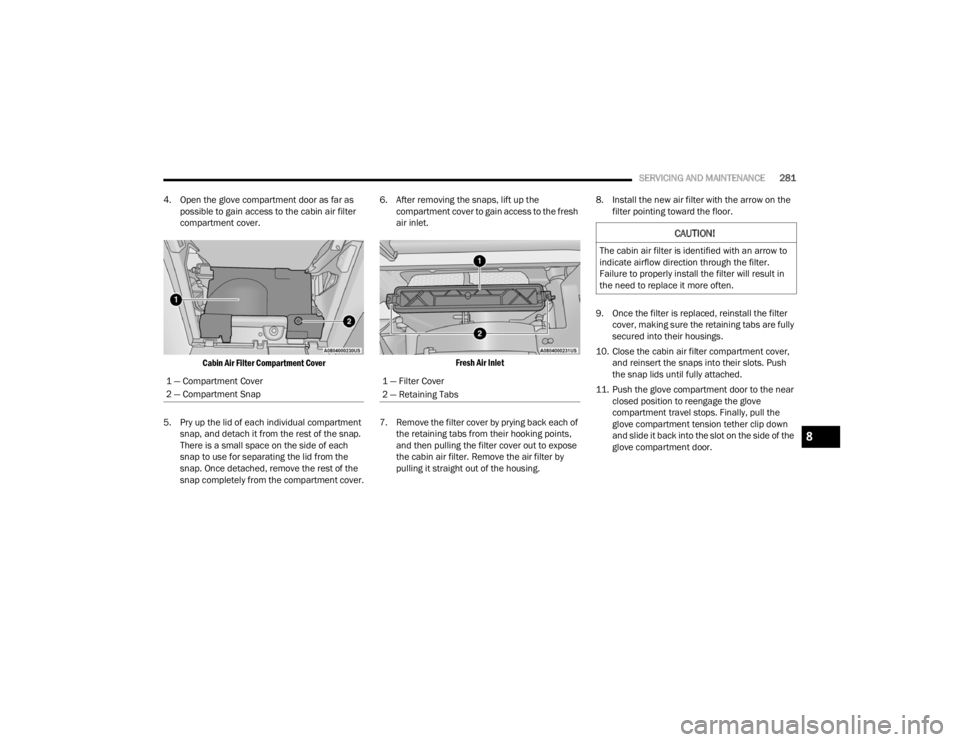
4. Open the glove compartment door as far as possible to gain access to the cabin air filter
compartment cover.
Cabin Air Filter Compartment Cover
5. Pry up the lid of each individual compartment snap, and detach it from the rest of the snap.
There is a small space on the side of each
snap to use for separating the lid from the
snap. Once detached, remove the rest of the
snap completely from the compartment cover. 6. After removing the snaps, lift up the
compartment cover to gain access to the fresh
air inlet.
Fresh Air Inlet
7. Remove the filter cover by prying back each of the retaining tabs from their hooking points,
and then pulling the filter cover out to expose
the cabin air filter. Remove the air filter by
pulling it straight out of the housing. 8. Install the new air filter with the arrow on the
filter pointing toward the floor.
9. Once the filter is replaced, reinstall the filter cover, making sure the retaining tabs are fully
secured into their housings.
10. Close the cabin air filter compartment cover, and reinsert the snaps into their slots. Push
the snap lids until fully attached.
11. Push the glove compartment door to the near closed position to reengage the glove
compartment travel stops. Finally, pull the
glove compartment tension tether clip down
and slide it back into the slot on the side of the
glove compartment door.
1 — Compartment Cover
2 — Compartment Snap
1 — Filter Cover
2 — Retaining Tabs
CAUTION!
The cabin air filter is identified with an arrow to
indicate airflow direction through the filter.
Failure to properly install the filter will result in
the need to replace it more often.
8
21_RUV_OM_EN_USC_t.book Page 281
Page 291 of 348

SERVICING AND MAINTENANCE289
(Continued)
Make sure that the coolant expansion bottle
overflow hoses are not kinked or obstructed.
Keep the front of the radiator clean. If your
vehicle is equipped with air conditioning, keep
the front of the condenser clean.
Do not change the thermostat for Summer or
Winter operation. If replacement is ever neces -
sary, install ONLY the correct type thermostat.
Other designs may result in unsatisfactory
engine cooling performance, poor gas mileage,
and increased emissions.
BRAKE SYSTEM
In order to ensure brake system performance, all
brake system components should be inspected
periodically. For the proper maintenance intervals
Úpage 272.
Brake Master Cylinder
The fluid in the master cylinder should be checked
when performing under hood services or
immediately if the “Brake Warning Light” is
illuminated.
Be sure to clean the top of the master cylinder area
before removing the cap. If necessary, add fluid to
bring the fluid level up to the requirements
described on the brake fluid reservoir. With disc
brakes, fluid level can be expected to fall as the
brake pads wear. Brake fluid level should be
checked when pads are replaced. However, low
fluid level may be caused by a leak and a checkup
may be needed.
Use only manufacturer recommended brake fluid
Úpage 327.
WARNING!
Riding the brakes can lead to brake failure and
possibly a collision. Driving with your foot resting
or riding on the brake pedal can result in
abnormally high brake temperatures, excessive
lining wear, and possible brake damage. You
would not have your full braking capacity in an
emergency.
WARNING!
Use only manufacturer recommended brake
fluid Úpage 327. Using the wrong type of
brake fluid can severely damage your brake
system and/or impair its performance. The
proper type of brake fluid for your vehicle is
also identified on the original factory installed
hydraulic master cylinder reservoir.
To avoid contamination from foreign matter or
moisture, use only new brake fluid or fluid that
has been in a tightly closed container. Keep
the master cylinder reservoir cap secured at
all times. Brake fluid in a open container
absorbs moisture from the air resulting in a
lower boiling point. This may cause it to boil
unexpectedly during hard or prolonged
braking, resulting in sudden brake failure. This
could result in a collision.
Overfilling the brake fluid reservoir can result
in spilling brake fluid on hot engine parts,
causing the brake fluid to catch fire. Brake
fluid can also damage painted and vinyl
surfaces, care should be taken to avoid its
contact with these surfaces.
Do not allow petroleum-based fluid to contam -
inate the brake fluid. Brake seal components
could be damaged, causing partial or
complete brake failure. This could result in a
collision.
WARNING!
8
21_RUV_OM_EN_USC_t.book Page 289
Page 304 of 348
302SERVICING AND MAINTENANCE
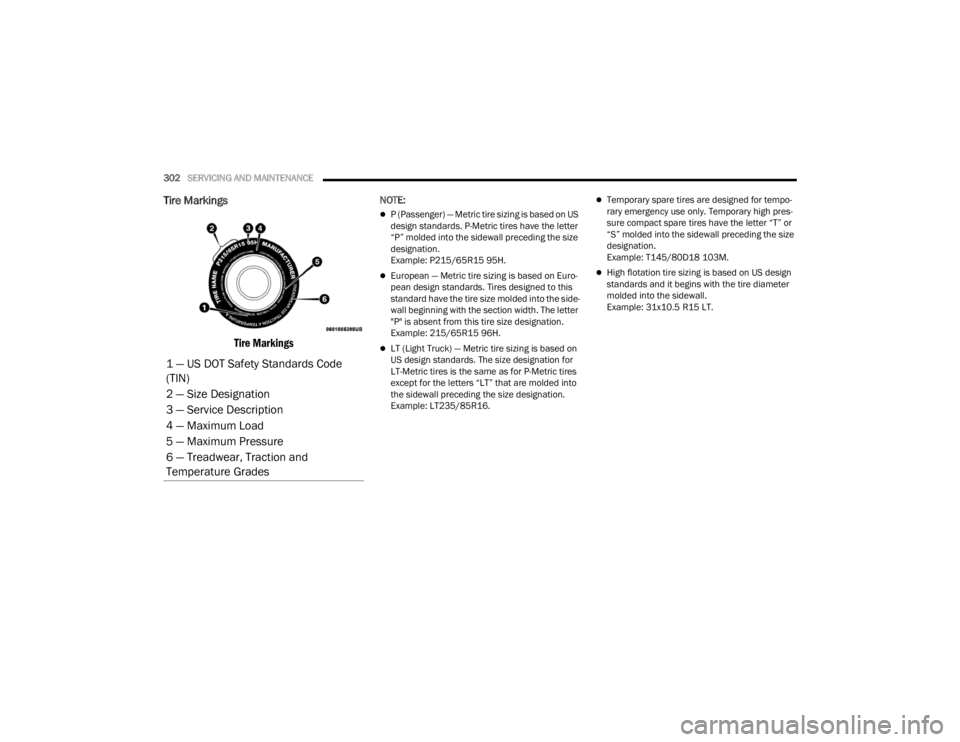
Tire Markings
Tire Markings
NOTE:
P (Passenger) — Metric tire sizing is based on US
design standards. P-Metric tires have the letter
“P” molded into the sidewall preceding the size
designation.
Example: P215/65R15 95H.
European — Metric tire sizing is based on Euro -
pean design standards. Tires designed to this
standard have the tire size molded into the side -
wall beginning with the section width. The letter
"P" is absent from this tire size designation.
Example: 215/65R15 96H.
LT (Light Truck) — Metric tire sizing is based on
US design standards. The size designation for
LT-Metric tires is the same as for P-Metric tires
except for the letters “LT” that are molded into
the sidewall preceding the size designation.
Example: LT235/85R16.
Temporary spare tires are designed for tempo -
rary emergency use only. Temporary high pres -
sure compact spare tires have the letter “T” or
“S” molded into the sidewall preceding the size
designation.
Example: T145/80D18 103M.
High flotation tire sizing is based on US design
standards and it begins with the tire diameter
molded into the sidewall.
Example: 31x10.5 R15 LT.
1 — US DOT Safety Standards Code
(TIN)
2 — Size Designation
3 — Service Description
4 — Maximum Load
5 — Maximum Pressure
6 — Treadwear, Traction and
Temperature Grades
21_RUV_OM_EN_USC_t.book Page 302
Page 306 of 348

304SERVICING AND MAINTENANCE
Tire Identification Number (TIN)
The TIN may be found on one or both sides of the tire; however, the date code may only be on one side. Tires with white sidewalls will have the full TIN, including
the date code, located on the white sidewall side of the tire. Look for the TIN on the outboard side of black sidewall tires as mounted on the vehicle. If the TIN is
not found on the outboard side, then you will find it on the inboard side of the tire.Load Identification:
Absence of the following load identification symbols on the sidewall of the tire indicates a Standard Load (SL) tire:
XL = Extra load (or reinforced) tire, or
LL
= Light load tire or
C, D, E, F, G = Load range associated with the maximum load a tire can carry at a specified pressure
Maximum Load – Maximum load indicates the maximum load this tire is designed to carry
Maximum Pressure – Maximum pressure indicates the maximum permissible cold tire inflation pressure for this tire
EXAMPLE:
EXAMPLE:
DOT MA L9 ABCD 0301
DOT = Department of Transportation
This symbol certifies that the tire is in compliance with the US Department of Transportation tire safety standards and is approved for highway use
MA = Code representing the tire manufacturing location (two digits)
L9 = Code representing the tire size (two digits)
ABCD = Code used by the tire manufacturer (one to four digits)
03 = Number representing the week in which the tire was manufactured (two digits)
03 means the 3rd week
21_RUV_OM_EN_USC_t.book Page 304
Page 331 of 348

CUSTOMER ASSISTANCE329
MEXICO
Av. Prolongacion Paseo de la Reforma, 1240
Sante Fe C.P. 05109
Mexico, D.F.
In Mexico City: 800-505-1300
Outside Mexico City: +(52)55 50817568
PUERTO RICO AND US VIRGIN ISLANDS
FCA Caribbean LLC
P.O. Box 191857
San Juan 00919-1857
Phone: (800) 247-9753
Fax: (787) 782-3345
CUSTOMER ASSISTANCE FOR THE
H
EARING OR SPEECH IMPAIRED
(TDD/TTY)
To assist customers who have hearing difficulties,
FCA US LLC has installed special TDD (Telecommu -
nication Devices for the Deaf) equipment at its
customer center. Any hearing or speech impaired
customer, who has access to a TDD or a
conventional teletypewriter (TTY) in the United
States, can communicate with FCA US LLC by
dialing 1-800-380-2479. Canadian residents with hearing difficulties that
require assistance can use the special needs relay
service offered by Bell Canada. For TTY
teletypewriter users, dial 711 and for Voice callers,
dial 1-800-855-0511 to connect with a Bell Relay
Service operator.
SERVICE CONTRACT
You may have purchased a service contract for a
vehicle to help protect you from the high cost of
unexpected repairs after FCA US LLC’s New Vehicle
Limited Warranty expires. The Mopar® Vehicle
Protection plans are the ONLY vehicle extended
protection plans authorized, endorsed and backed
by FCA US LLC to provide additional protection
beyond your vehicle’s warranty. If you purchased a
Mopar® Vehicle Protection Plan, you will receive
Plan Provisions and an Owner Identification Card in
the mail within three weeks of the vehicle delivery
date. If you have any questions about the service
contract, call FCA US LLC’s Service Contract
National Customer Hotline at 1-800-521-9922
(Canadian residents, call (800) 465-2001 English
/ (800) 387-9983 French).
FCA US LLC is not responsible for any service
contract you may have purchased from another
manufacturer. If you require service after the
FCA US LLC New Vehicle Limited Warranty expires,
please refer to the contract documents, and
contact the person listed in those documents.
We appreciate that you have made a major
investment when you purchased the vehicle. An
authorized dealer has also made a major
investment in facilities, tools, and training to
assure that you are absolutely delighted with the
ownership experience.
WARNING!
Engine exhaust (internal combustion engines
only), some of its constituents, and certain
vehicle components contain, or emit, chemicals
known to the State of California to cause cancer
and birth defects, or other reproductive harm. In
addition, certain fluids contained in vehicles and
certain products of component wear contain, or
emit, chemicals known to the State of California
to cause cancer and birth defects, or other
reproductive harm.
10
21_RUV_OM_EN_USC_t.book Page 329
Page 334 of 348

332
INDEX
A
About Your Brakes......................................... 322Adding Engine Coolant (Antifreeze)............... 287Additives, Fuel............................................... 325AdjustDown........................................................... 41Forward....................................................... 41Rearward..................................................... 41Up................................................................ 41Advance Phone Connectivity......................... 179Air Bag........................................................... 214Air Bag Operation...................................... 215Air Bag Warning Light...................... 213, 216Driver Knee Air Bag................................... 220Enhanced Accident Response......... 223, 270Event Data Recorder (EDR)....................... 270Front Air Bag............................................. 216If Deployment Occurs................................ 223Knee Impact Bolsters................................ 220Maintaining Your Air Bag System.............. 224Maintenance............................................. 224Redundant Air Bag Warning Light.............213Side Air Bags............................................. 220Transporting Pets...................................... 242Air Bag Light..................................97, 213, 242
Air Cleaner, Engine
(Engine Air Cleaner Filter)............................. 278Air Conditioner Maintenance........................ 279Air Conditioner Refrigerant.................. 279, 280Air Conditioner System................................. 279Air Conditioning Filter..............................70, 280Air Conditioning, Operating Tips....................... 70Air Filter........................................................ 278Air PressureTires......................................................... 310AlarmArm The System.......................................... 19Disarm The System..................................... 19Security Alarm.......................................... 100Alterations/ModificationsVehicle........................................................... 8Android Auto........................................ 181, 182Android Auto™ ¹............................................ 181Antifreeze (Engine Coolant)................. 287, 326Disposal................................................... 288Anti-Lock Brake System (ABS)...................... 186Anti-Lock Warning Light................................ 100Apple CarPlay....................................... 181, 184Apple CarPlay®
b
..................................... 183Ashtray............................................................. 78Assist, Hill Start............................................. 190
Audio Jack........................................................75Audio Settings............................................... 166Audio Systems (Radio).................................. 141Auto Up Power Windows..................................79Automatic Dimming Mirror...............................48Automatic Headlights.......................................54Automatic Temperature Control (ATC)..............69Automatic Transaxle..................................... 113Automatic Transmission................................ 115Adding Fluid..................................... 290, 327Fluid And Filter Change............................. 290Fluid Change............................................. 290Fluid Level Check...................................... 290Fluid Type........................................ 290, 327Special Additives...................................... 290AutoPark....................................................... 107AUX Cord..........................................................75Auxiliary Electrical Outlet (Power Outlet)..........76Axle Lubrication............................................ 327
B
Back-Up Camera........................................... 127Battery................................................... 98, 276Charging System Light.................................98Jump Starting........................................... 262Keyless Key Fob Replacement....................13
21_RUV_OM_EN_USC_t.book Page 332
Page 335 of 348

333
Battery Saver Feature
...................................... 55Belts, Seat..................................................... 242Blind Spot Monitoring.................................... 192Bluetooth Connecting To A Particular MobilePhone Or Audio Device After Pairing
..... 174Body Mechanism Lubrication........................ 282B-Pillar Location............................................. 306Brake Assist System...................................... 187Brake Control System, Electronic.................. 187Brake Fluid.................................................... 327Brake System...................................... 289, 322Anti-Lock (ABS).......................................... 322Fluid Check..................................... 289, 327Master Cylinder......................................... 289Parking...................................................... 111Warning Light.............................................. 97Brake/Transmission Interlock....................... 115Brightness, Interior Lights................................ 56Bulb Replacement............................... 299, 301Bulbs, Light................................. 243, 299, 301
C
Camera.......................................................... 127Camera, Rear................................................ 127Capacities, Fluid............................................ 326Caps, FillerFuel........................................................... 129Oil (Engine)................................................ 275Radiator (Coolant Pressure)...................... 288
Car Washes................................................... 319Carbon Monoxide Warning............................ 244CargoVehicle Loading........................................... 82Cargo Area Cover............................................. 82Cargo CompartmentLuggage Carrier........................................... 83Cargo Load Floor.............................................. 82Cargo Tie-Downs.............................................. 82CD................................................................. 168Cellular Phone.............................................. 185Certification Label......................................... 129Chains, Tire................................................... 316Change Oil Indicator........................................ 90Changing A Flat Tire...................................... 249Chart, Tire Sizing........................................... 303Check Engine Light
(Malfunction Indicator Light)......................... 105Checking Your Vehicle For Safety................. 241Checks, Safety.............................................. 241Child Restraint.............................................. 225Child RestraintsBooster Seats........................................... 228Center Seat LATCH................................... 234Child Seat Installation..................... 236, 238How To Stow An unused ALR Seat Belt.... 235Infant And Child Restraints....................... 226Lower Anchors And Tethers For Children......................................... 229Older Children And Child Restraints......... 227
Seating Positions...................................... 229Using The Top Tether Anchorage.............. 239Cigar Lighter.....................................................78Clean Air Gasoline......................................... 324CleaningWheels...................................................... 315Climate Control................................................58Automatic....................................................58Manual........................................................64Rear......................................................62, 68Coat Hook........................................................74Cold Weather Operation................................ 109Compact Spare Tire...................................... 314Computer, Trip/Travel......................................96Contract, Service........................................... 329Controls........................................................ 160Cooling Pressure Cap (Radiator Cap)............ 288Cooling System............................................. 286Adding Coolant (Antifreeze)...................... 287Coolant Level............................................ 288Cooling Capacity....................................... 326Disposal Of Used Coolant......................... 288Drain, Flush, And Refill............................. 286Inspection........................................ 286, 288Points To Remember................................ 288Pressure Cap............................................ 288Radiator Cap............................................. 288Selection Of Coolant (Antifreeze)..... 287, 326Corrosion Protection..................................... 319Cruise Control............................................... 120
11
21_RUV_OM_EN_USC_t.book Page 333