Hood CHRYSLER VOYAGER 2021 User Guide
[x] Cancel search | Manufacturer: CHRYSLER, Model Year: 2021, Model line: VOYAGER, Model: CHRYSLER VOYAGER 2021Pages: 348, PDF Size: 18.73 MB
Page 265 of 348
IN CASE OF EMERGENCY263
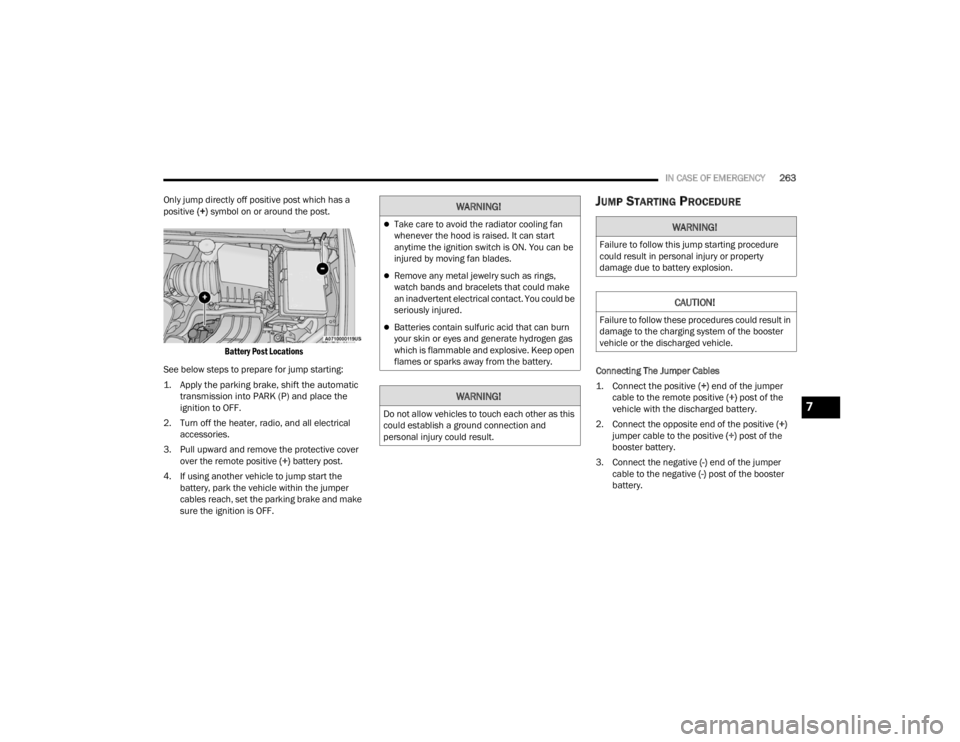
Only jump directly off positive post which has a
positive (+) symbol on or around the post.
Battery Post Locations
See below steps to prepare for jump starting:
1. Apply the parking brake, shift the automatic transmission into PARK (P) and place the
ignition to OFF.
2. Turn off the heater, radio, and all electrical accessories.
3. Pull upward and remove the protective cover over the remote positive (+) battery post.
4. If using another vehicle to jump start the battery, park the vehicle within the jumper
cables reach, set the parking brake and make
sure the ignition is OFF.
JUMP STARTING PROCEDURE
Connecting The Jumper Cables
1. Connect the positive
(+) end of the jumper
cable to the remote positive (+)
post of the
vehicle with the discharged battery.
2. Connect the opposite end of the positive (+)
jumper cable to the positive (+) post of the
booster battery.
3. Connect the negative (-) end of the jumper
cable to the negative (-) post of the booster
battery.
WARNING!
Take care to avoid the radiator cooling fan
whenever the hood is raised. It can start
anytime the ignition switch is ON. You can be
injured by moving fan blades.
Remove any metal jewelry such as rings,
watch bands and bracelets that could make
an inadvertent electrical contact. You could be
seriously injured.
Batteries contain sulfuric acid that can burn
your skin or eyes and generate hydrogen gas
which is flammable and explosive. Keep open
flames or sparks away from the battery.
WARNING!
Do not allow vehicles to touch each other as this
could establish a ground connection and
personal injury could result.
WARNING!
Failure to follow this jump starting procedure
could result in personal injury or property
damage due to battery explosion.
CAUTION!
Failure to follow these procedures could result in
damage to the charging system of the booster
vehicle or the discharged vehicle.
7
21_RUV_OM_EN_USC_t.book Page 263
Page 267 of 348
IN CASE OF EMERGENCY265
(Continued)
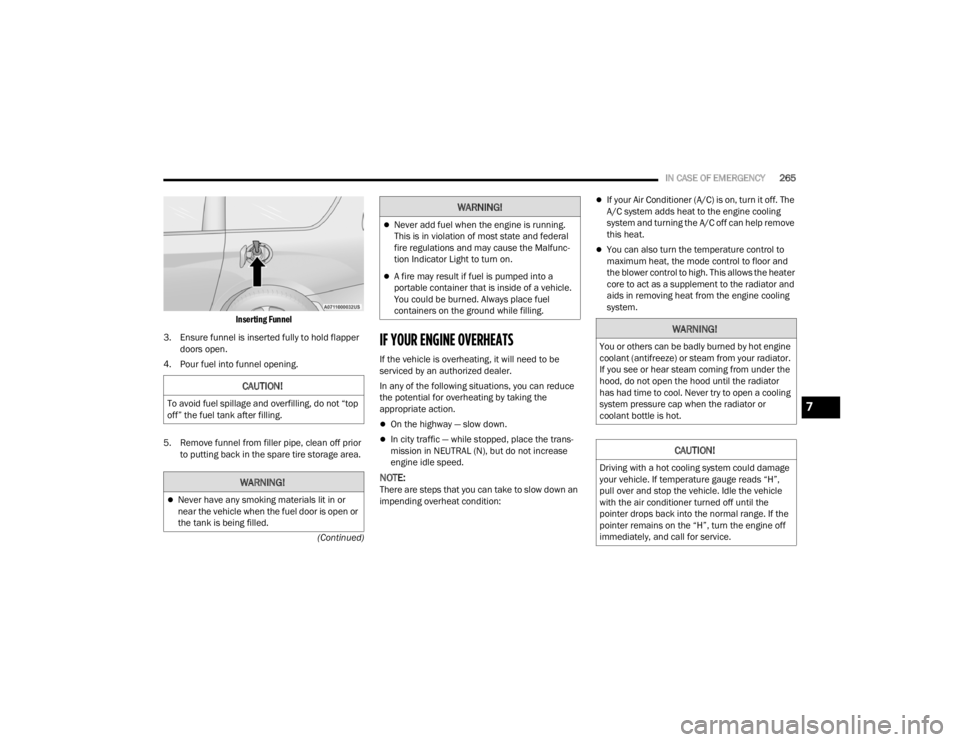
Inserting Funnel
3. Ensure funnel is inserted fully to hold flapper doors open.
4. Pour fuel into funnel opening.
5. Remove funnel from filler pipe, clean off prior to putting back in the spare tire storage area.
IF YOUR ENGINE OVERHEATS
If the vehicle is overheating, it will need to be
serviced by an authorized dealer.
In any of the following situations, you can reduce
the potential for overheating by taking the
appropriate action.
On the highway — slow down.
In city traffic — while stopped, place the trans -
mission in NEUTRAL (N), but do not increase
engine idle speed.
NOTE:There are steps that you can take to slow down an
impending overheat condition:
If your Air Conditioner (A/C) is on, turn it off. The
A/C system adds heat to the engine cooling
system and turning the A/C off can help remove
this heat.
You can also turn the temperature control to
maximum heat, the mode control to floor and
the blower control to high. This allows the heater
core to act as a supplement to the radiator and
aids in removing heat from the engine cooling
system.
CAUTION!
To avoid fuel spillage and overfilling, do not “top
off” the fuel tank after filling.
WARNING!
Never have any smoking materials lit in or
near the vehicle when the fuel door is open or
the tank is being filled.
Never add fuel when the engine is running.
This is in violation of most state and federal
fire regulations and may cause the Malfunc -
tion Indicator Light to turn on.
A fire may result if fuel is pumped into a
portable container that is inside of a vehicle.
You could be burned. Always place fuel
containers on the ground while filling.
WARNING!
WARNING!
You or others can be badly burned by hot engine
coolant (antifreeze) or steam from your radiator.
If you see or hear steam coming from under the
hood, do not open the hood until the radiator
has had time to cool. Never try to open a cooling
system pressure cap when the radiator or
coolant bottle is hot.
CAUTION!
Driving with a hot cooling system could damage
your vehicle. If temperature gauge reads “H”,
pull over and stop the vehicle. Idle the vehicle
with the air conditioner turned off until the
pointer drops back into the normal range. If the
pointer remains on the “H”, turn the engine off
immediately, and call for service.
7
21_RUV_OM_EN_USC_t.book Page 265
Page 284 of 348
282SERVICING AND MAINTENANCE
BODY LUBRICATION
Locks and all body pivot points, including such
items as seat tracks, door hinge pivot points and
rollers, liftgate, tailgate, decklid, sliding doors and
hood hinges, should be lubricated periodically. Use
a lithium-based grease, such as Mopar® Spray
White Lube to ensure quiet, easy operation and to
protect against rust and wear. Prior to the
application of any lubricant, the parts concerned
should be wiped clean to remove dust and grit;
after lubricating, excess oil and grease should be
removed. Particular attention should also be given
to hood latching components to ensure proper
function. When performing other underhood
services, the hood latch release mechanism, and
safety catch should be cleaned and lubricated.
The external lock cylinders should be lubricated
twice a year, preferably in the Autumn and Spring.
Apply a small amount of a high quality lubricant,
such as Mopar® Lock Cylinder Lubricant directly
into the lock cylinder.
WINDSHIELD WIPER BLADES
Clean the rubber edges of the wiper blades and the
windshield periodically with a sponge or soft cloth
and a mild nonabrasive cleaner. This will remove
accumulations of salt or road film. Operation of the wipers on dry glass for long
periods may cause deterioration of the wiper
blades. Always use washer fluid when using the
wipers to remove salt or dirt from a dry windshield.
Avoid using the wiper blades to remove frost or ice
from the windshield. Keep the blade rubber out of
contact with petroleum products such as engine
oil, gasoline, etc.
NOTE:Life expectancy of wiper blades varies depending
on geographical area and frequency of use. If chat
-
tering, marks, water lines or wet spots are present,
clean the wiper blades or replace as necessary.
The wiper blades and wiper arms should be
inspected periodically, not just when wiper
performance problems are experienced. This
inspection should include the following points:
Wear or uneven edges
Foreign material
Hardening or cracking
Deformation or fatigue
If a wiper blade or wiper arm is damaged, replace
the affected wiper arm or blade with a new unit. Do
not attempt to repair a wiper arm or blade that is
damaged.
Front Wiper Blade Removal/Installation
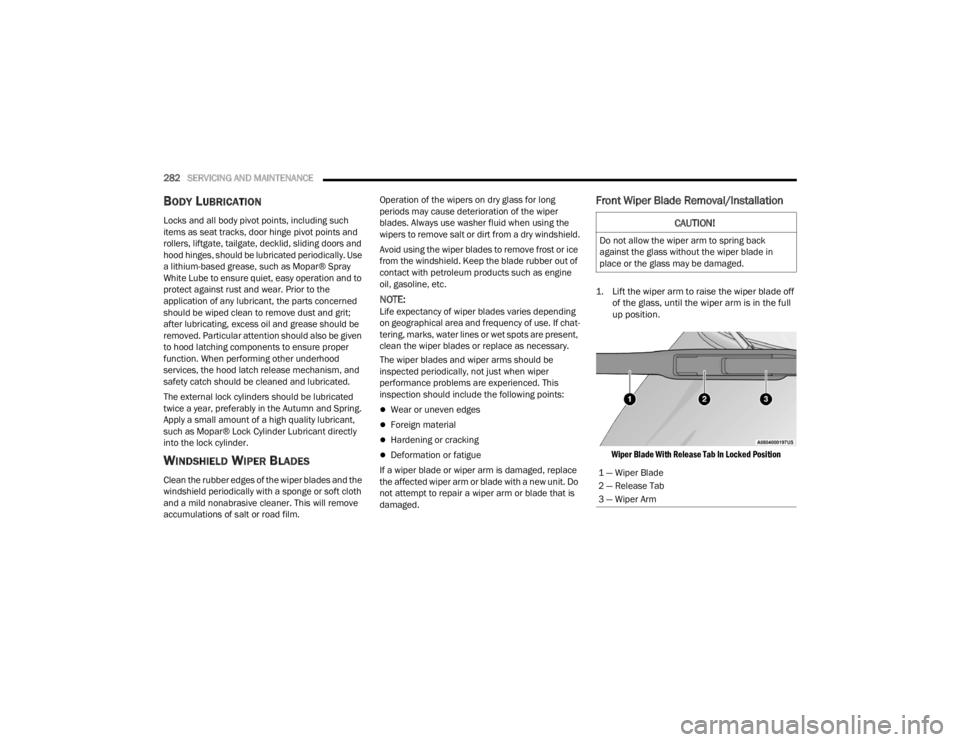
1. Lift the wiper arm to raise the wiper blade off of the glass, until the wiper arm is in the full
up position.
Wiper Blade With Release Tab In Locked Position
CAUTION!
Do not allow the wiper arm to spring back
against the glass without the wiper blade in
place or the glass may be damaged.
1 — Wiper Blade
2 — Release Tab
3 — Wiper Arm
21_RUV_OM_EN_USC_t.book Page 282
Page 288 of 348
286SERVICING AND MAINTENANCE
Under normal operating conditions, the catalytic
converter will not require maintenance. However, it
is important to keep the engine properly tuned to
ensure proper catalyst operation and prevent
possible catalyst damage.
NOTE:Intentional tampering with emissions control
systems can result in civil penalties being
assessed against you.
In unusual situations involving grossly
malfunctioning engine operation, a scorching odor
may suggest severe and abnormal catalyst
overheating. If this occurs, stop the vehicle, turn off
the engine and allow it to cool. Service, including a
tune-up to the manufacturer specifications, should
be obtained immediately.
To minimize the possibility of catalytic converter
damage:
Do not interrupt the ignition when the transmis -
sion is in gear and the vehicle is in motion.
Do not try to start the vehicle by pushing or
towing the vehicle.
Do not idle the engine with any ignition compo -
nents disconnected or removed, such as when
diagnostic testing, or for prolonged periods
during very rough idle or malfunctioning oper -
ating conditions.
COOLING SYSTEM
Engine Coolant Checks
Check the engine coolant (antifreeze) protection
every 12 months (before the onset of freezing
weather, where applicable). If the engine coolant is
dirty, the system should be drained, flushed, and
refilled with fresh Organic Additive Technology
(OAT) coolant (conforming to MS.90032) by an authorized dealer. Check the front of the A/C
condenser for any accumulation of bugs, leaves,
etc. If dirty, clean by gently spraying water from a
garden hose vertically down the face of the
condenser.
Check the engine cooling system hoses for brittle
rubber, cracking, tears, cuts, and tightness of the
connection at the coolant recovery bottle and
radiator. Inspect the entire system for leaks. DO
NOT REMOVE THE COOLANT PRESSURE CAP
WHEN THE COOLING SYSTEM IS HOT.
Cooling System — Drain, Flush And Refill
NOTE:Some vehicles require special tools to add coolant
properly. Failure to fill these systems properly
could lead to severe internal engine damage. If any
coolant is needed to be added to the system
please contact an authorized dealer.
If the engine coolant (antifreeze) is dirty
or contains visible sediment, have an authorized
dealer clean and flush with Organic Additive
Technology (OAT) coolant (conforming to
MS.90032).
For the proper maintenance intervals
Úpage 272.
WARNING!
You or others can be badly burned by hot
engine coolant (antifreeze) or steam from your
radiator. If you see or hear steam coming from
under the hood, do not open the hood until the
radiator has had time to cool. Never open a
cooling system pressure cap when the radi
-
ator or coolant bottle is hot.
Keep hands, tools, clothing, and jewelry away
from the radiator cooling fan when the hood is
raised. The fan starts automatically and may
start at any time, whether the engine is
running or not.
When working near the radiator cooling fan,
disconnect the fan motor lead or turn the igni -
tion to the OFF mode. The fan is temperature
controlled and can start at any time the igni -
tion is in the ON mode.
21_RUV_OM_EN_USC_t.book Page 286
Page 291 of 348
SERVICING AND MAINTENANCE289
(Continued)
Make sure that the coolant expansion bottle
overflow hoses are not kinked or obstructed.
Keep the front of the radiator clean. If your
vehicle is equipped with air conditioning, keep
the front of the condenser clean.
Do not change the thermostat for Summer or
Winter operation. If replacement is ever neces -
sary, install ONLY the correct type thermostat.
Other designs may result in unsatisfactory
engine cooling performance, poor gas mileage,
and increased emissions.
BRAKE SYSTEM
In order to ensure brake system performance, all
brake system components should be inspected
periodically. For the proper maintenance intervals
Úpage 272.
Brake Master Cylinder
The fluid in the master cylinder should be checked
when performing under hood services or
immediately if the “Brake Warning Light” is
illuminated.
Be sure to clean the top of the master cylinder area
before removing the cap. If necessary, add fluid to
bring the fluid level up to the requirements
described on the brake fluid reservoir. With disc
brakes, fluid level can be expected to fall as the
brake pads wear. Brake fluid level should be
checked when pads are replaced. However, low
fluid level may be caused by a leak and a checkup
may be needed.
Use only manufacturer recommended brake fluid
Úpage 327.
WARNING!
Riding the brakes can lead to brake failure and
possibly a collision. Driving with your foot resting
or riding on the brake pedal can result in
abnormally high brake temperatures, excessive
lining wear, and possible brake damage. You
would not have your full braking capacity in an
emergency.
WARNING!
Use only manufacturer recommended brake
fluid Úpage 327. Using the wrong type of
brake fluid can severely damage your brake
system and/or impair its performance. The
proper type of brake fluid for your vehicle is
also identified on the original factory installed
hydraulic master cylinder reservoir.
To avoid contamination from foreign matter or
moisture, use only new brake fluid or fluid that
has been in a tightly closed container. Keep
the master cylinder reservoir cap secured at
all times. Brake fluid in a open container
absorbs moisture from the air resulting in a
lower boiling point. This may cause it to boil
unexpectedly during hard or prolonged
braking, resulting in sudden brake failure. This
could result in a collision.
Overfilling the brake fluid reservoir can result
in spilling brake fluid on hot engine parts,
causing the brake fluid to catch fire. Brake
fluid can also damage painted and vinyl
surfaces, care should be taken to avoid its
contact with these surfaces.
Do not allow petroleum-based fluid to contam -
inate the brake fluid. Brake seal components
could be damaged, causing partial or
complete brake failure. This could result in a
collision.
WARNING!
8
21_RUV_OM_EN_USC_t.book Page 289
Page 293 of 348
SERVICING AND MAINTENANCE291
The fuses protect electrical systems against
excessive current.
When a device does not work, you must check the
fuse element inside the blade fuse for a break/
melt.
Also, please be aware that when using power
outlets for extended periods of time with the
engine off may result in vehicle battery discharge.
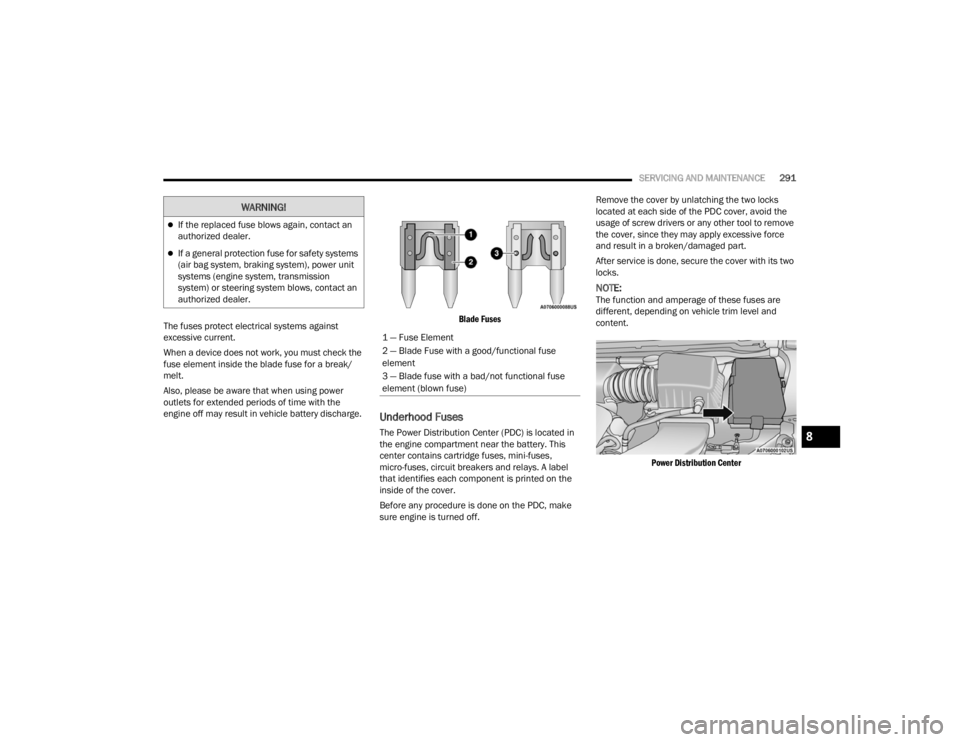
Blade Fuses
Underhood Fuses
The Power Distribution Center (PDC) is located in
the engine compartment near the battery. This
center contains cartridge fuses, mini-fuses,
micro-fuses, circuit breakers and relays. A label
that identifies each component is printed on the
inside of the cover.
Before any procedure is done on the PDC, make
sure engine is turned off.Remove the cover by unlatching the two locks
located at each side of the PDC cover, avoid the
usage of screw drivers or any other tool to remove
the cover, since they may apply excessive force
and result in a broken/damaged part.
After service is done, secure the cover with its two
locks.
NOTE:The function and amperage of these fuses are
different, depending on vehicle trim level and
content.
Power Distribution Center
If the replaced fuse blows again, contact an
authorized dealer.
If a general protection fuse for safety systems
(air bag system, braking system), power unit
systems (engine system, transmission
system) or steering system blows, contact an
authorized dealer.
WARNING!
1 — Fuse Element
2 — Blade Fuse with a good/functional fuse
element
3 — Blade fuse with a bad/not functional fuse
element (blown fuse)
8
21_RUV_OM_EN_USC_t.book Page 291
Page 303 of 348
SERVICING AND MAINTENANCE301
Replacing Exterior Bulbs
FRONT TURN SIGNAL LAMP
See below steps to replace:
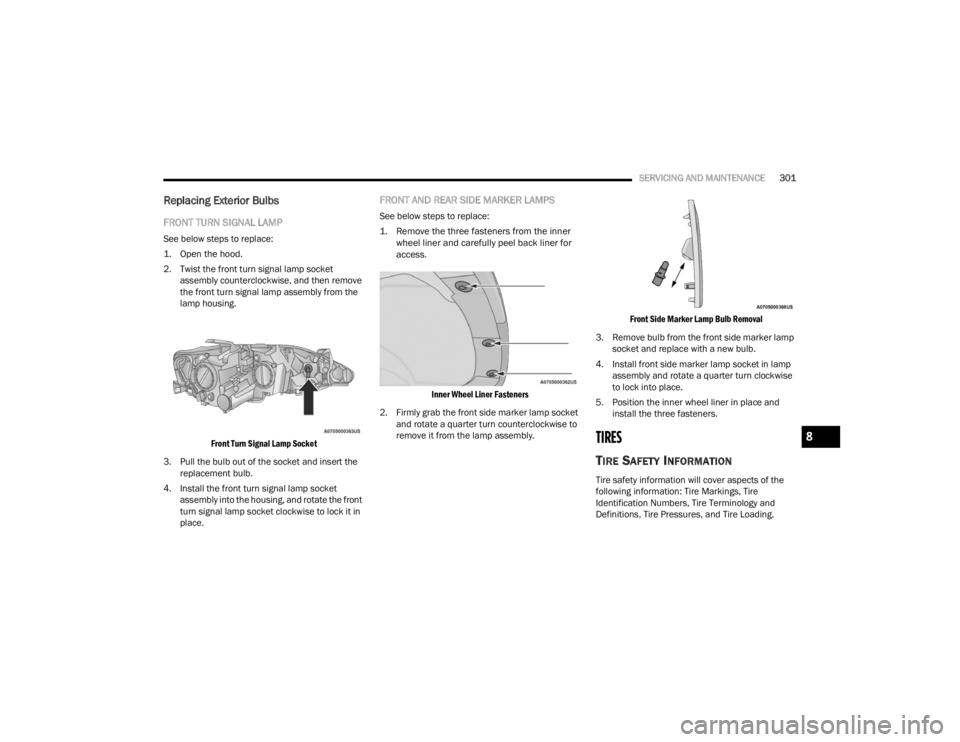
1. Open the hood.
2. Twist the front turn signal lamp socket
assembly counterclockwise, and then remove
the front turn signal lamp assembly from the
lamp housing.
Front Turn Signal Lamp Socket
3. Pull the bulb out of the socket and insert the replacement bulb.
4. Install the front turn signal lamp socket assembly into the housing, and rotate the front
turn signal lamp socket clockwise to lock it in
place.
FRONT AND REAR SIDE MARKER LAMPS
See below steps to replace:
1. Remove the three fasteners from the inner wheel liner and carefully peel back liner for
access.
Inner Wheel Liner Fasteners
2. Firmly grab the front side marker lamp socket and rotate a quarter turn counterclockwise to
remove it from the lamp assembly.
Front Side Marker Lamp Bulb Removal
3. Remove bulb from the front side marker lamp socket and replace with a new bulb.
4. Install front side marker lamp socket in lamp assembly and rotate a quarter turn clockwise
to lock into place.
5. Position the inner wheel liner in place and install the three fasteners.
TIRES
TIRE SAFETY INFORMATION
Tire safety information will cover aspects of the
following information: Tire Markings, Tire
Identification Numbers, Tire Terminology and
Definitions, Tire Pressures, and Tire Loading.
8
21_RUV_OM_EN_USC_t.book Page 301
Page 337 of 348

335
Fluid Level Checks Brake
........................................................ 289Engine Oil.................................................. 276Fluid, Brake................................................... 327Fog Lights................................................. 53, 54Fold In Floor (Stow ‘n Go) Seating.................... 37Fold-Flat Seats................................................. 28Forward Collision Warning............................. 196Freeing A Stuck Vehicle................................. 267Front Position Light........................................ 301Fuel............................................................... 323Additives................................................... 325Clean Air.................................................... 324Ethanol...................................................... 324Filler Cap (Gas Cap)................................... 129Gasoline.................................................... 323Materials Added........................................ 325Methanol................................................... 324Octane Rating................................. 323, 326Requirements........................................... 323Specifications............................................ 326Tank Capacity............................................ 326Fuses............................................................. 290
G
Garage Door Opener (HomeLink).................... 50Gas Cap (Fuel Filler Cap)............................... 129Gasoline, (Fuel)............................................. 323Gasoline, Clean Air........................................ 324Gasoline, Reformulated................................. 324
Gear Ranges................................................. 115Glass Cleaning.............................................. 321Gross Axle Weight Rating.............................. 131Gross Vehicle Weight Rating......................... 131GVWR............................................................ 129
H
HazardDriving Through Flowing, Rising,Or Shallow Standing Water
.................. 140Hazard Warning Flashers.............................. 245Head Restraints............................................... 43Headlights....................................................... 53Cleaning................................................... 319High Beam/Low Beam Select Switch.......... 53Lights On Reminder.............................. 53, 54Passing................................................. 53, 54Switch.......................................................... 53Time Delay................................................... 53Heated Mirrors................................................. 48Heated Seats................................................... 43Heater, Engine Block.................................... 110Hill Start Assist.............................................. 190HitchesTrailer Towing........................................... 132HomeLink (Garage Door Opener)..................... 50Hood Prop........................................................ 80Hood Release.................................................. 80Hook, Coat....................................................... 74
I
Ignition.............................................................15Switch..........................................................15Inside Rearview Mirror........................... 48, 245Instrument Cluster...........................................88Descriptions.............................................. 103Display.........................................................88Display Controls...........................................89KeySense Message.....................................90Menu Items.................................................91Instrument Panel Lens Cleaning................... 321Interior And Instrument Lights.........................55Interior Appearance Care.............................. 320Interior Lights...................................................55Intermittent Wipers (Delay Wipers)..................57Introduction....................................................... 7
J
Jack Location................................................ 250Jack Operation.............................................. 249Jump Starting................................................ 262
K
Key Fob............................................................12Arm The System...........................................19Disarm The Alarm........................................19Programming Additional Key Fobs...............14Key Fob Battery Service
(Remote Keyless Entry)....................................13
11
21_RUV_OM_EN_USC_t.book Page 335
Page 338 of 348

336
Key Fob Programming
(Remote Keyless Entry)
................................... 14Keyless Enter-N-Go.......................................... 22Passive Entry............................................... 22Keys................................................................. 12
L
Lane Change And Turn Signals........................ 53Lane Change Assist.................................. 53, 55Lap/Shoulder Belts....................................... 204Latches.......................................................... 243Hood........................................................... 80Lead Free Gasoline........................................ 323Leaks, Fluid................................................... 243Life Of Tires................................................... 312Liftgate............................................................ 81Power.......................................................... 81Light Bulbs........................................... 243, 301Lighter Cigar............................................................ 78Lights............................................................. 243Air Bag.......................................97, 213, 242Battery Saver............................................... 55Brake Assist Warning................................ 190Brake Warning............................................ 97Bulb Replacement........................... 299, 301Cruise........................................................ 103Daytime Running......................................... 53
Dimmer Switch, Headlight........................... 53Engine Temperature Warning...................... 98Exterior............................................ 243, 301Fog.............................................................. 54Headlights............................................ 53, 54High Beam/Low Beam Select...................... 53Instrument Cluster....................................... 53Intensity Control.......................................... 56Interior......................................................... 55Lights On Reminder.............................. 53, 54Malfunction Indicator (Check Engine)....... 101Park.......................................................... 103Passing................................................. 53, 54Reading....................................................... 55Seat Belt Reminder..................................... 99Security Alarm.......................................... 100Service..................................................... 299Side Marker.............................................. 301Traction Control........................................ 190Turn Signals.................... 53, 103, 243, 301Warning Instrument Cluster Descriptions...................................98, 103Load Floor, Cargo............................................. 82Load Shed Battery Saver Mode....................... 95Load Shed Battery Saver On............................ 95Load Shed Electrical Load Reduction.............. 95Load Shed Intelligent Battery Sensor............... 95
Loading Vehicle...................................... 82, 129Tires.......................................................... 306Low Tire Pressure System............................. 199Lubrication, Body.......................................... 282Lug Nuts........................................................ 322Luggage Carrier................................................83
M
Maintenance Free Battery............................ 276Maintenance Schedule................................. 271Malfunction Indicator Light
(Check Engine)..................................... 101, 105ManualPark Release............................................ 266Service...................................................... 331Map/Reading Lights........................................55Marker Lights, Side....................................... 301Media Hub.......................................................75Media Mode.................................................. 168Memory Seat....................................................49Methanol....................................................... 324Mini-Trip Computer..........................................96Mirrors.............................................................48Automatic Dimming.....................................48Electric Remote...........................................49Exterior Folding............................................49Heated.........................................................48Outside........................................................48Rearview............................................ 48, 245Vanity...........................................................48
21_RUV_OM_EN_USC_t.book Page 336
Page 339 of 348

337
Modifications/Alterations Vehicle
.......................................................... 8Monitor, Tire Pressure System....................... 199Mopar Parts................................................... 330MP3 Control.................................................... 75Multi-Function Control Lever............................ 53
N
New Vehicle Break-In Period.......................... 110
O
Occupant Restraints...................................... 202Octane Rating, Gasoline (Fuel)............ 323, 326Oil Change Indicator........................................ 90Reset........................................................... 90Oil Filter, Change........................................... 278Oil Filter, Selection......................................... 278Oil Pressure Light............................................ 99Oil, Engine........................................... 277, 326Capacity.................................................... 326Checking................................................... 276Dipstick..................................................... 276Disposal.................................................... 278Filter................................................ 278, 326Filter Disposal........................................... 278Identification Logo..................................... 278Materials Added To................................... 278Pressure Warning Light............................... 99Recommendation............................ 277, 326Synthetic................................................... 278
Viscosity................................................... 326Onboard Diagnostic System.......................... 104Operating Precautions.................................. 104Operator ManualOwner's Manual........................................ 331Outside Rearview Mirrors................................ 48Overheating, Engine...................................... 265
P
Paint Care..................................................... 319Pair (Link) Uconnect Phone To A
Mobile Phone
b
........................................ 172Parking Brake............................................... 111ParkSense System, Rear.............................. 122Passive Entry................................................... 22Personalized Main Menu Bar........................ 158Pets.............................................................. 242Phone Mode................................................. 170Placard, Tire And Loading Information.......... 306PowerBrakes...................................................... 322Mirrors......................................................... 49Outlet (Auxiliary Electrical Outlet)................ 76Seats........................................................... 41Steering.................................................... 118Power SeatsDown........................................................... 41Forward....................................................... 41Rearward..................................................... 41Up................................................................ 41
Power Sliding DoorOn / Off Switch.....................................24, 81Pregnant Women And Seat Belts.................. 210Preparation For Jacking................................ 249Presets.......................................................... 166PretensionersSeat Belts................................................. 210
R
Radial Ply Tires.............................................. 310Radiator Cap (Coolant Pressure Cap)............ 288RadioPresets..................................................... 166Radio Controls.............................................. 160Radio Mode................................................... 160Radio Operation................................... 160, 185Radio Remote Controls................................. 159Rear Air Conditioning................................ 62, 68Rear Cross Path............................................ 194Rear ParkSense System................................ 122Rear Seat Removal..........................................30Rear View.........................................................48Reclining Front Seats.......................................29Recreational Towing...................................... 138Reformulated Gasoline................................. 324Refrigerant.................................................... 280Release, Hood..................................................80Reminder, Lights On........................................53Reminder, Seat Belt...................................... 203
11
21_RUV_OM_EN_USC_t.book Page 337