change time CHRYSLER VOYAGER 2023 Owner's Guide
[x] Cancel search | Manufacturer: CHRYSLER, Model Year: 2023, Model line: VOYAGER, Model: CHRYSLER VOYAGER 2023Pages: 256, PDF Size: 13.97 MB
Page 194 of 256
192
SERVICING AND MAINTENANCE
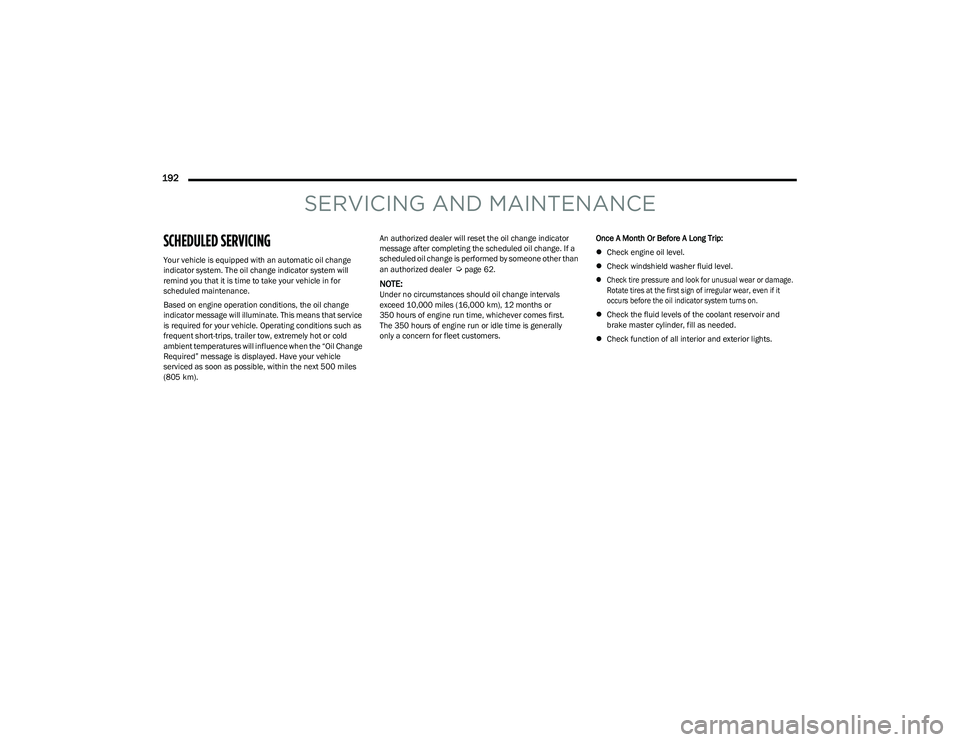
SCHEDULED SERVICING
Your vehicle is equipped with an automatic oil change
indicator system. The oil change indicator system will
remind you that it is time to take your vehicle in for
scheduled maintenance.
Based on engine operation conditions, the oil change
indicator message will illuminate. This means that service
is required for your vehicle. Operating conditions such as
frequent short-trips, trailer tow, extremely hot or cold
ambient temperatures will influence when the “Oil Change
Required” message is displayed. Have your vehicle
serviced as soon as possible, within the next 500 miles
(805 km).An authorized dealer will reset the oil change indicator
message after completing the scheduled oil change. If a
scheduled oil change is performed by someone other than
an authorized dealer Úpage 62.
NOTE:Under no circumstances should oil change intervals
exceed 10,000 miles (16,000 km), 12 months or
350 hours of engine run time, whichever comes first.
The 350 hours of engine run or idle time is generally
only a concern for fleet customers.
Once A Month Or Before A Long Trip:
Check engine oil level.
Check windshield washer fluid level.
Check tire pressure and look for unusual wear or damage.
Rotate tires at the first sign of irregular wear, even if it
occurs before the oil indicator system turns on.
Check the fluid levels of the coolant reservoir and
brake master cylinder, fill as needed.
Check function of all interior and exterior lights.
23_RUV_OM_EN_US_t.book Page 192
Page 195 of 256
SERVICING AND MAINTENANCE193
MAINTENANCE PLAN
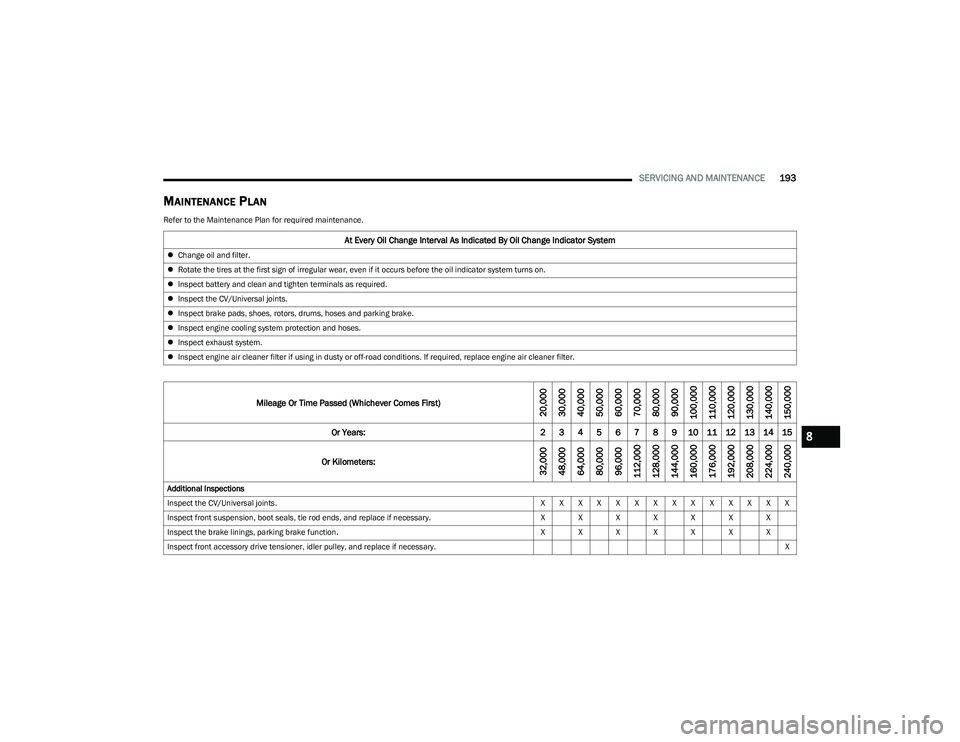
Refer to the Maintenance Plan for required maintenance.
At Every Oil Change Interval As Indicated By Oil Change Indicator System
Change oil and filter.
Rotate the tires at the first sign of irregular wear, even if it occurs before the oil indicator system turns on.
Inspect battery and clean and tighten terminals as required.
Inspect the CV/Universal joints.
Inspect brake pads, shoes, rotors, drums, hoses and parking brake.
Inspect engine cooling system protection and hoses.
Inspect exhaust system.
Inspect engine air cleaner filter if using in dusty or off-road conditions. If required, replace engine air cleaner filter.
Mileage Or Time Passed (Whichever Comes First)20,000
30,000
40,000
50,000
60,000
70,000
80,000
90,000
100,000
110,000
120,000
130,000
140,000
150,000
Or Years: 2 3 4 5 6 7 8 9 10 11 12 13 14 15
Or Kilometers:
32,000
48,000
64,000
80,000
96,000
112,000
128,000
144,000
160,000
176,000
192,000
208,000
224,000
240,000
Additional Inspections
Inspect the CV/Universal joints. X X X X X X X X X X X X X X
Inspect front suspension, boot seals, tie rod ends, and replace if necessary. X X X X X X X
Inspect the brake linings, parking brake function. X X X X X X X
Inspect front accessory drive tensioner, idler pulley, and replace if necessary. X
8
23_RUV_OM_EN_US_t.book Page 193
Page 196 of 256
194SERVICING AND MAINTENANCE
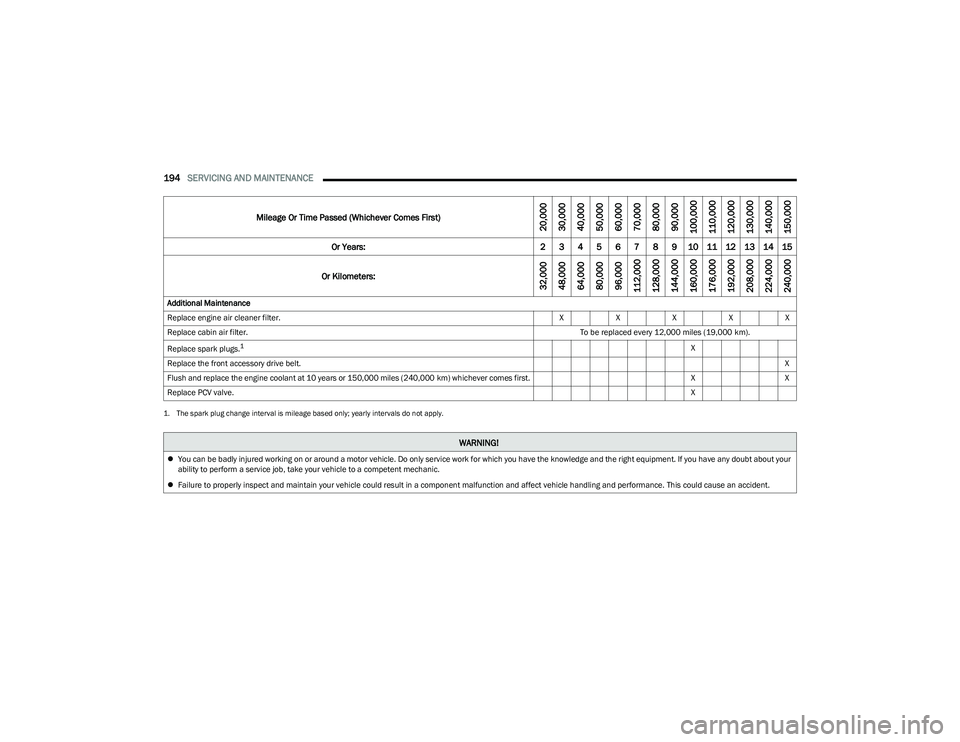
Additional Maintenance
Replace engine air cleaner filter. XXXXX
Replace cabin air filter. To be replaced every 12,000 miles (19,000 km).
Replace spark plugs.
1X
Replace the front accessory drive belt. X
Flush and replace the engine coolant at 10 years or 150,000 miles (240,000 km) whichever comes first. XX
Replace PCV valve. X
1. The spark plug change interval is mileage based only; yearly intervals do not apply.
WARNING!
You can be badly injured working on or around a motor vehicle. Do only service work for which you have the knowledge and the right equipment. If you have any doubt about your
ability to perform a service job, take your vehicle to a competent mechanic.
Failure to properly inspect and maintain your vehicle could result in a component malfunction and affect vehicle handling and performance. This could cause an accident.
Mileage Or Time Passed (Whichever Comes First)20,000
30,000
40,000
50,000
60,000
70,000
80,000
90,000
100,000
110,000
120,000
130,000
140,000
150,000
Or Years: 2 3 4 5 6 7 8 9 10 11 12 13 14 15
Or Kilometers:
32,000
48,000
64,000
80,000
96,000
112,000
128,000
144,000
160,000
176,000
192,000
208,000
224,000
240,000
23_RUV_OM_EN_US_t.book Page 194
Page 205 of 256
SERVICING AND MAINTENANCE203
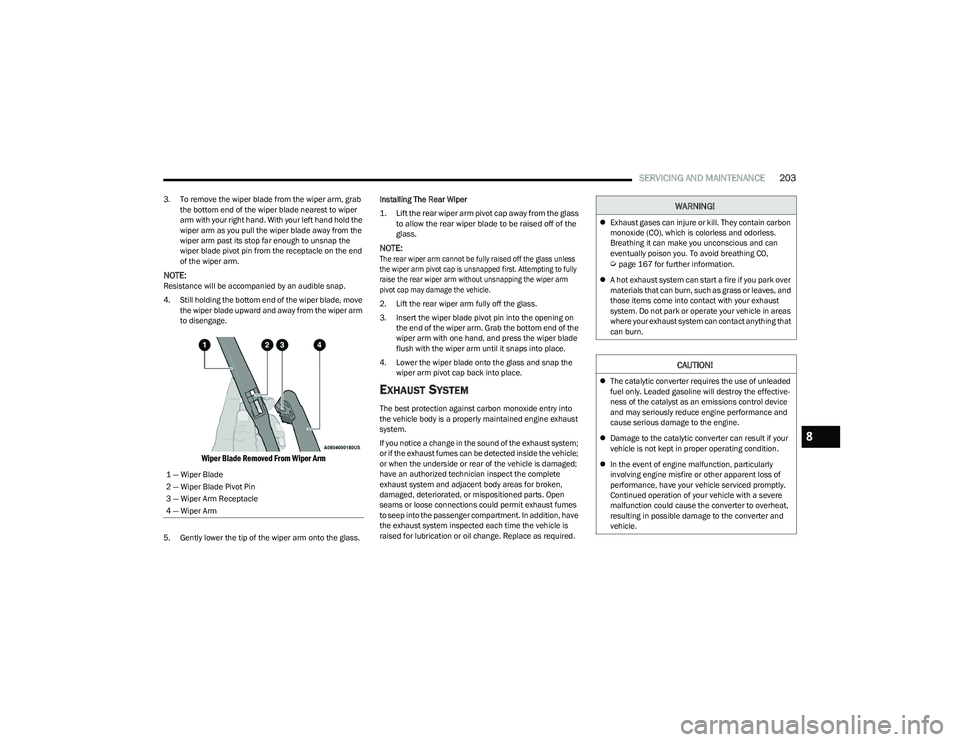
3. To remove the wiper blade from the wiper arm, grab
the bottom end of the wiper blade nearest to wiper
arm with your right hand. With your left hand hold the
wiper arm as you pull the wiper blade away from the
wiper arm past its stop far enough to unsnap the
wiper blade pivot pin from the receptacle on the end
of the wiper arm.
NOTE:Resistance will be accompanied by an audible snap.
4. Still holding the bottom end of the wiper blade, move the wiper blade upward and away from the wiper arm
to disengage.
Wiper Blade Removed From Wiper Arm
5. Gently lower the tip of the wiper arm onto the glass. Installing The Rear Wiper
1. Lift the rear wiper arm pivot cap away from the glass
to allow the rear wiper blade to be raised off of the
glass.
NOTE:
The rear wiper arm cannot be fully raised off the glass unless
the wiper arm pivot cap is unsnapped first. Attempting to fully
raise the rear wiper arm without unsnapping the wiper arm
pivot cap may damage the vehicle.
2. Lift the rear wiper arm fully off the glass.
3. Insert the wiper blade pivot pin into the opening on the end of the wiper arm. Grab the bottom end of the
wiper arm with one hand, and press the wiper blade
flush with the wiper arm until it snaps into place.
4. Lower the wiper blade onto the glass and snap the wiper arm pivot cap back into place.
EXHAUST SYSTEM
The best protection against carbon monoxide entry into
the vehicle body is a properly maintained engine exhaust
system.
If you notice a change in the sound of the exhaust system;
or if the exhaust fumes can be detected inside the vehicle;
or when the underside or rear of the vehicle is damaged;
have an authorized technician inspect the complete
exhaust system and adjacent body areas for broken,
damaged, deteriorated, or mispositioned parts. Open
seams or loose connections could permit exhaust fumes
to seep into the passenger compartment. In addition, have
the exhaust system inspected each time the vehicle is
raised for lubrication or oil change. Replace as required.
1 — Wiper Blade
2 — Wiper Blade Pivot Pin
3 — Wiper Arm Receptacle
4 — Wiper Arm
WARNING!
Exhaust gases can injure or kill. They contain carbon
monoxide (CO), which is colorless and odorless.
Breathing it can make you unconscious and can
eventually poison you. To avoid breathing CO,
Úpage 167 for further information.
A hot exhaust system can start a fire if you park over
materials that can burn, such as grass or leaves, and
those items come into contact with your exhaust
system. Do not park or operate your vehicle in areas
where your exhaust system can contact anything that
can burn.
CAUTION!
The catalytic converter requires the use of unleaded
fuel only. Leaded gasoline will destroy the effective -
ness of the catalyst as an emissions control device
and may seriously reduce engine performance and
cause serious damage to the engine.
Damage to the catalytic converter can result if your
vehicle is not kept in proper operating condition.
In the event of engine malfunction, particularly
involving engine misfire or other apparent loss of
performance, have your vehicle serviced promptly.
Continued operation of your vehicle with a severe
malfunction could cause the converter to overheat,
resulting in possible damage to the converter and
vehicle.
8
23_RUV_OM_EN_US_t.book Page 203
Page 208 of 256
206SERVICING AND MAINTENANCE
(Continued)
As long as the engine operating temperature is satisfactory, the
coolant bottle need only be checked once a month.
When additional coolant is needed to maintain the proper
level, it should be added to the coolant bottle. Do not
overfill.
See an authorized dealer for service.
Cooling System Notes
NOTE:When the vehicle is stopped after a few miles/kilometers
of operation, you may observe vapor coming from the front
of the engine compartment. This is normally a result of
moisture from rain, snow, or high humidity accumulating
on the radiator and being vaporized when the thermostat
opens, allowing hot engine coolant (antifreeze) to enter
the radiator.
If an examination of your engine compartment shows no
evidence of radiator or hose leaks, the vehicle may be
safely driven. The vapor will soon dissipate.
Do not overfill the coolant expansion bottle.
Check the coolant freeze point in the radiator and in
the coolant expansion bottle. If engine coolant needs
to be added, the contents of the coolant expansion
bottle must also be protected against freezing.
If frequent engine coolant additions are required, the
cooling system should be pressure tested for leaks.
Maintain engine coolant concentration at a minimum
of 50% OAT coolant (conforming to MS.90032) and
distilled water for proper corrosion protection of your
engine which contains aluminum components.
Make sure that the coolant expansion bottle overflow
hoses are not kinked or obstructed.
Keep the front of the radiator clean. If your vehicle is
equipped with air conditioning, keep the front of the
condenser clean.
Do not change the thermostat for Summer or Winter
operation. If replacement is ever necessary, install
ONLY the correct type thermostat. Other designs may
result in unsatisfactory engine cooling performance,
poor gas mileage, and increased emissions.
BRAKE SYSTEM
In order to ensure brake system performance, all brake
system components should be inspected periodically.
For the proper maintenance intervals
Úpage 193.
Brake Master Cylinder
The fluid in the master cylinder should be checked when
performing under hood services or immediately if the
Brake Warning Light is illuminated.
Be sure to clean the top of the master cylinder area before
removing the cap. If necessary, add fluid to bring the fluid
level up to the requirements described on the brake fluid
reservoir. With disc brakes, fluid level can be expected to
fall as the brake pads wear. Brake fluid level should be
checked when pads are replaced. However, low fluid level
may be caused by a leak and a checkup may be needed.
Use only manufacturer recommended brake fluid
Úpage 239.
WARNING!
Riding the brakes can lead to brake failure and possibly
a collision. Driving with your foot resting or riding on
the brake pedal can result in abnormally high brake
temperatures, excessive lining wear, and possible brake
damage. You would not have your full braking capacity
in an emergency.
WARNING!
Use only manufacturer recommended brake fluid Úpage 239. Using the wrong type of brake fluid can
severely damage your brake system and/or impair its
performance. The proper type of brake fluid for your
vehicle is also identified on the original factory
installed hydraulic master cylinder reservoir.
To avoid contamination from foreign matter or moisture,
use only new brake fluid or fluid that has been in a tightly
closed container. Keep the master cylinder reservoir cap
secured at all times. Brake fluid in an open container
absorbs moisture from the air resulting in a lower boiling
point. This may cause it to boil unexpectedly during hard
or prolonged braking, resulting in sudden brake failure.
This could result in a collision.
23_RUV_OM_EN_US_t.book Page 206
Page 248 of 256
246 C
Camera ............................................................................92
Camera, Rear ..................................................................92
Capacities, Fluid ........................................................... 238
Caps, Filler Fuel .............................................................................93
Oil (Engine) .............................................................. 195
Radiator (Coolant Pressure)................................... 205
Car Washes .................................................................. 233
Carbon Monoxide Warning .......................................... 169
Cargo Vehicle Loading..........................................................58
Cargo Load Floor ............................................................. 58
Cellular Phone .............................................................. 120
Certification Label ...........................................................93
Chains, Tire................................................................... 230
Change Oil Indicator ....................................................... 63
Changing A Flat Tire ..................................................... 173
Chart, Tire Sizing .......................................................... 218
Check Engine Light (Malfunction Indicator Light) .........74
Checking Your Vehicle For Safety ............................... 167
Checks, Safety.............................................................. 167
Child Restraint.............................................................. 153
Child Restraints Booster Seats.......................................................... 155
Center Seat LATCH ................................................. 160Child Seat Installation ................................... 162
, 163
How To Stow An unused ALR Seat Belt ................. 161
Infant And Child Restraints .................................... 154 Lower Anchors And Tethers For Children .............. 156Older Children And Child Restraints ...................... 155
Seating Positions .................................................... 156
Using The Top Tether Anchorage........................... 165
Clean Air Gasoline........................................................ 236 Cleaning
Wheels .....................................................................229
Climate Control ............................................................... 44 Manual ....................................................................... 44
Rear ............................................................................ 47
Cold Weather Operation ................................................. 77
Compact Spare Tire ...................................................... 228
Contract, Service .......................................................... 242
Cooling Pressure Cap (Radiator Cap) ..........................205
Cooling System ............................................................. 204 Adding Coolant (Antifreeze) ....................................205
Coolant Level ...........................................................205
Cooling Capacity ...................................................... 238
Disposal Of Used Coolant ....................................... 205Drain, Flush, And Refill............................................204
Inspection ...................................................... 204
, 205
Points To Remember............................................... 206
Pressure Cap ...........................................................205
Radiator Cap ............................................................205 Selection Of Coolant (Antifreeze) ................. 204
, 238
Corrosion Protection ..................................................... 232
Cruise Control ................................................................. 86
Cruise Light ..................................................................... 72
Customer Assistance ....................................................240
Cybersecurity ................................................................ 104
DDaytime Running Lights ................................................. 39
Dealer Service............................................................... 197
Defroster, Windshield ...................................................167
Delay (Intermittent) Wipers ............................................ 42
Diagnostic System, Onboard.......................................... 73
Dimmer Switch Headlight .................................................................... 39 Dipsticks
Oil (Engine) .............................................................. 196
Disable Vehicle Towing ................................................ 190
Disposal Antifreeze (Engine Coolant) .................................... 205
Door Ajar .................................................................. 68
, 69
Door Ajar Light ......................................................... 68, 69
Driver’s Seat Back Tilt .................................................... 23
Driving Through Flowing, Rising, Or Shallow Standing Water .................................................. 103
EElectric Brake Control System ..................................... 122Anti-Lock Brake System .......................................... 121Traction Control System ......................................... 125
Electric Parking Brake.................................................... 79
Electronic Stability Control (ESC) ................................ 123
Electronic Throttle Control Warning Light ..................... 68
Emergency Braking ...................................................... 131
Emergency Gas Can Refueling .................................... 187
Emergency, In Case Of Hazard Warning Flasher ......................................... 170Jacking ............................................................ 173
, 175
Jump Starting .......................................................... 185
Overheating ............................................................. 187
Towing...................................................................... 190
Emission Control System Maintenance ........................ 74
Engine ........................................................................... 195 Air Cleaner ............................................................... 198Block Heater .............................................................. 78
Break-In Recommendations..................................... 78
23_RUV_OM_EN_US_t.book Page 246
Page 250 of 256

248 I
Ignition .............................................................................12 Switch .........................................................................12
Inside Rearview Mirror.......................................... 38
, 170
Instrument Cluster ...................................................60, 62
Descriptions ............................................................... 72
Display ........................................................................62
Display Controls .........................................................62
KeySense Message ...................................................64
Menu Items ................................................................64
Instrument Panel Lens Cleaning ................................. 234
Interior And Instrument Lights .......................................41
Interior Appearance Care ............................................ 233
Interior Lights ..................................................................41
JJack Location................................................................ 174
Jack Operation ............................................................. 173
Jacking And Tire Changing — If Equipped
b
........... 173
Jump Starting ............................................................... 185
KKey Fob ............................................................................10 Arm The System .........................................................16
Disarm The Alarm ...................................................... 16
Programming Additional Key Fobs ...........................12
Key Fob Battery Service (Remote Keyless Entry) .........11
Key Fob Programming (Remote Keyless Entry) ............ 12
Keyless Enter 'n Go™ ...................................................... 18 Passive Entry .............................................................. 18
Keys .................................................................................10
LLane Change And Turn Signals...................................... 39 Lane Change Assist ................................................. 39, 41
Lap/Shoulder Belts ...................................................... 135
Latches .......................................................................... 168 Hood ........................................................................... 56
Lead Free Gasoline....................................................... 236
Leaks, Fluid ...................................................................168
Life Of Tires ...................................................................226
Liftgate ............................................................................ 56 Power ......................................................................... 57
Light Bulbs .......................................................... 168
, 216
Lights .............................................................................168 Air Bag ..................................................... 67
, 143, 167
Battery Saver ............................................................. 41
Brake Assist Warning .............................................. 124 Brake Warning ........................................................... 68
Bulb Replacement......................................... 215
, 216
Cruise ......................................................................... 72
Daytime Running ....................................................... 39
Dimmer Switch, Headlight ........................................ 39
Engine Temperature Warning................................... 69
Exterior ........................................................... 168
, 216
Headlights ........................................................... 39, 40
High Beam/Low Beam Select .................................. 39
Instrument Cluster .................................................... 39
Intensity Control ........................................................ 42
Interior........................................................................ 41
Lights On Reminder............................................ 39
, 41
Malfunction Indicator (Check Engine)...................... 70
Park ............................................................................ 72 Passing ............................................................... 39
, 40
Reading...................................................................... 41
Seat Belt Reminder ................................................... 69
Security Alarm ........................................................... 70
Service ..................................................................... 215 Side Marker ............................................................. 216
Traction Control ....................................................... 124Turn Signals...................................... 39
, 72, 168, 216
Warning Instrument Cluster Descriptions ........ 69, 72
Load Floor, Cargo ........................................................... 58
Load Shed Battery Saver Mode..................................... 66
Load Shed Battery Saver On ......................................... 66 Load Shed Electrical Load Reduction ........................... 66Load Shed Intelligent Battery Sensor ........................... 66Loading Vehicle ....................................................... 58
, 93
Tires ......................................................................... 221
Locks Child Protection ......................................................... 16
Manual ....................................................................... 16
Power Door ................................................................ 16
Low Tire Pressure System............................................ 131
Lubrication, Body.......................................................... 200
Lug Nuts ........................................................................ 235
MMaintenance Free Battery ........................................... 196
Maintenance Schedule ................................................ 192
Malfunction Indicator Light (Check Engine) .......... 70
, 74
Manual Park Release ........................................................... 188
Service ..................................................................... 243
23_RUV_OM_EN_US_t.book Page 248
Page 255 of 256
The driver’s primary responsibility is the safe operation of the vehicle. Driving while distracted can result in loss of vehicle control, resulting in an accident and personal
injury. FCA US LLC strongly recommends that the driver use extreme caution when using any device or feature that may take their attention off the road. Use of any
electrical devices, such as cellular telephones, computers, portable radios, vehicle navigation or other devices, by the driver while the vehicle is moving is dangerous
and could lead to a serious accident. Texting while driving is also dangerous and should never be done while the vehicle is moving. If you find yourself unable to devote
your full attention to vehicle operation, pull off the road to a safe location and stop your vehicle. Some states or provinces prohibit the use of cellular telephones or
texting while driving. It is always the driver’s responsibility to comply with all local laws.
This Owner’s Manual has been prepared to help you get acquainted with your new Chrysler brand vehicle and to provide a convenient reference source for common
questions.
Not all features shown in this manual may apply to your vehicle. For additional information, visit mopar.com/om (USA), owners.mopar.ca (Canada) or your local Chrysler
brand dealer.
U.S. Residents: If you are the first registered retail owner of your vehicle, you may obtain a complimentary printed copy of the Warranty Booklet by calling
1-800-247-9753 or by contacting your dealer. Replacement kits can be purchased by visiting www.techauthority.com.
Canadian Residents: If you are the first registered retail owner of your vehicle, you may obtain a complimentary printed copy of the Warranty Booklet or purchase a
replacement kit by calling 1-800-387-1143 or by contacting your dealer.
WARNING: Operating, servicing and maintaining a passenger vehicle or off-highway motor vehicle can
expose you to chemicals including engine exhaust, carbon monoxide, phthalates, and lead, which are known to
the State of California to cause cancer and birth defects or other reproductive harm. To minimize exposure,
avoid breathing exhaust, do not idle the engine except as necessary, service your vehicle in a well-ventilated area
and wear gloves or wash your hands frequently when servicing your vehicle. For more information go to
www.P65Warnings.ca.gov/passenger-vehicle.
This Owner’s Manual illustrates and describes the operation of features and equipment that are either standard or optional on this vehicle. This manual may also include
a description of features and equipment that are no longer available or were not ordered on this vehicle. Please disregard any features and equipment described in this
manual that are not on this vehicle. FCA US LLC reserves the right to make changes in design and specifications, and/or make additions to or improvements to its
products without imposing any obligation upon itself to install them on pr\
oducts previously manufactured.
With respect to any vehicles sold in Canada, the name FCA US LLC shall be deemed to be deleted and the name FCA Canada Inc. used in substitution therefore.
This Owner’s Manual is intended to familiarize you with the important features of your vehicle. Your most up-to-date Owner’s Manual, Radio Instruction Manual and
Warranty Booklet can be found by visiting the website on the back cover.
DRIVING AND ALCOHOL
Drunk driving is one of the most frequent causes of accidents. Your driving ability can be seriously impaired with blood alcohol levels far below the legal minimum. If
you are drinking, don’t drive. Ride with a designated non-drinking driver, call a cab, a rideshare, a friend, or use public transportation.
WARNING
Driving after drinking can lead to an accident. Your perceptions are less sharp, your reflexes are slower and your judgment is impaired when you have been drinking.
Never drink and then drive.
ROADSIDE ASSISTANCE 24 HOURS, 7 DAYS A WEEK AT YOUR SERVICE. CALL 1-800-521-2779 OR VISIT CHRYSLER.RSAHELP.COM (USA) CALL 1-800-363-4869 OR VISIT FCA.ROADSIDEAID.COM (CANADA) SERVICES: Flat Tire Service, Out Of Gas/ Fuel Delivery, Battery Jump Assistance, Lockout Service and Towing Service
Please see the Customer Assistance chapter in this Owner’s Manual for further information.
FCA US LLC reserves the right to modify the terms or discontinue the Roadside Assistance Program at any time. The Roadside Assistance Program is subject to restrictions and conditions of use, that are determined solely by FCA US LLC.