lock Citroen BERLINGO 2012 2.G Owner's Guide
[x] Cancel search | Manufacturer: CITROEN, Model Year: 2012, Model line: BERLINGO, Model: Citroen BERLINGO 2012 2.GPages: 208, PDF Size: 6.67 MB
Page 69 of 208
67
EASE OF USE and COMFOR
T
33
Seats
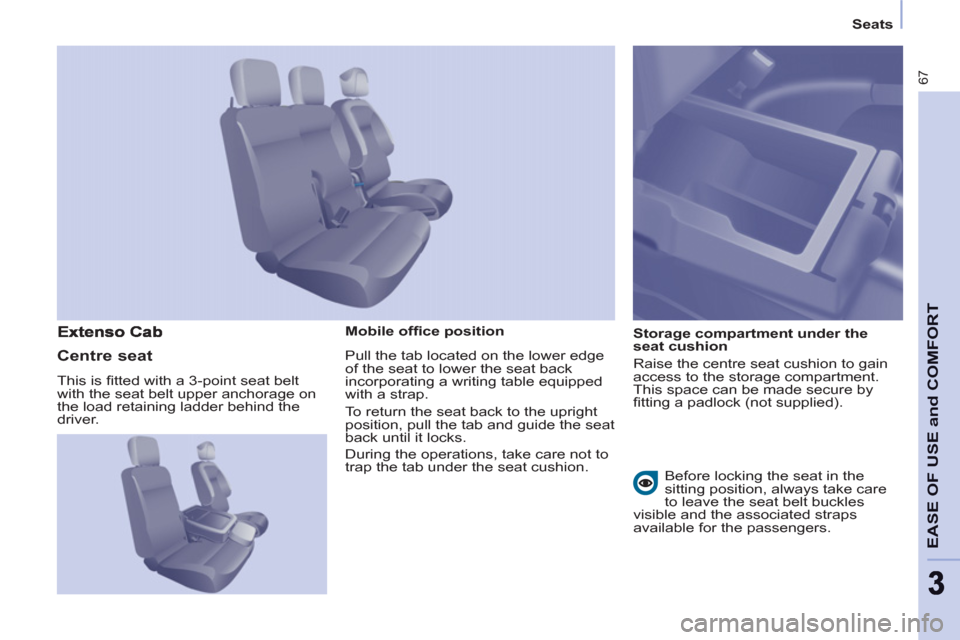
Mobile offi ce position
Pull the tab located on the lower edge
of the seat to lower the seat back
incorporating a writing table equipped
with a strap.
To return the seat back to the upright
position, pull the tab and guide the seat
back until it locks.
During the operations, take care not to
trap the tab under the seat cushion.
Storage compartment under the
seat cushion
Raise the centre seat cushion to gain
access to the storage compartment.
This space can be made secure by
fi tting a padlock (not supplied).
Centre seat
This is fi tted with a 3-point seat belt
with the seat belt upper anchorage on
the load retaining ladder behind the
driver.
Before locking the seat in the
sitting position, always take care
to leave the seat belt buckles
visible and the associated straps
available for the passengers.
Page 70 of 208
68
Seats
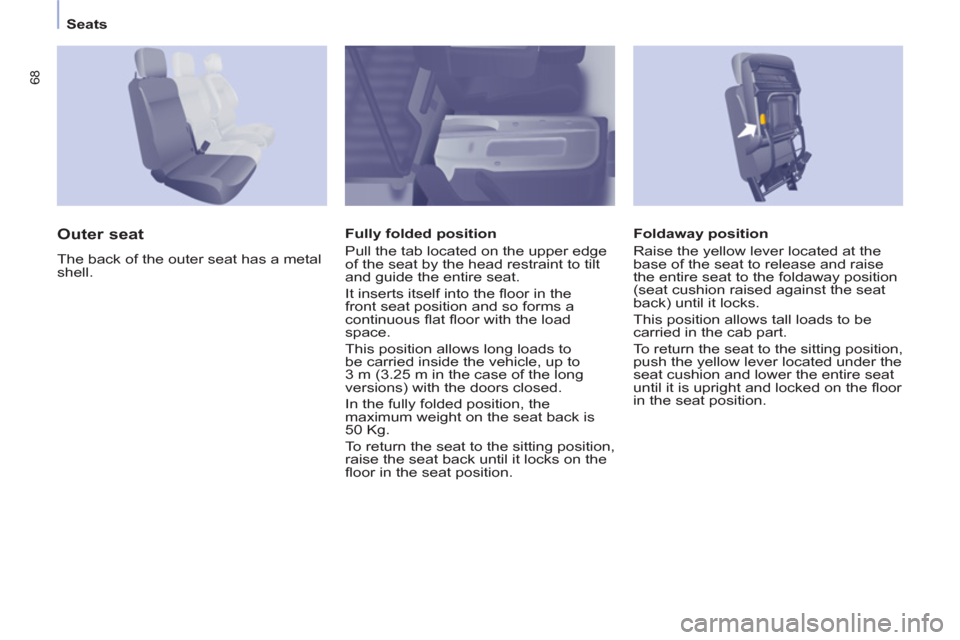
Foldaway position
Raise the yellow lever located at the
base of the seat to release and raise
the entire seat to the foldaway position
(seat cushion raised against the seat
back) until it locks.
This position allows tall loads to be
carried in the cab part.
To return the seat to the sitting position,
push the yellow lever located under the
seat cushion and lower the entire seat
until it is upright and locked on the fl oor
in the seat position.
Outer seat
The back of the outer seat has a metal
shell.
Fully folded position
Pull the tab located on the upper edge
of the seat by the head restraint to tilt
and guide the entire seat.
It inserts itself into the fl oor in the
front seat position and so forms a
continuous fl at fl oor with the load
space.
This position allows long loads to
be carried inside the vehicle, up to
3 m (3.25 m in the case of the long
versions) with the doors closed.
In the fully folded position, the
maximum weight on the seat back is
50 Kg.
To return the seat to the sitting position,
raise the seat back until it locks on the
fl oor in the seat position.
Page 74 of 208
72
Practical information
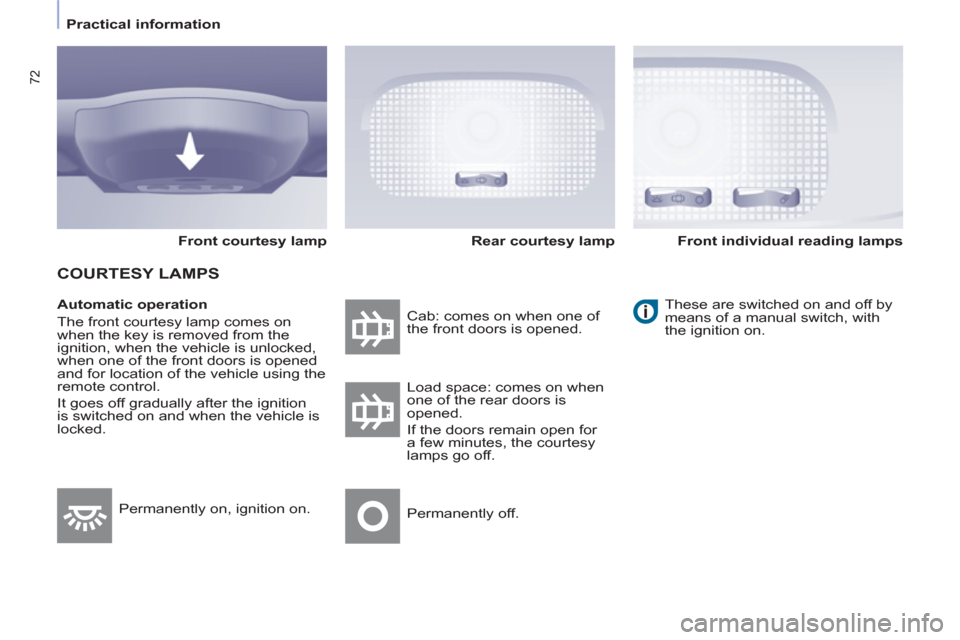
Automatic operation
The front courtesy lamp comes on
when the key is removed from the
ignition, when the vehicle is unlocked,
when one of the front doors is opened
and for location of the vehicle using the
remote control.
It goes off gradually after the ignition
is switched on and when the vehicle is
locked. Cab: comes on when one of
the front doors is opened. These are switched on and off by
means of a manual switch, with
the ignition on.
Load space: comes on when
one of the rear doors is
opened.
If the doors remain open for
a few minutes, the courtesy
lamps go off.
Permanently off. Permanently on, ignition on.
Front courtesy lamp
COURTESY LAMPS
Rear courtesy lamp
Front individual reading lamps
Page 76 of 208
74
Practical information
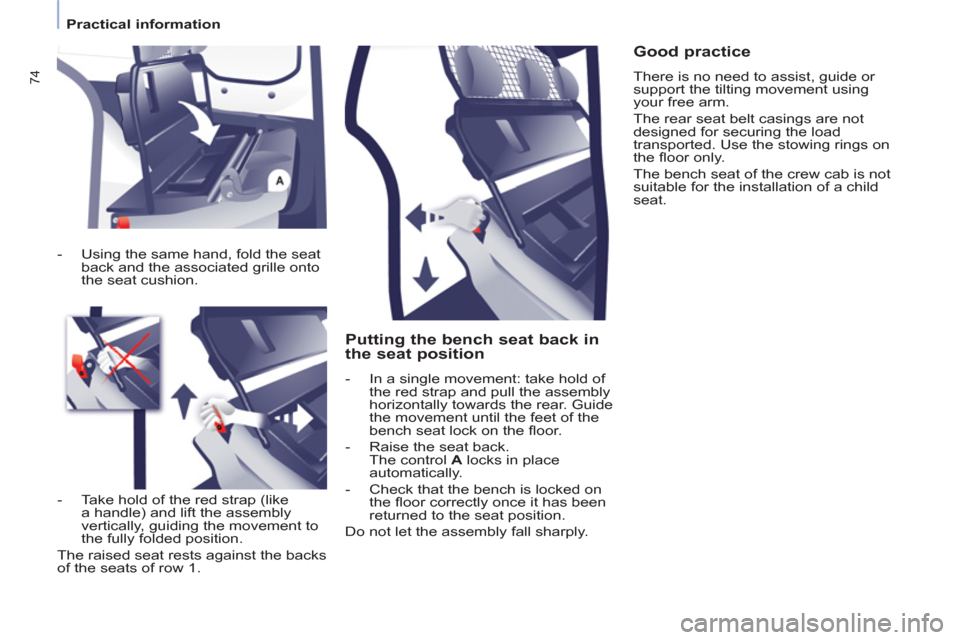
Putting the bench seat back in
the seat position
- In a single movement: take hold of
the red strap and pull the assembly
horizontally towards the rear. Guide
the movement until the feet of the
bench seat lock on the fl oor.
- Raise the seat back.
The control A
locks in place
automatically.
- Check that the bench is locked on
the fl oor correctly once it has been
returned to the seat position.
Do not let the assembly fall sharply.
Good practice
There is no need to assist, guide or
support the tilting movement using
your free arm.
The rear seat belt casings are not
designed for securing the load
transported. Use the stowing rings on
the fl oor only.
The bench seat of the crew cab is not
suitable for the installation of a child
seat.
- Using the same hand, fold the seat
back and the associated grille onto
the seat cushion.
- Take hold of the red strap (like
a handle) and lift the assembly
vertically, guiding the movement to
the fully folded position.
The raised seat rests against the backs
of the seats of row 1.
Page 86 of 208
ABS
ABS
84
Driving safely
(ABS - EBFD)
The ABS and EBFD (electronic brake
force distribution) systems improve the
stability and manoeuvrability of your
vehicle on braking, in particular on
poor or slippery surfaces.
The ABS prevents locking of the
wheels, the EBFD provides control of
the braking pressure wheel by wheel. If this warning lamp comes
on, accompanied by an
audible signal and a message
in the screen, it indicates a
malfunction of the ABS which
could result in a loss of control of the
vehicle on braking.
If this warning lamp comes
on, together with the brake
and STOP warning lamps,
accompanied by an audible
signal and a message in the
screen, it indicates a malfunction of
the electronic brake force distribution
which could result in a loss of control of
the vehicle on braking.
EMERGENCY BRAKING
ASSISTANCE SYSTEM
(EBA)
In an emergency, this system enables
the optimum braking pressure to be
reached more quickly, press the pedal
fi rmly without releasing it.
It is triggered by the speed at which the
brake pedal is activated.
This alters the resistance of the brake
pedal under your foot.
To prolong the operation of the
emergency braking assistance system:
keep your foot on the brake pedal.
Good practice
The anti-lock braking system comes
into operation automatically when
there is a risk of wheel lock. It does not
reduce the braking distance.
On very slippery surfaces (ice,
oil, etc...) the ABS may increase the
braking distance. When braking in
an emergency, do not hesitate to
press the brake pedal fi rmly, without
releasing the pressure, even on a
slippery surface, you will then be able
to continue to manoeuvre the vehicle
to avoid an obstacle.
Normal operation of the ABS may be
felt by slight vibration of the brake
pedal.
When changing wheels (tyres
and rims), ensure that these are
recommended by CITROËN.
Stop
as soon as it is safe to do so
.
In both cases, contact a CITROËN
dealer or a qualifi ed workshop.
Page 91 of 208
The inertia reels are fi tted with a
device which automatically locks the
strap in the event of a collision or
emergency braking or if the vehicle
rolls over.
You can unfasten the seat belt by
pressing the red button on the buckle.
Guide the seat belt after unfastening.
The airbag warning lamp comes on
if the pretensioners are deployed.
Contact a CITROËN dealer or a
qualifi ed workshop.
Recommendations for children:
- use a suitable child seat if the
passenger is less than 12 years old
or shorter than one metre fi fty,
- never allow a child to travel on
your lap, even with the seat belt
fastened.
For more information on child
seats, refer to the "Children on
board" section of chapter 4.
Clean the seat belt straps with
soapy water or a textile cleaning
product, sold by CITROËN
dealers.
In accordance with current safety
regulations, your CITROËN dealer can
guarantee all work or any checks, from
testing to maintenance, on your seat
belt equipment.
Have the seat belts checked regularly
(even after a minor impact) by a
CITROËN dealer or a qualifi ed
workshop: they must not show any
signs of wear, cutting or fraying
and they must not be converted or
modifi ed.
Front seat belts
The front seats are fi tted with
pretensioners and force limiters.
The seat belt associated with
the centre seat of the front bench does
not have a pretensioner.
In order to be effective, a seat belt must:
- restrain one person only,
- must not be twisted, check by
pulling in front of you with an even
movement,
- be tightened as close to the body
as possible.
The upper part of the seat belt should
be positioned in the hollow of the
shoulder.
The lap part should be placed as low
as possible on the pelvis.
Do not invert the seat belt buckles as
they will not fulfi l their role completely.
If the seats are fi tted with armrests, the
lap part of the seat belt should always
pass under the armrest.
Check that the seat belt is fastened
correctly by pulling the strap fi rmly.
Seat belts
89
SAFETY
4
Page 101 of 208
ADVICE ON CHILD SEATS
The incorrect installation of a child seat
in a vehicle compromises the child's
protection in the event of an accident.
Remember to fasten the seat belts or
the child seat harnesses keeping the
slack
in relation to the child's body to a
minimum
, even for short journeys.
For optimum installation of the "forward
facing" child seat, ensure that the back
of the child seat is in contact with the
back of the vehicle's seat and that the
head restraint does not cause any
discomfort.
If the head restraint has to be removed,
ensure that it is stored or attached
securely to prevent it from being
thrown around the vehicle in the event
of sharp braking.
Children under the age of 10 must not
travel in the "forward facing" position
on the front passenger seat, unless
the rear seats are already occupied by
other children, cannot be used or are
absent.
Deactivate the passenger's airbag
when a "rear facing" child seat is
installed on the front seat.
Otherwise, the child would risk being
seriously injured or killed if the airbag
were to infl ate.
As a safety precaution, do not leave:
- one or more children alone and
unsupervised in a vehicle,
- a child or an animal in a vehicle
which is exposed to the sun, with
the windows closed,
- the keys within reach of children
inside the vehicle.
To prevent accidental opening of the
doors, use the "Child Lock".
Take care not to open the rear windows
by more than one third.
To protect young children from the rays
of the sun, fi t side blinds to the rear
windows.
Installing a booster seat
The chest part of the seat belt must
be positioned on the child's shoulder
without touching the neck.
Ensure that the lap part of the seat belt
passes correctly over the child's thighs.
CITROËN recommends the use of a
booster seat which has a back, fi tted
with a seat belt guide at shoulder level.
Child safety
99
4
Page 111 of 208
109
CHECK
S
6
Checks
CHECKS
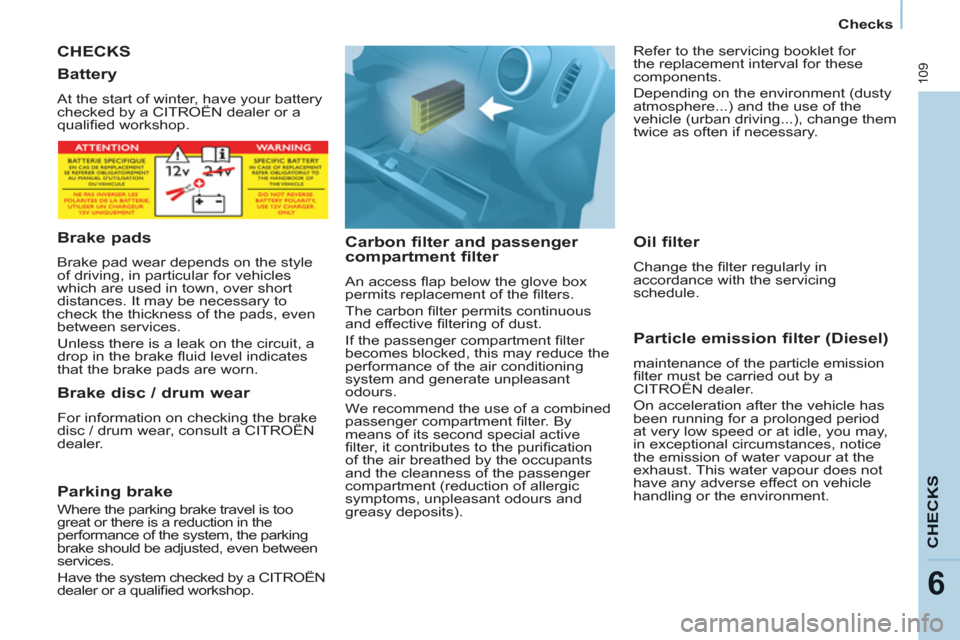
Carbon filter and passenger
compartment filter
An access fl ap below the glove box
permits replacement of the fi lters.
The carbon fi lter permits continuous
and effective fi ltering of dust.
If the passenger compartment fi lter
becomes blocked, this may reduce the
performance of the air conditioning
system and generate unpleasant
odours.
We recommend the use of a combined
passenger compartment fi lter. By
means of its second special active
fi lter, it contributes to the purifi cation
of the air breathed by the occupants
and the cleanness of the passenger
compartment (reduction of allergic
symptoms, unpleasant odours and
greasy deposits).
Particle emission filter (Diesel)
maintenance of the particle emission
fi lter must be carried out by a
CITROËN dealer.
On acceleration after the vehicle has
been running for a prolonged period
at very low speed or at idle, you may,
in exceptional circumstances, notice
the emission of water vapour at the
exhaust. This water vapour does not
have any adverse effect on vehicle
handling or the environment.
Battery
At the start of winter, have your battery
checked by a CITROËN dealer or a
qualifi ed workshop.
Brake pads
Brake pad wear depends on the style
of driving, in particular for vehicles
which are used in town, over short
distances. It may be necessary to
check the thickness of the pads, even
between services.
Unless there is a leak on the circuit, a
drop in the brake fl uid level indicates
that the brake pads are worn.
Brake disc / drum wear
For information on checking the brake
disc / drum wear, consult a CITROËN
dealer.
Parking brake
Where the parking brake travel is too
great or there is a reduction in the
performance of the system, the parking
brake should be adjusted, even between
services.
Have the system checked by a CITROËN
dealer or a qualifi ed workshop.
Oil filter
Change the fi lter regularly in
accordance with the servicing
schedule. Refer to the servicing booklet for
the replacement interval for these
components.
Depending on the environment (dusty
atmosphere...) and the use of the
vehicle (urban driving...), change them
twice as often if necessary.
Page 113 of 208
111
6
Fuel
FILLING WITH FUEL
Low fuel level
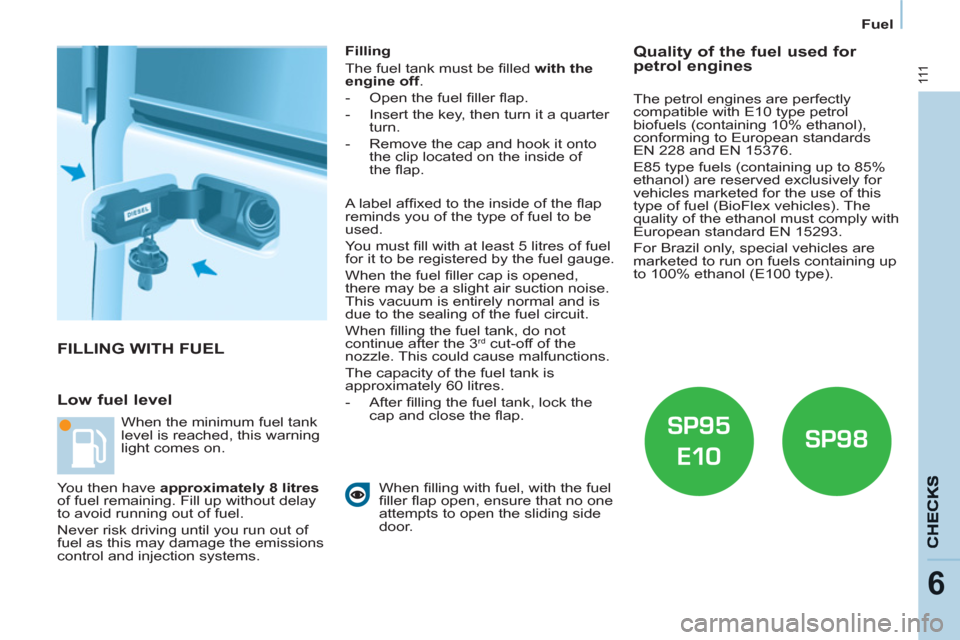
Filling
The fuel tank must be fi lled with the
engine off
.
- Open the fuel fi ller fl ap.
- Insert the key, then turn it a quarter
turn.
- Remove the cap and hook it onto
the clip located on the inside of
the fl ap.
When fi lling with fuel, with the fuel
fi ller fl ap open, ensure that no one
attempts to open the sliding side
door. When the minimum fuel tank
level is reached, this warning
light comes on.
You then have approximately 8 litres
of fuel remaining. Fill up without delay
to avoid running out of fuel.
Never risk driving until you run out of
fuel as this may damage the emissions
control and injection systems.
Quality of the fuel used for
petrol engines
A label affi xed to the inside of the fl ap
reminds you of the type of fuel to be
used.
You must fi ll with at least 5 litres of fuel
for it to be registered by the fuel gauge.
When the fuel fi ller cap is opened,
there may be a slight air suction noise.
This vacuum is entirely normal and is
due to the sealing of the fuel circuit.
When fi lling the fuel tank, do not
continue after the 3
rd cut-off of the
nozzle. This could cause malfunctions.
The capacity of the fuel tank is
approximately 60 litres.
- After fi lling the fuel tank, lock the
cap and close the fl ap.
The petrol engines are perfectly
compatible with E10 type petrol
biofuels (containing 10% ethanol),
conforming to European standards
EN 228 and EN 15376.
E85 type fuels (containing up to 85%
ethanol) are reserved exclusively for
vehicles marketed for the use of this
type of fuel (BioFlex vehicles). The
quality of the ethanol must comply with
European standard EN 15293.
For Brazil only, special vehicles are
marketed to run on fuels containing up
to 100% ethanol (E100 type).
Page 122 of 208
120
Changing a bulb
CHANGING A BULB
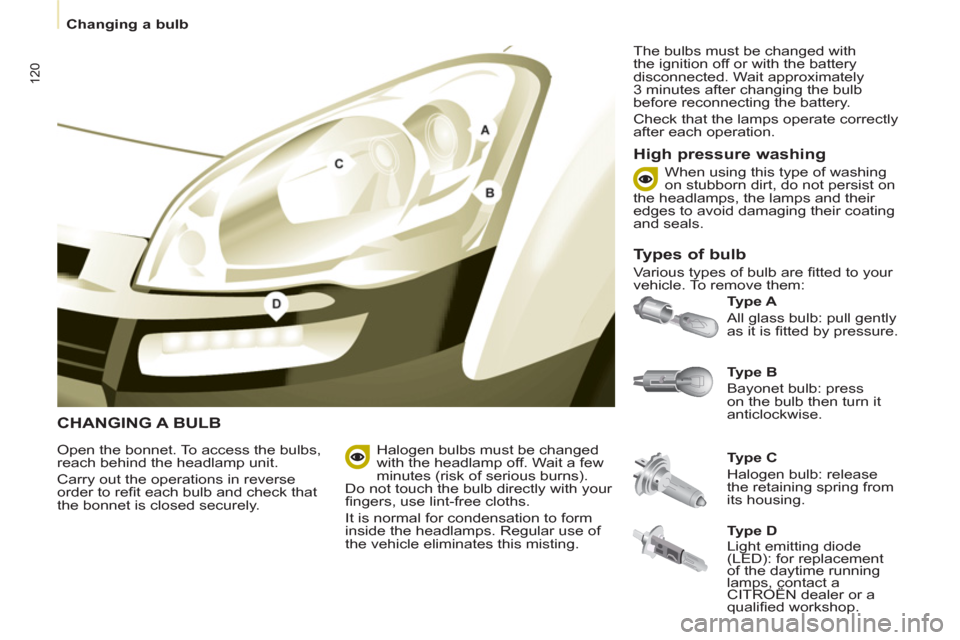
Ty p e B
Bayonet bulb: press
on the bulb then turn it
anticlockwise.
Ty p e A
All glass bulb: pull gently
as it is fi tted by pressure.
Open the bonnet. To access the bulbs,
reach behind the headlamp unit.
Carry out the operations in reverse
order to refi t each bulb and check that
the bonnet is closed securely.
Ty p e C
Halogen bulb: release
the retaining spring from
its housing.
Halogen bulbs must be changed
with the headlamp off. Wait a few
minutes (risk of serious burns).
Do not touch the bulb directly with your
fi ngers, use lint-free cloths.
It is normal for condensation to form
inside the headlamps. Regular use of
the vehicle eliminates this misting. The bulbs must be changed with
the ignition off or with the battery
disconnected. Wait approximately
3 minutes after changing the bulb
before reconnecting the battery.
Check that the lamps operate correctly
after each operation.
High pressure washing
Types of bulb
Various types of bulb are fi tted to your
vehicle. To remove them: When using this type of washing
on stubborn dirt, do not persist on
the headlamps, the lamps and their
edges to avoid damaging their coating
and seals.
Ty p e D
Light emitting diode
(LED): for replacement
of the daytime running
lamps, contact a
CITROËN dealer or a
qualifi ed workshop.