light Citroen BERLINGO 2015 2.G Owner's Guide
[x] Cancel search | Manufacturer: CITROEN, Model Year: 2015, Model line: BERLINGO, Model: Citroen BERLINGO 2015 2.GPages: 266, PDF Size: 10.47 MB
Page 104 of 266
102
BERLInGO-2-VU_En_CHAP05_SECURITE_ED01-2015BERLInGO-2-VU_En_CHAP05_SECURITE_ED01-2015
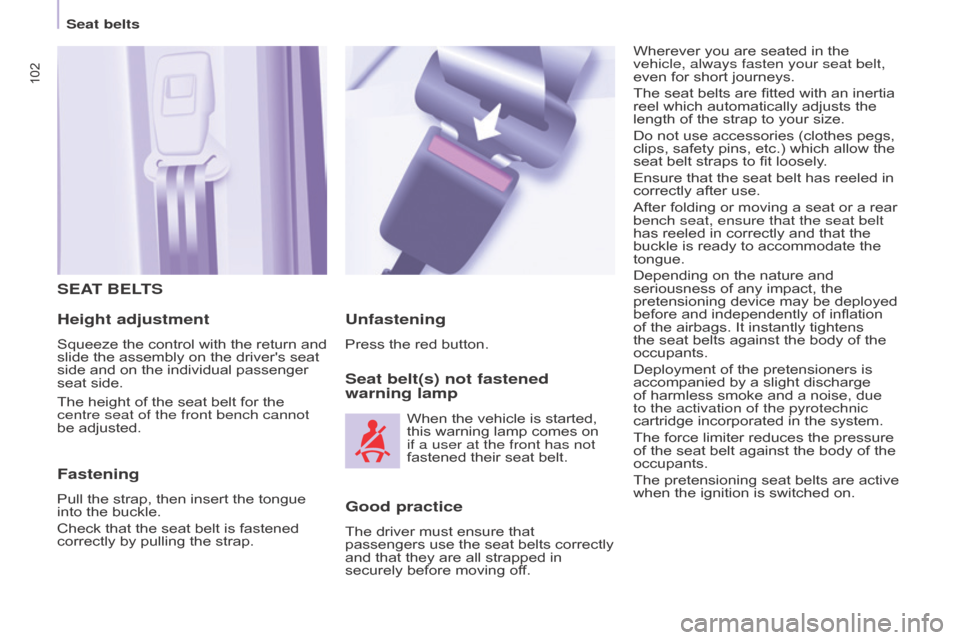
SEAT BELTS
Height adjustment
Squeeze the control with the return and
slide the assembly on the driver's seat
side and on the individual passenger
seat side.
Fastening
Pull the strap, then insert the tongue
into the buckle.
Check that the seat belt is fastened
correctly by pulling the strap.
Seat belt(s) not fastened
warning lamp
Wherever you are seated in the
vehicle, always fasten your seat belt,
even for short journeys.
The seat belts are fitted with an inertia
reel which automatically adjusts the
length of the strap to your size.
Do not use accessories (clothes pegs,
clips, safety pins, etc.) which allow the
seat belt straps to fit loosely.
Ensure that the seat belt has reeled in
correctly after use.
After folding or moving a seat or a rear
bench seat, ensure that the seat belt
has reeled in correctly and that the
buckle is ready to accommodate the
tongue.
Depending on the nature and
seriousness of any impact, the
pretensioning device may be deployed
before and independently of inflation
of the airbags. It instantly tightens
the seat belts against the body of the
occupants.
Deployment of the pretensioners is
accompanied by a slight discharge
of harmless smoke and a noise, due
to the activation of the pyrotechnic
cartridge incorporated in the system.
The force limiter reduces the pressure
of the seat belt against the body of the
occupants.
The pretensioning seat belts are active
when the ignition is switched on.
Unfastening
Press the red button.When the vehicle is started,
this warning lamp comes on
if a user at the front has not
fastened their seat belt.
Good practice
The driver must ensure that
passengers use the seat belts correctly
and that they are all strapped in
securely before moving off.
The height of the seat belt for the
centre seat of the front bench cannot
be adjusted.
Seat belts
Page 107 of 266
105
BERLInGO-2-VU_En_CHAP05_SECURITE_ED01-2015BERLInGO-2-VU_En_CHAP05_SECURITE_ED01-2015
Good practice
Sit in a normal upright position.
Wear a correctly adjusted seat belt.
Do not leave anything between the
occupants and the airbags (a child,
pet, object...). This could hinder the
operation of the airbags or injure the
occupants.
After an accident or if the vehicle has
been stolen or broken into, have the
airbag systems checked.
All work on the airbag system is strictly
forbidden unless it is carried out by
qualified personnel at a CITROËN
dealer or a qualified workshop.
Even if all of the precautions
mentioned are observed, a risk of
injury or of minor burns to the head,
chest or arms when an airbag is
deployed cannot be ruled out. In fact,
the bag inflates almost instantly (within
a few milliseconds) then deflates within
the same time discharging the hot gas
via openings provided for this purpose.Lateral airbags
Only put recommended covers on
the seats. These will not hinder
inflation of the lateral airbags. Contact
a CITROËN dealer or a qualified
workshop.
Do not fix or attach anything to the seat
backs. This could cause injury to the
chest or arms when the lateral airbag
inflates.
d
o not sit with the upper part of the
body any nearer to the door than
necessary.
Front airbags
Do not drive holding the steering wheel
by its spokes or resting your hands on
the centre part of the wheel.
Do not allow passengers to place
their feet on the dashboard, they risk
serious injury if the airbag is deployed.
Smoke as little as possible as
deployment of the airbags can cause
burns or the risk of injury from a
cigarette or pipe.
Never remove or pierce the steering
wheel or hit it violently.
Airbags only operate when the
ignition is switched on.
This equipment only operates once.
If a second impact occurs (during the
same or a subsequent accident), the
airbag will not operate.
The deployment of an airbag or airbags
is accompanied by a slight discharge
of smoke and a noise, due to the
activation of the pyrotechnic cartridge
incorporated in the system.
This smoke is not harmful, but
sensitive individuals may experience
some irritation.
The noise of the detonation may result
in a slight loss of hearing for a short
time.
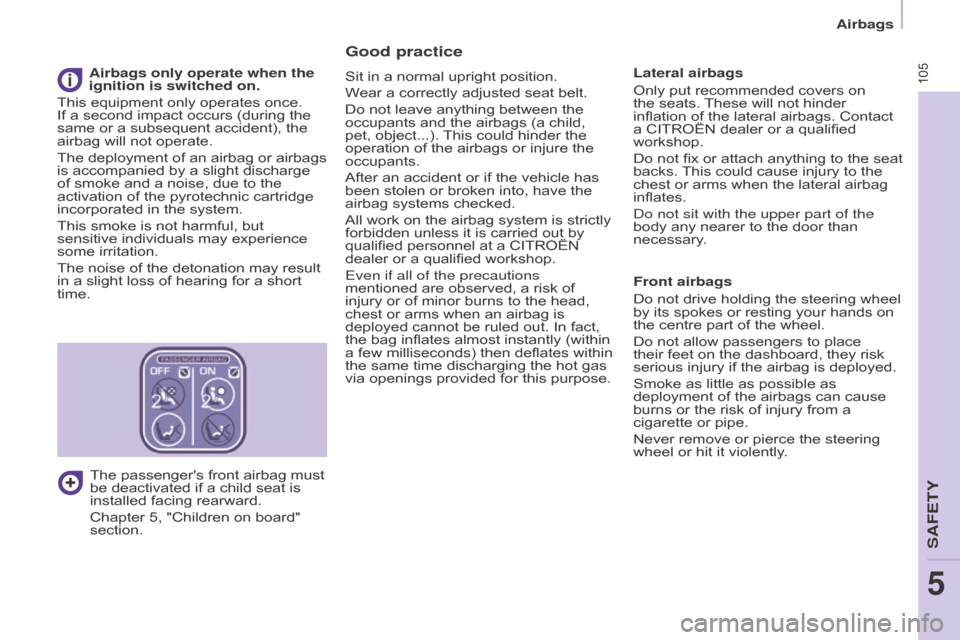
The passenger's front airbag must
be deactivated if a child seat is
installed facing rearward.
Chapter 5, "Children on board"
section.
SAFETY
5
Airbags
Page 122 of 266
120
Berlingo-2-VU_en_Chap06_Accessoire_ed01-2015
During use
Never unlock the device when
a trailer or load carrier is fitted to the
swan neck.
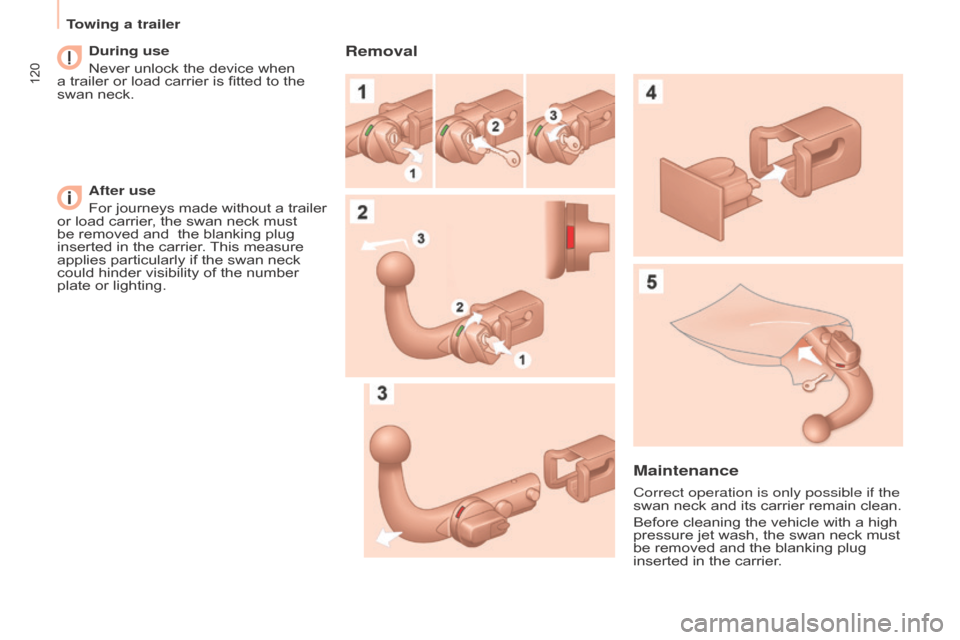
After use
For journeys made without a trailer
or load carrier, the swan neck must
be removed and
the blanking plug
inserted in the carrier. This measure
applies particularly if the swan neck
could hinder visibility of the number
plate or lighting.Removal
Maintenance
Correct operation is only possible if the
swan neck and its carrier remain clean.
Before cleaning the vehicle with a high
pressure jet wash, the swan neck must
be removed and the blanking plug
inserted in the carrier.
Towing a trailer
Page 126 of 266
124
Berlingo-2-VU_en_Chap07_Verification_ed01-2015
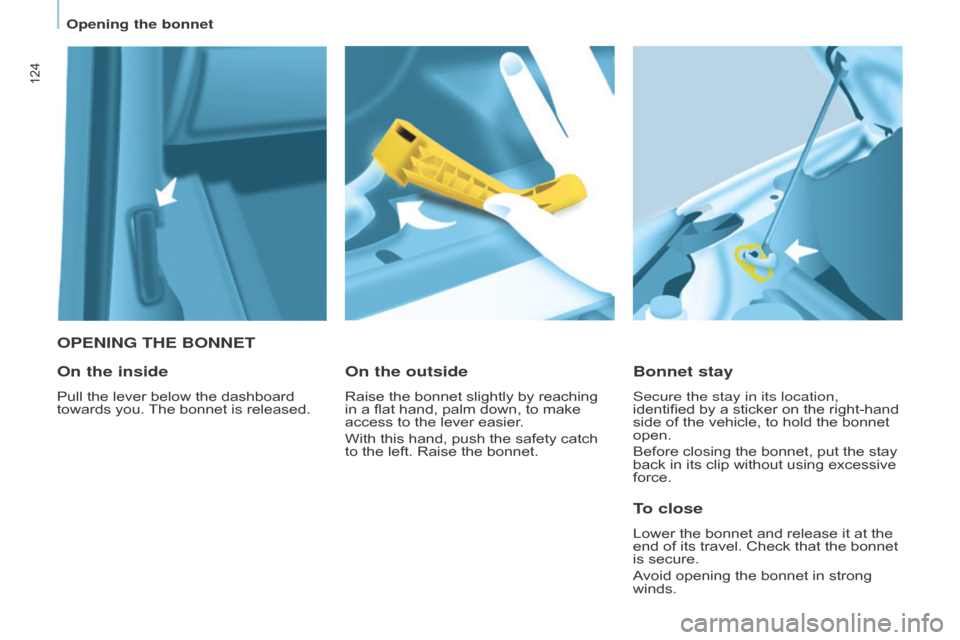
OPEnInG THE BOnnET
Bonnet stay
Secure the stay in its location,
identified by a sticker on the right-hand
side of the vehicle, to hold the bonnet
open.
Before closing the bonnet, put the stay
back in its clip without using excessive
force.
On the outside
Raise the bonnet slightly by reaching
in a flat hand, palm down, to make
access to the lever easier.
With this hand, push the safety catch
to the left. Raise the bonnet.
On the inside
Pull the lever below the dashboard
towards you. The bonnet is released.
To close
Lower the bonnet and release it at the
end of its travel. Check that the bonnet
is secure.
Avoid opening the bonnet in strong
winds.
Opening the bonnet
Page 130 of 266
128
Berlingo-2-VU_en_Chap07_Verification_ed01-2015Berlingo-2-VU_en_Chap07_Verification_ed01-2015
Cooling system
Only use the fluid recommended by the
manufacturer.
Otherwise, you risk seriously damaging
your engine.
When the engine is warm, the
temperature of the coolant is controlled
by the engine fan. As this fan can
operate with the ignition key removed
and because the cooling system is
pressurised, wait for at least one hour
after the engine has stopped before
carrying out any work.
Slacken the cap by 1/4 of a turn to
release the pressure to prevent any
risk of scalding. When the pressure
has dropped, remove the cap and top
up the level with coolant.
If fluid has to be added frequently,
this indicates a fault which must be
checked by a CITROËN dealer as
soon as possible.
Power steering fluid level
The vehicle must be parked on level
ground with the engine cold. Unscrew
the cap integrated with the gauge and
check the level which must be between
the MIN and MAX marks.In order to regenerate the filter, you
are advised to drive at a speed higher
than 40 mph (60 km/h) for at least five
minutes as soon as possible, when
traffic conditions permit (until the
message disappears and the service
warning lamp goes off).
During regeneration of the particle
emission filter, the noise of a relay
operating may be heard under the
dashboard.
If the message is still displayed and
if the service warning lamp remains
on, contact a CITROËN dealer or a
qualified workshop.
Topping up
The level must be between the MIN
and MAX marks on the expansion
bottle. If more than 1 litre of fluid is
required to top up the level, have the
system checked by a CITROËN dealer
or a qualified workshop.
Screenwash and headlamp
wash level
For best quality cleaning and for your
safety, we would advise that you use
products of the CITROËN range.
For optimum cleaning and to avoid
freezing, this fluid must not be topped
up or replaced with plain water.
Capacity of the screenwash reservoir:
approximately 3 litres.
If your vehicle is fitted with headlamp
washers, the capacity of the reservoir
is 6 litres.
Diesel additive level
(Diesel with particle
filter)
Topping up
This additive must be topped up by
a CITROËN dealer or a qualified
workshop without delay.
Waste products
Avoid prolonged contact of used oil
with the skin.
Brake fluid is harmful to health and
very corrosive.
Do not dispose of used oil, brake fluid
or coolant into drains or into the ground
but into the containers dedicated to this
use at a CITROËN dealer (France) or
an authorised waste disposal site.
The minimum level of this additive
is indicated by lighting of the service
warning lamp, accompanied by an
audible signal and a message in the
screen.
When this occurs with the engine
running it is due to the start of
saturation of the particle filter
(exceptionally prolonged urban type
driving conditions: low speed, long
traffic jams, ...).
Levels
Page 132 of 266
130
Berlingo-2-VU_en_Chap07_Verification_ed01-2015Berlingo-2-VU_en_Chap07_Verification_ed01-2015
Good practice
Only use products recommended by
CITROËN or products of equivalent
quality and specification.
In order to optimise the operation
of units as important as the braking
system, CITROËN selects and offers
specific products.
Bleeding water from the Diesel
filterManual gearbox
Have the level checked in accordance with
the manufacturer's servicing schedule.
If this warning lamp comes
on, bleed the filter. Otherwise
bleed regularly each time the
engine oil is changed.
To drain the water, unscrew the bleed
screw located on the filter.
Operate until all of the water no longer
flows in the transparent pipe, then
tighten the bleed screw.
Particle filter (Diesel)
Maintenance of the particle filter must
be carried out by a CITROËN dealer.
o
n acceleration after the vehicle has
been running for a prolonged period
at very low speed or at idle, you may,
in exceptional circumstances, notice
the emission of water vapour at the
exhaust. This water vapour does not
have any adverse effect on vehicle
handling or the environment.
Oil filter
Change the filter regularly in
accordance with the manufacturer's
servicing schedule.
HDi engines use advanced
technology. All work requires
special training, which is assured
by a CITROËN dealer.
Depending on country of sale. In order to avoid damaging the
electrical units, high pressure
washing to clean the engine
compartment is strictly prohibited.
After washing the vehicle dampness,
or in winter, ice may form on the brake
discs and pads: braking efficiency may
be reduced. Make some light brake
applications to dry and de-ice the
brakes.
Checks
Page 133 of 266
131
Berlingo-2-VU_en_Chap07_Verification_ed01-2015Berlingo-2-VU_en_Chap07_Verification_ed01-2015
REFUELLInG
Low fuel level
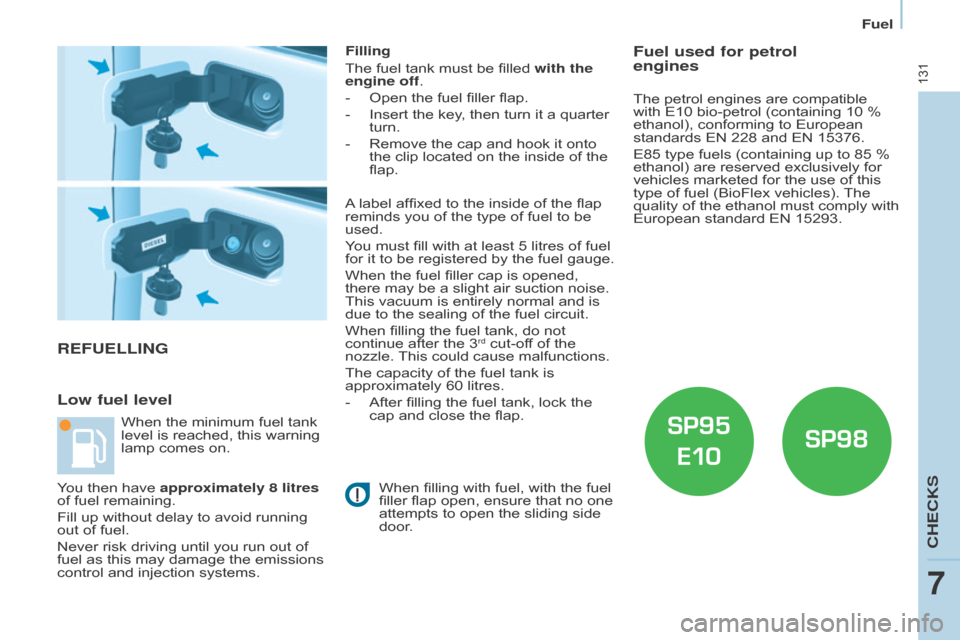
Filling
The fuel tank must be filled with the
engine off.
-
Open the fuel filler flap.
-
Insert the key
, then turn it a quarter
turn.
-
Remove the cap and hook it onto
the clip located on the inside of the
flap.
When fillin
g with fuel, with the fuel
filler flap open, ensure that no one
attempts to open the sliding side
door.
When the minimum fuel tank
level is reached, this warning
lamp comes on.
You then have approximately 8 litres
of fuel remaining.
Fill up without delay to avoid running
out of fuel.
Never risk driving until you run out of
fuel as this may damage the emissions
control and injection systems.Fuel used for petrol
engines
A label affixed to the inside of the flap
reminds you of the type of fuel to be
used.
You must fill with at least 5 litres of fuel
for it to be registered by the fuel gauge.
When the fuel filler cap is opened,
there may be a slight air suction noise.
This vacuum is entirely normal and is
due to the sealing of the fuel circuit.
When filling the fuel tank, do not
continue after the 3
rd cut-off of the
nozzle. This could cause malfunctions.
The capacity of the fuel tank is
approximately 60 litres.
-
After fillin
g the fuel tank, lock the
cap and close the flap. The petrol engines are compatible
with E10 bio-petrol (containing 10 %
ethanol), conforming to European
standards EN 228 and EN 15376.
E85 type fuels (containing up to 85 %
ethanol) are reserved exclusively for
vehicles marketed for the use of this
type of fuel (BioFlex vehicles). The
quality of the ethanol must comply with
European standard EN 15293.
CHECKS
7
Fuel
Page 135 of 266
133
Berlingo-2-VU_en_Chap07_Verification_ed01-2015Berlingo-2-VU_en_Chap07_Verification_ed01-2015
BLUEHDI
A n D A D B LUE
® ADDITIVE
The technology
AdBlue® is the brand name of the
solution needed for operation of the
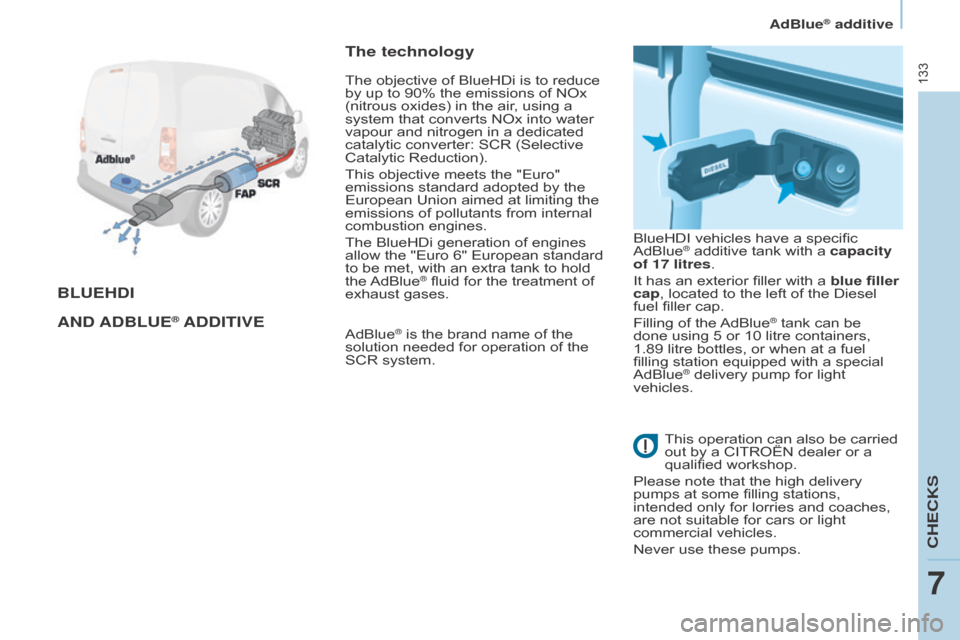
SCR system. BlueHDI vehicles have a specific
AdBlue
® additive tank with a capacity
of 17 litres.
It has an exterior filler with a blue filler
cap, located to the left of the Diesel
fuel filler cap.
Filling of the AdBlue
® tank can be
done using 5 or 10 litre containers,
1.89 litre bottles, or when at a fuel
filling station equipped with a special
AdBlue
® delivery pump for light
vehicles.
The objective of BlueHDi is to reduce
by up to 90% the emissions of NOx
(nitrous oxides) in the air
, using a
system that converts NOx into water
vapour and nitrogen in a dedicated
catalytic converter: SCR (Selective
Catalytic Reduction).
This objective meets the "Euro"
emissions standard adopted by the
European Union aimed at limiting the
emissions of pollutants from internal
combustion engines.
The BlueHDi generation of engines
allow the "Euro 6" European standard
to be met, with an extra tank to hold
the AdBlue
® fluid for the treatment of
exhaust gases.
This operation can also be carried
out by a CITROËN dealer or a
qualified workshop.
Please note that the high delivery
pumps at some filling stations,
intended only for lorries and coaches,
are not suitable for cars or light
commercial vehicles.
Never use these pumps.
CHECKS
7
AdBlue® additive
Page 136 of 266
134
Berlingo-2-VU_en_Chap07_Verification_ed01-2015Berlingo-2-VU_en_Chap07_Verification_ed01-2015
Good practice
While the quantity of AdBlue® in
the additive tank is sufficient, no
information is displayed.
On the other hand, once the additive
level drops to the quantity needed
for a range of 1 500 miles (2 400 km)
driving, you are warned by dif
ferent
temporary signals (warning lamp,
message, audible signal).
As more miles are covered, these
signals intensify and the message
becomes permanent.
When the AdBlue
® tank is empty,
restarting becomes impossible.
It is strongly recommended that you
do not wait for the successive alerts
before topping-up the AdBlue
® tank,
but do this as soon as possible.
Filling the additive tank
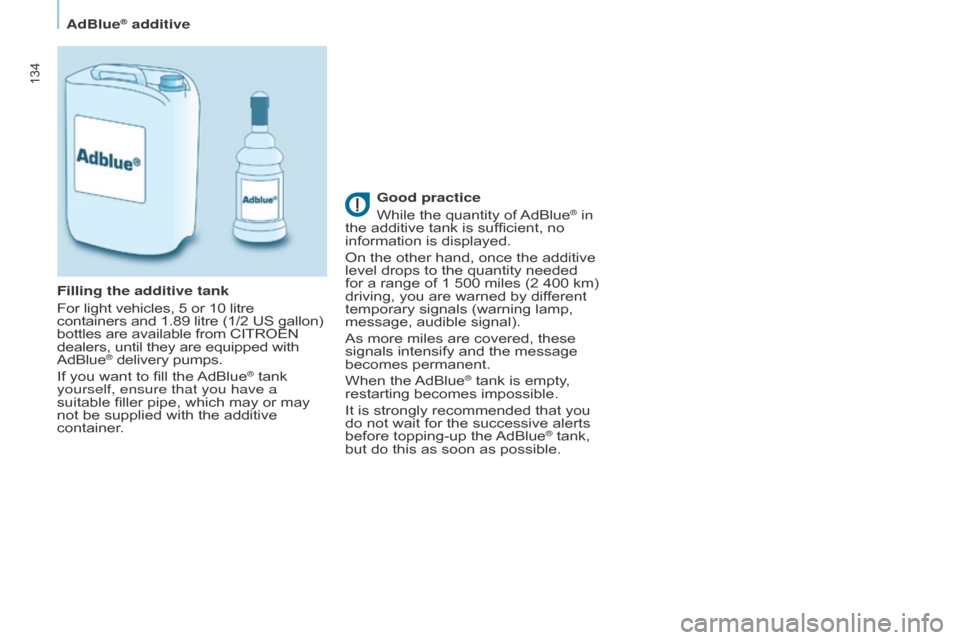
For light vehicles, 5 or 10 litre
containers and 1.89 litre (1/2 US gallon)
bottles are available from CITROËN
dealers, until they are equipped with
AdBlue
® delivery pumps.
If you want to fill the AdBlue® tank
yourself, ensure that you have a
suitable filler pipe, which may or may
not be supplied with the additive
container.
AdBlue® additive
Page 141 of 266
139
Berlingo-2-VU_en_Chap07_Verification_ed01-2015Berlingo-2-VU_en_Chap07_Verification_ed01-2015
Keep AdBlue® out of the reach
of children, in its original
container.
Never transfer AdBlue
® to another
container: it would loose its purity.
Never dilute the additive with water.
Never pour the additive into the Diesel
fuel tank.
Recommendations on storage
never store containers or bottles of
AdBlue® in your vehicle.
Freezing of the AdBlue
® additive
AdBlue® freezes at about -11°C
(12.2° F) and deteriorates above 25°C.
It is recommended that containers and
bottles be stored in a cool area and
protected from direct sunlight.
Under these conditions, the additive
can be kept for at least a year.
Additive has been frozen can be used
once it has thawed out in ambient air. The SCR system includes an
AdBlue
® tank heater that ensures
operation of the vehicle in normal
conditions.
In exceptional situations, such as when
the vehicle is kept at temperatures
below -15°C (5°F) for a long period, an
emission fault alert may be related to
freezing of the AdBlue
® additive.
Park the vehicle in an area at a more
moderate temperature for a few hours
until the additive becomes a liquid
again.
The emissions warning lamp does not
go off immediately, but will occur after
a few miles of driving.
CHECkS
7
adblue® additive