Battery Citroen BERLINGO 2016 2.G User Guide
[x] Cancel search | Manufacturer: CITROEN, Model Year: 2016, Model line: BERLINGO, Model: Citroen BERLINGO 2016 2.GPages: 264, PDF Size: 8.42 MB
Page 52 of 264
50
Berlingo-2-VU_en_Chap03_Pret-a-partir_ed01-2016Berlingo-2-VU_en_Chap03_Pret-a-partir_ed01-2016
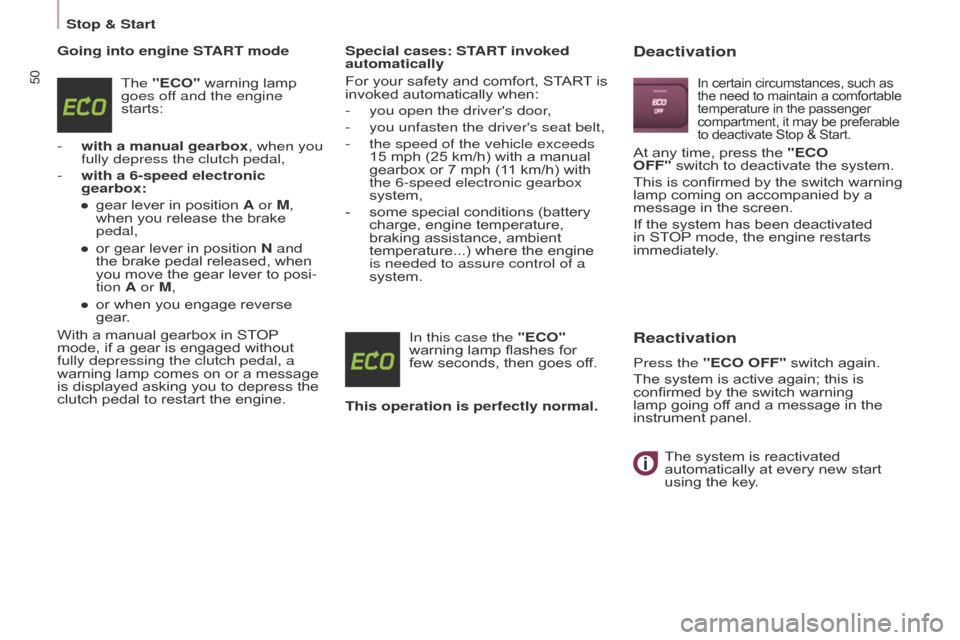
Going into engine START modeThe "ECO" warning lamp
goes off and the engine
starts:
-
with a manual gearbox
, when you
fully depress the clutch pedal,
-
with a 6-speed electronic
gearbox:
●
gear lever in position
A or M,
when you release the brake
pedal,
●
or gear lever in position
N and
the brake pedal released, when
you move the gear lever to posi-
tion A or M,
●
or when you engage reverse
gear
.
With a manual gearbox in STOP
mode, if a gear is engaged without
fully depressing the clutch pedal, a
warning lamp comes on or a message
is displayed asking you to depress the
clutch pedal to restart the engine. Special cases: START invoked
automatically
For your safety and comfort, START is
invoked automatically when:
-
you open the driver's door
,
-
you unfasten the driver's seat belt,
-
the speed of the vehicle exceeds
15 mph (25 km/h) with a manual
gearbox or 7 mph (1
1 km/h) with
the 6-speed electronic gearbox
system,
-
some special conditions (battery
charge, engine temperature,
braking assistance, ambient
temperature...) where the engine
is needed to assure control of a
system.In this case the
"ECO"
warning lamp flashes for
few
seconds, then goes off.
This operation is perfectly normal.Deactivation
In certain circumstances, such as
the need to maintain a comfortable
temperature in the passenger
compartment, it may be preferable
to deactivate Stop & Start.
At any time, press the "ECO
OFF" switch to deactivate the system.
This is confirmed by the switch warning
lamp coming on accompanied by a
message in the screen.
If the system has been deactivated
in STOP mode, the engine restarts
immediately.
Reactivation
Press the "ECO OFF" switch again.
The system is active again; this is
confirmed by the switch warning
lamp going off and a message in the
instrument panel.
The system is reactivated
automatically at every new start
using the key.
Stop & Start
Page 53 of 264
51
Berlingo-2-VU_en_Chap03_Pret-a-partir_ed01-2016Berlingo-2-VU_en_Chap03_Pret-a-partir_ed01-2016
Operating fault
In the event of a malfunction
with the system, the "ECO
OFF" switch warning lamp
flashes, then comes on
continuously.
Have it checked by a CITROËN dealer
or a qualified workshop.
In the event of a fault in STOP mode,
the vehicle may stall. All of the warning
lamps in the instrument panel come
on. It is then necessary to switch off
the ignition and start the engine again
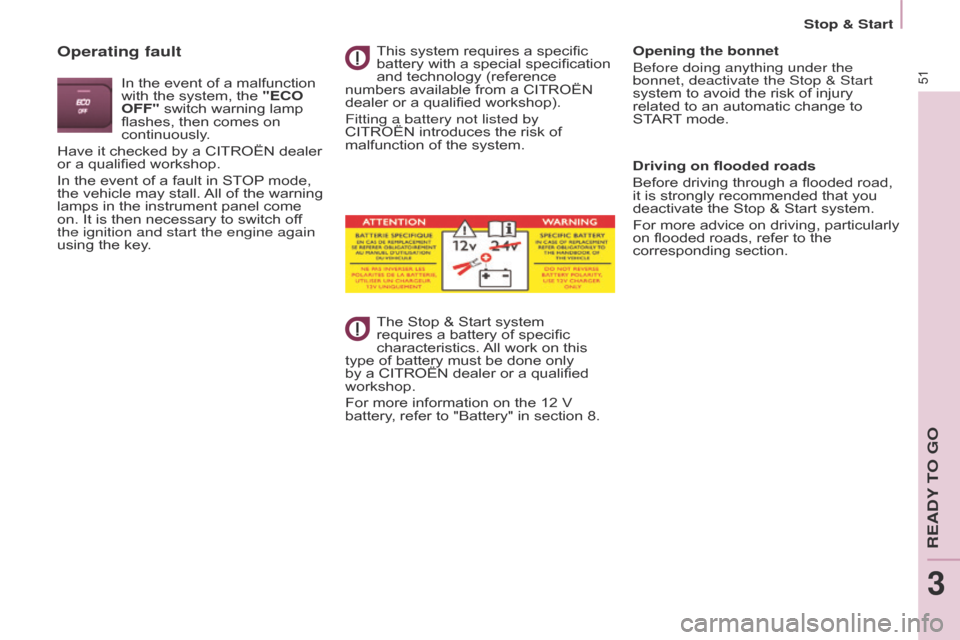
using the key. This system requires a specific
battery with a special specification
and technology (reference
numbers available from a CITROËN
dealer or a qualified workshop).
Fitting a battery not listed by
CITROËN
introduces the risk of
malfunction of the system.
The Stop & Start system
requires a battery of specific
characteristics. All work on this
type of battery must be done only
by a CITROËN dealer or a qualified
workshop.
For more information on the 12 V
battery, refer to "Battery" in section 8. Opening the bonnet
Before doing anything under the
bonnet, deactivate the Stop & Start
system to avoid the risk of injury
related to an automatic change to
START mode.
Driving on flooded roads
Before driving through a flooded road,
it is strongly recommended that you
deactivate the Stop & Start system.
For more advice on driving, particularly
on flooded roads, refer to the
corresponding section.
READY TO GO
3
Stop & Start
Page 58 of 264
56
Berlingo-2-VU_en_Chap04_Ergonomie_ed01-2016
If the sunshine sensor
does not function correctly,
the lighting comes on
accompanied by the service
warning lamp, an audible
signal and a message in the screen.
Contact a CITR
o Ë n dealer or a
qualified workshop.
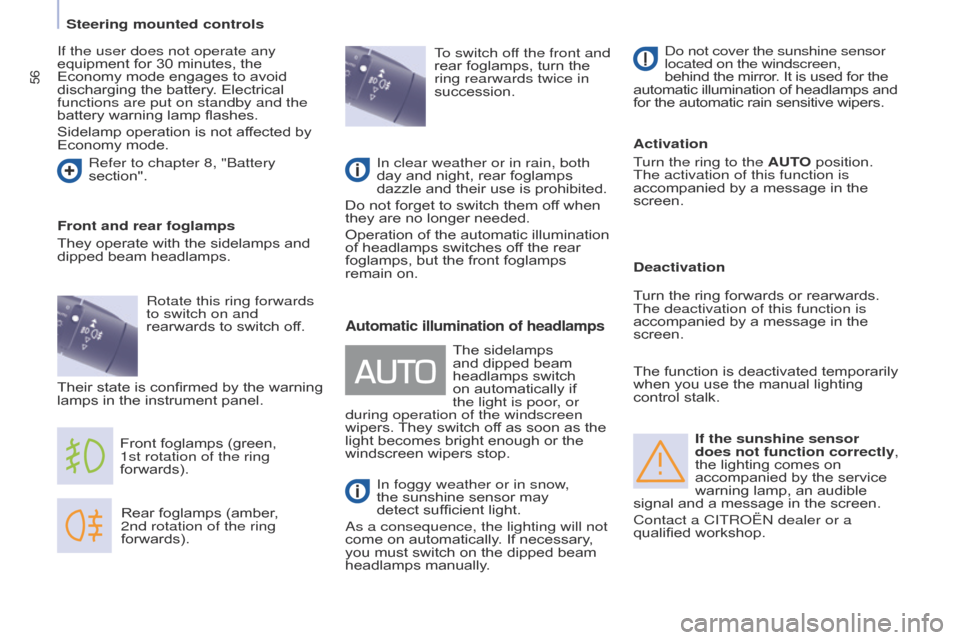
Rear foglamps (amber,
2nd
rotation of the ring
forwards).
Front foglamps (green,
1st
rotation of the ring
forwards).
Front and rear foglamps
They operate with the sidelamps and
dipped beam headlamps.
To switch off the front and
rear foglamps, turn the
ring rearwards twice in
succession.
Automatic illumination of headlamps
In foggy weather or in snow,
the sunshine sensor may
detect
sufficient light.
a
s a consequence, the lighting will not
come on automatically. If necessary,
you must switch on the dipped beam
headlamps manually.
d
o not cover the sunshine sensor
located on the windscreen,
behind the mirror. It is used for the
automatic illumination of headlamps and
for the automatic rain sensitive wipers.
Activation
Turn the ring to the AUTO position.
The activation of this function is
accompanied by a message in the
screen.
The sidelamps
and dipped beam
headlamps switch
on automatically if
the light is poor, or
during operation of the windscreen
wipers. They switch off as soon as the
light becomes bright enough or the
windscreen wipers stop.
If the user does not operate any
equipment for 30 minutes, the
Economy mode engages to avoid
discharging the battery. Electrical
functions are put on standby and the
battery warning lamp flashes.
Sidelamp operation is not affected by
Economy mode.
Refer to chapter 8, "Battery
section".
Rotate this ring forwards
to switch on and
rearwards to switch off.
Their state is confirmed by the warning
lamps in the instrument panel. In clear weather or in rain, both
day and night, rear foglamps
dazzle and their use is prohibited.
Do not forget to switch them off when
they are no longer needed.
Operation of the automatic illumination
of headlamps switches off the rear
foglamps, but the front foglamps
remain on. Deactivation
Turn the ring forwards or rearwards.
The deactivation of this function is
accompanied by a message in the
screen.
The function is deactivated temporarily
when you use the manual lighting
control stalk.
Steering mounted controls
Page 86 of 264
84
Berlingo-2-VU_en_Chap04_Ergonomie_ed01-2016Berlingo-2-VU_en_Chap04_Ergonomie_ed01-2016
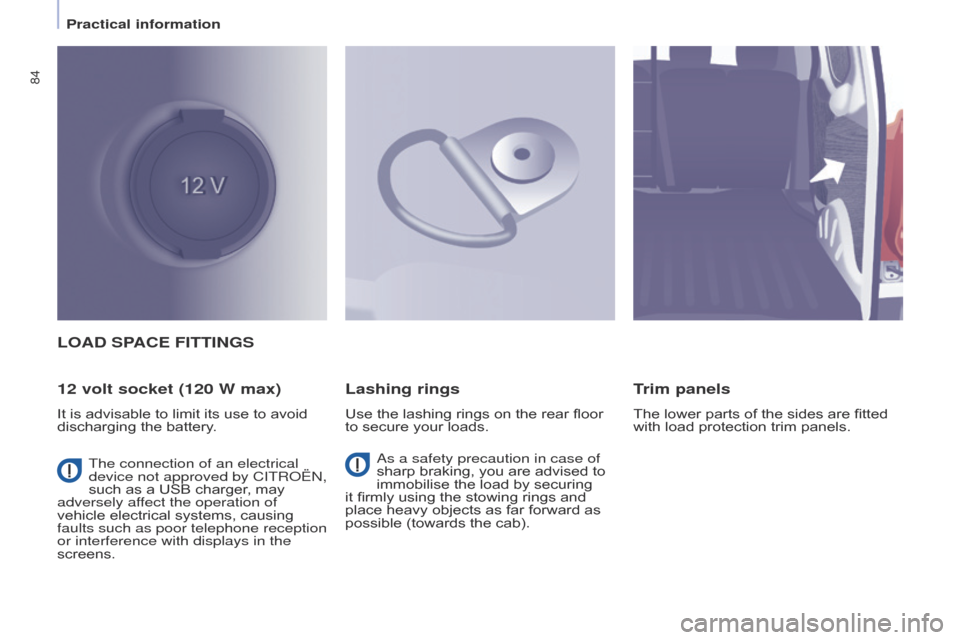
LOAD SPACE FITTINGS
12 volt socket (120 W max)
It is advisable to limit its use to avoid
discharging the battery.
Lashing rings
Use the lashing rings on the rear floor
to secure your loads.
Trim panels
The lower parts of the sides are fitted
with load protection trim panels.
a
s a safety precaution in case of
sharp braking, you are advised to
immobilise the load by securing
it firmly using the stowing rings and
place heavy objects as far forward as
possible (towards the cab).
The connection of an electrical
device not approved by CITR
o
Ë
n
,
such as a USB charger, may
adversely affect the operation of
vehicle electrical systems, causing
faults such as poor telephone reception
or interference with displays in the
screens.
Practical information
Page 91 of 264
89
Berlingo-2-VU_en_Chap04_Ergonomie_ed01-2016Berlingo-2-VU_en_Chap04_Ergonomie_ed01-2016
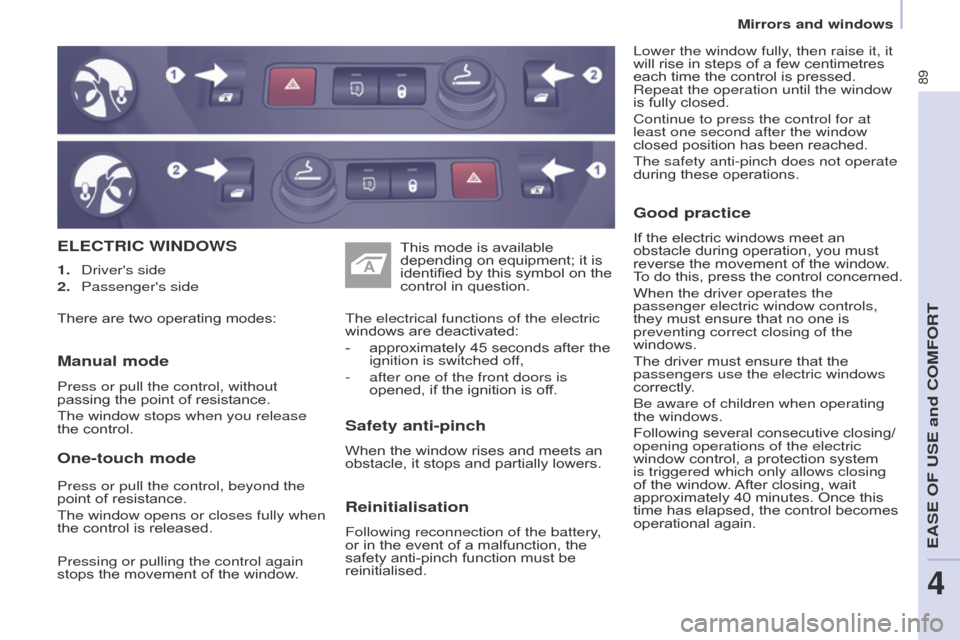
ELECTRIC WINDOWS
Safety anti-pinch
When the window rises and meets an
obstacle, it stops and partially lowers. The electrical functions of the electric
windows are deactivated:
-
approximately 45 seconds after the
ignition is switched of
f,
-
after one of the front doors is
opened, if the ignition is of
f.
Manual mode
Press or pull the control, without
passing the point of resistance.
The window stops when you release
the control. This mode is available
depending on equipment; it is
identified by this symbol on the
control in question.
1. d river's side
2.
Passenger's side
Reinitialisation
Following reconnection of the battery,
or in the event of a malfunction, the
safety anti-pinch function must be
reinitialised.
Good practice
If the electric windows meet an
obstacle during operation, you must
reverse the movement of the window.
To do this, press the control concerned.
When the driver operates the
passenger electric window controls,
they must ensure that no one is
preventing correct closing of the
windows.
The driver must ensure that the
passengers use the electric windows
correctly.
Be aware of children when operating
the windows.
Following several consecutive closing/
opening operations of the electric
window control, a protection system
is triggered which only allows closing
of the window. After closing, wait
approximately 40 minutes. Once this
time has elapsed, the control becomes
operational again. Lower the window fully, then raise it, it
will rise in steps of a few centimetres
each time the control is pressed.
Repeat the operation until the window
is fully closed.
Continue to press the control for at
least one second after the window
closed position has been reached.
The safety anti-pinch does not operate
during these operations.
There are two operating modes:
One-touch mode
Press or pull the control, beyond the
point of resistance.
The window opens or closes fully when
the control is released.
Pressing or pulling the control again
stops the movement of the window.
EASE OF USE and COMFORT
4
Mirrors and windows
Page 127 of 264
125
Berlingo-2-VU_en_Chap07_Verification_ed01-2016Berlingo-2-VU_en_Chap07_Verification_ed01-2016
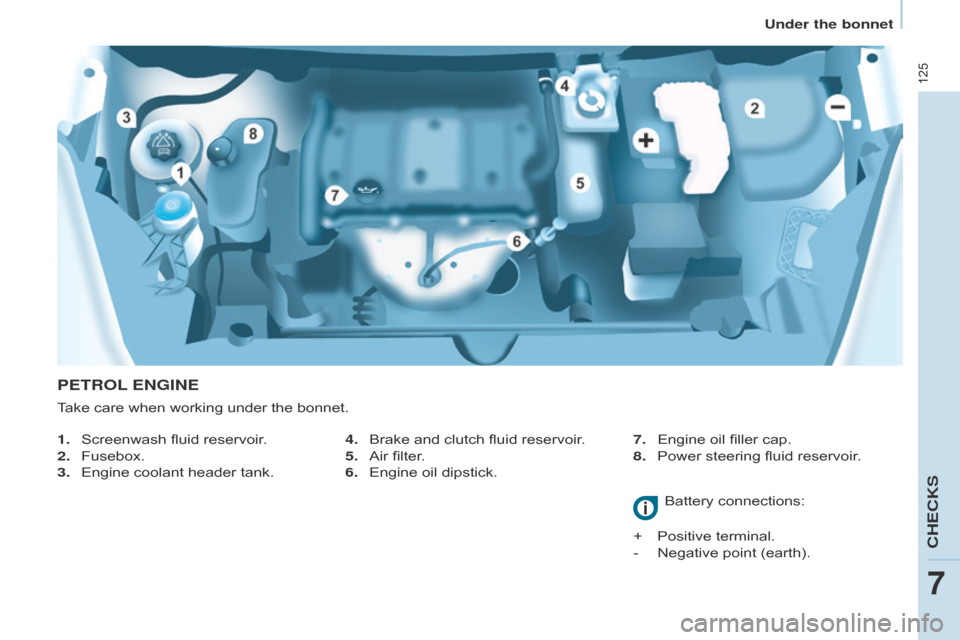
PETROL ENGINE
1. Screenwash fluid reservoir .
2.
Fusebox.
3.
Engine coolant header tank. Battery connections:
+
Positive terminal.
-
Negative point (earth).
T
ake care when working under the bonnet.
4. Brake and clutch fluid reservoir .
5.
Air filter
.
6.
Engine oil dipstick.7.
Engine oil filler cap.
8.
Power steering fluid reservoir
.
CHECKS
7
Under the bonnet
Page 128 of 264
126
Berlingo-2-VU_en_Chap07_Verification_ed01-2016Berlingo-2-VU_en_Chap07_Verification_ed01-2016
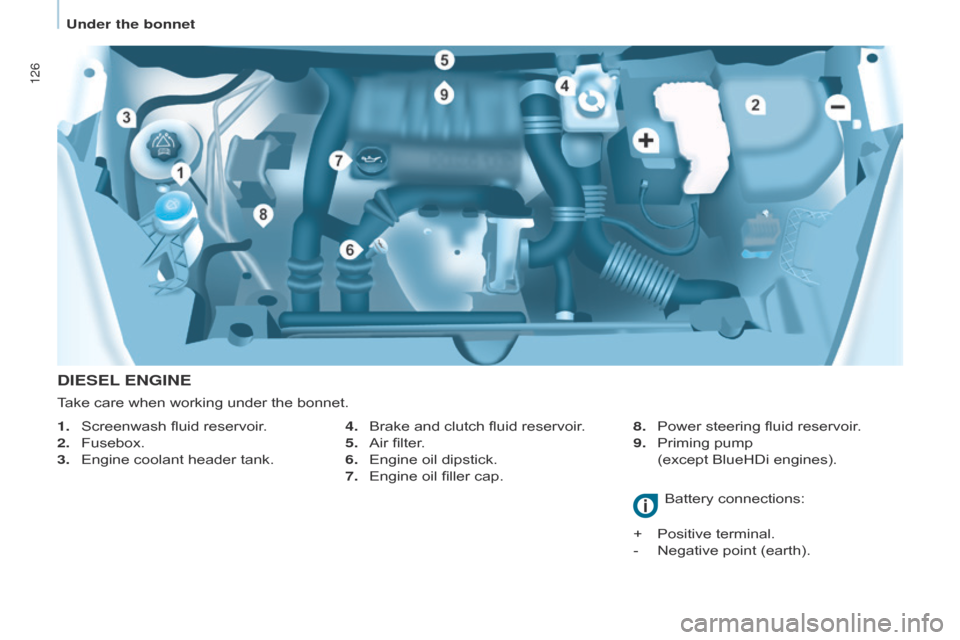
DIESEL ENGINE
4. Brake and clutch fluid reservoir .
5.
Air filter
.
6.
Engine oil dipstick.
7.
Engine oil filler cap. 8.
Power steering fluid reservoir .
9.
Priming pump
(except BlueHDi engines).
1.
Screenwash fluid reservoir
.
2.
Fusebox.
3.
Engine coolant header tank.
Battery connections:
+
Positive terminal.
-
Negative point (earth).
T
ake care when working under the bonnet.
Under the bonnet
Page 131 of 264
129
Berlingo-2-VU_en_Chap07_Verification_ed01-2016Berlingo-2-VU_en_Chap07_Verification_ed01-2016
CHECKS
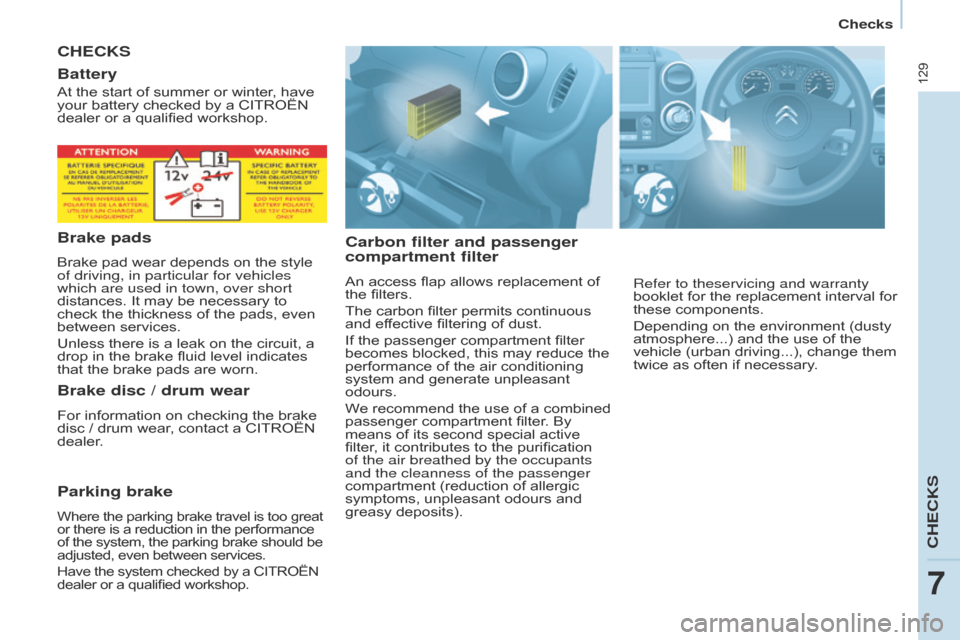
Carbon filter and passenger
compartment filter
An access flap allows replacement of
the filters.
The carbon filter permits continuous
and effective filtering of dust.
If the passenger compartment filter
becomes blocked, this may reduce the
performance of the air conditioning
system and generate unpleasant
odours.
We recommend the use of a combined
passenger compartment filter. By
means of its second special active
filter, it contributes to the purification
of the air breathed by the occupants
and the cleanness of the passenger
compartment (reduction of allergic
symptoms, unpleasant odours and
greasy deposits).
Battery
At the start of summer or winter, have
your battery checked by a CITROËN
dealer or a qualified workshop.
Brake pads
Brake pad wear depends on the style
of driving, in particular for vehicles
which are used in town, over short
distances. It may be necessary to
check the thickness of the pads, even
between services.
Unless there is a leak on the circuit, a
drop in the brake fluid level indicates
that the brake pads are worn.
Brake disc / drum wear
For information on checking the brake
disc / drum wear, contact a CITROËN
dealer.
Parking brake
Where the parking brake travel is too great
or there is a reduction in the performance
of the system, the parking brake should be
adjusted, even between services.
Have the system checked by a CITROËN
dealer or a qualified workshop.
Refer to theservicing and warranty
booklet for the replacement interval for
these components.
Depending on the environment (dusty
atmosphere...) and the use of the
vehicle (urban driving...), change them
twice as often if necessary.
CHECKS
7
Checks
Page 142 of 264
140
Berlingo-2-VU_en_Chap08_aide-rapide_ed01-2016
BATTERY
Before disconnecting the battery, you
must wait for 2 minutes after switching
off the ignition.
Never disconnect a terminal when the
engine is running.
Never charge a battery without first
disconnecting the terminals.
a
fter every reconnection of the battery,
switch on the ignition and wait 1 minute
before starting to allow the electronic
systems to be initialised. If problems
remain after doing this, please contact
a CITROËN dealer or a qualified
workshop.
a
fter changing bulbs, wait
approximately 3 minutes before
reconnecting the battery.
It is advisable to disconnect the
battery if the vehicle is not to be
used for a period of more than one
month.
To charge the battery using a
battery charger
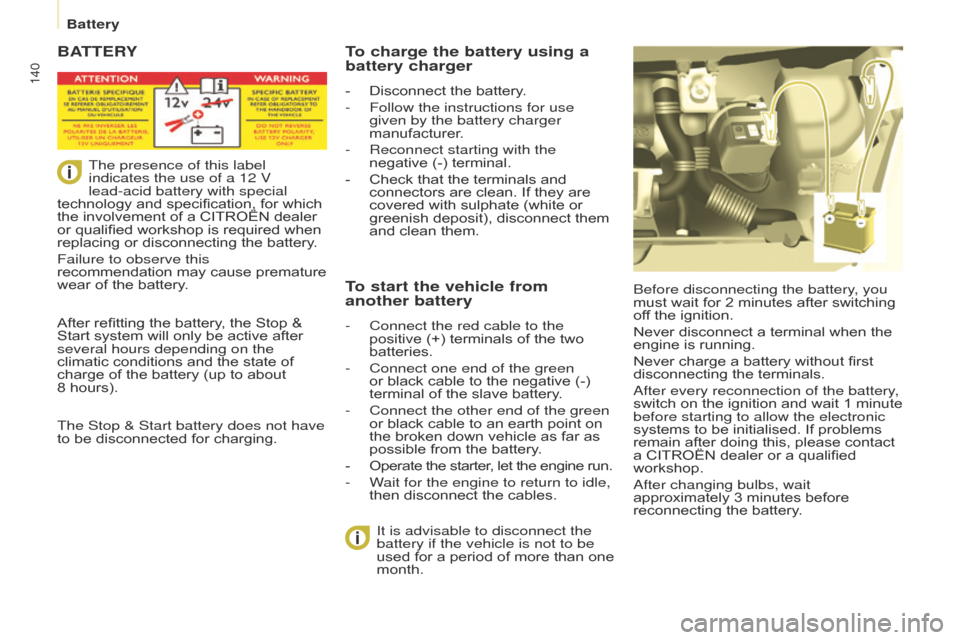
- Disconnect the battery .
-
Follow the instructions for use
given by the battery charger
manufacturer
.
-
Reconnect starting with the
negative (-) terminal.
-
Check that the terminals and
connectors are clean. If they are
covered with sulphate (white or
greenish deposit), disconnect them
and clean them.
To start the vehicle from
another battery
- Connect the red cable to the
positive (+) terminals of the two
batteries.
-
Connect one end of the green
or black cable to the negative (-)
terminal of the slave battery
.
-
Connect the other end of the green
or black cable to an earth point on
the broken down vehicle as far as
possible from the battery
.
-
Operate the starter
, let the engine run.
-
W
ait for the engine to return to idle,
then disconnect the cables.
The presence of this label
indicates the use of a 12 V
lead-acid battery with special
technology and specification, for which
the involvement of a CITROËN dealer
or qualified workshop is required when
replacing or disconnecting the battery.
Failure to observe this
recommendation may cause premature
wear of the battery.
After refitting the battery, the Stop &
Start system will only be active after
several hours depending on the
climatic conditions and the state of
charge of the battery (up to about
8
hours).
The Stop & Start battery does not have
to be disconnected for charging.
Battery
Page 143 of 264
141
Berlingo-2-VU_en_Chap08_aide-rapide_ed01-2016
ECONOMY MODE
after the engine has stopped, with
the key in the ignition position, certain
functions (windscreen wiper
, electric
windows, courtesy lamps, audio
equipment, etc.) can only be used for a
cumulative duration of thirty minutes, to
prevent discharging of the battery.
Once the thirty minutes have elapsed,
the active functions are put on standby
and the battery warning lamp flashes
accompanied by a message in the
screen.
To resume the use of these functions
immediately, start the engine and let it
run for a few minutes.
The time available will then be double
the time for which the engine was left
running. However, this time will always
be between five and thirty minutes.
A flat battery will prevent the
engine from starting.
Battery
QUICk HELP
8