Fault Citroen BERLINGO 2016 2.G User Guide
[x] Cancel search | Manufacturer: CITROEN, Model Year: 2016, Model line: BERLINGO, Model: Citroen BERLINGO 2016 2.GPages: 264, PDF Size: 8.42 MB
Page 46 of 264
44
Berlingo-2-VU_en_Chap03_Pret-a-partir_ed01-2016Berlingo-2-VU_en_Chap03_Pret-a-partir_ed01-2016
Trip recorder zero reset
button
after this operation, if you wish
to disconnect the battery , lock
the vehicle and wait for at least
five
minutes, otherwise the zero re-set
will not be registered.
Zero reset
Your CITROËN dealer or a qualified
workshop carries out this operation
after each service.
However, if you carry out the service
yourself, the re-set procedure is as
follows:
-
switch of
f the ignition,
-
press and hold the trip recorder
reset button,
-
switch on the ignition.
The display begins a countdown.
When the display shows
"=0", release
the button; the spanner disappears.
Engine oil level indicator
depending on your vehicle's engine,
when the ignition is switched on,
the engine oil level is indicated for
a few
seconds, after the service
information. Oil level correct
Low oil level
Flashing of "OIL",
linked with the
service warning lamp,
accompanied by an
audible signal and a message in the
screen, indicates a low oil level which
could damage the engine.
If the low oil level is confirmed by a
check using the dipstick, it is essential
that the level is topped up.
Oil level gauge
fault
Flashing of "OIL--"
indicates a malfunction
of the engine oil level
indicator. Contact a CITROËN dealer or
a qualified workshop.
The level read will only be correct
if the vehicle is on level ground
and the engine has been off for
more than 30 minutes. Dipstick
A = maximum, never exceed
this level as a surplus of oil
may damage the engine.
Contact a CITR
o Ë n dealer
or a qualified workshop
without delay.
B = minimum, top up the level
via the oil filler cap, using the
grade of oil suited to your
engine.
With the lighting on,
press the button to vary
the brightness of the
instruments and controls.
When the lighting
reaches the minimum
(or maximum) setting, release the
button then press it again to increase
(or
reduce) the brightness.
a
s soon as the lighting is of the
required brightness, release the button. With the ignition on, press
the button until the zeros
appear.
Lighting dimmer
Instruments and controls
Page 53 of 264
51
Berlingo-2-VU_en_Chap03_Pret-a-partir_ed01-2016Berlingo-2-VU_en_Chap03_Pret-a-partir_ed01-2016
Operating fault
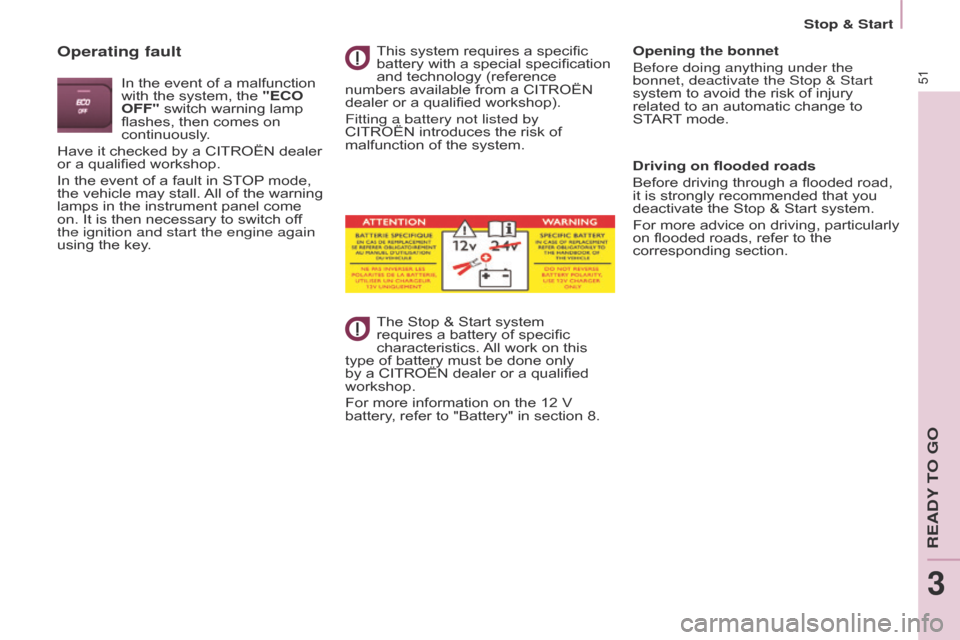
In the event of a malfunction
with the system, the "ECO
OFF" switch warning lamp
flashes, then comes on
continuously.
Have it checked by a CITROËN dealer
or a qualified workshop.
In the event of a fault in STOP mode,
the vehicle may stall. All of the warning
lamps in the instrument panel come
on. It is then necessary to switch off
the ignition and start the engine again
using the key. This system requires a specific
battery with a special specification
and technology (reference
numbers available from a CITROËN
dealer or a qualified workshop).
Fitting a battery not listed by
CITROËN
introduces the risk of
malfunction of the system.
The Stop & Start system
requires a battery of specific
characteristics. All work on this
type of battery must be done only
by a CITROËN dealer or a qualified
workshop.
For more information on the 12 V
battery, refer to "Battery" in section 8. Opening the bonnet
Before doing anything under the
bonnet, deactivate the Stop & Start
system to avoid the risk of injury
related to an automatic change to
START mode.
Driving on flooded roads
Before driving through a flooded road,
it is strongly recommended that you
deactivate the Stop & Start system.
For more advice on driving, particularly
on flooded roads, refer to the
corresponding section.
READY TO GO
3
Stop & Start
Page 55 of 264
53
Berlingo-2-VU_en_Chap03_Pret-a-partir_ed01-2016Berlingo-2-VU_en_Chap03_Pret-a-partir_ed01-2016
HILL START ASSIST
Operation
With the brake pedal and clutch pedal
pressed, from the time you release
the brake pedal, without using the
parking brake, you have approximately
2
seconds to move off before the
vehicle starts to roll back.
During the moving off phase, the
function is deactivated automatically,
gradually releasing the braking
pressure. During this phase, the
characteristic noise of mechanical
release of the brakes may be heard,
indicating the imminent movement of
the vehicle.
Operating fault
Hill start assist is deactivated in the
following situations:
-
when the clutch pedal is released,
-
when the parking brake is applied,
-
when the engine is switched of
f,
-
when the engine stalls. If a malfunction of the system
occurs, this warning lamp
comes on accompanied
by an audible signal and
confirmed by a message in
the screen. Have the system checked
by a CITROËN dealer or a qualified
workshop.
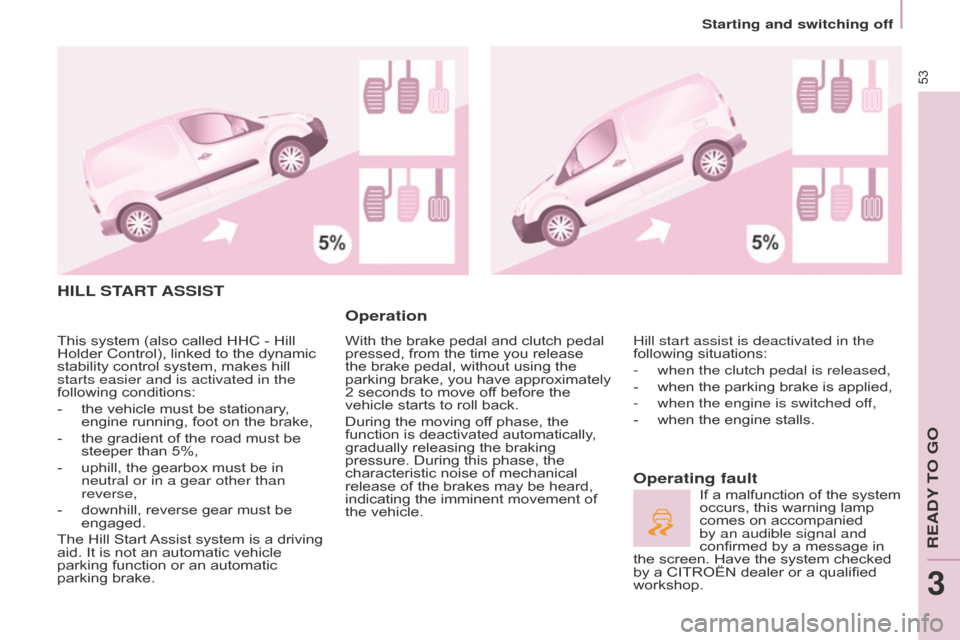
This system (also called HHC - Hill
Holder Control), linked to the dynamic
stability control system, makes hill
starts easier and is activated in the
following conditions:
-
the vehicle must be stationary
,
engine running, foot on the brake,
-
the gradient of the road must be
steeper than 5%,
-
uphill, the gearbox must be in
neutral or in a gear other than
reverse,
-
downhill, reverse gear must be
engaged.
The Hill Start
Assist system is a driving
aid. It is not an automatic vehicle
parking function or an automatic
parking brake.
READY TO GO
3
Starting and switching off
Page 59 of 264
57
Berlingo-2-VU_en_Chap04_Ergonomie_ed01-2016
Guide-me-home lighting
Keeping the dipped beam headlamps
on temporarily with the ignition off,
makes the driver's exit easier when the
light is poor.
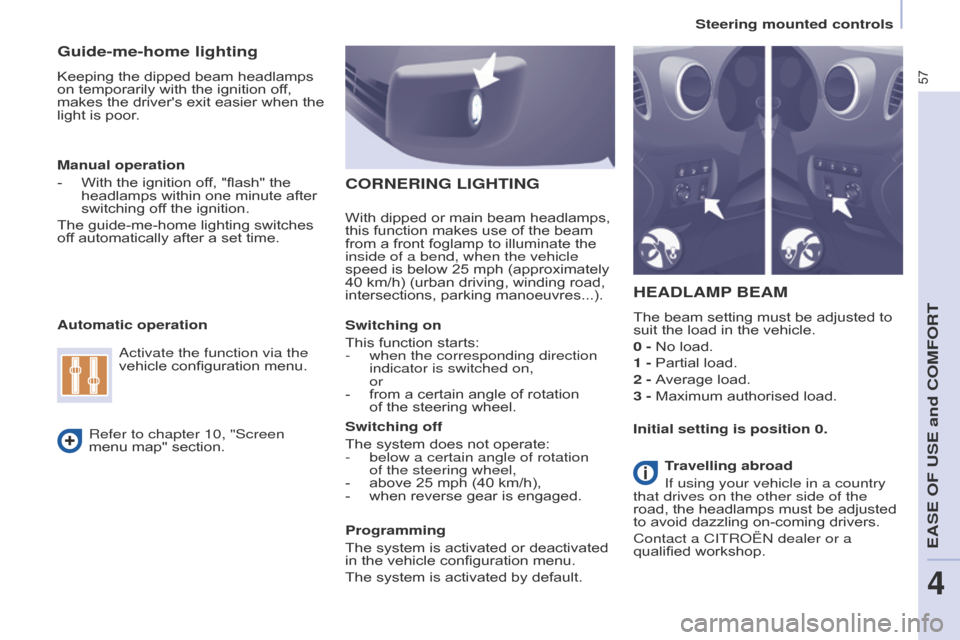
HEADLAMP BEAM
The beam setting must be adjusted to
suit the load in the vehicle.
0 - No load.
1 - Partial load.
2 - Average load.
3 - Maximum authorised load.
Manual operation
-
With the ignition of
f, "flash" the
headlamps within one minute after
switching off the ignition.
The guide-me-home lighting switches
off automatically after a set time.
Automatic operation
Refer to chapter 10, "Screen
menu map" section.
a
ctivate the function via the
vehicle configuration menu.
Initial setting is position 0.
CORNERING LIGHTING
With dipped or main beam headlamps,
this function makes use of the beam
from a front foglamp to illuminate the
inside of a bend, when the vehicle
speed is below 25 mph (approximately
40 km/h) (urban driving, winding road,
intersections, parking manoeuvres...).
Switching on
This function starts:
-
when the corresponding direction
indicator is switched on,
or
-
from a certain angle of rotation
of the steering wheel.
Switching off
The system does not operate:
-
below a certain angle of rotation
of the steering wheel,
-
above 25 mph (40 km/h),
-
when reverse gear is engaged.
Programming
The system is activated or deactivated
in the vehicle configuration menu.
The system is activated by default. T
ravelling abroad
If using your vehicle in a country
that drives on the other side of the
road, the headlamps must be adjusted
to avoid dazzling on-coming drivers.
Contact a CITR
o Ë n dealer or a
qualified workshop.
Steering mounted controls
EASE OF USE and COMFORT
4
Page 63 of 264
61
Berlingo-2-VU_en_Chap04_Ergonomie_ed01-2016
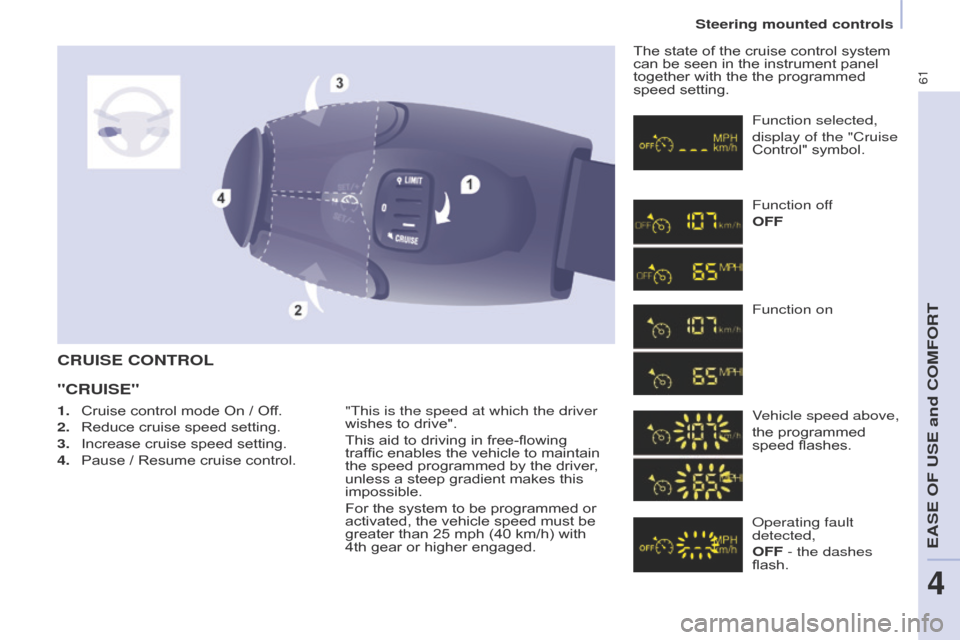
CRUISE CONTROL
"CRUISE"
"This is the speed at which the driver
wishes to drive".
This aid to driving in free-flowing
traffic enables the vehicle to maintain
the speed programmed by the driver,
unless a steep gradient makes this
impossible.
For the system to be programmed or
activated, the vehicle speed must be
greater than 25 mph (40 km/h) with
4th gear or higher engaged. The state of the cruise control system
can be seen in the instrument panel
together with the the programmed
speed setting.
Function selected,
display of the "Cruise
Control" symbol.
Function off
OFF
Function on
Vehicle speed above,
the programmed
speed flashes.
o
perating fault
detected,
OFF - the dashes
flash.
1.
Cruise control mode On / Of
f.
2.
Reduce cruise speed setting.
3.
Increase cruise speed setting.
4.
Pause / Resume cruise control.
Steering mounted controls
EaSE oF USE and CoMFoRT
4
Page 65 of 264
63
Berlingo-2-VU_en_Chap04_Ergonomie_ed01-2016
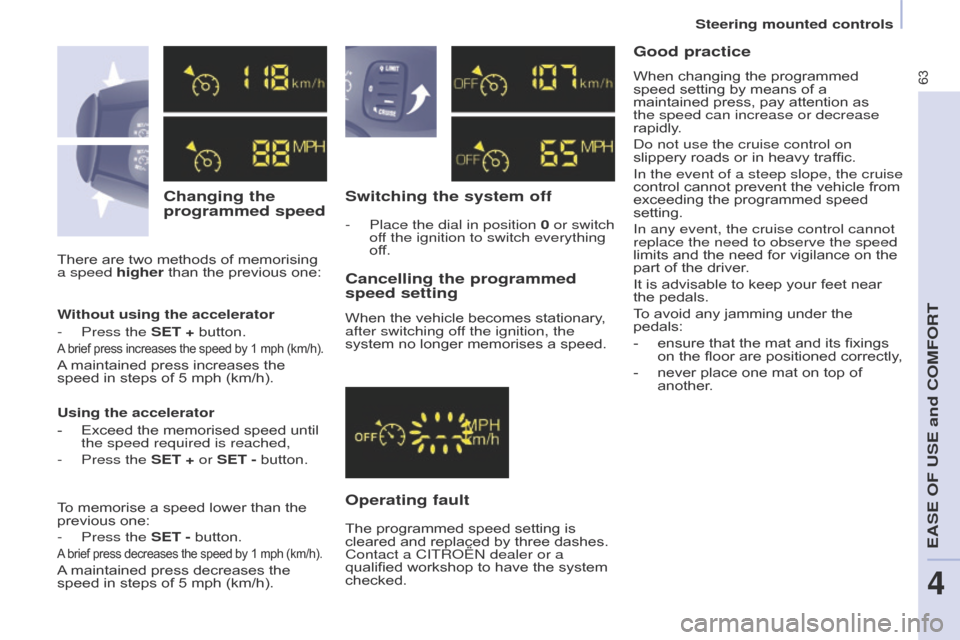
Changing the
programmed speedSwitching the system off
Operating fault Cancelling the programmed
speed setting
When the vehicle becomes stationary,
after switching off the ignition, the
system no longer memorises a speed.
There are two methods of memorising
a speed higher than the previous one:
-
Place the dial in position
0 or switch
off the ignition to switch everything
off.
Good practice
Without using the accelerator
-
Press the
SET + button.
A brief press increases the speed by 1 mph (km/h).
A maintained press increases the
speed in steps of 5 mph (km/h).
Using the accelerator
-
Exceed the memorised speed until
the speed required is reached,
-
Press the
SET + or SET - button.
To memorise a speed lower than the
previous one:
-
Press the
SET - button.
A brief press decreases the speed by 1 mph (km/h).
A maintained press decreases the
speed in steps of 5 mph (km/h). The programmed speed setting is
cleared and replaced by three dashes.
Contact a CITR
o Ë n dealer or a
qualified workshop to have the system
checked. When changing the programmed
speed setting by means of a
maintained press, pay attention as
the speed can increase or decrease
rapidly.
d
o not use the cruise control on
slippery roads or in heavy traffic.
In the event of a steep slope, the cruise
control cannot prevent the vehicle from
exceeding the programmed speed
setting.
In any event, the cruise control cannot
replace the need to observe the speed
limits and the need for vigilance on the
part of the driver.
It is advisable to keep your feet near
the pedals.
To avoid any jamming under the
pedals:
-
ensure that the mat and its fixings
on the floor are positioned correctly
,
-
never place one mat on top of
another
.
Steering mounted controls
EASE OF USE and COMFORT
4
Page 66 of 264
64
Berlingo-2-VU_en_Chap04_Ergonomie_ed01-2016
The speed of the vehicle responds to
the pressure of the driver's foot, up
to the the accelerator pedal's point of
resistance, which indicates that the
programmed speed has been reached.
However, pressing the pedal beyond
this point of resistance to the floor
allows the programmed speed to be
exceeded. To resume use of the limiter,
simply reduce the pressure on the
accelerator pedal gradually and return
to a speed below that programmed.
Adjustments can be carried out
when stationary, with the engine
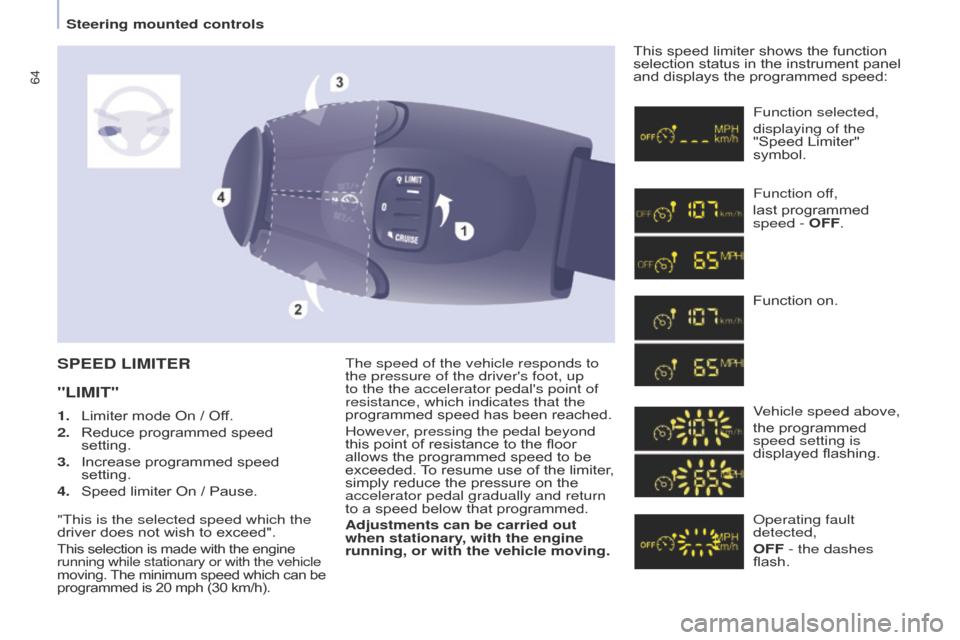
running, or with the vehicle moving.This speed limiter shows the function
selection status in the instrument panel
and displays the programmed speed:SPEED LIMITER
"LIMIT"
Function selected,
displaying of the
"Speed Limiter"
symbol.
Function off,
last programmed
speed - OFF.
Function on.
Vehicle speed above,
the programmed
speed setting is
displayed flashing.
o
perating fault
detected,
OFF - the dashes
flash.
1.
Limiter mode On / Of
f.
2.
Reduce programmed speed
setting.
3.
Increase programmed speed
setting.
4.
Speed limiter On / Pause.
"This is the selected speed which the
driver does not wish to exceed".
This selection is made with the engine
running while stationary or with the vehicle
moving. The minimum speed which can be
programmed is 20 mph (30 km/h).
Steering mounted controls
Page 68 of 264
66
Berlingo-2-VU_en_Chap04_Ergonomie_ed01-2016
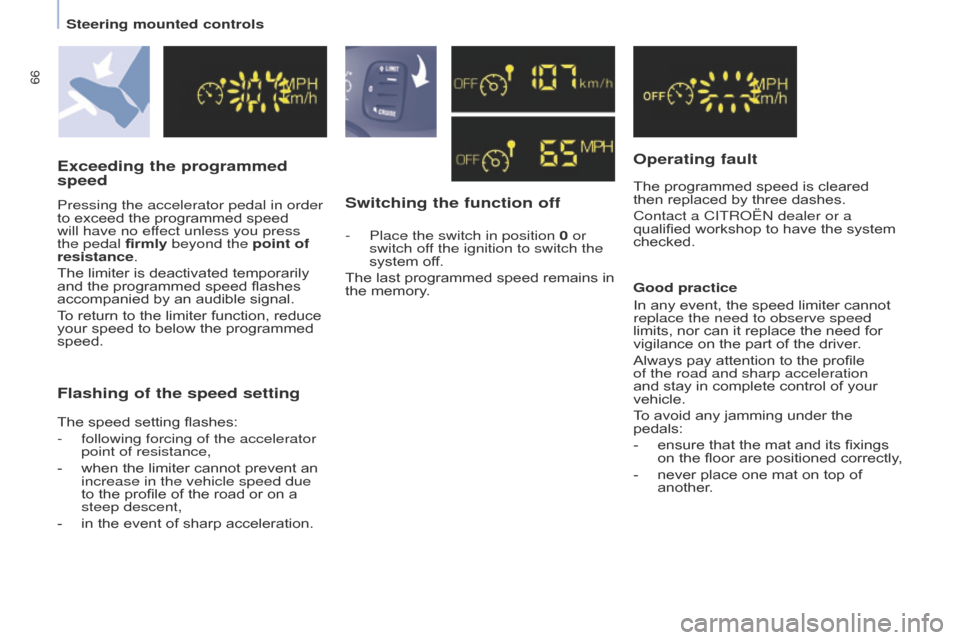
Switching the function offOperating fault
The programmed speed is cleared
then replaced by three dashes.
Contact a CITR
o Ë n dealer or a
qualified workshop to have the system
checked.
Flashing of the speed setting
Good practice
In any event, the speed limiter cannot
replace the need to observe speed
limits, nor can it replace the need for
vigilance on the part of the driver.
Always pay attention to the profile
of the road and sharp acceleration
and stay in complete control of your
vehicle.
To avoid any jamming under the
pedals:
-
ensure that the mat and its fixings
on the floor are positioned correctly
,
-
never place one mat on top of
another
.
Exceeding the programmed
speed
Pressing the accelerator pedal in order
to exceed the programmed speed
will have no effect unless you press
the pedal firmly beyond the point of
resistance.
The limiter is deactivated temporarily
and the programmed speed flashes
accompanied by an audible signal.
To return to the limiter function, reduce
your speed to below the programmed
speed.
The speed setting flashes:
-
following forcing of the accelerator
point of resistance,
-
when the limiter cannot prevent an
increase in the vehicle speed due
to the profile of the road or on a
steep descent,
-
in the event of sharp acceleration. -
Place the switch in position
0 or
switch off the ignition to switch the
system off.
The last programmed speed remains in
the memory.
Steering mounted controls
Page 86 of 264
84
Berlingo-2-VU_en_Chap04_Ergonomie_ed01-2016Berlingo-2-VU_en_Chap04_Ergonomie_ed01-2016
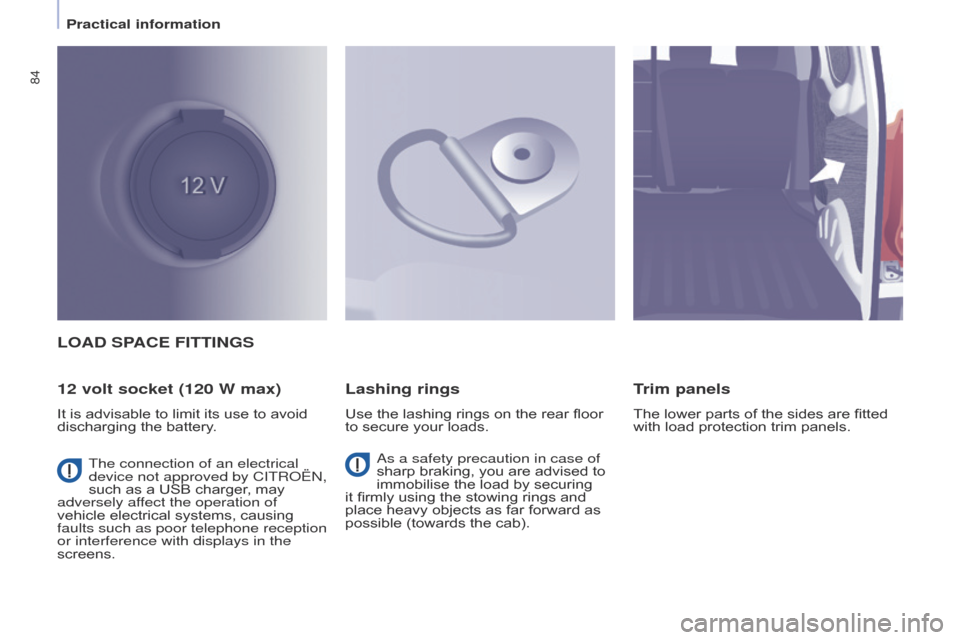
LOAD SPACE FITTINGS
12 volt socket (120 W max)
It is advisable to limit its use to avoid
discharging the battery.
Lashing rings
Use the lashing rings on the rear floor
to secure your loads.
Trim panels
The lower parts of the sides are fitted
with load protection trim panels.
a
s a safety precaution in case of
sharp braking, you are advised to
immobilise the load by securing
it firmly using the stowing rings and
place heavy objects as far forward as
possible (towards the cab).
The connection of an electrical
device not approved by CITR
o
Ë
n
,
such as a USB charger, may
adversely affect the operation of
vehicle electrical systems, causing
faults such as poor telephone reception
or interference with displays in the
screens.
Practical information
Page 97 of 264
95
Berlingo-2-VU_en_Chap05_Securite_ed01-2016
ANTI-SLIP REGULATION (ASR)
AND
DYNAMIC STABILITY
CONTROL (DSC)
These systems are linked and
complement the ABS.
The ASR system is very useful for
maintaining optimum drive and
avoiding losses of control of the vehicle
on acceleration.
The system optimises drive to prevent
the wheels skidding, by acting on the
brakes of the drive wheels and on the
engine. It also allows the directional
stability of the vehicle to be improved
on acceleration.
Use the
d SC to hold your course
without attempting to countersteer.
If there is a variation between the
trajectory followed by the vehicle and
that required by the driver, the
d SC
system automatically acts on the
engine and the brake of one or more
wheels, in order to put the vehicle back
on course.
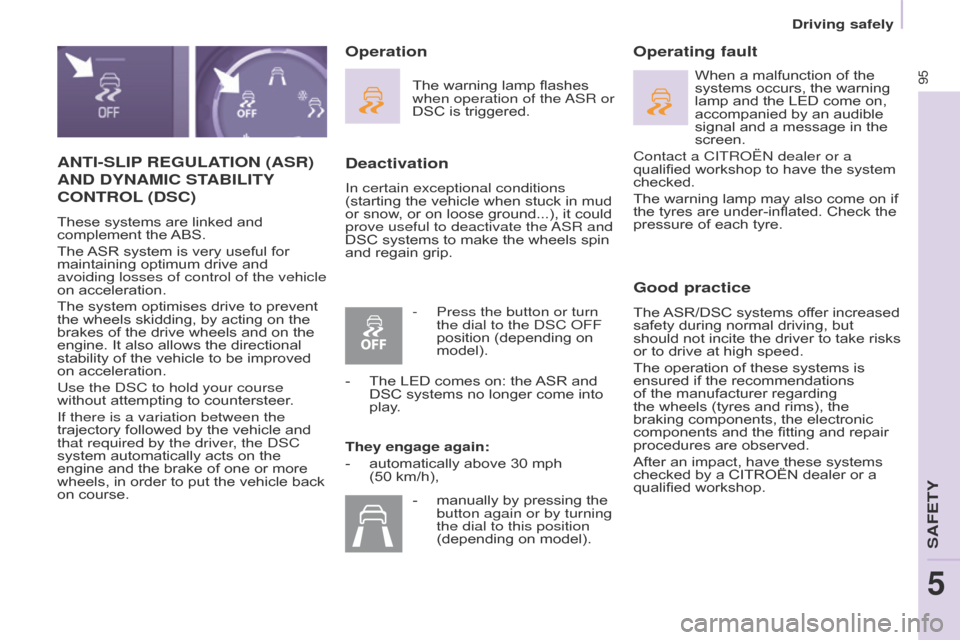
Deactivation
In certain exceptional conditions
(starting the vehicle when stuck in mud
or snow, or on loose ground...), it could
prove useful to deactivate the
a
SR and
DSC systems to make the wheels spin
and regain grip.
Operating fault
Good practice
The ASR/DSC systems offer increased
safety during normal driving, but
should not incite the driver to take risks
or to drive at high speed.
The operation of these systems is
ensured if the recommendations
of the manufacturer regarding
the wheels (tyres and rims), the
braking components, the electronic
components and the fitting and repair
procedures are observed.
After an impact, have these systems
checked by a CITROËN dealer or a
qualified workshop.
Operation
The warning lamp flashes
when operation of the a SR or
DSC is triggered.
They engage again:
-
automatically above 30 mph
(50 km/h), When a malfunction of the
systems occurs, the warning
lamp and the LED come on,
accompanied by an audible
signal and a message in the
screen.
Contact a CITR
o Ë n dealer or a
qualified workshop to have the system
checked.
The warning lamp may also come on if
the tyres are under-inflated. Check the
pressure of each tyre.
-
Press the button or turn
the dial to the
d SC o FF
position (depending on
model).
-
The LED comes on: the
ASR and
DSC systems no longer come into
play.
-
manually by pressing the
button again or by turning
the dial to this position
(depending on model).
Driving safely
SAFETY
5