Rear seats CITROEN BERLINGO 2023 Owner's Manual
[x] Cancel search | Manufacturer: CITROEN, Model Year: 2023, Model line: BERLINGO, Model: CITROEN BERLINGO 2023Pages: 324, PDF Size: 9.41 MB
Page 113 of 324
 Universal child seat: child seat suitable for installation in all vehic\
les using the seat belt.
U Seat position suitable for installing a child seat secured using the se\
at belt and")
111
Safety
5(c) Universal child seat: child seat suitable for installation in all vehic\
les using the seat belt.
U Seat position suitable for installing a child seat secured using the se\
at belt and universally approved for rearward-facing and/or forward-faci\
ng use.
UF Seat position suitable for installing a child seat secured using a seat\
belt and universally approved for forward-facing use.
X Seat position not suitable for installing a child seat for the stated w\
eight class.
Child weight and age guide
Seat Under 13
kg
(groups
0 (d)
and
0+)
Up to about 1 year old From 9 to 18
kg
(group 1)
From about 1 to 3 years old 15-25 kg
(group
2)
From about 3 to 6 years old 22-36 kg
(group
3)
From about 6 to 10 years old
Row 1 (a) Fixed passenger seat X
Passenger seat
with forwards
and backwards
adjustment With passenger
airbag deactivated
"OFF"
U (f)
With passenger
airbag activated
"ON" X
UF (f)
Row
2 (b) (e) U
Row
3 (b) (e) U (g) (h)
Key
(a) Refer to the current legislation in the country in which you are drivin\
g before placing a child in this seat position.
(b) To install a rearward-facing or forward-facing child seat on a rear seat,\
adjust the rear seat to the fully back position with the backrest strai\
ghtened.
(c) Universal child seat: child seat suitable for installation in all vehic\
les using the seat belt.
(d) Group 0: from birth to 10
kg. Carrycots and "car" infant carriers must not be installed on the fro\
nt passenger seat(s) or the seats in row 3.
(e) To install a rearward-facing or forward-facing child seat on a rear seat,\
move the seats in front of it forward, then straighten their backrests \
to allow
sufficient room for the child seat and the child's legs.
Page 114 of 324
11 2
Safety
(f) With the fixed passenger seat (which cannot be placed in the folded position), adjust the backrest angle to 0°.
For more information on the Front seats and, in particular, the folded position for the backrest, refer to the corresponding secti\
on.
(g) On the M version, fold down the backrests in row
2.
(h) Installing child seats with a support leg is prohibited in the third ro\
w.
U Seat position suitable for installing a child seat secured using the se\
at belt and universally approved for rearward-facing and/or forward-faci\
ng use.
UF Seat position suitable for installing a child seat secured using a seat\
belt and universally approved for forward-facing use.
X Seat position not suitable for installing a child seat for the stated w\
eight class.
"ISOFIX" mountings
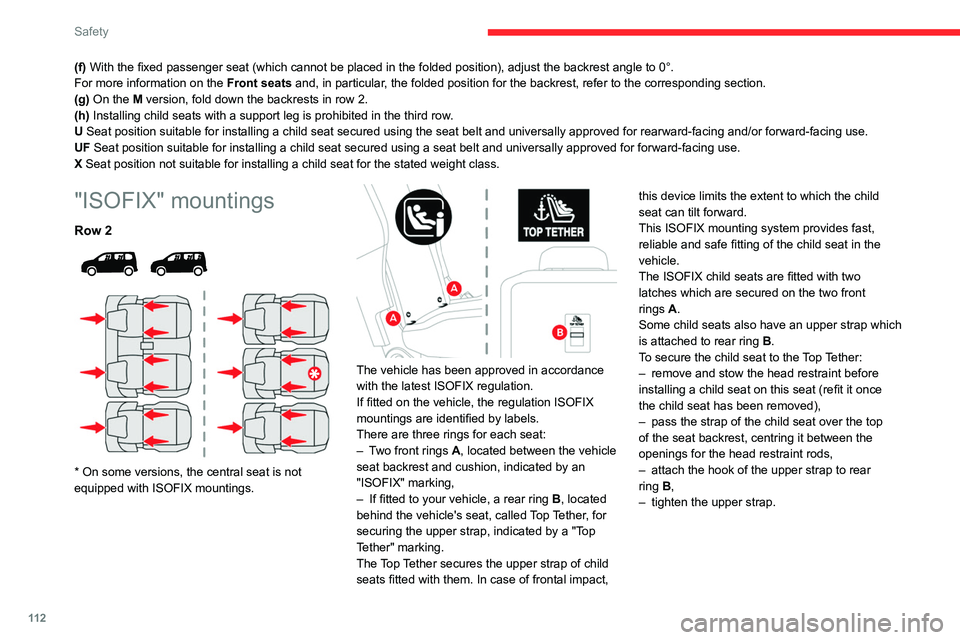
Row 2
* On some versions, the central seat is not
equipped with ISOFIX mountings.
The vehicle has been approved in accordance
with the latest ISOFIX regulation.
If fitted on the vehicle, the regulation ISOFIX
mountings are identified by labels.
There are three rings for each seat:
–
T
wo front rings A, located between the vehicle
seat backrest and cushion, indicated by an
"ISOFIX" marking,
–
If fitted to your vehicle, a rear ring
B, located
behind the vehicle's seat, called Top Tether, for
securing the upper strap, indicated by a "Top
Tether" marking.
The Top Tether secures the upper strap of child
seats fitted with them. In case of frontal impact, this device limits the extent to which the child
seat can tilt forward.
This ISOFIX mounting system provides fast,
reliable and safe fitting of the child seat in the
vehicle.
The ISOFIX child seats are fitted with two
latches which are secured on the two front
rings
A.
Some child seats also have an upper strap which
is attached to rear ring B.
To secure the child seat to the Top Tether:
– remove and stow the head restraint before
installing a child seat on this seat (refit it once
the child seat has been removed),
–
pass the strap
of the child seat over the top
of the seat backrest, centring it between the
openings for the head restraint rods,
–
attach the hook of the upper strap to rear
ring
B,
–
tighten the upper strap.
Page 115 of 324
11 3
Safety
5Incorrect installation of a child seat in a
vehicle can compromise a child's safety
in the event of an accident.
Strictly follow the fitting instructions provided
in the installation guide supplied with the child
seat.
Recommended ISOFIX
child seats
Also consult the user guide from the child seat’s manufacturer to find out how to
install and remove the seat.
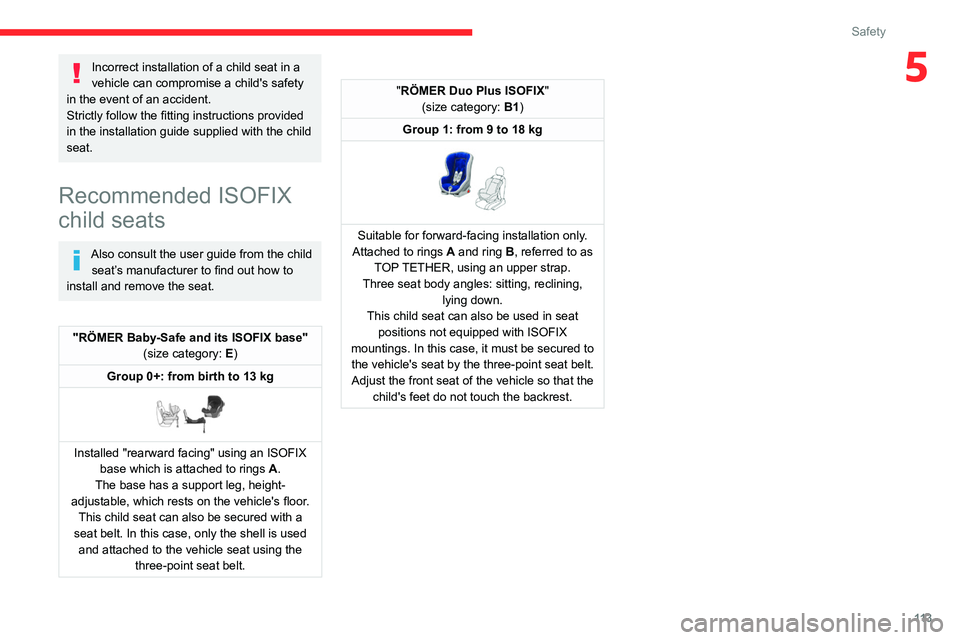
"RÖMER Baby-Safe and its ISOFIX base" (size category: E)
Group 0+: from birth to 13 kg
Installed "rearward facing" using an ISOFIX base which is attached to rings A .
The base has a support leg, height-
adjustable, which rests on the vehicle's floor. This child seat can also be secured with a
seat belt. In this case, only the shell is used and attached to the vehicle seat using the three-point seat belt.
"RÖMER Duo Plus ISOFIX "
(size category: B1)
Group 1: from 9 to 18 kg
Suitable for forward-facing installation only.
Attached to rings A and ring B, referred to as
TOP TETHER, using an upper strap.
Three seat body angles: sitting, reclining, lying down.
This child seat can also be used in seat positions not equipped with ISOFIX
mountings. In this case, it must be secured to the vehicle's seat by the three-point seat belt. Adjust the front seat of the vehicle so that the child's feet do not touch the backrest.
Page 116 of 324
11 4
Safety
Locations for ISOFIX child seats
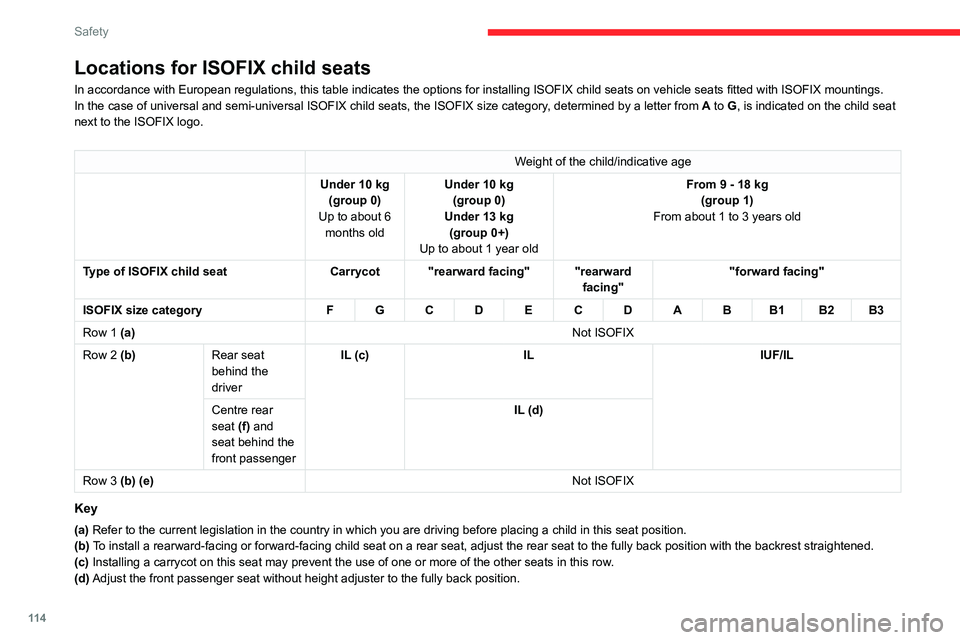
In accordance with European regulations, this table indicates the options for installing ISOFIX child seats on vehicle seats fitted with ISOFIX mountings.
In the case of universal and semi-universal ISOFIX child seats, the ISOF\
IX size category, determined by a letter from A to G, is indicated on the child seat
next to the ISOFIX logo.
Weight of the child/indicative age
Under 10
kg
(group
0)
Up to about 6 months old Under 10
kg
(group
0)
Under 13
kg
(group
0+)
Up to about 1 year old From 9 - 18 kg
(group 1)
From about 1 to 3 years old
Type of ISOFIX child seat Carrycot "rearward facing" "rearward
facing""forward facing"
ISOFIX size category F G C D E C D A B B1 B2 B3
Row 1 (a) Not ISOFIX
Row
2 (b) Rear seat
behind the
driver IL (c)
IL IUF/IL
Centre rear
seat (f) and
seat behind the
front passenger IL (d)
Row
3 (b) (e) Not ISOFIX
Key
(a) Refer to the current legislation in the country in which you are drivin\
g before placing a child in this seat position.
(b) To install a rearward-facing or forward-facing child seat on a rear seat,\
adjust the rear seat to the fully back position with the backrest strai\
ghtened.
(c) Installing a carrycot on this seat may prevent the use of one or more o\
f the other seats in this row.
(d) Adjust the front passenger seat without height adjuster to the fully bac\
k position.
Page 117 of 324
 Installing child seats with a support leg is prohibited in the third ro\
w.
(f) On some versions, the central seat is not equipped with ISOFIX mounting\
s.
IUF Seat suitable for insta")
11 5
Safety
5(e) Installing child seats with a support leg is prohibited in the third ro\
w.
(f) On some versions, the central seat is not equipped with ISOFIX mounting\
s.
IUF Seat suitable for installing a forward-facing ISOFIX Universal seat sec\
ured using the upper strap.
IL Seat suitable for an ISOFIX Semi-Universal child seat, which may be eit\
her:
–
rearward-facing, fitted with an upper strap or a support leg.
–
"forward facing" fitted with a support leg.
–
a carrycot fitted with an upper strap or a support leg.
For more information on ISOFIX child seats and in particular on securing the upper strap, refer to the correspondi\
ng section.
i-Size child seats
i-Size child seats have two latches that are anchored to the two rings A.
These i-Size child seats also have:
–
either an upper strap that is attached to ring B
.
–
or a support leg that rests on the vehicle floor
, compatible with the approved i-Size seat position.
Their role is to prevent the child seat from tipping forward in the even\
t of a collision.
For more information on the ISOFIX mountings, refer to the corresponding section.
Locations for i-Size child seats
In accordance with the new European regulations, this table indicates the options for installing i-Size child seats on seats in the vehicle fitted with i-Size
approved ISOFIX mountings.
Seat position i-Size child restraint system
Row 1 (a) Passenger seat Not i-Size
Row 2 (b) (c) (d) i-U
Row
3 (b) Not i-Size
Key
(a) Refer to the current legislation in the country in which you are drivin\
g before placing a child in this seat position.
(b) To install a rearward-facing or forward-facing child seat on a rear seat,\
adjust the rear seat to the fully back position with the backrest strai\
ghtened.
Page 291 of 324

289
Alphabetical index
Changing a wheel 203, 206
Changing a wiper blade
89–90
Changing the remote control battery
40
Changing to free-wheeling
199, 218
Charger, induction
62
Charger, wireless
62
Charging cable
180
Charging cable (Electric)
179
Charging connector (Electric)
178, 183, 185–186
Charging flap (Electric)
178, 183, 185–186
Charging system (Electric)
5, 9, 30, 176, 193
Charging the traction battery
(Electric)
176, 183, 185–186
Checking the levels
193–195
Checking tyre pressures
(using the kit)
204–205
Checks
193, 195–197
Checks, routine
195–197
Child lock
11 6
Children
102, 110, 114–116
Children (safety)
11 6
Child seats
102, 106–107, 109–111, 114–115
Child seats, conventional
109
Child seats, i-Size
11 5
Child seats, ISOFIX
114–116
Cleaning (advice)
177, 200–201
Closing the doors
32, 37
Collision Risk Alert
152–153
Configuration, vehicle
29–30
Connected applications
272Connection, Bluetooth 242–243, 255–256,
272–273, 277–278
Connection, MirrorLink
254
Connection, Wi-Fi network
273
Connectivity
271
Consumption figures
30
Container, AdBlue®
198
Control, emergency boot release
39
Control, emergency door
32, 38–39
Control, heated seats
52–53
Controls, steering mounted
131
Control stalk, lighting
83–84
Control stalk, wipers
88–90
Control unit
179–180
Courtesy lamp
81–82
Courtesy lamp, front
82
Courtesy lamp, rear
82
Courtesy lamps
82
Cover, load space
65
Cruise control
142–143, 146–148, 152
Cruise control, adaptive
148
Cruise control by speed limit
recognition
142–143
Cruise control, dynamic with Stop
function
142–143
Cup holder
60
D
DAB (Digital Audio Broadcasting) -
Digital radio
240, 252, 275
Date (setting) 258, 280
Daytime running lamps
85, 210–211
Deactivating the passenger
airbag
104, 108–109
Deactivation of DSC (ESC)
96
Deadlocking
38
Deferred charging
31
Deferred charging (Electric)
30, 178, 183, 186
Defrosting
54, 77
Defrosting, front
77
Demisting
77
Demisting, front
77
Demisting, rear
53, 78
Demisting, rear screen
53, 78
Dials and gauges
10, 12
Digital instrument panel
11–13
Dimensions
221
Dipstick
193
Direction indicators
84, 210, 212–213
Display, head-up
138
Display screen, instrument panel
10
Domestic charging
180
Domestic charging (Electric)
185–186, 236
Doors, side
43
Doors, side-hinged
37–38
Driver’s attention warning
160
Drive selector (Electric)
132, 196
Driving
117–118
Driving aids camera (warnings)
139
Driving aids (recommendations)
139
Driving economically
8
Driving modes
133–134
Page 292 of 324
290
Alphabetical index
Dynamic stability control (DSC) 96–98
E
EBFD 95
Eco-driving (advice)
8
ECO mode
134
Economy mode
187
Electric motor
5, 9, 30, 176, 190,
193, 215, 218, 236
Electric windows
47
Electronic brake force distribution (EBFD)
95
Emergency braking assistance (EBA)
95
Emergency call
92–93
Emergency warning lamps
67, 94
Emissions control system, SCR
197
Energy economy mode
187
Energy flows
30
Energy recovery
133
Engine compartment
193
Engine, Diesel
174, 193, 202, 229–231, 235
Engine, petrol
193, 227–228
Engines
227–231, 235
Environment
8, 40, 81, 118
ESC (electronic stability control)
95
Expanded traffic sign recognition
143
Exterior lighting
86
F
Fatigue detection 160
Filling the AdBlue® tank
195, 198
Filling the fuel tank
174–175
Filter, air
196
Filter, oil
196
Filter, particle
195–196
Filter, passenger compartment
73, 196
Finisher
209
Fitting a wheel
207–208
Fitting roof bars
191
Fittings, interior
60, 64
Flap, fuel filler
174–175
Flap, removable
69
Flashing indicators
84, 213
Fluid, brake
194
Fluid, engine coolant
194
Foglamp, rear
213
Foglamps
212
Foglamps, front
83, 210
Foglamps, rear
83
Folding the rear seats
56–57
Frequency (radio)
274
Fuel
8, 174
Fuel consumption
8
Fuel tank
174–176
Fuses
214
G
Gauge, fuel 174–175
Gearbox, automatic
126–132, 196, 216
Gearbox, manual
126–127, 196
Gear lever, automatic gearbox
127–129
Gear lever, manual gearbox
126–127
Gear shift indicator ~ Gear efficiency
indicator
134
Glove box
60
G.P.S.
268
H
Hazard warning lamps 67, 94
Headlamp adjustment
88
Headlamps, automatic dipping
86–87
Headlamps, automatic illumination
84–86
Headlamps, dipped beam
83, 210–211
Headlamps, halogen
210
Headlamps, main beam
83, 86, 210, 212
Head restraints, front
59
Head restraints, rear
56–57
Head-up display
138–139
Heating
73–75, 79–80
Heating, additional
46, 79–80
Heating, programmable
46, 79–81
High voltage
176
Hill Assist Descent Control (HADC)
98
Hill start assist
126
Histogramme, fuel consumption
30
Page 295 of 324

293
Alphabetical index
Running out of fuel (Diesel) 202
S
Safety, children 104, 106–108, 110, 114–116
Saturation of the particle filter (Diesel)
196
Screen, cold climate
188
Screen menu map
254
Screenwash
89
Screenwash, front
88
Screenwash, rear
89
SCR (Selective Catalytic Reduction)
197
Seat belts
99–102, 109
Seat, bench front, 2-seat
55–56, 100
Seat, rear bench
56, 58
Seats, front
50–52, 55–56
Seats, front bench
55–56
Seats, heated
52–53
Seats, Multiflex ~ Extenso Cab
68
Seats, rear
50, 55–58, 107
Selector, gear
130–132
Sensors (warnings)
140
Serial number, vehicle
236
Service indicator
20
Servicing
20, 195
Settings, equipment
29–30
Settings, system
244, 257, 280
Shield, snow
188
Sidelamps
83–85, 210–211
Side parking sensors
162
Side repeater
2 11
Silent vehicle warning sound (Electric)
95, 118
Sliding side door, electric 37, 44
Smartphone
62
Snow chains
137, 188
Snow screen
188
Socket, 12 V accessory
60–61
Socket, 220 V
62
Socket, auxiliary
241, 252, 275
Socket, Jack
275
Speed limiter
142–145, 152
Speed limit recognition
140, 142
Speedometer
10, 12, 140
Sport mode
134
Stability control (ESC)
95–98
Starting a Diesel engine
174
Starting the engine
119, 121
Starting the vehicle
120, 122, 127–129, 131
Starting using another battery
122, 215
Station, radio
239–240, 250–251, 274
Stay, bonnet
192
Steering mounted controls, audio
237–238, 248, 261
Steering wheel, adjustment
53
Stickers, customising ~ Stickers,
expressive
201
Stopping the vehicle
121–122,
127–129, 131–132
Stop & Start
28, 74, 78, 134–136, 174, 192, 195, 218
Storage
60
Storage boxes
63
Stowing rings
67
Sunshine sensor
73
Super-fast charging (Electric)
185–186, 236Surround Rear Vision 164
Switching off the engine
119, 121
Synchronising the remote control
41
T
Tables of engines 236
Tank, fuel
174–175
Technical data
227–231, 235, 236
Telephone
242–243, 255–256, 277–279
Time (setting)
244, 257, 281
TMC (Traffic info)
268
Tools
203
Topping-up AdBlue®
198
Touch screen
28–30, 81
Towbar
96, 189
Towed loads
227–231, 235, 236
Towing another vehicle
218–219
Towing eye
219
Traction battery charge
180
Traction battery (Electric)
30, 176–177, 236
Traction control (ASR)
96–98
Traffic information (TMC)
268
Trailer
96, 189
Trailer stability assist (TSA)
96
Trajectory control systems
95
Triangle, warning
67
Trip computer
27–28
Type of bulbs
210
Tyres
197, 236
Tyre under-inflation detection
136–137, 206