parking brake Citroen BERLINGO MULTISPACE RHD 2015 2.G User Guide
[x] Cancel search | Manufacturer: CITROEN, Model Year: 2015, Model line: BERLINGO MULTISPACE RHD, Model: Citroen BERLINGO MULTISPACE RHD 2015 2.GPages: 276, PDF Size: 12.21 MB
Page 53 of 276

Berlingo_2_VP_en_Chap03_Pret-a-partir_ed02-2014
51
HILL StA rt ASSIS t
This system (also called HHC - Hill Holder
Control), linked to the dynamic
stability
control system, makes hill
starts easier and is activated in the
following
conditions:
-
the
vehicle must be stationary,
engine
running, foot on the brake,
-
the
gradient of the road must be
steeper than 5%,
-
uphill,
the gearbox must be in
neutral or in a gear other than
reverse,
-
downhill,
reverse gear must be
engaged.
The Hill Start
a
ssist function is
a
driving aid system. It is not an
automatic
vehicle parking function or
an
automatic parking brake.
Operation
With the brake pedal and clutch pedal pressed, from the time you release the
brake
pedal you have approximately
2 seconds before the vehicle starts to
roll
back and without using the parking
brake
within which to move off.
During
the moving off phase, the
function
is deactivated automatically,
gradually
releasing the braking
pressure.
During this phase, the
characteristic
noise of mechanical
release
of the brakes may be heard,
indicating
the imminent movement of
the
vehicle.
Operating fault
Hill start assist is deactivated in the
following situations:
-
when the clutch pedal is released,
-
when
the parking brake is applied,
-
when the engine is switched of
f,
-
when
the engine stalls.
If
a malfunction of the
system
occurs, this
warning
lamp comes on
accompanied
by an audible
signal
and confirmed by
a
message in the screen. Have the
system
checked by at a CITROËN
dealer
or a qualified workshop.
Starting and stopping
REadY To Go
3
Page 108 of 276

106
Berlingo_2_VP_en_Chap05_Securite_ed02-2014
HAZArd WArnInG LAMPS
HO rn
Press the centre of the steering wheel.
PArKInG BrAKE
Applying
Pull the parking brake lever up to immobilise your vehicle.
Check
that the parking brake is applied
firmly
before leaving the vehicle.Pull
on the parking brake lever, only
with the vehicle stationary.
In the exceptional case of use of the
parking
brake when the vehicle is
moving,
apply the brake by pulling
gently
to avoid locking the rear wheels
(risk
of skidding).
Press this button, the direction
indicators
flash.
They
can
operate
with
the
ignition
off.
The
hazard
warning
lamps
should
only
be used in dangerous situations, when
stopping
in
an
emergency
or
when
driving
in
unusual
conditions.
When
parking on a slope, direct your
wheels
towards the pavement and pull
the
parking brake lever up.
There is no advantage in engaging
a
gear after parking the vehicle,
particularly
if the vehicle is loaded.
If the parking brake is still on or has not been released properly, this is
indicated
by this warning lamp which
comes
on on the instrument panel.
Automatic operation of hazard
warning lamps
When braking in an emergency, depending on the force of deceleration,
the hazard warning lamps come
on
automatically.
They
switch off
automatically
the first time you
accelerate.
It
is also possible to switch them off by
pressing
the switch on the dashboard.releasing
Pull the lever and press the button to
lower the parking brake lever.
driving safely
Page 138 of 276

136
Berlingo_2_VP_en_Chap06_Accessoire_ed02-2014
Good Practice
In certain cases of particularly arduous
use (towing the maximum load up a
steep
slope in high temperatures), the
engine
automatically limits its power.
In this case,
the air conditioning is
automatically
cut off to save engine
power
.
tyres
Check
the tyre pressures of the towing
vehicle and of the trailer
, observing the
recommended
pressures.
Chapter
7, "Levels" section.
If
the coolant temperature
warning
lamp comes on, stop
the vehicle and switch of
f the
engine
as soon as possible.Brakes
Towing
increases the braking distance. Drive
at a moderate speed, change
down
early and brake gradually.
towbar
We recommend the use of genuine CITRo Ë n towbars and their
harnesses, which have been tested
and
approved from the design stage of
your vehicle, and that you entrust the
fitting
of this equipment to a CITROËN
dealer
.
If
this equipment is not fitted by a
CITROËN
dealer, it is imperative that
it
is fitted using the electrical pre-
equipment
installed at the rear of the
vehicle and in accordance with the
manufacturer's
instructions.
In accordance with the general
instructions
a reminder of which has
been given above, we draw your
attention
to the risk associated with
fitting
a towbar or electrical accessory
not
recommended by CITROËN.
Fitting
such equipment could result in
the failure of your vehicle's electronic
system.
Please obtain information from
the
Manufacturer before fitting this type
of
equipment.
Side wind
Sensitivity
to
side
wind
is
increased.
Drive
smoothly
and
at
a
moderate
speed.
ABS/
d
S
c
The
ABS
or
DSC
systems
only
control
the
vehicle,
not
the
trailer
or
caravan.
Parking sensors
The
rear
parking
sensors
system
does
not
function
while
the
vehicle
is
towing.
Chapter
9,
"Identification
markings"
section.
towing a trailer
Page 147 of 276
Berlingo_2_VP_en_Chap07_Verification_ed02-2014
145
cHEcKS
c
arbon filter and passenger compartment filterParticle filter (
d iesel)
Maintenance of the particle filter must be carried out by a CITROËN dealer.
o
n acceleration after the vehicle has
been running for a prolonged period
at
very low speed or at idle, you may,
in
exceptional circumstances, notice
the
emission of water vapour at the
exhaust.
This
water vapour does not
have any adverse ef
fect on vehicle
handling
or the environment.
Battery
At the start of summer or winter, have your battery checked by a CITROËN
dealer
or a qualified workshop.
Brake pads
Brake pad wear depends on the style of driving, in particular for vehicles
which are used in town, over short
distances.
It may be necessary to
check
the thickness of the pads, even
between
services.
Unless
there is a leak on the circuit, a
drop
in the brake fluid level indicates
that
the brake pads are worn.
Brake disc / drum wear
For information on checking the brake disc / drum wear, contact a CITROËN
dealer
.
Parking brake
Where the parking brake travel is too great or there is a reduction in the
performance
of the system, the parking
brake
should be adjusted, even between
services.
Have
the system checked by a CITROËN
dealer
or a qualified workshop.
Oil filter
Change the filter regularly in accordance with the manufacturer's
servicing
schedule.
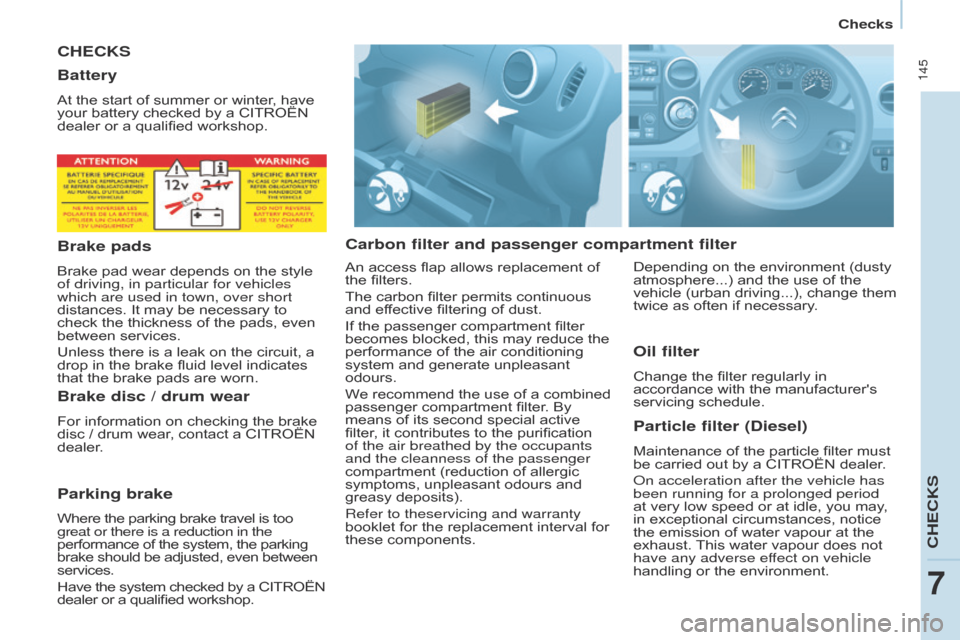
An
access
flap
allows
replacement
of
the
filters.
The
carbon
filter
permits
continuous
and
effective
filtering
of
dust.
If
the
passenger
compartment
filter
becomes
blocked,
this
may
reduce
the
performance
of
the
air
conditioning
system
and
generate
unpleasant
odours.
W
e
recommend
the
use
of
a
combined
passenger
compartment
filter.
By
means
of
its
second
special
active
filter
,
it
contributes
to
the
purification
of the air breathed by the occupants
and the cleanness of the passenger
compartment
(reduction
of
allergic
symptoms,
unpleasant
odours
and
greasy
deposits).
Refer to theservicing and warranty
booklet
for
the
replacement
interval
for
these
components. Depending
on the environment (dusty
atmosphere...)
and the use of the
vehicle
(urban driving...), change them
twice
as often if necessary.
Checks
CHECkS
7
Page 162 of 276
Berlingo_2_VP_en_Chap08_aide-rapide_ed02-2014
160
1. Parking the vehicle
- The occupants must get out of the vehicle
and wait in a safe location.
-
If
possible, park the vehicle on
level, stable and non-slippery
ground.
-
Apply
the parking brake, switch
of
f the ignition and engage first or
reverse
gear. -
Place a chock under the wheel diagonally opposite the one to be
changed.
cHAnGInG A WHEEL
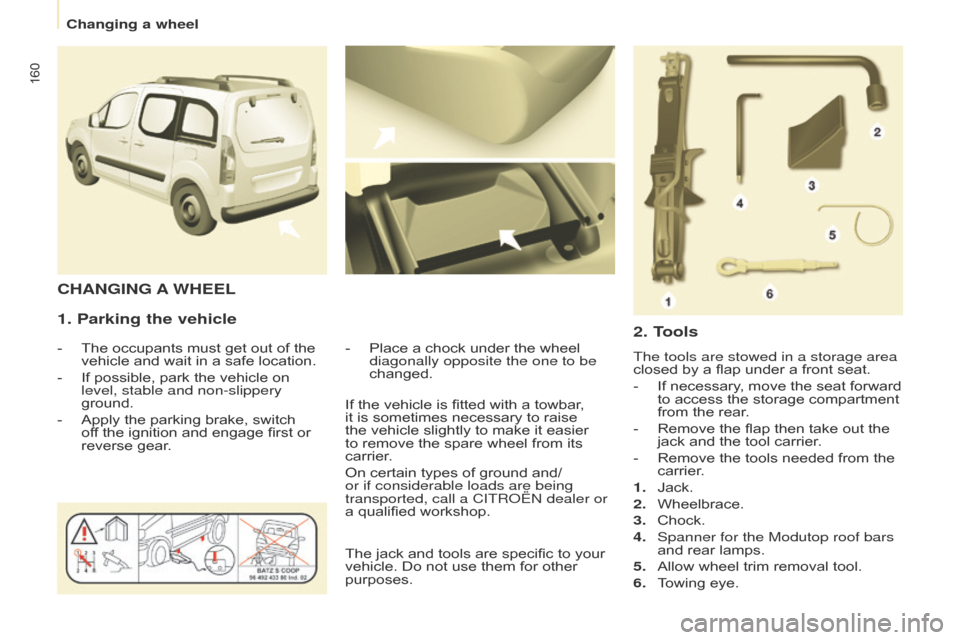
2. t
ools
The tools are stowed in a storage area
closed by a flap under a front seat.
-
If
necessary, move the seat forward
to
access the storage compartment
from
the rear.
-
Remove
the flap then take out the
jack
and the tool carrier.
-
Remove
the tools needed from the
carrier
.
1.
Jack.
2.
Wheelbrace.
3.
Chock.
4.
Spanner for the Modutop roof bars
and
rear lamps.
5.
Allow
wheel trim removal tool.
6.
T
owing eye.
If
the
vehicle
is
fitted
with
a
towbar,
it
is
sometimes
necessary
to
raise
the
vehicle
slightly
to
make
it
easier
to
remove
the
spare
wheel
from
its
carrier
.
On
certain
types
of
ground
and/
or if considerable loads are being
transported, call a CITR
o
Ë
n
dealer or
a
qualified
workshop.
The
jack
and
tools
are
specific
to
your
vehicle.
Do
not
use
them
for
other
purposes.
Changing a wheel
Page 169 of 276

Berlingo_2_VP_en_Chap08_aide-rapide_ed02-2014
167
SnOW cHAInS
In wintry conditions, snow chains
improve traction as well as the
behaviour
of the vehicle when braking.
The
snow chains must be fitted
only
to the driving wheels.
They
must
never be fitted to "space-
saver"
type spare wheels.
T
ake account of the legislation in
force in your country on the use
of
snow chains and the maximum
running
speed authorised.Advice on installation
F
If
you have to fit the chains during
a
journey, stop the vehicle on a flat
surface
on the side of the road.
F
Apply
the parking brake and
position
any wheel chocks to
prevent
movement of your vehicle.
F
Fit the chains following the
instructions provided by the
manufacturer
.
F
Move of
f gently and drive for a
few
moments, without exceeding
30
mph (50 km/h).
F
Stop
your vehicle and check that
the snow chains are correctly
tightened.It
is recommended that before you
leave,
you practise fitting the snow
chains
on a level and dry surface.
Use only the chains designed to be
fitted
to the type of wheel fitted to your
vehicle:
For
more information on snow chains,
contact a CITR
o Ë n dealer or a
qualified
workshop.
o
riginal
tyre size Maximum
link
size.
195/65
R159
mm
195/70
R15
205/65
R15
215/55
R16
215/50
R17
avoid driving on roads that have
been cleared of snow
, to avoid
damaging
your vehicle's tyres and the
road
surface. If your vehicle is fitted
with
alloy wheels, check that no part of
the
chain or its fixings is in contact with
the
wheel rim.
Snow chains
QUICk HELP
8